Introduction
Tearful emotional crying is a uniquely human behavior. Why only humans—and no other species—display this behavior and what its main functions are have been the object of much speculation. Surprisingly, Darwin (1872) concluded that emotional tears failed to serve any function and were a side effect of putting pressure on the lacrimal glands. Current investigations focus on two hypothesized functions: (1) the intra-individual effects of crying and (2) the inter-individual effects of crying. The intrapersonal effects of crying concern the notion that the production of tears might result in better mental and physical well-being and that the inhibition of crying would facilitate the development of health problems.Reference Gračanin, Bylsma and Vingerhoets 1 Regarding interpersonal functions, increasing evidence shows that tears are a strong social signal, conveying helplessnessReference Vingerhoets, van de Ven and van de Velden 2 and fostering help and succor in others.
The current best available estimates of the frequencies of crying among adults suggest that women in Western countries cry 2 to 4 times a month and men 0 to 1 times every two months, although there is wide interindividual variability.Reference Bylsma, Croon, Vingerhoets and Rottenberg 3 , Reference Frey, Hoffman-Ahren, Johnson, Lykken and Tuason 4 Individual variation is related to several factors, including genetics, personality, and attachment style.Reference Vingerhoets and Bylsma 5 Evidence suggests that crying behavior may be temporarily changed depending upon factors like sleep deprivation, alcohol or drug intake, becoming a parent, bereavement, and trauma.Reference Vingerhoets and Bylsma 5 , Reference Vingerhoets 6 A considerable minority of the adult population hardly, if ever, cry,Reference Frey, Hoffman-Ahren, Johnson, Lykken and Tuason 4 and crying as a clinical indicator of distress or possible depression has not been investigated. Severe depression is reported to lead to emotional numbing, and depressed patients often report that they have lost the ability to cry.Reference Rottenberg, Cevaal and Vingerhoets 7
Anecdotal evidence suggests that individuals may lose their capacity to cry after a traumatic experience or when severely depressed.Reference Vingerhoets, Rottenberg, Cevaal and Nelson 8 For instance, VingerhoetsReference Vingerhoets 6 describes a woman who had never wept in the 23 years following her stillbirth, though the loss of tearful crying was not problematic for her. One concern was that her family and friends sometimes considered her as emotionally cold and indifferent, although she reportedly felt emotions. Further examples include Billy Joe Capshaw, who was severely tortured but escaped from the infamous serial killer Jeffrey Dahmer, and Adolf Hitler, who as a boy consciously discontinued crying when spanked by his father in order to show his toughness.Reference Novak 9 These examples highlight how severe punishment and physical abuse may result in a loss of the ability to cry.
These case studies also suggest a negative association between the incapacity to cry and emotional well-being and raise opportunities for therapeutic intervention. In this light, LintonReference Linton 10 initiated a treatment that enabled an emotionally inhibited woman to successfully express sadness and crying, which subsequently increased her well-being.
In the present study, we address the loss of the capacity to cry and its concomitants. Given the postulated major functions of crying, we hypothesized that individuals who never cry may suffer limitations in their social functioning and well-being. In addition, we describe a reliable representative population estimate of the prevalence of not crying.
Methods
Participants
Survey
Study participants were recruited through several radio programs in the United Kingdom (UK). One national station, with 9.73 million weekly listeners, requested volunteers for a study of people who do not cry. Controls who cried were recruited from a taped radio program sent to 12 UK stations. In both cases, the audiences were widespread and unselected in any specific way. Interested individuals could send an email to a special Gmail account. Those who emailed and self-identified as tearless cases received an email reply explaining the survey and requesting that they ask others in their environment to write to the Gmail account if they were interested in participating as controls. A link to the survey was provided.
Panel study
Separately, estimates of the prevalence of crying and not crying were obtained from a panel survey of 2,000 households in the Netherlands. This panel is representative of the Dutch population with respect to sex, age, education, religion, and regional distribution (for further details, see Toepoel et al.Reference Toepoel, Das and van Soest 11 ).
Survey
Cases and controls were asked about demographics, including age, gender, education, current marital status, and whether the respondent was a case or a control. Controls were asked about their last crying episode and their age at that time. They were asked if there was an event after which they no longer cried, if they wished they could cry, if they had a medical condition that prevented crying, if they had sought professional help, if they ever saw their mother or father cry, and what they thought of people who cry.
Cases and controls completed the following scales:
“Crying proneness” was evaluated with a 33-item questionnaire measured on a Likert-type scale, ranging from 1 (very unlikely) to 7 (very likely).Reference Denckla, Fiori and Vingerhoets 12 This measure differentiates between crying proneness associated with positive events, such as the birth of a child, and crying proneness associated with negative events, such as the death of a person. The values of Cronbach’s α were 0.95 for positive crying and 0.93 for negative crying.
“Attachment style” was measured with the Experiences in Close Relationship Scale–Short Form (ECR–SFReference Wei, Russell, Mallinckrodt and Vogel 13 ). This measure distinguishes between avoidant and anxious attachment. Avoidant attachment refers to the inability to trust attachment figures, manifesting as emotionally distant and compulsively self-reliant, whereas anxious attachment denotes an overwhelming desire for connection coupled with a fear of rejection.Reference Nelson 14 Responses were rated on a 7-point Likert-type scale, ranging from 1 (strongly disagree) to 7 (strongly agree). If one variable had a missing value on avoidant attachment or anxious attachment, we calculated the mean of the remaining variables in the scale and inserted the mean in the missing variable. Cronbach’s α was 0.82 for anxious attachment and 0.90 for avoidant attachment.
“Empathy” was assessed by four questions extracted from an emotional empathy measureReference Mehrabian and Epstein 15 and rated on a 5-point Likert-type scale, ranging from 1 (strongly disagree) to 5 (strongly agree). The value of Cronbach’s α was 0.79.
“Well-being” was measured by five questions posed in a positive light, covering the previous two weeks (World Health Organization [WHO–5]).Reference Bech, Olsen, Kjoller and Rasmussen 16 Questions were scored on a Likert-type scale, ranging from 1 (all of the time) to 6 (at no time), and the overall score was summed. Cronbach’s α was 0.88.
“Perceived social support” was evaluated by four questions covering having someone around when needed, emotional help from family and friends, counting on friends when things go wrong, and talking about problems with family and friends.Reference Zimet, Dahlem, Zimet and Farley 17 These items were rated on a 7-point Likert-type scale, ranging from 1 (very strongly disagree) to 7 (very strongly agree) and summed for the scale. Cronbach’s α was 0.87.
“Social connectedness” was determined using the Inclusion of Other in the Self Scale (IOS),Reference Aron, Aron and Smollan 18 which consisted of a pictorial measure representing nine pairs of circles that were “not at all” (code=1) to “nearly completely” (code=9) overlapping.
Panel study
The panel study used the fourth response to item 10 on the Beck Depression Inventory (BDI)—“I used to be able to cry, but now I can’t cry even though I want to”—to determine the prevalence of non-crying.Reference Beck and Beck 19
Data analysis
Survey
Descriptive analysis was conducted using percentages and means and standard deviations. Males were compared to females on different scales, using the chi-square statistic for categorical data and the t test for continuous data. Tukey’s studentized range test was employed in order to determine differences between controls and different tearless groups on all measures.
Logistic regression was used for bivariate and multivariable analysis of factors associated with tearlessness compared to tearfulness, and separately in both genders. To construct the models, variables entered the model if they had a value of p<0.25, and remained in the model if p<0.1. The Hosmer–Lemeshow test of goodness of fit was indicative of a good fit in all adjusted models, and that the Akaike information criterion was low. Only two-tailed statistical tests were conducted.
Panel study
Percentages were calculated by gender for respondents who, reportedly, had lost the capacity to cry.
Ethics
Our study was carried out in accordance with the latest version of the Declaration of Helsinki. The study design was reviewed by the institutional review board at Columbia University and was considered exempt due to the voluntary participation and the anonymity of the online survey.
Results
Survey
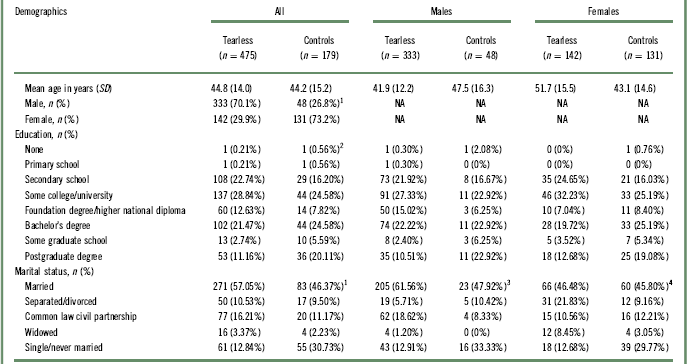
The survey was completed by 475 tearless cases and 179 controls (Table 1). Men predominated among cases (70.1%) but not controls (26.8, p<0.0001). The mean age between cases and controls did not differ. Educational attainment differed in cases versus controls (p=0.01), with a greater percentage of controls having a higher level of education. More cases were married and more controls single or never married (p<0.0001 for all, p=0.002 for males, p=0.0005 for females).
Demographics in tearless cases and controls

1 p<0.0001; 2 p=0.01; 3 p=0.002; 4 p=0.0005.
Crying proneness (Table 2)
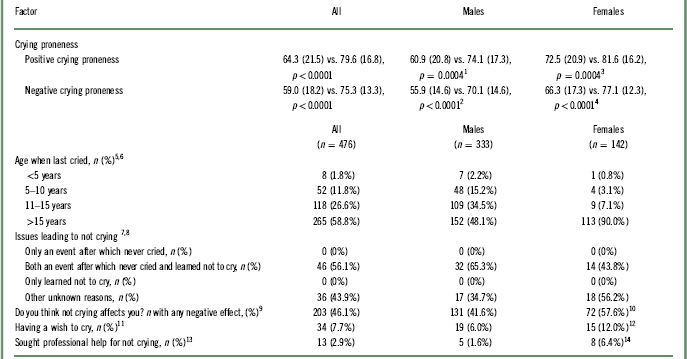
As expected, crying proneness both to positive and negative events was decreased in cases compared to controls (p<0.0001), and separately for males and females (p=0.0004 for positive crying, p<0.0001 for negative crying). This suggests that the self-defined status of being tearless is valid.
Characteristics of tearless cases

1284 tearless, 35 controls; 2 283 tearless, 35 controls; 3 118 tearless, 101 controls; 4 101 tearless, 119 controls; 5 missing 17 males, 15 females, 33 total; 6 p<0.0001 males vs. females; 7 p=0.056 males vs. females; 8 missing 284 males, 110 females, 396 total; 9 missing 18 males, 17 females, 35 total; 10 p=0.02 males vs. females; 11 missing 18 males, 17 females, 35 total; 12 p=0.04 males vs. females; 13 missing 16 males, 16 females, 32 total; 14 p=0.007 males vs. females.
Among tearless cases, age at last crying was predominantly over 15 years (Table 2), and female participants predominated in this age group (p<0.0001). Among all cases, 36.0% experienced an event after which they never cried. Learning not to cry was endorsed by 42.8% and was more frequent among women (p=0.02). Approximately 46.1% felt that not crying affected them negatively, particularly females (p=0.04). Among the non-criers, 2.9% sought professional help because they did not cry, which was also more common in females (6.4 vs. 1.6%, p=0.04). Compared to men, women were twice as likely to wish they could cry (p=0.007).
Among controls, the most recent crying episode was 1–5 days ago in 54.1%, 6–30 days ago in 24.1%, 1–6 months ago in 9.9%, 7–12 months in 3.5%, and more than a year ago in 8.1%. The number of times controls cried during the previous four weeks ranged from 0 (n=26, 16.8%) to 40 times; 67.7% cried 1–4 times, and 83.4% cried 1–8 times in the previous four weeks.
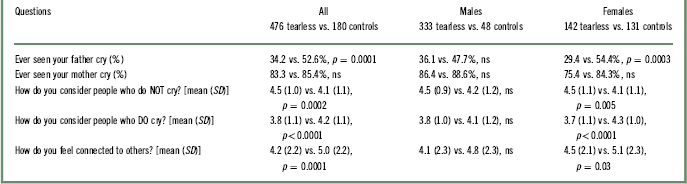
Compared to controls, tearless cases were less likely to have seen their fathers cry (p=0.0001; Table 3). They further considered people who did not cry to be stronger (p=0.0002) and people who cried to be weaker (p<0.0001). These factors were statistically significant in comparisons among females but not in males.
Thoughts on crying in tearless cases versus controls

Being touched or moved and crying proneness (Table 4)
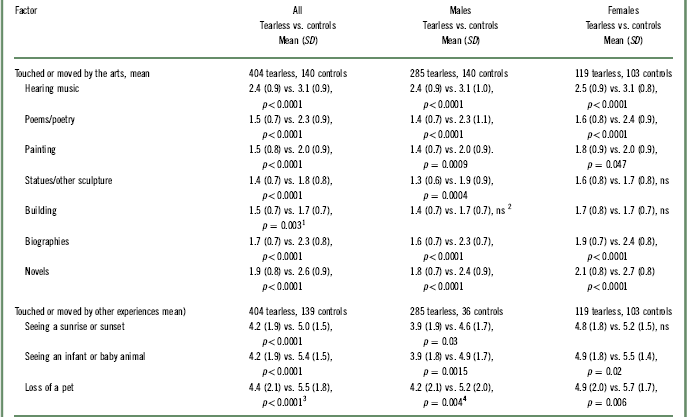
Compared to controls, tearless cases were significantly less likely to be moved by music, poems/poetry, paintings, statues or other sculpture, buildings, biographies, and novels. Separate analyses in men and women mostly showed the same pattern. Being touched or moved by seeing a sunrise or sunset, an infant or baby animal, or loss of a pet was greater in controls compared to tearless cases, with little variation in males and females.
Being touched or moved by the arts and by other experiences in tearless cases versus controls

1403 tearless, 140 controls; 2 284 tearless, 140 controls; 3 406 tearless, 140 controls; 4 287 tearless, 37 controls.
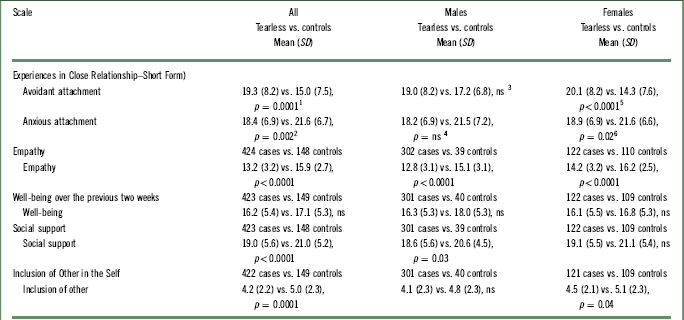
Attachment, empathy, well-being, social support, and connectedness with others (Table 5)
Compared to controls, tearless cases had a higher mean for avoidant attachment (p=0.0003) and a lower mean for anxious attachment (p=0.0013). In females, the same pattern of findings emerged: means for avoidant attachment were higher in tearless cases (p=0.0001) and lower for anxious attachment (p=0.02). In contrast, the results were not significant in males. Empathy scores were lower in tearless cases than in controls (p<0.0001 for all comparisons), and the same held for social support (p<0.0001 for all comparisons). On the IOS, controls felt more connected with others than the tearless cases (for the whole group, p=0.0001; for women, p=0.03, but not for men). Tearless cases and crying controls did not differ with respect to well-being.
Social relationships, empathy, life satisfaction, social support, and Inclusion of Other in the Self Scale in tearless cases versus controls

1325 tearless, 65 controls; 2 393 tearless, 76 controls; 3 235 tearless, 16 controls; 4 286 tearless, 17 controls; 5 90 tearless, 49 controls; 6 107 tearless, 59 controls.
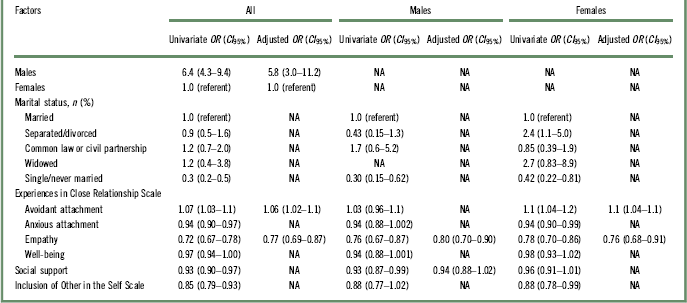
Logistic regression analysis (Table 6)
In adjusted analyses, there was a statistically significant strong positive association between male gender and being tearless. Empathy was negatively associated with being tearless, whereas the avoidant attachment style was positively associated with tearlessness. In analyses restricted to males, empathy and social support both emerged as statistically significant negative predictors of being tearless. Among women, empathy was negatively associated with being tearless, whereas avoidant attachment was positively associated with tearlessness.
Logistic regression analysis for tearless cases versus controls

Differences between tearless subgroups
Based on two questions on the background of becoming tearless, we created four major groups: (1) those who both lost the capacity to cry after a specific event and learned not to cry (n=78); (2) those who learned not to cry only (n=110); (3) those with an event only (n=81); and (4) those with unknown reasons (n=170). The sex ratios were not different across tearless groups. Controls had a higher mean empathy compared to each tearless case group (p<0.05, Tukey), a higher mean social support and a higher mean IOS score for an event only and for learning not to cry only (p<0.05, Tukey), and a higher positive and negative crying mean for each tearless group (p<0.05, Tukey). There were no differences in well-being during the previous two weeks between controls and each of the four tearless subgroups.
Panel survey
Panel study prevalence estimates revealed that, in a representative sample in the Netherlands, 8.6% of men and 6.5% of women did not cry.
Discussion
This is the first study that systematically evaluated associations between having lost the capacity to cry emotional tears and psychological and social functioning in adults. Prevalence estimates from the panel study suggest that non-crying is a rather frequent condition, which justifies the attention of researchers to help understand the causes and consequences of a behavior that is so intimately bound with emotional expression, which to date has received little attention from either neurologists or behavioral scientists.
Why do individuals not cry? In addition to the exposure to traumatic experiences or severe depression, the use of such medications as selective serotonin reuptake inhibitors may inhibit crying.Reference van der Veen, Jorritsma, Krijger and Vingerhoets 20 Further, diseases like Sjögren’s or Mobius syndrome and various ocular disorders may play a role.Reference van Leeuwen, Bossema and Vermeer 21 In contrast, crying, as a sign of emotional distress, is hardly mentioned in the DSM–V and is not mentioned as a sign of depression,Reference Vingerhoets, Rottenberg, Cevaal and Nelson 8 although estimates of crying in depression range from 82% in the “neurotic” and 24% in the “psychotic” categories.Reference Davis, Lamberti and Ajans 22 On the other hand, the BDI contains the abovementioned item about the inability to cry.Reference Beck and Beck 19
Earlier work has shown that four elements of the BDI–II (loss of pleasure, loss of interest, loss of libido, and suicidal thoughts) were associated with not crying in depression, whereas sadness proved to be protective for not crying.Reference Steer 23 Given the importance attributed to crying (catharsis and emotional recovery, social functioning, emotional and physical ill health), one would expect that individuals who have lost the capacity to cry would have been studied, especially from the clinical and therapeutic perspectives.
As predicted, tearless individuals had lower levels of empathy, more avoidant attachment, and lower social support, but, contrary to expectations, they did not report a lower level of well-being. The latter finding may reflect that individuals have the capacity to adapt relatively easily to the loss of the capacity to cry. Alternatively, it could be hypothesized that people who become tearless perceive this as a form of defense, as they consider non-crying people to be “strong.” If they would allow themselves to cry, they might get in touch with many painful affects. That is why not crying helps them to maintain their well-being. The disturbances in social functioning are in line with previous findings which suggest that adults who cannot cry bond less well with others, particularly patients with eating disorders.Reference Benecke, Cierpka and Kast 24 Provine et al.Reference Provine, Krosnowski and Bricatim 25 report about a tearless graduate student who described “the frustration of being forced to explain, at the most difficult of times, and sometimes with quivering voice, her feelings that were once automatically communicated with tears.” This illustrates the importance of crying for interpersonal functioning. Maybe it is not remarkable that females reported the negative effects of not crying: 12% expressed a wish to cry, while only 6% sought help.
Of particular interest, those who learned not to cry had a higher well-being score than the other subgroups. In the overall sample, the tearless group felt less connected to others, less empathetic, and had less of an emotional response to almost all art forms and to nature. They were less moved by human life events, which usually arouse emotions and crying. We were unable to obtain information on the reasons why people ceased crying after specific events and had taught themselves not to cry. This may be very important from a therapeutic point of view when dealing with people suffering from posttraumatic stress disorder (PTSD).
Our study suffers from some limitations. First, we relied upon self-report to identify tearless individuals and their attributed explanations for not crying. Second, we do not know to what extent these tearless individuals are representative of the whole population from which they came, as no population-based studies of tearless individuals have been published before now. Additionally, our cross-sectional study design prevents clarification of the precise nature of the relationships between being tearless and its correlates. Does being tearless have a negative effect on empathy and social support, or the other way around? Or is there a third variable (e.g., personality) that is associated with both features? If crying facilitates social bonding, does being tearless result in lower empathy and social support? For the avoidant attachment style, in contrast, it seems more obvious to hypothesize that it precedes the loss of tears and the decrease in social functioning or that this attachment style and both lower empathy and low social support result from a third factor. Non-crying respondents, particularly men, were less likely to have seen their father cry and considered crying a sign of weakness, both of which may have influenced their own emotional behaviors, as well as their attitudes about crying.
We do not know how many members of our tearless sample were suffering from clinical depression in this self-selected group of non-criers. Keller and NesseReference Keller and Nesse 26 found that crying was less frequent in definitive failure situations (e.g., high workload) and more frequent in response to loss or separation from a loved one. Our limited data on tearlessness justify further work on the loss of the capacity to cry in general and in depression and PTSD in particular. Further, the therapeutic implications of an inability to cry should be explored.
Conclusions
Despite its limitations, our study offers a first glimpse into the social functioning and well-being of tearless individuals compared to crying controls. The popular claims that crying is healthy and that not crying may jeopardize one’s health status clearly need more attention from researchers.Reference Cornelius 27 , Reference Vingerhoets and Bylsma 28 The correlates of tearlessness in our study are mainly found in aspects of social functioning, expressed by reduced empathy, greater avoidant attachment, less anxious attachment, and diminished closeness to others. In this regard, studies of psychopathy also show reduced empathy and social functioning,Reference Hare and Neumann 29 which parallels the reduced empathy, social connectedness and avoidant attachment in our study. However, we do not know how others perceive these individuals—whether they really are less liked and approached less in different social settings, or even avoided. Further evaluation of those who do not or cannot cry by their partners and colleagues is needed with the use of behavioral and implicit measures in addition to self-reports in order to clarify the potential bidirectional associations between an incapacity to cry and different clinical conditions (e.g., PTSD, psychopathy, and depression) and alexithymia (i.e., the inability to understand and express emotion). Alexithymia is also associated with a history of emotional traumaReference Eichhorn, Brahler, Franz, Friedrich and Glaesmer 30 and with somatoform disorders such as non-epileptic seizures (pseudoseizures), which present considerable therapeutic challenges.Reference Eichhorn, Brahler, Franz, Friedrich and Glaesmer 30 Finally, future work should assess how the present findings fit into concepts like alexithymia, emotional suppression, and emotional numbness.Reference Vingerhoets, van den Berg, Kortekaas, Van Heck and Croon 31
Disclosures
Dr. Hesdorffer reports personal fees from Cyberonics, personal fees from Upsher Smith, personal fees from Acorda, personal fees from being an associate editor at Epilepsia, grants from the Centers for Disease Control, grants from Finding a Cure for Epilepsy and Seizures, grants from the Patient-Centered Outcomes Research Institute, grants from the Epilepsy Study Consortium, grants from the National Institute of Neurological Disorders and Stroke, personal fees from the Mount Sinai Medical Center–Rehabilitation, all outside the submitted work.
Ad Vingerhoets and Michael Trimble hereby declare that they have nothing to disclose.