Several countries have recently revised guidelines for infective endocarditis prophylaxis with a general trend towards limiting or discontinuing antibiotics completely, reflecting concerns about the risk–benefit ratio of prophylaxis. 1 – Reference Danchin 3 In 2007, the American Heart Association released an updated guideline that recommended restricting antibiotic prophylaxis before dental work to only patients at the greatest risk of adverse outcomes from infective endocarditis.Reference Wilson, Taubert and Gewitz 4
Studies across multiple countries have reported mixed results regarding rates of infective endocarditis following release of these more restrictive guidelines. Early reports from the United Kingdom, France, and the United States of America found no increase in hospitalisations following the release of guidelines recommending more restrictive prophylaxis.Reference Duval, Delahaye and Alla 5 – Reference Thornhill, Dayer and Forde 8 Although these studies focussed primarily or exclusively on adult hospitalisations, Pasquali et alReference Pasquali, He and Mohamad 9 also reported no increase in infective endocarditis hospitalisations across United States children’s hospitals in the first 3 years following publication of the American Heart Association guidelines. In contrast, more recent studies over longer time periods in both the United Kingdom and the United States of America have suggested an increase in infective endocarditis rates;Reference Dayer, Jones, Prendergast, Baddour, Lockhart and Thornhill 10 , Reference Pant, Patel and Deshmukh 11 however, as these studies primarily focussed on adults, contemporary infective endocarditis trends in children remain unclear. The paediatric population is of particular interest as it includes children with CHD, a population in which the American Heart Association guidelines significantly restricted prophylaxis, and thus may be the most likely to be impacted by this change in guidelines. Therefore, the purpose of the present study was to examine recent trends in paediatric infective endocarditis hospitalisations in the United States over time, before and after the 2007 American Heart Association antibiotic prophylaxis guidelines.
Methods
Data source
The Pediatric Health Information System Database was utilised for this multicentre, retrospective study. This database is a large administrative data set containing inpatient data from over 40 children’s hospitals in the United States of America affiliated with the Children’s Hospital Association (Overland Park, KS). The database currently contains information from nearly six million inpatient discharges and has been used extensively in paediatric outcomes research.Reference Morse, Hall and Fieldston 12 – Reference Pasquali, Li and He 14 Participating hospitals provide discharge data including patient demographics, International Classification of Diseases (ICD) diagnosis and procedures codes, as well as billing data such as medications, imaging studies, laboratory tests, and supplies charged to each patient. Data quality and reliability are promoted through systematic monitoring including bimonthly coding consensus meetings, coding consistency reviews, and quarterly data reports. This study, using a de-identified data set, was not considered human subjects research by the University of Michigan Institutional Review Board.
Study population and data collection
Centres that submitted complete inpatient data to the Pediatric Health Information System, including medication data, from 2003 to 2014 (n=29) were included. This time period was chosen to include the period before and after the 2007 American Heart Association antibiotic prophylaxis guidelines were published and to maximise the number of eligible hospitals. From these centres, we identified children ⩽18 years of age hospitalised with infective endocarditis – defined as having an ICD-9 diagnosis code for “acute and subacute bacterial endocarditis” (421.0). Only the first (index) hospitalisation for infective endocarditis was analysed, which was enabled by using the patient identifiers available within the database, allowing exclusion of subsequent admissions at the same hospital. Our primary analysis focussed on infective endocarditis cases most directly related to the American Heart Association guideline change, which are community-acquired cases related to oral streptococcal species in those children likely to be receiving dental care. These cases were identified in the database as children >5 years of age, having an infective endocarditis diagnosis code as defined above, and a code for administration of any intravenous antibiotic covering an oral streptococcal species within 7 days of admission. Anti-streptococcal antibiotics were defined as any of the following on the basis of the American Heart Association guidelines for the treatment of infective endocarditis:Reference Baddour, Wilson and Bayer 15 monotherapy with vancomycin, penicillin, or ceftriaxone; combination therapy with vancomycin and gentamicin; or ceftriaxone or penicillin plus gentamicin.
In addition, two secondary cohorts were evaluated. The first was the subgroup with CHD, which was identified using the same criteria as specified in the preceding section, but then further limited to those patients with any diagnostic or procedural code related to CHD.Reference Jenkins, Gauvreau, Newburger, Spray, Moller and Iezzoni 16 The other secondary cohort was a broader cohort including children of any age hospitalised with community-acquired infective endocarditis. Inclusion to this cohort required a diagnosis code for infective endocarditis, as specified in the preceding section, and administration of any intravenous antibiotic within 7 days of hospital admission, with no restrictions on age or type of antibiotics.
In addition to data regarding infective endocarditis, patient demographic information and mortality data were also recorded.
Analysis
Standard summary statistics were used to describe study variables, and were compared using χ2 or Wilcoxon’s ranked-sum tests as appropriate. Infective endocarditis rates were indexed to the total number of hospitalisations, because raw rates could simply reflect changes in hospital catchment area or referral patterns. Indexed infective endocarditis rates and 95% confidence intervals were analysed semi-annually. The mean rates in the pre- and post-guideline periods were calculated and compared using the Wilcoxon’s ranked-sum test. Segmented regression analysis of interrupted time series was then used to model indexed semi-annual infective endocarditis rates over time to assess whether the guideline had an effect at the time of introduction or whether the guideline altered the trajectory of the infective endocarditis rate from the pre-guideline period trend. All analyses were performed using SAS v.9.4 (SAS Institute, Cary, North Carolina, United States of America), and p<0.05 was considered to be statistically significant.
Results
Study population characteristics
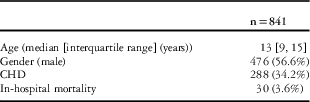
In our primary cohort, 841 infective endocarditis cases were identified during the study period across the 29 hospitals. Patient demographics and outcomes are summarised in Table 1. The median age was 13 years, 57% were males, and approximately one-third were coded as having CHD. The in-hospital mortality rate was 4%.
Study population characteristics of the primary cohort.

Infective endocarditis rates in the pre- and post-guideline period
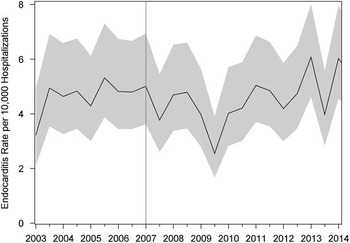
The indexed rates of infective endocarditis per semi-annual period are shown in Figure 1. In the pre-guideline period, the mean infective endocarditis rate in the primary cohort was 4.6/10,000 hospitalisations per semi-annual period. In the post-guideline period, the mean rate was also 4.6/10,000 hospitalisations per semi-annual period (p=0.194).
Infective endocarditis rates over time. Raw rate of infective endocarditis in the primary study cohort per 10,000 hospitalisations per semi-annual period with 95% confidence intervals indicated by the shaded area. The vertical line in 2007 indicates release of the 2007 American Heart Association guidelines. There was no significant difference in the mean rate in the pre-guideline period compared with the post-guideline period – 4.6 cases/10,000 hospitalisations per semi-annual period versus 4.6 cases/10,000 hospitalisations per semi-annual period (p=0.194).

Interrupted time series analysis
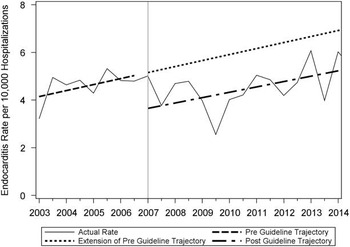
In the pre-guideline period, the rate of infective endocarditis increased by 0.13 cases/10,000 hospitalisations per semi-annual period (Fig 2). In the post-guideline period, the rate of infective endocarditis increased by 0.12 cases/10,000 hospitalisations per semi-annual period. Thus, overall, there was a slight increase in infective endocarditis over time, but no significant difference in the rate of change in the pre- versus post-guidelines period (p=0.895).
Interrupted time series analysis. The interrupted time series analysis in the primary study cohort is displayed. The vertical line indicates the 2007 American Heart Association guideline release, and the solid line indicates the observed rate of endocarditis. In the interrupted time series analysis, the pre-guideline trajectory is indicated by the dashed line, and the post-guideline trajectory by the dash–dot line. For comparison, the dotted line indicates the expected trajectory if the pre-guideline rates were extended over time. In the pre-guideline period, the rate of endocarditis increased by 0.13 cases/10,000 hospitalisations per semi-annual period versus 0.12 cases/10,000 hospitalisations per semi-annual period in the post-guideline period (p=0.895).

Secondary analyses
In the CHD subgroup, we identified 288 infective endocarditis cases. Similar to the main findings, there was no significant difference in the infective endocarditis rate in the pre- versus post-guideline period in this cohort: we found an increase of 0.02 cases/10,000 hospitalisations per semi-annual period versus 0.06 cases/10,000 hospitalisations per semi-annual period (p=0.539).
In the broad cohort of all children hospitalised with infective endocarditis, there were 1722 cases identified. Again, similar to the main findings, there was no significant difference in the infective endocarditis rate in the pre- versus post-guideline period in this cohort: we found an increase of 0.06 cases/10,000 hospitalisations per semi-annual period versus 0.02 cases/10,000 hospitalisations per semi-annual period (p=0.579).
Discussion
We analysed infective endocarditis rates over 11 years across 29 United States children’s hospitals. Our results suggest that in general infective endocarditis rates have increased slightly over time; however, we did not detect any change in the rate of increase before versus after the revised 2007 American Heart Association antibiotic prophylaxis guidelines.
The increase in infective endocarditis admissions over time demonstrated in our study is consistent with the results of multiple previous studies across the United States of America and other countries.Reference Thornhill, Dayer and Forde 8 , Reference Dayer, Jones, Prendergast, Baddour, Lockhart and Thornhill 10 , Reference Pant, Patel and Deshmukh 11 Pant et alReference Pant, Patel and Deshmukh 11 cite the increased survival of CHD patients as well as the increased use of prosthetic devices and procedures resulting in transient bacteraemia as possible reasons for the overall increase in infective endocarditis incidence in United States adults. Other possible reasons for this may include more sensitive diagnostic techniquesReference Pant, Patel and Deshmukh 11 or improved coding in administrative data sets. Another possible reason specific to this study may be an increasing tendency for these patients to be cared for in tertiary children’s hospitals rather than community settings.
Although multiple earlier studies following the release of more restrictive prophylaxis guidelines have suggested no change in the increase of infective endocarditis rates, two more recent studies have suggested increases in infective endocarditis following guideline changes. Pant et alReference Pant, Patel and Deshmukh 11 recently reported significant increase in streptococcal infective endocarditis hospitalisation rates in United States adults without any increase in the overall infective endocarditis hospitalisation rate after the 2007 American Heart Association guidelines were released. Dayer et al also recently reported an increase in infective endocarditis in the United Kingdom following the change in guidelines in 2008. The ability to track outpatient prescriptions, which declined sharply after the change in guidelines, as well as infective endocarditis hospitalisations in the United Kingdom’s National Health System is a particular strength of the Dayer study.Reference Dayer, Jones, Prendergast, Baddour, Lockhart and Thornhill 10 In contrast to these reports, our study found no difference in infective endocarditis rates over time in a paediatric cohort before and after the release of the 2007 American Heart Association guidelines. These differences between studies may be due to the more restrictive recommendations in the United Kingdom guidelines, which recommended the complete cessation of infective endocarditis prophylaxis for essentially all populations. 1 In contrast, the American Heart Association guidelines recommend continuing prophylaxis for specific cardiac conditions with the highest risk of adverse outcome from infective endocarditis. Differences in study population or methodology could also account for differences in findings. Dayer et al’s study included data from the entire United Kingdom national health system in contrast to our study population of patients admitted to United States children’s hospitals. Another explanation for this difference could be lower rates of compliance with the guidelines among paediatric care providers in the United States of America.Reference Pharis, Conway, Warren, Bullock and Mackie 17 , Reference Naik, Patel, Wang and Shah 18 Unfortunately, in contrast to the data available in the United Kingdom, comprehensive prescribing data in the United States of America are not as easily accessible.
Novel approaches utilised in our study include the use of inpatient antibiotic data to increase the specificity in identifying cases of infective endocarditis related to oral streptococcal species and our focus on selecting community-acquired cases of infective endocarditis in children most likely to be receiving dental care. These criteria are important as, although there may be changes in hospital-acquired cases or non-streptococcal cases when evaluating the overall cohort of patients with infective endocarditis, these cases are less likely to be related to the change in guidelines. The inpatient antibiotic data are particularly useful as previous studies have found that diagnostic codes for specific microorganisms are missing in many cases.Reference Pasquali, He and Mohamad 9 , Reference Dayer, Jones, Prendergast, Baddour, Lockhart and Thornhill 10 Thus, our study serves as an example of the potential strengths of taking advantage of the full array of information available in data sets such as the Pediatric Health Information System Database in addition to the diagnosis and procedural codes. In addition, as a check to ensure that our selection criteria did not inadvertently exclude patients of interest, we also evaluated the overall cohort of patients with infective endocarditis and found no change in this group in the pre- and post-guidelines period.
Limitations
The general limitations associated with the use of administrative data apply to this study, including lack of clinical detail. Specifically for this study, lack of validation of infective endocarditis cases is a limitation; however, our combined use of discharge diagnosis codes and antibiotic administration minimises the likelihood that children without infective endocarditis were included. In addition, our ability to identify patients across hospital admissions ensures that repeat encounters for infective endocarditis for the same patient at a given hospital were not inadvertently included. In addition, although our study included a large sample of children’s hospitals, the generalisability of these findings to other children’s hospitals or other populations is unclear. It is also possible that our study may be underpowered to detect differences over time; however, our point estimates do not suggest that there are clinically important differences present that we were not able to demonstrate statistically. Finally, as we do not know the size of the population at risk for infective endocarditis in this data set, the incidence cannot be calculated using these data.
Conclusions
This multicentre analysis of infective endocarditis hospitalisations across 29 United States children’s hospitals found no significant change in hospitalisation rates following release of the revised 2007 American Heart Association infective endocarditis prophylaxis guidelines. Given the rarity of infective endocarditis, further study over time is necessary. In addition, the general increase in the rate of infective endocarditis over time found in our study and others suggests that a better understanding of the current epidemiology of infective endocarditis and further study of the underlying risk factors are needed in order to reverse these trends.
Acknowledgements
None.
Financial Support
K.D.H. receives salary support for research from the National Center for Advancing Translational Sciences of the NIH (KL2TR001115-02), from the Gilead Sciences Cardiovascular scholars program, and from industry for paediatric drug development (www.dcri.duke.edu/research/coi.jsp). S.K.P. receives support from the Janette Ferrantino Professorship.
Conflicts of Interest
None.