Milk yield and milk quality are heavily impacted by udder health status, especially mastitis incidence. Mastitis is a major disease of dairy farming and is characterized by mild or severe pathological changes of the mammary tissue, an increased somatic cell count or score (SCC, SCS) and abnormal milk composition (Rasheed et al., Reference Rasheed, Usman and Niaz2020). Mastitis has two forms: clinical and subclinical, and clinical cases are characterized by several local symptoms, including soreness, redness, warmth and swelling of the udder, as well as visible changes in the milk. Animals with clinical mastitis can be easily identified by dairy farmers, based on the observation of these symptoms (Asaf et al., Reference Asaf, Kumar, Rahim, Sebastian, Mohan, Dewangan and Panigrahi2014). On the other hand, due to its asymptomatic course, it is hard to diagnose subclinical mastitis (Krishnamoorthy et al., Reference Krishnamoorthy, Goudar, Suresh and Roy2021a). All cattle breeds are affected by mastitis, which is known to cause major economic losses to dairy cattle farms because of reduced milk yield and milk quality and increased health expenses (Ashraf and Imran, Reference Ashraf and Imran2018; Moru et al., Reference Moru, Umoh, Maikai B, Barje and Amuta2018; Leitner et al., Reference Leitner, Lavon, Merin, Jacoby, Blum, Krifucks and Silanikove2019; Yang et al., Reference Yang, Zhang, Shang, Wang, Yan, Li and Li2019). The annual cost of mastitis to the global dairy industry is estimated at approximately 30 billion € (Martins et al., Reference Martins, Martins, Cardoso, Germano, Rodrigues, Duarte, Bexiga, Cardoso and Freitas2019; Krishnamoorthy et al., Reference Krishnamoorthy, Suresh, Jayamma, Shome, Patil and Amachawadi2021b) and in Turkey the economic loss per cow has been calculated as 199€ and 87€ for clinical and subclinical disease, respectively (Sarıözkan, Reference Sarıözkan2019).
Given the low heritability of mastitis, the chance of selection programs based on phenotypic data achieving success is low (Chegini et al., Reference Chegini, Hossein-Zadeh, Hosseini-Moghadam and Shadparvar2018, Reference Chegini, Hossein-Zadeh, Moghaddam and Shadparvar2019; Zavadilová et al., Reference Zavadilová, Kašná, Krupová and Brzáková2020). Thus, as is the case with all quantitative traits, there is increasing interest in identifying potential molecular markers for mastitis resistance. Several marker genes related to the major yield traits of livestock have been reported (Koshchaev et al., Reference Koshchaev, Shchukina I, Garkovenko A, Ilnitskaya E, Radchenko V, Bakharev and Khrabrova2018; Bekele et al., Reference Bekele, Taye, Abebe and Meseret2023; Rahman et al., Reference Rahman, Kumar, Singh, Shahi, Ghosh, Verma, Pathak, Dar, Kumar and Sharma2023), potentially enabling tailoring of breeding programs for increased mastitis resistance (Asaf et al., Reference Asaf, Kumar, Rahim, Sebastian, Mohan, Dewangan and Panigrahi2014; Kurz et al., Reference Kurz, Yang, Weiss, Wilson, Rood, Liu and Wang2019). In many countries, regular records are not kept of the incidence of clinical mastitis in dairy cattle. Therefore, indirect data on udder health, including SCS, serve as valuable alternative tools for breeding programs aimed at the improvement of mastitis resistance (Koivula et al., Reference Koivula, Mäntysaari, Negussie and Serenius2005; Gutiérrez-Reinoso et al., Reference Gutiérrez-Reinoso, Aponte and García-Herreros2023; Tommasoni et al., Reference Tommasoni, Fiore, Lisuzzo and Gianesella2023). In this context, it is considered that the identification of genes or mutations associated with SCS would contribute to the improvement of mastitis resistance.
Literature reports indicate that the determination of quantitative trait loci (QTL) and the use of these QTL for the selection of livestock would enable a more rapid genetic advance in relevant traits when compared to conventional selection programs (Weigel and Shook, Reference Weigel and Shook2018; Rasheed et al., Reference Rasheed, Usman and Niaz2020). Multiple QTLs associated with several production traits have been mapped in cattle (Ibeagha-Awemu et al., Reference Ibeagha-Awemu, Peters, Akwanji, Imumorin and Zhao2016; Van Den Berg et al., Reference Van Den Berg, Hayes, Chamberlain and Goddard2019) and are registered to an online database (Anonymous, 2023). Among these, the bovine calcium channel, voltage-dependent, alpha-2/delta subunit 1 (CACNA2D1) gene has been proposed as a potential marker gene for mastitis resistance, given its proximity to regions associated with SCS and SCC (Magotra et al., Reference Magotra, Gupta, Verma, Alex, Mr and Ahmad2019). In cattle the CACNA2D1 gene which encodes the voltage-dependent calcium channel complex protein is located on the 4th chromosome and consists of 39 exons and 38 introns (Buitkamp et al., Reference Buitkamp, Ewald, Masabanda, Bishop and Fries2003; Magotra et al., Reference Magotra, Gupta, Verma, Chaudhari M, Arya, Vineeth, Kumar and Selvan2017; Silva et al., Reference Silva, Silva, Silva, Costa, Silva, Lopes, Veroneze, Thompson and Carvalheira2020). The CACNA2D1 gene is involved in several cellular mechanisms, including muscle contraction, hormone secretion and neurotransmitter molecule release (Yuan et al., Reference Yuan, Li, Liu, Zhang, Zhang, Chen, Chen, Gao, Li and Chen2011a). Furthermore, the CACNA2D1 gene also has a regulatory role in the activation/inactivation of calcium channels, and aids in the opening and closing of the teat sphincters during milking (Gabashvili et al., Reference Gabashvili, Sokolowski, Morton and Giersch2007).
In several studies, the CACNA2D1 gene has been reported to be related to eight different QTL described as being mastitis indicators, including among others SCS and SCC (Zhang et al., Reference Zhang, Boichard, Hoeschele, Ernst, Eggen, Murkve, Pfister-Genskow, Witte, Grignola and Uimari1998; Buitkamp et al., Reference Buitkamp, Ewald, Masabanda, Bishop and Fries2003; Rupp and Boichard, Reference Rupp and Boichard2003; Longeri et al., Reference Longeri, Polli, Strillacci, Samore and Zanotti2006; Jaglan et al., Reference Jaglan, Ravikumar, Sukhija, George, Alex, Vohra and Verma2023). On the other hand, to the authors' knowledge, there is no previous study on the association of the rs43389227, rs43390124 and rs482883241 SNPs of the CACNA2D1 gene with electrical conductivity (EC) and pH, both of which are mastitis indicators that can be measured during milking. Thus, the present study investigated the association of these three SNPs of the CACNA2D1 gene (rs43389227, rs43390124 and rs482883241) with milk yield and milk composition in Holstein dairy cows.
Material and methods
Animals
We studied 166 Holstein dairy cows, which were in their second lactation and were raised at a dairy farm located in the Kayseri province of Turkey. The blood sampling of the study animals was performed according to the 10.04.2013 dated and 13/72 numbered approval of the Local Ethics Board for Animal Experiments of Erciyes University.
Milk sample collection
The cows were milked three times a day (07:00, 15:00 and 23:00 h). The milk yield of each animal at each milking was recorded to determine the 305-day lactation milk yield. For the conduct of milk composition and milk quality analyses, a specific control day was determined for each month, and 50-ml milk samples were taken from each animal at the morning milking on this specific control day. The milk samples were stored at +4°C until used for analysis. Milk somatic cell counts were performed with a DeLaval cell counter (DeLaval, Stockholm, Sweden), and milk EC, pH, fat%, non-fat dry matter (NFDM)%, density% and protein% measurements were performed with the aid of a Milkana milk analyzer (Mayasan, Istanbul-Turkey).
DNA isolation and PCR-RFLP
Blood samples were taken into EDTA-coated tubes from the vena jugularis of animals. DNA was isolated from blood samples by the phenol–chloroform–isoamyl alcohol extraction method (Sambrook et al., Reference Sambrook, Fritsch and Maniatis1989). The PCR and RFLP procedures for the rs43389227, rs43390124, and rs482883241 SNPs of the CACNA2D1 gene were performed as described by Yuan et al. (Reference Yuan, Li, Zhang, Zhang, Chen, Chen, Gao, Li, Chen and Gao2011b). The PCR reactions were carried out in 20 μl reactions containing 2.5 mM MgCl2, 50 μM dNTP mix, 0.2 μM forward and reverse primer Yuan et al. (Reference Yuan, Li, Zhang, Zhang, Chen, Chen, Gao, Li, Chen and Gao2011b), 1.25 U Taq DNA polymerase, 50 ng/μl DNA, and nuclease-free water. The thermal cycling conditions carried out comprised initial denaturation at 94°C for 5 min followed by 35 cycles of denaturation at 94°C for 30 s, annealing temperature (specified in online Supplementary Table S1) 1 for 30 s, and extension at 72°C for 30 s with a final extension step at 72°C for 8 min. The PCR amplicons were digested with the restriction enzymes shown in online Supplementary Table S1. The resulting products were visualized by electrophoresis on 2% agarose gel.
Statistical analysis
The genotype and allele frequencies and Hardy–Weinberg equilibrium (HWE) status of the investigated SNPs were determined by chi-square analyses. Before the statistical analyses, the study data were checked for normality distribution using the UNIVARIATE procedure of the SAS V9.0 software (SAS Institute, Cary, NC, USA), and the SCS data were transformed to log10 for the verification of normality distribution. Data pertaining to milk composition and milk quality were analyzed with a mixed model using the MIXED procedure of the SAS version 9.0 software package. The mixed model used both the random effect of the control test day (10) and the fixed effects of the sire (19) and genotype (2 or 3). The control test day represents the single specific day of a month on which the test results for milk traits are recorded for a lactation year.
Results
Descriptive statistics of the milk yield and composition data for the complete group of 166 cows are shown in online Supplementary Table S2.
The polymerase chain reaction-restriction fragment length polymorphism (PCR-RFLP) analyses performed for the rs43389227, rs43390124 and rs482883241 SNPs of the CACNA2D1 gene generated PCR products of lengths of 322, 386 and 269 bp, respectively (Fig. 1, top panels). The Holstein cows included in this study were determined to be polymorphic for all three of the investigated SNPs. Following enzymatic restriction (Fig. 1, bottom panels), for rs43389227, two bands of 236, and 86 bp length were obtained for the CC genotype, three bands of 322, 236, and 86 bp length were obtained for the CT genotype, and a single band of 322 bp length was obtained for the TT genotype. For the rs43390124 SNP, two bands of 229 and 157 bp length were obtained for the GG genotype, three bands of 386, 229 and 157 bp length were obtained for the AG genotype, and a single band of 386 bp was obtained for the AA genotype. Finally, for rs482883241, two bands of 175 and 94 bp length were obtained for the GG genotype and a single band of 269 bp was obtained for the AA genotype. The AG genotype was not detected in the sample analyses.
PCR-RFLP agarose gel images of the rs43389227, rs43390124 and rs482883241 SNPs (top panels). The bottom panels show the individual genotypes for each SNP following enzymatic restriction.
M: 100 bp ladder; A: 322 bp; B: 386 bp; C: 269 bp.

The most common genotypes harboring the rs43389227, rs43390124 and rs482883241 SNPs were determined to be CT (0.51), GG (0.72) and AA (0.93), respectively. The study animals were at the Hardy–Weinberg equilibrium (HWE) for the rs43389227 SNP, but deviated from the HWE for the rs43390124 and rs482883241 SNPs (P < 0.05). The allele and genotype frequencies determined for the mapped rs43389227, rs43390124, and rs482883241 SNPs are presented in Table 1.
χ2 analyses of the rs43389227, rs43390124 and rs482883241 SNPs of the CACNA2D1 gene

χ2, Chi-square
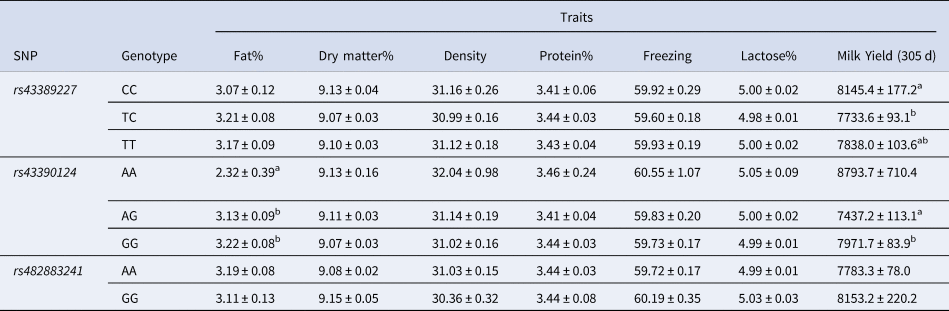
Data for genotypic variation in milk yield and composition are in Table 2. SNP rs43390124 was significantly associated with percentage milk fat (P < 0.05), animals of the rs43390124-AA genotype having lower milk fat than the other genotypes (Table 2). SNPs rs43389227 and rs43390124 were associated with the 305-day milk yield (P < 0.05) in that animals of the rs43389227-CC and rs43390124-AA genotypes had higher milk yields than the other genotypes (P < 0.05, Table 2).
Milk composition traits associated with the rs43389227, rs43390124 and rs482883241 SNPs of the CACNA2D1 gene

Values are least squares mean ± standard error; within a defined SNP and trait, genotypes that differ are shown by a and b: P < 0.05.
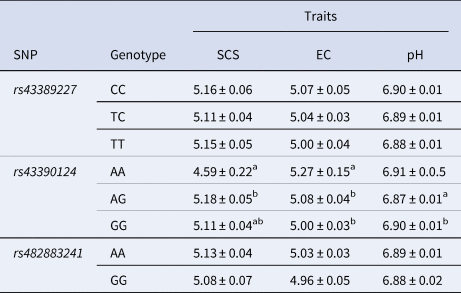
Relationships between genotype and milk quality traits are shown in Table 3. The rs43390124 SNP was significantly associated with SCS, EC and pH (P < 0.05).
Milk quality traits associated with the rs43389227, rs43390124 and rs482883241 SNPs of the CACNA2D1 gene

SCS, somatic cell score; EC, electrical conductivity.
Values are least-squares mean ± standard error.
Within a defined SNP and trait, genotypes that differ are shown by a and b; P < 0.05.
Discussion
Identification of genes and SNPs associated with susceptibility to mastitis could enable greater use of genetics in efforts to increase mastitis resistance. Research in this field has proposed the CACNA2D1 gene as a potential marker gene for mastitis resistance, owing to its proximity to QTL associated with SCS and SCC (Zhang et al., Reference Zhang, Boichard, Hoeschele, Ernst, Eggen, Murkve, Pfister-Genskow, Witte, Grignola and Uimari1998; Buitkamp et al., Reference Buitkamp, Ewald, Masabanda, Bishop and Fries2003; Rupp and Boichard, Reference Rupp and Boichard2003; Longeri et al., Reference Longeri, Polli, Strillacci, Samore and Zanotti2006; Jaglan et al., Reference Jaglan, Ravikumar, Sukhija, George, Alex, Vohra and Verma2023). Our study investigated the association of the rs43389227, rs43390124 and rs482883241 SNPs of the CACNA2D1 gene with milk yield and composition traits in Holstein dairy cows raised in Turkey. Whilst there are literature reports available on the association of other SNPs of the bovine CACNA2D1 gene with production traits (Deng et al., Reference Deng, Yuan, Gao, Li, Chen, Gao and Xu2011; Silva et al., Reference Silva, Silva, Silva, Costa, Silva, Lopes, Veroneze, Thompson and Carvalheira2020), this is the first study to investigate these particular SNPs.
In a previous study conducted by Yuan et al. (Reference Yuan, Li, Zhang, Zhang, Chen, Chen, Gao, Li, Chen and Gao2011b) on the rs43389227 SNP in Holstein, Sanhe and Simmental cattle, the highest frequency was determined for the TT genotype (0.52). On the other hand, Bagheri et al. (Reference Bagheri, Miraie-Ashtiani, Moradi-Shahrbabak, Nejati-Javaremi, Pakdel, von Borstel, Pimentel and König2013) reported the highest frequency for the CT genotype (0.56) in Holstein cattle raised in Iran as it was in our study (CT genotype 0.51: Table 3). Differences can probably be attributed to the different geographical regions the animals were raised in.
In the study just mentioned, Yuan et al. (Reference Yuan, Li, Zhang, Zhang, Chen, Chen, Gao, Li, Chen and Gao2011b) reported that there was no statistically significant association between the rs43389227 SNP and SCS. Similarly, we determined that the rs43389227 SNP was not associated with SCS and the other milk quality traits. In this context, the findings agree. We showed a significant relationship between the rs43389227 SNP and 305-day milk yield in our Holstein dairy cows. Animals of the CC genotype were observed to be higher yielding than those of the other detected genotypes. Furthermore, animals of this same genotype had a lower milk fat percentage, compared to those of the other genotypes. This finding is consistent with the literature information suggesting a negative correlation between milk yield and milk fat (Chauhan and Hayes, Reference Chauhan and Hayes1991).
Turning to the rs43390124 SNP. Bagheri et al. (Reference Bagheri, Miraie-Ashtiani, Moradi-Shahrbabak, Nejati-Javaremi, Pakdel, von Borstel, Pimentel and König2013) reported AA as the rarest genotype (0.12) for this SNP in Holstein cattle raised in Iran, and we observed the same. On the other hand, Yuan et al. (Reference Yuan, Li, Zhang, Zhang, Chen, Chen, Gao, Li, Chen and Gao2011b) reported that, in Holstein cattle raised in China, AA was the most common genotype. Bagheri et al. (Reference Bagheri, Miraie-Ashtiani, Moradi-Shahrbabak, Nejati-Javaremi, Pakdel, von Borstel, Pimentel and König2013) found a relationship for this SNP with 305-day milk yield was associated with each other, and we observed the same and in addition found a relationship with milk fat percentage. AA genotype cows had higher 305-day milk yields but lower milk fat percentage, the same relationships as for the AA genotype of rs43389227 SNP. Based on these findings, we suggest that these SNPs could be used to increase milk yield of dairy cattle by breeding for the CC and AA genotypes, providing that milk fate were not a priority. Our milk quality traits support a further potential benefit of the latter. Yuan et al. (Reference Yuan, Li, Zhang, Zhang, Chen, Chen, Gao, Li, Chen and Gao2011b) found no association between the rs43390124 SNP and SCS. However, we did find relationships with SCS, EC and pH whereby animals of the rs43390124-AA genotype had lower SCS values.
The third SNP that we detected was rs482883241. In this case the most common genotype was determined to be rs482883241-AA (0.93). Similarly, in previous studies investigating the rs482883241 SNP, the highest frequencies were determined for the AA genotype in Holstein cattle raised in China, as well as crossbred Frieswal (Sahiwal × Holstein) cattle and crossbred Karan Fries (Tharparkar × Holstein Friesian) cattle (Yuan et al., Reference Yuan, Li, Zhang, Zhang, Chen, Chen, Gao, Li, Chen and Gao2011b; Deb et al., Reference Deb, Singh, Kumar, Kumar, Singh, Sengar, Mann and Sharma2014; Magotra et al., Reference Magotra, Gupta, Verma, Alex, Mr and Ahmad2019). We did not find any genotypic relationships between this SNP and any of the measured traits, which might be related to the dominance of the AA genotype and absence of AG genotype. By contrast, Magotra et al. (Reference Magotra, Gupta, Verma, Alex, Mr and Ahmad2019) reported that this genotype had reduced milk yield.
In conclusion, we have shown association of the rs43390124 SNP of the bovine CACNA2D1 gene with milk yield, milk fat and mammary health traits, as well as association of the rs43389227 SNP with milk yield. We suggest that these SNPs are candidates for use in breeding programs aimed at improving milk yield, milk composition and udder health.
Supplementary material
The supplementary material for this article can be found at https://doi.org/10.1017/S0022029925000056