Vancomycin-resistant Enterococci (VRE) infections can be lethal and costly, resulting in 1.5 times higher cost of hospitalization and 2.5 times higher mortality than non–VRE-infected controls.Reference Chiang, Perencevich and Nair 1 VRE infections affect high-risk patient populations such as liver transplant and hematopoietic stem cell (HSC) transplant recipients.Reference Russell, Flood and Zaroda 2 , Reference Kamboj, Chung and Seo 3 Among California hospitals in 2016, VRE bloodstream infections (BSIs) were seen in 0.0825 cases per 1,000 patient days in academic medical centers compared to 0.0297 cases per 1,000 patient days in community medical centers. 4
Early VRE detection in high-risk patients may have implications for infection prevention and treatment outcomes for VRE infection. Contact precautions can be effective at reducing VRE transmission.Reference Popiel and Miller 5 Perencevich et alReference Perencevich, Fisman, Lipsitch, Harris, Morris and Smith 6 predicted that admission VRE screening with contact precaution isolation would reduce VRE transmission by 39%. Effectiveness of targeted infection prevention programs are dependent on early VRE detection.Reference Perencevich, Fisman, Lipsitch, Harris, Morris and Smith 6 Targeted terminal cleaningReference Wong, Woznow and Petrie 7 and endoscope reprocessingReference Rakoczy, Hendrickson, Kline, Streifel, Guspiel and Gross 8 may also reduce transmission. Early VRE detection may lead to improved outcomes from VRE infections. Patients with VRE colonization are at higher risk for VRE infection,Reference Olivier, Blake, Steed and Salgado 9 and early empiric therapy improves clinical outcomes in large, observational cohort studies.Reference Britt, Potter, Patel and Steed 10 , Reference McKinnell and Arias 11
Despite the potential benefits of early VRE detection, optimal surveillance methods for practical clinical use have not been well defined. D’Agata et alReference D’Agata, Gautam, Green and Tang 12 found that rectal swabs had a sensitivity of 58% in detecting VRE compared with stool samples. Unfortunately, routine collection of stool samples is cumbersome. Moreover, our prior work suggests that admission-only screening misses incident colonization.Reference McKinnell, Kunz and Moser 13 We evaluated a practical screening methodology for the detection of asymptomatic VRE colonization, suitable for use in high-risk patient populations. We sought to compare (1) compliance with perirectal swabbing versus stool sampling, (2) sensitivity of perirectal swabs versus stool samples, and (3) admission-only versus admission-plus-weekly screening.
Methods
Study design and setting
We conducted a prospective, patient-level surveillance program of incident VRE colonization in a liver-transplant surgical intensive care unit (SICU) at the Ronald Reagan UCLA Medical Center (RRMC). The RRMC is an urban tertiary-care hospital with 520 beds and 5 adult ICUs. The liver transplant program is a tertiary-care referral center where >150 adult liver transplants are performed annually. The 24-bed liver-transplant SICU had the highest incidence of VRE BSIs among the ICUs.
Monitoring for VRE colonization
In this study, VRE surveillance was conducted from June through August 2015. VRE surveillance began with a point prevalence estimate (all patients present in the SICU when the study began), followed by admission screening and weekly surveillance. Perirectal swabs and stool samples were collected by nursing staff on the day of admission to the SICU (admission screen); the swabs and samples were collected on the same day. Once per week, nursing staff collected an additional perirectal swab and stool sample from all patients in the unit (weekly surveillance). Perirectal swabs were taken around the exterior anal area, without insertion into the rectal vault, with a minimum of 1 rotation.
VRE isolation
Perirectal swabs were collected using the Eswab Transport System for Aerobic, Anaerobic & Fastidious Bacteria (Becton Dickinson, Sparks MD), and stool samples were collected in C&S medium (modified Cary Blair; Medical Chemical Corporation, Torrance, CA). After collection, all samples were refrigerated (4–8°C) until they were sent to the UCLA Clinical Microbiology Laboratory within 24 hours after collection. Upon arrival in the laboratory, Eswab Transport tubes and C&S vials were vortexed completely prior to plating; vortexing of Eswab Transport tubes allows the stool specimen and any organisms in the swab to be released into the transport media present. Using a sterile, plastic transfer pipette, 1 drop (~50 µL) of the vortexed sample was added to 1 quadrant of a Spectra VRE plate (Remel, Lenexa, KS) and was then streaked for isolation. Plates were incubated at 35°C ± 2°C in ambient air for 24 hours and interpreted according to the manufacturer’s instructions: navy blue to pink colonies for E. faecium and light blue colonies indicated E. faecalis. Characteristic colonies were subcultured to tryptic soy agar with 5% sheep blood (BBL, Becton Dickinson) for definitive identification by matrix-assisted laser desorption ionization time-of-flight (MALDI-TOF; Vitek MS, bioMérieux, Durham, NC) and susceptibility testing using CLSI reference broth microdilution panels prepared in house. Minimum inhibitory concentration (MIC) testing was performed according to CLSI standards. 14
VRE strain typing
DiversiLab (DL) typing was performed on paired patient isolates from blood cultures and surveillance cultures. Thereafter, DNA was extracted using an EZ1 DNA Blood Kit (Qiagen, Valencia, CA). Repetitive sequence-based polymerase chain reaction (repPCR) amplification was performed with an Enterococcus DL Fingerprinting Kit according to manufacturer’s instructions (bioMérieux).
Patient data
Demographic and clinical data were collected from medical charts. The Charlson score was used to assess comorbidity, and the Model for End-Stage Liver Disease (MELD) score was used to assess liver disease severity. Statistical analyses were conducted using the McNemar test, the Fisher exact test, the t test, or the χ2 measures of association (Stata software, StataCorp, College Station, TX). A P value<.05 was considered statistically significant. This research was approved by the University of California–Los Angeles Institutional Review Board (UCLA IRB), who determined that informed consent was not required.
Surveillance compliance for admission and weekly surveillance
Compliance measured whether either a perirectal swab or stool sample was collected when required. Compliance was defined as number of samples obtained compared to sample opportunities.
Definition of colonization status
We defined VRE colonization as either a perirectal swab or a stool sample positive for VRE. The sensitivity of the perirectal swabs was defined as the number of VRE colonization events detected by perirectal swabs divided by the number of VRE colonization events detected by either perirectal swab or stool sample. The sensitivity of stool samples was defined likewise. Sensitivity results were compared when a single patient contributed both perirectal swabs and stool samples.
Definition of incident colonization
Incident colonization was defined as a negative screen by perirectal swabbing or stool sampling on admission, followed by positive surveillance by either swab or stool. The never-colonized group was defined by a negative screen by swabbing or stool sampling on admission, followed by negative weekly surveillance for all samples collected, including all available swab and stool specimens. The results of the surveillance were not shared with the clinical staff. In the SICU, methicillin-resistant Staphylococcus aureus admission screening (but no other pathogen screening) was performed, and VRE admission screening was discontinued in 2013.Reference Russell, Flood and Zaroda 15 Since 2013, universal chlorhexidine bathing has been conducted daily.Reference Huang, Chen, Wang and He 16 Patients were treated according to standard infection control policies including contact isolation, dedicated equipment, and the cleaning and disinfecting of the environment.
Identification of VRE bacteremia
Monitoring for VRE bloodstream infection (BSI) was conducted through passive microbiologic surveillance; VRE BSIs were tracked for 2 months after the conclusion of surveillance efforts. Microbiologically confirmed VRE BSIs were defined as having ≥1 positive Enterococcus blood culture with resistance to vancomycin, as reported by institutional susceptibility results. VRE infections from other sources were tracked based on at least 1 positive culture as well as chart review to confirm signs and/or symptoms of infection. Genotypic analyses were conducted on an ad hoc basis based on availability of blood samples for comparison to stool sample isolates.
Results
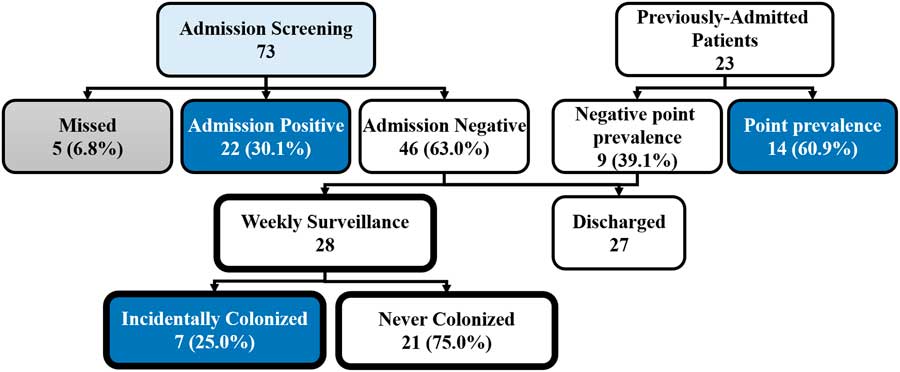
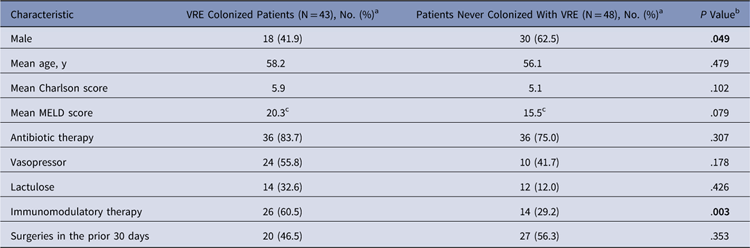
Overall, 96 patients received care in the liver transplant unit during the study period, and 91 patients were evaluated for VRE colonization (Fig. 1). Although 43 patients were colonized at some point during the study with VRE, 48 patients were never colonized. Table 1 presents the characteristics of these 2 patient groups.
Admission and incident VRE colonization. The diagram shows pre-existing point prevalence of VRE colonization in the unit, VRE colonization on admission, and incident VRE colonization. Note. VRE, vancomycin-resistant enterococci.

Patient Characteristics on Initial Surveillance

Note. VRE, vancomycin-resistant enterococci; MELD, model for end-stage liver disease.
a Unless otherwise noted.
b Bold values indicate statistical significance.
c MELD score was calculated based on available laboratory data.
At the beginning of the study, 23 patients were present in the SICU. For these patients, the point prevalence of VRE colonization was 14 of 23 (60.9%), with 23 of 23 (100%) of patients contributing data.
In addition, 73 patients were admitted during the study period. Admission screening (either perirectal swabbing or stool sampling) was performed for 68 of these 73 patients (93.2%), and 22 (30.1%) tested positive for VRE colonization on admission. All patients who had an admission screening without weekly surveillance were discharged before the scheduled weekly surveillance day.
A total of 28 noncolonized patients underwent weekly surveillance. Weekly surveillance (either perirectal or stool) was performed for 28 of 28 (100%). Incidental colonization occurred in 7 of 28 patients (25.0%). The incidence rate of VRE colonization was 27.0 per 1,000 SICU days.
Compliance with stool samples and perirectal swabs
Overall, there were 226 collection opportunities. Both stool samples and perirectal swabs were collected in 102 (45.1%) of those opportunities. Perirectal swabs only were collected in 99 opportunities (43.8%), and stool samples only were collected in 25 opportunities (11.1%). Compliance with collection of a perirectal swab occurred 201 of 226 times (88.9%) compared to 127 of 226 (56.1%) for stool collection (P≤0.001). For admission screening, compliance with perirectal swabbing occurred in 85 of 91 opportunities (93.4%) versus 39 of 91 opportunities (42.9%) for stool sampling. For weekly surveillance, compliance with perirectal swabbing was 85.9% (116 of 135) versus 65.2% (88 of 135) for stool sampling.
Sensitivity of VRE colonization by collection method
In 67 collections, both a stool sample and a perirectal swab were collected from the same patient at the same time and 1 or both of the samples were positive for VRE. Some of these samples were collected from patients previously identified as VRE colonized. Perirectal swabs were sensitive for VRE in 64 of 67 of those collections (95.5%). Stool samples were sensitive for VRE in 56 of 67 of those collections (83.6%; P=.023). If each patient contributed only 1 collection, and the first VRE-positive collection from the patient was used, 30 of 32 perirectal swabs (93.8%) were sensitive for VRE versus 27 of 32 stool samples (84.4%).
VRE colonization versus bloodstream infections
During the study period, we detected 10 VRE BSIs among the study population. VRE BSIs were more common among VRE-colonized patients (8 of 43) than non–VRE-colonized patients (2 of 48; P=.028). The 30-day mortality rate for those with VRE BSIs was 30.0%. For the 2 patients who developed a VRE BSI without VRE colonization on surveillance, 1 patient had 1 negative swab on surveillance 2 days before developing VRE BSI. The other patient transferred out of the unit, and 48 days had elapsed since the last surveillance. Another 3 patients had other VRE infections: an abscess, a positive omental fluid sample, and a urinary tract infection (UTI).
VRE strain typing
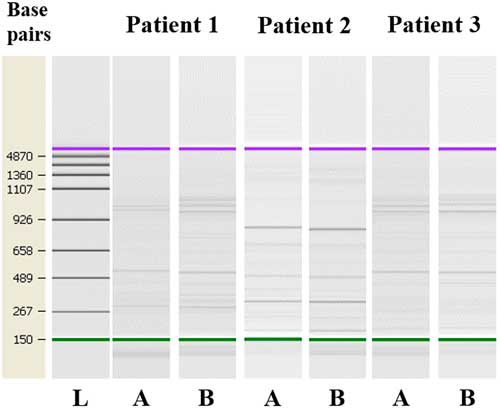
Of 10 patients with VRE BSI, 3 had both a blood-culture isolate and a surveillance isolate available for strain typing analyses. The bloodstream isolates were distinct and unrelated. All 3 colonizing isolates were >90% similar to the patient’s infecting strain, with 2 colonization–infection pairs being >95% similar (Fig. 2).
DNA fingerprints of VRE surveillance and bloodstream infection isolates. The diagram shows the matching strain types for patients with both a blood culture isolate and surveillance isolate available. Note. DNA, deoxyribonucleic acid; VRE, vancomycin-resistant enterococci; L, ladder; A, surveillance isolate; B, blood isolate.

Discussion
Vancomycin-resistant enterococcal infections disproportionately affect high-risk patient populations, including liver and HSC transplant recipients.Reference Russell, Flood and Zaroda 2 , Reference Kamboj, Chung and Seo 3 In our study, those on immunosuppressive regimens were at statistically significant higher risk of VRE colonization. Screening programs in high-risk units within a hospital have the potential to improve infection controlReference Perencevich, Fisman, Lipsitch, Harris, Morris and Smith 6 – Reference Rakoczy, Hendrickson, Kline, Streifel, Guspiel and Gross 8 and may identify patients who would benefit from early empiric therapy for VRE.Reference Perencevich, Fisman, Lipsitch, Harris, Morris and Smith 6 , Reference Olivier, Blake, Steed and Salgado 9 – Reference McKinnell and Arias 11 The prior literature suggests that stool collection is the most reliable means of VRE surveillance, but it can be time-consuming and unpleasant, which can lead to low compliance.Reference Perencevich, Fisman, Lipsitch, Harris, Morris and Smith 6 Our hypothesis that obtaining perirectal swabs is more convenient was correct: compliance with perirectal swabbing was significantly higher than compliance with stool sampling (89% vs 56%; P≤0.001).
Our finding that perirectal swabs were more sensitive than stool samples in detecting VRE (96% vs 84%; P=.023) was unexpected. Prior studies have repeatedly shown that perirectal swabs are less sensitive than stool samples for other pathogens.Reference Lautenbach, Harris and Perencevich 17 , Reference Kotton, Lankowski and Hohmann 18 Moreover, prior work by D’agata et alReference D’Agata, Gautam, Green and Tang 12 found that rectal swabs had a sensitivity of 58% in detecting VRE compared with stool samples. The D’agata study also reported that swabs detected VRE with high-density colonization but not low-density colonization (100% vs 0%, respectively). Possibly, patients from our liver transplant SICU were more commonly VRE colonized at a high density, but this would not explain why stool sampling performed relatively poorly. Alternatively, it is possible that the Spectra VRE media chosen for the study favored growth from perirectal swabs instead of stool samples. Spectra VRE media was chosen because it is FDA-approved for use with both stool sample and rectal swabs. The availability of commercial chromogenic agar allows for better recovery of VRE from stool samples and rectal swabs when compared with bile esculin azide agar supplemented with vancomycin, with reported sensitivities of >95%.Reference Jenkins, Raskoshina and Schuetz 19 – Reference Stamper, Shulder and Bekalo 21 However, we hesitate to draw premature conclusions, and further investigation is warranted.
Weekly surveillance identified that 25% of patients developed incident VRE colonization. Similar research conducted at the University of Alabama at Birmingham demonstrated that 22% of patients developed incident VRE colonization during their ICU stay.Reference McKinnell, Kunz and Moser 13 Widespread genotypic testing was not performed, so we could not determine whether the incident VRE cases represent VRE transmission or VRE “emerged,” that is, some patients had undetectable levels of VRE on admission that increased to the level of detection during their ICU stay, which is known as the “intestinal domination” effect.Reference Taur, Xavier and Lipuma 22 VRE colonization pressure was high in the unit, which could have contributed to increased risk for transmission. But neither UCLA nor the University of Alabama at Birmingham ICU units had significant burden of other transmissible pathogens like Clostridium difficile; thus, we favor a conclusion that includes some proportion of VRE emergence. Regardless, our study data indicate that a significant burden of VRE is missed by admission-only surveillance. Given the high burden of infection, RRMC started active daily management for central lines, which decreased central-line–associated BSIs from 4.08 per 1,000 patient days in 2015 to 1.58 per 1,000 patient days in 2016. Ongoing monitoring of VRE clinical infections, relative to other MDROs, will be used to determine the role of active VRE surveillance as part of a comprehensive infection control program.
Multiple investigations have demonstrated that VRE-colonized patients are at higher risk for VRE infection, and our data confirmed that outcome.Reference Olivier, Blake, Steed and Salgado 9 Our limited genotypic analysis provided linkage between the VRE bloodstream isolate and the colonizing isolate. The similarity between isolates, instead of identicalness, is a limitation of the repPCR typing method. Further research is needed, but colonization data could influence early empiric therapy for VRE, which can improve outcomes.Reference Britt, Potter, Patel and Steed 10 , Reference McKinnell and Arias 11 Currently, patients in the unit are placed on empiric therapy for VRE per physician preference.
Our study has several limitations. First, the study took place in an SICU with a high VRE burden. It is unknown whether weekly VRE colonization surveillance would be as effective in identifying incident colonization in hospital units with lower VRE burdens. Second, our surveillance methodology was based on routine culture methods. Modern PCR platforms may influence sensitivity of stool or perirectal swabs. However, we did not pursue PCR testing because a high-cost platform would not be practical for surveillance. Moreover, we did not measure the VRE concentration in stool samples, which many have impacted stool sensitivity compared to perirectal swabs.Reference D’Agata, Gautam, Green and Tang 12 In addition, genotypic analysis of all isolates would help determine whether VRE was transmitted within the unit or whether VRE “emerged” over the course of hospitalization. If VRE transmission is the primary driver of spread, universal chlorhexidine bathing, improved hand hygiene, and universal contact precautions should be recommended.Reference Huang, Chen, Wang and He 16 , Reference Donskey and Deshpande 23 If the primary problem is the “emergence” of existing VRE, greater attention to antimicrobial usage would be warranted.
In conclusion, we suggest using perirectal swabs for VRE surveillance instead of stool samples because perirectal swabs are more sensitive and more convenient in detecting VRE. Moreover, we recommend at least weekly surveillance of VRE instead of admission-only screening in high-burden units. Further work in VRE surveillance may have implications for both patient care and infection prevention.
Acknowledgments
Financial support
The overall study was supported by the UCLA Division of Infectious Diseases and the Perkins Foundation.
Conflicts of interest
All authors report no conflicts of interest relevant to this article.