Introduction
People with dementia disorders often live in institutional care facilities, especially when the dementia disorder becomes severe or complicated by various behavioral disturbances (Burns et al., Reference Burns, O'Brien and Ames2005; Coehlo et al., Reference Coehlo, Hooker and Bowman2007).
The spectrum of behavioral disturbances includes physically or verbally aggressive behaviors, restless or wandering behaviors, passiveness or apathy and numerous others (Robert et al., Reference Robert2005; Testad et al., Reference Testad, Aasland and Aarsland2007; Lövheim et al., Reference Lövheim, Sandman, Karlsson and Gustafson2008b). These behavioral disturbances often constitute a major burden for caring staff and relatives of the person afflicted and some, but not all of them, also negatively affect the person's own quality of life (Burns and Rabins, Reference Burns and Rabins2000; Black and Almeida, Reference Black and Almeida2004; Shin et al., Reference Shin, Carter, Masterman, Fairbanks and Cummings2005). Behavioral disturbances among people with dementia are often grouped together with psychological symptoms such as mood disturbances and psychotic features under the label BPSD (behavioral and psychological symptoms of dementia). Symptom complexes frequently overlap and are not always easily separated.
Over recent decades, institutional geriatric care for people with dementia in Sweden has evolved towards utilizing smaller caring units and more home-like caring environments, called group dwellings for people with dementia, as compared to large, psychogeriatric, long-stay wards. However, many people with dementia still live in non-specialized geriatric care units, such as nursing homes or residential care facilities (Lövheim et al., Reference Lövheim, Sandman, Kallin, Karlsson and Gustafson2008a). Another major change has been the great increase in psychotropic drug treatment for people living in institutional care, both with and without dementia (Lopez et al., Reference Lopez2003; Nygaard et al., Reference Nygaard, Ruths, Straand and Naik2004; Lövheim et al., Reference Lövheim, Sandman, Kallin, Karlsson and Gustafson2008a). There has been a particularly large increase in the use of antidepressants but also, at least in Sweden, of anxiolytics, hypnotics and sedatives. The use of antipsychotics, however, has remained fairly stable (Lövheim et al., Reference Lövheim, Sandman, Kallin, Karlsson and Gustafson2006; Reference Lövheim, Sandman, Kallin, Karlsson and Gustafson2008a).
Changes over time in the prevalence of various psychological symptoms among people living in institutional geriatric care has previously been investigated and discussed in relation to changes in pharmacological strategies and organizational structures (Lövheim et al., Reference Lövheim, Sandman, Kallin, Karlsson and Gustafson2008a), but no corresponding analysis of behavioral disturbances has yet been published.
The aim of the present study was to analyze and compare the prevalence of various behavioral symptoms and psychotropic drug treatments among people with cognitive impairment living in institutional care, in two large, comparable, samples from 1982 and 2000 respectively.
Methods
Materials
The analysis is based on two cross-sectional questionnaire surveys performed in 1982 and 2000 in the county of Västerbotten in northern Sweden. The two surveys used the same methodology and the same questionnaire, and included all those living in institutional care for old people. When the first investigation was conducted, the population in the area was 245,000, of whom 38,000 (15.5%) were older than 65 years; by the time of the second investigation the population had increased to approximately 256,000, of whom 44,000 (17.2%) were aged 65 years or older (Statistics Sweden, 2007).
The number of people living in institutions providing geriatric care was 3910 in 1982 and 4357 in 2000. In 1982 the institutions comprised 23 nursing homes, 36 residential care units, 16 somatic geriatric or somatic long-stay wards, nine psychiatric long-stay wards and nine psychogeriatric wards. In 2000, there were 31 nursing homes, 68 residential care units, 66 group dwellings for people with dementia, seven short-stay or rehabilitation units, four somatic geriatric wards and four psychogeriatric wards. The response rate in 1982 and 2000 was 92.3% and 87.3% respectively, rating 3607 and 3804 individuals respectively. People younger than 65 years or for whom no age was registered were excluded from the analysis. Out of 3195 people from 1982 and 3669 from 2000, those who had a cognitive score that indicated cognitive impairment (Gottfries’ cognitive scale: score of less than 24 points, see below) were selected. Thus, 1369 persons were selected from the 1982 survey and 2035 from the 2000 survey, giving a total of 3404 people.
The Regional Ethical Review Board in Umeå approved the study (registration number 00–170).
Procedures
The survey form was sent to all care settings in the county providing institutional geriatric care. Staff members were asked to complete the form and return it to the researchers. For each resident, the member of staff who knew the particular resident best was asked to complete the assessment scales. Written instructions about how to carry out the assessments were included and the staff were informed that the members of the research team could be contacted by telephone to answer questions or provide additional guidance. The staff were informed that their assessment should be based on observations of the resident's state during the preceding week.
Assessments
The assessments were made using the Multi-Dimensional Dementia Assessment Scale (MDDAS) (Sandman et al., Reference Sandman, Adolfsson, Norberg, Nyström and Winblad1988). The scale measures level of functioning in activities of daily living (ADL), cognition and behavioral and psychological symptoms and also includes a registration of current drug prescriptions. The MDDAS has good inter- and intra-rater reliability (Sandman et al., Reference Sandman, Adolfsson, Norberg, Nyström and Winblad1988).
A registered nurse filled in the data concerning prescribed medication from the resident's prescription record. Psychotropic drug data were grouped by members of the research team. Every person was assigned a dichotomous value for each group. Information about doses and pro re nata (“as needed”) medication was not coded; thus only figures for ongoing medication are given.
Cognitive impairment was measured using a scale developed by Gottfries and Gottfries (Adolfsson et al., Reference Adolfsson, Gottfries, Nyström and Winblad1981). This scale consists of 27 items measuring a person's level of cognitive functioning. A score of less than 24 is considered to indicate cognitive impairment, which correlates with a sensitivity of 90% and a specificity of 91% (Adolfsson et al., Reference Adolfsson, Gottfries, Nyström and Winblad1981) to the cut-off point 24/30, traditionally used in the Mini-mental State Examination (MMSE) (Folstein et al., Reference Folstein, Folstein and McHugh1975). The cognitive scale was further divided into mild cognitive impairment (score 16–23), moderate cognitive impairment (score 8–15) and severe cognitive impairment (score 0–7). An activities of daily living (ADL) score was calculated based on the resident's ability to cope with dressing, hygiene, eating and bladder and bowel control. All ADL categories score 1–5, except that for bladder control, which scores 0–4. Hence the ADL score varies from 4 to 24, where a higher score indicates greater ADL independence.
The MDDAS contains 25 items relating to various behavioral symptoms. Each item is rated on a three-point scale, indicating whether the symptom or behavior occurs at least once a day, at least once a week or not at all during the one-week observation period. The variables were dichotomized between at least once a week and less than once a week, and prevalence numbers, therefore, indicate one-week prevalences. The items were then grouped according to a rotated factor analysis as presented previously (Lövheim et al., Reference Lövheim, Sandman, Kallin, Karlsson and Gustafson2006). Each item is presented, in Table 3, under the factor to which it loaded the most.
Statistics
For the background variables, dichotomous variables were analyzed using the Pearson χ2 test and continuous variables using the independent variable T-test. The one-week prevalence of 25 behavioral symptoms and the use of different classes of psychotropic drugs in 1982 and 2000 respectively were compared. Multivariate logistic regression models were constructed to control for demographic changes between the two samples. The models constructed had the behavioral symptom or drug class as dependent variable and included sex, age, level of cognitive impairment (divided into mild, moderate and severe cognitive impairment: Gottfries’ cognitive scores 16–23, 8–15 and 0–7), level of ADL dependency (divided into low, medium or high dependency: ADL scores 4–10, 11–17 and 18–24) and year of investigation (1982 or 2000) as independent variables. Statistical calculations were performed using the Statistical Package for Social Science SPSS® version 11.0 for Mac OS X.
Results
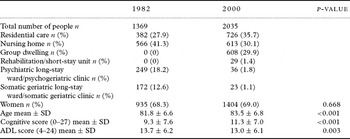
Some background characteristics of the two samples are presented in Table 1. Compared to the sample from 1982, the mean age in 2000, the mean cognitive score and the level of dependence in ADL were all higher. There had been some changes among the different types of institutional care facilities between the two years: principally, the introduction of the group dwellings for people with dementia, where 29.9% of the people now lived in 2000, and the closure of the somatic, psychiatric and psychogeriatric long-stay wards.
Characteristics of the two studied samples of people with cognitive impairment aged 65 years and over

ADL = activities of daily living, SD = standard deviation.
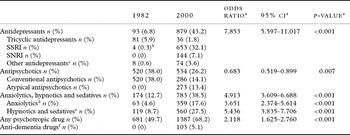
The psychotropic drug treatments are presented in Table 2. In 2000, treatment with antidepressants had become more common than in 1982, with a rise in prevalence from 6.8% to 43.2% (p < 0.001). The use of anxiolytics, hypnotics and sedatives had also become more common in 2000 compared to 1982 (38.5% compared to 12.7%, p < 0.001) while treatment with antipsychotics had become less common (26.2% compared to 38.0%, p = 0.007). Atypical antipsychotics, which were not available in 1982, accounted for about half of the prescriptions of antipsychotic drugs in 2000. In 2000, 5.1% of the people used cholinesterase inhibitors, another class of drug not available in 1982.
Psychotropic drug use

aCorrected for sex, age, ADL performance (high, medium or low dependency) and level of cognitive impairment (mild, moderate or severe cognitive impairment).
bIn 1982 four people received zimelidine, the very first SSRI, withdrawn in 1983.
cOther antidepressants include tetracyclic antidepressants and monoamine oxidase inhibitors.
dAnxiolytics includes benzodiazepine anxiolytics and clomethiazole.
eHypnotics and sedatives include benzodiazepines, benzodiazepine-like substances (e.g. zopiclone), propiomazine, sedative antihistamines, barbiturates and chloral hydrate.
fAnti-dementia drugs comprise cholinesterase inhibitors.
SSRI = selective serotonin reuptake inhibitor; SNRI = serotonin and noradrenalin reuptake inhibitor.
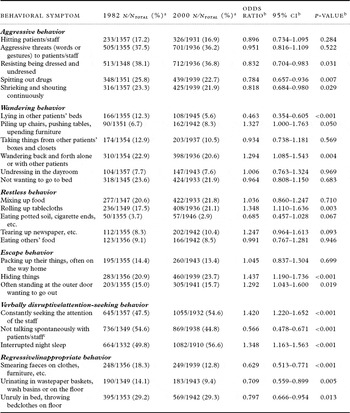
The one-week prevalences for the various MDDAS behavioral symptoms for the samples from 1982 and 2000 are presented in Table 3. Table 3 also presents the p-value, odds ratio and confidence interval for changes from 1982 to 2000, controlled for differences in demographic composition of the samples. Odds ratios larger than 1 correspond to a higher prevalence in 2000 than in 1982.
Prevalence of various behavioral symptoms in 1982 and 2000

aFor each item, the number of affirmative answers is given first, then the total number of answers to the specific question, then the percentage. Prevalences correspond to people having exhibited the behavior or symptom at least once during the one-week observation time.
bCorrected for sex, age, ADL performance (high, medium or low dependency) and level of cognitive impairment (mild, moderate or severe cognitive impairment).
cThis variable contributed negatively to the factor.
Fourteen out of 25 behaviors showed a significant difference in prevalence between 1982 and 2000, six behaviors had become more common and eight had become less common. Eleven behavioral symptoms did not show any significant change in prevalence when controlled for demographic composition. The following behaviors showed a higher prevalence in 2000 than in 1982, after controlling for demographic changes: wandering back and forth, rolling up the tablecloth, hiding things, standing at the outer door wanting to go out, constantly seeking the attention of the staff and having interrupted night sleep. The following behaviors were less common: resisting being dressed or undressed, spitting out drugs, shrieking and shouting continuously, lying in other patients’ beds, not talking spontaneously, smearing faeces, urinating in the wrong places and being unruly in bed and throwing bedclothes on the floor.
Discussion
It has previously been shown that the prevalence of different psychological symptoms – and depressive symptoms in particular – has decreased over the last few decades (Nygaard et al., Reference Nygaard, Ruths, Straand and Naik2004; Lövheim et al., Reference Lövheim, Sandman, Kallin, Karlsson and Gustafson2008a), supposedly coupled with the increased use of antidepressants among old people living in institutional care (Montagnier et al., Reference Montagnier2006; Lövheim et al., Reference Lövheim, Sandman, Kallin, Karlsson and Gustafson2008a). The impact of improvements in the organization of geriatric care has also been discussed in previous studies (Lövheim et al., Reference Lövheim, Sandman, Kallin, Karlsson and Gustafson2008a).
The present study investigated the prevalence of various behavioral symptoms among people with cognitive impairment and revealed some interesting results and possible patterns among the changes. First, many of the behavioral symptoms that have increased indicate a generally increased, although sometimes inadequate, level of activity. Such behaviors are “wandering back and forth”, “rolling up the tablecloth”, “hiding things”, “standing at the outer door wanting to go out” and “constantly seeking the attention of the staff”. The number of people who spontaneously talked to other residents and staff had also increased.
Secondly, there was a decrease in regressive behaviors (“smearing faeces”, “urinating in wastepaper baskets, wash basins or on the floor” and “unruly in bed, throwing bedclothes on the floor”), “shrieking and shouting continuously” and passive resistance to care such as “resisting being dressed and undressed” and “spitting out drugs”.
Various factors may have contributed to the changes in prevalence of the behaviors. The transition towards smaller and more adjusted caring environments, such as the group dwellings for people with dementia, might be one such explanation. The group dwellings are units for 8 to 12 people, with private rooms for each resident and a shared dining room and kitchen. Staff are available around the clock, and the staffing rate is somewhat higher than in the residential care facilities (Kallin et al., Reference Kallin, Gustafson, Sandman and Karlsson2004). It seems possible that the changes in the caring environment, together with possibly better education of the caring staff at the institutional geriatric care units, have contributed to the decrease in regressive and resistive behaviors. Various non-pharmacological interventions targeting behavioral disturbances have been evaluated previously, showing promising results (O'Connor et al., Reference O'Connor, Ames, Gardner and King2009). Resistance to care arises in a context that includes both the resident and the staff. More humane and possibly less repressive caring milieus and treatment traditions might be reflected in the behaviors of the residents. Closer surveillance and support also probably hinder the development of regressive behaviors. The decrease in the number of people found in other residents’ beds probably reflects the decreasing number of people sharing rooms with others, another effect of the modernization of the care facilities.
Yet another factor might be the shift in psychotropic drug treatments. Between 1982 and 2000 there was a huge increase in the proportion of people treated with antidepressants, anxiolytics, hypnotics and sedatives, and a decrease in the proportion of people receiving antipsychotic treatments.
Treatment with SSRI antidepressants might have contributed to increasing the general level of activity, at least in those people where passiveness was a symptom of depression, which is very common among old people living in geriatric care (Lebowitz et al., Reference Lebowitz1997; Sandberg et al., Reference Sandberg, Gustafson, Brännström and Bucht1998). This corresponds to the previously reported decrease in depressive symptoms and people lacking in initiative (Lövheim et al., Reference Lövheim, Sandman, Kallin, Karlsson and Gustafson2008a). Furthermore, mania and hyperactivity have also been described as side effects of SSRI antidepressants (Spigset, Reference Spigset1999; Ramasubbu, Reference Ramasubbu2004). Although the prevalence of antipsychotic treatment decreased from 38.0% to 26.2%, there was no increase in the core aggressive symptoms “hitting patients/staff” or “aggressive threats”. Antipsychotic treatments for behavioral disturbances among people with dementia have been increasingly questioned over the past few years with regard to the high risk of adverse events (Douglas and Smeeth, Reference Douglas and Smeeth2008; Rochon et al., Reference Rochon2008; Ballard et al., Reference Ballard2009), and their generally mediocre effect on behavioral symptoms of dementia (Schneider et al., Reference Schneider, Dagerman and Insel2005; Sink et al., Reference Sink, Holden and Yaffe2005). In 2000, 5.1% of the sample were using cholinesterase inhibitors. Although this involved only a small fraction of the people, these drugs might have positive effects on some behavioral symptoms (Tangwongchai et al., Reference Tangwongchai2008), and hence might have contributed to some extent to the changes.
It is striking that the proportion of those with interrupted sleep had increased, even though the use of sedative drugs as standing medication has also increased in this population, from 8.7% to 27.5%. This underlines the current recommendation that benzodiazepines are for short-term use only (Morgan, Reference Morgan, Tallis and Fillit2003), because when used as standing medication, as for the sample in this study, tolerance soon develops and no treatment effect remains. Sadly enough, however, the risk of several adverse effects remains.
The power of this study of 3404 people with cognitive impairment living in geriatric care was good, and any relevant change in the studied behavioral symptoms has probably been detected. The main limitation of this study is the possibility of many confounding factors acting on the two samples, taken 18 years apart. This is partly controlled for by the multiple logistic regression models applied to the material, and is probably reduced by the fact that all units providing geriatric care in the county were included both in 1982 and in 2000. Nevertheless, it is possible that, for example, different criteria for institutionalization have affected the prevalence of different behaviors among those living in institutional care. This possible effect has to be taken into account when interpreting the results. It is also important to remember that the MDDAS assessment instrument registers symptoms reported by caring staff, and not formal medical diagnoses. It is therefore possible that the prevalences of certain behaviors are affected by changes over time in staff perception of, and tolerance towards the behavior. Staff members in a specialized dementia care facility might, for example, be more familiar with some behaviors, and not notice them to the same extent. However, the MDDAS instrument focuses on very concrete behaviors, and is aimed to be used by untrained assessors. We hence judge this only as a minor source of error.
Another limitation is that for the main analysis, 25 behavioral items were analyzed at the p < 0.05 level. Multiple testing increases the risk of type 1-errors, and the result of one single analysis should therefore be interpreted with great caution as there might be random significances among the results. A full adjustment for multiple testing would have required a p < 0.002 level of significance, which reduces the number of significant changes in the prevalence of various behaviors from 14 to six. However, as the conclusions are based on general patterns and not single items, and because the described patterns are supported by many items including those significant at the p < 0.002 level, we judge that the risk of type 1-errors does not compromise our conclusions.
Conclusions
Between 1982 and 2000, there has been a change in the prevalence of several behavioral symptoms among old people with cognitive impairment living in institutional geriatric care. One-week prevalence of regressive symptoms and resistance to care had decreased and there were signs of a generally increased level of activity among people with cognitive impairment. These changes might be an effect of the extensive changes in pharmacological treatments as well as those concerning the organization of institutional geriatric care.
Conflict of interest
None.
Description of authors' roles
All authors were involved in the acquisition of data. H. Lövheim and Y. Gustafson analyzed and interpreted the data and prepared the manuscript. P.O. Sandman and S. Karlsson were responsible for the study concept and design. All authors reviewed the manuscript, added their comments and approved the final version.
Acknowledgments
This study was supported financially by grants from the Umeå University Foundation for Medical Research, the Swedish Foundation for Healthcare Sciences and Allergy Research, the Field Research Centre for the Elderly in Västerbotten, the Swedish Research Council, the Swedish Dementia Association (Stiftelsen Demensfonden) and Erik and Anne-Marie Detlof's Foundation, Umeå University.