As the 2004 presidential election approached, journalists discovered an apparently new political phenomenon: the “religion gap,” or the tendency of the most religious Americans to espouse conservative political beliefs and prefer Republican candidates. As a typical news story put it, “Want to know how Americans will vote next Election Day? Watch what they do the weekend before. If they attend religious services regularly, they probably will vote Republican by a 2-1 margin. If they never go, they likely will vote Democratic by a 2-1 margin” (Thomma 2003). The religion gap was illustrated frequently and clearly by public opinion polls. A Pew Research Center (2003) study, for example, found the American public sharply divided between the Republicans and Democrats on the eve of the 2004 campaign, with frequency of worship attendance emerging as a powerful predictor of party preference. In fact, most evidence of the religion gap was linked to differences in worship attendance.
Descriptions of the worship attendance gap quickly expanded, with journalists renaming it the “religion gap” and eventually the “God gap.” Of course, it does not take a great imagination to move from emphasizing the political importance of worship attendance (which is, after all, one of the most important public expressions of faith) to thinking about the general political significance of belief in God (which is the central feature of faith for most Americans: Fowler, Hertzke, Olson, and den Dulk 2004). The God gap terminology attracted the most attention—and controversy—because it suggested that the Republicans have become the party of America's “believers” and the Democrats the party of its “non-believers.” Although most observers realized that the God gap story was overstated to a degree, it certainly fit well with the overall prominence of religion in the 2004 presidential campaign.
Religion's influence on elections had long been assumed to operate through communal ties, with the particular values of different religious communities generating disparate voting patterns (Herberg 1955; Wuthnow 1988). In the 1930s and 1940s, for example, Catholics were loyal Democrats and most Protestants voted Republican. The religion gap, however, suggested something quite novel. Differences within religious communities were now apparently more politically significant than differences among religious traditions (Green, Guth, Smidt, and Kellstedt 1996; Hunter 1991; Kohut, Green, Keeter, and Toth 2000; Layman 2001; Leege and Kellstedt 1993; Leege, Wald, Krueger, and Mueller 2002; Wuthnow 1988).
It is hardly surprising that such stark imagery prompted extensive commentary. Some observers criticized the religion gap on the grounds that both major political parties have religious constituencies (Eastland 2004; Zelizer 2004). For example, some of the most religious people in the United States, African-American Protestants, are heavily Democratic (Harris 1999). Other religious traditions, including Judaism (Maisel and Forman 2003), mainline Protestantism (Manza and Brooks 1999; 2002), and to some extent Catholicism (Cochran and Cochran 2003) actively teach moderate-to-liberal positions on many issues. Observers also took aim at the God gap language, arguing that if a large majority of Americans claim to believe in God (as they do: Fowler et al. 2004), then belief in God by definition cannot readily be linked to political differences (Sullivan 2005).
Although such criticisms do carry a certain degree of validity, there is also substantial value in analyzing today's religion gap. For one thing, the religion gap captures an important feature of contemporary politics—indeed, one that may mark off a new era from the past. Worship attendance is measured regularly in public opinion polls, so analysis of a possible religion gap is quite straightforward. Moreover, like its predecessors in the literature including the generation gap and the gender gap, the religion gap relates an important feature of everyday life to political behavior.
The fact of the matter is that there is a religion gap in American voting behavior (Fiorina 2005; Green 2004; Green and Silk 2003; Green, Smidt, Guth, and Kellstedt 2004; Kohut et al. 2000; Layman 2001). Wuthnow (1988) was the first to propose that American religion could no longer be understood exclusively on the basis of the traditional (Herberg 1955) “Protestant-Catholic-Jewish” framework. Extensive societal changes caused two dominant religious orientations to emerge in the United States by the end of World War II: (1) a theologically and politically conservative religious witness and (2) a more liberal, relativist approach to both theology and politics. Wuthnow demonstrates that this dichotomy appears within all major American religious families. Therefore, it becomes most politically relevant to compare individuals who are highly committed to religious life—whatever their actual affiliation may be—to those who report a lower degree of religious commitment.
In the past decade, the religion gap has become one of the more significant points of division in American politics. President George W. Bush was indebted to millions of conservative evangelical Protestant and Catholic votersfollowing his reelection in November 2004 (Cooperman and Edsall 2004). The Bush-Cheney campaign worked hard to mobilize these traditionalist Christians, and they turned out to vote for Bush in droves (Green et al. 2004; Pew Forum 2004). Scholars of political behavior therefore need to analyze in greater detail exactly how and why religious Americans appear to view the political world differently than those who are less committed to religious life.
The Emergence of the Religion Gap
Worship attendance is a common form of religious behavior in the United States. Typically at least 40% of Americans tell pollsters that they attend worship services once a week or more often. Although there is some question about the accuracy of these reports (Hadaway, Marler, and Chaves 1993), the worship attendance pattern has been quite consistent for decades (Fowler et al. 2004).
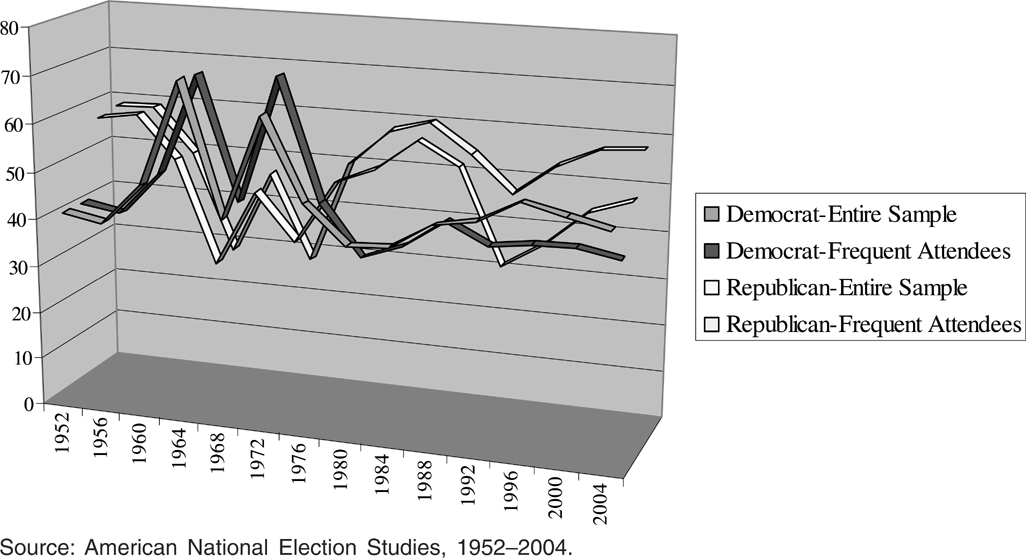
Figure 1 charts the emergence of the worship attendance gap from 1952 to 2004 using data from the American National Election Studies (ANES). The figure illustrates the overall level of support for the Democratic and Republican presidential candidates and the level of support for each candidate among survey respondents who attend worship services “regularly” (as the item was worded from 1952 through 1968) or “every week” (as the item has been worded since 1972). The figure clearly illustrates the fact that there was no sustained “religion gap” in presidential voting behavior until 1992. Richard Nixon did better among frequent attendees in 1972, and Ronald Reagan enjoyed a similar advantage among frequent attendees in 1980, but the worship attendance gap really does not emerge as a clear, predictable feature of American presidential voting behavior until 1992 and after.

Worship Attendance and Presidential Voting, 1952–2004
To some extent, this finding contradicts conventional wisdom and a good bit of scholarship (Leege, Wald, Krueger, and Mueller 2002; Layman 2001; Wilcox 1992; Wilcox and Larson 2006) indicating that Reagan's presidency initiated the political cleavage between America's most religious voters and their more secular counterparts. The genesis of the religion gap may well lie with Ronald Reagan, but it apparently took a dozen years to take hold in the mass public. It is ironic that George H. W. Bush—who, unlike his son, was not noted for public displays of religiosity—was one of the first to benefit from a double-digit advantage (12.8 percentage points) among frequent worship attendees as compared with the public at large.
It is especially useful to consider the religion gap in the context of the most committed evangelical Protestant and Catholic voters. There have been noteworthy changes in the voting behavior of these two religious traditions in recent decades. Evangelicals have undergone a thorough political realignment since the 1980s, becoming one of the most loyal of the Republican Party's constituencies (Layman 2001). Meanwhile, Catholics have been transformed from a stalwart contingent of the Democrats' New Deal Coalition to a true swing constituency (Kohut et al. 2000).
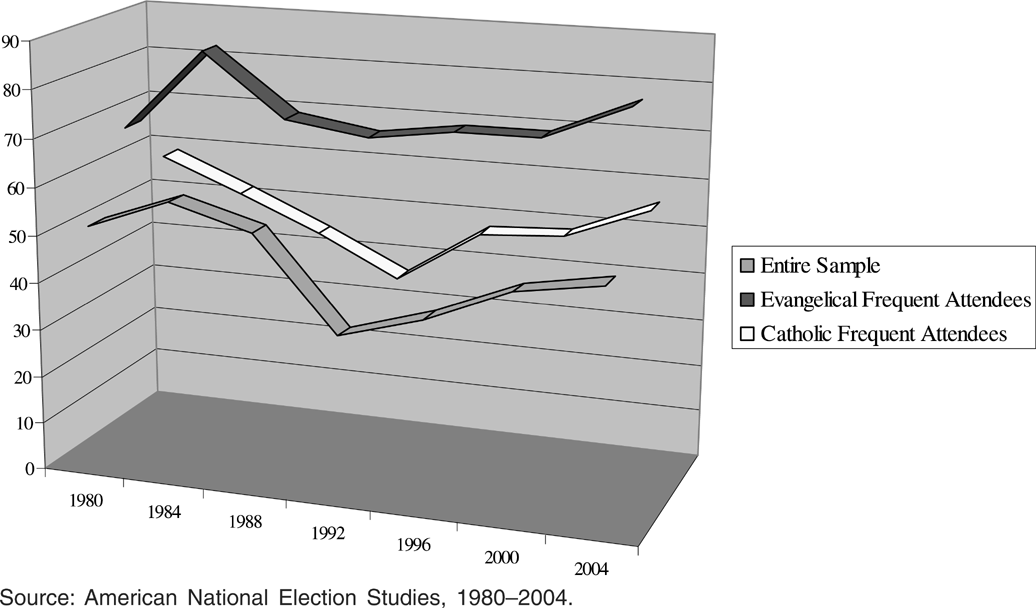
Figure 2 illustrates the gaps between the voting behavior of the electorate at large and evangelical Protestant and Catholic frequent attendees using 1980–2004 ANES data. Here the religion gap is particularly striking, revealing that the Republican Party indeed has done a remarkably effective job appealing to the most committed evangelical and Catholic voters in the American electorate (see also Cooperman and Edsall 2004; Green et al. 2004; Kohut et al. 2000; Layman 2001; Pew Forum 2004; 2005). The closest the frequently attending evangelical vote has been to the overall sample vote in 24 years is 16 percentage points, and that was in 1980. The voting gap between frequently attending Catholics and the overall sample has been smaller but no less persistent. Frequently attending Catholics have favored the Republican candidate in every election since 1980—and they favored George W. Bush over fellow Catholic John Kerry by 6.3 percentage points more than did the overall sample in 2004.

Republican Presidential Voting among Evangelical Protestant and Catholic Frequent Attendees, 1980–2004
The Religion Gap in 2004
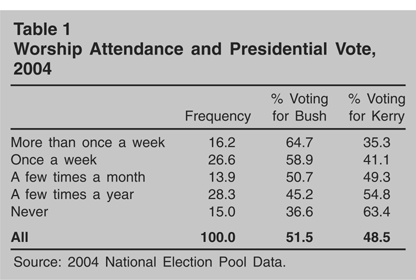
To what extent was the religion gap a significant decisive factor in the religion-infused 2004 presidential election? According to the exit poll data reported in Table 1, 16.2% of voters in 2004 claimed to attend worship services more than once a week and another 26.6% said they worshiped once a week. Thus “weekly attendees” comprised 42.8% of the 2004 electorate. On the opposite end of the scale, 15.0% of 2004 voters claimed never to attend worship services, while 28.3% said they attended only a few times a year (typically on Christmas and Easter). These figures total to 43.3%, comprising almost the same proportion of the electorate as the weekly attendees. The remaining “middle” category (those who report worshiping a few times a month) accounted for the remaining 13.9% of the electorate.
Worship Attendance and Presidential Vote, 2004

Thus worship attendance divided voters fairly evenly in 2004. And each level of attendance is clearly associated with the vote for George W. Bush and John F. Kerry. The pattern is striking and nearly symmetrical. Just under two-thirds (64.7%) of voters (regardless of their specific religious affiliation) who attended worship services more than once a week backed Bush, compared to a bit more than one-third (35.3%) who supported Kerry. Meanwhile, among voters who never worship, a little over a third voted for Bush (36.6%) and just under two-thirds (63.4%) voted for Kerry. In fact, the vote for Bush declined steadily as the frequency of reported worship attendance decreased—and the Kerry vote increased in exactly the opposite fashion. Notice as well how close the contest was among voters in the middle attendance category (those who worship several times a month). Here Bush bested Kerry by less than 1%.
These data reveal an extensive gap in the two-party vote. The difference between the Bush vote among the most and least frequent worship attendees was fully 28 percentage points. Moreover, fully one-half of all of Bush's ballots were cast by weekly worship attendees, whereas some two-thirds of all Kerry's votes were cast by less-than-weekly attendees. These results are valuable because we know for certain that exit poll respondents actually came to the polls, a fact that is more difficult to assure with other survey data (including ANES).
As impressive as these figures are, it is important not to overstate their significance. President Bush could not have been reelected without the support he received from less-frequent worshipers. Likewise, the election would not have been nearly as close if Kerry had not received a substantial number of votes from frequent worship attendees (suggesting that there still might be some semblance of a religious left in the United States; see Olson 2006). Nevertheless, these results reveal clear evidence of the reality behind the religion gap.
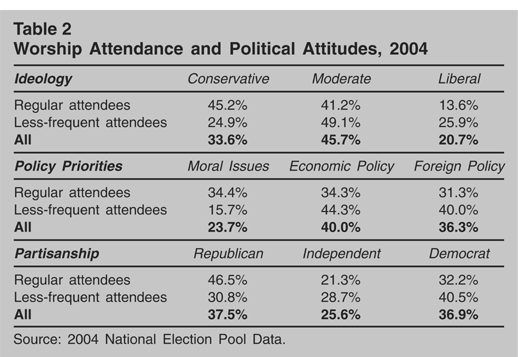
Our results would imply that the religion gap bears a strong association to political attitudes, with weekly worship attendees holding more conservative views and less-than-weekly attendees espousing more liberal attitudes. There was a good bit of truth behind this assumption in 2004, but the results must be interpreted with considerable nuance. Table 2 reveals that frequency of worship attendance was closely associated with self-reported ideology in 2004. Nearly half (45.2%) of the weekly attendees said they were conservative, compared to just a quarter (24.9%) of the less-than-weekly attendees. However, another two-fifths (41.2%) of the weekly attendees claimed the “moderate” label. Here the less-than-weekly attendees were more numerous, with just about one-half (49.1%) reporting moderate political views. In contrast, only about one-seventh (13.6%) of all weekly attendees were liberal, a proportion only half the size of the liberal contingent among less-than-weekly attendees (25.9%). These patterns, of course, are skewed a bit by that fact that only one-fifth of the electorate self-identified as liberal in 2004. Evidently the “L” word remains a dirty word in American politics.
Worship Attendance and Political Attitudes, 2004

A similar pattern holds for the self-reported issue priorities of 2004 voters. Just over a third (34.4%) of the weekly attendees said that “moral values” were the most important motivation for their vote—more than twice the number of “moral values” voters among less-frequent attendees (15.7%). However, almost as many weekly attendees chose an economic issue (such as the economy, jobs, or health insurance), and others chose a foreign policy issue (such as terrorism or the war in Iraq). Note, however, that economic issues (44.3%) and foreign policy (40.0%) were markedly more common priorities of the less-than-weekly attendees.
The clearest religion gap in Table 2 emerges around partisanship. Nearly half (46.5%) of the weekly attendees considered themselves Republicans, compared to less than a third (30.8%) of the less-than-weekly attendees. On the other hand, just about a third (32.2%) of the weekly attendees are Democrats, compared to two-fifths (40.5%) of the less-regular attendees.
What Lies Behind the Religion Gap?
The evidence of the religion gap begs several important questions. Does the religion gap have an independent impact on politics, or is it simply a product of other factors associated with the vote? Even if it does have an independent impact, what is the relationship between the religion gap and other demographic and political factors? Does the religion gap counter or reinforce the political effects of other factors such as gender or social class?1
See our introduction to this symposium in this issue of PS for a discussion of the relative significance of the religion gap vis-à-vis other gaps. The religion gap, as measured by worship attendance, is not likely to be a byproduct of other demographic gaps.
First, the religion gap may in part reflect the continuing political significance of religious affiliation. After all, most people attend worship in a particular congregation, which probably belongs to a denomination, and in turn, a larger religious tradition. Such religious communities and institutions have long been the most important means of linking religion to politics (Djupe and Gilbert 2003; 2006; Djupe and Grant 2001; Wald, Owen, and Hill 1988; 1990). So the religion gap may be capturing some of the effects of religious affiliation. It may be, for instance, that weekly attendees are concentrated in some religious communities and not in others, or it might be that less-frequent attendees are not particularly influenced by the distinctive values of religious communities. The role of religious affiliation may help explain the limitations of the religion gap as well as its impact, in that some weekly attendees may belong to congregations that encourage moderate or liberal political values.
Second, the religion gap may reflect the political significance of religious belief. It may be, for instance, that weekly worship attendees are more likely to hold certain sorts of religious beliefs, while less-than-weekly attendees are more likely to hold contrary beliefs (Kohut et al. 2000; Layman and Green 2005). Here, too, the impact of religious beliefs may help explain why the religion gap is important but not comprehensive in its effects: some weekly attendees may espouse religious beliefs that foster liberal or moderate political views.
Third, the religion gap may reflect the political significance of religious commitment quite apart from the impact of religious affiliation or belief. High levels of religious commitment, of which weekly worship attendance is just one component, may foster particular connections between religion and politics by exposing individuals to special kinds of information. Such information might be a byproduct of religious life, such as sermon messages or the content of conversations with fellow attendees (Djupe and Gilbert 2003; 2006). Or it might be the result of deliberate efforts to motivate political action, such as official pronouncements on issues or voter guides distributed in congregations (Guth, Kellstedt, Green, and Smidt 2002). If so, weekly worship attendees are more likely to be exposed to this special information than less-than-weekly attendees. And the political significance of religious commitment may also help explain why the impact of the religion gap is strong but not uniform: weekly attendees may receive different kinds of politically relevant information.
Addressing these questions is an important task for scholars. If the appearance of the religion gap does in fact mark the beginning of a new political era with a new kind of connection between religion and politics, then it is critical to understand its religious underpinnings. After all, religion's political consequences are significant and likely to remain so in the near future. We fully expect the religion gap to continue to exert a powerful effect on voting behavior in 2006 and beyond.
Biographies
Laura R. Olson is professor of political science at Clemson University. Recent books include (as co-author) Women with a Mission: Religion, Gender, and the Politics of Women Clergy (University of Alabama Press, 2005) and Religion and Politics in America: Faith, Culture, and Strategic Choices (Westview, 2003), and (as co-editor) Religious Interests in Community Conflict (Baylor University Press, forthcoming), The Encyclopedia of American Religion and Politics (Facts on File, 2003), and Christian Clergy in American Politics (Johns Hopkins University Press, 2001).
John C. Green is distinguished professor of political science and director of the Ray C. Bliss Institute of Applied Politics at the University of Akron. He is also a senior fellow with the Pew Forum on Religion and Public Life in Washington, D.C. He is co-author of The Bully Pulpit: The Politics of Protestant Clergy (University Press of Kansas, 1997); Religion and the Culture Wars: Dispatches From the Front (Rowman and Littlefield, 1996); and The Diminishing Divide: Religion's Changing Role in American Politics (Brookings Institution, 2000). In addition, he is co-editor of The State of the Parties (Rowman and Littlefield, 2003), now in its 5th edition, and Multiparty Politics in America (Rowman and Littlefield, 2002), in its 2nd edition.