Somatic cell count (SCC) is the most widespread udder-health and milk hygienic parameter in dairy practice because an infection of the mammary gland is the major factor that increases the SCC. Infections reduce both the quality and the yield of milk, and the SCC of individual quarters can affect the total milk SCC of the cow and, consequently, the bulk tank SCC. Therefore, an early detection of milk with markedly increased SCC is important to prevent its addition to the bulk tank milk. Quarter foremilk sampling before milking for monitoring milk quality and the detection of mastitis, using California Mastitis Test (CMT) or by exact determination of SCC, is well established. However, the estimation of quarter SCC based on foremilk measurements is critical and it has to be taken into account that different milk fractions of a quarter can show different SCC. It was previously shown that the SCC of cisternal milk is higher than in the first 25% of alveolar milk in cows with <100×103 cells/ml in whole udder milk (Ontsouka et al. Reference Ontsouka, Bruckmaier and Blum2003) and the SCC increased in later milk fractions until the end of milking (Vangroenweghe et al. Reference Vangroenweghe, Dosogne and Burvenich2002; Sarikaya et al. Reference Sarikaya, Werner-Misof, Atzkern and Bruckmaier2005). In addition, Sarikaya & Bruckmaier (Reference Sarikaya and Bruckmaier2006) distinguished between strict foremilk (taken without udder preparation) and cisternal milk where the SCC decreased with each squirt of milk and was higher than in the alveolar milk fractions. This difference between foremilk and alveolar milk was more distinctive at increased total quarter SCC (>100×103 cells/ml). Therefore, the definition of the tested fraction is of most importance if the results are used for the prediction of total quarter milk SCC.
To obtain strict foremilk samples without an intermixture with alveolar milk, samples of all quarters must be taken within a lag time of 40–50 s, i.e. before the start of milk ejection (Bruckmaier & Hilger, Reference Bruckmaier and Hilger2001). This is often not possible under practical farming conditions. Therefore, it is more suitable to remove foremilk samples after milk ejection has commenced. However, the use of foremilk SCC (SCC-F) taken after udder preparation and induction of milk ejection to estimate total quarter SCC (SCC-T) in dairy cows has not been systematically investigated.
The goal of the present study was to test the usefulness of quarter foremilk samples taken after udder stimulation to provide representative data of total quarter SCC.
Material and Methods
Animals and sampling
Nineteen dairy cows of different breeds (10 Holstein, 6 Simmental, 3 Swiss Brown) in the middle (week 14–28) of their 1st to 5th lactation were used. The cows had a daily milk yield of 27·1±1·5 kg and an average whole udder milk SCC of (122±8)×103/ml. They were sampled during routine milking twice a day at 5.30 and 15.30 for 10 subsequent days (378 milkings in total). Immediately before the onset of the milking clusters, 10-ml foremilk samples of each quarter were taken after a 1-min udder stimulation by massage of the teats and removing 2–3 jets of milk from each quarter. Milking was performed with a special milking device to collect separate quarter milk. At the end of the milking procedure samples from total milk of each quarter were collected for SCC measurements.
Milk samples were kept at 4°C and SCC analyses were performed within 24 h. SCC was measured with the DeLaval cell counter (DCC; DeLaval International, Tumba, Sweden).
Statistical analysis
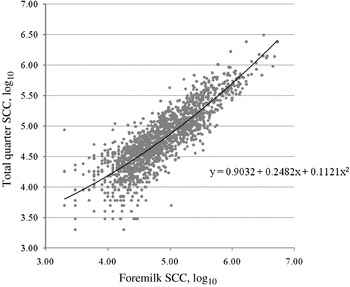
Pairs of quarter milk recordings (foremilk v. total quarter milk) were analysed by various regression analyses. A random effects linear regression model with maximum likelihood estimates (MLE) and exact confidence intervals was fitted to predict values of log(SCC-T). The model included a constant term (intercept), the linear and quadratic form of the predictor log(SCC-F), and cow as a random effect (STATA 10; function xtreg). The inclusion of cow as a random effect accounted for the repetition of measurements within cow over quarter, milking (morning, afternoon) and time (10 measuring days per cow). Model predictions of log(SCC-T) by log(SCC-F), therefore, are averages over the possible differences between quarters, milking time, and sampling date. A polynomial regression of all quarter SCC (log10) was used to test the relationship between all SCC-T and SCC-F (Fig. 1).
Polynomial random effects regression of all foremilk v. total quarter milk SCC (log10) measurements.

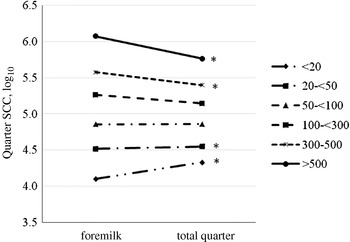
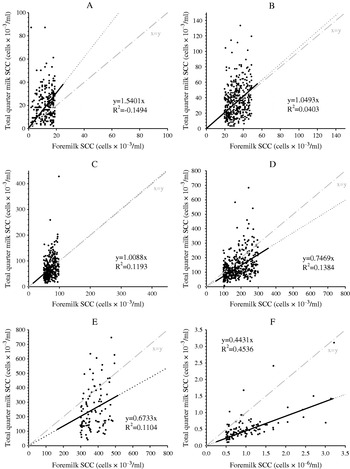
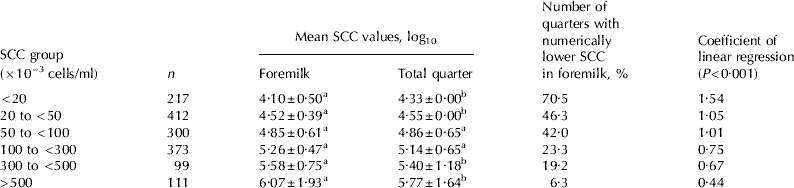
In addition, for a better characterization of the predictability of SCC-T by SCC-F the samples were grouped into six different SCC-F classes [<20 (n=217), 20 to <50 (n=412), 50 to <100 (n=300), 100 to <300 (n=373), 300 to <500 (n=99), and >500 (n=111)×103 cells/ml]. (Table 1, Fig. 2). Data are presented as means with sem. The association between foremilk and total quarter milk SCC at different SCC classes was determined by simple linear regression (Fig. 3). In all analyses, P<0·05 was considered as significant.
Mean foremilk and total quarter milk SCC (log10) in the six different foremilk SCC groups [<20 (n=217), 20 to <50 (n=412), 50 to <100 (n=300), 100 to <300 (n=373), 300–500 (n=99) and >500 (n=111)×103 cells/ml, respectively]; * indicates a significant difference (P<0·05) between foremilk and total quarter SCC within groups.

Linear regressions (black lines; elongations: dotted lines) of total quarter and foremilk SCC grouped into different foremilk SCC: A: <20×103 cells/ml (n=217); B: 20 to <50×103 cells/ml (n=412); C: 50 to <100×103 cells/ml (n=300); D: 100 to <300×103 cells/ml (n=373); E: 300–500×103 cells/ml (n=99); F: >500×103 cells/ml (n=111). A line where x=y is indicated in dash – dotted grey.

Foremilk and total quarter milk SCC in groups of different foremilk SCC
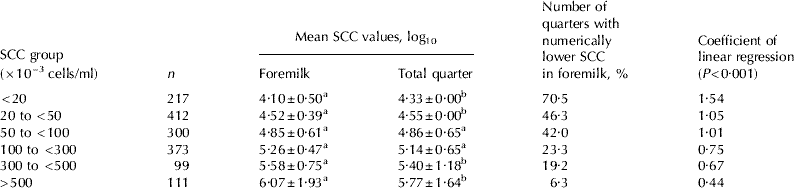
a,b =Means without common superscript letters are significantly different between foremilk and total quarter milk within SCC groups (P<0·05)
Results
A total of 1512 pairs of quarter milk recordings (foremilk v. total quarter milk) from 19 dairy cows were analysed. SCC-F ranged from (5–5400)×103 cells/ml, whereas SCC-T ranged from (2–3100)×103 cells/ml, respectively. The polynomial regression of all quarter SCC (log10) between all SCC-T and SCC-F showed the equation: y=0·9032+0·2482×+0·1121×2 (Fig. 1). The percentage of quarters with numerically lower SCC in the foremilk than in the total quarter milk of each group are shown in Table 1. At higher SCC-F levels of >300×103 cells/ml, mean SCC-F were significantly higher than SCC-T (Fig. 2). Only at SCC-F levels of (50–300)×103 cells/ml did mean foremilk and total quarter SCC not differ considerably. At very low SCC-F levels of <50×103 cells/ml, SCC were numerically even lower in foremilk than in total quarter milk for most quarters.
Coefficients of linear regression (P<0·001) in the groups <20, 20 to <50, 50 to <100, 100 to <300, 300 to 500, and >500×103 cells/ml were 1·54, 1·05, 1·01, 0·75, 0·67 and 0·44, respectively (Fig. 3).
Discussion
In the present study 1512 SCC measurements of foremilk samples from 19 dairy cows were compared with total quarter SCC. The samples were taken after a 1-min udder stimulation by massage of the teats and removing 2–3 jets of milk from each quarter. Therefore, milk ejection had already commenced and cisternal milk was already mixed with alveolar milk at the time of sampling. This decreases SCC of the cisternal milk because the first alveolar fractions have fewer cells than later milk fractions (Urech et al. Reference Urech, Puhan and Schällibaum1999; Waldmann et al. Reference Waldmann, Ropstad, Landsverk, Sørensen, Sølverød and Dahl1999; Ontsouka et al. Reference Ontsouka, Bruckmaier and Blum2003; Bruckmaier et al. Reference Bruckmaier, Weiss, Wiedemann, Schmitz and Wendl2004; Tančin et al. Reference Tančin, Uhrinčat, Mačuhová and Bruckmaier2007). However, taking foremilk samples after udder stimulation was chosen because this is the procedure usually used to collect milk samples for SCC measurement under practical milking conditions and particularly in automatic milking systems where, for technical reasons, no milk samples can be taken before intensive teat cleaning and teat cup attachment. This routine of udder preparation inevitably induces milk ejection before a milk sample can be taken (Dzidic et al. Reference Dzidic, Mačuhová and Bruckmaier2004a, Reference Dzidic, Weiss and Bruckmaierb). In conventional milking systems sampling of strict foremilk, i.e. without alveolar milk ejection, is hardly possible in all four quarters because milk sampling induces milk ejection within 40–50 s of the start of stimulation (Bruckmaier & Hilger, Reference Bruckmaier and Hilger2001). Induction of milk ejection via oxytocin is a systemic effect reaching the whole udder; the sampling of the first quarters can induce milk ejection within this short time also in the quarters not yet sampled, and it may well happen that in two or three quarters a sampling of strict foremilk is possible while in the last quarters milk ejection has already occurred (Bruckmaier & Hilger, Reference Bruckmaier and Hilger2001; Bruckmaier et al. Reference Bruckmaier, Weiss, Wiedemann, Schmitz and Wendl2004). However, the purpose of this study was to test the usefulness of foremilk sampling to predict total quarter milk SCC under regular practical conditions.
The results show that total quarter milk SCC cannot be predicted precisely from foremilk SCC measurements. Only when SCC-F was (50–300)×103 cells/ml did foremilk and total quarter SCC not differ considerably. At higher SCC-F, foremilk after initiation of milk ejection contained more cells than total quarter milk. These results confirm previous investigations (Sarikaya & Bruckmaier, Reference Sarikaya and Bruckmaier2006) where the SCC decreased from strict foremilk to cisternal milk and, furthermore, to the first 400 ml and the rest of the alveolar milk fraction from unstimulated udders in quarters with >100×103 cells/ml. Most interestingly, in the present study SCC-T was higher than SCC-F when SCC-F was <50×103 cells/ml. Differently from the results of the present research, Sarikaya & Bruckmaier (Reference Sarikaya and Bruckmaier2006) did not see a significant change in groups with <20, (20–50), and (50–100)×103 cells/ml based on 5, 14 and 9 quarter milk samples, respectively. Paape & Tucker (Reference Paape and Tucker1966) had already found that the first 20 ml of removed milk had more somatic cells than the second 20-ml fraction and then the SCC increased to strippings and residual milk with an average SCC of 102×103 cells/ml in the main milk fraction (primary milk removed by machine milking after removal of 180 ml of milk). Low SCC are obviously the reason why Vangroenweghe et al. (Reference Vangroenweghe, Dosogne and Burvenich2002) found no difference in SCC in strict foremilk, cisternal milk and the alveolar fraction in infection-free quarters with SCC<150×103 cells/ml with an average most likely far below 100×103 cells/ml. In addition, Ontsouka et al. (Reference Ontsouka, Bruckmaier and Blum2003) showed that in cows with a whole udder SCC<100×103 cells/ml the cisternal milk that was removed before milk ejection did not have a SCC different from the first 25% and 50% of the alveolar milk fraction. Only the last 50% of the alveolar fraction and the residual milk (after high-dosage oxytocin injection) had higher SCC than the cisternal fraction. Furthermore, comparable results were found by Urech et al. (Reference Urech, Puhan and Schällibaum1999). They also described a higher SCC in foremilk than in bucket milk (main milk fraction) if SCC was elevated (>100×103/ml) during subclinical mastitis. These differences between studies are probably due to a different distribution of SCC levels. If the selection criteria are below a threshold SCC of (100–200)×103/ml the part of quarters below or above 50×103 cells/ml have to be taken into account.
The question arises why there is such a difference between foremilk (milk of the cistern) and the alveolar milk. In the presence of chemokines, which are produced during an infection by different cells, there is a high influx of cells in the time between milkings. It is possible that, owing to the large numbers of cells invading the alveoli, a substantial number of these cells leave the alveoli and accumulate in the cisternal milk fraction, leading to a high SCC in the foremilk fraction. Another explanation could be that different mechanisms exist for the transport of cells from blood into milk. While it can be assumed that in the entire secretory parenchyma leucocytes pass by paracellular mechanisms through the tight junctions of the epithelium, it is likely that cells invade the cistern directly in the area of the Fürstenberg's rosette. In this area, a lot of immune cells are found in the tissue, specifically in the epithelial lining (Nickerson & Pankey, Reference Nickerson and Pankey1983). In addition, it has been shown that in quarters with high cell counts (>100×103/ml) an increased number of cells that express L-selectin and 2-integrin, which they need for diapedesis, are found in this area (Simon et al. Reference Simon, Hluchý, Horovská, Antalíková and Čuboň2007). The specific transfer of leucocytes close to the potential entrance port of pathogenic microorganisms would be advantageous in the case of infection. However, in a healthy gland there are almost no chemokines produced and, therefore, the cell influx during the milkings is very low. Then most cells tha invade the mammary gland are in the alveoli and increase the total quarter milk SCC as compared with the foremilk.
The worldwide goal today is to decrease the SCC as much as possible for the best hygienic quality and, most importantly, for the farmers to get the highest price for their milk. The present study showed that foremilk measurements were not suitable to predict the exact value of very low SCC, albeit prediction of the range is well possible. However, under practical farming conditions there is usually no necessity for detection of exact low SCC, only increased SCC values that can reduce the milk quality are of great importance.
In addition, in the present study it was seen that in some cows the differences of foremilk and total quarter milk were extreme, as outliers in the regression analyses illustrate. This variation was not necessarily related to high SCC and shows that single sampling for SCC always has to be interpreted very carefully.
In conclusion, foremilk samples can predict values of quarter milk SCC if the milk contains around (50–300)×103 cells/ml. At higher SCC values, foremilk samples contain more cells and the difference relative to total quarter milk increases with increasing SCC. At very low SCC levels foremilk contains fewer cells than total quarter milk. Therefore, foremilk samples are useful to detect high quarter milk SCC to recognize infected quarters only when precise cell counts are not required. However, foremilk samples can be misleading if very low cell numbers are to be detected. In addition, it has to be taken into account that individual cows can show dramatic variations in foremilk SCC that are not very well related to total quarter milk SCC.