Although the presentation and prevalence of anxiety disorders in children is similar in rural and urban areas (Lyneham & Rapee, Reference Lyneham and Rapee2007), the availability of skilled mental health professionals with expertise in treating children is reduced in rural regions (Duncan, Velasquez, & Nelson, Reference Duncan, Velasquez and Nelson2014; Judd et al., Reference Judd, Jackson, Komiti, Murray, Hodgins and Fraser2002). Rural families are often faced with greater barriers to treatment, including travel, lack of anonymity in small communities, lack of information about available services, long waiting times, and financial issues (Boydell et al., Reference Boydell, Pong, Volpe, Tilleczek, Wilson and Lemieux2006; Pullman, VanHooser, Hoffman, & Heflinger, Reference Pullman, VanHooser, Hoffman and Heflinger2010). While evidence-based therapies such as cognitive behaviour therapy (CBT) are well established to treat anxiety disorders in youth, difficulties accessing treatment suggest the need for alternative, more accessible methods for delivering evidence-based psychological assessment and treatments.
The use of technology in the delivery of psychological services may bridge the access gap, particularly in rural and remote areas, by reducing (or removing) the need for therapist-client proximity (Lyneham & Rapee, Reference Lyneham and Rapee2006). It has been suggested that CBT-based programs are particularly suited to technology-assisted delivery, given their structured and systematic format (Anderson, Jacobs, & Rothbaum, Reference Anderson, Jacobs and Rothbaum2004). Technology is therefore a particularly promising method of increasing access to anxiety interventions. Using technology to deliver child psychological services also presents other unique advantages, including decreased self-consciousness and increased confidentiality as the psychologist is outside the local community, and enhanced youth engagement as children have increasing experience and proficiency with the use of technology (Dunstan & Tooth, Reference Dunstan and Tooth2012; Himle et al., Reference Himle, Fischer, Muroff, Van Etten, Lokers, Abelson and Hanna2006).
Emerging research suggests that computer-assisted and online CBT with minimal therapist contact (whether over the phone or via email) has the potential to be an effective treatment for children in rural areas and could alleviate pressure on trained therapists (Podina, Mogoase, David, Szentagotai, & Dobrean, Reference Podina, Mogoase, David, Szentagotai and Dobrean2016; Rooksby, Elouafkaoui, Humphris, Clarkson, & Freeman, Reference Rooksby, Elouafkaoui, Humphris, Clarkson and Freeman2015; Vigerland et al., Reference Vigerland, Ljotsson, Thulin, Ost, Andersson and Serlachius2016). Although results are promising, these studies typically include self-referred samples, which raises the question of whether outcomes are specific to motivated children and families, therefore limiting the generalisability of results to non-self-referred samples (Rooksby et al., Reference Rooksby, Elouafkaoui, Humphris, Clarkson and Freeman2015). Even within these motivated and treatment-seeking samples, a number of challenges have been identified for computer-assisted anxiety programs with minimal therapist contact. Such challenges include limited treatment adherence, child resistance to complete the program, difficulties implementing the skills and successfully pitching therapy concepts at the right developmental level, challenges with designing appropriate exposure hierarchies, time demands, and computer-internet access issues (Rapee, Abbott, & Lyneham, Reference Rapee, Abbott and Lyneham2006; Richardson, Stallard & Velleman, Reference Richardson, Stallard and Velleman2010; Spence et al., Reference Spence, Donovan, March, Gamble, Anderson, Prosser, Kercher and Kenardy2008). These challenges are likely to be even more pronounced for individuals who are not self-referring for treatment. Research evaluating outcomes of technology-assisted CBT delivery among non-self-referring patients is crucial. In addition, interventions that improve access while allowing direct therapist contact and support are likely to be important. In line with this focus, many authors have suggested an urgent need for alternative telecare treatment delivery methods for children and families who are less likely to respond to online CBT with minimal therapist input (Infantino, Donovan, & March, Reference Infantino, Donovan and March2016; Vallury, Jones, & Oosterborek, Reference Vallury, Jones and Oosterbroek2015).
Telecare delivery of psychological assessments and intervention involves contact between therapist and client traditionally through the use of telephone. An important extension of telecare that allows direct therapist contact, albeit virtual, is the use of videoconferencing. Evidence supports the use of videoconferencing for child diagnostic assessments, with the suggestion that assessment accuracy and child engagement is likely to be improved with the advantage of visual interaction over only audio (Elford et al., Reference Elford, White, Bowering, Ghandi, Maddiggan and John2000; Richardson et al., Reference Richardson, Freuh, Grubaugh, Johnson, Egede, Johnson and Elhai2009). In comparison to studies available with adults, there is limited information on the efficacy of providing psychological interventions directly to children through videoconferencing (Slone, Reese, & McClellan, Reference Slone, Reese and McClellan2012). Although further evidence is needed, preliminary studies investigating the feasibility and efficacy of therapy via videoconferencing with children, particularly in rural settings, are promising (Slone et al., Reference Slone, Reese and McClellan2012). There is an urgent need to determine a clearer evidence base for psychological services delivered via videoconferencing given recent Australian Government initiatives to provide rebates for psychological services delivered using this medium into rural communities.
Careful consideration is necessary when selecting the location for delivering therapy via videoconferencing, especially into rural communities. Broadband availability and connectivity, technology security, and the availability of support people on site to mitigate any potential risks and assist adherence and participation are some of the most important considerations (Duncan et al., Reference Duncan, Velasquez and Nelson2014; Slone et al., Reference Slone, Reese and McClellan2012). The delivery of telecare programs into schools, utilising the Department of Education secure connection systems in Australia, is likely to meet many of these requirements.
The objective of the current pilot study was to explore the feasibility and preliminary efficacy of a therapist-facilitated telecare CBT anxiety program delivered via an interactive videoconferencing online platform through schools, to children within rural communities in New South Wales, Australia.
Method
Participants
Sixteen children aged 9–12 years (mean = 10.06 years, SD = 0.93), of whom 13 (81.25%) were male, and their mothers (mean age = 42.19 years, SD = 6.58) were included in this pilot trial. Of these children, four (25%) identified as Aboriginal, nine (56%) identified as Oceanic (e.g., Australian, New Zealander), and three identified as North-West European (e.g., British, Irish, Austrian, Dutch, French, Danish, Swedish). Almost all children (13, 81.25%) lived in two-parent homes. Twelve mothers worked full time or part time, three were home by choice, and one was a student. Parent education level ranged from Year 10 completion to an undergraduate level, with 11 (68.8%) having completed a certificate/diploma or an undergraduate degree.
Principal (i.e., most impairing) diagnoses for children were generalised anxiety disorder (GAD; 37.5%, n = 6), specific phobia (SpP; 25%, n = 4), social phobia (SOC; 18.75%, n = 3), separation anxiety disorder (SAD; 12.5%, n = 2), and panic disorder (PD; 6.25%, n = 1). All children also met diagnostic criteria for another anxiety disorder, with 3 of 16 (18.75%) presenting with three anxiety disorders and 4 of 16 (25%) presenting with four anxiety disorders.
Participants were recruited through rural schools within New South Wales that had existing connections with Royal Far West. Royal Far West (RFW) is a non-government, charitable organisation based in metropolitan Sydney in Australia. RFW provides multidisciplinary assessment and intervention services for children and their families from rural and remote regions of Australia who present with developmental, learning, behavioural, and non-acute mental health difficulties. RFW is also integrated with an educational model of care and works in close partnership with the RFW School. The RFW School offers online programs to various rural NSW schools using Adobe Connect software and the Department of Education and Communities’ secure broadband connection. This equipment and software was utilised for the current pilot study.
Principals, school counsellors and, where appropriate, parents (i.e., where potential participants were existing clients of RFW), were approached by the research team to inform them about the anxiety program. Information pamphlets regarding the program were distributed to schools. Parents interested in taking part completed a referral form. The program was offered to children in Years 4 to 6 who were presenting with a primary anxiety disorder ascertained by a diagnostic interview with parents and children. Children deemed ineligible to participate included: children accessing regular psychological therapy in their local community, children with an intellectual disability, children experiencing acute family difficulties (e.g., marital breakdown, recent placement in Out-of-Home Care), children with a complex trauma background, and children presenting with suicidal ideation and/or engaging in self-harming behaviour. Medication status did not affect eligibility.Footnote 1 Parents were provided with appropriate referral options if their child was ineligible to participate (e.g., school counsellor referral, local psychologist contact details).
Following the above criteria, 22 children were screened or assessed. Nineteen of these children met criteria for a primary anxiety disorder and provided consent to participate in the pilot study. Three children and their parents did not complete the program and failed to provide post-treatment information due to family stressors.Footnote 2
Measures
Structured diagnostic interview
Anxiety diagnoses were assessed using the Anxiety Disorders Interview Schedule for DSM-IV (ADIS-IV). The parent and child ADIS (ADIS-P-IV and ADIS-C-IV; Silverman & Albano, Reference Silverman and Albano1996) are semi-structured diagnostic interviews for children aged 6–18 years conducted with parents and children. Clinician severity ratings (CSR, 0–8 Likert scale) were assigned for each disorder using information provided by both parent and child, where a CSR of 4 or greater reflects a clinical-diagnostic level of impairment. The ADIS-IV-C/P is a widely used and reliable instrument for diagnosing anxiety disorders in childhood (e.g., Lyneham, Abbott, & Rapee, Reference Lyneham, Abbott and Rapee2007).
Self-Report Measures
Spence Children's Anxiety Scale
To measure severity of anxiety symptoms, both parents and children completed the Spence Children's Anxiety Scale (SCAS). Both the SCAS-Parent Version (SCAS-P; Nauta et al., Reference Nauta, Scholing, Rapee, Abbott, Spence and Waters2004) and SCAS-Child Version (SCAS-C; Spence, Reference Spence1998) contain 38 items defined by six scales summed to provide a total anxiety score (Spence, Reference Spence1998). The SCAS has demonstrated sound psychometric properties and effectively differentiates anxious from non-clinical children (Nauta et al., Reference Nauta, Scholing, Rapee, Abbott, Spence and Waters2004).
The Strengths and Difficulties Questionnaire
The Strengths and Difficulties Questionnaire (SDQ; Goodman, Reference Goodman1997) was completed by parents and children as a measure of externalising symptoms. The SDQ includes 25 items comprising of five scales: Emotional Symptoms Scale, Conduct Problems Scale, Hyperactivity Scale, Peer Problems Scale, and Pro-social Scale. An externalising score that sums the two Conduct Problems and Hyperactivity subscales was of interest for this study, as a measure of overall externalising difficulties. The SDQ has shown good psychometric properties as a measure of childhood difficulties (Goodman, Reference Goodman2001; Goodman & Scott, Reference Goodman and Scott1999).
Short Mood and Feelings Questionnaire
As an additional measure of emotional symptoms, the Short Mood and Feelings Questionnaire (SMFQ; Angold et al., Reference Angold, Costello, Messer, Pickles, Winder and Silver1995) was completed by parents and children. The SMFQ is a brief 13-item depression checklist with parent and child versions, which has shown to be a brief and reliable measure of depressive symptoms in children (Angold et al., Reference Angold, Costello, Messer, Pickles, Winder and Silver1995; Messer et al., Reference Messer, Angold, Costello, Loeber, Van Kammen and Stouthhamer-Loeber1995).
Child Anxiety Life Interference Scale
As a measure of symptom impairment, children and parents completed the Child Anxiety Life Interference Scale (CALIS; Lyneham et al., Reference Lyneham, Sburlati, Abbott, Rapee, Hudson, Tolin and Carlson2013). The nine-item CALIS provides a measure of the functional impact of anxiety symptoms in a number of domains in a child's life, including social, academic and home life. An additional seven items on parent report also include the functional impact of anxiety symptoms on parents’ lives.
Procedures
Screening process
Following referral, parents were contacted by phone for a prescreening phone call. The prescreening phone call was conducted by RFW clinical psychologists and involved a standard question set to determine eligibility to participate in the program. If eligible, parents were required to sign a consent form and both parents and children completed screening measures online. Parents also completed a socio-demographic questionnaire.
Assessment
Children were required to attend their local school for the diagnostic assessment interview. The ADIS-C-IV was completed with the child via real-time videoconferencing using Adobe Connect. The ADIS-P-IV was completed with parents by phone. Previous research has demonstrated telephone administration to have high validity (Lyneham & Rapee, Reference Lyneham and Rapee2005). Where possible, the same clinical psychologist completed the assessment and intervention program. Parents and children were required to complete the self-report and parent-report measures online.
Intervention
An adaption of the Cool Kids Child and Adolescent Anxiety Management Program (Rapee, Lyneham et al., Reference Rapee, Lyneham, Schniering, Wuthrich, Abbott, Hudson and Wignall2006) was utilised. This CBT-based program teaches practical skills and involves child and parent participation. It is targeted for children aged 7–17 years, with slightly different versions for the younger (up to 12 years) and older age groups. The Cool Kids Child and Adolescent Anxiety Program has undergone considerable research evaluation, with results consistently demonstrating its efficacy in treating anxiety disorders and improving children's functioning across various domains including school attendance, academic achievement, confidence, friendships and involvement in extra-curricular activities (Lyneham & Rapee, Reference Lyneham and Rapee2006; Rapee, Lyneham et al., Reference Rapee, Lyneham, Schniering, Wuthrich, Abbott, Hudson and Wignall2006). Specific topics covered in the program include: learning about feelings and anxiety, learning to think more realistically (detective thinking), fighting fears by facing fears (stepladders/exposure hierarchies), learning to solve problems, building assertiveness and dealing with teasing, and ways that parents can help (Rapee, Lyneham et al., Reference Rapee, Lyneham, Schniering, Wuthrich, Abbott, Hudson and Wignall2006).
The treatment program was delivered by clinical psychologists at RFW and involved 10 weekly, 45-minute sessions with children via real-time videoconferencing connection at their school. Session times were arranged between the treating clinician and schools at the beginning of the program. All sessions occurred during school hours. The session worksheets from the child workbook were uploaded as a PDF document that was visible to the child and the psychologist, and both could type and draw onto the document during the session. The interface allowed the child and clinician to simultaneously see and hear each other while also viewing worksheets. For additional privacy and to protect confidentiality, the child and the clinician used headsets.
An identified contact person at each school was responsible for assisting the child in preparing for therapy and accessing the interface (e.g., ensuring session worksheets were printed for the child) and was available to liaise with the treating psychologist should any issues arise during or after sessions (e.g., to assist in the event of any clinical and/or risk issues). The key contact person was identified by individual schools and were either learning support teachers or teachers’ aides. Following each session the clinician created PDF files of all written work completed during the session and emailed this to the school contact and parent. The school contact printed the documents and stored them in the child's folder at school so children were able to refer to worksheets outside of sessions. To ensure participant safety, clinicians had parent, teacher, and GP contact information on hand at each session if any risk factors (e.g., strong emotional response, self-harm, suicidal ideation) were identified during the session.
To learn the skills of the program, parents were mailed a copy of ‘Helping Your Anxious Child: A Step-By-Step Guide for Parents’ (Rapee et al., Reference Rapee, Wignall, Spence, Cobham and Lyneham2008), which outlines a self-help version of the Cool Kids program. Parents were asked to read sections of the book throughout the program to enhance their understanding of anxiety management strategies so that practice at home could be facilitated. In addition, after each child session, a session summary and practice tasks were emailed to parents, and parents participated in up to four 30-minute phone sessions throughout the course of the child's intervention. These phone calls addressed understanding of the core components of the program, provided an opportunity for the therapist to gather information about the child's fears and worries, and also served as an opportunity to trouble-shoot any problems experienced during skill implementation. The four topics for the parent phone calls were: anxiety psychoeducation and introduction to detective thinking (Chapters 1–3); stepladders (Chapters 5– 6); parenting an anxious child (Chapter 4); and revisiting detective thinking, troubleshooting stepladders, and future planning (Chapters 7–10).
Results
Session Attendance
The number of videoconference sessions attended by children ranged from 5–12Footnote 3 sessions (mean = 8.88, SD = 2.00), with 31.25% (5 of 16) attending 8 sessions, 25% (4 of 16) attending 10 sessions, 12.5% (2 of 16) attending 12 sessions, and 6.25% (1 of 16) completing 5, 6, 7, and 9 sessions respectively. Parent telephone calls completed ranged from 0–4, with 12.5% (2 of 16) not completing a parent phone call, 18.75% (3 of 16) completing one phone call, 25% (4 of 16) completing two phone calls, 18.75% (3 of 16) completing three phone calls, and 25% (4 of 16) completing four phone calls.
Diagnostic Status
According to combined parent and child reports,Footnote 4 62.5% (10 of 16) of children no longer met DSM-IV (APA, 2000) diagnostic criteria for their primary anxiety disorder, 43.75% (7 of 16) did not meet diagnostic criteria for their primary or secondary anxiety disorder, and 31.25% (5 of 16) did not meet diagnostic criteria for any anxiety disorder post-treatment.
Child and Parent Report
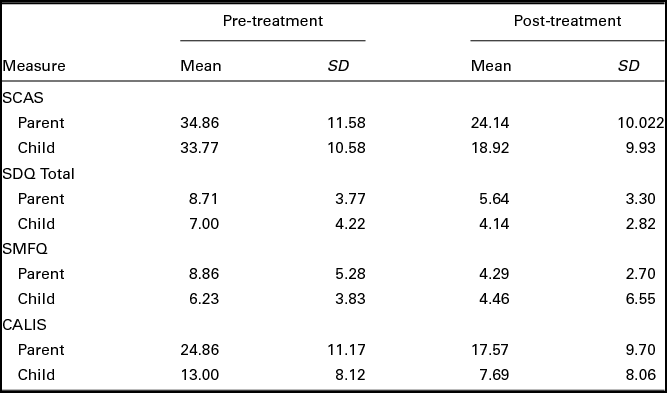
Paired-sample t tests were conducted to compare the severity of anxiety symptoms pre- and post-treatment. Child and parent versions of each scale were analysed. Table 1 summarises mean and standard deviations for questionnaires completed pre- and post-treatment by children and parents. Three children and two parents did not complete all post-questionnaire components of the assessment, resulting in a sample of n = 14 for parent-reported symptoms, and n = 13 for child-reported symptoms. Child-reported anxiety symptoms, anxiety life interference, and mood symptoms were non-normally distributed at post. Square root transformations corrected normality and affected the pattern of results. Means and confidence intervals for these variables were back-transformed for reporting purposes. Bonferroni-adjusted alpha levels of .012 was used to correct for the five comparisons within each reporter. Results on the SCAS indicated a significant difference between pre- and post-treatment scores for parent report, t(13) = 4.171, p = .001, 95% CI [5.165, 16.264], d = 2.314, and child report, t(12) = 10.327, p < .001, 95% CI [7.744, 21.949], d = 5.962. These results suggest that the severity of anxiety symptoms in children as reported by both parents and children decreased post-treatment.
Means and Standard Deviations for Parent and Child Report Questionnaire Pre- and Post-Treatment

Note: SCAS = Spence Children's Anxiety Scale; SDQ = Strengths and Difficulties Questionnaire; SMFQ = Short Moods and Feelings Questionnaire; CALIS = Child Anxiety Life Interference Scale. N = 14 for parent report; N = 13 for child report.
The functional impact of anxiety symptoms in children significantly decreased from pre- to post-treatment according to parent report, t(13) = 3.064, p = .009, 95% CI [2.149, 12.422], d = 1.700, and child report, t(12) = 5.068, p < .001, 95% CI [.824, 9.792], d = 2.926.
Externalising difficulties, as measured by the SDQ externalising score, significantly reduced pre- to post-treatment according to both parent report, t(13) = 3.899, p = .002, 95% CI [1.370, 4.773], d = 2.163, and child report, t(12) = 3.982, p = .002, 95% CI [1.289, 4.403], d = 2.299.
Depressive symptoms in children also significantly reduced from pre- to post-treatment on parent report, t(13) = 3.101, p = .008, 95% CI [1.387, 7.756], d = 1.720, and child report, t(12) = 4.612, p = .001, 95% CI [-2.338, 5.876], d = 2.663.
Discussion
The aim of the current pilot study was to investigate the feasibility and preliminary efficacy of delivering a CBT anxiety program via an interactive videoconferencing online platform through schools to children within a rural population. The delivery of a therapist-facilitated adaption of the Cool Kids Child and Adolescent Anxiety Management Program (Rapee, Lyneham et al., Reference Rapee, Lyneham, Schniering, Wuthrich, Abbott, Hudson and Wignall2006) via videoconferencing with children, combined with telephone sessions with parents, was piloted.
Results indicated a significant reduction in the number of anxiety disorder diagnoses following treatment. Similarly, the severity of anxiety and functional impact of anxiety also improved significantly according to both child and parent report. Improvements were also reported on parent and child reports of externalising difficulties and mood symptoms. Although direct causal conclusions cannot be made without the presence of a control group, these preliminary results are promising. Even with the small sample size, comparable rates of primary anxiety diagnostic remission were found in this study as in large-scale reviews of youth face-to-face anxiety therapy (James, James, Cowdrey, Soler, & Choke, Reference James, James, Cowdrey, Soler and Choke2013), and slightly stronger results were found compared to child anxiety self-directed internet interventions (e.g., March, Spence, & Donovan, Reference March, Spence and Donovan2009; Vigerland et al., Reference Vigerland, Ljotsson, Thulin, Ost, Andersson and Serlachius2016). Large effect sizes were also found on symptom measures according to both child and parent report.
Interestingly, these promising outcomes were achieved with relatively low levels of parental involvement. Although parent involvement was encouraged to assist children in implementing skills outside of sessions by means of offering regular telephone calls, it was found that the degree of parent participation varied. Due to the small sample size, it is unclear whether parent involvement had an impact on treatment outcomes. Research is mixed about the added benefits of parental involvement in child anxiety treatment, with some research suggesting it is important (Barrett, Dadds, & Rapee, Reference Barrett, Dadds and Rapee1996; Rapee, Reference Rapee2012), especially with completion of homework for younger children (Barrett et al., Reference Barrett, Dadds and Rapee1996; Wei & Kendall, Reference Wei and Kendall2014), yet others failing to find additional benefits (Reynolds, Wilson, Austin, & Hooper, Reference Reynolds, Wilson, Austin and Hooper2012; Silverman, Pina, & Viswesvaran, Reference Silverman, Pina and Viswesvaran2008). Although parent involvement was likely reduced by the school-based delivery of the program, this facilitated the inclusion of children who may not have otherwise been able to access treatment due to geographical isolation and lack of access to technology.
Importantly, improvements in anxiety and the experiences in running the program highlight the feasibility of videoconferencing as a method of treatment delivery for children in rural communities. Specifically, children appeared to enjoy the technology aspect of sessions, and the online platform enabled interaction and collaboration between the child and psychologist in a way that closely replicated face-to-face therapy. Having a therapist-delivery model also enabled sessions to be individualised and adapted as clinically indicated, an identified limitation in self-directed online anxiety programs (Rapee, Abbott et al., Reference Rapee, Abbott and Lyneham2006; Richardson et al., Reference Richardson, Stallard and Velleman2010; Spence et al., Reference Spence, Donovan, March, Gamble, Anderson, Prosser, Kercher and Kenardy2008). The Adobe Connect software utilised in delivering the intervention was technology already being used by schools to deliver educational programs via videoconferencing. As such, the technology was both readily available and familiar to school staff. Overall, interest in the pilot study was positive, and schools were receptive to the concept of utilising technology to provide psychological therapy to children due to the limited availability of services in their rural locations. Schools were supportive and willing to provide the resourcing required for children to participate in the program. Families also appreciated the convenience of the therapy model, which eliminated any travel constraints, a common challenge encountered by rural families in accessing psychological services in rural Australia.
Research suggests that school counsellors in rural areas are providing more than one third of mental health services in rural areas (Lyneham & Rapee, Reference Lyneham and Rapee2007). Reducing demands placed on school counsellors and potentially also reducing the stigma associated with receiving traditional individual therapy by using a school-based delivery with a psychologist outside the local community are likely benefits of the program. That being said, delivering telecare to children at school requires a willing and supportive school. A challenge encountered during the pilot study was the reliance on a key support person within the school setting for program implementation. Their role included monitoring the emotional wellbeing of the involved children and consulting with the treating psychologist. The support person was also able to liaise directly with school staff to help ensure that strategies were being generalised to the school environment, as well as assisting with scheduling appointments and any technological issues that arose. Clearly, developing and maintaining relationships with key support people across rural schools will be pivotal to the success of this model of therapy. The importance of having a key person at school serving as the bridge between telepsychology and the client and family has been identified in other telecare models of delivery (Duncan et al., Reference Duncan, Velasquez and Nelson2014).
The promising results of the pilot study should be considered within the context of a number of study limitations, which provide important areas for future research. Results were obtained in a small sample and in the absence of a comparison group. Further studies are needed utilising a randomised controlled trial design and larger sample sizes comparing telecare delivery with face-to-face and no treatment.
Overall, there is growing evidence for the use of telecare models of psychological services to better meet the needs of children and families in rural communities. The effectiveness of delivering psychological therapy via technology to children is still a relatively new area of research. The current pilot study demonstrates positive preliminary results for a therapist-facilitated adaptation of the Cool Kids Child and Adolescent Anxiety Management Program delivered using an interactive videoconferencing online platform through schools. These preliminary results suggest that this model of therapy could be a feasible and effective way of providing children and their families in rural communities with increased access to evidence-based treatments delivered by skilled clinicians. Further systematic research evaluation is necessary, particularly given recent government initiatives to provide rebates for psychological therapy delivered via videoconferencing for rural communities.
Acknowledgments
We thank the clinicians who delivered the intervention and school personnel who assisted with treatment. We also thank the families who participated in treatment and gave their time willingly to complete research.