Introduction
Persistent vertigo can be a disabling symptom, and optimal management is essential. In the current clinical scenario, there is an established role of medical management for vertigo, including intratympanic treatments. Hence, the role of surgery is on the decline. The advent of intratympanic treatments has usurped some of the traditional indications for surgery.
Intent-directed management, keeping in view the diagnosis, is central to optimal management of these patients, so they may be spared non-validated and ineffective treatment options. Furthermore, patients with refractory vertigo may benefit from judicious patient selection and surgery directed at the cause. Surgical management of vertigo, though required rarely and only in select situations, may offer excellent outcomes in a few clinical scenarios.
This report presents the clinico-surgical treatment profile of patients referred to an institutional vertigo clinic. We classify and discuss the various surgical interventions and the long-term outcomes of these patients managed with surgery for intractable vertigo, and try to define the current role of surgery in patients referred for vertigo. A thorough search of peer-reviewed English language literature published in the last decade revealed a few studies that tried to define the role of contemporary vertigo surgery.Reference Sismanis1–Reference Kaylie, Jackson and Gardner4 Our study included the entire gamut of vertigo in an ENT context, in an Asian-Indian setting, and tried to define the role of surgery for vertigo in contemporary practice.
Materials and methods
The clinical charts of 1060 patients referred to an institutional clinic for vertigo and dizziness, from January 2003 to December 2012, were reviewed retrospectively. This was followed up with prospective recording of data.
All patients with vertigo who underwent surgery and had a minimum follow up of 18 months post-operatively were included in the study. Two patients, who were advised surgery for intractable posterior canal benign paroxysmal positional vertigo and superior canal dehiscence, did not meet the inclusion criteria and were excluded from the evaluation.
The charts of patients in the study population were evaluated for demographic data. Patients were routinely examined, and underwent detailed clinical history-taking and standard clinical neurological, oculomotor and neuro-vestibular testing. Tests included pure tone audiometry (PTA), electronystagmography (ENG) and imaging (contrast-enhanced computed tomography and magnetic resonance imaging) on a case-by-case basis. Hearing class was graded as per the American Academy of Otolaryngology – Head and Neck Surgery criteria. The operating surgeon interpreted the radiological images in conjunction with a neuroradiologist.
Surgical indications
The indications for surgical management were stringent and included the following: (1) persistent, disabling vertigo diagnosed as of labyrinthine or peripheral origin that did not respond to medical management (including intratympanic treatments) for six months, or (2) patients with a surgically correctable cause, who did not respond to medical management in the preceding three to six months.
Details of the surgery indications, surgical procedures performed and follow up for relief of symptoms were recorded. All surgical procedures were performed by the senior author (AT).
Surgical intent
Surgical procedures were classified as either a disease-modifying surgical procedure or a destructive procedure.
Vertigo control
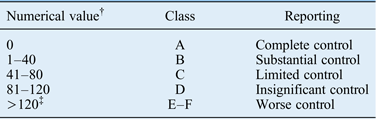
The vertigo spells that occurred 18–24 months post-surgery were compared with pre-operative spells and reported as per the Committee on Hearing and Equilibrium guidelines, 1995 (Table I).5 Class A vertigo control represented complete control of definitive vertigo spells, and class F control represented initiation of secondary treatment because of disability from vertigo. Class A was reported as complete control of vertigo spells, class B as substantial control, class C as limited control, class D as insignificant control, and class E and F as worse.
Classification of vertigo control in patients who underwent surgery*

* As per Committee on Hearing and Equilibrium guidelines, 1995.5†Numerical value = (X/Y) × 100, rounded to the nearest whole number, where X = vertigo frequency for the six months post-surgery and Y = vertigo frequency for the six months pre-operation. ‡Secondary treatment initiated because of disability from vertigo
Hearing
The worst pre-operative audiogram at 6 months before treatment was compared with the worst post-operative audiogram between 18 and 24 months after treatment, at the same time that vertigo was assessed. Hearing outcomes were reported as unchanged (within 10 dB), worse (more than 10 dB) or improved (10 dB or less).
Results
Demographics
From the year 2002 to March 2012, 1060 new patients visited the institutional vertigo clinic. Of these, 12 patients (1.13 per cent) required surgery. The mean age of the patients who underwent surgery was 38.83 ± 10.84 years (range, 26–58 years). There were 10 males (83.33 per cent) and 2 females (16.67 per cent), with a mean age of 37 ± 10.45 years (range, 26–58 years) and 48.5 ± 9.19 years (range, 42–55 years) respectively.
Symptomatology and aetiology
Patients presented with symptoms of vertigo, sensorineural hearing loss (SNHL) and tinnitus. One patient had left-sided otorrhoea and he developed vertigo after open tympanoplasty. In addition, two patients presented with ‘drop attacks’.
In patients diagnosed with perilymphatic fistula, there was a history of weight lifting or trauma (including barotrauma), and one patient had a congenital aetiology.
Investigative findings
In the seven patients who were diagnosed with perilymphatic fistula, PTA revealed mild to moderate SNHL. One patient with end-stage Ménière's disease had severe SNHL. One patient who developed secondary hydrops following open tympanoplasty surgery also had severe SNHL. One patient with a vascular loop had moderate SNHL on the affected side. One patient with vestibular schwannoma had class F hearing.
The ENG revealed canal paresis on the affected side in the two patients who had end-stage Ménière's disease. In the patient who had delayed endolymphatic hydrops following open tympanoplasty, ENG showed a hypoactive labyrinth on the affected side.
Surgical details
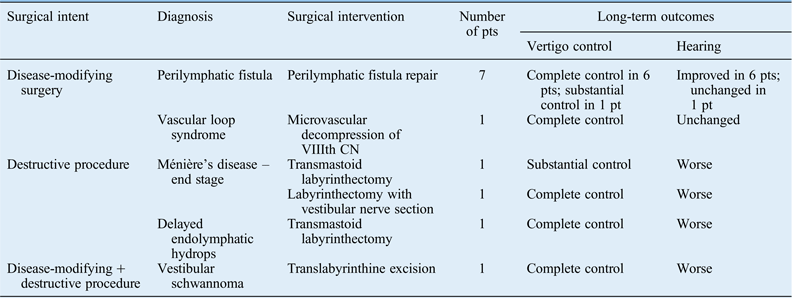
A total of 12 patients required planned surgical interventions, with the primary aim being relief of vertigo symptoms (Table II). The surgical details were classified according to surgical intent, as follows. Disease-modifying surgical procedures: seven patients underwent perilymphatic fistula repair for perilymph fistulae and one patient underwent microvascular decompression of the vestibular nerve for vascular loop syndrome. Destructive procedures: two patients underwent transmastoid labyrinthectomy (one had end-stage Ménière's disease and one had delayed endolymphatic hydrops). Furthermore, in the patient with end-stage Ménière's disease, labyrinthectomy with vestibular nerve section was conducted. Both procedure types (disease-modifying and destructive): translabyrinthine excision was performed in the patient diagnosed with vestibular schwannoma.
Clinical and surgical details of study population
Pt = patient; CN = cranial nerve
Relevant surgical findings
The site of perilymphatic fistula (as ascertained during surgery) was anterosuperior to the oval window in five patients and was the round window in two patients (Figure 1b). The patient with vestibular schwannoma had a <2 cm largely intracanalicular tumour. Figure 1a shows the site of the round window leak. Figure 2 shows the sealing of the leak with fat harvested from the ear lobule.
Sites of perilymphatic fistula (a) and frequency of leaks at each site (b). OW = oval window; RW = round window.
Intra-operative image of site of round window leak and sealing with fat.
Follow-up details
Vertigo control
All patients had subjective improvement of vertigo. Complete control was achieved in 10 patients and substantial control was observed in 2 patients.
Hearing outcome
Hearing improvement was observed in all patients who underwent perilymphatic fistula repair, except one, in whom hearing remained unchanged. In the four patients who showed worsening of hearing, pre-operative hearing was unserviceable.
Discussion
The selection of patients for surgery to treat vertigo is now guarded following the advent of intratympanic treatments. In our series, 1.13 per cent of patients underwent surgery for vertigo. A variety of factors need to be taken into account, including: symptom severity, the role of medical management, contralateral hearing status, the choice of various surgical procedures which may be offered on a case-by-case basis, likely post-operative outcomes and patient preference.
Vertigo can be a disabling symptom; however, surgery appears late in the treatment protocol.Reference Derebery, Fischer, Berliner, Chung and Green6, Reference Teufert and Doherty7 Surgical indications include Ménière's disease not responding to medical treatment, perilymphatic fistula, vascular loop and vestibular schwannoma. Given the recent advances in neuro-microsurgery and better anaesthesia techniques, it is possible for neurotological surgery to provide excellent results for the vertiginous patient; such patients need not endure symptoms long term.
Medical management
Almost all patients undergo a trial of medical management prior to surgery.Reference Yu, Lee and Chung8–Reference Yap, Pothula and Lesser10 Medical treatment includes labyrinthine sedatives, diuretics, vasodilators, mainly selective labyrinthine vasodilators and intratympanic treatment. We have administered these on a case-by-case basis, together with supportive care in the form of stool softeners and a low salt diet. Patients are advised to avoid straining (e.g. weightlifting) or situations likely to cause barotrauma. For vascular loop, carbamazepine tablets are trialled prior to surgery. Medical management is also trialled in perilymphatic fistula patients.
Intratympanic aminoglycosides
Chemical labyrinthectomy, in the form of intratympanic gentamicin or methylprednisolone, has revolutionised the treatment of intractable vertigo.Reference Paradis, Hu and Parnes11–Reference Shea, Richey, Wan and Stevens14 Current evidence indicates that intratympanic gentamicin is the preferred option.Reference Cohen-Kerem, Kisilevsky, Einarson, Kozer, Koren and Rutka15–Reference Casani, Piaggi, Cerchiai, Seccia, Franceschini and Dallan17 The mechanism of action of gentamicin is ototoxic damage to the dark cells that produce endolymph, which subsequently reduces endolymph volume. The effect of intratympanic gentamicin at low doses is more vestibulotoxic than cochleotoxic.Reference Sajjadi and Paparella18–Reference Harner, Driscoll, Facer, Beatty and McDonald21 However, inner-ear toxicity may rarely be a side effect, and, hence, may be a reserved option in young patients with good hearing. All our patients with end-stage Ménière's had experienced failure of multiple intratympanic gentamicin injections prior to surgery.
Intent of surgery
Surgical procedures for vertigo may be classified based on whether they are disease-modifying or destructive procedures. The former include procedures where the labyrinth is preserved, and the latter may be offered in patients with unserviceable hearing. In our series, seven patients underwent perilymphatic fistula repair for perilymph fistulae and one patient underwent microvascular decompression of the vestibular nerve for vascular loop syndrome as disease-modifying surgery. Two patients underwent transmastoid labyrinthectomy for end-stage Ménière's disease, classified as a destructive procedure. The sole patient who underwent translabyrinthine excision of vestibular schwannoma was considered to have undergone both a disease-modifying and destructive surgical procedure.
Surgery for intractable vertigo
Labyrinthectomy ablates the vestibular end organs and is advocated in patients with disabling vertigo in the presence of non-serviceable hearing. It is important to evenly open all the semicircular canals and vestibule, and preserve landmarks. After exposure of the ampullae and vestibule, the five individual groups of neurosensory epithelia are excised under direct visualisation to eliminate abnormal vestibular input from the diseased ear.
Two approaches for vestibular end-organ ablation are transmastoid labyrinthectomy and transcanal labyrinthectomy. Transmastoid labyrinthectomy is an effective treatment option for poorly compensated unilateral, peripheral vestibular dysfunction in the presence of ipsilateral, profound or severe SNHL. SchuknechtReference Schuknecht22 and CawthorneReference Cawthorne23 introduced the modern transcanal labyrinthectomy technique for the management of unilateral, peripheral dysfunction in the 1950s. The advantages of the technique are as follows: it is less invasive than transmastoid labyrinthectomy, it enables a direct approach to the vestibular end organ, and operating time is shorter with lower morbidity than transmastoid labyrinthectomy. The disadvantages include limited surgical field exposure and a higher incidence of incomplete labyrinthectomy in the hands of an inexperienced surgeon.
Vestibular neurectomy allows for selective vestibular ablation with hearing preservation. The middle fossa approach is technically demanding but allows for a clear differentiation of the vestibular and cochlear nerves, while this differentiation is less discrete when a retrolabyrinthine approach is used.
Labyrinthine fistulae may be congenital or secondary. Secondary perilymphatic fistula may occur as a result of trauma (including barotrauma), an inflammatory process in the middle ear (e.g. cholesteatoma or granulomatosis) or following surgery (e.g. cholesteatoma, cochlear implantation or otosclerosis).
Perilymphatic fistulae are most commonly seen at the round or oval window, as in our study. In symptomatic fistulae cases that are unresponsive to treatment, surgical exploration is indicated, with repair of the fistula with periosteum, muscle or other tissues.
Recommendations
Intratympanic gentamicin forms the mainstay of treatment in most cases of intractable vertigo. However, we recommend surgery in select cases of vertigo for the best possible results, ensuring that these patients are not denied the benefit of adequate medical therapy. Surgery may be offered with curative intent in perilymphatic fistulae cases. For Ménière's disease, surgery should be offered in cases of medical treatment failure or in the presence of drop attacks. For vascular loop, patients may be offered surgery after failure of carbamazepine therapy. In cases of vestibular schwannoma presenting with vertigo, surgery should be offered in accordance with current guidelines regarding tumour size, brainstem compression and hearing status, considering intratympanic gentamicin treatment when a conservative option is planned.Reference Giannuzzi, Merkus and Falcioni24 A standardised reporting of vertigo surgery results, in terms of vertigo control, is suggested; in this study, results were reported as per the Committee on Hearing and Equilibrium guidelines (1995).5
• In contemporary management of vertigo, intratympanic treatment is the therapy of choice, rather than surgical treatment
• However, intractable vertigo is disabling, and if medical management fails, a clinically indicated patient should not be denied surgical benefit
• Though there are now few indications for surgery, in our experience surgery provides excellent vertigo control in select patients
• Intent-directed management, with consideration of medical management response, hearing status and patient preference, is vital
Strengths and weaknesses
This report is based on a large cohort of patients (n = 1060) who were referred to a contemporary vertigo clinic. The surgical treatment group per se is small, but we feel that in the era of intratympanic treatment this may soon become the norm. Furthermore, it suggests that there are relatively few, but definitive, indications for contemporary vertigo surgery.
Conclusion
Surgery for vertigo is rarely indicated in the current clinical scenario. However, it may be indicated in certain situations, depending on diagnosis, medical management failure, intractable symptoms and patient preference. Surgery offered in this select group of patients, with due consideration given to surgical intent, can offer very good long-term clinical outcomes, in terms of vertigo and hearing improvements, in carefully selected patients.