Implications
During the last decades the muscularity of broilers clearly rose because of the increase of muscle fibre size. This ‘bodybuilding’ can give rise to pathological alterations like deep pectoral myopathy whereas the impact on the meat quality is rather unclear (Maltby et al., Reference Maltby, Somaiya, French and Stickland2004). Considering that appropriate muscle growth could also be obtained by increasing the muscle fibre number thereby reducing possible negative effects. The aim of this study was to investigate if a change of the incubation temperature during embryonic myogenesis has an impact on the muscle fibre number as already shown in turkeys (Maltby et al., Reference Maltby, Somaiya, French and Stickland2004).
Introduction
Avian embryos are a good object to analyse molecular mechanisms of embryonic organogenesis (Scaal and Christ, Reference Scaal and Christ2004). A main advantage is that the embryonic development can be easily manipulated. Different endogenic factors with an impact on the avian embryogenesis have been investigated including the oxygen concentration (Leon-Velarde and Monge, Reference Leon-Velarde and Monge2004; Chan and Burggren, Reference Chan and Burggren2005; Mortola and Labbe, Reference Mortola and Labbe2005), the light colour (Rozenboim et al., Reference Rozenboim, Huisinga, Halevy and El Halawani2003; Halevy et al., Reference Halevy, Piestun, Rozenboim and Yablonka-Reuveni2006) or the temperature around the brooding eggs (Christensen et al., Reference Christensen, McMurtry, Donaldson and Nestor2001; Gauly et al., Reference Gauly, Reiner, Groschl and Dzapo2001; Von Blumroder and Tonhardt, Reference Von Blumroder and Tonhardt2002; Maltby et al., Reference Maltby, Somaiya, French and Stickland2004; Tonhardt et al., Reference Tonhardt, Brauch and von Plettenberg2004; Yahav et al., Reference Yahav, Collin, Shinder and Picard2004a and Reference Yahav, Sasson Rath and Shinder2004b; Lourens et al., Reference Lourens, van den Brand, Meijerhof and Kemp2005; Collin et al., Reference Collin, Berri, Tesseraud, Requena Rodon, Skiba-Cassy, Crochet, Duclos, Rideau, Tona, Buyse, Bruggeman, Decuypere, Picard and Yahav2007; Hammond et al., Reference Hammond, Simbi and Stickland2007; Piestun et al., Reference Piestun, Harel, Barak, Yahav and Halevy2009). Direct manipulations include the in-ovo injection of growth hormones or factors (e.g. insulin-like growth factor), amino acids, carbohydrates or neuro-muscular active drugs into the embryos or its embryonic membranes (Kocamis et al., Reference Kocamis, Kirkpatrick-Keller, Klandorf and Killefer1998; Heywood et al., Reference Heywood, McEntee and Stickland2005; Uni et al., Reference Uni, Ferket, Tako and Kedar2005; McEntee et al., Reference McEntee, Simbi, Bayol, Macharia and Stickland2006; Pitsillides, Reference Pitsillides2006).
During the last years many reports have been published that investigated factors like hatchability, body weights (BWs), muscle fibre size, total muscle fibre number (MFN) or thermotolerance after treatment of poultry eggs with higher incubation temperatures. The investigations differed in poultry egg species (e.g. turkeys, laying hens and broiler), muscle types (e.g. Musculus semitendinosus, Musculus gastrocnemius, Musculus pectoralis superficialis), treatment periods and conditions during embryogenesis (e.g. embryonic day (ED) 4 to 7, ED 8 to 12, ED 8 to 10, ED 16 to 18) and sampling times before and after hatch of the animals (e.g. ED 18, 4 day, 25 day and 35 day post-hatch) (Maltby et al., Reference Maltby, Somaiya, French and Stickland2004; Yahav et al., Reference Yahav, Collin, Shinder and Picard2004a and Reference Yahav, Sasson Rath and Shinder2004b; Collin et al., Reference Collin, Berri, Tesseraud, Requena Rodon, Skiba-Cassy, Crochet, Duclos, Rideau, Tona, Buyse, Bruggeman, Decuypere, Picard and Yahav2007; Hammond et al., Reference Hammond, Simbi and Stickland2007; Piestun et al., Reference Piestun, Harel, Barak, Yahav and Halevy2009). Considering these publications – especially of this Maltby et al. (Reference Maltby, Somaiya, French and Stickland2004) who showed that higher incubation temperatures between ED 9 and 12 in turkeys increases the MFN, the aim of this study was to investigate, how a higher incubation temperature between ED 7 and 10 – an important period of primary (embryonic) and secondary (foetal) myotube formation (Miller and Stockdale, Reference Miller and Stockdale1986) – influences muscle development and/or structure in broiler post-hatch. As the muscle structure is clearly related to the muscle-to-meat transition process the meat quality was also investigated.
Material and Methods
About 360 eggs of the broiler genetic Cobb 500 (Cobb-Vantress Inc., Siloam Spring, AR, USA) were initially incubated at 37.5°C for 6 days in a commercial incubator (Petersime, Zulte, Belgium). At day 7 the eggs were candled and half of the fertilised eggs (N = 160) were transferred to an incubator of identical construction but at a higher incubation temperature of 38.5°C. After 3 days the high temperature (HT) eggs were transferred back to the 37.5°C incubator until hatch. At the day of hatch (day 21) the hatchability was determined. The gender of all chicks was determined by the feather sexing method (Leeson and Walsh, Reference Leeson and Walsh2004)
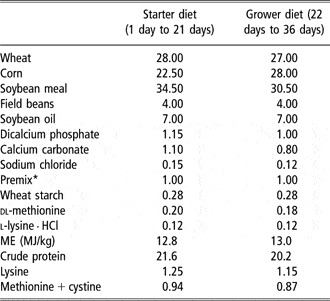
A growth study was conducted at the experimental unit of the Division for Animal Nutrition Physiology using 192 growing chicken (96 birds per incubation group; 8 birds per pen; 4 females and 4 males in each pen), according to the animal welfare regulations. A standard diet based on wheat, corn, soybean meal and field beans (Table 1) was fed ad libitum. Feed intake and the individual BW of birds were measured weekly. At day 36, a total of 60 chickens per incubation group was randomly collected, transported in commercial poultry cages in maximal 20 min to the Institute of Animal Breeding and Genetics and slaughtered in the experimental poultry abattoir of the institute. After slaughter the carcass weights were determined, the breast muscles and legs dissected by two experienced employees and the skin removed. After weighing the dissected body parts the colour values (L*a*b*) were determined on the medial surface (bone side) of the left Musculus pectoralis superficialis (MPS) after removal of the Musculus supracoracoideus with a colorimeter (Minolta CR 400, Minolta GmbH, Langenhagen, Germany). Before measurement the surface was exposed to air for 15 min at room temperature before determining the colour. Each value was an average of at least four measurements.
Composition of the standard diets (%)

*Provided (per kilogram of diet): vitamin A, 12 000 IU; vitamin D3, 3500 IU; vitamin E, 40 mg; thiamin, 2.5 mg; riboflavin, 8.0 mg; vitamin B6, 6.0 mg; vitamin B12, 32 g; vitamin K3, 4.5 mg; nicotinic acid, 45 mg; calcium pantothenate, 15 mg; folic acid, 1.2 mg; biotin, 50 g; choline chloride, 550 mg; Mn, 100 mg; Zn, 80 mg; Fe, 30 mg; Cu, 20 mg; I, 1.2 mg; Co, 0.4 mg; Se, 0.4 mg; and butylated hydroxytoluene, 100 mg.
The left MPS were transferred to a chilling room and stored there at 4°C until next day. After 24 h post-mortem (p.m.) the L*a*b* values were determined again at the medial surface of the left MPS.
The pH and electrical conductivity (EC) was analysed on the lateral side of the breast muscle in the centre of the muscle with a portable pH metre (pH-Star, Matthäus GmbH, Poettmes, Germany) combined with a glass electrode (InLab 427, Mettler-Toledo, Urdorf, Switzerland) and an EC metre equipped with two parallel stainless steel electrodes (LF-Star, Matthäus GmbH, Poettmes, Germany). The pH metre was calibrated with two pH standard solutions (Sigma-Aldrich Chemie GmbH, Taufkirchen, Germany, pH 7.0, pH 4.0) and adjusted to the mean temperature of the meat samples (39°C (20 min); 4°C (24 h)), whereas the EC metre was calibrated with a specific calibration block (10 mS/cm). Both instruments were recalibrated regularly.
For the analysis of the total fibre number and the muscle fibre diameters the MPS was cross-sectioned perpendicularly to the direction of the myofibres, and the cross-sectional area was traced on transparent paper (Scheuermann et al., Reference Scheuermann, Bilgili, Tuzun and Mulvaney2004). After that a tissue block (1 × 1 × 1 cm) was removed from the centre of the cross-sectional area, frozen in liquid nitrogen and stored at −70°C until analysis. The cryopreserved muscle samples were transferred to a cryo-microtome (Cryocut CM 1900, Leica GmbH, Nussloch, Germany) and allowed to equilibrate to −20°C before being cut into slices of 12 μm thickness. The slices were stained with eosin (Scheuermann et al., Reference Scheuermann, Bilgili, Tuzun and Mulvaney2004) and investigated with a stereo microscope (Nikon GmbH, Duesseldorf, Germany) at a low magnification (×4), and several sections were transferred through a digital camera to a personal computer. For the determination of the cross-sectional areas at least 200 muscle fibres were circumscribed and semi-automatically analyzed using LUCIA software (Nikon GmbH, Duesseldorf, Germany).
Statistics
The statistical analysis of the data was performed with the software package Statistica 7.0 (StatSoft, Hamburg, Germany) following the GLM procedure. The statistical model included the fixed variables incubation group, gender as well as the interaction between gender and the incubation group. The P-value was calculated with the TUKEY test considering P < 0.05.
The hatchability was analysed with the same software using the χ 2 test.
Results
The hatch rate was 86.6% for the chicken incubated for the whole period at 37.5°C (normal temperature (NT) group) and 82.4% for the HT animals. The hatchability values did not differ significantly.
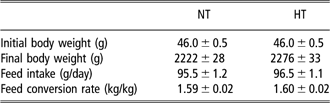
The observed zootechnical parameters dependant on incubation group are shown in Table 2. No significant differences were observed for final BW, daily feed intake and feed conversion rate for both of the treatments (P > 0.05). However, significant sex differences were observed. Altogether, the growth of the cocks was faster and they yielded significantly higher final BWs (2421 ± 28 g v. 2079 ± 20 g, P < 0.001, data not shown).
Mean values (LSM) and standard errors of growth and feeding characteristics depending on the incubation group (NT = ED 7 to 10:37.5°C; HT = ED 7 to 10:38.5°C) of the investigated birds
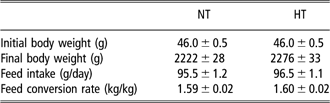
NT = normal temperature; HT = high temperature.
Values for all parameter were not different between treatments (P > 0.05).
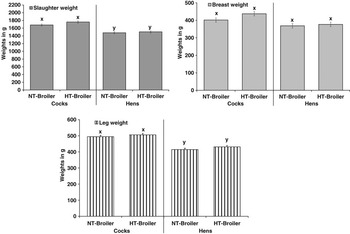
After slaughter and dissection of the broiler at day 36 the carcass, breast and leg weights did not differ significantly between the animals of the NT and HT group (P > 0.05). However, the carcass and breast weights of the HT animals were tendentially higher (P = 0.11, P = 0.12, respectively). The HT chicken had carcass, breast and leg weights of 1631 g, 407 g and 468 g and the NT animals of 1582 g, 385 g and 454 g, respectively (Figure 1). Considering also the gender of the broilers, the cocks and hens of the NT and HT groups had carcass, breast and leg weights that did not differ significantly (Figure 2). Independent of the incubation group, the cocks had significantly (P < 0.05) higher carcass, breast and leg weights than the hens (Figure 2).
Mean values (LSM) and standard errors of the slaughter, breast and leg weights of the investigated birds depending on the incubation group (normal temperature (NT) = embryonic day (ED) 7 to 10:37.5°C; high temperature (HT) = ED 7 to 10:38.5°C). Considered are 60 birds per incubation group. Values for all parameter were not different between treatments (P > 0.05).

Mean values (LSM) and standard errors of the slaughter, breast and leg weights of the birds depending on the gender and the incubation group (normal temperature (NT) = embryonic day (ED) 7 to 10:37.5°C; high temperature (HT) = ED 7 to 10:38.5°C). Considered are 30 birds per gender and incubation group. Columns (xy) with different letters between the genders within the same incubation groups differ significantly (P < 0.05).

With regard to the muscle structure the statistical analysis of the histological data showed that the impact of the gender was significant, whereas the treatment and the interaction of gender and treatment had no significant influence on these results. The cocks of the two incubation groups had MPS with muscle fibre areas and MFNs that did not differ significantly. However, the NT hens had significantly higher muscle fibre areas whereas the MFN values did not differ between the NT and HT hens. The muscle fibre areas of the NT cocks were significantly lower and the MFN higher than those of the NT hens. In the HT incubation group no differences of the histological muscle parameters could be found between the genders (Table 3).
Mean values (LSM) and standard errors of the muscle fibre area and muscle fibre numbers of the Musculus pectoralis superficialis depending on the incubation group (NT = ED 7 to 10:37.5°C; HT = ED 7 to 10:38.5°C) and the gender of the investigated birds

NT = normal temperature; HT = high temperature; S = sex, T = treatment, S × T = interaction sex and treatment.
a,bLSM with different letters within a line differ significantly (P < 0.05); S = sex; T = treatment, S × T = interaction sex and treatment.
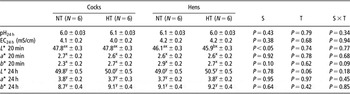
The pH and EC values did not differ between the investigated animals either considering gender, incubation group or the interaction of these factors. With regard to the colour (L*a*b*) values of the MPS determined 20 min p.m. the L* values were significantly lower in the hens independent of the incubation group whereas the a* values were not different. The yellowness (b*) was higher (P < 0.05) in the NT hens than in the NT cocks. The male and female HT chicken had b* values that did not differ significantly. 24 h p.m. the colour values were generally higher in all investigated chicken independent of the gender and incubation group (Table 4). Comparing the cocks and hens within the same incubation group the lightness, redness and yellowness values were not different. Within the gender the a* and b* values also did not differ significantly, but the HT hens had significantly higher L* values than the NT animals whereas the lightness values of the NT and HT cocks were not different (Table 2).
Mean values (LSM) and standard errors of the pH, EC as well as lightness (L*), redness (a*) and yellowness (b*) of the breast muscles depending on the incubation group (NT = ED 7 to 10:37.5°C; HT = ED 7 to 10:38.5°C) and the gender of the investigated birds

EC = electrical conductivity; NT = normal temperature; HT = high temperature; S = sex, T = treatment, S × T = interaction sex and treatment.
a,bLSM with different letters within a line differ significantly (P < 0.05); x,yLSM with different letters within a column and the color group (L*, a*, b*) differ significantly (P < 0.05).
Discussion
Maltby et al. (Reference Maltby, Somaiya, French and Stickland2004) showed that a higher incubation temperature between ED 9 and 12 increases the MFN of the semitendinosus muscle in turkeys without having an impact on the hatchability. With regard to these results the aim of this study was to analyse, if an increase of the temperature at a similar period during broiler incubation influences hatchability and muscle development/structure post-hatch, considering commercial rearing conditions.
The ability of a living embryo to hatch depends on several endogenous factors like energy metabolism, embryonic malformations or malpositions (Romanoff, Reference Romanoff1951). Therefore an increasing temperature might also affect these factors. However, in this study a low not significant difference of the hatch rates was determined and this agrees with publications by Yahav et al. (Reference Yahav, Collin, Shinder and Picard2004a) who investigated broiler eggs incubated between ED 8 and 10 at higher temperatures (3 h/day) and French (Reference French2000) who determined the hatch rates after increasing the incubation temperature (24 h/day) during ED 9 and 12 in turkeys. However, Collin et al. (Reference Collin, Berri, Tesseraud, Requena Rodon, Skiba-Cassy, Crochet, Duclos, Rideau, Tona, Buyse, Bruggeman, Decuypere, Picard and Yahav2007) presented higher hatch rates in broiler that were incubated between ED 8 and 10 (3 h/day) at higher temperatures.
During ED 7 to 10 embryonic muscle development is mainly characterized by the formation of secondary myotubes close to the already existing primary myotubes (Miller and Stockdale, Reference Miller and Stockdale1986). Considering the results of Maltby et al. (Reference Maltby, Somaiya, French and Stickland2004) the hypothesis was that an increased temperature between ED 7 and 10 of broiler incubation affects myogenesis. There is either a direct effect by influencing molecular steps necessary for the proliferation and differentiation of myoblasts, or an indirect by general stimulation of the metabolism and the in-ovo movement of the embryo, as postulated by Hammond et al. (Reference Hammond, Simbi and Stickland2007). The present results showing no difference of the broiler growth and slaughter characteristics are difficult to discuss because already published investigations differed in the analysed poultry species, the treatment conditions and the time of sampling. Independent of this, the final BWs and feed conversion rates of the broiler were comparable with the performance data published by Cobb-Vantress (2008). The results agree with the report of Collin et al. (Reference Collin, Berri, Tesseraud, Requena Rodon, Skiba-Cassy, Crochet, Duclos, Rideau, Tona, Buyse, Bruggeman, Decuypere, Picard and Yahav2007) who also found no differences of the BWs of 28 days and 41 days broiler. The investigation differs in the treatment period and conditions as the eggs were incubated between ED 8 and 10 at 39.5°C for 3 h/day in contrast to ED 7 to 10 at 38.5°C for the whole period in this study. Other publications that increased the incubation temperature at a similar period during embryogenesis disagree with the present results. Maltby et al. (Reference Maltby, Somaiya, French and Stickland2004), Yahav et al. (Reference Yahav, Collin, Shinder and Picard2004a) and Hammond et al. (Reference Hammond, Simbi and Stickland2007) showed that the increased temperature has an positive effect on the post-hatch muscle development (e.g. BW or MFN). The main differences to this study are the different poultry species, treatment periods and sampling times. Yahav et al. (Reference Yahav, Collin, Shinder and Picard2004a) treated broiler eggs between ED 8 and 10 at 39.5°C for 3 h/day and analysed 4 day chicks, Maltby et al. (Reference Maltby, Somaiya, French and Stickland2004) treated turkeys eggs between ED 9 and 12 at 38.5°C and killed the animals at day 16 post-hatch, whereas Hammond et al. (Reference Hammond, Simbi and Stickland2007) treated laying hen eggs at 38.5°C between ED 4 and 7 and killed the foetuses at ED 18.
The histological analysis of the female MPS partly agrees with a study by Berri et al. (Reference Berri, Le Bihan-Duval, Debut, Sante-Lhoutellier, Baeza, Gigaud, Jego and Duclos2007) who showed that broiler hens have larger muscle fibre areas. The significantly lower fibre areas in the HT hens indicate that the manipulation during embryogenesis decreased the MFN. This result agrees with the investigation of Maltby et al. (Reference Maltby, Somaiya, French and Stickland2004) and Hammond et al. (Reference Hammond, Simbi and Stickland2007). As this gender dependency is unclear, additional investigations are necessary to clarify this result.
Considering the meat quality parameters, the pH and EC values determined 24 h after slaughter were in a usual range compared to other investigations (Debut et al., Reference Debut, Berri, Baeza, Sellier, Arnould, Guemene, Jehl, Boutten, Jego, Beaumont and Le Bihan-Duval2003; Berri et al., Reference Berri, Le Bihan-Duval, Baeza, Chartrin, Picgirard, Jehl, Quentin, Picard and Duclos2005, Reference Berri, Le Bihan-Duval, Debut, Sante-Lhoutellier, Baeza, Gigaud, Jego and Duclos2007; Werner et al., Reference Werner, Janisch, Kuembet and Wicke2009) not indicating an irregular muscle-to-meat transition in the different groups. Collin et al. (Reference Collin, Berri, Tesseraud, Requena Rodon, Skiba-Cassy, Crochet, Duclos, Rideau, Tona, Buyse, Bruggeman, Decuypere, Picard and Yahav2007) show that the MPS of 43-day-old broiler had a lower pH24 h and higher drip loss if temperature was increased to 39.5°C between ED 8 and 10. With regard to the meat colour values the gender difference of the L* values 20 min p.m. agree with an investigation by Berri et al. (Reference Berri, Le Bihan-Duval, Debut, Sante-Lhoutellier, Baeza, Gigaud, Jego and Duclos2007), although this result should not be overstated as the difference was only of visible 20 min p.m. The increase in the lightness, redness and yellowness values between 20 min and 24 h p.m. in the presented study is in accordance with the investigation of Petracci and Fletcher (Reference Petracci and Fletcher2002). However, to directly compare the presented data with other studies the colour analysis system has to be considered. In scientific reports that also used the Minolta colorimeter comparable L*a*b* values of the breast muscle had been determined (Cavitt et al., Reference Cavitt, Hargis and Owens2004; Young et al., Reference Young, Karlsson and Henckel2004; Fanatico et al., Reference Fanatico, Cavitt, Pillai, Emmert and Owens2005).
Considering the investigation of Berri et al. (Reference Berri, Le Bihan-Duval, Debut, Sante-Lhoutellier, Baeza, Gigaud, Jego and Duclos2007) who showed that broiler with a higher muscle fibre area had lower lightness and higher pH24 h values it could be expected that the larger muscle fibre areas of the NT hens also affected the pH, EC and lightness values of the MPS. However, reports that investigated the impact of the muscle fibre size on the poultry meat quality are rather inconsistent. Mehaffey et al. (Reference Mehaffey, Pradhan, Meullenet, Emmert, Mckee and Owens2006) investigated different broiler strains slaughtered after 42 days and 49 days. Although the authors did not statistically analyse the age related results the data indicate lower drip loss and higher cook loss and shear force values in the older birds, as well as comparable pH and L* values. Santiago et al. (Reference Santiago, Denbow, Emmerson, Denbow, Graham and Hohenboken2005) compared commercial broilers slaughtered at 42 days and 53 days and also found higher water-holding properties in the MPS of the older birds but comparable pH and lightness values. Sandercock et al. (Reference Sandercock, Hunter, Nute, Mitchell and Hocking2001) compared broilers with ages of 35 and 69 days and the authors found – contrary to this study – no differences of the drip loss and colour score but a reduced pH24 h p.m. in the older broiler.
In conclusion, an increased temperature between ED 7 and 10 of broiler incubation has no influence on the post-hatch muscle development neither in the hens nor in the cocks. However, the manipulation results in lower muscle fibre areas in the HT hens. Different meat quality parameters were not affected by the manipulation during incubation.
Acknowledgement
The authors gratefully acknowledge Dieter Daniel, Peter Ludewig, Mario Schuette and Ruth Wigger for their participation at the sample collections and realisation of the laboratory experiments.