Clostridioides difficile infection (CDI) rates in Department of Veterans Affairs (VA) acute-care facilities have decreased nationwide by 37% in the 7 years since the implementation of a VA CDI control guideline in 2012. Reference Roselle, Evans, Simbartl, McCauley, Lipscomb and Clifton1 For much of that time, the diagnosis was made using a compatible clinical illness and a positive nucleic acid amplification test (NAAT). This test has a sensitivity of ˜96%, but because it detects bacterial DNA, it may be positive in stool containing toxin-producing bacteria, bacteria carrying the nonexpressed toxin gene, or DNA left behind by dead bacteria. These factors led some investigators to suggest that the test was too sensitive and resulted in unnecessary isolation and treatment of patients whose true cause of diarrhea was something else. Reference Polage, Gyorke and Kennedy2 For this reason, some have advocated the use of an enzyme immunoassay (EIA), which detects C. difficile toxin in the stool rather than detecting the genes responsible for toxin production. Unfortunately, commercially available toxin EIAs have a sensitivity in the range of 60%–70%, meaning that some patients with CDI may be missed if this test is used alone. One solution is to use an NAAT, and if positive, to perform a follow-up toxin EIA. The National Healthcare Safety Network of the Centers for Disease Control and Prevention adopted this 2-step process and recommended that the results of the final test (usually the toxin EIA) be reported for surveillance purposes. Thus, NAAT-positive/toxin EIA–negative patients would be diagnosed negative for CDI and would not be reported in a national surveillance database.
Others have reported, however, that clinicians ultimately treat between 22% to 77% of NAAT positive/toxin EIA negative patients with oral drugs such as vancomycin, fidaxomicin, or metronidazole, which are indicated for CDI. Reference Hitchcock, Holubar, Hogan, Tompkins and Banaei3–Reference Lenggenhager, Zanella, Poncet, Kaiser and Schrenzel7 This finding suggests that CDI cases might be underreported. These publications come from single centers where patient management and antibiotic prescribing may reflect a “community standard of practice.” We wished to assess how common this practice is within the national VA healthcare system. A discrepancy between laboratory results and patient management may be germane to CDI rates reported to national surveillance programs.
Methods
Data from the VA Corporate Data Warehouse (CDW) were used to identify all unique VA acute-care inpatients from October 1, 2018, to March 30, 2021, nationwide who had a positive CDI NAAT followed by a negative CDI toxin EIA within 36 hours. The prescription of oral vancomycin, fidaxomicin, or metronidazole for these patients within 72 hours of the toxin EIA result was used as a surrogate marker for the decision to treat for CDI and was obtained from pharmacy records in the CDW. Coding was done using the structured query language (SQL) relational database management system (Microsoft, Redmond, WA), and CDW data were provided by the VA Information and Computer Infrastructure (VINCI). This study was approved by the Cincinnati VA/University of Cincinnati Institutional Review Board.
Results
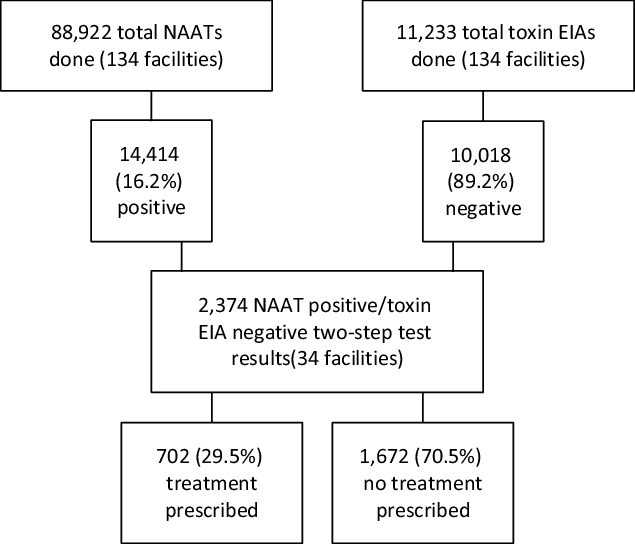
All 134 acute-care VA medical centers were included in the database, and 34 (26.6%) did 2-step testing for CDI during the study period. More than 1.25 million oral prescriptions were written for inpatients and outpatients during the study period including 25,393 prescriptions for oral vancomycin, metronidazole, or fidaxomicin. In total, 88,922 NAATs were performed for unique patients for the diagnosis of CDI and 14,414 (16.2%) of these were positive (Fig. 1). Also, 11,233 toxin EIAs were performed for unique patients, and 10,018 (89.2%) of these were negative. In the 34 facilities that did 2-step testing, a positive NAAT result was followed by a negative toxin EIA result within 36 hours for 2,374 unique patients. Of these, 702 (29.5%) were prescribed one of the oral drugs indicated for the treatment of CDI within 72 hours of the negative toxin EIA result. Vancomycin was prescribed 92.9% of the time, metronidazole was prescribed 6.7% of the time, and fidaxomicin was prescribed 0.4% of the time. This pattern occurred in 25 (74%) of the 34 facilities doing 2-step testing and occurred in facilities widely distributed across the United States.
Clostridioides difficile nucleic acid amplification tests (NAAT) and toxin enzyme immunoassays (EIA) for unique patients performed from October 2018 through March 2021 in VA medical facilities.

Discussion
The VA C. difficile Prevention Initiative depends on an accurate assessment of CDI rates for monitoring the value of the program and local prevention efforts. Reference Evans, Kralovic, Simbartl, Jain and Roselle8 The accuracy of reported CDI rates may be poor if patients deemed not infected and not reported based on 2-step laboratory testing are assessed as having CDI by clinicians and treated. We sought to determine how often this might occur in our large nationwide acute-care VA system and found that it occurred in nearly one-third of NAAT positive/toxin EIA negative patients in 74% of facilities doing 2-step testing. Facilities where this occurred were widely distributed across the United States, suggesting that this was not a localized “community standard of practice.”
Limitations of this analysis include our inability to determine whether oral metronidazole was prescribed for reasons other than the treatment of CDI. This was probably not true for vancomycin, which was prescribed most often, or fidaxomicin because oral indications for these medications are more specific for CDI. Also, we did not evaluate whether prescribing therapy for CDI might be considered clinically appropriate because we did not review individual patient clinical records. Notably, only ˜20% of CDI NAATs in our database were positive. Although the sensitivity of NAAT for CDI is in the range of 96% when compared to “gold” standards (eg, cell cytotoxicity neutralization assay, C. difficile toxigenic culture) in the research setting, our data are consistent with the 15%–20% positivity rate reported in clinical settings where hospitalized patients are often tested for CDI if they develop diarrhea. Reference Polage, Gyorke and Kennedy2
In 2017, ˜85% of VA medical facilities used NAAT alone for the diagnosis of CDI and <1% used NAAT plus toxin EIA. In 2021 this has changed to 48% using NAAT alone and 33% using the 2-step approach. Adoption of 2-step testing has been associated with decreased CDI rates within VA facilities. Reference McCauley, Evans, Simbartl, Gamage, Kralovic and Roselle9 Our analysis suggests that adoption of 2-step testing may account, in part, for the decrease in reported CDI rates but may not be an accurate measure of disease.
Acknowledgements
None
Financial support
No financial support was provided relevant to this article.
Conflicts of interest
All authors report no conflicts of interest relevant to this article.