The number of herbicides registered by the US Environmental Protection Agency for use on vegetable soybean, also known as edamame, has increased in recent years. Prior to the registration of S-metolachlor in 2010 (Anonymous 2010), sethoxydim appears to have been the only herbicide with a federal registration (i.e., Section 3) for use on vegetable soybean. Since then, additional herbicides have received a federal label, including bentazon (Anonymous 2015a), fomesafen (Anonymous 2014a), imazamox (Anonymous 2013c), linuron (Anonymous 2012), and trifluralin (Anonymous 2014b). Additionally, special local needs labels (i.e., Section 24c) have been issued for imazethapyr (Anonymous 2013a) and sulfentrazone (Anonymous 2013b). One consideration for herbicide registration on “minor use” crops is the need to confirm crop tolerance to the proposed herbicide. For instance, recent research showed that bentazon, fomesafen, imazamox, linuron, and sulfentrazone posed no greater risk of crop injury to vegetable soybean than they do to grain-type soybean (Williams and Nelson Reference Williams and Nelson2014). Such information facilitates the herbicide registration process.
Despite these advances, vegetable growers and processors need greater development of weed management systems for vegetable soybean. Recent analysis of available weed management treatments showed that a number of improvements are needed, including better crop establishment, wider use of non-chemical tactics, and registration of additional herbicides (Williams Reference Williams2015a).
Pyroxasulfone is being considered for use on vegetable soybean. Pyroxasulfone is a group 15 herbicide that inhibits very long chain fatty acid (VLCFA) synthesis (Tanetani et al. Reference Tanetani, Fujioka, Kaku and Shimizu2011). The herbicide can be applied prior to crop emergence (PRE) or early postemergence (EPOST) (Anonymous 2015b). While pyroxasulfone can be applied over emerged crops, it will not control emerged weeds. Pyroxasulfone safety in grain-type soybean appears comparable to that of other VLCFA-inhibiting herbicides such as S-metolachlor, but pyroxasulfone is used at a lower application rate (Yamaji et al. Reference Yamaji, Honda, Kobayashi, Hanai and Inoue2014). Compared to dimethenamid and S-metolachlor, pyroxasulfone can provide better control of certain broadleaf weed species (Yamaji et al. Reference Yamaji, Honda, Kobayashi, Hanai and Inoue2014), including multiple herbicide–resistant waterhemp (Hausman et al. Reference Hausman, Tranel, Riechers, Maxwell, Gonzini and Hager2013), a common weed in vegetable soybean production. Moreover, tank-mixing pyroxasulfone with sulfentrazone enhanced weed control compared to the herbicides applied individually (Belfry and McNaughton et al. Reference Belfry, McNaughton and Sikkema2015).
In order to determine if pyroxasulfone is suitable for use on vegetable soybean, crop tolerance to the herbicide needs to be confirmed. Pyroxasulfone has been registered for use on grain-type soybean for several years. This work aimed to resolve whether or not vegetable soybean tolerance to pyroxasulfone differs from that of grain-type soybean. The objective was to quantify vegetable soybean tolerance to pyroxasulfone applied PRE and EPOST.
Materials and Methods
Germplasm
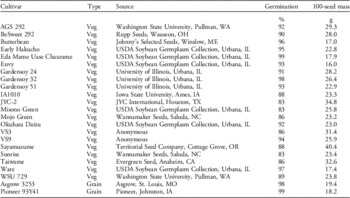
Vegetable soybean cultivars were selected based on availability of seed of cultivars grown commercially in the United States. A total of 21 vegetable soybean cultivars were obtained from seven private and four public sources (Table 1). In addition, two grain-type soybean cultivars widely grown in Illinois were included as controls. The grain-type cultivars are believed to exhibit tolerance to pyroxasulfone, given their widespread use in the state and lack of reports of injury from pyroxasulfone. Prior to planting, seed of all cultivars was characterized for 100-seed mass and germination. Germination rate was determined by incubating 100 seeds per cultivar on distilled water–moistened germination paper at 21C and 90% relative humidity, then counting and removing seedlings daily.
Source, germination, and 100-seed mass of vegetable soybean (Veg) and grain-type cultivars used in field experiments near Urbana, IL.

Experimental Approach
Trials were conducted in a different field each year at the University of Illinois Vegetable Crop Research Farm near Urbana, Illinois. The previous year’s crop was soybean. The soil was a Flanagan silt loam (fine, smectitic, mesic Aquic Argiudolls) averaging 3.1% organic matter and a pH of 6.2. Prior to planting, fields received two passes of a field cultivator. Trials were planted May 21, 2014 and May 27, 2015. Trials were kept weed free with hand-weeding as needed.
The experimental design was a split block with three replications. Main plots measured 2.5 m by 17.5 m. Subplots consisted of individual rows 2.5 m in length on 76-cm spacing. Herbicide treatments were assigned to main plots and soybean cultivars were assigned to subplots. Each subplot was planted with 50 seeds at a depth of 2.0 to 2.5 cm. Herbicide treatments included a nontreated control and pyroxasulfone at 417 g ha−1 (2× recommended field use rate) applied either PRE or EPOST. The PRE application was made the day of planting and the EPOST application was made when most plants had two fully emerged trifoliate leaves (V2). All applications were made with a compressed air backpack sprayer calibrated to deliver 185 L ha−1 spray volume at 275 kPa.
Data Collection
Soybean response to pyroxasulfone was quantified using five approaches. The crop seedlings were counted two weeks after planting (WAP) to determine population density. Four days later, seedlings with at least one fully emerged trifoliate leaf, hereafter called V1 plants, were counted. The V1 plants were counted to determine if the PRE treatment delayed development of emerging seedlings. Response to pyroxasulfone was assessed visually 14 and 30 days after treatment (DAT) for the PRE application, and 7 and 14 DAT for the EPOST application. Injury relative to the nontreated control was rated on a scale from 0 (no visible symptoms) to 100 (all plants dead). Crop injury was a cumulative measure of stunting, delayed growth, and leaf damage. Five WAP, individual plant leaf area and biomass were determined. Three plants were randomly selected from each subplot and cut at the soil surface. The leaves were cut at the base of the petiole and leaf area was quantified using an area meter (LI-3100C, LI-COR, Lincoln, NE). Plant tissue (leaves and stems) was dried until constant weight to determine aboveground plant biomass.
Daily rainfall and temperature data were obtained from a weather station located within 1 km of the study sites (Illinois State Water Survey, Champaign, IL). Growing degree days (GDD) were calculated using a base temperature of 7 C.
Data Analysis
Data were found to comply with ANOVA assumptions of homogeneity of variance, based on the modified Levene’s test (Neter et al. Reference Neter, Kutner, Nachtsheim and Wasserman1996). With the exception of population density and crop injury, variances were found to meet ANOVA assumptions of normality. Arcsine transformation of crop injury data improved normality. Normality of population density data could not be improved with any transformation; therefore, non-transformed population density data were analyzed. Response variables were analyzed by ANOVA using the Proc Mixed procedure of SAS version 9.3 (SAS Institute, Cary, NC). Year and replicate nested within year were considered random effects. Herbicide treatment and cultivar were considered fixed effects. Treatment means were compared using protected, Bonferroni-corrected multiple comparisons. All effects were declared significant at P<0.05.
Results and Discussion
Weather
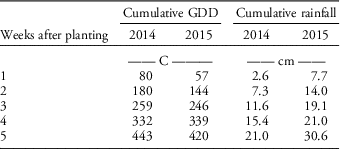
Rainfall a few days after planting was sufficient to incorporate pyroxasulfone into the soil and facilitate seed imbibition and seedling emergence. Within two WAP, fields received 7.3 and 14.0 cm of rainfall in 2014 and 2015, respectively (Table 2). High rainfall in 2015 caused concern that pyroxasulfone applied PRE may have moved out of the seed emergence zone. Post hoc weed seedling counts were made three WAP in 2015 to determine herbicide bioavailability. Nearly weed-free conditions in the PRE treatment three WAP, compared to >60 weeds m−2 in the nontreated control, confirmed bioavailability of pyroxasulfone.
Cumulative growing degree days (GDD) (base 7 C) and rainfall during field experiments conducted near Urbana, IL.

Emergence
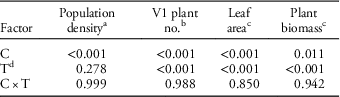
No interaction was observed between cultivar and treatment for population density (Table 3). Furthermore, population density was unaffected by pyroxasulfone treatment (P = 0.278). Across cultivars and treatments, soybean population density averaged 15.7plantsm−2, reflecting an overall emergence rate of 58% of seed planted.
Significance (P) of main effects of vegetable soybean cultivar (C), pyroxasulfone treatment (T), and their interaction (C×T) on crop response.

a Determined two weeks after planting.
b Number of plants with one or more fully expanded trifoliate leaves, determined 18 days after planting.
c Determined five weeks after planting.
d Treatments at time that population density and V1 plant number were recorded were pyroxasulfone applied PRE and nontreated check; treatments at time that leaf area and plant biomass were recorded were pyroxasulfone applied PRE, pyroxasulfone applied EPOST, and nontreated check.
Inherent differences in emergence were observed among cultivars. For instance, population density ranged from 12.1 to 18.5plantsm−2 among cultivars, with grain-type cultivars having among the highest rates of emergence (data not shown). Such emergence differences would be expected given the differential germination among seed lots (Table 1). The potential for poor emergence of vegetable soybean, relative to grain-type soybean, has been reported (Williams Reference Williams2015b; Zhang et al. Reference Zhang, Hashemi, Hebert and Li2013).
Crop Injury
Only low levels of crop injury were observed from pyroxasulfone at 417 g ha−1 (data not shown). Mean injury 14 DAT was 10% and 8% in the PRE and EPOST treatments, respectively. Results are consistent with previous research on soybean tolerance to pyroxasulfone. Yamaji et al. (Reference Yamaji, Honda, Kobayashi, Hanai and Inoue2014) reported low levels (<12%) of soybean injury from pyroxasulfone applied PRE at rates as high as 500 g ha−1. In the present work, the main effect of cultivar was not significant, with P-values ranging from 0.755 to 0.996 across all evaluation periods. The few studies examining soybean cultivar sensitivity to pyroxasulfone found that up to 376 g ha−1 of pyroxasulfone applied PRE resulted in <3% injury across eight grain-type cultivars commonly grown in Ontario, Canada (Belfry and Soltani et al. Reference Belfry, Soltani, Brown and Sikkema2015, McNaughton et al. Reference McNaughton, Shropshire, Robinson and Sikkema2014). Visual assessment data indicate that the vegetable soybean cultivars tested were no more sensitive to pyroxasulfone applied PRE or EPOST than were the grain-type soybean cultivars.
Growth
No interactions were observed between cultivar and treatment for any of the growth response variables, including V1 plant number, leaf area, and plant biomass (Table 3). The lack of significant interactions for crop growth responses showed that soybean cultivars were not differentially affected by pyroxasulfone. Both cultivar and treatment main effects were significant (P<0.001).
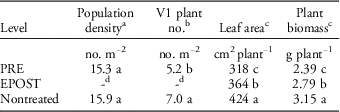
Pyroxasulfone applied PRE delayed early season growth of all cultivars. For instance, V1 plant number in the PRE treatment was delayed 26% compared to the nontreated control (Table 4). Since population density was unaffected by pyroxasulfone, reduction in V1 plant number in the PRE treatment was not due to reduced emergence, but rather was due to delayed seedling growth relative to the nontreated control. Similar reductions (approximately 25%) in plant growth due to the PRE treatment were observed for leaf area and plant biomass 5 WAP (Table 4). Pyroxasulfone applied EPOST also reduced leaf area and plant biomass 5 WAP, but to a lesser extent (approximately 12%) than it did when applied PRE.
Mean crop response to pyroxasulfone applied at 417 g ha−1 PRE and EPOST relative to the nontreated control.

a Determined two weeks after planting.
b Number of plants with one or more fully expanded trifoliate leaves, determined 18 days after planting.
c Determined five weeks after planting.
d EPOST treatment was not applied at time of assessment.
Inherent differences in crop growth were observed among cultivars. At 5 WAP, leaf area ranged from 279 to 475 cm2 per plant and plant biomass ranged from 2.25 to 3.36 g per plant (data not shown). The grain-type cultivars were among the smallest plants measured at 5 WAP. Results are consistent with those seen in previous research comparing vegetable and grain-type soybean. A comparison of 136 vegetable and 14 grain-type soybean lines showed that seedling height, leaf area, and leaf biomass at 3 WAP were larger in vegetable soybean (Williams Reference Williams2015b). Differences in seedling size between soybean types was attributed to cultivar seed size. Seed of vegetable soybean cultivars used in this study were 35% heavier than were those of the grain-type cultivars, on average. Positive relationships between soybean seed mass and various aspects of seedling growth have been reported (Burris et al. Reference Burris, Edje and Wahab1973; Place et al. Reference Place, Reberg-Horton, Carter and Smith2011).
Implications
Pyroxasulfone does not have a negative effect on vegetable or grain-type soybean emergence or early season growth. Crop establishment was unaffected by pyroxasulfone, and visual assessment of crop injury showed minimal (≤10%) crop response. At 5 WAP, a delay in soybean growth was seen as a result of PRE application of 417 g pyroxasulfone ha−1, twice the recommended use rate for this soil type. However, vegetable soybean was no more sensitive to pyroxasulfone than was grain-type soybean. Vegetable soybean cultivars grown in the United States for commercial production have the same low risk of crop injury associated with pyroxasulfone as does grain-type soybean.
While some herbicides have become available in recent years, the total number of herbicides available for use in vegetable soybean remains limited, and weed interference continues to be a major threat to domestic production of the crop. Compared to currently registered herbicides, pyroxasulfone could provide better control over certain broadleaf species when applied alone (Hausman et al. Reference Hausman, Tranel, Riechers, Maxwell, Gonzini and Hager2013) or in combination with other herbicides (Belfry and McNaughton et al. Reference Belfry, McNaughton and Sikkema2015). Registration of pyroxasulfone on vegetable soybean would provide the industry with an additional tool that could be used to expand the options for weed management systems.
Acknowledgements
Mention above of any trademark, proprietary product, or vendor does not constitute a guarantee or warranty of the product by the US Department of Agriculture and does not imply its approval to the exclusion of other products or vendors that also may be suitable.