Introduction
Members of the family Plagiorhynchidae Golvan, 1960 are acanthocephalans that use birds, mammals and, rarely, reptiles distributed across the world as definitive hosts (see Smales, Reference Smales2002; Amin, Reference Amin2013). Currently, the family is composed of three subfamilies: Porrorchinae Golvan, 1956, containing six genera; Sphaerechinorhynchinae Golvan, 1956, represented by a single genus; and Plagiorhynchinae Meyer, 1931, containing two genera (see Amin, Reference Amin2013). The genus Plagiorhynchus Lühe, 1911 is the most diverse within Plagiorhynchinae and contains approximately 46 recognized species. The species of Plagiorhynchus are characterized morphologically by possessing a cylindrical or ovoid body, with a cylindrical proboscis, armed with numerous hooks, a double-walled proboscis receptacle with a cerebral ganglion located at the base and long tubular lemnisci. The males possess two spherical to oblique testes in tandem placed in the anterior region of the body and three to six long, tubular cement glands. The females have a terminal or subterminal genital pore and oval or elongated eggs with or without polar prolongation of the fertilization membrane (see Schmidt & Kuntz, Reference Schmidt and Kuntz1966; Smales, Reference Smales2002; Dimitrova, Reference Dimitrova2009). In a taxonomic review of the family, Schmidt & Kuntz (Reference Schmidt and Kuntz1966) divided the genus Plagiorhynchus into two subgenera: Plagiorhynchus and Prosthorhynchus Kostylew, 1915. This classification was later accepted by Golvan (Reference Golvan1994), Amin (Reference Amin2013), Smales (Reference Smales2002) and Dimitrova (Reference Dimitrova2009). These subgenera can be easily distinguished by the presence of a terminal genital pore in females, elongated eggs with prolongation of the middle shell and parasites of aquatic birds in Plagiorhynchus, whereas Prosthorhynchus is characterized by having a subterminal genital pore in females, oval eggs without polar prolongation and parasites of terrestrial birds (see Schmidt & Kuntz, Reference Schmidt and Kuntz1966; Dimitrova, Reference Dimitrova2009).
According to Dimitrova (Reference Dimitrova2009) and Amin (Reference Amin2013), the subgenus Plagiorhynchus constitutes 18 species that are distributed across the world. In the Americas, four species have been described: two in the Neotropical region (Plagiorhynchus (Plagiorhynchus) reticulatus (Westrumb, 1821) Golvan, 1956 and P. (Plagiorhynchus) freitasi Vicente, 1977) and two in the Nearctic region (P. (Plagiorhynchus) rectus (Linton, 1892) Van Cleave, 1918 and P. (Plagiorhynchus) paulus Van Cleave & Williams, 1951).
In the current research, adult acanthocephalans were collected from the intestine of long-billed curlew (Numenius americanus Bechstein, 1812) from northern Mexico. The aims of this study were (1) to provide a morphological description of the new species and (2) to test the systematic position of the genus Plagiorhynchus within Plagiorhynchidae using molecular data from two nuclear ribosomal genes (small subunit (SSU) and large subunit (LSU)).
Material and methods
Specimen collection
A single long-billed curlew (N. americanus) was collected in Topolobampo bay (25°38′52.3″N, 109°02′11.8″W) Sinaloa, Mexico. The long-billed curlew was identified using the field guides of Howell & Webb (Reference Howell and Webb1995) and the American Ornithologists’ Union (1998). Acanthocephalans were collected alive, placed in distilled water to relax the proboscis for 10–12 h at 4°C and subsequently were fixed and preserved in 100% ethanol.
Morphological study
Selected worms were punctured dorsally with a fine needle, stained with Mayer's paracarmine, dehydrated in graded ethanol series, cleared in methyl salicylate and mounted on permanent slides in Canada balsam. Mounted specimens were examined using a bright-field Leica DM 1000 LED microscope (Leica, Wetzlar, Germany). Measurements were taken using the Leica Application Suite microscope software and are presented in micrometres unless otherwise stated, with the range followed by the mean in parenthesis. Drawings were made with the aid of a drawing tube. For scanning electron microscopical (SEM) observations, some specimens were dehydrated through a graded series of ethyl alcohol, and then critical-point dried with carbon dioxide. Specimens were coated with gold and examined using a Hitachi Stereoscan model SU1510 (Hitachi High-Technologies Mexico S.A. de C.V., Mexico) at 15 kV. Specimens of the type-series were deposited in the Colección Nacional de Helmintos, Instituto de Biología, Universidad Nacional Autónoma de México, Mexico City.
DNA extraction, polymerase chain reaction (PCR) amplification, sequencing and phylogenetic analyses
Two specimens were placed individually in tubes and digested overnight at 56°C in a solution containing 10 mm Tris-HCl (pH 7.6), 20 mm NaCl, 100 mm Na2-EDTA (pH 8.0), 1% Sarkosyl and 0.1 mg/ml proteinase K. Following digestion, DNA was extracted using DNAzol reagent (Molecular Research Center, Cincinnati, OH, USA) according to the manufacturer's instructions. Two regions of nuclear ribosomal DNA (rDNA) were amplified using the PCR. The nearly complete SSU rDNA gene (~1800 bp) was amplified using two primer sets that yielded two overlapping fragments of ~1000 bp. The PCR primers used were 5′-AGATTAAGCCATGCATGCGT-3′ (forward) and 5′-AACTTTTCGTTCTTGATTAATG-3′ (reverse) (amplicon # 1); 5′-GCAGCGCGGTAATTCCAGCTC-3′ (forward) and 5′-GCAGGTTCACCTACGGAAA-3′ (reverse) (amplicon # 2). The nearly complete LSU rDNA gene (~2900 bp) was amplified using three overlapping fragments of ~1200 bp. Primers used for LSU were 5′-CAAGTACCGTGAGGGAAAGTTGC-3′ (forward) and 5′-CAGCTATCCTGAGGGAAAC-3′ (reverse) (amplicon # 1); 5′-ACCCGAAAGATGGTGAACTATG-3′ (forward) and 5′- CTTCTCCAACGTCAGTCTTCAA-3′ (reverse) (amplicon # 2), 5′- CTAAGGAGTGTGTAACAACTCACC-3′ (forward) and 5′-CTTCGCAATGATAGGAAGAGCC-3′ (reverse) (amplicon # 3) (García-Varela & Nadler, Reference García-Varela and Nadler2005). PCR reactions (25 µl) consisted of 10 µm of each primer, 2.5 µl of 10× buffer, 2 mm MgCl2 and 1 U of Taq DNA polymerase (Platinum Taq, Invitrogen Corporation, São Paulo, Brazil). PCR cycling parameters for rDNA amplifications included denaturation at 94°C for 3 min, followed by 35 cycles of 94°C for 1 min, annealing at 50–58°C (optimized for each rDNA amplification) for 1 min, and extension at 72°C for 1 min, followed by a post-amplification incubation at 72°C for 7 min. Sequencing reactions were performed using ABI Big Dye (Applied Biosystems, Boston, MA, USA) terminator sequencing chemistry and reaction products were separated and detected using an ABI 3730 capillary DNA sequencer. Contigs were assembled and base-calling differences resolved using Codoncode Aligner version 5.1.5 (Codoncode Corporation, Dedham, MA, USA). Sequences obtained in the current research for the SSU and LSU of Plagiorhynchus (Plagiorhynchus) sp., P. (Prosthorhynchus) transversus Rudolphi, 1819, Centrorhynchus aluconis Müller, 1780 and C. globocaudatus Zeder, 1800 were aligned with other sequences downloaded from GenBank data set (see table 1). Sequences of each molecular marker were aligned separately using the software Clustal W (Thompson et al., Reference Thompson, Gibson, Plewniak and Jeanmougin1997). A nucleotide substitution model was selected for each molecular marker using jModelTest version 2.1.7 (Posada, Reference Posada2008) applying the Akaike criterion. The best nucleotide substitution models for both data sets were GTR+G+I. Phylogenetic trees were reconstructed using the maximum likelihood (ML) method with the program RAxML version 7.0.4 (Stamatakis, Reference Stamatakis2006). A GTRGAMMAI substitution model was used, and 10,000 bootstrap replicates were run to assess nodal support. We also estimated phylogenetic relationships using MrBayes 3.2.2 (Ronquist et al., Reference Ronquist, Teslenko and Van Der Mark2012), with two runs of the Markov chain (MCMC) for ten million generations, sampled every 1000 generations, a heating parameter value of 0.2 and burn-in (25%). Phylogenetics trees were drawn using FigTree version 1.4.0 (Rambaut, Reference Rambaut2012).
Specimens analysed in this study, with accompanying host name and GenBank accession numbers of each molecular marker.

Sequences in bold were generated in this study. Nd, not determined.
Results
Morphological description
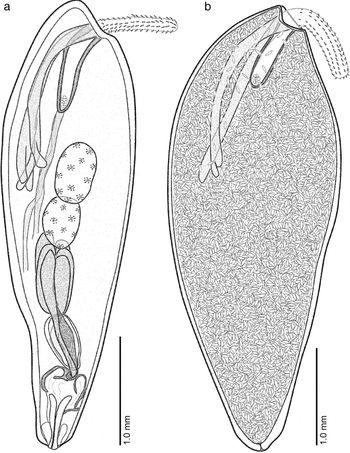
Plagiorhynchus (Plagiorhynchus) aznari n. sp. (figs 1–3).
Plagiorhynchus (Plagiorhynchus) aznari n. sp., from Numenius americanus. (a) Adult male, whole worm (holotype), lateral view; (b) adult female whole worm (allotype), lateral view.

Plagiorhynchus (Plagiorhynchus) aznari n. sp., from Numenius americanus. (a) Proboscis; (b) hooks with roots; (c) female reproductive system; (d) egg.

Scanning electron micrographs of Plagiorhynchus (Plagiorhynchus) aznari n. sp., from Numenius americanus. (a) Proboscis adult male ventral view; (b) proboscis adult male horizontal view; (c) adult male; (d) gonopore of adult female. Scale bars: (a) 400 µm; (b, d) 100 µm; (c) 1000 µm.

General. Plagiorhynchidae, with characters of the genus Plagiorhynchus, subgenus Plagiorhynchus. Living specimens of white colour. Sexual dimorphism evident; females larger than males. Proboscis cylindrical, armed with 14–15 longitudinal rows, with 19 hooks per row with simple roots, decreasing in size from anterior to posterior region. Neck small, cone shaped (fig. 3a); trunk expanded anteriorly (figs 1a, b and 3c). Proboscis receptacle double-walled, with sub-oval cephalic ganglion at its posterior end (fig. 1a). Lemnisci digitiform, split end into two or three, longer than the proboscis receptacle. Genital pore terminal in both sexes (figs 1a, b, 2c and 3d).
Male. (Based on seven mounted adult specimens and one analysed by SEM.) Trunk 4.0 mm (3.2–4.8 mm) × 1.3 (0.94–1.67 mm); maximum width at hind-trunk level. Proboscis 706 (606–761) × 133 (105–154). Proboscis cylindrical, armed with 19 longitudinal rows of hooks, with 14–15 hooks each row (fig. 2a). All the hooks similar in shape, decreasing in size, from anterior to posterior region (length, 36, 39, 39, 38, 36, 33, 32, 30, 28, 23, 19, 18, 16, 15 and 11). Roots decrease posteriorly (fig. 2a, b). Proboscis receptacle 0.8 mm (0.6–1.34 mm) × 216 (183–277). Lemnisci 1.7 mm (1.2–2.6 mm). Testes ovoid, in tandem, posterior to the proboscis receptacle. Anterior testis 627 (451–786) × 445 (378–515). Posterior testis 551 (411–650) × 406 (261–538). Cement glands, six tubular, 826 (711–946) long. Säfftigen's pouch 568 (503–626) long. Copulatory bursa 594 (482–663) × 479 (408–543).
Female. (Based on 11 gravid mounted specimens and one analysed by SEM.) Trunk 4.8 mm (3.4–6.0 mm) × 1.8 (0.9–2.22 mm) (fig. 1b). Proboscis 727 (533–917) × 155 (117–206). Proboscis cylindrical, armed with 19 longitudinal rows of hooks, with 14–15 hooks each row. All the hooks were similar in shape, decreasing in size from anterior to posterior region (length 40, 38, 41, 41, 41, 37, 41, 30, 27, 25, 22, 21, 17, 17 and 15). Roots reduce posteriorly. Proboscis receptacle 657 (447–970) × 217 (174–243). Lemnisci 1.9 mm (1.7–2.1 mm). Uterine bell short with a thick body wall 237 (226–256) long. Uterus long 667 (480–832); vagina complex with two sphincter muscles 182 (156–205) long; terminal gonopore(fig. 2c). Mature eggs, with polar prolongation of the fertilization membrane 93 (83–104) × 33 (24–40) (fig. 2d).
Taxonomic summary
Type host. Long-billed curlew N. americanus Bechstein, 1812 (Aves: Charadriiformes: Scolopacidae).
Site of infection. Intestine.
Type locality. Topolobampo bay (25°38′52.3″N, 109°02′11.8″W), Sinaloa, Mexico.
Type material. Holotype; (CNHE: 11207), allotype (CNHE: 11208); Paratype (CNHE: 11209).
Etymology. The species is named for Dr. Francisco Javier Aznar, Professor from the University of Valencia, for his contribution and passion for the knowledge of the taxonomy and systematic of the acanthocephalans.
Remarks
The new species is placed in the subgenus Plagiorhynchus (Plagiorhynchus) by having a cylindrical proboscis, a small cone-shaped neck, six tubular cement glands, genital pore terminal in both sexes and eggs with polar prolongation in the middle fertilization membrane (Schmidt & Kuntz, Reference Schmidt and Kuntz1966; Smales, Reference Smales2002; Dimitrova, Reference Dimitrova2009).
Plagiorhynchus (Plagiorhynchus) aznari n. sp. differs from three other congeneric species from the Americas by having a trunk expanded anteriorly and a proboscis cylindrical, armed with 19 longitudinal rows of hooks, with 14–15 hooks each row (figs 1–3), whereas the proboscis of P. (Plagiorhynchus) paulus is armed with 15 longitudinal rows with 14–15 hooks each; P. (Plagiorhynchus) rectus has 24 longitudinal rows with 20 hooks each; P. (Plagiorhynchus) reticulatus has 14–16 longitudinal rows with 16–17 hooks each. The new species can also be differentiated from other congeneric species from the Americas by having digitiform lemnisci, with ends split into two or three (fig. 1a, b).
Phylogenetic analyses
The SSU data set included 25 sequences with 1796 nucleotides (including gaps), with GTR+G+I as the best evolution model. The phylogenetic tree inferred from ML and Bayesian inference (BI) analyses shows that the sequence obtained from P. (Plagiorhynchus) aznari n. sp. is sister to a clade formed by two species of the subgenus Prosthorhynchus: P. (Prosthorhynchus) transversus is a common parasite of Passeriformes from Eurasia, and P. (Prosthorhynchus) cylindraceus (Goeze, 1782) is a generalist parasite with a wide host spectrum because it has been found in Passeriformes, Charadriiformes and birds of prey from Eurasia, North America, Australia and South Africa (Schmidt & Kuntz, Reference Schmidt and Kuntz1966; Yamaguti, Reference Yamaguti1963; Amin et al., Reference Amin, Canaris and Kinsella1999; Smales, Reference Smales2002; Dimitrova, Reference Dimitrova2009; Lisitsyana, Reference Lisitsyana2010; Garcia-Salguero et al., Reference Garcia-Salguero, Delgado-Serra, Sola, Negrete, Miranda and Paredes-Esquivel2019). The sister relationships among the three species of Plagiorhynchus received strong bootstrap support (99%) and Bayesian posterior probabilities (1.0). The phylogenetic tree also showed that Plagiorhynchidae species formed a sister relationship with Centrorhynchidae Van Cleave, 1916 (Golvan, 1960) (but received relatively weaker nodal support; (59%) bootstrap and (0.6) Bayesian posterior probabilities in ML and BI, respectively), a family represented by parasites of birds and terrestrial mammals, in turn being sister to Polymorphidae Meyer, 1931, a family represented by endoparasites of marine mammals, fish-eating birds and waterfowl that are distributed across the world (García-Varela et al., Reference García-Varela, Pérez-Ponce de León, Aznar and Nadler2013) (fig. 4a). The LSU data set included 26 sequences with 3096 nucleotides (including gaps), with GTR + G + I as the best evolution model. The tree topologies inferred from the LSU data set are not the same because their taxon samplings were different. Nevertheless, they were similar to each other, in that Plagiorhynchidae and Centrorhynchidae were nested together, and this clade received stronger nodal support (90% bootstrap and 0.9 Bayesian posterior probabilities in ML and BI, respectively) by the SSU analysis (fig. 4a). The phylogenetic analyses inferred from the LSU data set included the sequence of P. (Plagiorhynchus) allisonae Smales, 2002, a parasite of the South Island Pied oystercatcher (Haematopus ostralegus finschi Linnaeus, 1758) and Variable oystercatchers (Haematopus unicolor Linnaeus, 1758) from New Zealand (Smales, Reference Smales2002); this species is sister to P. (Plagiorhynchus) aznari n. sp., with strong branch support (100% bootstrap and 1.0 Bayesian posterior probabilities in ML and BI, respectively; fig. 4b). These two species of the subgenus Plagiorhynchus are sisters to two other species of the subgenus Prosthorhynchus, confirming Plagiorhynchidae as monophyletic (fig. 4b).
Phylogenetic trees using maximum likelihood and consensus Bayesian Inference for SSU data set (a), and LSU data set (b). Numbers near internal nodes show maximum likelihood bootstrap percentage values and Bayesian posterior probabilities. Scale bars represent the branch length.

Discussion
Schmidt & Kuntz (Reference Schmidt and Kuntz1966) reviewed the taxonomy of the subfamily Plagiorhynchinae and recognized two key morphological differences that discriminate Plagiorhynchus (Plagiorhynchus) from Plagiorhynchus (Prosthorhynchus): the position of the genital pore in female and the presence or absence of polar prolongation of the middle membrane of the eggshell. The new species belongs to the subgenus Plagiorhynchus by possessing a terminal genital pore in both sexes and eggs with polar prolongation in the middle fertilization membrane. According to Dimitrova (Reference Dimitrova2009) and Amin (Reference Amin2013), the subgenus Plagiorhynchus includes approximately 18 species distributed worldwide. However, the number of species has been controversial because both taxonomic keys differ in the number of species. In the current research, we recognized three species of the subgenus Plagiorhynchus distributed across the Americas: P. (Plagiorhynchus) reticulatus, P. (Plagiorhynchus) rectus and P. (Plagiorhynchus) paulus. Although the fourth species, P. (Plagiorhynchus) freitasi Vicente, 1977, was first reported in Brazil and validated by Golvan (Reference Golvan1994) and subsequently recognized by Amin (Reference Amin2013), this species was not validated by Dimitrova (Reference Dimitrova2009). We could not find any record of the species P. (Plagiorhynchus) freitasi. Vicente (Reference Vicente1977) described a new species of trematode from Brazil as Plagiorchis freitasi, which we believe may have been the cause of confusion in Golvan (Reference Golvan1994); therefore, the species P. (Plagiorhynchus) freitasi is not valid. We consider only three species of the subgenus Plagiorhynchus valid in the Americas. In the Nearctic region from Mexico, P. (Plagiorhynchus) rectus was described from unidentified gull (Larus sp.) (Van Cleave & Williams, Reference Van Cleave and Williams1951), and it has never been recorded again in subsequent taxonomic literature. Based on the morphological and molecular data generated in this study, we believe that P. (Plagiorhynchus) aznari n. sp. represents the second record in Mexico and the fourth species in the Americas.
The phylogenetic analyses inferred from two molecular markers (SSU and LSU) in the current study consistently showed that the new species P. (Plagiorhynchus) aznari n. sp. is closely related to two other species of the subgenus Prosthorhynchus: P. (Prosthorhynchus) transversus and P. (Prosthorhynchus) cylindraceus. In our phylogenetic trees inferred from the LSU sequences depicted, P. (Plagiorhynchus) aznari n. sp. is sister to P. (Plagiorhynchus) allisonae from New Zealand, supporting the monophyly of the subgenus. Although we included very few species of the subgenera Plagiorhynchus and Prosthorhynchus from Plagiorhynchidae, we assessed the phylogenetic relationships among Polymorphida Petrochenko, 1956 for the first time a group of acanthocephalans that includes approximately 372 species of the families Plagiorhynchidae, Centrorhynchidae and Polymorphidae (Amin, Reference Amin2013). The phylogenetic trees inferred from the SSU and LSU data sets supported the monophyly of Polymorphida, which was subdivided into two groups: Plagiorhynchidae + Centrorhynchidae and Polymorphidae. This result is consistent with the phylogenetic relationships inferred from the complete mitochondrial genome sequences of three species of acanthocephalans, each representing one of three families of Polymorphida (see Gazi et al., Reference Gazi, García-Varela, Park, Littlewood and Park2015). This result also supports the classification of the order Polymorphida based on morphological and ecological characters (see Amin, Reference Amin2013). The phylogenetic relationships inferred among the members of Polymorphida provide significant insights into the evolution of the ecological associations between parasites and their definitive hosts within the order Polymorphida. It can be assumed that the colonization of Polymorphidae species into marine mammals, fish-eating birds and waterfowl might have occurred independently from a common ancestor of Centrorhynchidae and Plagiorhynchidae that colonized terrestrial birds and mammals. The present study included a limited number of species in the phylogenetic analysis, and to better understand evolutionary relationships among the order Polymorphida, further sequence information from broader taxon sampling, particularly from the families Centrorhynchidae and Plagiorhynchidae, is required.
Acknowledgements
We are grateful to Rogelio Rosas Valdez and David Hernández Mena for their help during field work. We also thank Berenit Mendoza for her help with the use of the SEM unit, Luis García Prieto for providing material from the CNHE and Laura Marquez and Nelly López Ortis for their help during the sequencing of the DNA fragments.
Financial support
This research was supported by grants from the Programa de Apoyo a Proyectos de Investigación e Inovación Tecnológica (PAPIIT-UNAM) IN207219.
Conflicts of interest
None.
Ethical standards
Specimens were collected under the Cartilla Nacional de Colector Científico (FAUT 0202) issued by the Secretaría del Medio Ambiente y Recursos Naturales (SEMARNAT), to MGV.