Introduction
Despite the fact that Gypsies and Travellers can lay claim to being some of Britain's oldest minority ethnic communities,Footnote 1 the history of the relationship between these nomadic groups and the sedentary ‘mainstream’ population has over many centuries been fraught with contradictions and tensions. Whilst Gypsies and Travellers were over several hundred years welcomed as the bearers of news and entertainment and formed a source of cheap agricultural labour during harvest and at times of other high labour intensity; their ‘otherness’ has been continually racialised and problematised by the surrounding sedentary populations (Bancroft, Reference Bancroft2005). The relationship between the two communities remains in many ways as problematic and nebulous today as in previous centuries. Whilst other minority ethnic communities were known to reside in early modern Britain prior to the advent of groups of ‘Egyptians’ in the first quarter of the sixteenth century, the small-scale migration of Jews, and latterly Africans and Lascars (Ackroyd, Reference Ackroyd2002), caused potentially less concern amongst settled populations, despite the fact that they too were at times subject to proclamations, additional taxation, threats of expulsion, persecution and indignant prejudice from the indigenous communities (Mayall, Reference Mayall1995; Winder, Reference Winder2004; Bancroft, Reference Bancroft2005). To a large extent, although the above-named groups and other less ‘visible’ migrants, such as Huguenots (who were initially welcomed as refugees fleeing persecution rather than potentially threatening economic migrants) and Icelanders (Ackroyd, Reference Ackroyd2002), were alien to the majority sedentary population, not only were these new communities relatively small in number, but, in stark contrast to the newly arrived ‘Egyptians’, they wished to settle in a local area and to some extent assimilate into the populace through provision of goods or services.
In contrast (although both the legislative reaction and popular discourse pertaining to nomadic communities must be set against this wider historical picture), Gypsies were distinctly different in appearance, language and behaviour from the other minority communities known to some (sophisticated) city-dwellers. Not only were the conjuring, craft and musical skills of the ‘Egyptians’ often previously unknown to the indigenous population, but their physical appearance was unlike that of the majority English community who may never before have met someone who was ‘black’ (Bancroft, Reference Bancroft2005: 36), spoke an unknown language, was renowned for wearing gaudy clothes and, most alarmingly (and enticingly) of all, was preceded by a reputation for fortune-telling and magic (Mayall, Reference Mayall1995). Moreover, the very use of the name ‘Egyptian’ was often encouraged by these ‘exotic’ foreigners to add spice to their stories of wanderings in other lands. Equating themselves with a country known mainly to the predominantly unlettered indigenous population through biblical tales, enabled Gypsies to add further credence to their claims of expertise in magic and ritual, and thus enhanced both their client base and their carefully preserved mystique.
By 1530, when the first Egyptians Act was passed (Mayall, Reference Mayall1995), the numbers of Gypsies crossing through Western Europe in relatively large, semi-autonomous bands ruled by leaders using titles such as ‘Duke’ and ‘Count’ (Kenrick, Reference Kenrick2004) had increased substantially, leading to considerable alarm amongst regional and state governments whose lands they crossed. Indeed, it was the presence of new nomadic groups sailing to Spain and moving up through Southern Europe (apparently having left their relatively well-established bases in Greece to avoid the advance of the Ottoman empire) that is believed to have triggered the passing of a series of Europe-wide decrees, which attempted to regulate the movements of individuals who were nomadic and lacked fixed employment (Kenrick, Reference Kenrick2004: 70). By the 1520s a number of groups of ‘Egyptians’ were known to be travelling in England in areas as diverse as Suffolk, Bristol, Hereford and Cornwall (Fraser, Reference Fraser1992: 172). They had first been recorded some twenty years earlier in Scotland, where they had initially performed as dancers at the court having arrived in a troupe from Spain.
With the rapidly increasing population of Gypsies attracting critical attention from state agencies, reports of their movements throughout Britain became ever-more closely monitored by a central administrative regime which was anxious to control the movements of both ‘aliens’ and potentially seditious ‘home grown’ revolutionaries (Humphries, Reference Humphries1999; Ackroyd, Reference Ackroyd2002; Winder, Reference Winder2004). It is perhaps not coincidental that the first anti-Gypsy legislation was passed in 1530 when suspicion of ‘foreigners’ was beginning to reach a crescendo following Henry VIII's dispute with Rome over his divorce from Catherine of Aragon. In that year, fears of domestic revolution (which it was believed would be enflamed by traitorous (foreign) Catholic spies fermenting discord by carrying news of planned uprisings in favour of Catherine across the country) spiralled in many quarters, generating a sense of anxiety amongst an unsettled populace (Weir, Reference Weir2001). Indeed the political situation in England was precarious in that year not only because of the upheaval in the old order, but resulting too from a severe economic depression which had begun in the late 1520 s following disastrous harvests and the long-term international impacts of the Franco-Spanish conflicts of 1528–1529 (Humphreys, 1999: 43). In response to fears of destabilisation within the country, the Tudor establishment passed laws aimed at suppressing vagrancy and controlling the movements of ‘masterless men’ (Beier, Reference Beier1985) with savage penalties enacted to control the ‘great and excessyve nombres’ of the idle and those ‘travelling the roads’ (Humphreys, 1999: 44).
The Egyptian Act of 1530 explicitly aimed to rid the country of all Gypsies by banning further immigration and requiring those already in the country to depart within sixteen days, on pain of confiscation of all property, imprisonment and deportation (Mayall, Reference Mayall1995: 20). That this policy failed signally to deal with the ‘problem’ was evidenced by the passing of a further eight Acts by the end of the sixteenth century, all of which sought to force Gypsies to either leave the kingdom or adopt a sedentary way of life and occupation. In total Mayall (Reference Mayall1995) records 29 laws concerning Gypsies passed in England and Wales between 1530 and 1908. Whilst the most notorious piece of legislation (passed in 1554), which provided for the death penalty for ‘persons callynge themselves Egyptians’, was ultimately repealed in 1783 and for some considerable time may have been used predominantly as an incentive to force Gypsies to leave the country, evidence exists to show that a series of deportations (and some executions) took place under the auspices of this statute until it fell into disuse in the seventeenth century (Mayall, Reference Mayall1995). The repeal of Egyptians Acts however did not indicate that Gypsies, Travellers and other nomadic persons were safe from official intolerance, with the Vagrancy Acts of 1822–1824 substituting a regime of summary local justice for the former system of trial by jury (Mayall, Reference Mayall1995; Rickard Reference Rickard1995), placing them at the mercy of local political and personal preference. This ‘most pernicious piece of legislation’ (Mayall, Reference Mayall1995: 29) imposed a three-fold classification of vagrants: ‘idle and disorderly persons’, ‘rogues and vagabonds’ and ‘incorrigible rogues’. Gypsies and Travellers were explicitly grouped with rogues and vagabonds who, if ‘not having any visible means of subsistence and not giving a good account of himself’, were subject to imprisonment on the decision of a local magistrate. When coupled with the various other legislative controls – the Highways Act of 1835, which fined individuals who ‘encamped on the side of the Highway’; a series of Hawkers and Pedlars Acts (enacted between 1810 and 1888), which required nomadic people to hold a licence to work; the gradual enclosure of common land, which limited still further the places where Travellers could halt; and various public health measures aimed at limiting overcrowding in wagons and ‘moveable dwellings’ (Greenfields, Reference Greenfields2006b) – by the early twentieth century the romanticised view of the ‘freedom of the road’ derived from authors such as Borrow (Reference Borrow1851, Reference Borrow1857) was (if ever true) a long way from the reality of the lives of most Gypsies.
Theoretical explanations for anti-nomadic discourse and policy
Before exploring the recent changes in English (and Welsh) policy approaches to the accommodation and broader social needs of Gypsies and Travellers it is a valuable exercise to examine the ‘place’ of nomadic people in the broader context of social theory. By so doing it is possible to consider the reasons why anti-nomadic and pro-sedentary cultural norms have dominated legislative approaches to engagement with these communities for so long, despite the growth of awareness of multi-cultural consciousness and the (officially led) valuing of diversity.
Despite the heterogeneity of nomadic communities in the Western world, the generally low status of, and hostility towards, Roma, Gypsy and Traveller communities (Stonewall, 2001: CRE, 2006) can be identified in probably every country in Europe, with increased rates of racial hatred recorded against them, which have escalated with the ‘resurgence of nationalism in Europe’ (Bancroft; 2005: 47). A number of explanations have been posited for the almost universal hatred of Gypsies and Travellers (McVeigh, Reference McVeigh and Acton1997; Bancroft, Reference Bancroft2005), predominantly focussing on the interface between the sedentary/nomadic worlds and the imposition of class and race-based labels which allow the ‘othering’ of the community to which one does not belong (ni Shuinear, Reference ni Shuinear and Acton1997) whilst allowing one's own community to be perceived of as morally superior and ‘civilised’. Both ni Shuinear and McVeigh unpick the manner in which ‘race’ as an explanatory concept for dislike of travelling people may at times be too crude a tool to explain the hostility that exists between sedentary and nomadic communities, with both authors identifying that house dwellers may reserve their most virulent criticism for individuals who are nomadic but perceived of as having elected to reject sedentary values whilst being of the same (or very similar) ethnicity as the settled community (for example, New Travellers or Irish Travellers). In such situations, nomadic people are denied ‘authenticity’, either differentiated from ‘ethnic’ Roma/Gypsy/Traveller populations along crude racial/ethnic typologies, or presented as ‘backward’ for failing to change in line with the expectations of the mainstream population. As ni Shuinear (Reference ni Shuinear and Acton1997: 31) notes, the sedentary Irish population have ‘very strong, uncomfortable feelings about [Irish Travellers] because they are a reminder of who and what they themselves used to be’.
It may be posited (albeit this explanation is unduly simplistic and un-nuanced) that by imposing restrictions upon nomads (or those ‘not like ourselves’), which aim to enforce ‘integration’ into a model of behaviour that reifies sedentarism, the settled community and agents of the monolithic state seek to demonstrate the superiority of our own mode of life and thus distance ourselves from practices that may reflect elements of our own history or similarities that we find uncomfortable. Deleuze and Guattari (Reference Deleuze, Guattari and Massumi1988) theorise that the modern nation-state's concern to control nomadic populations arises from the tensions inherent in ‘territorialisation’, the dynamic relationship between psycho-social processes that creates change through altering meaning and/or physical dimensions. Thus the very meaning of social actions can be altered by adjusting the prism through which an action is viewed. Creating a ‘territory’ (perhaps in this context a nation-state or a small sedentary community, for example, a village) can move beyond the physical to psychological and spiritual: ‘enabling philosophy and ideology to historically reterritorialise land as Homeland or Fatherland’ (Deleuze and Guattari, Reference Deleuze, Guattari, Tomlinson and Burchell1994: 1968). By refusing to accept notions of territoriality and differentiated ‘owned’ spaces that impinge on customary paths and behaviours, nomads both threaten the social order of sedentary society and offer (through the concept of ‘nomadology’) an alternative perspective on civilisation, history and normative constructs of ‘society’ and ‘state’. Thus Fox (Reference Fox2002: 355) posits that through their ‘commitment to deterritorialization the nomad is intrinsically political, always on the side of freedom, choice and becoming, always opposed to power, territory and the fixing of identity’. Indeed, it is in the role of despoiler or ‘invader’ of rural localities that Gypsy and Traveller encampments (or purchase of land on which to develop a site) are often portrayed in localised discourse or political and media reports (Turner, Reference Turner2002).
Deleuze's work is frequently bracketed with that of his contemporary, Foucault, and indeed applying Foucault's work on the ‘gaze’ (1963) to Deleuze's theory of ‘nomadology’ provides an additional critical layer of explanation as to how (and why) the actions and behaviours of Gypsies and Travellers are interpreted as dangerous and in need of ‘control’ by agents of the state. In his work on punishment and the penal system (1977) and the control of the body through medicalisation and pathologisation of behaviours (1961, 1963), Foucault relates the notion of ‘discourse’ or interpretation of actions through the medium of language to the ‘gaze’ or controlling observation of those individuals who ‘exercise’ power (1980). Discourse carries embedded meanings and assumptions constructed by the agents of control, and thus words and ‘labels’ (Becker, Reference Becker1963) are utilised within the panoply of systemic control mechanisms operationalised against those who would resist the ‘territorialisation’ of their way of life.
The standardised use of inflammatory and racist language by the media when discussing Gypsies and Travellers (Morris, Reference Morris, Clark and Greenfields2006; James and Richardson, Reference James, Richardson, Dearling, Newburn and Somerville2006) is thus part of the discourse of control ranged against nomads, explicitly aimed at ‘othering’ or proclaiming deviant the actions of those who are not members of sedentary society. Richardson (Reference Richardson2006) examined media articles for key phrases and words used about Gypsies and Travellers and found particular discursive links between nomadic communities, ‘cost’ and ‘mess’. Cohen (Reference Cohen1980) and Cohen and Scull's (1983) descriptions of the role of the media and state in the making of ‘folk devils’ and ‘moral panics’ maps elegantly across on to the realm of Gypsy and Traveller policy and discourse around these ‘pariah groups’ (Barth, Reference Barth and Barth1969) who are rejected by the majority yet (at least historically) are seen as necessary to fulfil certain economic functions. With the decline in traditional economic practices of nomadic groups (Greenfields, Reference Greenfields2006a) it is perhaps more appropriate in late modernity to consider the ways in which Gypsies, Travellers (and Roma refugees in particular) operate as a convenient scapegoat for the ills of planning policies and resentments over unequal access to property and wealth, and are accordingly problematised and stigmatised as ‘scroungers’ and criminals within the popular media.
Simmel's (1950) concept of ‘the Stranger’ (Sway, Reference Sway1975; Bancroft, Reference Bancroft2005) offers yet another perspective on the longevity of anti-Gypsy rhetoric and sentiment, with the ‘Stranger group’ being defined as possessing the characteristics of non-ownership of land, mobility and specifically the concept of being ‘outside’ of and parasitic on, the majority culture or group. Accordingly, being without benefit of social status conferred through being ‘within’ a culture or community ‘the Stranger’ may be subject (in pre-modernity) to particularised taxes or tithes, and, in modern nation-states, processes of control aimed at regulation, assimilation or removal (Bancroft, Reference Bancroft2005: 48). In considering the ferocious rhetoric of dirt, disease and barbarity levelled against Gypsies and Travellers – who either purchase land and develop sites without planning permission (CRE, 2006) or who live at roadside locations and other unofficial stopping places (Morris, Reference Morris, Clark and Greenfields2006) – is to realise that the ‘Strangers’ who are Gypsies and Travellers in modern Britain are perceived of as being as dislocated and distressing to the socio-spatial order as Simmel's Jewish traders, or as distinct from the ‘law of proximity’ which permits common neighbourliness and humanity as the expendable victims of Nazi terror (Bauman, Reference Bauman1989). In 2005 (Morris, Reference Morris, Clark and Greenfields2006) the Sun newspaper called for the policy community and (it has been claimed) their readers to ‘Stamp on the Camps’ of Gypsies, a campaign launched a mere matter of months after an Irish Traveller child was beaten to death in an attack, during which, witnesses testified, he was subjected to racist verbal abuse pertaining to his ethnicity (Clark, Reference Clark, Clark and Greenfields2006). Almost simultaneously, the Firle Bonfire Society burnt an effigy of a Gypsy caravan containing images of children in an extraordinary display of race hatred, claimed as a ‘good humoured’ way of expressing concern over matters which impacted on village life (in this case, recent unauthorised encampments in the vicinity).
It is against this backdrop of intolerance, racial hatred and social unease (Crawley, Reference Crawley2004; CRE, 2006) that the Government has, since 2000, undertaken an intensive policy review aimed at redressing the cycle of encampment at unsuitable locations, the setting up of ‘unauthorised developments’,Footnote 2 high profile evictions, hostile media reporting and expensive ‘clean-up’ processes (Morris and Clements, Reference Morris and Clements2002) brought about by a historical shortage of authorised sites (Home, Reference Home, Clark and Greenfields2006). Perhaps more importantly, the current overhaul of administrative and legislative procedures is explicitly aimed at reviewing processes that have consistently allowed Gypsies and Travellers to be discriminated against in terms of equality of access to, and equal treatment in outcomes of, applications for planning permission for caravan sites (Williams, Reference Williams1999; CRE, 2006).
The policy position 1968–2007
Although, in contrast to the ‘anti-Gypsy’ legislation of earlier centuries, late modern policy approaches have moved away from the explicit control of specific communities because of their ethnic and racial origins (and under current Race Relations legislation, policy and anti-nomadic discourseFootnote 3 can no longer be phrased in such an offensively ‘ethnically targeted’ manner), since 1960 three key statutes have consistently evidenced an underlying strategy of assimilation and control aimed at Gypsy and Traveller communities (see further Kenrick and Clark, Reference Kenrick and Clark1999; James and Richardson, Reference James, Richardson, Dearling, Newburn and Somerville2006).
The Caravan Sites and Control of Development Act of 1960 introduced far greater regulation over caravan sites of all kinds than had hitherto existed, resulting in the closure of many traditional Gypsy sites, and the imposition of planning and site licensing controls on where Gypsies and Travellers could station a caravan (at risk of prosecution and fine). Following a heated political campaign to mitigate the effects of this legislation (Dodds, Reference Dodds1966; Acton, Reference Acton1974), and the subsequent passing of the Caravan Sites Act 1968 (Part II), local authorities were required ‘so far as may be necessary to provide adequate accommodation for Gypsies residing in or resorting to their area’. The 1968 Act further empowered the Secretary of State to make ‘designation orders’ for areas where he (sic) was satisfied that there was adequate accommodation, or on grounds of expediency. By 1994 a third of local authorities (including several in the areas considered within this article) had achieved ‘designation’, and thus became exempt from making further provision, as well as achieving additional powers against ‘unauthorised encampment’.
With the implementation of the controversial Criminal Justice and Public Order Act 1994 (which repealed most of the 1968 Act, and moreover abolished any statutory obligation to provide accommodation, discontinued government grants for the provision of local authority sites, and made it a criminal offence for anyone to camp on land without the owner's consent), the situation for unsited Gypsies and Travellers became dire, with many families forced to settle into housing (Kenrick and Clark, Reference Kenrick and Clark1999) or to move abroad (Dearling, Reference Dearling1998) in response to the draconian penalties (Johnson and Willers, Reference Johnson and Willers2004) (and decrease in stopping places) brought about by the Act.
The 1994 Act was driven not only by a resurgence of anti-nomadic discourse targeted particularly at New Travellers (Clark, Reference Clark and Acton1997; James, Reference James2006) but was also ideologically based, implicitly containing the expectation that Gypsies and Travellers who wished to live on (authorised) sites should be responsible for the self-provision of their accommodation, in line with the privatisation of housing stock which continued apace during the Thatcher years. Accordingly, Planning Circular 1/94 instructed local authorities to provide advice and practical help which would assist Gypsies to ‘help themselves, to allow them to secure the kind of sites they require and thus help avoid breaches of planning control’.
Perhaps unsurprisingly this instruction has been largely ignored by local planning authorities, creating a situation where Gypsies and Travellers are often unable to access public sites which may have very little movement off them and large waiting lists to obtain a pitch, and conversely (if they can afford land) unable to provide their own site as a result of the harsh interpretation of planning regulations operated by local authorities. In general, reluctance to grant planning permission for Gypsy sites (whether privately owned or publicly provided) hinge on political considerations, with local politicians fearing a backlash from the sedentary population who do not want a Gypsy site in their locality despite research evidence which suggests once a site is granted permission residents overwhelmingly report their fears were unfounded (Duncan, Reference Duncan1996). The result is a deadlock, with an increase in the number of Gypsies and Travellers pragmatically purchasing land and developing a site in opposition to planning regulations. The attitude of numerous individuals with whom the author has spoken is summed up in the following focus group response: ‘we have to live somewhere and if they won't give planning permission if we ask first, we'll stop on our own land until they do. If they get us off, we've had a few years here and the children have had some schooling and we're not on the roadside.’
By the early twenty-first century the majority of planning applications for Gypsy sites were being won on appeal rather than at first application, with associated time, anxiety and cost implications for both applicants and local authorities (Home, Reference Home, Clark and Greenfields2006). In 2006, approximately 14 per cent of caravans were stationed on privately owned, unauthorised developments, 8 per cent on roadside and other unauthorised encampments and the remainder at authorised sites, divided fairly evenly between publicly provided and privately (Gypsy) owned sites. With an assumed annual growth rate of 3 per cent in the Gypsy and Traveller population (CLG, 2006) and increasing public outcry about the ‘scandal’ of unauthorised sites being developed across the country, it became increasingly clear that action needed to be taken to ensure that adequate sites were available for those families who wished to live on them.
In anticipation of a year-on-year increase in unauthorised developments and recognition of the risk of social disorder targeted at Travellers, the Government and associated bodies commenced a major review of law and policy in 2004. Outcomes included a Parliamentary Committee report (House of Commons, 2004), amendments to the Housing Act 2004, the replacement of Planning Circular 1/94 (DoE, 1994) by Circular 1/2006 (ODPM, 2006b), and guidance on undertaking accommodation assessments (ODPM, 2006a). The review has not resulted in much change to primary legislation, but a raft of policy guidance, which is still being played out in practice. Despite calls from lobbying bodies such as the pioneering Gypsy and Traveller Law Reform Coalition (now disbanded), there was no repeal of the 1994 Act criminalisation provisions, and no reinstatement of the statutory duty on local authorities to provide accommodation (the Government rejecting the Parliamentary Committee recommendation on this).
The only specific legislative change was the introduction of an amendment to the Housing Act 2004, which requires all local authorities with housing responsibilities to consider the needs of Gypsies and Travellers in separate accommodation assessments (GTAAs), which have become inextricably woven into the new planning regimes. Under the Government's Sustainable Communities Plan (2003), Regional Housing Boards were created and charged with delivering and funding Regional Housing strategies, including the delivery of new accommodation for Gypsies and Travellers. This radical approach to exploring the extent of accommodation shortfall and preference amongst Gypsies and Travellers has been greatly assisted by the requirements under the Race Relations (Amendment) Act 2000 s71, which imposes tough race relations obligations upon local authorities and other public bodies (including the police, local authorities, education and health authorities) ‘to promote equality of opportunity and good relationship between persons of different racial groups’ functions. The Commission for Racial Equality's major inquiry into local authorities’ policy approaches towards ‘ethnic’ members of the Traveller communities (2006) has also emphasised the duty on public bodies to ensure that Gypsies and Travellers receive equality of treatment and due regard to their need for appropriate accommodation. With these statutory drivers to force dialogue on site issues, researchers and local authority officers are now in a position to consider how best to meet the accommodation crisis wrought by decades of neglect.
Guidance and methods for undertaking GTAAs
The amendments to the Housing Act 2004, whilst requiring that GTAAs should be undertaken, provided no clear guidance on how such assessments of need were to be made. Accordingly, in a number of cases (prior to the issue of CLG Guidance in January 2006) consultants proposed methodologies based broadly upon those utilised in ‘conventional’ accommodation assessments viz: standardised surveys of accommodation stock and ‘housing’ need, and relying upon survey questions which varied little from those used with ‘mainstream’ communities. Perhaps unsurprisingly, given the somewhat special circumstances of Gypsy and Traveller communities, and their long history of exclusion from consultation, attempts to import pre-existing assessment methods were widely regarded as unsuitable by community activists and council officers who had extensive experience of working on site provision.
One of the earliest GTAAs undertaken was in Cambridgeshire (see below) and this project (commissioned prior to the Act's implementation) benefited greatly from the localised pre-existing engagement with Gypsy and Traveller communities, the existence of a multi-agency Travellers’ Forum (albeit operating without the participation of community members) and a plethora of pre-existing research and statistics regularly updated by the Local Authority research unit team. The commissioning of a multi-district GTAA (still the largest undertaken in England at the time of writing) to map the needs of Gypsies and Travellers at a sub-regional level permitted a consortium of public authorities (including Primary Care Trusts and Traveller Education Service/Local Education Authorities who used the exercise to consult on aspects of their work) to engage in partnership work with the academic team and a specially convened Gypsy and Traveller Advisory Group to devise a blueprint for consultation, research and questionnaire design. The multi-agency, community partnership approach to the research design proved highly successful, despite the many difficulties involved in undertaking a complex large-scale study of this kind (Greenfields and Home, Reference Greenfields and Home2006) and the methodology has been recognised as best practice by the Commission for Racial Equality and Government departments, with particular elements of the methodology subsequently incorporated into the Communities and Local Government guidance on undertaking GTAAs (2006).
One aspect of the Cambridge methodology has proved particularly successful in ensuring appropriate engagement with survey respondents and in capacity building amongst community members. The use of trained, paid community interviewers (from each main nomadic group in a given locality) who are recruited at an early stage of the project and thus have a role in questionnaire design and input into the other aspects of data collection (such as assessment of population ethnicity and numbers) has been replicated by consultants in a number of areas (including East Kent, Cornwall and Devon) in addition to the localities where the initial academic team has worked. By using such partnership research methods (Schensul, Reference Schensul and Hyland2005) it is envisaged that interviewers and advisory panel members will remain engaged in consultation processes with local authorities and public agencies after the lifetime of the project, and act as a nucleus of core of ‘policy aware’ community members who are able to cascade information down through their contacts. An additional benefit which arose from the Cambridge project was that all of the first interviewers obtained further related employment as a result of their experiences on that project. In two cases interviewers were subsequently employed as ‘team leaders’ to train and work with Gypsies and Travellers in other localities undertaking GTAAs.
Whilst the Cambridge methodology has proved highly popular amongst Gypsy and Traveller communities by providing a conduit for consultation and participation in planning at an early stage, it is potentially slower and more expensive than standard survey methods utilised in ‘housing’ accommodation assessments. This, plus the expectation of Gypsy and Traveller community empowerment and meaningful engagement, may make it unattractive to some local authorities.
The variance in approaches to GTAAs has inevitably raised concerns over robustness and potential challenges to pitch calculations at planning enquiries. Accordingly, after reviewing a series of completed GTAAs and undertaking consultation with academic teams engaged in this work, the Department of Community and Local Government issued draft guidance in February 2006.Footnote 4 Although certain outputs must be delivered (for example, pitch numbers) and clear recommendations given as to the content of questionnaires, and that close consultation with community members should be embedded into the research process, a relatively wide degree of flexibility still exists. The lack of proscription means that there is still great scope for consultants to vary in content and approach. In identifying essential aspects of GTAAs, the guidance draws heavily on the experience of a number of academics (particularly Pat Niner of Birmingham University who is highly respected for her work for Central Government on caravan counts (2004) and the condition of local authority Gypsy sites in 2003) and makes a series of recommendations for undertaking calculations of accommodation need. In total fifteen different variables are discussed in the Guidance (ranging from calculation of suppressed households to demographic growth rate, overcrowding and whether or not to include housed Gypsies and Travellers) and this complexity can inevitably lead to problems of comparability across adjoining authorities and concerns about the robustness of data collection, for example, risk of ‘double counting’ of mobile populations.
A subsequent review and benchmarking exercise has recently been completed (Universities of Birmingham, Salford and Sheffield Hallam, 2007) and, whilst still not advocating a single method (and acknowledging the limitations of the approach) a ‘desk-top’ formula has been devised which can be utilised to check whether pitch recommendations are broadly realistic in the light of known data sources. If so, such figures can be incorporated into regional plans with the potential to be adjusted for specific local conditions or concerns identified at the public enquiry stage.
In January 2007, CLG issued a consultation on planning provision for Showmen's sitesFootnote 5 (essentially to reflect the changes brought about Circular 1/06 on planning for Gypsy and Traveller sites). Despite a consistent shortfall in sites for Showpeople (who have similar demographic patterns to Gypsies and Travellers and in addition require relatively large ‘winter quarters’ to store rides and equipment), to date they have been excluded from consistent assessment of need. The Cambridge project (and others undertaken by the same team), have included Showmen within the survey sample whenever possible, but again individual consultants and local authorities take differing approaches. With the issue of the consultation document, it is likely that future GTAAs will be expected to include the needs of Showmen when assessing need. In areas where studies have been completed without reference to their needs, a pitch provision figure will be imputed based upon information provided by their trade association, the Showmen's Guild.
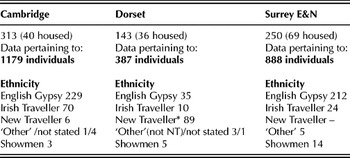
Interviews undertaken by Ethnicity by Study Area

Notes: Other may be Welsh Gypsy/Scottish Traveller, etc.
*New Traveller includes ‘other’ category in Dorset only, as many respondents who would otherwise be classified as NT stated ‘human being’ ‘just a Traveller’ etc.
Local variations: Cambridge, Dorset and North and East Surrey
Findings from three GTAAs undertaken by the author of this paper (and others) indicate the variation in experience, access to accommodation and ethnic population of Gypsies, Travellers and Showmen in different areas of the country. Not only may local conditions suggest that additional research is required to support certain CLG suggested assumptions which feed into pitch calculations, but the variety of findings indicate the potential risks of simply applying a formula in the absence of a robust accommodation assessment or adequate local authority record keeping.
In Surrey and Cambridgeshire the population are predominantly of English Gypsy origins, although in both areas relatively recent in-migration by Irish Travellers has led to changes in the number of unauthorised developments in the study area. For historical reasons associated with low turn over on public sites and length of historical connection to local areas, residents of public sites in all areas surveyed tend to be English Gypsies, somewhat older than the general Gypsy and Traveller population and living amongst a group of close family members who have been allocated pitches on the site as they married and had children. With the lack of new site provision and preferred tendency by both main communities to live amongst Gypsies/Travellers of their own ethnicity, Irish Travellers have, in contrast, tended to cluster on private sites, which are often larger in size than those occupied by English Gypsies and are likely to be unauthorised developments for which retrospective planning permission is sought.
Preferred size of site is for Irish Travellers driven in part by larger family size (average household of 4.9 people, as opposed to 3.5 for English Gypsies and 2.6 for Showmen) and a corresponding tendency for groups of siblings to co-purchase land together. Interestingly, survey results show divergence in preference for site size by ethnicity, with Showmen and English Gypsies generally recording a smaller optimum size for sites, whether or not these are family owned or publicly provided. Thus, the number of sites to be provided or granted permission in any study area will vary accordingly.
Location of sites (for all ethnic Gypsies) is often determined by the proximity of family members and (in the case of both unauthorised developments and licensed private sites) availability of land. For individuals who still travel seasonally or for most of the year (predominantly Irish Travellers), access to major road systems remains important. In the case of Showmen whose livelihood depends on mobility and the ability to follow a particular annual circuit (with large vehicles that may not always fit down country roads), specific considerations apply. Thus their choice of residence is bound not only by where they can obtain permission to store their rides or family preference but by their regular employment commitments. The highest percentage of Showmen we interviewed were based in Surrey, with their preference for this location explained by ease of access to London and Home Counties Fairs. Moreover, these families were often living on sites which had been their traditional ‘yards’ for over 100 years, pre-dating the imposition of modern planning regimes.
In stark contrast, in Dorset which has a very high percentage of New Travellers for reasons associated with proximity to seasonal field work (daffodil picking in Cornwall) and the music festival ‘circuit’, the type of provision requested varies significantly from areas with more ‘ethnic’ Gypsies, Travellers and Showmen. In Dorset, New Travellers predominantly requested less rigidly regulated and formally laid out public provision and reported a preference for small, woodland or ‘Green Lane’ traditional halts. The demographics amongst this population is also very different from other communities with small average household sizes and a high percentage of young, single people with no or very few children. Findings pertaining to the large housed Gypsy population in the Dorset area were particularly interesting as due to a consistent long-term shortfall in public site provision and a policy of low tolerance of unauthorised developments and failure to grant planning permission for private sites, a large number of English Gypsies and the small Irish Traveller populations were mainly resident in housing, to the extent that entire council estates were known as ‘Gypsy areas’. Accordingly, assumptions pertaining to future demographic growth and the potential movement into and out of housing by second generation Gypsies (and indeed New Travellers who may return to housing) has a considerable impact on calculations undertaken and assumptions of future need to be applied to the study area.
Changing employment practices and the rural or urban nature of a locality will also impact on the future pitch provision in any given area as, for example, the increase in migrant workers undertaking fieldwork (Cambridgeshire) and gradual decline in travelling found amongst long-term English Gypsy site residents (Surrey and Cambridgeshire) has led to an increase in take-up of ‘conventional’ local employment. Even if respondents clearly wished to remain living in a caravan rather than moving into housing, their spacial needs pertaining to self-employment and the likelihood of family members joining them for employment purposes are different from ‘traditional’ nomadic families who may work, live and travel together.
Transit requirements also vary significantly from area to area and this is reflective both of employment practices, ethnicity and travelling patterns and availability of access to permanent sites. Perhaps most importantly of all, individual local authorities’ historical approach to Gypsies and Travellers and their policies on granting planning permission (or toleration of roadside encampments) may lead to an area being a more or less desirable location for families seeking accommodation. Thus the historical legacy of earlier regimes and policy approaches continue to reverberate in current assessments of need.
The current situation
The Department for Communities and Local Government has made it clear that all local authorities with housing responsibilities are expected to have completed their GTAAs by the end of 2007, with findings to be fed into planning strategies and regional reviews of accommodation need (CLG, 2007a). Pressure is therefore building on local authorities who have not completed or are only part-way through the process, as a benchmarking exercise (University of Birmingham et al., 2007) has been undertaken, based upon a series of completed GTAAs in the Eastern Region, and a ‘formula’ devised which can be used to impute the numbers of pitches required by recalcitrant (or merely slow) authorities. Accordingly, virtually all local authorities will find themselves responsible for the provision of at least some residential and transit sites.Footnote 6 Although, ironically, councils consistently returning low caravan counts will, through the use of the formula, be required to deliver few pitches, potentially ‘rewarding’ those authorities with non-existent public provision, a reluctance to grant planning provision for private sites and a policy of rapidly moving on unauthorised encampments. In this way, the legacy of ‘designation’ under the 1968 Act (see above) still lives on, albeit in an updated form.
Although at the time of writing the national figure for new caravan pitches has still to be determined, in the Eastern Region alone, a further 1200 pitches are required by 2011.Footnote 7 Whilst it is inevitable that in many local authority areas there will be resistance to the findings from GTAAs with both local people and politicians reluctant to accept the need to provide Gypsy sites (over 67 per cent of local authorities who responded to the CRE review reported that encampments and site applications/developments had caused community tension in their area), change is clearly afoot, driven both by governmental political will and the determination of Gypsy and Traveller community members to become active agents in research partnerships and Community Fora, a position which can be used to monitor the implementation of GTAA pitch recommendations. The provision of equalities and skills training to Fora members will doubtless further empower Gypsy and Traveller activists to work in partnership with local authorities and public agencies and challenge ambiguities or delays where appropriate.
Conclusion
The considered opinion of researchers who have undertaken GTAAs is that the findings from these studies are likely to lead to a rapid increase in private site provision, with authorities either granting permission at first application or Planning Inspectors passing sites on evidence of unduly low provision in any given area. Unpublished research undertaken on behalf of the Liberal Peer Lord Avebury by Jo Richardson in 2007 (private communication from the commissioning agent and researcher) provided preliminary indications that the assumption pertaining to private sites is being borne out in practice, with a sample of 129 planning decisions showing a 20 per cent increase in the number of appeals allowed over the preceding three month period. The impact of delayed GTAAs or deferred identification of ‘suitable’ land for Gypsy sites may be found however in the increased rate of ‘time limited’ temporary planning permissions or those which only permit residence on a site by named individuals. These restrictions on private (family owned) sites provide an indication that the planning inspectorate expect local authorities to identify land to which families may be directed as suitable for purchase to provide a Gypsy site in a timely manner. The underlying intention of temporary or restricted permissions is that ‘unsuitably located’ sites will gradually cease to function as families move on to land zoned for such developments.
Whether or not enhanced public provision will develop at a similar rate (despite the increase in Government funding available and the active encouragement of Registered Social Landlords to become involved in the provision of sitesFootnote 8) will need to be reviewed in due course. Regrettably (if perhaps unsurprisingly given the history of resistance to site provision discussed above), regional variations in provision of public sites are considerable, with the ‘Eastern Region’ (which includes the Cambridgeshire sub-region) significantly in advance of some other localities in developing provision strategies, site identification and applications for Government grants to provide public sites. In other areas, prevarication and refusal to agree recommended pitch numbers is causing considerable delay in the development of public provision with a number of local authorities arguing that pitches should be provided not necessarily where need arises but through the process of implementing ‘back-door quotas’ to decide where need should be met across a GTAA study area. Where political and social pressures exist to diminish recognition (or delay provision) of additional Gypsy and Traveller sites in a given location (or alternatively ‘quota’ systems are negotiated between authorities), in essence the post-1968 situation pertaining to ‘designation’ (see above) is recycled, setting back the equalities agenda by decades.
Whilst the current situation pertaining to site provision for Gypsies and Travellers represents a curious amalgam of cutting edge policy initiatives grounded in civil liberties, human rights arguments which respect the rights of minority ethnic communities to live in moveable accommodation, and continual historically grounded resistance to (and argument over the authenticity and local connections of) Gypsies and Travellers, for once the legislation is ahead of (much) public and political opinion. The media, many local politicians and even some public authorities, whilst recognising the severe social exclusion experienced by travelling communities continue to engage in discourse around the ‘otherness’ of Gypsies and Travellers, (mis)representing the notion of the ‘Stranger’ who challenges the stability of the sedentary population in any given area. The drivers for site provision have, in the twenty-first century (albeit motivated by increased application of statutory control mechanisms), arisen predominantly from the actions of Gypsies and Travellers themselves, who in their desire to provide stable accommodation for their families have challenged notions of ‘nomadism’ as a synecdoche for membership of their minority ethnic communities. This change from within, itself a reflection of contested land use and altered life chances in post-modernity, is, despite the oft-stated regrets of Travellers who remember the ‘freedom’ of the ‘old days’, a marker of cultural dynamism and confidence in demanding participation in decision making over accommodation needs.
Longitudinally, the outcomes of bold decisions pertaining to land usage and the provision of even a few sites (whether public or private) in a locality will in theory set up a ‘virtuous cycle’, with Gypsies and Travellers recognised as ‘neighbours’ who are part of the wider community (Duncan, Reference Duncan1996). The growth of social intercourse between local residents of all communities (e.g at school, social events, etc.) may potentially cause less resentment of future planning applications and renew positive discourse in the debate on future Traveller sites, defusing the use of inflammatory and poorly informed argument based upon historical misapprehensions and fears.
For the moment, however – whilst the magnitude of the initial needFootnote 9 identified within GTAAs is digested by politicians and the wider public – campaigners, Gypsy and Traveller community members and forward-thinking council officers who have to deal with the ‘problem’ will doubtless simply feel that the granting of any new sites will bring about some improvement in the current scandalous state of accommodation that faces Britain's indigenous nomadic communities.
Acknowledgements
The author would like to acknowledge the work and support of Professor Robert Home of Anglia Ruskin University, Faculty of Law with whom she has worked on a series of GTAAs and associated projects. Thanks are also due to the community interviewers, Gypsy/Traveller/Showmen advisory groups, administrative and research teams associated with these projects, Ros Lishman and the anonymous reviewers of the earlier draft of this article for their helpful comments. Particular gratitude is owed to the Gypsies, Travellers and Showmen who participated in the interviews and focus groups which informed the findings of the GTAAs discussed within this paper.