In the target article, Smaldino proposed the defining characteristics of an emergent group-level trait. Apart from the examples in the target article, we point out that human language, as a prominent sociocultural phenomenon in human communities, is also an emergent group-level trait, considering the facts that (a) human groups tend to organize in such a way to efficiently trigger a communal language and (b) linguistic interactions can influence the formation of social organization having certain properties. In line with Smaldino, these facets demonstrate that language is more than a collective behavior dependent on specific organizations of differentiated individuals. In this commentary, based on empirical evidence and computer simulation, we illustrate how to verify a sociocultural phenomenon like language as an emergent group-level trait from these two aspects.
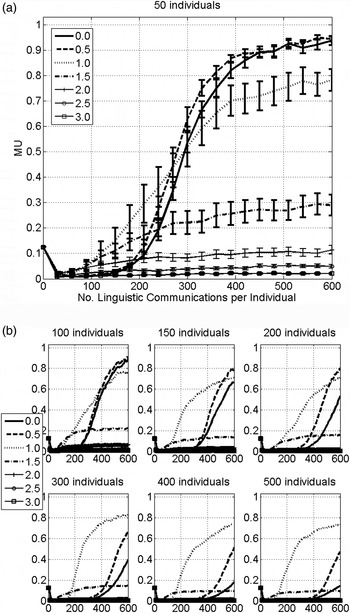
On the one hand, according to the empirical evidence (Newman Reference Newman2003), social communities formed via language-related interactions tend to show a scale-free characteristic (Barabási Reference Barabási1999); these communities usually exhibit power-law degree (the number of social connections an individual has with others) distributions, and the λ values of those distributions are often around 2.0 (e.g., the telephone call network, λ = 2.1 or the e-mail message network, λ = 2.0). Whether such social organization is correlated with language evolution can be explored by computer simulation. For example, we can adopt the lexicon-syntax coevolution model (Gong Reference Gong2009; Reference Gong2011) tracing the origin of both lexical items and basic word orders in a population and define a power-law distributed social popularity (the probability for an individual to participate in communications has a power-law relation with its rank in the group) to mimic such social organization. Then, by adjusting the population size and the λ value in the social popularity, our simulations show that: when λ = 1.0, a communal language with a high mutual understandability (MU, the proportion of semantic expressions that all individuals can produce and accurately interpret using their linguistic knowledge) can be efficiently triggered across various population sizes, but if λ has bigger values, MU starts to drop significantly, particularly in bigger groups (see Fig. 1). Mathematically speaking, λ = 1.0 in this social popularity corresponds to λ = 2.0 in the power-law degree distributions in those social communities. These results clearly reveal the correlation between language and human communities: a particular social organization can efficiently trigger a communal language with a high MU.
Figure 1.
Mutual understandability (MU) under Various Social Popularities in a 50-individual Population (a) and Populations Having Other Sizes (b). Each line denotes the average MU (over 20 simulations) under a social popularity with a particular λ. Error bars denote standard errors (because of size, error bars in (b) are omitted). It is shown that when λ = 1.0, the dynamics of language origin (indicated by MU) is not only similar across different population sizes, but also optimal compared to those under other λ values.
On the other hand, just like other cooperative behaviors, linguistic interactions and mutual understandability can form social bonds among individuals. Such local bonds may trigger some social organization at the group level. To illustrate this, we conduct another study also based on the lexicon-syntax coevolution model. Here, we assume that: (a) each individual has a predefined local-view and only interacts with others falling into his or her local-view; (b) individuals adjust the weights (initially 0.0) of their links to other individuals, based on the success or failure of previous communications with others; and (c) once the weight of a link exceeds a threshold (say, 0.5), a permanent link is formed, and this individual will prefer interacting with those he or she permanently connects to. These assumptions resemble the friendship formation based on common interests in human communities.
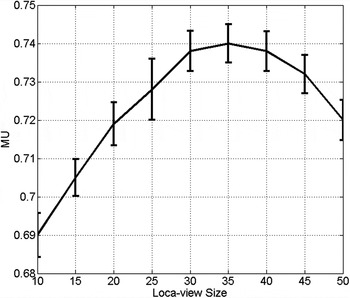
Under such assumptions, our simulations show that a social structure possessing the small-world characteristic (Watts Reference Watts1999) can be gradually formed, along with the origin of a communal language with a high MU. We also observe a correlation between MU and the local-view size (see Fig. 2): with the increase in local-view size in different sets of simulations, some individuals become more centralized than others and participate in more communications to spread their linguistic knowledge, thus increasing MU of the group; however, too much centralization around few individuals fails to further increase MU, because apart from these individuals, others may not have sufficient opportunities to interact with each other, and as a consequence, this may affect the spread of linguistic knowledge and MU of the group. These results not only echo the findings in Figure 1, but also show that certain social organization or properties can be partially ascribed to the group-level trait such as language. According to Smaldino, this is a key feature to distinguish a group-level trait from a simple collective behavior.
Figure 2.
Mutual understandability (MU) vs. Local-view Size (when local-view size = 50, each individual can view all members in the group). Each simulation has 50 individuals and 500 communications, and the adjustment on link weight is 0.01. The results are averaged over 20 simulations. Error bars denote standard errors.
In the above two aspects, apart from the lexicon-syntax coevolution model, studies based on other language models (e.g., Baronchelli et al. Reference Baronchelli, Felici, Loreto, Caglioti and Steels2006; Puglisi et al. Reference Puglisi, Baronchelli and Loreto2008) can also examine the effects of structural features on language evolution (e.g., Baronchelli et al. Reference Baronchelli, Cattuto, Loreto, Puglisi, Minett and Wang2009; Dall'Asta et al. Reference Dall'Asta, Baronchelli, Barrat and Loreto2006; Gong et al. Reference Gong, Baronchelli, Puglisi and Loreto2012a; Reference Gong, Shuai, Tamariz and Jäger2012b). Apart from social interactions, it is shown that combinations of different forms of cultural transmission can also affect language evolution across generations of individuals (e.g., Gong Reference Gong2010). Moreover, models of other social activities (e.g., cooperation, collaboration, labor division, leadership formation, etc.) can also be adopted in those simulation studies. Exploring the dynamic correlation between sociocultural organization and language (or other group-level traits), these studies offer a general computational framework to evaluate whether a sociocultural phenomenon is qualified as an emergent group-level trait. This framework focuses on individual behaviors and group structures, as well as on the correlation between emergent group-level traits and sociocultural organization patterns. According to Smaldino, this framework is very promising for the future work concerning group-level traits in ecological and evolutionary contexts.





In the target article, Smaldino proposed the defining characteristics of an emergent group-level trait. Apart from the examples in the target article, we point out that human language, as a prominent sociocultural phenomenon in human communities, is also an emergent group-level trait, considering the facts that (a) human groups tend to organize in such a way to efficiently trigger a communal language and (b) linguistic interactions can influence the formation of social organization having certain properties. In line with Smaldino, these facets demonstrate that language is more than a collective behavior dependent on specific organizations of differentiated individuals. In this commentary, based on empirical evidence and computer simulation, we illustrate how to verify a sociocultural phenomenon like language as an emergent group-level trait from these two aspects.
On the one hand, according to the empirical evidence (Newman Reference Newman2003), social communities formed via language-related interactions tend to show a scale-free characteristic (Barabási Reference Barabási1999); these communities usually exhibit power-law degree (the number of social connections an individual has with others) distributions, and the λ values of those distributions are often around 2.0 (e.g., the telephone call network, λ = 2.1 or the e-mail message network, λ = 2.0). Whether such social organization is correlated with language evolution can be explored by computer simulation. For example, we can adopt the lexicon-syntax coevolution model (Gong Reference Gong2009; Reference Gong2011) tracing the origin of both lexical items and basic word orders in a population and define a power-law distributed social popularity (the probability for an individual to participate in communications has a power-law relation with its rank in the group) to mimic such social organization. Then, by adjusting the population size and the λ value in the social popularity, our simulations show that: when λ = 1.0, a communal language with a high mutual understandability (MU, the proportion of semantic expressions that all individuals can produce and accurately interpret using their linguistic knowledge) can be efficiently triggered across various population sizes, but if λ has bigger values, MU starts to drop significantly, particularly in bigger groups (see Fig. 1). Mathematically speaking, λ = 1.0 in this social popularity corresponds to λ = 2.0 in the power-law degree distributions in those social communities. These results clearly reveal the correlation between language and human communities: a particular social organization can efficiently trigger a communal language with a high MU.
Mutual understandability (MU) under Various Social Popularities in a 50-individual Population (a) and Populations Having Other Sizes (b). Each line denotes the average MU (over 20 simulations) under a social popularity with a particular λ. Error bars denote standard errors (because of size, error bars in (b) are omitted). It is shown that when λ = 1.0, the dynamics of language origin (indicated by MU) is not only similar across different population sizes, but also optimal compared to those under other λ values.
On the other hand, just like other cooperative behaviors, linguistic interactions and mutual understandability can form social bonds among individuals. Such local bonds may trigger some social organization at the group level. To illustrate this, we conduct another study also based on the lexicon-syntax coevolution model. Here, we assume that: (a) each individual has a predefined local-view and only interacts with others falling into his or her local-view; (b) individuals adjust the weights (initially 0.0) of their links to other individuals, based on the success or failure of previous communications with others; and (c) once the weight of a link exceeds a threshold (say, 0.5), a permanent link is formed, and this individual will prefer interacting with those he or she permanently connects to. These assumptions resemble the friendship formation based on common interests in human communities.
Under such assumptions, our simulations show that a social structure possessing the small-world characteristic (Watts Reference Watts1999) can be gradually formed, along with the origin of a communal language with a high MU. We also observe a correlation between MU and the local-view size (see Fig. 2): with the increase in local-view size in different sets of simulations, some individuals become more centralized than others and participate in more communications to spread their linguistic knowledge, thus increasing MU of the group; however, too much centralization around few individuals fails to further increase MU, because apart from these individuals, others may not have sufficient opportunities to interact with each other, and as a consequence, this may affect the spread of linguistic knowledge and MU of the group. These results not only echo the findings in Figure 1, but also show that certain social organization or properties can be partially ascribed to the group-level trait such as language. According to Smaldino, this is a key feature to distinguish a group-level trait from a simple collective behavior.
Mutual understandability (MU) vs. Local-view Size (when local-view size = 50, each individual can view all members in the group). Each simulation has 50 individuals and 500 communications, and the adjustment on link weight is 0.01. The results are averaged over 20 simulations. Error bars denote standard errors.
In the above two aspects, apart from the lexicon-syntax coevolution model, studies based on other language models (e.g., Baronchelli et al. Reference Baronchelli, Felici, Loreto, Caglioti and Steels2006; Puglisi et al. Reference Puglisi, Baronchelli and Loreto2008) can also examine the effects of structural features on language evolution (e.g., Baronchelli et al. Reference Baronchelli, Cattuto, Loreto, Puglisi, Minett and Wang2009; Dall'Asta et al. Reference Dall'Asta, Baronchelli, Barrat and Loreto2006; Gong et al. Reference Gong, Baronchelli, Puglisi and Loreto2012a; Reference Gong, Shuai, Tamariz and Jäger2012b). Apart from social interactions, it is shown that combinations of different forms of cultural transmission can also affect language evolution across generations of individuals (e.g., Gong Reference Gong2010). Moreover, models of other social activities (e.g., cooperation, collaboration, labor division, leadership formation, etc.) can also be adopted in those simulation studies. Exploring the dynamic correlation between sociocultural organization and language (or other group-level traits), these studies offer a general computational framework to evaluate whether a sociocultural phenomenon is qualified as an emergent group-level trait. This framework focuses on individual behaviors and group structures, as well as on the correlation between emergent group-level traits and sociocultural organization patterns. According to Smaldino, this framework is very promising for the future work concerning group-level traits in ecological and evolutionary contexts.
ACKNOWLEDGMENT
This work is supported by the Seed Fund for Basic Research of the University of Hong Kong.