

Introduction
Maize (Zea mays L.) is one of the most important cereal crops for alleviating global food crises (Tongjura et al., Reference Tongjura, Amuga and Mafuyai2010; Adedire, Reference Adedire2011; Sasson, Reference Sasson2012), and its value as a food, cash crop and industrial raw material cannot be over emphasized (Fajemisin, Reference Fajemisin and Wolf1991; Okoruwa, Reference Okoruwa1992).
Munyiri et al. (Reference Munyiri, Mugo, Otim, Mwololo and Okori2013) reported decreasing maize output and widespread hunger since the 1980s. The activities of weevil Sitophilus zeamais Motsch. (Coleoptera: Curculionidae) in stored maize reasonably contribute to decreasing maize consumption (Adedire, Reference Adedire, Ofuya and Lale2001) by adversely affecting the viability through damage to grains. This calls for enhanced breeding for resistance against this post-harvest pest. The successful use of varieties with good resistance has a number of merits over control by chemical insecticides (Morah and Mbata, Reference Morah and Mbata1982). These are not safe for the user and the environment, often require periodic repetition and are consequently not cost-effective (Gadzirayi et al., Reference Gadzirayi, Mutandwa and Chikuvire2006).
Research efforts have focused on environmentally friendly management options (Arthur and Throne, Reference Arthur and Throne2003) and genetic manipulation for host resistance to pests of stored products, which seems to be an indispensable remedy. Breeding success largely depends on the extent of genetic variability within the germplasm, heritability of the desired character and magnitude of selection intensity applied (Falconer, Reference Falconer1989). In improved varieties, different sources of resistance to insect pests of stored products, especially S. zeamais, have been incorporated (Mwololo et al., Reference Mwololo, Mugo, Okori, Tefera, Otim and Munyiri2012), but a recent study has found that S. zeamais still infests and damages elite maize varieties (Nwosu, Reference Nwosu2014).
The need for a sustainable solution to this infestation demands quick action to work out the characteristics that can be exploited in resistance breeding. Previous studies have identified grain characteristics that breeders can consider to reduce susceptibility to attack (Gudrups et al., Reference Gudrups, Floyd, Kling, Bosque-Perez and Orchard2001; Tongjura et al., Reference Tongjura, Amuga and Mafuyai2010; Mwololo et al., Reference Mwololo, Mugo, Okori, Tefera, Otim and Munyiri2012). Colour, shape, size, hardness and contents of protein, moisture, sugar and phenol have been reported as the bases of resistance (Dobie, Reference Dobie1974; Garcia-Lara et al., Reference Garcia-Lara, Bergvinson, Burt, Ramputh, Diaz-Pontones and Arnason2004; Tongjura et al., Reference Tongjura, Amuga and Mafuyai2010).
Meanwhile, the locus of grain resistance characters is still debatable (Dobie, Reference Dobie1974; Shafique and Chaudry, Reference Shafique and Chaudry2007; Nadeem et al., Reference Nadeem, Hamed and Shafique2011). Unfortunately, there is a dearth of information on the roles of the grain side and the grain side area, as they differ in their susceptibility to weevil penetration and feeding. This study, therefore, reports on the preference of S. zeamais for feeding sites on elite maize varieties.
Materials and methods
Experimental site
The investigation was carried out in the Research Laboratory of the Department of Crop Production, University of Agriculture, Makurdi, Benue State, Nigeria, at an average temperature of 32.7 °C and a relative humidity of 70.4%.
Maize variety
A total of 20 improved maize varieties were used (Plate 1): TZBRCOMP.2C1F1, TZBRELD3C5, PVASYN-3F2, PVASYN-6F2, DTSYN-11-W, BR9943DMRSR, IWDC3SNY-W, WHITEDTSTRSYN, 2008DTMA-YSTR and 2000SYNEE-WSTR obtained from the Maize Breeding Unit, International Institute for Tropical Agriculture (IITA), Ibadan, Nigeria and ILE-1-OB, IFEMAIZEHYBRID-1, IFEMAIZEHYBRID-2, IFEMAIZEHYBRID-5, IFEMAIZEHYBRID-6, ARTCOMPOSITE-A-Y, ARTCOMPOSITE-B-Y, ART/98/SW1-OB, ART/98/SW4-OB and ART/98/SW5-OB, obtained from the Maize Breeding Unit, Institute of Agricultural Research and Training (IAR&T), Moor Plantation, Ibadan, Nigeria. All the test varieties possess dent face (concave depression around the lower part of the grain). The 2000SYNEE-WSTR variety (highly resistant against S. zeamais Motsch.) was used as a check in comparing the extent of varietal grain damage caused by the weevil.
20 elite maize varieties used in the study.

All grains were disinfested at − 20 ± 2 °C for 1 week in a deep freezer (Sulehrie et al., Reference Sulehrie, Golob, Tran and Farrell2003), and then kept for 2 weeks in muslin-covered plastic containers in the experimental conditions to stabilize the moisture content at 12–13% (Abebe et al., Reference Abebe, Tefera, Mugo, Beyene and Vidal2009).
Insect culture and routine maintenance
Cultures of S. zeamais were established to supply adults of similar age for the experiment. Bende White (25 kg) was bought from Umuahia Main Market, Abia State, Nigeria. Grains were sorted to eliminate those with visible damage symptoms and were disinfested in a deep freezer. A total of 100 adult weevils per 500 g of grains (Abebe et al., Reference Abebe, Tefera, Mugo, Beyene and Vidal2009) were maintained in seven containers (25 cm height and 15 cm diameter). The containers were covered with muslin (each lid with a hole of 15 cm diameter) to allow aeration and to prevent weevils from escaping. After 7 d of oviposition, all parent S. zeamais were removed from each container and placed on another set of grains under the same conditions. The removal of parent S. zeamais and transfer to a fresh grain medium were repeated until sufficient adult S. zeamais of similar age were available for the experiment.
Determination of grain perforation site preference
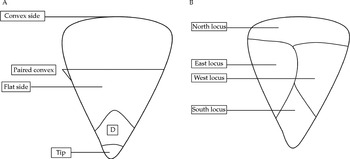
For this purpose, 30 grain varieties were randomly selected from a 20 g sample of each maize variety and placed in a transparent plastic container (11 cm diameter and 4.5 cm height). Each grain variety was placed carefully with one of its flattened sides facing the base of the container, equidistant from the centre and from one another. Two copulating pairs of 2-week-old adults, sexed morphologically using the method of Halstead (Reference Halstead1963), were introduced at the centre bottom of each plastic container and covered with white muslin for ventilation and to prevent exit and entry of insects. There were four replications for each maize variety. The containers of infested maize were arranged in a completely randomized design on a workbench in the laboratory and left for 47 days (sufficient time for the weevil to cause reasonable perforations but not long enough to prevent a loss of preference). Grain preferences for grain perforation side (Fig. 1A) and side-locus (Fig. 1B) were assessed, based on the holes/tunnels in grains. The number of damaged grains (in terms of holes/tunnels) and the percentage of grain damage were also determined using the method described in Tefera et al. (Reference Tefera, Mugo and Likhayo2011).
(A) Maize grain showing sides in this study. (B) Flat side of a maize grain showing its surface loci.

Statistical analysis
Analysis of variance (ANOVA) was used to analyse data from this study, and significantly different means were assessed using least significant difference (LSD) at 5% probability level.
Results
Grain site feeding preference by adult Sitophilus zeamais and varietal effect on grain damage
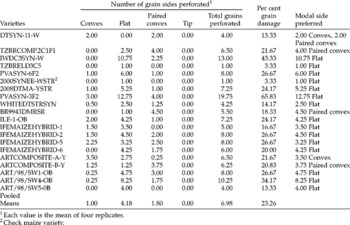
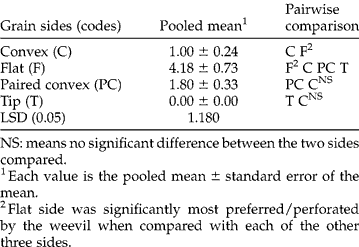
In all the varieties tested for preferences, the flattened body side of the grain was most preferred for feeding except in varieties TZBRCOMP.2C1F1, BR9943DMSR and ARTCOMPOSITE-B-Y. However, in WHITEDTSTRSYN, both the flat body side and the paired convex side were perforated (Table 1). The preference shown by adult S. zeamais to perforate the flat body side of the varieties was significant (LSD (0.05) = 1.0994) (Table 2). The tip of the grain was least preferred.
Sitophilus zeamais grain perforation site preference

1 Each value is the mean of four replicates.
2 Check maize variety.
Comparison of pooled varietal mean of maize grain sides perforated by Sitophilus zeamais
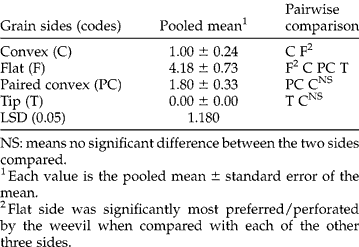
NS: means no significant difference between the two sides compared.
1 Each value is the pooled mean ± standard error of the mean.
2 Flat side was significantly most preferred/perforated by the weevil when compared with each of the other three sides.
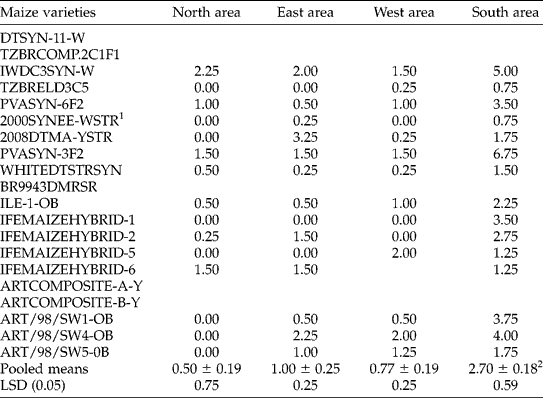
On the flat side, significant differences occurred among the loci preferred by the weevil (North area LSD (0.05) = 0.75; East area LSD (0.05) = 0.25; West area LSD (0.05) = 0.25 and South area LSD (0.05) = 0.59) (Table 3). However, the South locus/area was significantly the most often preferred when their overall means were further compared (LSD (0.05) = 0.195) (Table 3).
Perforation preference of Sitophilus zeamais for flat side locus of the grain
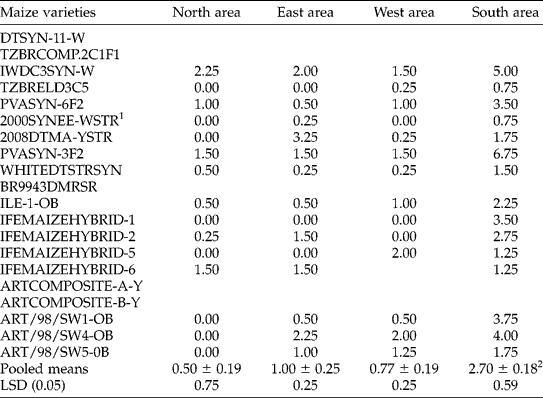
1 Check maize variety.
2 P= 0.05.
Considerable variations occurred in the extent of grain damage on each variety (Table 1). Adult S. zeamais hardly attacked the check variety (2000SYNEE-WSTR); the PVASYN-3F2 variety showed highest infestation rate (Table 1).
Discussion
The presence of significant differences among the four sides of a maize grain in terms of perforation preference and the choice of the flat body side were significant observations in terms of feeding damage that may provide useful information for resistance breeding in stored maize. The flattened body side that S. zeamais preferred to perforate, probably to gain more anchorage, is undoubtedly the largest side of a maize grain. The TZBRCOMP.2C1F1 and BR9943DMSR varieties, in particular, were exceptions to this observation, as S. zeamais instead preferred the paired convex side. Increased surface area and better anchorage may provide a better opportunity to damage the grain. Bell and Watters (Reference Bell and Watters1982) attributed increased feeding preference on stored maize by Prostephanus truncatus to the need for space and anchorage; the same may be true for Sitophilus spp. It can now be suggested that breeders should manipulate the grain to reduce surface area and size as well, in order to help to cope with infestation by S. zeamais in stored maize, provided this does not result in significant losses in the quantity available for human use. The observation that the flattened body side of the shelled grain was the most vulnerable to attack in this study may explain the lower rate of damage experienced in the field (Morah and Mbata, Reference Morah and Mbata1982; Demissie et al., Reference Demissie, Tefera and Tadesse2008). When grains are on the cob (unshelled), the flattened body side is masked by the arrangement, preventing easy attack, therefore weevils are limited to the convex side, which, in the present study, they did not find easy to penetrate, probably because of its hardness. The upper head (that is, convex side) is known to be the hardest part of a maize grain (Transtutors, 2013) (http://www.transtutors.com, accessed 16 May 2013). The reason why the paired convex side of TZBRCOMP.2C1F1, BR9943DMSR and ARTCOMPOSITE-B-Y varieties was most preferred is unknown. Investigating this exception, particularly by breeders, may also add new sources of resistance to pest attack.
Among the test varieties, the significant differences observed in the ability of the maize weevil to attack the grains are strongly indicative of variations in the inherent/genetic resistance. The finding that the check/standard variety (2000SYNEE-WSTR) had very low weevil perforation preference and feeding damage (3.33%) in contrast to the PVASYN-3F2 variety (65.83% feeding damage) is strongly attributed to the effect of host resistance. The PVASYN-3F2 variety was susceptible when compared with 2000SYNEE-WSTR in terms of percentage of grain damage. In addition, the finding that adult S. zeamais mostly preferred to feed on the South surface of the flat side of a maize grain has implications for grain viability. Adedire et al. (Reference Adedire, Akinkurolere and Ajayi2011) found that maize grains lose part of their viability or have it adversely affected following weevil infestation, possibly because the cells of the germ or embryo located within the South surface (Fig. 1B) are damaged in the course of feeding. These cells are known to secrete digestive enzymes during germination that digest and absorb the nutrients in the endosperm. Since these nutrients help in the development and growth of the seedling (http://www.transtutors.com), it is very likely that damage to the epithelial/germ cell layer from pest feeding is responsible for the loss in post-infestation viability. Why the South area of the flat side of the maize grain was most preferred in this study requires further study, since virtually all the energy-rich food reserve is concentrated in the endosperm encompassed by the three other surfaces. However, the embryo contains more proteins and other nutrients than the endosperm. It is possible that the soft appearance of the dent mark (concave depression) (Fig. 1A) that dominated the South area of the flat side of tested grains may have contributed to the preference for this side, since the portion that S. zeamais would prefer while feeding inside the grain cannot be foreseen. Incidentally, the South area of the grain internally bears the seed embryo (plumule and radicle). Therefore, any concentration of attack on this locus will have an undoubted adverse effect on the germination potential. Findings on the site preference for grain perforation have provided more insights for the study of the susceptibility of maize grains to infestation by S. zeamais.
Acknowledgements
We are grateful to Mrs Ugochinyere Ihuoma Nwosu (Department of Statistics, Federal University of Technology, Owerri, Imo State, Nigeria) for ensuring accuracy and validity in the statistical analysis of the data. We sincerely appreciate the contributions of Professor M.O. Ashamo (Food Storage Technology Programme, Department of Biology, Federal University of Technology, Akure, Ondo State, Nigeria) in ensuring that the investigation was carried out successfully. The International Institute for Tropical Agriculture (IITA), Ibadan, Nigeria, and the Institute of Agricultural Research and Training (IAR&T), Moor Plantation, Ibadan, Nigeria, supplied the elite maize varieties used in the study. This paper came from the first author's PhD research at the Federal University of Technology, Akure, Ondo State, Nigeria.