1. Introduction
According to a widely held view, democratic deliberations should arrive at results representing collective, informed decisions (Fishkin Reference Simon2009). According to this view, science must play an important role within democratic decision-making, as the provider of relevant knowledge and information. But the idea that science can play this role faces serious challenges. One emerges from the apparent inability of the public to make use of knowledge obtained by scientists. Research has demonstrated the extent of public ignorance on scientific matters, its lack of motivation to engage in serious study and deliberation on such matters, its vulnerability to manipulation, and the extent of systematic attempts to exploit this vulnerability. Thus, what we can reasonably expect to find is an “underinformed and nondeliberative public” (Fishkin Reference Simon2009, 7). Accordingly, even if scientists had all the relevant information needed to make a collective informed decision, the public’s decision would often not be informed. Call this the responsiveness-to-science problem.
A different kind of challenge emerges from the fact that scientific activity may not be properly responsive to the values, needs, and interests of different segments of society. The clearest example of this concerns the way in which the scientific agenda is set. Scientists often do not pay enough attention to questions whose answers would serve the interests of much of the public.Footnote 1 Accordingly, even if the public were responsive to knowledge held by scientists, available scientific knowledge might not allow the public to make informed decisions, because the scientific agenda is unresponsive to the public and its needs. Call this the responsiveness-of-science problem.
While these are distinct problems, a single idea, developed independently by prominent philosophers of science such as Philip Kitcher (Reference Kitcher2001) and political theorists such as James Fishkin (Reference Simon2009), may suggest a way of addressing them both. The suggestion can be presented via an analogy with the treatment of consent in contemporary medical ethics. In medical contexts, where actual informed consent cannot be obtained because of a patient’s lack of decision-making capacity, it is widely held that treatment decisions should be based on what the patient would have decided on if he were to make an informed, considered decision. Analogously, when it comes to certain decisions that require scientific input, contemporary democracies may seem to lack the capacity to reach an informed democratic decision. On such questions, it might be suggested, policy should conform not to actual democratic decisions, but to what the public would have decided on if it were to reach a decision through an informed, democratic decision-making process. Thus, the problem of responsiveness to science can be addressed if public policy on science-related issues is not based on an actual democratic decision but instead conforms to a counterfactual informed democratic decision (CIDD).
Moreover, if CIDDs offer a solution to the responsiveness-to-science problem, then they can indirectly help solve the responsiveness-of-science problem, by specifying the standards that should guide scientific institutions. Indeed, this is the core idea underlying Kitcher’s (Reference Kitcher2001, Reference Kitcher2011) suggested specification of an ideal of a well-ordered science. Kitcher suggests that in asking what the scientific agenda should be like, or in evaluating contemporary scientific institutions, the standard to which we should appeal is to be specified democratically: not by the actual democratic decisions of an ignorant public, but instead by considering ideal, hypothetical democratic deliberations. The actual scientific agenda should conform to the agenda that would be decided on if it were decided on through ideal, counterfactual, informed democratic deliberations.
While I believe that considering the results of CIDDs can play an important role in our attempt to address the problems of scientific responsiveness, I think that it is a mistake to think that we should make public policy decisions requiring scientific input in accordance with CIDDs, or that CIDDs determine the standards against which actual institutions should be judged. CIDDs, I shall argue, do not have the same normative import, and do not carry the same kind of authority, as either actual democratic decisions or counterfactual decisions of incapacitated patients. The latter have legitimizing force, while the significance of CIDDs is merely epistemic. The idea that public policy should ultimately accord with CIDDs therefore misconstrues their significance.
2. Democratic Decision Making for Incapacitated Societies
In the medical context, the standard contemporary view is that if a patient lacks decision-making capacity, then, provided that certain conditions are met, whoever acts as surrogate decision-maker should “attempt to decide as the patient would have decided in the circumstances that now obtain, if the patient were competent” (Brock Reference Brock1994, S9). This is often referred to as the substituted judgment standard (SJS). Now it might be suggested that when it comes to certain decisions for which scientific input is required, contemporary societies lack decision-making capacity. They are incapacitated, in the sense that they are unable to arrive at collective informed decision, not because relevant knowledge and information are unavailable, but because, like incapacitated patients, they lack the ability to make decisions based on sound deliberation on available information. It is for this reason that the analogy with the treatment of incapacitated patients may suggest itself.
Here is how Fishkin employs the analogy: “Just as when individuals offer informed consent to a medical … procedure, we think they should know what they are agreeing to … we can apply generally similar considerations to the outlines of an acceptable collective process of achieving something analogous—the consent of ‘we the people’” (Reference Simon2009, 34). Now because our community is in a sense “incapacitated,” the “choice … is between debilitated but actual opinion, on the one hand, and deliberative and counterfactual opinion, on the other” (26). Fishkin, in advocating an approach based on the use of deliberative polling, obviously thinks we should go for the latter: “Deliberative Polling attempts to employ social science to uncover what deliberative public opinion would be on an issue. … The resulting deliberative public opinion is both informed and representative. As a result, it is also, almost inevitably, counterfactual” (Fishkin Reference Simon2009, 26).
It should be noted that Fishkin, while claiming that knowledge of CIDDs of “we the people” has normative import, is not always clear on what its import should be. But the analogy with informed consent in the medical context suggests that under certain conditions, such decisions should be authoritative.Footnote 2 And Kitcher, as already noted, defends such a view explicitly with respect to the scientific agenda. Thus, in claiming that democratic deliberative procedures should determine the proper scientific agenda, he is explicit that given the ignorance of the public, “there’s no thought that well-ordered science must actually institute the [democratic procedures] envisaged.” Instead, “the thought is that, however inquiry proceeds, we want it to match the outcomes those complex procedures would achieve” (Kitcher Reference Kitcher2001, 123).
In the medical context, for SJS to be applicable, a number of conditions must hold. First, the decision to be made is one on which the patient’s informed decision, if it were actually made, would have been authoritative, but on which the patient has not made a decision. Second, the patient must lack decision-making capacity. Third, the surrogate decision-maker must nonetheless be able to know how the patient would have decided if he were able to make an informed decision.
If we take the analogy with the treatment of incapacitated patients seriously, the following might therefore suggest itself: On questions on which actual democratic decisions would have been authoritative, but on which no democratic decision has been made, and on which, moreover, our society is unable to actually make an informed democratic decision, we should, as in the medical context, appeal to SJS. On such questions—call them difficult science-related questions—we should attempt to decide as the public would have decided if it were able to make an informed democratic decision.
Of course, one question about the applicability of SJS to democratic decisions is whether we can know what decision the public would have made if it were to make an informed democratic decision. However, if we can have counterfactual knowledge about the kind of decisions an individual would have made if he were informed, then there are no principled reasons to think that we cannot have counterfactual knowledge about the democratic decision a community would have made if it were properly informed. Indeed, social scientists are developing tools whose purpose is precisely to allow us to have such counterfactual knowledge. This is the purpose of deliberative polling, in which a random, representative sample of the population is invited and incentivized to participate in a deliberative process, culminating in a democratic vote on a policy question that is supposed to represent the decision the entire population would have made if it could make an informed democratic decision. In recent years such deliberative polls have been put to use to decide on a range of questions—to determine the identity of party candidates in Greece, to guide the energy policy of the state of Texas, to prioritize ways of investment in infrastructure in Wenling, China, and more (Fishkin Reference Simon2009).
We can now see how the analogy with informed individual consent might motivate Kitcher’s suggestion that the agenda of science should also be set in accordance with a CIDD. Three features of contemporary science seem to support this suggestion. On the one hand, public funding of science and science’s significant effect on the public may suggest that an actual democratic decision would have authority in determining the scientific agenda. On the other hand, public ignorance about science may suggest that the scientific agenda should not be determined by actual noninformed democratic decision, but in accordance with a CIDD (Kitcher Reference Kitcher2001, Reference Kitcher2007).
3. Counterfactual Decisions, Individual and Collective
However, there are reasons for doubt about the suggestion that decisions on the scientific agenda, or on science-related questions more generally, should conform to CIDDs. The normative import of CIDDs is very different from that of counterfactual decisions of individuals.
According to SJS, when we have reliable knowledge about an incapacitated patient’s informed counterfactual decision, we should act accordingly, even if we also know that his counterfactual decision would not best serve his interests. It is only when we lack knowledge about his counterfactual decisions that we should make decisions based on the best-interest standard (Brock Reference Brock1994). Thus, if we are certain that a Jehovah’s Witness, if he were capacitated, would have refused a course of treatment requiring blood transfusion, we should not provide him with such treatment when incapacitated, even if we are quite certain that such treatment would best serve his interests.
If acting on patients’ counterfactual decision when these decisions are not best is justified, this is because doing so allows us to respect patients’ autonomy and right of self-determination by deciding in accordance with their values and conception of the good (Brock Reference Brock1994). But it is doubtful that a similar justification can be given to the idea that we should make decisions in accordance with CIDDs, even when these decisions do not best serve the community’s interests and do not achieve the most just distribution of benefits. There are at least two reasons underlying this doubt.
First, in the case of incapacitated patients, adhering to SJS when their informed counterfactual decisions are not best involves sacrificing their interests in order to respect their own values and conception of the good. In contrast, in the case of a community, acting in accordance with CIDDs when these counterfactual decisions are not best—when they do not best serve the interests of community members, or the most just distribution—involves sacrificing the interest of some, in order to respect the values and conception of the good of others. In this sense the analogy studied here, to paraphrase Rawls, extends to society a principle of choice for one person, thereby failing to take seriously “the distinction between persons” (Reference Rawls1971, 27). But this distinction is of prime significance precisely when it comes to the right of self-determination. This right of yours requires that I respect your values and decisions about how you conduct your own life, but not that I respect your decisions and values when it comes to other persons’ lives.
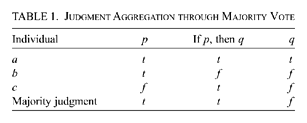
A second objection to the analogy emerges from consideration of what is known as the discursive dilemma (Pettit Reference Pettit2001). Consider the following case, of a community composed of three individuals, each with a perfectly consistent set of judgments regarding the truth of three propositions (p; if p, then q; and q), as described in table 1.
Judgment Aggregation through Majority Vote

| Individual | p | If p, then q | q |
|---|---|---|---|
| a | t | t | t |
| b | t | f | f |
| c | f | t | f |
| Majority judgment | t | t | f |
Here, even though all members of the community have rational sets of judgments, so that all sets include whatever conclusions follow from accepted premises, the same is not true of the resulting collective set of judgments, generated by aggregating individuals’ judgments through majority vote. As is well known, this is a general feature of majority vote. Certain principles and facts, from which certain conclusions logically follow, may be accepted by a majority of the population, and yet the conclusions might be rejected by the majority.Footnote 3 Thus, majority vote is a way of making collective decisions that are responsive to individuals’ judgments, but majority vote cannot be equally responsive to all judgments of all individuals. So the second reason why the analogy with the case of incapacitated patients fails is that in the case of a community, deciding on a question in accordance with the counterfactual informed decision of the majority may not amount to deciding on it in accordance with the values and principles of most members of the community.
4. Democratic Decision Making, Actual and Counterfactual
CIDDs therefore do not have the same normative import as counterfactual informed decisions of incapacitated individuals. The latter are authoritative in the sense that we should abide by them, even if we are quite certain that the decision made is not best. CIDDs do not have this kind of legitimizing force. They can at best serve as an indication of what the best decision is. And they are neither the only relevant kind of indicator nor the best possible one. Indeed, sometimes the consensus of scientists, or possibly of philosophers, might provide a much better indication.
A supporter of CIDD-based standards might try to undermine my objections to their authoritativeness by claiming that if these objections were sound, they would show not only that CIDDs should not be authoritative but also that the same is also true of actual democratic decisions. And this is surely implausible. However, this counterargument from actual democracy is based on a mistake. The objection to CIDD-based standards would undermine the authoritativeness of actual democratic decisions only if it equally applied to actual and counterfactual democratic decisions, and only if whatever could be said for the legitimacy of actual democratic decision-making would also apply to CIDDs. But neither of these conditions holds.
Consider the objection from self-determination to the applicability of SJS to the case of the community. One might attempt to undermine the objection by claiming that communities, not only individuals, have a right to self-government, by virtue of which a community’s democratic decision is authoritative, even when the decision is not best, and even if, as a result, some individuals’ interests are sacrificed. This is something I do not want to contest. However, we need not deny that communities have such rights in order to deny the authoritativeness of CIDDs. For it is a community’s actual democratic decisions, not its counterfactual democratic decisions, that are authoritative. Even if knowledge of hypothetical decisions of agents has normative import, the reason why such knowledge has normative import is not the same as the reason why actual decisions have normative import. As Dworkin noted with respect to Rawls’s hypothetical-contract argument for his theory of justice, “A hypothetical contract is not simply a pale form of an actual contract; it is no contract at all” (Reference Dworkin and Daniels1975, 18). Actual consent to a contract can generate for me a reason to do what I would otherwise have no reason to do. In contrast, the fact that under certain conditions I would have consented to a contract does not create for me a reason for action. Instead, the force of a hypothetical-contract argument is merely epistemic: it can serve to show what reasons apply to us anyway. Accordingly, if the option that would be accepted by a CIDD is not best, its counterfactual acceptability does not generate for us a reason to accept it.
But then why is it that in the case of the individual incapacitated patient we ought to decide as the patient would have decided, even when we know that his decision is not best? This is presumably so because we have reasons to respect his values, principles, and conception of the good, and because his counterfactual decision would follow from these and thus represent them. But it is doubtful whether a community’s CIDDs similarly represent its values and principles. In the case of an individual, we normally ascribe counterfactual decision to her on the basis of values, beliefs, and principles we know she actually accepts, and we can thus take her counterfactual decision as representing her actual values and principles. But where our basis for attributing to an individual or collective subject a counterfactual decision is not knowledge of her actual deep commitments, but rather a deliberative poll, or some other such experimental test indicating how she would have decided under counterfactual conditions, it would be a mistake to think that this counterfactual decision represents the subject’s actual commitments. Even if we can attribute mental states to collective subjects, these cannot be attributed to them by virtue of merely counterfactual decisions. If we were to attribute mental states to communities merely on the basis of CIDDs, these would be very bizarre mental states. They would not satisfy minimal conditions of self-knowledge and rationality that any account of mental-state attribution should arguably insist on.Footnote 4
The central virtue Fishkin (Reference Simon2009) attributes to deliberative polls is that they arrive at a decision that is both representative and informed. But while deliberative polls may represent the counterfactual informed decision of the public, this counterfactual decision, unlike individual counterfactual decision appealed to in the medical contexts, cannot be assumed to represent the subject’s actual values and principles. Therefore, it is not clear why what deliberative polls represent merits special respect. Matters are quite different with actual democratic decisions. Here, by virtue of the actual decision made, we have grounds to attribute commitments to a collective subject. Therefore, my objections to the acceptance of CIDD-based standards do not equally apply to actual and counterfactual democratic decisions.
Consider the second condition that must hold for the counterargument from actual democracy to succeed. Is it the case that whatever can plausibly be said for the legitimacy of actual democratic decision-making similarly supports the adoption of CIDD-based standards on science-related policy questions? There are reasons to think not. Indeed, there are reasons to think that, quite generally, plausible arguments for democracy do not support adopting CIDD-based standards (Keren Reference Keren2013). A detailed argument for this would demand much more space than available here, for arguments for democracy are many and varied. But what has been said above suggests some reasons for thinking so, for it shows that some arguments for democracy, such as arguments from autonomy and self-determination (Christiano Reference Christiano and Zalta2015), do not support adopting CIDD-based standards. Moreover, instrumental arguments for democracy provide us with further prima facie reasons for thinking that the objection from actual democracy fails. Such arguments appeal to the good consequences of implementing actual democratic decision-making procedures. For instance, one historically important instrumental argument for democracy is based on claims about the positive effects of participation in democratic decision-making on the character of citizens (Mill Reference Mill1861/1991). Obviously, conforming public policy to CIDDs would not have similar effects on citizens’ character. And the same is arguably true of other familiar instrumental arguments for democracy (Keren Reference Keren2013). For according to such arguments, we should insist on the state being governed by actual democratic decision-making procedures, because the good consequences associated with such democratic procedures cannot be obtained otherwise. Hence, if sound, such arguments suggest that these good consequences cannot be obtained by merely conforming public policy to CIDDs. Indeed, if they could be thus obtained, we could get all the good consequences of actual democratic voting and deliberation, while avoiding some of the familiar shortcomings and costs associated with modern democracies. Even when actual democratic voting could be informed, this would constitute a powerful instrumental argument against the claim that we should make decisions through actual democratic voting procedures.
5. The Epistemic Role of CIDDs
We thus see that neither the analogy with medical informed consent nor our commitment to democracy should lead us to accept the authoritativeness of CIDDs on science-related questions. Reasons for insisting on the state being governed democratically do not similarly support the claim that public policy should conform to counterfactual democratic decisions. And reasons for giving authority to informed counterfactual decisions of individuals do not support giving authority to informed counterfactual democratic decisions of communities. The analogy with the informed consent of medical patients thus misrepresents the normative significance of CIDDs: the question of which option most people, if informed, would regard as best is not the question we ultimately need to answer when faced with science-related policy issues.
Nonetheless, the answer to this question is significant, and once the misguided idea that public policy should conform to CIDDs is rejected, we can better appreciate its true significance. For the problem with this idea is not only that it attributes to CIDDs a kind of significance that they do not have, but also that it suggests that CIDDs do not have the kind of significance that they should have. If it is the public’s counterfactual informed democratic decisions with which public policy should conform, then for the well-functioning of our democracies, it does not really matter how uninformed the public actually is. As long as we are able to know how the public would have decided under ideal counterfactual conditions, it does not matter whether the public learns about science from Fox News or from Scientific American, or whether our education system provides future citizens with a sound training in science or in creation science. All that we need to make the right decision on behalf of the public is to know how it would decide if it were properly informed.
But this is a mistake. Systematic manipulation of evidence made available to the public and resulting erroneous beliefs held by much of the public represent a most serious threat to the well-functioning and legitimacy of contemporary democracies. And if consideration of CIDDs does not allow us to avoid this problem, then there is arguably no way of addressing it that does not involve combating this kind of public ignorance. It is in this context that deliberative polling can have an important epistemic role.
Quite generally, knowledge of the opinion of other informed persons is an important epistemic resource. This can be an important epistemic resource even when the informed person is my peer (Christensen Reference Christensen2007), and more so when she is better informed than I am. This is why it is often important for us to know what scientists think on an issue. For this reason, knowing what the public would have judged, if it were informed, is an important epistemic resource.Footnote 5 Indeed, as a resource not only for coping with our fallibility and ignorance but also for learning about our fallibility and ignorance, it may have a unique role to play, a role that knowledge of what scientists think cannot by itself play.
A developed system of cognitive division of labor would not create such problems for a democratic decision-making system based on the idea of giving equal say to all if the lay public knew that experts do not differ from the public in their interests, but simply had superior knowledge, and trusted them accordingly. But trust is lacking partially because the public systematically differs from scientists not only in terms of knowledge but also in terms of interests. So while the encounter with others is an opportunity to learn, both scientists and the public often fail to learn because it is not clear what underlies the difference in opinions between them: different levels of knowledge or different kinds of interests.
It is for this reason that CIDDs may provide both scientists and the public with a helpful mirror. For a CIDD represents the (possible) collective opinion of a group of individuals similar to the public in terms of their interests, but more similar to scientists in terms of their knowledge. A difference between the decision made through a CIDD and actual public opinion may suggest to the public that the difference between actual public opinion and scientific opinion is likely to be the result of the public’s own ignorance. In contrast, if the CIDD is similar to actual public opinion, and different from the opinion of the scientific community, this may suggest to scientists that the differences between scientists’ opinion and that of the public may be explained not by public ignorance but by something else: perhaps lack of trust, perhaps differences in interests.
Because the division of cognitive labor creates systematic differences between scientists and the lay public in terms of both knowledge and interests, members of the scientific community can learn from knowledge of the general public opinion, and members of the public can learn from the scientific community’s opinion. But members of both communities can learn more from these if they also have knowledge of CIDDs. Devices like deliberative polling might therefore serve an important educational function that neither standard public opinion polls nor statements representing the scientific consensus can serve. But to see that this is indeed an important function, we must reject the idea that public policy on science-related questions ought to conform to CIDDs. We must admit that the well-functioning of our democracies does not ultimately depend on our knowledge of how the public would decide if it were properly informed, but rather on how misinformed the public actually is.