Introduction
Pomegranate is one of the oldest edible fruits that have high nutritional value and medicinal properties. The genus Punica belongs to the family Lythraceae and has two species including Punica granatum L. and Punica protopunica Balf. (Morris, Reference Morris2007). Earlier reported chromosome number of cultivated species Punica granatum was 2n = 2x = 16, 18 (Morton, Reference Morton1987). Researchers believe that pomegranate is native to Iran and its surrounding countries, including Afghanistan, Pakistan, India and Oman, from where it diversified to other regions. The ability of pomegranate trees to adjust to different climatic conditions is reflected in the distribution of the genotype forms throughout Eurasia to the Himalayas (Sarkhosh et al., Reference Sarkhosh, Zmani, Fatahi and Ebadi2006; Karimi et al., Reference Karimi, Zari, Mirdehghan, Mohamadi Mirik and Sarkhosh2020). Various studies show that Iran is considered the pomegranate centre of origin and possesses one of the richest pomegranate gene pools worldwide, which can be used in pomegranate breeding programs (Sarkhosh et al., Reference Sarkhosh, Zamani, Fatahi and Ranjbar2009). The existence of more than 760 pomegranate genotypes with different characteristics proves this claim (Parvizi et al., Reference Parvizi, Sepaskhah and Ahmadi2016). Pomegranate cultivars are named independently of their geographical origin, while the characteristics based on the common genetics of the cultivars are contrary to the phenotypic differences (Karimi and Mirdehghan, Reference Karimi and Mirdehghan2013). In addition, due to the long history of pomegranate cultivation in various environmental conditions, the occurrence of spontaneous mutations and genetic diversity is not unexpected, which is one of the major problems in naming and classifying pomegranate genotypes. Due to the extraordinary importance of this valuable plant, the preparation of molecular identification for existing cultivars and genotypes to determine the identity and genetic ancestry and study of relationships will be a valuable step in identifying and conservation of genetic resources (Sarkhosh et al., Reference Sarkhosh, Zamani, Fatahi and Ranjbar2009). Careful study of plant phenotypic and phylogenetic relationships plays an important role in the development of breeding programmes to produce new cultivars with premium quality and greater resistance to adverse environmental conditions (Zarkti et al., Reference Zarkti, Ouabbou, Hilali and Udupa2010). Morphological markers are used to identify cultivars and genetic resources of fruit trees, but due to the long growth of fruit trees and environmental factors affecting them, this method alone is not valuable. Today, modern biotechnology methods are used for the genetic fingerprinting and identification of the genetic diversity of plants (Yuan et al., Reference Yuan, Yin, Qu, Zhu and Li2007; Jbir et al., Reference Jbir, Hasnaoui, Mars, Marrakchi and Trifi2008; Sheidai et al., Reference Sheidai, Sadeghi, Shahreiyari, Noormohammadi, Farahanei and Tabatabaei Ardakanei2008). A wide range of molecular markers such as RAPD markers (Talebi Badaf et al., Reference Talebi Badaf, Bahar and Sharif2003; Hasnaoui et al., Reference Hasnaoui, Mars, Chibani and Trifi2010), AFLP markers (Yuan et al., Reference Yuan, Yin, Qu, Zhu and Li2007; Jbir et al., Reference Jbir, Hasnaoui, Mars, Marrakchi and Trifi2008), SSR markers (Sinjare, Reference Sinjare2015; Basaki et al., Reference Basaki, Khayam Nekouei, Choukanand and Mardi2016; Gunnaiah et al., Reference Gunnaiah, Jagadeesha, Cholin, Prabhuling, Govindaswamy Babu, Fakrudin, Pujer and Murthy2021), and ISSR markers (Almiahy and Jum'a, Reference Almiahy and Jum'a2017) have been used to evaluate the genetic diversity of pomegranate cultivars and their wild genotypes. A novel molecular marker known as Start Codon Targeted (SCoT) polymorphism targets based on Polymerase Chain Reaction (PCR) which is designed based on the short conserved sequences in plant genes surrounding the ATG initiation codon (Collard and Mackill, Reference Collard and Mackill2009). SCoT marker is an effective technique for population studies, assessment of genetic variation and structure, identify cultivars and DNA fingerprinting (Collard and Mackill, Reference Collard and Mackill2009). SCoT markers are more reproducible in comparison with RAPD and ISSR (Amirmoradi et al., Reference Amirmoradi, Talebi and Karami2012). The SCoT marker has been successfully used to study genetic diversity in mango (Luo et al., Reference Luo, He, Chen, Hu and Ou2012) and citrus fruits (Mahjbi et al., Reference Mahjbi, Baraket, Oueslati and Salhi-Hannachi2015; Juibary et al., Reference Juibary, Seyedmehdi, Sheidai, Noormohammadi and Koohdar2021). Tabasi et al. (Reference Tabasi, Sheidai, Hassani and Koohdar2020) reported that the SCoT marker is an effective tool for evaluating genetic diversity; identifying genotypes and DNA fingerprinting of Persian walnut populations. Guo et al. (Reference Guo, Zhang and Liu2012) used SCoT polymorphic markers to assess genetic relationships among 64 grape varieties. In this study, a total of 434 loci were produced and 339 loci were polymorphism. Baghizadeh and Dehghan (Reference Baghizadeh and Dehghan2018) used SCoT and ISSR markers in the assessment of genetic diversity in some Iranian pistachio and reported that cluster analysis on SCoT and ISSR data discriminated the cultivars. Xiong et al. (Reference Xiong, Zhong, Han, Jiang, He, Zhuang and Tang2011) showed that start codon targeted polymorphism technique can be utilized to identify DNA polymorphisms and fingerprint cultivars in domesticated peanuts. In another study, 22 SCoT markers were used to detect the genetic relationship between male and female pistachio cultivars. The results showed that a total of 434 loci were produced that 339 loci were polymorphism (Malekzadeh et al., Reference Malekzadeh, Mahmoodnia Meimand and Amirebrahimi2018). Most previous studies have been on the genetic diversity of pomegranate cultivars in each country, and few comprehensive studies have been conducted on the origin and genetic relationships of pomegranate cultivars in different countries. Therefore, the present study was designed to evaluate the efficiency of SCoT marker in studying the genetic diversity and relationships of Iranian pomegranate cultivars with other countries and also to evaluate the correlation between geographical distance and genetic distance in the studied populations.
Materials and methods
Plant material
A total of 50 pomegranate genotypes from eight countries, including Iran, Afghanistan, Turkmenistan, Syria, Lebanon, India, Yemen and the United States located in two continents of Asia and the America, were used for SCoT analysis. The studied genotypes were geographically divided into two continents: Asia and the America. The characteristics of the populations studied are presented in Table 1.
Details of pomegranate populations used in this study

DNA extraction
Total genomic DNA was extracted from the leaves using the cetyl trimethyl ammonium bromide (CTAB) method described by Murry and Thompson (Reference Murry and Thompson1980) with minor modifications. DNA quality and quantity were measured using an ultraviolet spectrophotometer at 260 and 280 nm wavelength and 1% (w/v) agarose gel electrophoresis. DNA samples were diluted to 40 ng/μl with distilled water and stored at −20°C for further use.
Polymerase chain reaction
For this study, 36 SCoT primers were assayed for initial screening (Soriano et al., Reference Soriano, Zuriaga, Rubio, Llacer, Infante and Badenes2010). 15 SCoT primers generated clear amplification products and polymorphisms and were used in further analysis (Table 2). The PCR reaction was performed using PCR Master Mix (2X PCR kit) prepared by Sinagen Company in a volume of 20 microliters. The amplification stages included initial denaturation at 94°C for 3 min, 40 cycles of denaturation at 94°C for 30 s, primer annealing for 30 s and at each primer's optimum temperature, extension at 72°C for 2 min and the final extension at 72°C for 7 min were all conducted in Thermal Cycler Bio-Rad, C1000tm. Amplified products were loaded into the wells of a 1.5% agarose gel in 0.5× TBE buffer, and electrophoresis was conducted at the voltage of 120 for 2 h. Then, gel imaging was performed using Gel Doc equipment (Malekzadeh et al., Reference Malekzadeh, Mahmoodnia Meimand and Amirebrahimi2018).
Characteristics of SCoT primers used in this study

Data analysis
PCR-amplified fragments were scored as either one (1) or zero (0) based on the presence or absence of a band, respectively. To evaluate the efficiency of each primer, polymorphic information content (PIC) (Weising et al., Reference Weising, Nybon, Wolff and Kahl2005), resolving power (RP) (Prevost and Wilkinson, Reference Prevost and Wilkinson1999) and marker index (MI) (Powell et al., Reference Powell, Morgante, Andre, Hanafey, Vogel, Tingey and Rafalski1996) were calculated separately. The similarity matrix was calculated using a Simple Matching coefficient, and cluster analysis was performed based on the complete linkage method in NTSYS pc 2.02e software (Rohlf, Reference Rohlf2000).
The dissimilarity coefficients were used to perform principal coordinate analyses (PCoA) and construct Neighbor-Joining trees, analysis of molecular variance (AMOVA) and the relationship between genetic distance and geographical distance of the studied populations were performed by using GenAlex 6.4 (Peakall and Smouse, Reference Peakall and Smouse2006).
Genetic diversity parameters, including percentage polymorphic loci, the effective number of alleles (ne), Nei's gene diversity (h) (Nei and Li, Reference Nei and Li1979) and Shannon's information index (I), were calculated by the POPGENE software version 1.32 software (Yeh et al., Reference Yeh, Yang, Boyle, Ye and Mao2000). The total genetic diversity (Ht), the mean genetic diversity within the population (Hs) and gene diversity among populations (GST) were calculated using POPGENE software version 1.32 (Yeh et al., Reference Yeh, Yang, Boyle, Ye and Mao2000). The Nei genetic distance (Weising et al., Reference Weising, Nybon, Wolff and Kahl2005) was determined among the studied populations and was used for the grouping of the populations.
Results
Analysis of genetic diversity using SCoT polymorphic markers
The 15 SCoT primers generated a total of 213 polymorphic bands (100%) with an average of 14.20 bands per primer. The greatest number of SCoT markers was recorded by SCoT19 primer (21 bands), which the SCoT31 primer generates a lower number of polymorphic bands (5 bands). The number of effective alleles varied from 1.37 for SCoT31 primer to 1.74 for SCoT3 primer with an average of 1.55 bands per primer. Polymorphic information content (PIC) ranges from 0.34 to 0.44 with an average of 0.39. The maximum and lowest PIC values were for the SCoT3 and SCoT31 primers, respectively. The resolution power (Rp) ranged from 0.49 for the SCoT5 primer to 1.24 for the SCoT31 primer with an average of 0.97. The marker index (MI) ranged from 1.71 (SCoT31) to 8.32 (SCoT19) primer with an average of 5.70. H values (Nei's genetic diversity) ranged from 0.26 for SCoT31 to 0.41 for SCoT3, with an average of 0.33 for all primers. I value also showed a similar trend on an average of 0.49, with a maximum of 0.59 for SCoT3 and a minimum of 0.41 for SCoT11. The mean total heterozygosity observed (Ht) in 15 polymorphic markers was 0.33 (Table 3).
Statistical summary of 15 polymorphic SCoT used for genetic diversity of 50 pomegranate genotypes

TAB, Total amplified bands; NPB, number of polymorphic bands; PPB, percentage of polymorphic bands; PIC, Polymorphic Information Content; Rp, Resolution Power; MI, Marker Index; ne, Effective number of alleles; h, Nei's gene diversity; I, Shannon's Information index; Ht, total heterozygosity.
Genetic differentiation analysis among different populations of pomegranate
Among the populations from different continents, the average number of alleles in Asia and America were 0.42 and 0.52, respectively. The number of effective alleles ranged from 1.46 in American genotypes to 1.52 in Asian genotypes. Highest observed expected Heterozygosity (0.32) was observed in Asian genotypes, indicating higher genetic diversity compared to the genotypes from different continents. Mean heterozygosity within the population and gene diversity (Gst) among populations were 0.24 and 0.22, respectively (Table 4). No specific bands were observed in at least 25 or 50% of the studied populations, and only 3 specific bands were observed in the Asian population (Table 5).
Genetic diversity analysis among three pomegranate populations by 15 SCOT markers

N, Observed number of alleles; Na, No of Different Alleles; N, No of Effective Alleles; I, Shannon's Information Index; He, Expected Heterozygosity; uHe, Unbiased Expected Heterozygosity; Hs, subpopulation heterozygosity; Gst, analogue of Fst.
The SCoT bands pattern in pomegranate populations from different continents.

Molecular analysis of variance (AMOVA)
AMOVA produced significant genetic differences based on SCoT data among the most studied populations. AMOVA analysis showed that the percentage of molecular variance among populations is 1% and within populations is 99%. Genetic differentiation parameters estimate also supported AMOVA and produced significant differences within most pomegranate populations studied. The pairwise genetic differentiation among the genotypes from different continents was compared based on F ST values. F ST values between the two populations were 0.108. The Nei genetic distance obtained for the studied populations based on SCoT data revealed that the distance between populations was 0.092.
Cluster analysis
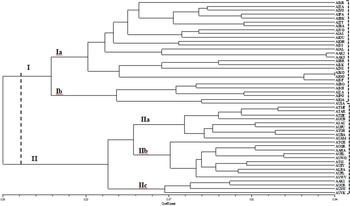
Cluster analysis was able to classify the studied genotypes based on geographical origin. A dendrogram was obtained by the UPGMA method using the total number of amplified SCoT fragments and grouped into two main clusters (Fig. 1). The first group (Ι) included most of the Asian genotypes, while the American genotypes and some Asian genotypes were in the second group (ΙΙ). The first group (I) was further divided into two subgroups, Ia and Ib, segregating at a genetic distance level of 0.51. The first subgroup (Ia) the first subgroup included 19 Iranian genotypes and 2 genotypes from Afghanistan (AAK2 and AAK3) their genetic similarity is justifiable. In the second subgroup (Ib), genotypes from Iran and India (AIGA) were located in this subgroup. Among them, Golbad (AIKO) and Golbeh Behshahr (AIGO) were clustered more closely, indicating a higher similarity in their genetic background. The second group (II) was further divided into three subgroups, IIa; IIb and IIc, at a genetic distance of 0.62. The first subgroup (IIa) The first subgroup (IIa) included mostly American genotypes, as well as some Asian genotypes, but no Iranian genotypes, whereas all Iranian genotypes were found in the first group. Sirenevyi's (ATSI) genotype from Turkmenistan was located in this subgroup. The Red Angel genotype was also classified alongside the Ever sweet genotype. In this subgroup, the highest genetic similarity was related to Elf and Wonderful genotypes from the America. The second subgroup (IIb) included the rest of the genotypes from America, three from Turkmenistan (ATME, ATDE, and ATAR) and one from Syria (ASAU) and Afghanistan (AAK1), thus confirming the relationship between the American and the Asian genotypes. Most of the genotypes of Turkmenistan belonged to this subgroup and were classified with the Cranberry genotype from the America. Genotypes from Asia including Kandahar 1 and Unknown from Yemen were located next to genotypes Crab and Balegal from America, respectively. The three subgroups (IIc) included only the genotype from America (AUVK), indicating this genotype is not closely related to the other genotypes in subgroups IIa, IIb, and all other major groups I genotype.
Dendrogram resulting from the analysis of data related to different pomegranate populations using the COMLETE algorithm and based the similarity simple matching (SM) coefficient: The first letter: the name of continent: The second letter: the name of the country origin: The third letter: the name of the cultivar in abbreviation.

Principal component analysis
SCoT data were subjected to a principal component analysis (PCoA) to obtain an alternative view of the relationships between the genotypes. In the two-dimensional PCoA plot, in general, similar groupings were found as obtained with the UPGMA dendrogram. All the pomegranate genotypes from different countries were classified into two groups of the plot from PCoA. The two main axes explained 23.81% of the cumulative variance. The first two principal axes accounted for 15.87 and 7.93% of the total variation, respectively, indicating the complex multidimensional nature of SCoT variation. Group 1 included all Iranian genotypes as well as genotypes from India. Group 2 contained all American genotypes included in the analysis, but also 11 Asian genotypes from different countries. The two multivariate approaches, UPGMA and PCoA, used in the analysis of genetic relationships among the genotypes produced generally comparable results.
Discussion
The correct selection of genetic material by breeders requires the proper use of genetic diversity. Production of desirable and superior genotypes is possible only through the correct selection of genetic materials in a plant species with high genetic diversity and a comprehensive evaluation of superior genotypes in different environments (Garrido-Cardenas et al., Reference Garrido-Cardenas, Mesa-Valle and Manzano-Agugliaro2018). The present study provided comprehensive information on the genetic structure of pomegranate genotypes from eight countries across two continents: Asia and the America. The SCoT marker was regarded as suitable for studying genetic diversity in pistachios (Malekzadeh et al., Reference Malekzadeh, Mahmoodnia Meimand and Amirebrahimi2018), citrus (Mahjbi et al., Reference Mahjbi, Baraket, Oueslati and Salhi-Hannachi2015), walnuts (Tabasi et al., Reference Tabasi, Sheidai, Hassani and Koohdar2020) and grapes (Guo et al., Reference Guo, Zhang and Liu2012). The 15 SCoT markers selected in this study are high in polymorphisms (100%) and can be used to differentiate pomegranate genotypes. SCoT markers have been used in previous studies to analyse the level of polymorphism in cultivars of different such as mango (73.82%) (Luo et al., Reference Luo, He, Chen, Hu and Ou2012), peanut (38.22%) (Xiong et al., Reference Xiong, Zhong, Han, Jiang, He, Zhuang and Tang2011), pistachios (92%) (Malekzadeh et al., Reference Malekzadeh, Mahmoodnia Meimand and Amirebrahimi2018) and grapes (93.1%) (Guo et al., Reference Guo, Zhang and Liu2012). Mahjbi et al. (Reference Mahjbi, Baraket, Oueslati and Salhi-Hannachi2015) reported a total of 132 amplified loci using 12 SCoT primers on 15 citrus species, and 93.9% of the loci displayed polymorphism. The present study showed that the percentage of polymorphic loci of each primer in pomegranate is higher as compared with those reported in other plant species. The average number of effective alleles (1.55) was lower than the total number of alleles. These observations show that few alleles contributed to the variation. However, the number of effective alleles in our study was lower than that reported for pomegranate genotypes from Iran (Alamuti et al., Reference Alamuti, Zeinalabedini, Derazmahalleh, Shojaie, Irandoost, Zahravi, Vazifehshenas, Ebrahimi, Nekouei and Salekdeh2012; Parvaresh et al., Reference Parvaresh, Talebi and Sayed-Tabatabaei2012; Zarei and Sahraroo, Reference Zarei and Sahraroo2018) and India (Singh et al., Reference Singh, Abburi, Ramajayam, Kumar, Chandra, Sharma, Sharma, Babu, Pal, Mundewadikar, Saminathan, Cantrell, Nimmakayala and Reddy2015; Gunnaiah et al., Reference Gunnaiah, Jagadeesha, Cholin, Prabhuling, Govindaswamy Babu, Fakrudin, Pujer and Murthy2021). The disparity observed between the result of the present study and previous results might be due to the differences among individuals of the same population, size and of position the population used in each study. PIC is very helpful for marker informativeness and is an important factor to identify genotypic variation and population genetic diversity. The average PIC was equal to 0.39 ranging from 0.34 to 0.44 indicating moderate discriminating power of these markers. Similar to these results, Çaliskan et al., (Reference Çaliskan, Bayazit, Oktem and Ergul2017), Zarei and Sahraroo (Reference Zarei and Sahraroo2018) and Gunnaiah et al. (Reference Gunnaiah, Jagadeesha, Cholin, Prabhuling, Govindaswamy Babu, Fakrudin, Pujer and Murthy2021) previously reported PIC values of 0.2–0.50 for pomegranate cultivars. It has been reported that low PIC values indicate high genetic similarity of genotypes. Therefore, moderate PIC in this study is due to the vegetative reproduction of pomegranate. According to the PIC analysis, four studied SCoT primers (SCoT3, SCoT12, SCoT30, SCoT35) had higher PIC values and could contribute substantial information concerning pomegranate genetics and are useful for genetic diversity, mapping and breeding studies. Shannon's information index (I) and Nei's gene diversity (h) are one of the most widely used parameters to study genetic diversity in a population. Nei's gene diversity obtained for the studied populations varied from 0.26 to 0.41. This result shows a significant genetic diversity among pomegranate genotypes and supported the results of Shannon's information indicating a high level of genetic differentiation within the population's pomegranate. Among the studied populations, the highest diversity index was related to the Asian population, which indicates the richness of germplasms of this population compared to other populations. In Iranian genotypes, three private bands were observed that can be used to distinguish Iranian genotypes from other genotypes. In this study, two populations exhibited low heterozygosity (He = 0.43). Low heterozygosity of markers may be because the loci under consideration are least exposed to evolutionary forces such as mutation, selection or gene flow and asexual reproduction methods in pomegranate (Gunnaiah et al., Reference Gunnaiah, Jagadeesha, Cholin, Prabhuling, Govindaswamy Babu, Fakrudin, Pujer and Murthy2021). The genetic diversity within and between populations was 0.24 and 0.22, respectively. Low genetic differentiation among the genotypes from different countries suggests restricted gene flow among populations, which happens due to the large geographical distance between the populations and the clonal selection. The results obtained from AMOVA analysis and pairwise Fst test showed significant molecular diversity within most populations studied. Therefore, in situ conservation is important to protect and preserve genetic resources. The result obtained had not agreed with the previous observations that different pomegranate cultivars maintain most of their variation within the population (Parvaresh et al., Reference Parvaresh, Talebi and Sayed-Tabatabaei2012; Guyana et al., 2021). Guyana et al. (2021) reported that gene flow and clonal selection have caused molecular diversity between pomegranate germplasms of different countries. The Nei genetic distance obtained for the studied populations based on SCoT data revealed that the distance between populations was 0.092, which indicates the gene flow between these two populations. This result also shows that the genotypes of two populations (Asian and American) differ in some degree in their genetic content and may be used in hybridization and breeding programs (Bussell, Reference Bussell1999). Based on the clustering results, Iranian genotypes were a high level of genetic diversity. Among Iranian genotypes, Golbad and Golbeh Behshahr had a closer relationship genetic. Iran is considered the pomegranate centre of origin and possesses one of the richest pomegranate gene pools worldwide. Hence, the identification, collection as well as conservation of different cultivars of pomegranate from different geographical regions of Iran would be of great importance. Allelic richness among Iranian pomegranates is the reason for the distribution of pomegranates in different regions and adaptation to different weather conditions. Due to the long history of cultivation and diversity, pomegranate cultivars have a similarity of names or similar genotypes in different regions. Therefore, identifying morphological traits and knowing the genetic structure of genotypes is important. A closer examination of the origin of the cultivars may explain their inclusion in the different clusters. Thus, Iranian genotypes appeared in cluster I far away from all other American genotypes probably due to their different origin. The three main groups include three different continents, which strongly indicates that geographical isolation played an important role in the genetic structure and distribution of the pomegranate genotype. In the present study, some Asian genotypes were located closest to American genotypes. The pomegranate's place of origin is Central Asia, where it has spread to the rest of the world (Mediterranean Basin, Southern Asia and several countries of North and South America) (Sarkhosh et al., Reference Sarkhosh, Zmani, Fatahi and Ebadi2006). It is probable that a cutting from one genotype in a geographical area is relocated and associated with another name in the new region. American genotypes showed close relationships to Turkmenistan genotypes, which are likely to have originated in Turkmen genotypes. It is reported that some of the cultivars available in America were imported from Turkmenistan by Dr Gregory and cultivated there (Volk and Preece, Reference Volk and Preece2021). The placement of different cultivars with different geographical origins in a group to factors such as evolutionary processes, migration (Koehmstedt et al., Reference Koehmstedt, Aradhya, Soleri, Smith and Polito2011), selection based on Morphological traits (Belaj et al., Reference Belaj, Munoz-Diez, Baldoni, Satovic and Barranco2010) and finally breeding was attributed using foreign and domestic genetic resources (Sarri et al., Reference Sarri, Baldoni, Porceddu, Cultrera, Contento, Frediani, Belaj, Trujillo and Cionini2006).
Conclusions
In this study, 50 pomegranate genotypes from eight different countries were analysed using SCoT to assess their genetic diversity and population structure. Genetic diversity indices showed a relatively high level of diversity in the studied pomegranate genotype. The results show that the primers SCoT3, SCoT12, SCoT30 and SCoT35 are efficient for studying the genetic diversity of pomegranates. Hence, these four primers may also be of potential value for further research on genetic Mapping, linkage analysis and marker-assisted selections in pomegranate. The high level of genetic diversity observed within the studied populations is due to the variety of genetic backgrounds or the different genetic origins of the genotypes. Among the studied genotypes, Iranian genotypes had higher genetic diversity compared with other genotypes. These genotypes have undergone genetic changes in terms of some genes and even alleles during the evolutionary period and adaptation to their growth areas, and parallel to that, the allelic diversity in the genotypes has increased. Iranian pomegranate genotypes can be a source of variation for many traits of interest in breeding, in particular tolerance to abiotic and biotic stresses. Therefore, a component of germplasm characterization, management and conservation is necessary to prevent genetic erosion. The obtained results can be used in the breeding programs of this valuable plant, especially the selection and hybridization programmes to produce hybrid cultivars, as well as the selection of parents for maximum heterosis.
Author contributions
HRK designed the experiments; ESS performed the experiments and AMM analysis data. All authors read and approved the final manuscript.
Conflict of interest
The authors declare that they have no conflict of interest.
Data archiving statement
All relevant data are within the paper and tables and figures.