This article provides an outline of the historical construction of Timorese (East Timorese and Indonesian West Timorese) ‘geo-bodies’ and their sense of belonging from the mid-nineteenth century to the present time, thereby reconstructing the origins of many ‘national imaginings’ amongst the Timorese people. Following the work of Benedict Anderson and Thongchai Winichakul, this article treats ‘nation’ as an ‘imagined community’, and ‘geo-body’ as a nation's space — that is, a mixture of territory, an imagined geography enabled by certain technologies, and a spatial object of collective actions and emotions.Footnote 1 Thereby, it situates the Timorese case within the literature of state formation, identity politics, place studies, and nationalism in Southeast Asia.Footnote 2
The entire article is based on the following three propositions: place is a social product;Footnote 3 a sense of belonging and representation of space reinforce each other;Footnote 4 and the same place has different meanings for separate groups of people.Footnote 5 Within this conceptual framework, the article produces a genealogy of the ways in which various Timorese ‘communities of interpretation’ have expressed belonging and affiliation in diverse contexts.Footnote 6 My analysis draws on nineteenth and twentieth-century official, literary, scholarly, political, and advocacy texts in Portuguese, English, French, Japanese, Indonesian, and Timorese (Tetun).
The key contributions of this article follow three main trajectories. The first is a reminder of the way in which political identity and resistance have been understood by international commentators. I argue that knowledge production of ‘East Timor’ within both Cold War and post-Cold War perspectives resulted in the image of the East Timorese as a homogeneous nation with a victimised population that is racially, historically and culturally distinct from Indonesia. The second thread of the article takes readers deeper into the past to demonstrate how various notions of Timorese identities and geo-bodies were much more malleable and fluid in reality, drawing from Southeast Asian and South Pacific ethnicities, religions, languages, and cultures that would be distilled by international commentators in the late 1970s. In particular, the article traces ‘Indonesia’ as a historically important spatial category for Timorese identity-making, and situates the term in relation to others. Finally, the article alerts readers to the political role of place-making by showing how different communities socially constructed different understandings of Timor to reflect the meanings, values, and worldviews that most suited their interests.Footnote 7
A discovery of this study is that the spatial representation of Timor has been contested and constructed as a sub-region of other places (as a part of the Indonesian or Papuan worlds, a colony of Portugal, the ‘Cuba’ of Southeast Asia, and Indonesia's twenty-seventh province), and has been inseparable from regional and global place-making. Hence, when the representation of Timor was altered at various times, it also affected the representations of connected spaces such as Portugal, Indonesia, Southeast Asia, and the South Pacific. Such productions of space have continued since Timor-Leste's independence in 2002 as the country seeks to renew its national space, strives to consolidate its national territory in relation to neighbouring countries, and negotiates its membership in the Association of Southeast Asian Nations (ASEAN) and other regional and international organisations.
Present notions of ‘East Timor’ and ‘Indonesia’
Before exploring the past, it is appropriate here to introduce present notions of independent ‘East Timor’ and ‘Indonesia’ . In the past four decades, the historiography of Timor has been predominantly framed by the ‘East Timorese vs Jakarta’ perspective.Footnote 8 In this historical narrative, East Timor is represented as a politically and culturally coherent nation which is distinct from Indonesia; the term ‘Indonesian’ has functioned as an important negative identification to describe who ‘East Timorese’ are not.
The first Portuguese author who constructed the East Timorese as ‘non-Indonesian’ was Luís Felipe Thomaz, the historian. Citing Pierre Gourou (a French geographer of Indochina), Thomaz wrote in the wake of the Indonesian occupation of East Timor that the unity of Indonesia was maintained by three factors: Malay–Javanese elites, the Indonesian language, and Islam.Footnote 9 He insisted that none of these were present in Timor.
In the United States, the earliest public remarks of such a perspective were made by the anthropologist Shepard Forman (who was primarily a specialist of Brazil and began his fieldwork in East Timor in 1973) at the congressional hearings on human rights in East Timor in 1977.Footnote 10 Forman presented the Indonesian rule of East Timor as a ‘foreign occupation’ by arguing that Indonesians were inherent ‘foreigners’ to the East Timorese because they were included in the local category of malai, the word of alterity applied to Javanese, Islamic traders, the Dutch, Portuguese, and the Japanese.Footnote 11 He explained Indonesia as a consequence of Dutch colonialism and post-colonial boundaries, and not a place of ethnolinguistic and cultural unity. Moreover, he denied the precolonial history of Javanese/Islamic kingdoms’ suzerainty over Timor. Forman also rejected any linguistic affinity between the East Timorese and Indonesian languages. Finally, referring to the precolonial polities of Belu and Servião on Timor Island, he insisted that these two corresponded to the post-colonial division of Timor Island, thereby justifying the territorial division of East Timor from Indonesian West Timor on grounds of historical precedence.Footnote 12
Since then, Thomaz's and Forman's comments have been repeatedly cited by both Timorese and international activists as expert views. Abilio Araujo, a leading figure in FRETILIN for example, used Tomaz's argument (without mentioning its author), and characterised Indonesian unity as the dominance of Malay–Javanese elements, the Malay-Indonesian language, and Islam.Footnote 13 Araujo rejected the commonalities between Indonesia and East Timor for four reasons: East Timor lacked a Hindu legacy (although he acknowledged Kediri and Majapahit's historical relations with Timor as suzerains); the difference in their colonial regimes; Malay-Indonesian speakers were a minority; and Muslims were a minority. Then he discussed the Timorese polities of Sombai (the central kingdom of Servião) and Wehali in the year 1515 and how they corresponded to modern West Timor and East Timor respectively.Footnote 14 He concluded that Indonesia and East Timor had been culturally, racially, and historically different, and therefore that Indonesia did not have the right to rule East Timor.
Such a perspective was based on an interpretation of the historical demarcation of geo-bodies seen through the lens of the Indonesian invasion and occupation from 1975–76 and the East Timorese resistance of the late 1970s. It encompassed the revolutionary government of Lisbon's declaration of a decolonisation plan for Portuguese Timor in 1974, the birth of East Timorese political parties, and a civil war. On its part, the Indonesian government justified the potential integration of Portuguese Timor into Indonesia based on the respective territories’ racial, historical, and cultural affinities while criticising Dutch and Portuguese colonialism for creating artificial boundaries.Footnote 15
To sum up, the communal identity of the East Timorese as non-Indonesian was constructed against this backdrop. East Timor was accordingly situated in the 1970s to 1990s as a place embedded within diverse political meanings: ‘a Cuba in Southeast Asia’ (the Cold War account), a land of victimisation (human rights account), and a place of resistance (national independence account).
Such ‘East Timorese vs Jakarta’ perspectives resulted in the birth of the East Timorese nation-state and the scholarly tradition of East Timor Studies as distinct from Indonesian Studies and even Southeast Asian Studies. Scholars, however, have not paid enough attention to the history of East Timor and Indonesia from a critical standpoint in terms of the political role of place-making.Footnote 16 The rest of this article intends to bridge the spatial aspects of this gap between East Timor Studies and related disciplines.
Demarcating colonial boundaries
From this section onwards, I trace various notions of space and belonging in Timor since the mid-nineteenth century to demonstrate their underlying complexity. In the mid-nineteenth century, both the colonial powers of Portugal and the Netherlands were competing over their clashing interpretations of territory on Timor Island. The direct Portuguese settlements in Timor were limited to the three northern coastal towns of Dili, Manatuto and Batugade. The Dutch, on the other hand, occupied the southwestern coastal area of Kupang. The Timorese ‘kingdoms’ in the rest of the island maintained a high degree of independence. Governor Affonso de Castro's own words in 1867 express the weakness of European control of the island:
Portuguese sovereignty, it could be said, does not exist in the island of Timor, except for Dili, Batugade, and Manatuto. In the [Timorese] kingdoms, we are only suzerains.Footnote 17
It is interesting to note that another colonial officer expressed more or less the same view on the weakness of the Portuguese presence in the eyes of the Timorese people even in the year 1903.Footnote 18
The 1859 treaty was the first Dutch–Portuguese agreement over the territorial division of the island. It did not, however, define the border on the ground, but only clarified the Timorese borderland ‘kingdoms’ which would mark the limitations of the two spheres of influence on paper.Footnote 19
Living in or visiting Timor Island resulted in different geographic views. For example, the Portuguese who settled along the northern coast called the southern coast ‘the opposite coast’ (contra costa), an expression still used in Dili today. An American traveller in the 1880s also remembered the European territories as ‘northern Portuguese settlements’ and ‘southwestern Dutch settlements’.Footnote 20
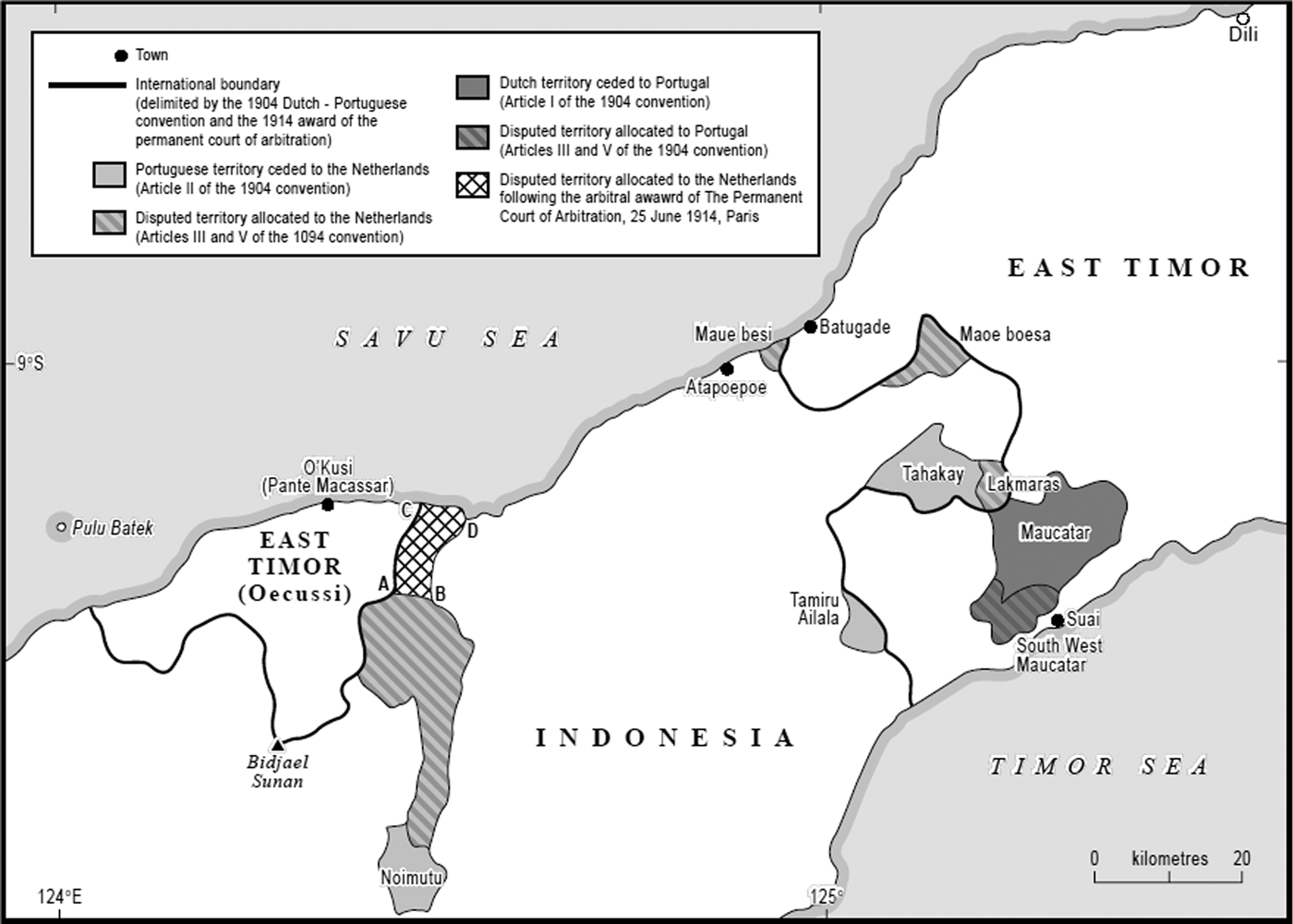
A clearer border was demarcated in 1904 after a series of conquests, field research and disputes as shown in fig. 1. In this process, several kingdoms were exchanged between the two European powers. Rivers such as the Biku, Bebulu and Masin began to function as parts of the border. The legal definition limited Portuguese territory to the East of Salele on the southern coast and Batugade on the northern coast, with the exception of the enclave of Oecussi.
Boundary changes on the Island of Timor following the 1904 Boundary Convention between Portugal and the Netherlands, and the 1914 Arbitral Award of the Permanent Court of Arbitration (Neil Deeley, ‘The international boundaries of East Timor’, IBRU Boundary and territory briefing 3, 5 [2001]: 8).

Race, colonial history, and Timor Island
In the mid-nineteenth century, when major parts of Timor had yet to be explored by European travellers, the dominant geographic categories were ‘race’ and ‘island’. Euro-American authors represented the ‘Timorese’ as the inhabitants of ‘Timor Island’, rather than belonging to Portuguese or Dutch ‘territories’.
Portuguese authors were inclined to discuss the island in connection with both the Indonesian/Malay and the Oceanian worlds. Thus, Governor Castro wrote:
The Timorese are a branch of the big Malay family, resemble them in physical and moral [features] to all the inhabitants of the islands of Malaysia and Polynesia.Footnote 21
Pioneering Southeast Asianists in the twentieth century often pointed out that ‘the sea unites and the land divides’. Similarly, Governor Castro stated, ‘Timor had been often visited by the Malay, Bugis, Makassarese, Balinese, and Papuan traders and pirates’.Footnote 22 More recent scholarship tends to forget that views such as Castro's were also shaped by Timor's subjugation under the authority of the Sultan of Ternate when the first Portuguese visitors arrived.Footnote 23 Thus, the island was understood through its connectedness with the surrounding regions and the world, that is, through trade, politics, and violence rather than in isolation or separation.
Regarding pre-colonial spatial arrangements inside Timor, Castro and other colonial authors mentioned the provinces of Belu and Servião. Earlier descriptions of Belu complicate the present notion of the precolonial polity as preceding East Timor: Belu held sway over many kingdoms in the central and eastern regions, but its centre was in Wehali, a southern coastal village in today's Indonesian West Timor.Footnote 24
In contrast to Portuguese authors, British travellers conceptually separated the Malay space and the Oceanian one, reflecting their colonial loci that saw the Dutch East Indies and Portuguese Timor as spaces between British colonies in Southeast Asia and the South Pacific. An important intellectual figure in this respect was Alfred Russel Wallace, who drew a bio-geographic line between the Asian (Malay) and the Oceanian (Papuan) zones on his map of the region.Footnote 25 In his and his followers’ works, Timor Island was constructed as a ‘border-island’ between these two zones.Footnote 26 This, in turn, encouraged the emergence of debate over Timorese racial belonging between the Malay and the Papuan zones. Arguably, the separation of these two spaces could not be imagined without British travellers’ epistemic attitudes. Nevertheless, mid-nineteenth century anthropologists, who had no clear methodology of racial classification, were genuinely puzzled by the apparently diverse physical features of the Timorese.
The solidification of European control over the island in the beginning of the twentieth century enabled new types of knowledge production about its peoples. Physical anthropologists gained the opportunity to visit the interior of the island, and mathematically measure the ‘pacified’ indigenous bodies.Footnote 27
When physical anthropologists (pioneered by Ten Kate and Fonseca Cardoso) arrived in Timor for the first time, they began utilising pseudo-ethnic categories that were commonly used by the Portuguese.Footnote 28 They categorised their human samples as either ‘Belunese’ (inhabitants of the eastern part of the island) or ‘Atoni’ (inhabitants of the western part of the island), and accumulated anthropometric data under these categories. According to Hans Hägerdal, these two terms have indigenous origins, but the geographic connotations as mentioned above were constructed by the Portuguese for the sake of convenience.Footnote 29
Among Portuguese anthropologists, António Mendes Correia's view became dominant from the 1940s. He equated the Belunese to the ‘natives of our territory’ and the Atoni to the ‘Dutch natives’.Footnote 30 Based on the accumulated anthropometric knowledge, Mendes Correia insisted that the Belunese resembled the Indonesians and the Atoni the Papuans. Furthermore, he demanded a revision of the Wallace Line that situated Timor in the Papuan space. Against this backdrop, ideas of the ‘Papuan Dutch natives’ and the ‘Malay-looking Portuguese natives’ prevailed among Portuguese circles.
When Dutch colonial historians reconstructed the history of ancient Javanese kingdoms and the Dutch East Indies, they too connected Timor to Java and the Netherlands.Footnote 31 As they wrote the history of Kediri and Majapahit based on Chinese, Javanese and European sources, they identified Timor as a ‘protectorate’ of these empires. In doing so, they produced spatial representations of Timor as a sub-region of Java and the Netherlands. Accordingly, knowledge of Timor and its peoples converged with colonial territorial and border arrangements in the works of colonial anthropologists and historians.
In general, Portuguese, Dutch and British colonial knowledge production of Timorese space and communal identity provided models and categories that later generations would adapt. Race, territory, ethnicity, language, and religion constituted its prominent components. Discourses on these categories were not mutually exclusive, but often engaged in conversation with each other, for example, when Mendes Correia converged territory and race.
Colonial place-making, like other types of knowledge production, had its own peculiarities.Footnote 32 Places were treated in a hierarchical manner, and a ‘colony’ was represented as an inferior place to the ‘metropole’. The idea of a ‘civilising mission’ was also important because it conceptually separated ‘colony’ from the ancient grand milieu (in Timor's case, the Indonesian kingdoms), and connected the island to the European metropoles (Portugal and the Netherlands). European knowledge producers found Timor to be one of the lowest and most obscure of spaces to be ‘saved’ (or ‘improved’) in a Europe-centric global history, although unsurprisingly not all Timorese accepted such a view.
The Japanese Occupation as a period of a united Timor
The Pacific War in Timor (1941–45) was a time of disorder that wrought changes in spatial practices for the island and its peoples. The subsequent impact of the dialectics between the experiences of war, post-war Portuguese and Indonesian orientations, and the notion of a ‘united Timor’ should not be underestimated.
Although Portugal declared its neutrality during the Second World War, Portuguese Timor was at first occupied by the Allied Forces and then invaded by the Japanese.Footnote 33 Eventually, both the Dutch and the Portuguese lost control of their territories to the Japanese. Thousands of Timorese were drawn by both sides into wartime violence between the Japanese and the Allies and many died.
The pro-Japanese Timorese troops, whom the Portuguese called the Colunas Negras (Black Columns), were a mixture of Timorese men from both Dutch and Portuguese territories. The first group of Colunas Negras was made up of Timorese immigrants from the Portuguese territory who were in Dutch Timor. Initially they numbered only 300 to 700, and the Timorese troops recruited more members in Portuguese Timor.Footnote 34 Japanese and Portuguese sources agree that thousands of Timorese participated in the war on the side of the Japanese Army, and fought against Europeans, Australians, and pro-Caucasian Timorese populations.Footnote 35 The utilisation of Timorese in battles by the Australian, Japanese and Portuguese forces brought about an intensification of hostilities among the Timorese population.
After the Japanese took control of the entire island, the colonial territorial borders were blurred. The experience of the Colunas Negras resulted in the collaboration of Timorese groups across both the former Dutch and Portuguese territories. East Timorese expatriates in the Dutch territory rebuilt their kingdoms on the Portuguese side. Some Japanese officers and pro-Japanese Timorese groups attempted to unify the island through match-making between the families of western rajas and eastern liurais (kings). Several eastern authorities visited the former Dutch territory and were welcomed there. Due to such alternative spatial experiences, ‘a united Timor’ was added to the Timorese political vocabulary from the time of the Japanese Occupation.
Citizenship as Indonesian and Portuguese post-war place-making
The Japanese surrender and the Portuguese reoccupation in 1945 resulted in the reimposition of pre-war colonial borders. The Europeans in Timor experienced it as a ‘liberation’, while pro-Japanese Timorese troops were jailed on Atauro Island. The Colunas Negras were remembered both as ‘Dutch natives’ and ‘native separatists’.
On the other hand, the Timorese martyrs who fought against the Japanese were commemorated as heroes. The most prominent loyalist was Dom Aleixo Corte-Real, the king of Suro. In 1912, he participated in the Manufahi War (the final colonial war of ‘pacification’) on the Portuguese side.Footnote 36 Dom Aleixo was martyred in a battle against the Japanese and a Coluna Negra in June 1943. The Portuguese government commemorated him as a ‘loyal native king’, ‘genuine Portuguese’, and a national hero. His portrait was printed on banknotes in post-war Portuguese Timor. Such appreciation of a Timorese as a ‘Portuguese’ national hero was unprecedented.
West Timor experienced a different historical trajectory. From 1945 to 1949 (during the Indonesian Revolution), their elites were divided between being sympathisers of the Jakarta-based Republic of Indonesia and of the Makassar-based State of East Indonesia.Footnote 37 After the State of East Indonesia's integration into the Republic, the West Timorese were transformed into Indonesian citizens. In comparison to Portuguese Timor in 1950 where even so-called ‘civilised’ subjects remained ‘natives’, the people of West Timor were no longer called ‘natives’, but ‘Indonesian citizens’. The East and West Timorese who belonged to two different societies frequently intermingled, however, through legal and illegal transactions. Along with the global rise of anti-colonialism, this increased the concerns of the Portuguese rulers in the eastern part of the island.
The Portuguese fear of both the Japanese and the Indonesians affected their native policy.Footnote 38 Portugal officially adapted multiracialism and pluricontinentalism as its state ideology in 1951. Conceptually, the Iberian metropole and ‘overseas provinces’, the former ‘colonies’, became ‘equal’ places to each other. New schools for indigenous children were established to create ‘civilised natives’ (civilizado or assimilado) who could acquire Portuguese citizenship. This resulted in an increase in the number of Timorese with Portuguese citizenship. The inhabitants of the border areas were forced to resettle in assigned villages to decrease their contact with the Indonesian West Timorese. The Portuguese government also prohibited the ‘uncivilised natives’ (não-civilizado) from moving beyond their designated districts. In other words, different spatial policies were applied to separate social strata in Portuguese Timor.
The prominent East Timorese public figures during the Indonesian Occupation (1976–99) were the products of this post-Second World War Portuguese policy. They were born into the families of ‘civilised natives’, educated in Portuguese schools, and studied in the Portuguese language. Some were enlisted as Portuguese soldiers to fight the African nationalists. Some fortunate Timorese were able to study in the Iberian metropole and received a higher education. These ‘civilised’ Timorese elites began to feel their sense of belonging to Portugal as Portuguese citizens.Footnote 39 However, those who were categorised as ‘uncivilised’ (more than 90 per cent of the population) were generally excluded from the fruits of this new Portuguese multiracialism and continued to be treated as if they were ‘colonial natives’.
Despite the emergence of the ‘Indonesians’ and ‘New Portuguese’ (non-European Portuguese) citizens in Timor, the idea of a united Timor was a recurrent spatial imaginary in resistance against the central authorities. In West Timor, the antipathy against Jakarta that first appeared in support for the Makassar-centred state resurfaced in the separatist Permesta Movement.Footnote 40 The mixture of the largely West Timorese Permesta members, the disgruntled East Timorese urban middle-class and rural farmers resulted in the Viqueque Rebellion against the Portuguese in 1959.Footnote 41 Although solid connecting evidence is lacking, the revolt was organised in Uato-Lari, the village to which the eldest son of the most eminent wartime Japanese collaborator was exiled.Footnote 42 Two decades after the rebellion, José Manuel Duarte, a principal participant, told Australian journalist Jill Jolliffe that
[we] never regarded ourselves as part of Portugal. We are not interested in the government of Indonesia, but in the integration of East Timor and West Timor.Footnote 43
Historical sources imply that Portuguese policemen in Timor had no idea about such historical contexts and ideological orientations. Archival and spatial production in the years after the revolt was characterised by Portuguese hysteria over an ‘Indonesian conspiracy’. An interesting reference to a united Timor reappeared in Portuguese police sources on 12 March 1961: A group of people from West Timor intruded into Portuguese territory and declared the independence of ‘Uni Republic Timor’ in Batugade. The leading figure was Mao Klao, a man from Maubara in Portuguese Timor who had studied in Kupang.Footnote 44 The West Timorese members included former Japanese collaborators, some affiliates of East Timorese Colunas Negras and future pro-Indonesian integrationists.Footnote 45 Their documents referred to the revival of the ‘Confederation of Wehali’, the symbol of the pre-colonial unity of Timor Island. Putting such information from different archives together reveals island-wide linkages among the activists for a united Timor, from Kupang, Atambua, Maubara, Atsabe and Viqueque.
The Portuguese authorities reacted to such irredentism by the physical separation of their territory from the Indonesian world. For example, Portugal permanently cancelled the ferry route between eastern Indonesia and Atauro because they were afraid of the spread of eastern Indonesian Protestantism. As one secret policeman reported:
Purportedly the texts are written in the Malay language. The Protestants sing also in Malay and Indonesian folklore songs! If the faith is Indonesian, it is necessary to counter its development, because it is to connect the population of this island to a spiritual community of Indonesia.Footnote 46
The state was able to physically cut the connection, but Atauro remains as one of the few areas in Timor-Leste where Protestants are the majority.
Everyday forms of border violation received the state's attention only during times of such hysteria: the three most common forms were ‘smuggling’, illegal migration, and petty crimes such as stealing livestock from the other side. The smuggling was in fact the free trading of goods and commodities, bypassing authorities — an activity which had been going on for centuries.Footnote 47 Every week, a few hundred to a thousand Indonesians visited the markets on the Portuguese side: local policemen routinely overlooked these activities. From time to time, political asylum was also overlooked in such a loose regime of border control. Steven Farram mentions a member of the Indonesian Communist Party who fled to Portuguese Timor after the Red Purge in 1965.Footnote 48 Interestingly, both Portugal and Indonesia constructed the other side as a nest of communists for opposite reasons: Portugal observed communists coming from West Timor, while Indonesia knew that they fled to Portuguese territory.
During politically unstable periods, both state authorities, especially the Portuguese, had been particularly sensitive about cases of stealing and skirmishes along the border because they feared that these events might be exploited as pretexts for a full-fledged invasion from the other side. However, from a Portuguese perspective, the unpredictability of West Timorese groups was of greater concern than the intentions of state elites in Java.
The strong Portuguese and Indonesian production of space in the post-Pacific War era shaped the differentiated experiences of the Timorese in their various social memberships. Analysed thorough the category of ‘citizenship’, for example, West Timorese were directly transformed from colonial ‘natives’ into ‘Indonesians’ while the educated inhabitants of Portuguese Timor became ‘New Portuguese’, moving beyond the confines of the former Portuguese Timor. The experiences of the uneducated Timorese, however, were usually confined to their designated districts. Such differentiated experiences of place characterised the multiplicity of Timorese imaginations of their geo-bodies in the 1970s.
1974–75: The ‘East Timor problem’
Portuguese Timor emerged as an international issue when a group of military men in Lisbon succeeded in a coup d’état and declared a decolonisation plan for Portugal's possessions in Africa and East Timor in April–May 1974. The military junta lifted the censorship which had operated under the Salazar–Caetano dictatorship, and permitted the Timorese elites to freely form political parties. Despite the three decades of assimilation policy to produce ‘New Portuguese’, the ‘overseas provinces’ were suddenly redefined as ‘colonies’.
As the Timorese elites were pressed to form their own political parties, all the existing indigenous geo-political views, colonial territorial arrangements, scholarly knowledge of the population, citizenship and nationality, and external political trends began to matter in imagining their communities and geo-bodies.Footnote 49 It is worth mentioning that the Timorese elites proactively and independently formed their parties rather than being controlled by external actors, at least in the initial few months. As the Portuguese Empire was collapsing, the ‘civilised natives’ synthesised their local contexts to the ideas of the nation-state, decolonisation, and the Cold War to explain their political stances.
The Timorese Democratic Union (União Democrática Timorense, UDT) was made up of the elites educated in Portuguese educational traditions. For Mário Carrascalão, the prominent leader of UDT, what mattered most was the fact that the Timorese elites were already Portuguese citizens, and shared similar rights and obligations with other Portuguese people, whereas the majority of the Timorese remained ‘uncivilised natives’ who were ignorant of such new senses of belonging.Footnote 50 UDT initially planned to maintain close ties with Portuguese communities until the majority of Timorese were familiarised with the ideas of modern public life. The party considered indigenous political units, ethnology, and anti-colonialism as of little importance. Therefore, although UDT is often labelled as a ‘conservative fascist party’, they were the party who emphasised the significance of the assimilationist progress of the recent past. For the Lusophile UDT supporters, the difference between the East Timorese and the West Timorese and other Indonesians was ensured by the Portuguese legacy, embodied in such aspects as Portuguese education, language, political orientation, territorial arrangement, and Catholicism.
The second party, the Timorese Popular Democratic Association (Associação Popular Democratica Timorense, APODETI) is known as the party of pro-Indonesian integrationists. APODETI's party leaders emphasised indigenous conceptions of their communities and ethnic affinities with Indonesians. Nonetheless, the primary sources suggest that their priority was a unification with Indonesian West Timor, rather than with Jakarta: Integration with Indonesia was a means to achieve this end. Thus, the original Portuguese version of the Balibo Declaration — that requested East Timor's integration with Indonesia — states:
Feeling that, through Portuguese and Dutch colonialist actions which for nearly 500 years deeply separated the blood ties, ethnic, moral, and cultural affinities with the Indonesian people of the island of Timor (O povo Indonésio da ilha da Timor) ….Footnote 51
It is clear from the context that the signatories were referring to a unification of the island of Timor through integration with the Republic of Indonesia. The phrase O povo Indonésio da ilha da Timor (the Indonesian people of the island of Timor) was incorrectly translated as ‘the Indonesian Nation’ in the United Nations’ English translation and Bangsa Indonesia (Indonesian Nation) in an Indonesian translation.Footnote 52
Osorio Soares, an APODETI leader, explained his reason for supporting integration with Indonesia as follows:
Our [Indonesian and Timorese] customs are the same; only our colonialism is different. We are the one country: We are part of all Timor and Timor is in the middle of Indonesia.Footnote 53
Notably, he locates Portuguese Timor primarily as part of ‘all Timor’ and only secondarily as being in Indonesia. Soares also mentioned that integration with Indonesia was to prevent the state of being ‘divided from each other’. The commonly used Tetun phrase of fahe malu (divided from each other) might have originated from the pre-colonial condition of being under weak control from the political centres. However, the territory was maintained by the Portuguese mode of war, which relied heavily on the troops made up of Timorese loyalists who fought against other Timorese. The same mode of war would be used later by Australian guerrillas, the Japanese occupiers, and the Indonesian army. What Soares hoped was that Indonesia would act as a traditional Asian suzerain and maintain unity among all Timorese.Footnote 54
APODETI's anti-colonialism included a rejection of the territorial border between West and East Timor, which had been externally defined by the Dutch and Portuguese metropoles. APODETI's idea, however, did not attract most of the educated elites in Dili. On the other hand, they were welcomed by some of the traditional authorities of the border districts, the participants in the 1959 Viqueque Rebellion, and the West Timorese groups that shared the Pan-Timorese ideology.
The East Timorese nationalists, represented by the Revolutionary Front for an Independent East Timor (Frente Revolucionária de Timor-Leste Independente, FRETILIN), had to counter all these ideas — Portuguese citizenship, integration with Indonesia, and the idea of a united Timor, by means of anti-colonialist discourse. This was the unique conceptual difficulty that FRETILIN faced. As belated Asian nationalists in the mid-1970s, if they emphasised anti-colonialism and ethnic ties in order to reject Portugal's control, their ideology resembled that of APODETI and the Indonesian integrationists. In contrast, if they emphasised difference from Indonesia (in particular, from the West Timorese), they had to acknowledge the Portuguese legacy. Steering their ideological boat was highly complicated.
What FRETILIN did in 1975 — rather than what they officially decided — was to utilise two different propagandas for two separate audiences. Reading FRETILIN's documents in Portuguese and English, one encounters imitations of Indonesian and African nationalists’ discourses of anti-colonialism, nationalism, freedom, and ‘Mauberism’ (copied from Sukarno's Marhaenism), mixed with contemporary leftist catchphrases such as ‘liberation from imperialism and exploitation’.Footnote 55 They rejected both Portuguese and Indonesian interference based on the ideas of the existing territorial border and anti-colonialism.
Nonetheless, reading in Tetun, FRETILIN's official political manual and the party anthem did not emphasise the colonial territorial arrangement or even ‘East Timor’.Footnote 56 The collective term for the Timorese was timor oan (children of Timor) and the conception of their land was Timor rather than East Timor (or Timor Lorosae). They made little effort to explain the concepts of nation-state, modern territory, or colonial borders to an indigenous population who were largely unfamiliar with these ideas. What they did emphasise in the local language was a self-rule based on consanguinity (ukun rasik an, usually translated as ‘self-rule’, but rasik also means ‘consanguine’), the expulsion of colonial masters, and the rejection of domination by ‘money masters’. Aside from their definition of Indonesia as an external actor, their political terminology in Tetun resembled that of APODETI. The FRETILIN leadership in the 1970s well understood that it was not easy for the uneducated Timorese, the ‘Maubere’, to feel a sense of belonging based on the colonial borders.Footnote 57
The political interests of the external actors under Cold War dispensations and the rivalry between the three Timorese parties resulted in the island's unfortunate course of history, from the civil war in August–September 1975, to FRETILIN's unilateral declaration of Independence in November, and the Indonesian invasion and occupation from December 1975. The Suharto regime exploited the pretext provided by alleged ‘persecution by the FRETILIN communists’ and the refugees’ intrusion into West Timor, along with the Balibo Declaration, as justifications for the military intervention. East Timor was officially ‘integrated’ as the twenty-seventh province of Indonesia in 1976.
In the Indonesian official view, the territorial border only continued to define the administrative division between East Timor and East Nusa Tenggara province. Migration between East Timor and ‘the rest of Indonesia’ increased.Footnote 58 However, the ‘border’ was experienced by both rebels and foreign visitors due to the continuation of armed conflict in East Timor until the mid-1980s. Under the Suharto regime's censorship, the violence in East Timor was attributed to the ‘excesses of the FRETILIN rebels’. For the FRETILIN guerrillas, however, the occupation represented an ongoing massacre committed by Indonesian troops. One aspect of historical continuity from the colonial period is that the leaders of West and East Timor — regardless of their political affiliations — continued to attribute the cause of the forced migrations across the border to factors on the other side of the island.
The 1970s–90s: Knowledge production and international activism
Activism directed against Indonesia's military operation subsequently emerged in several countries. The debates between the backers of Indonesia on the one hand and of FRETILIN (and the other pro-East Timorese writers) on the other produced new types of ethnological views on the Timorese people. Ethnology and border became sites of political debate in the first place in reaction to the pro-Indonesian commentators’ justification of their cause based on the ethnic ties and racial affinity between the East Timorese and Indonesians — a view largely accepted by colonial and Southeast Asian scholarship at the time. Although there was variety within this perspective, the extreme case was based on an equation of the Srivijaya and Majapahit empires’ pre-colonial authority to the modern conception of nation-states in the region.Footnote 59 This extreme view implied that since Timor had been a protectorate of Majapahit, this meant that it should belong to modern Indonesia. The racial ‘sameness’ of all Timorese (including the West Timorese) supposedly confirmed such an argument.
Counter-arguments emerged from FRETILIN activists and their backers. Already in May 1975, FRETILIN leaders Alarico Fernandes and José Ramos-Horta suggested that the Central Committee insist that East Timor belonged to the South Pacific rather than the Indonesian world.Footnote 60 The same report stressed the necessity to find scientific proof to support this argument. Contrary to FRETILIN's hope, however, Southeast Asian specialists and the European physical anthropology of the early 1970s did not corroborate such a view. Thus, they had to wait until Tomaz, Forman and other writers started constructing an East Timorese ethno-historical identity against that of Indonesia.
After Tomaz and Forman, Jolliffe reinforced the view that the East Timorese were distinct from the West Timorese. She argued that the Belunese kingdoms existed in the contemporary geographic sphere of Portuguese Timor while the Atoni's Vaiqueno-speaking kingdoms owed allegiance to Servião in West Timor.Footnote 61 She concluded that the traditional political division ‘roughly corresponded to the final border agreement made between the Dutch and Portuguese colonial administrations in 1910’.Footnote 62 Furthermore, contrary to Dutch and Portuguese physical anthropologists who linked the East Timorese to Indonesians, Jolliffe linked them not only with Papuans but with Australian Aborigines as well.
Broader-focused scholars began to accept the new intellectual tradition of East Timor Studies (as distinct from Indonesian and Southeast Asian Studies) in the early 1990s.Footnote 63 This change in dominant discourses happened only after the international exposure of the Santa Cruz Massacre in November 1991 (the mass shooting of reportedly around 200 Timorese by the Indonesian Army) through the Western mass media. For example, Peter Carey, the historian of the Java War, saw the Indonesian Occupation as a ‘form of ethnocide designed to undermine local values and replace them with an alien “Indonesian-ness,” the national values of a Muslim Javanese colonial power’.Footnote 64 Like Forman and Jolliffe, Carey argued that the Belu and Atoni were two distinct peoples, adding that the former had been supportive of the Australian guerrillas against the Japanese during the Pacific War while the latter had been reluctant collaborators.Footnote 65 After mentioning their different administrative experiences, he insisted that ‘the distinctiveness of the peoples of East Timor is thrown into even sharper relief’.Footnote 66
In the East Timor Studies of the 1990s, the East Timorese were viewed as a politically homogeneous unit. The counter-discourses of ‘division among the Timorese’, ‘Timor as Portugal’, ‘the Timorese as Indonesian’, and the Belunese heartland in West Timor were excluded from their analysis. Western academics in the 1990s contributed to the imagined ethnological division between East and West Timorese. Furthermore, such an intellectual construction was perceived as a moral obligation of scholars in the post-Cold War period.
1999: Popular consultation and beyond
International activism for East Timor and its knowledge production did shape the course of the island's history of place-making. The demise of the Suharto regime and the United Nation's intervention at the end of the twentieth century once again raised the issue of who the (East) Timorese were. We know that the result was the Independence of East Timor in 2002. Post-Cold War representations of the East Timorese, however, continued to frame eligibility and the ballot paper for the Popular Consultation in August 1999. The United Nations defined East Timorese voters as follows:
The following persons, aged 17 or above, shall be eligible to vote in the popular consultation: (a) Persons born in East Timor, (b) Persons born outside East Timor but with at least one parent having been born in East Timor, and (c) Persons whose spouses fall under either of the two categories above.Footnote 67
Whether they had stayed in East Timor after the Indonesian invasion or not, they had to be tied to the territory of Portuguese Timor by their births or their parents’ births. The voter had to be born before August 1982 — meaning that they belonged to the generation that experienced the worst period of the Indonesian invasion. The phrase ‘aged 17 or above’, while conforming to voter eligibility in many countries, also excluded the new generation who experienced the less violent half of the Indonesian occupation. In other words, it was the generation of resistance that signed the social contract binding the future generations of East Timorese.
The ballot paper asked the voters to choose either ‘Autonomy in Indonesia’ or ‘Rejection of Autonomy’ — that is, the Independence of East Timor. Alternative ideas such as a ‘united Timor’, or ‘East Timor as Portugal’ were precluded from the choices. The question was either Indonesia or East Timor. Those who desired other spatial arrangements had to choose between the two designs of geo-bodies.
Kenji Isezaki, the district administrator of Covalima during the United Nations Transitional Administration in East Timor (UNTAET), recorded the process of re-bordering that followed the Referendum.Footnote 68 The violence caused by the integrationist militias, fomented by the Indonesian military, after the 1999 Popular Consultation and the International Forces’ attacks against them resulted in the massive migration of sectors of the East Timorese population towards East Nusa Tenggara province. As the International Force chased the militias towards the regional border between East Timor and East Nusa Tenggara (the former international border), they formed the Tactical Coordination Working Group (TCWG) with the Indonesian Army.Footnote 69 Both forces were deployed along the unsettled border and faced each other. Suddenly an armed international territorial border appeared without legal basis, and more than 100,000 ‘refugees’ and ‘militias’ were stuck all together on the Indonesian side.
The solidification of the new border was a somewhat violent process. Both conscious and unconscious crossings of the yet-to-be-legal border were frequently committed by the militia groups (named the Heroes of United Timor, Laksaur, etc.), ordinary villagers, UN troops, civilian officers, and the Indonesian army. It was virtually impossible for the foreign forces to distinguish between members of the militias and ordinary returnees. Clashes along the border occurred between the UN troops and the Indonesian army partly because they used different maps. Moreover, both the United Nations and Indonesia were unable to prosecute the crimes committed by border intruders on either side.
Under these tense conditions, the killing of a New Zealand soldier by border intruders in July 2000 caused a change in the practice of the UN ‘peacekeepers’ who began to shoot at armed intruders from West Timor.Footnote 70 On the Indonesian side, the killing of Olívio Mendosa Maruk (the leader of Laksaur) and three United Nations High Commission for Refugees (UNHCR) officers in September caused a similar reaction from the Indonesian army.Footnote 71 All who were shot to death were reported as members of ‘militias’.
The state of ‘refugees’ and the news of violence contributed to the image of the other side as a dangerous place and the cause of troubles. Sandeep Ray's ethnographic documentary reveals this commonly held view in a West Timorese border village. In this ethnographic documentary, an older villager speaks to an East Timorese migrant who has settled on illegally cleared land as follows:
Like I told you before, it's about life or death, and I don't think Indonesians want to kill you. Unlike FRETILIN forces, here they may give you a warning.Footnote 72
In the East Timorese border district, after hearing about the murders of the UNHCR staff and the sufferings of refugees in West Timor, Administrator Isezaki wrote a diary entry on 24 August 2000, revealing the persistent attraction of visions of a ‘united Timor’:
Maybe it's only a dream (like) story, but … (Supposing if) Indonesia abandoned West Timor, the United Nations’ Forces were deployed in West Timor, and might eliminate the militia groups … Unification of the West and the East, Banzai ….Footnote 73
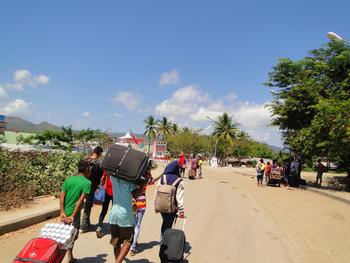
Isezaki and the integrationist militia groups shared the vision of a united Timor. As Michael Szonyi observed in the case of Quemoy under Taiwan, what one side of the border imagined about the other side resembled what the latter thought of first (fig. 2).Footnote 74
A view from the border: Porters and moneychangers between Batugade, East Timor, and Mota-Ain, Nusa Tenggara Timor, Indonesia (photograph by Kisho Tsuchiya, 2015)

Conclusion
This article has outlined aspects of the historical construction of the Timorese sense of belonging and geo-bodies from the mid-nineteenth century to the present time, and traced the historical hardening of certain geographic imaginaries which were eventually tied to their nations. It has demonstrated that geographic notions on Timor were much more fluid until the early 1970s, with prominent representations including Timor as part of Asian (Malay) and Oceanian (Papuan) inter-island relations, northern Portuguese settlements/ Dutch southwest/ independent southern Timorese kingdoms, Dutch (Indonesian) West Timor/ Portuguese East Timor, a united Timor, Timor as Portugal, Timor as divided groups of people, etc. As the Indonesian Occupation of East Timor emerged as an international issue in the late 1970s, two representations of Timor became dominant perspectives: Timor as part of Indonesia and East Timor as a nation distinct from Indonesia. Today, the latter has become the single standard geo-body of political and scholarly discussions.
Both East Timor and Indonesia have been producing new spaces that fit new sensibilities since the beginning of this century. For example, in the Museum of Timorese Resistance in Dili, visitors encounter the following description about pre-colonial Timor:
Before the arrival of the Portuguese, Timor was divided into some 60 small feudal-type kingdoms that had coalesced around two domineering liurais (local rulers): 16 kingdoms in the so-called Servião province were loyal to the liuirai of Sombai, while 46 kingdoms in the Belos province (corresponding to the territory of Timor-Leste and the kingdom of Atambua) acknowledged their allegiance to the liurai of Behale [Wehali].
Here, the profound complexity of pre-colonial geo-political arrangements in Timor is simplified as a precedent to the present spatial division between Indonesian West Timor and independent East Timor. The separation of East and West Timor is apparently accepted by many local inhabitants of Dili, calling themselves timor oan (children of Timor) while referring to those in West Timor as ema Indonesia sira (Indonesian people). In West Timor, both the Indonesian government and former leading East Timorese ‘integrationists’ are trying to integrate a new group of migrants called ‘warga ex Timtim’ (‘former East Timor citizens’), or more precisely ‘citizens originally from East Timor’ into Indonesian society.Footnote 75
However, on many occasions while living in Timor, I encountered individuals who complicate the dominant view. In 2015, for example, I met a person whose description of himself defies such neat categorisation: a young Atambuanese man born in Dili who calls himself a timor oan who works for the Indonesian government. He has always regarded himself as an Indonesian, because there was no East Timorese citizenship when he migrated to Atambua from Dili. Interestingly, some of these refugees understand their migration to West Timor as a return to their origin place and continue to identify themselves as both East Timorese and Indonesian.
Currently, Timor-Leste is seeking to consolidate its territorial boundaries and national resources. It reached an agreement on maritime territorial boundaries with Australia in March 2018. Timor-Leste has been an active participant-observer in various ASEAN forums since 2002. Its full ascension into ASEAN is an ongoing item on the regional grouping's agenda. Timor-Leste's territorial negotiations with Australia and Indonesia and its placement within ASEAN will continue to renew the country's geo-body.
To conclude, from the 1860s to the present time, many individuals and groups have produced spatial representations of Timor and its inhabitants. Timor has had different meanings for separate groups of people. The social construction of the place changed the image of the ‘Timorese’, and vice versa: representations of the Timorese and place-making reinforced each other at various times. When Affonso de Castro and Alfred Rusel Wallace published their influential works in the 1860s, Timor Island was a virtually unknown ‘space’ (empty, obscure, and unruly) except for its inhabitants. Since then, commentators have produced diverse representations of Timor as geo-bodies that fit their interests. Factors such as trends in scientific inquiries, political interests, and even religious activities added new layers of meanings to the imagined human geographies in Timor. Furthermore, the production of space in Timor resulted in the reorganisation of connected spaces such as Portugal, Indonesia, Australia and Southeast Asia.
The historical construction of Timor as a geo-body is characterised by the competition of knowledge producers, politicians and practitioners from various locations, genealogies, and economies (such as Timorese oral traditions, Dutch historians, Portuguese governors, Australian activists, FRETILIN). The disagreement between Indonesia's and FRETILIN's human-geographies does not necessarily mean that either one is true or false. Instead, they belong to different political stances, economies, and lineages of knowledge. Obviously, Indonesian state officials had to justify their ‘intervention’ in East Timor for political reasons. Dutch colonial historiography and Southeast Asian Studies were used for this purpose. FRETILIN and its backers, on the other hand, had to put together fragmentary evidence that demonstrated the distinction between Indonesia and East Timor. In this way, the history of place-making reveals the previously hidden nature of rule, historical conflicts and struggles over space and knowledge.