INTRODUCTION
The heat shock protein-70 (HSP70) family constitutes a group of conserved proteins acting as molecular chaperones which fold, assemble and translocate other proteins (Robert, Reference Robert2003; Mayer and Bukau, Reference Mayer and Bukau2005). Their widespread expression in different organisms have made HSP70s useful for various purposes, including phylogenetic studies (Borchiellini et al. Reference Borchiellini, Boury-Esnault, Vacelet and Le Parco1998), as well as representing a biomarker for monitoring environmental pollution (Arts et al. Reference Arts, Schill, Knigge, Eckwert, Kammenga and Köhler2004). These proteins are critical for parasite survival (Polla, Reference Polla, Ash and Gallagher1991; Thompson et al. Reference Thompson, Barker, Hughes and Viney2008). Several studies have identified HSP70s as major immunogens in parasitic infections, either through the analysis of humoral responses in the host (Moser et al. Reference Moser, Doumbo and Klinkert1990; Ortona et al. Reference Ortona, Marguti, Delunardo, Vaccari, Riganó, Profumo, Buttari, Teggi and Siracusano2003; Sotillo et al. Reference Sotillo, Valero, Sánchez del Pino, Fried, Esteban, Marcilla and Toledo2008), the screening of recombinant expression libraries using sera from hosts infected with distinct helminths (Colebrook and Lightowlers, Reference Colebrook and Lightowlers1997; Scott and McManus, Reference Scott and McManus1999; Kanamura et al. Reference Kanamura, Hancock, Rodrigues and Damian2002; Ravi et al. Reference Ravi, Kubofcki, Bandopathyaya, Geetha, Narayanan, Nutman and Kaliraj2004) or immunochemical studies (Vayssier et al. Reference Vayssier, Le Guerhier, Fabien, Philippe, Vallet, Ortega-Pierres, Soule, Perret, Liu, Vega-Lopez and Boireau1999). Recent studies describing the knock-down of HSP70 in Caenorhabditis elegans have indicated a potential role for HSP70 as a target for parasite intervention (Kimura et al. Reference Kimura, Tanaka, Nakamura, Takano and Ohkuma2007), confirming a previous hypothesis regarding its function in cell death in the parasitic nematode Trichinella spiralis (see Martinez et al. Reference Martinez, Pérez-Serrano, Bernardina, Rincón and Rodriguez-Caabeiro2004).
The course and characteristics of Echinostoma caproni infection are largely dependent on host-related factors (Toledo and Fried, Reference Toledo and Fried2005). This knowledge has allowed workers to define hosts with high or low compatibility for several echinostome species. The differences between host species with varied compatibility are reflected predominantly in worm establishment and growth, egg output, parasite fecundity and survival of the worms. In high-compatible hosts, such as mice and hamsters, E. caproni infection becomes chronic, and the parasite can survive for up to 20 weeks, whereas the worms are rapidly expelled in low-compatible hosts, such as rats (Toledo and Fried, Reference Toledo and Fried2005). Our research group has recently identified HSP70 in excretory/secretory products (ESP) from Echinostoma spp. (Bernal et al. Reference Bernal, Carpena, Espert, De la Rubia, Esteban, Toledo and Marcilla2006; Sotillo et al. Reference Sotillo, Valero, Sánchez del Pino, Fried, Esteban, Marcilla and Toledo2008). Interestingly, this molecule was more abundant in E. friedi ESP obtained from high-compatible than from low-compatible hosts, suggesting a possible role of HSP70 in inflammatory responses (Bernal et al. Reference Bernal, Carpena, Espert, De la Rubia, Esteban, Toledo and Marcilla2006). Also, a recent study has revealed that variation in HSP70 gene expression in Fasciola species are also related with host compatibility (Smith et al. Reference Smith, Spithill, Pike, Meeusen and Piedrafita2008).
In spite of HSP70s being predominantly intracellular proteins, there is increasing evidence for their expression on the cell surface in helminths. A study of Brugia malayi has detected HSP70 in musculature, hypodermis and reproductive organs (Schmitz et al. Reference Schmitz, Hale, Rajan and Yates1996), and a recent report described it as one of the most abundant surface antigens in Schistosoma mansoni egg secretions based on proteomic analysis (Cass et al. Reference Cass, Johnson, Califf, Xub, Hernandez, Stadecker, Yates and Williams2007).
In the present study, we cloned E. caproni HSP70 (EcHSP70) and immunolocalized this molecule in adult parasites using polyclonal antibodies raised against the recombinant protein produced in Escherichia coli.
MATERIALS AND METHODS
Parasites and experimental infections
The techniques used for the maintenance of Echinostoma caproni in the laboratory have been described (Toledo et al. Reference Toledo, Espert, Carpena, Muñoz-Antoli, Fried and Esteban2004). Encysted metacercariae of E. caproni were removed from the kidneys and pericardial cavities of experimentally infected snails (Biomphalaria glabrata) and used to infect golden hamsters (Mesocricetus auratus) as well as albino Wistar rats (Rattus norvegicus). Outbred male golden hamsters, weighing 45–60 g, and male rats, weighing 110–150 g, were each infected (via gavage) with 100 metacercariae of E. caproni. The rats were maintained under standard conditions and provided with food and water ad libitum. The number of E. caproni eggs released per rat per day was recorded, as described previously (Toledo et al. Reference Toledo, Espert, Carpena, Muñoz-Antoli and Esteban2003).
Parasite antigens
Excretory/secretory products (ESP) and somatic lysates were obtained as reported previously (Marcilla et al. Reference Marcilla, Pérez-García, Espert, Bernal, Muñoz-Antolí, Esteban and Toledo2007). Tegumentary proteins were obtained using Triton X-100, following the protocol by Anuracpreeda et al. (Reference Anuracpreeda, Wanichanon, Chaithirayanon, Preyavichyapugdee and Sobhon2006). Identical weights of E. caproni adults from rats and from hamsters were washed twice with 10 mm Tris-HCl, pH 7·4, 150 mm NaCl (TBS), and treated with 1% Triton-X100 in 50 mm Tris-HCl buffer, pH 8·0, 10 mm ethylenediaminetetraacetic acid (EDTA), 150 mm NaCl, for 20 min at room temperature. The integrity of the parasites was monitored by microscopical examination. Soluble tegumentary material was obtained following centrifugation at 10 000 g for 20 min. The protein content of individual samples was determined using the Bradford method (Bio-Rad).
Cloning of full-length EcHSP70 gene
Total RNA from E. caproni obtained from hamsters and rats was isolated using the Rapid Total RNA purification system (Marligen Biosciences Inc.), according to the manufacturer's instructions. The cDNA was synthesized using the SuperScript™ III system employing the oligo(dT)12–18 primer supplied (Invitrogen). Internal primers to the HSP70 gene were designed, aligning the helminth HSP70 sequences available in the databases (Caenorhabditis elegans, M18540; Onchocerca volvulus, J04006, Echinococcus granulosus, V26448; Schistosoma mansoni, X05384 and Schistosoma japonicum, AF044412) using the online Clustal W 1.8 program (www.ebi.uk), and choosing 2 conserved regions (corresponding to regions 343–350 and 454–461 of the S. mansoni molecule). All oligonucleotides used in the present study are listed in Table 1 as Supplementary material. The polymerase chain reaction (PCR) was performed using 2 μl of cDNA employing the following cycling protocol: 94°C for 3 min; 30 cycles of 94°C for 30 s, 56°C for 45 s, 72°C for 50 s; and 72°C for 5 min in an MJ Research MiniCycler (MJ Research).
To obtain a full-length copy of EcHSP70, 5′ and 3′ rapid amplification of cDNA ends (RACE) by PCR was performed using a SMART RACE cDNA Amplification kit® (Clontech), according to the manufacturer's instructions. The 5′ RACE technique was used to generate (full-length) cDNA in the 5′ direction using 5′ RACE system. First-strand cDNA synthesis was initiated on total RNA (0·6 μg) using the oligo(dT) anchor primer (5′ CDS RACE) and the SMART primer. The 5′ RACE-PCR product was amplified using the 5′ RACE adaptor primer (UPM, universal primer mix) and GSP1. The 3′ RACE was used to generate full-length cDNA in the 3′ direction using 3′ RACE system. First-strand cDNA synthesis was initiated at the total RNA (0·6 μg) using the oligo(dT) anchor primer (3′ CDS RACE). The 3′ RACE product was amplified by PCR using primer GSP2 and the 3′ RACE adaptor primer (UPM). These two PCRs were performed under the following conditions: 2·5 μl (~0·2 μg) of cDNA, 10 μm primer GSP1 (or GSP2) and UPM, 10 mm of each dNTP and TITANIUM™ TaqDNApolymerase (5 U/μl, Clontech) in 50 μl of buffer. The PCR was carried out for 26 cycles as follows: 94°C for 30 s for denaturation, 68°C for 30 s (annealing) and 72°C for 3 min (extension).
PCR fragments were subcloned in the pGEM-T™ vector system (Promega Biotech Iberica, Spain) following the manufacturer's instructions and sequencing (both strands) was performed using the Taq DyDeoxy terminator method (Applied Biosystems Inc.) and run on an Applied Biosystems 373A DNA sequencer. The analysis of nucleotide and deduced amino acid sequences was conducted using the ExPASy package of software on line (www.expasy.org). Database comparisons against GenBank were made using the BLAST program (Altschul et al. Reference Altschul, Madden, Schaffer, Zhang, Miller and Lipman1997).
Expression of the EcHSP70 in bacteria
A PCR fragment containing the whole EcHSP70 gene was obtained using the 5′ RACE-PCR product as a template, employing the primers H70FBam (forward), and H70RPst (reverse), which contained the restriction enzyme sites for BamHI and PstI, respectively (Table 1, in Supplementary material), to assist cloning in the expression vector pQE30, which fuses the protein to a polyhistidine peptide in the N-terminal region (Qiagen). The PCR products were digested with BamHI and KpnI, and then cloned into the vector pQE30. E. coli M15 strain (Qiagen) was transformed with the recombinant plasmid, and the expression of a polyhistidine-containing recombinant protein was induced by adding isopropyl β-D-thiogalactopyranoside to a final concentration of 1 mm at 37°C for 4 h. The induced cells were harvested and lysed in a buffer containing 8 m urea, 100 mm KH2PO4, 10 mm Tris-HCl, pH 8·0. The histidine-tagged proteins were affinity-purified using a His-Trap kit (Qiagen), according to the manufacturer's instructions. The recombinant protein (rEcHSP70) was eluted with 8 m urea, 100 mm KH2PO4, 10 mm Tris-HCl, pH 4·5.
Production of anti-EcHSP70 antisera
Polyclonal antisera against rEcHSP70 were obtained by inoculating two 3 kg New Zealand white rabbits with 100 μg of the protein emulsified in 0·3 ml of Freund's complete adjuvant. Rabbits were given similar inoculations of Freund incomplete adjuvant at 5 different time-points (2 weeks apart). Blood was drawn 21 days after the final inoculation. Antibody titres were confirmed by indirect ELISA as described (Toledo et al. Reference Toledo, Espert, Carpena, Muñoz-Antoli, Fried and Esteban2004).
Sodium dodecyl sulphate polyacrylamide gel electrophoresis (SDS-PAGE) and immunoblot analysis
SDS-PAGE in 10% polyacrylamide gels was performed as described previously (Marcilla et al. Reference Marcilla, Rivero-Lezcano, Agarwal and Robbins1995). Gels were transferred to nitrocellulose membranes in 20 mm Tris, 192 mm glycine, methanol 20% (v/v), pH 8·3. Membranes were stained with 0·1% Ponceau S (Sigma) for 10 min, and blocked for 3 h in TBS containing 5% (w/v) skim milk. After extensive washes of the membranes with TBS containing 0·05% (v/v) Tween-20 (TBST), blots were incubated in TBS+3% bovine serum albumin (BSA) with anti-rEcHSP70 rabbit antisera. The recombinant protein (rEcHSP70) was used as a control. The bound antibodies were detected by incubating blots for 1 h at room temperature (22–24°C) with horseradish peroxidase (HRP) conjugated to goat anti-rabbit IgG (Bio-Rad) in TBST-1% (w/v) BSA. After 5 washes with TBST, immune complexes were detected using Lumi-light Western blotting substrate (Roche), following the manufacturer's instructions and images captured with a ChemiDoc™ XRS system (Bio-Rad).
Immunohistochemical detection of EcHSP70 in E. caproni adults
The immunolocalization of HSP70 in E. caproni adult worms from rats and hamsters was studied using immunohistochemical techniques. Endogenous peroxidase activity was neutralized by incubation in 3% (v/v) H2O2 at room temperature for 30 min. The sections were then blocked for 1 h with 1% (w/v) BSA to prevent non-specific binding. Immunohistochemistry was performed on 4 μm thick, paraffin-embedded E. caproni sections using the avidin-biotin-immunoperoxidase technique (LSAB, Dakocytomation, Denmark, following the manufacturer's instructions), with diaminobenzidine (Dakocytomation) as the chromogen. Anti-EcHSP70 antiserum, diluted 1:200 and incubated for 1 h at room temperature, served as primary antibody. Appropriate controls were included in all assays, with TBS and secondary antibody incubations being used as negative controls.
RESULTS
Cloning and DNA sequence analysis of E. caproni HSP70
To clone the E. caproni HSP70 gene, degenerate PCR primers were designed based on conserved amino acid sequence motifs present within the HSP70 family of proteins (Supplementary Table 1). The amplification of E. caproni cDNA by RT-PCR yielded a single product of 323 bp (data not shown). Sequence analysis of this DNA product revealed unambiguous homology (from 79 to 85%) to the HSP70 superfamily, having the best match (85% nucleotide identity) with the orthologue/homologue from the cestode Echinococcus granulosus (see Colebrook and Lightowlers, Reference Colebrook and Lightowlers1997).
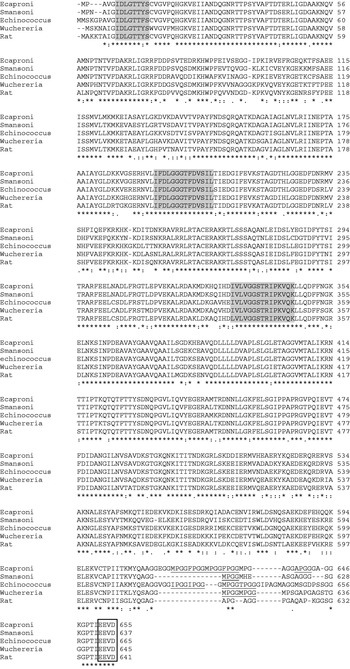
The entire coding sequence for E. caproni HSP70 was obtained by 5′ and 3′ RACE-PCR using cDNA as the template. The resultant cDNA was 2040 bp in size with an open reading frame (ORF) of 1968 bp, encoding 655 amino acids with a predicted molecular weight of 71708·94 Da and an isoelectric point of 5·5, as calculated via the ExPASy server (Gasteiger et al. Reference Gasteiger, Hoogland, Gattiker, Duvaud, Wilkins, Appel, Bairoch and Walker2005). The sequence data have been deposited in EMBL nucleotide sequence database (Accession number AM710614). This sequence contained the typical HSP70 signature motifs when compared with other HSP70s (Fig. 1). A multiple-alignment of EcHSP70 with other HSP70 sequences available from current databases revealed ~84% homology with helminth proteins (from Schistosoma mansoni, Echinococcus granulosus and Wuchereria bancrofti), and 81% with the molecule from rat, ruling out the possibility of host contamination. Major differences in amino acid sequence were located at the C-terminal region of the HSP70s. EcHSP70 presented the typical HSP70 eukaryotic motifs GGMP and the ending EEVD, but contained 6 repetitive units of the hydrophobic tetrapeptide GGXP (3 of them being GGMP). These units were present in lower numbers in the other helminth sequences examined (see Fig. 1).
Amino acid sequence alignment of Echinostoma caproni HSP70 (EcHSP70) with various HSP70s from other trematodes, selected nematodes and rat using Clustal W 1.8. Accession numbers of the aligned sequences are the following: Schistosoma mansoni (P08418); Echinococcus granulosus (AAA99139); Wuchereria bancrofti (AAF32254); and rat, Rattus novergicus (AAA17441). Amino acid residues identical among all 5 sequences are indicated by asterisks, and conserved and semi-conserved substitutions with dots. Fingerprinting domains for HSP70 (ExPASy) are shadowed, hydrophobic tetrapeptide repeats are underlined, and the ending motif is boxed.

Differential expression of EcHSP70 in E. caproni between low- and high-compatible hosts
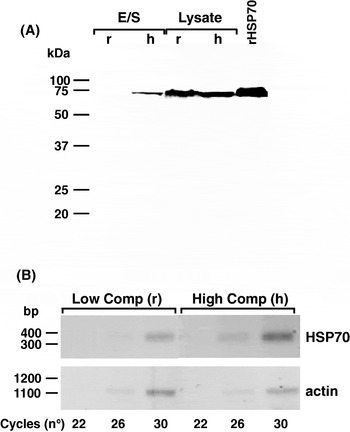
For the analysis of the expression of HSP70 in E. caproni between low- and high-compatible hosts, we used a specific rabbit antiserum against the E. caproni HSP70 recombinant protein (rEcHSP70) produced in E. coli. The serum detected the EcHSP70 in ESP from E. caproni which originated from hamster (high-compatible host), but not in material from the same species collected from rat (low-compatible host) (Fig. 2A). The molecule was detected in somatic lysates from E. caproni from either host, with a slightly lower amount in parasite material from the low-compatible host (Fig. 2A). To address whether the differences in the amount of HSP70 correlated with gene expression in these hosts, we performed semi-quantitative RT-PCR using mRNA from adult parasites from low- and high-compatible hosts, respectively.
Analysis of expression of HSP70 from Echinostoma caproni. (A) Western-blot of E. caproni excretory-secretory products (ESP) and total lysates developed with rabbit antisera obtained against recombinant EcHsp70 produced in E. coli (rEcHSP70). Samples of 100 μg (measured as protein) of ESP and total lysates of E. caproni adults collected from rat (low-compatible host, r) or hamster (high-compatible host, h) were analysed. The bacterial rEcHSP70 protein (rHSP70) was used as a positive control. The position of molecular weight markers in kDa is indicated. (B) Semi-quantitative-PCR using mRNA from E. caproni adults from low-compatible (rat, r) or high-compatible hosts (hamster, h). The number of PCR cycles and position of DNA markers in bp are indicated.

A set of primers was designed to carry out RT-PCR assays (see Table 1 in Supplementary material). Identical RNA amounts were prepared from E. caproni adults obtained from rats and hamster (3 weeks after experimental infection). The results indicated that EcHSP70 was differentially expressed between both hosts at that time, with a somewhat higher level of HSP70 mRNA being detected in E. caproni from hamsters (high-compatible host) (Fig. 2B, upper panel). Interestingly, the pattern of actin expression contrasted that of HSP70, with more mRNA being transcribed in E. caproni adults from rats (low-compatible host) than from hamsters (high-compatible host) (Fig. 2B, lower panel).
Immunolocalization of EcHSP70 in tissue sections of E. caproni adults from low- and high-compatible hosts
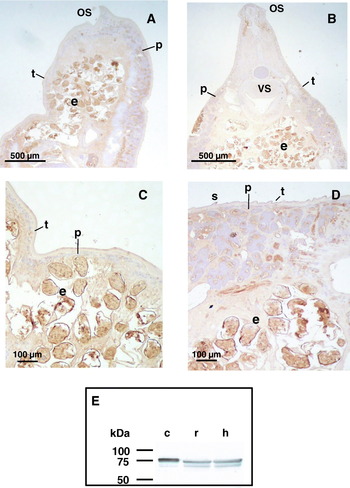
Subsequently, we studied the localization of the native EcHSP70 to structures in adult E. caproni, and compared its presence in this species collected from each host (low- or high-compatible hosts) by means of immunological staining using rabbit antisera anti-rEcHSP70. As shown in Fig. 3A–D, most of the staining was detected in eggs in the uterus of adult worms from both host species. Staining was also observed in the tegument and in the parenchyma, with slight differences between worms from the two hosts (Fig. 3A, B). No staining was observed in controls using only secondary antibodies (data not shown). At high magnification (×250), minor differences were observed in the localization of HSP70 on the worm surface between the two different host species (Fig. 3C, D). Protein EcHSP70 was located at the outer layer of the tegument, and was also detected in the subtegument and parenchyma in adult E. caproni from hamsters (high-compatible host) (Fig. 3D).
Localization of HSP70 in adults of Echinostoma caproni. (A–D) Immunohistochemical detection of EcHSP70 in tissue sections of adult E. caproni by rabbit anti-rEcHSP70, (×100). (A) Sagittal section of 3-week-old adult obtained from rat, (×100). (B) Frontal section of 3-week-old adult obtained from hamster. (C) High magnification (×250) of (A), detailing reactivity of eggs and tegument. (D) High magnification (×250) of (B), detailing tegumentary and subtegumentary reactivity. Os, oral sucker; vs, ventral sucker; s, spine; e, eggs; t, tegument; p, parenchyma. (E) Western-blot of adult E. caproni tegumentary proteins using anti-rEcHSP70 antiserum. Tegumentary proteins (25 μg/lane) obtained from E. caproni adults collected either from rat (r) or hamster (h). rEcHSP70 protein (c) was used as a control. The position of molecular weight markers in kDa is indicated.

To confirm the presence of EcHsp70 in the tegument and compare the amount of this protein in worms from rats (low-compatible host) or hamsters (high compatible host), adults from each host were subjected to tegumentary stripping using a brief treatment with detergent (Triton X-100) (see Anuracpreeda et al. Reference Anuracpreeda, Wanichanon, Chaithirayanon, Preyavichyapugdee and Sobhon2006). As shown in Fig. 3E, EcHsp70 was detected in the tegumental material by immunoblot analysis, with no appreciable variation in the amount of EcHsp70 between the two samples derived from the different hosts (Fig. 3E).
DISCUSSION
In the present study, we cloned HSP70 from E. caproni and expressed it as a recombinant molecule. It has an estimated molecular weight of 71 kDa, and the predicted amino acid sequence shows many similarities to eukaryotic HSP70s, including the repetitive sequence GGMP at the C-terminal region, which has been linked to HSP70 functionality (Demand et al. Reference Demand, Lüders and Höfeld1998). This tetrapeptide has been described in other parasitic helminths, such as W. bancrofti (see Ravi et al. Reference Ravi, Kubofcki, Bandopathyaya, Geetha, Narayanan, Nutman and Kaliraj2004), Brugia malayi (see Rothstein and Rajan, Reference Rothstein and Rajan1991), S. japonicum and S. mansoni (see Hedstrom et al. Reference Hedstrom, Culpepper, Schinski, Arabian and Newport1988) as well as in Plasmodium falciparum (see Kumar et al. Reference Kumar, Zhao, Graves, Folgar, Maloy and Zheng1990) and the protozoan parasite Trypanosoma cruzi (see Engman et al. Reference Engman, Dragon and Donelson1990). The presence of this GGMP peptide has been associated with the immunological properties of HSP70 in P. falciparum (see Richman and Reese, Reference Richman and Reese1988; Kumar et al. Reference Kumar, Zhao, Graves, Folgar, Maloy and Zheng1990), as well as with differences in virulence detected in different strains of Toxoplasma gondii (reviewed by Miller et al. Reference Miller, Smith and Johnson1999). In E. caproni, this GGMP sequence is repeated 3 times, alternating with 2 repeats of the related sequence GGFP, comprising a relatively large hydrophobic region. This latter characteristic could account for the external localization of HSP70 on E. caproni, in contrast to related molecules of Fasciola hepatica and F. gigantica, which are not detected in ESP and seem to contain only 1 tetrapeptide GGMP (Smith et al. Reference Smith, Spithill, Pike, Meeusen and Piedrafita2008).
EcHSP70 is present on the surface of E. caproni as well as in eggs. These findings seem similar to those for HSP70 of Brugia malayi, being present in the somatic musculature, hypodermis and reproductive structures (Schmitz et al. Reference Schmitz, Hale, Rajan and Yates1996) and also support the recent finding that HSP70 is one of the most abundant proteins in S. mansoni egg secretome (Cass et al. Reference Cass, Johnson, Califf, Xub, Hernandez, Stadecker, Yates and Williams2007). The amount of EcHsp70 detected by immunoblot on the surface of adults of E. caproni from the low-compatible host (rat) does not differ appreciably from that in parasites from the high-compatible host (hamster). This information suggests that there is no direct relationship between amount in the tegument and that present in excretory/secretory products (ESP), as EcHsp70 was absent from ESP from E. caproni from the low-compatible host.
The present results demonstrated a higher level of transcription and also HSP70 secretion from E. caproni from the high-compatible host (hamster) compared with the low-compatible host (rat). Since no differences were observed in the amount of EcHsp70 either in somatic lysates or surface materials, the increase in transcription in E. caproni from hamsters could correlate with a higher secretion of the molecule, which in turn could facilitate the parasite establishment in the host, and/or modulate the host response. In support of this notion, we have previously shown an enrichment of parasite ESP in the intestinal mucosa in the host as well as mucosal damage caused by E. caproni in hamsters (high-compatible hosts) (Toledo et al. Reference Toledo, Monteagudo, Espert, Fried, Esteban and Marcilla2006). More recent studies have revealed that increased levels of HSP70 may account for virulence of parasites by adapting to the host environmental changes and modulating host immune responses (see Song et al. Reference Song, Song, Na, Kim, Kwon, Park, Pak, Im and Shin2007). Recently, differential expression of HSP70 has also been observed in the liver flukes Fasciola hepatica and F. gigantica, although the molecule(s) were not detected in ESP (Smith et al. Reference Smith, Spithill, Pike, Meeusen and Piedrafita2008). Intriguingly, the distinct results between species of trematode could be due to differences in life cycle (i.e. with no tissue migration in the Echinostoma spp.), and/or parasite localization in the host (biliary ducts for species of Fasciola versus the intestine for E. caproni).
This work was supported by grants CGL2005-02321/BOS from the Spanish Ministry of Education and Science (Madrid, Spain) and FEDER; GV07/006 y ACOMP07/071 from Conselleria d'Empresa, Universitat i Ciència de la Generalitat Valenciana (Valencia, Spain); and 20050201 (Accions Especials) from the Universitat de València (Valencia, Spain). M. H. is a pre-doctoral fellow (FPU) from the Spanish Ministry of Education and Science.