





1. Introduction
The built environment serves as a crucial provisioning system for meeting basic human needs. However, it is also a significant driver of global resource consumption and associated social-ecological impacts occurring at all building lifecycle stages (Storck et al., Reference Storck, Slabik, Hafner and Herz2023). In the EU, buildings caused around a third of the annual greenhouse gas (GHG) emissions and material consumption in 2022, while contributing 42% of annual energy consumption (European Environment Agency, 2023).
At the same time, access to living space is considerably unequal. High levels of vacancy or under-occupied buildings persist, while many Europeans face overcrowded or unaffordable housing (Eurostat, 2024; Zimmermann & Firat, Reference Zimmermann and Firat2024). This has drawn increasing EU attention, with the second von der Leyen Commission presenting the first-ever Affordable Housing Plan in late 2025. It underscores the political and social importance of studying both the environmental and the social implications of buildings.
Given their systemic nature, these social-ecological concerns are unlikely to be resolved by improving resource efficiency and decarbonising the energy system alone (Bierwirth & Thomas, Reference Bierwirth and Thomas2019b). As a complement to such technological strategies, sufficiency approaches have been proposed by many authors (Bohnenberger, Reference Bohnenberger2021; Darby & Fawcett, Reference Darby and Fawcett2018; Kuittinen, Reference Kuittinen2023). At its core, sufficiency explores how much resource consumption is needed to provide equitable welfare for all within planetary boundaries (Cabeza et al., Reference Cabeza, Bai, Bertoldi, Kihila, Lucena, Mata, Mirasgedis, Novikova and Saheb2022).
Various studies demonstrate the potential for sufficiency to mitigate the ecological impacts of buildings while improving housing affordability and reducing inequalities (Bohnenberger, Reference Bohnenberger2021; Lehner et al., Reference Lehner, Richter, Kreinin, Mamut, Vadovics, Henman, Mont and Fuchs2024; Zu Ermgassen et al., Reference Zu Ermgassen, Drewniok, Bull, Corlet Walker, Mancini, Ryan-collins and Cabrera Serrenho2022). Despite these findings, sufficiency receives limited attention in policy (Sandberg, Reference Sandberg2021; Zell-Ziegler et al., Reference Zell-Ziegler, Thema, Best, Wiese, Lage, Schmidt, Toulouse and Stagl2021), even if awareness of sufficiency may be emerging among EU policymakers. For example, in the 2023 revision of the Energy Performance of Buildings Directive, the term ‘sufficiency’ was included in an early amendment by the European Parliament (European Parliament, 2023).
Recent research has primarily focused on national and sub-national policy initiatives for sufficiency in buildings and housing (Bagheri et al., Reference Bagheri, Roth, Siebke, Rohde and Linke2024; Lindgren et al., Reference Lindgren, Hahn, Karlsson and Malmaeus2023; Zell-Ziegler et al., Reference Zell-Ziegler, Thema, Best, Wiese, Lage, Schmidt, Toulouse and Stagl2021). Whereas EU policies can potentially shape local and national sufficiency approaches to the built environment, this area is underexplored. To our knowledge, no systematic analysis of sufficiency in EU building policies has been done. Moreover, few studies on policy mixes have assessed the built environment sector, particularly in the context of recent EU legislative cycles.
We attempt to fill these research gaps by presenting the first EU policy mix analysis of sufficiency approaches to buildings. Understanding how much EU building policies have incorporated (elements of) sufficiency thinking is crucial not only for advancing the academic debate but also for giving policymakers a concrete status quo and potential entry points for sufficiency approaches. For this purpose, we apply a qualitative content analysis approach. Treating the European Green Deal (EGD) as a starting point, we map EU policies for the built environment adopted between December 2019 and July 2025 and develop a policy mix. We assess how well the current policy mix aligns with sufficiency principles, identifying gaps and opportunities.
Section 2 of this paper reviews the existing literature on sufficiency approaches for buildings and housing. In Section 3, we provide an overview of our methodological approach. We present our results in Section 4 and discuss them in Section 5 in light of the literature. In Section 6, we conclude with policy implications.
2. Literature review
2.1. Sufficiency definitions
Sufficiency is variously defined in the academic literature, as it is by no means a recent concept. Sufficiency entered the academic debate around sustainability in the context of ecological economics and critiques of economic growth (Daly, Reference Daly1986; Princen, Reference Princen2003; Sachs, Reference Sachs1993). In the literature, sufficiency has been conceptualised as both a means to an end (a strategy, a tool, a process) and an end in itself (a state) (Lage, Reference Lage2022; Zell-Ziegler et al., Reference Zell-Ziegler, Thema, Best, Wiese, Lage, Schmidt, Toulouse and Stagl2021).
Sufficiency is often approached by setting a social floor (‘enough’ individual resource consumption to fulfil everyone’s basic needs) and an ecological ceiling (‘enough’ overall resource consumption to remain within biogeophysical limits) (Lage, Reference Lage2022). Taken together, these two thresholds define the conditions for a sustainable and decent life for all (Spengler, Reference Spengler2016). Sufficiency is therefore connected to the idea of sustainable ‘consumption corridors’, avoiding excess, luxuries, and riches, as well as deprivation, lack of necessities, and poverty (Gough, Reference Gough2020). Prominent frameworks for conceptualising the social floor or the ecological ceiling include the planetary boundaries (Rockström et al., Reference Rockström, Steffen, Noone, Persson, Chapin, Lambin, Lenton, Scheffer, Folke, Schellnhuber, Nykvist, de Wit, Hughes, van der Leeuw, Rodhe, Sörlin, Snyder, Costanza, Svedin and Foley2009), Doughnut Economics (Raworth, Reference Raworth2012), Doyal and Gough’s theory of human need (Doyal & Gough, Reference Doyal and Gough1991; Gough, Reference Gough2017), and Sen’s capability approach (Sen, Reference Sen1999).
Focusing on the built environment, the 2022 report of the Intergovernmental Panel on Climate Change (IPCC) defines sufficiency as ‘avoiding the demand for materials, energy, land, water and other natural resources while delivering a decent living standard for all within the planetary boundaries’ (Cabeza et al., Reference Cabeza, Bai, Bertoldi, Kihila, Lucena, Mata, Mirasgedis, Novikova and Saheb2022). Avoiding resource demand over buildings’ lifecycles addresses the ecological ceiling by tackling the root causes of environmental impacts of human activities, while a fair and equitable distribution of space and resources aims at provisioning decent living standards,Footnote 1 i.e. the social floor (Cabeza et al., Reference Cabeza, Bai, Bertoldi, Kihila, Lucena, Mata, Mirasgedis, Novikova and Saheb2022).
Sufficiency is frequently proposed as a complementary systemic strategy to technology-focused efficiencyFootnote 2 and consistencyFootnote 3 measures (Bierwirth & Thomas, Reference Bierwirth and Thomas2019a; Cabeza et al., Reference Cabeza, Bai, Bertoldi, Kihila, Lucena, Mata, Mirasgedis, Novikova and Saheb2022; Zimmermann & Firat, Reference Zimmermann and Firat2024). While efficiency and consistency are relevant for lowering energy and material intensities, rebound effects offset these gains through increased consumption volumes (Lorek & Spangenberg, Reference Lorek and Spangenberg2019). Both efficiency and consistency focus on (socio-)technological innovation, disregarding the potential of social innovation and broader structural changes (Dias & Partidário, Reference Dias and Partidário2019; Lage, Reference Lage2022). By contrast, sufficiency is characterised by long-term actions and non-technical solutions that lead to less consumption in absolute terms (Cabeza et al., Reference Cabeza, Bai, Bertoldi, Kihila, Lucena, Mata, Mirasgedis, Novikova and Saheb2022). However, scholars also recognise that a rigid distinction between these three sustainability strategies is often difficult in practice, and that related measures may overlap (Zell-Ziegler et al., Reference Zell-Ziegler, Thema, Best, Wiese, Lage, Schmidt, Toulouse and Stagl2021).
To practically implement sufficiency strategies, authors emphasise the need for bottom-up lifestyle changes as well as top-down policy and structural transformations (Lage, Reference Lage2022). For example, Bohnenberger (Reference Bohnenberger2021) highlights that sufficiency requires changes in consumption patterns in line with ecological sustainability, by adopting frugal lifestyles and reducing the demand for products and services with high resource footprints. At the same time, Darby and Fawcett (Reference Darby and Fawcett2018) argue that implementing sufficiency through demand reduction and individual consumer choices risked obstructing structural issues. According to them, consideration should be given primarily to (infra-)structures that shape individual demand (like the design and construction of the built environment), as they heavily influence consumption patterns.
2.2. Sufficiency for buildings and housing
In the recently expanding literature on sufficiency, many studies focus on energy (Bertoldi, Reference Bertoldi2022; Darby & Fawcett, Reference Darby and Fawcett2018; Thomas et al., Reference Thomas, Thema, Brischke, Leuser, Kopatz and Spitzner2019; Toulouse et al., Reference Toulouse, Sahakian, Bohnenberger, Bierwirth, Lorek and Leuser2019) and housing (Aagaard & Christensen, Reference Aagaard and Christensen2024; Bagheri et al., Reference Bagheri, Roth, Siebke, Rohde and Linke2024; Lehner et al., Reference Lehner, Richter, Kreinin, Mamut, Vadovics, Henman, Mont and Fuchs2024; Novy et al., Reference Novy, Baumgartner, Grabow, Plank and Volmary2024). To a lesser extent, recent research has investigated sufficiency in non-residential buildings such as offices (Barjot & Malmqvist, Reference Barjot and Malmqvist2024; Cabeza et al., Reference Cabeza, Bai, Bertoldi, Kihila, Lucena, Mata, Mirasgedis, Novikova and Saheb2022; Zimmermann & Firat, Reference Zimmermann and Firat2024). These strands are often cross-cutting and identify a recurring set of sufficiency measures. These include reducing living space per capita, e.g. through sharing living space or relocating to smaller dwellings when housing needs change, and prioritising renovation of the existing building stock over new construction (Lehner et al., Reference Lehner, Richter, Kreinin, Mamut, Vadovics, Henman, Mont and Fuchs2024; Thomas et al., Reference Thomas, Thema, Brischke, Leuser, Kopatz and Spitzner2019; Zimmermann & Firat, Reference Zimmermann and Firat2024).
Increasing dwelling size significantly drives energy demand (Cabeza et al., Reference Cabeza, Bai, Bertoldi, Kihila, Lucena, Mata, Mirasgedis, Novikova and Saheb2022; Ellsworth-Krebs, Reference Ellsworth-Krebs2020) and material use (Lorek & Spangenberg, Reference Lorek and Spangenberg2019; Zimmermann & Firat, Reference Zimmermann and Firat2024). Bierwirth and Thomas (Reference Bierwirth and Thomas2019b) demonstrate that a reduction of per-capita living space in the EU could yield substantial energy savings for space heating while revealing national differences that necessitate tailored measures. Combined approaches integrating smaller living spaces, energy efficiency, and renewable energy could deliver an additional 45% reduction in GHG emissions (Lorek & Spangenberg, Reference Lorek and Spangenberg2019, drawing on Pfäffli, Reference Pfäffli2012). Policy proposals for downsizing include municipal-level caps on average floor area per person and the promotion of shared communal spaces and co-living arrangements through financial and advisory instruments (Bierwirth & Thomas, Reference Bierwirth and Thomas2019a; Sandberg, Reference Sandberg2021; Thomas et al., Reference Thomas, Thema, Brischke, Leuser, Kopatz and Spitzner2019).
While many of these studies primarily focus on the physical dimension of sufficiency, others investigate the combined social-ecological benefits, such as improved affordability and decent housing (Gough et al., Reference Gough, Horn, Rogers and Tunstall2024; Zu Ermgassen et al., Reference Zu Ermgassen, Drewniok, Bull, Corlet Walker, Mancini, Ryan-collins and Cabrera Serrenho2022). Lehner et al. (Reference Lehner, Richter, Kreinin, Mamut, Vadovics, Henman, Mont and Fuchs2024) show that proper design of high-quality shared amenities can sustain and even improve quality of life despite smaller private living space (see also Sandberg, Reference Sandberg2018). Bagheri et al. (Reference Bagheri, Roth, Siebke, Rohde and Linke2024) and Bohnenberger (Reference Bohnenberger2021) propose progressive taxation, flat-swap schemes, occupancy guidance in social housing, and higher tax rates on per-capita space consumption in shortage areas to reallocate unused space.
Many of these measures are closely tied to design and construction choices that determine whether buildings can be adapted, shared, or reused over time. Multi-functional spaces and adaptable floor plans allow for shifts between uses (e.g. from offices to housing) or restructuring (e.g. merging units or converting a single-bedroom flat into shared apartments) to meet changing household needs (Bierwirth & Thomas, Reference Bierwirth and Thomas2019a; Zimmermann & Firat, Reference Zimmermann and Firat2024). Such flexibility can extend building lifetimes and reduce demand for new construction. Design for disassembly enables reuse and recycling of components, cutting waste and resource demand for new builds (Rasmussen et al., Reference Rasmussen, Birkved and Birgisdóttir2019; Rios et al., Reference Rios, Chong and Grau2015).
While avoiding new construction is preferable from an environmental standpoint (Storck et al., Reference Storck, Slabik, Hafner and Herz2023), authors argue that when new buildings are unavoidable, design should prioritise low carbon footprints, durability, and circularity, achieving societal value with minimal environmental and social harm (Kuittinen, Reference Kuittinen2023; Zimmermann et al., Reference Zimmermann, Brischke, Bierwirth and Buschka2023). This highlights potential synergies between circular strategies and sufficiency by prioritising a reduction of resource throughput and limiting rebound effects from efficiency gains (Calisto Friant et al., Reference Calisto Friant, Vermeulen and Salomone2020; Schröder et al., Reference Schröder, Bengtsson, Cohen, Dewick, Hoffstetter and Sarkis2019).
Preserving and adapting existing buildings offer much potential to reduce resource use while delivering social and ecological benefits (Kuittinen, Reference Kuittinen2023; Novy et al., Reference Novy, Baumgartner, Grabow, Plank and Volmary2024). In German cities, redistributing existing housing based on housing needs could address up to 34.5% of the housing shortage (Bagheri et al., Reference Bagheri, Roth, Siebke, Rohde and Linke2024), and renovating or extending the current stock could meet up to 83% of Germany’s annual housing demand (Zimmermann et al., Reference Zimmermann, Brischke, Bierwirth and Buschka2023). By contrast, continued urban expansion in the UK threatens farmland and biodiversity (Zu Ermgassen et al., Reference Zu Ermgassen, Drewniok, Bull, Corlet Walker, Mancini, Ryan-collins and Cabrera Serrenho2022). As Novy et al. (Reference Novy, Baumgartner, Grabow, Plank and Volmary2024) stress, the obligations of landlords play a key role to advance the social-ecological transformation through measures like thermal renovations, greening, and land-value taxes. Yet market mechanisms still prioritise new construction (Zimmermann & Firat, Reference Zimmermann and Firat2024), signalling the need for sufficiency-oriented housing policies.
Examples of research on existing sufficiency policies mostly concern the national and sub-national governance levels (e.g. Iten et al., Reference Iten, Seidl and Pütz2024). These include Berlin’s downsizing support and municipal housing advice (Bierwirth & Thomas, Reference Bierwirth and Thomas2019a), Tübingen’s municipal living-space counselling, Zürich’s minimum-occupancy rule in social housing, and France’s Échanger Habiter platform for social-housing flat swaps in the Île-de-France region (Bagheri et al., Reference Bagheri, Roth, Siebke, Rohde and Linke2024).
Nevertheless, sufficiency remains marginal in policymaking (Lindgren et al., Reference Lindgren, Hahn, Karlsson and Malmaeus2023; Sandberg, Reference Sandberg2021). In a cross-country review of Member States’ National Energy and Climate Plans (NECPs) and Long-Term Strategies, Zell-Ziegler et al. (Reference Zell-Ziegler, Thema, Best, Wiese, Lage, Schmidt, Toulouse and Stagl2021) find that sufficiency is rarely treated as a distinct policy domain. They categorise three types of sufficiency measures: reduction (absolute decreases in energy demand, e.g. less heated floor area), substitution (less energy-intensive practices, e.g. co-living), and general measures that reshape policy frameworks (e.g. taxation). They find that building policies emphasise efficiency and that the few sufficiency targets are mostly soft instruments like awareness campaigns or voluntary lifestyle adjustments, rather than binding regulations.
At the EU level, research on sufficiency remains scarce. Bierwirth and Thomas (Reference Bierwirth and Thomas2019a) link frameworks such as the Energy Taxation Directive and the EU Emissions Trading System (ETS) to German examples, while Cabeza et al. (Reference Cabeza, Bai, Bertoldi, Kihila, Lucena, Mata, Mirasgedis, Novikova and Saheb2022) refer to EU energy policies mainly in terms of energy audits and renovation programmes for vulnerable households. Lindgren et al. (Reference Lindgren, Hahn, Karlsson and Malmaeus2023) highlight how EU measures like the Energy Efficiency Directive (EED) and NECPs shape national approaches in Sweden. Still, a systematic and comprehensive EU policy analysis of sufficiency in the building sector is lacking.
Overall, the literature shows that sufficiency in the built environment is converging on a set of measures around prioritising and repurposing existing stock, reducing per-capita living space, and ensuring access to decent housing for all. Even so, studies offer limited insight into how sufficiency is reflected across the EU’s broader policy mix, despite its important role in shaping national policy. This paper aims to address these gaps, as described in the following section.
3. Methods
3.1. Policy mapping
The first step of the analysis consisted of delineating the policy mix. For this, we used a combined top-down and bottom-up approach, as outlined by Ossenbrink et al. (Reference Ossenbrink, Finnsson, Bening and Hoffmann2019). Our starting point was the flagship EGD, which set overarching EU policy objectives for 2019–2024, initiated a series of new policiesFootnote 4 and revised existing ones (Rizos & Zambianchi, Reference Rizos and Zambianchi2025). The EGD also marked a broader shift in EU sustainability discourse by making environmental and social aspects more central on the policy agenda (Schunz, Reference Schunz2025). While the strategy provided a high-level framework for policy selection, we also included policies that specifically target the built environment and relate to the sustainability of buildings across their lifecycles, encompassing both physical and social dimensions.
We then drew the policy mix for our analysis (Lindberg et al., Reference Lindberg, Markard and Andersen2019). We focused on two main types of EU policy documents: strategies and binding secondary law legislative acts, namely regulations, directives, and decisions (excluding recommendations and opinions). In our work, EU strategies refer to documents developed by the European Commission, Parliament, European Council, and Council of the European Union, which articulate overarching political objectives and medium-term plans, while being non-binding in nature (European Union, 2026a). Regulations are binding legislative acts that must be enforced in all EU countries. For directives, EU countries need to adopt their own national laws to reach the objectives set out in these EU legislative acts (European Union, 2026b). The latest versions of the legislation and strategies were gathered via the EUR-Lex website.
In terms of timing, we considered policies adopted, revised, or amended during December 2019–July 2025. This period corresponds to the first von der Leyen Commission, whose strategic objectives were shaped by the EGD, as well as the early months of the second von der Leyen Commission. An exception is Regulation (EU) 2018/1999, which we included due to its foundational role in shaping the EGD (Oberthür & von Homeyer, Reference Oberthür and von Homeyer2023). As we only included policies in force at the time of writing, we could not consider the new Affordable Housing Plan.
Further boundaries were drawn around the policy content. We excluded policies that primarily target the sustainability of upstream sectors, such as transport or mining. Although these sectors do affect the lifecycle social-ecological implications of buildings, such delimitations were necessary to maintain analytical coherence and methodological rigour.
The analysis began with the EGD and associated strategies (outlined in Section 4). On this basis, decisions, directives, and regulations were identified, either originating from these strategies or scheduled for review under them. To cover the full scope of sufficiency-related measures, policies oriented towards social issues were also included. Identified policies may contain several documents (e.g. the main text and annexes, as well as delegated acts, if relevant). When policies amended previous versions, we incorporated both the old and the new legal texts into the analysis.
3.2. Content analysis
In a second step, we used a combination of inductive and deductive content analysis (Elo & Kyngäs, Reference Elo and Kyngäs2008; Gossen & Kropfeld, Reference Gossen and Kropfeld2022) to understand how the identified documents incorporate sufficiency thinking. Deductive content analysis is based on a pre-existing categorisation matrix (Elo & Kyngäs, Reference Elo and Kyngäs2008). For this, we conceptualised our own definition of sufficiency from a synthesis of the literature:
Sufficiency is a guiding principle and a set of actions aimed at inducing changes in production and consumption patterns towards reducing resource consumption and associated ecological impacts, while fulfilling everyone’s basic needs equitably and within ecological limits.
In the literature, the boundaries between sufficiency, efficiency, and consistency are not always clear-cut, and more technical measures can also support at least the resource and environmental dimensions of sufficiency (Lindgren et al., Reference Lindgren, Hahn, Karlsson and Malmaeus2023; Zell-Ziegler et al., Reference Zell-Ziegler, Thema, Best, Wiese, Lage, Schmidt, Toulouse and Stagl2021). Since the debate is open on what fits under the umbrella of sufficiency, we chose a broad definition to include diverse interpretive approaches in our analysis.
To derive our categorisation matrix, four dimensions of sufficiency were extracted from this definition and subsequently applied in the content analysis (see Table S.1 in the supplementary materials, which links these dimensions with the literature). The first two relate more to the physical aspects of sufficiency (the environmental ceiling), while the other two focus more on social considerations (the social floor):
(1) Reducing resource consumption refers to policy measures for limiting the use of resources (e.g. material, energy, water, and land) across buildings’ lifecycles, in terms of absolute and relative reductions.Footnote 5 Example measures within this dimension are increasing the lifetime of buildings, using flexible and modular building designs, reducing energy needs, or downsizing.
(2) Improving environmental sustainability refers to reducing the ecological footprint of human activities, other than through demand reduction (which is already covered in the first dimension). This dimension may include facilitating access to renewable energy in buildings, substituting environmentally harmful construction materials with less impactful ones, or providing more green spaces.
(3) Enabling behavioural and lifestyle changes encompasses policy measures that encourage sufficiency behaviour by individuals and households, but also by businesses and organisations. Examples of policy measures in this dimension include energy consulting, R&D support for sustainable construction, awareness campaigns, or financial support.
(4) Providing equitable welfare denotes policy measures for improved equity and social justice related to buildings and housing, aiming at well-being and decent living conditions for all. This realm could involve equity-improving measures like financial support to low-income households for renovations, rent caps, and more systemic measures against energy poverty or a redistribution of living space, such as minimum occupancy rates.
We analysed the entire text of all identified policy documents to understand how the policies approached these four dimensions, including identifying policy measures (i.e. concrete obligations in directives or regulations) or objectives (i.e. non-binding goals in strategies). The relevant provisions were transposed into an Excel coding matrix (see Table S.2 in the supplementary materials). Where the identified measures or objectives could practically belong to multiple dimensions, the research team collectively chose the dimension that more closely aligned with the measure’s focus.
We then ranked policies (see Lindberg et al., Reference Lindberg, Markard and Andersen2019) to analyse how strongly they acknowledged a given sufficiency dimension. Ranks were assigned based on one guiding question across the four sufficiency dimensions: How does the policy aim to advance [the respective sufficiency dimension]? Policies achieved one of four ranks for each dimension:
0: The policy does not aim to advance the respective sufficiency dimension (no mentions).
1: The policy acknowledges the importance of advancing the respective sufficiency dimension only as a contextual reference (i.e. only in the introduction or recitals), without concrete measures or objectives (henceforth, ‘measures’).
2: The policy adopts at least one concrete measure for advancing the respective sufficiency dimension.
3: The policy adopts at least one concrete measure for advancing the respective sufficiency dimension, which is also a ‘core feature’ of the document.Footnote 6
To validate the preliminary results, each policy was analysed a second time by a different author and received a final check to ensure consistency by the first author. Findings were compared to reach an agreement on the ranking, pursuing consensus wherever possible; otherwise, the first author decided. Descriptive statistics were calculated to identify the lowest, highest, and average ranks per sufficiency dimension, individual policy, and policy type (strategy, directive, regulation).
After the deductive analysis, we added an inductive step (Elo & Kyngäs, Reference Elo and Kyngäs2008). We conducted a bottom-up coding of the identified measures, grouping them into different categories. The coding was performed by the main author in two rounds: in the first round, general themes were extracted from the description of reported measures; in the second, overlaps between these themes were identified to group assorted measures under one higher-order code (Burnard, Reference Burnard1991). This was important for contextualising the ranking of the policies, by showing the variety of approaches (or lack thereof) to each sufficiency dimension, and for enabling a later comparison with the literature. Emblematic quotes that exemplify how the coding was conducted are included in Table S.3 in the supplementary materials.
The results of our analysis, including the policy mix selection and the content analysis, are described in the following section.
4. Results
4.1. Policy mix analysis
The policy mix derived from the policy mapping consists of sixteen policies: five communications (‘strategies’), four directives, and seven regulations (see Figure 1). All of the identified legislative acts are connected to at least one of the strategies. In one case (the Taxonomy Regulation), the building-relevant measures of the policy are specified in delegated acts, which were therefore included in the analysis.
For our analysis, we grouped the identified policies according to four different themes that corresponded to their main intended function to better understand commonalities and differences (see Table 1): (i) funding instruments, (ii) energy and climate policies, (iii) buildings and construction policies, and (iv) cross-cutting policies.Footnote 7 Three of the four thematic groups contain a mix of the three analysed policy types (strategies, directives, and regulations), whereas funding instruments consist only of regulations.
EU policy mix for a sustainable built environment.

Figure 1 Long description
The image displays the sixteen different policies comprising the identified EU policy mix for sustainability in the built environment. The sixteen policies are grouped according to their policy type (strategies, directives and regulations). The image also shows which directives and regulations are connected to which of the five different strategies.
List of policies in the assessed policy mix for sustainable buildings

Table 1 Long description
The table lists the sixteen analysed policies, using their official legal titles as well as the abbreviations used in the paper for simplification purposes. The table also shows the years of adoption and types of policies (strategies, directives, regulations) by policy. It assigns each policy a thematic grouping (funding instruments, energy and climate policies, buildings and construction policies, and cross-cutting policies).
Notes:
a These regulations and directives repeal previous EU laws in their domains.
The 16 identified policies were analysed and ranked to determine the extent to which they each incorporate one of the four sufficiency dimensions: reduced consumption, environmental sustainability, behavioural change, and equitable welfare. The results of this content analysis are below.
4.2. Content analysis
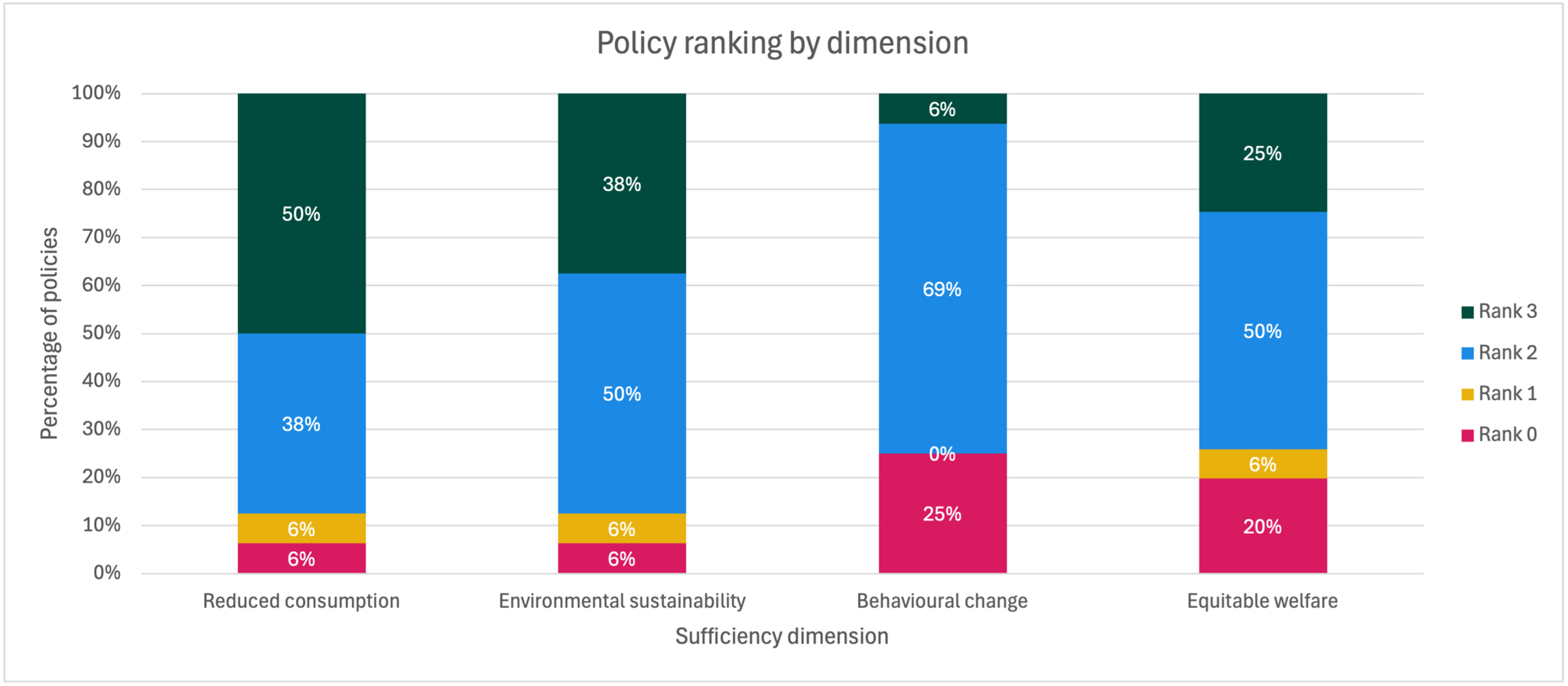
The content analysis of the 16 policies reveals several general trends. While many of the assessed policies address sufficiency dimensions, their rankings differ and are unevenly distributed (see Figure 2). The two physical sufficiency dimensions, reduced consumption and environmental sustainability, exhibit larger shares of policies that achieve the highest rank of 3. The social sufficiency dimensions, behavioural change and equitable welfare, display larger shares of policies with the lowest rank of 0. As a result, the average rank of policies on social dimensions is lower than those on physical dimensions. Across dimensions, there are relatively few policies that only include a contextual reference to sufficiency aspects (rank 1), with most policies achieving a minimum rank of 2 for all dimensions. This means that most of the analysed policies include concrete measures for achieving objectives that fall into at least one of the four sufficiency dimensions, rather than merely alluding to it in their introductions or recitals.
Policy ranking by dimension.

Reduced consumption is the dimension with the largest share of policies at rank 3. Half the analysed policies have measures to reduce resource consumption as core features. Table 2 displays the coded measures and objectives by dimension, policy, and rank (i.e. rank 2 or rank 3, since anything less was not counted as a measure).
Multiple core-feature measures of the reduced consumption dimension focus on renovation, efficiency, and ecodesign for circularity. One of the identified measures at rank 3 aims at an absolute reduction of resource consumption (in the EED). Around 38% of policies in this dimension were ranked 2, having adopted at least one measure or objective without it playing a central role in the policy text. Rank 2 measures include renovation, efficiency, circularity, and one other case of absolute reduction. Two policies, corresponding to 12%, did not include any measures on reducing resource consumption (ranked at 1 and 0, respectively).
Environmental sustainability exhibits the second largest share of rank 3 policies at 38%. Measures that were ranked as core features in these policies concern renewables, decarbonisation, ecodesign, and sustainable products or materials. A core feature in one policy addresses environmental protection more broadly. Half the policies in this dimension were attributed a ranking of 2, their measures largely overlapping with the core features. Around 6% of policies were ranked 1 or 0, each, not incorporating any sustainability measures or objectives.
Behavioural and lifestyle change is the dimension displaying the most extremes. While it has the highest share of rank 2 policies (69%), only one policy (corresponding to 6%) includes changing behaviour as a core feature. This pertains to the measure of financial incentives (specifically, carbon pricing in the ETS 2). Other policies (rank 2) include measures for financial or technical support, information and awareness, or labelling and disclosure. Behavioural change is the only dimension without any rank 1 policies and has the largest share of rank 0 policies: about a quarter of policies do not mention changing behaviours.
Equitable welfare has similar shares of rank 3 and rank 0 policies (25% and 20%, respectively). Policies that incorporate equitable welfare as a core feature have measures targeting financial support for vulnerable households and groups, reducing energy poverty, or ensuring the financial accessibility of different services (e.g. sustainable housing and renovations). One policy (the ERDF & CF) also aims at the socio-economic inclusion of vulnerable groups, more broadly. Around half the policies in this dimension achieved rank 2. The associated measures include providing information as well as financial and technical support. One policy was ranked at 1, providing only a contextual reference for equitable welfare.
While some policies include a wide range of measures across each dimension, others are limited to a single type. The EPBD and the Renovation Wave are examples of policies adopting various measures or communicating different objectives for most of the dimensions. To reduce resource consumption, the EPBD has measures tackling renovation, efficiency, digital tools, and absolute reduction of energy use. Although not a core feature, EPBD measures include changing behaviours and providing equitable welfare through infrastructure provision, financial support, technical support, and information.
The Renovation Wave puts forward objectives for improving the environmental sustainability of the built environment, including sustainable products or materials, ecodesign, and decarbonisation. Multiple objectives promote behavioural change and equitable welfare in the Renovation Wave, e.g. through conducting energy audits, removing regulatory barriers, and ensuring the financial accessibility of sustainable housing, renovations, and services.
Other policies, like the ETS 2 and the NEB, show less variety. To reduce the resource consumption of the built environment, the ETS 2 has only one type of measure (efficiency). This is also the case for behavioural change and equitable welfare, where ETS 2 measures are limited to financial incentives (carbon pricing) and financial support, respectively. The NEB focuses on objectives for reducing pollution in the environmental sustainability dimension, and on technical and financial support in the behavioural change domain.
None of the analysed policy documents achieved the maximum rank for all four dimensions (see Figure 3). Two policies, the Renovation Wave and the ERDF & CF, integrate measures from three out of four sufficiency dimensions as core features. Both are weakest on supporting behavioural change, with the Renovation Wave at rank 2 and the ERDF at rank 0 in this regard. While no policy scored 0 for all four dimensions, the ESF+ only achieved a ranking of 2 for equitable welfare, with all other dimensions lacking any reference.
Breakdown of measures and objectives by sufficiency dimension and policy

Table 2 Long description
The table shows which measures and objectives have been identified in which policies, grouped by sufficiency dimension (reduce consumption, environmental sustainability, behavioural change, equitable welfare). It also highlights the ranks associated with the coded measures and objectives in the respective policies. Rank 3 denotes that a measure/objective acts as a core feature in a policy. Rank 2 denotes that a measure/objective exists in a policy. Ranks 1 and 0 are absent from the table, since these are not associated with measures or objectives.
Notes: Numbers refer to the highest rank the identified measures achieved in the respective policy. Ranks 0 and 1 are not shown because these scores represent the lack of a measure. The second column reflects the coded measures. Analysed policies may include additional measures of the same type that do not specifically address buildings. These are not included in the analysis.
Ranks by policy, dimension, and thematic grouping.

Figure 3 Long description
The image shows the sixteen policies in the mix grouped according to their thematic grouping (funding instruments, energy and climate policies, buildings and construction policies, and cross-cutting policies). It displays the individual ranks of each policy in each of the four sufficiency dimensions (reduce consumption, environmental sustainability, support behavioural change, equitable welfare).
Looking at the thematic groupings (see Table 1), the analysis shows that funding instruments generally score highest on equitable welfare and lowest on behavioural change. Compared with all other policies, they have relatively low ranks for reduced consumption and environmental sustainability. Energy and climate policies perform relatively equally across dimensions, apart from a lower average rank for behavioural change than for the other dimensions. Still, relative to all other policies, energy and climate policies generally achieve higher ranks in the social dimensions of sufficiency.
Buildings and construction policies rank higher on the physical dimensions of sufficiency than on the social dimensions. While their average rank for environmental sustainability and behavioural change is higher than that of all other policies, their average rank for equitable welfare is lower. Cross-cutting policies display a notably higher average rank for reduced consumption than for any of the other dimensions. Equitable welfare ranks particularly low for these policies. Compared with the average for other policies, cross-cutting ones perform better on reduced consumption but worse on both environmental sustainability and equitable welfare.
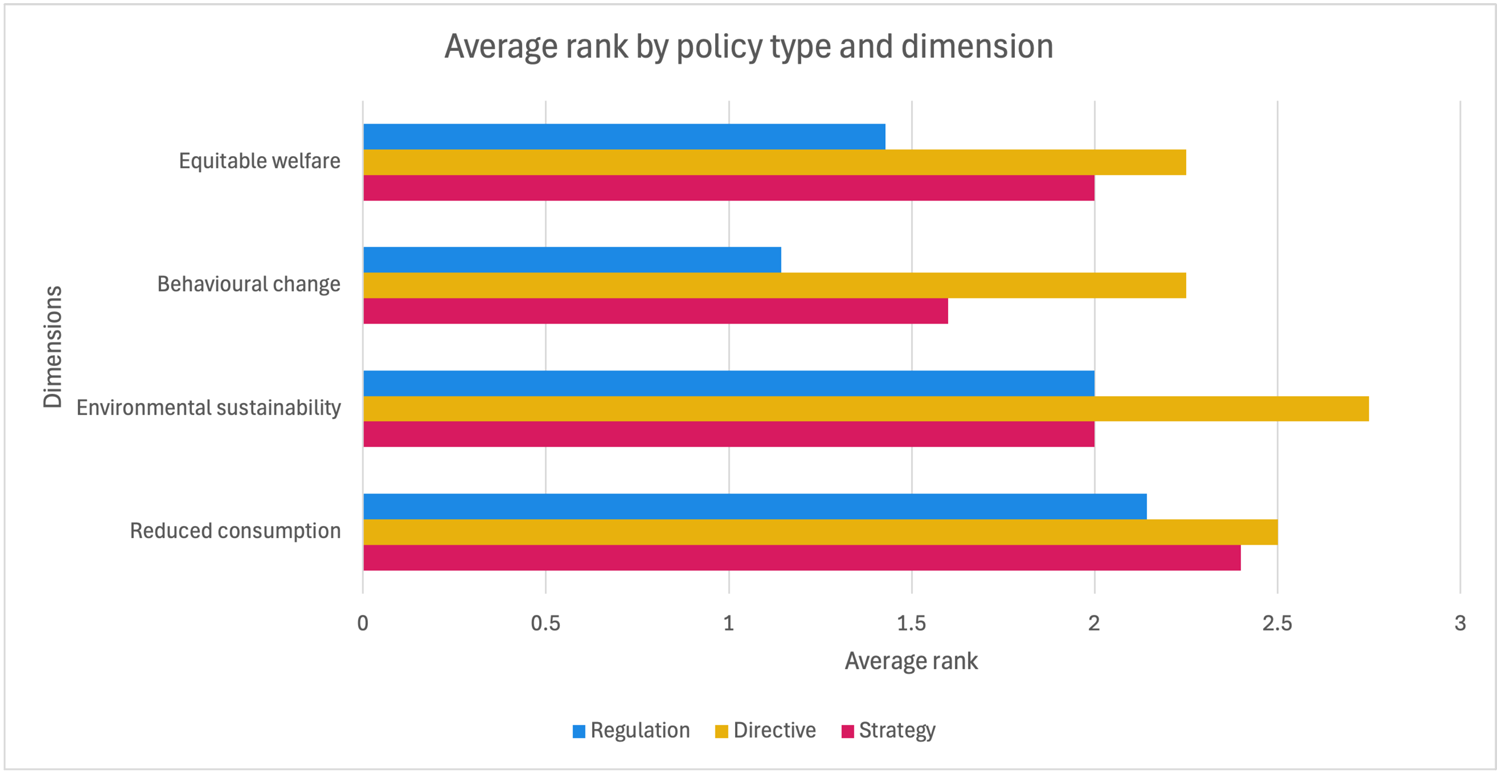
Some broad trends can be observed when grouping the policies by policy type (strategies, directives, and regulations). Starting with regulations, they generally ranked lower than other policies (see Figure 4). They also ranked lowest in social domains (1.14 for behavioural change and 1.43 for equitable welfare). Directives ranked higher in each dimension than any other type of policy. Strategies usually achieved higher ranks than regulations, except in environmental sustainability, where they tied. Directives scored highest in the physical dimensions (averaging 2.75 for environmental sustainability and 2.5 for reduced consumption). None of the policy types had a higher average rank for social dimensions than for physical dimensions. Yet, strategies tied in equitable welfare and environmental sustainability, with an average rank of 2 for both dimensions.
Average rank by policy type and dimension.

The implications of our results for EU policymaking on the built environment and the limitations are discussed below.
5. Discussion
5.1. Sufficiency in the EU policy mix for buildings
This paper attempts to fill three major gaps in the literature on sufficiency policy for buildings. First, existing studies primarily address energy sufficiency (e.g. Darby & Fawcett, Reference Darby and Fawcett2018; Thomas et al., Reference Thomas, Thema, Brischke, Leuser, Kopatz and Spitzner2019; Toulouse et al., Reference Toulouse, Sahakian, Bohnenberger, Bierwirth, Lorek and Leuser2019) while focusing on housing policy (Bagheri et al., Reference Bagheri, Roth, Siebke, Rohde and Linke2024; Lehner et al., Reference Lehner, Richter, Kreinin, Mamut, Vadovics, Henman, Mont and Fuchs2024; Novy et al., Reference Novy, Baumgartner, Grabow, Plank and Volmary2024). This paper therefore adopts an integrated sufficiency framework, including but not limited to energy sufficiency. It also expands the literature by investigating various policies for the built environment, going beyond the residential sector and housing policy. Second, policy analyses are largely confined to national and sub-national levels (e.g. Bagheri et al., Reference Bagheri, Roth, Siebke, Rohde and Linke2024; Lindgren et al., Reference Lindgren, Hahn, Karlsson and Malmaeus2023; Zell-Ziegler et al., Reference Zell-Ziegler, Thema, Best, Wiese, Lage, Schmidt, Toulouse and Stagl2021). As a result, insights into how EU policies incorporate elements of sufficiency remain extremely scarce. The present study contributes to closing this gap by investigating policies at the EU level. Third, there is no systematic analysis of sufficiency in policy mixes for buildings, irrespective of governance levels. To the best of our knowledge, this paper presents the first analysis of sufficiency in a policy mix for the built environment.
To examine the degree to which sufficiency is integrated into the analysed policy mix, we developed our own definition of sufficiency, building on the existing literature, and operationalised it into four key dimensions. We constructed a policy mix comprising 16 policies and applied content analysis to rank their relevance to each of the four sufficiency dimensions, while coding the identified measures to give more insight into the underlying mechanisms.
Our results reveal policies in the mix that address different sufficiency dimensions to varying degrees. In fact, very few policies did not include any provisions in the four sufficiency dimensions. The reduced consumption dimension stood out, containing the highest proportion of policies with at least one concrete measure as a core feature. Half the analysed policies included measures aligned with this dimension, ranging from building renovation to promoting energy efficiency and ecodesign for circularity.
The environmental sustainability dimension followed closely with the second largest share of rank 3 policies (38%) and measures on, e.g. renewable energy, ecodesign and sustainable products. This emphasis on reducing consumption and improving sustainability can be attributed to the expanding EU policy mix for the circular economy, which increasingly incorporates efficiency-focused instruments such as ecodesign and targets for recycling and reuse (Hartley et al., Reference Hartley, Schülzchen, Bakker and Kirchherr2023; Rizos & Zambianchi, Reference Rizos and Zambianchi2025).
However, ‘hard’ sufficiency measures like explicit caps on consumption remain rare. This mirrors findings from national studies (Lindgren et al., Reference Lindgren, Hahn, Karlsson and Malmaeus2023; Zell-Ziegler et al., Reference Zell-Ziegler, Thema, Best, Wiese, Lage, Schmidt, Toulouse and Stagl2021), which show that most measures within these dimensions are of a technical nature, aiming at relative reductions (efficiency or circularity) or substitution. As such, it is important to note that a high ranking in one of the four dimensions does not imply that a given policy should necessarily be considered a ‘sufficiency’ policy.
Still, our results show general trends of the policy mix and pinpoint where EU policymakers could take more ambitious action and build on existing measures. Notably, there are binding targets for an absolute reduction of aggregate energy consumption in two directives (the EED and the EPBD), although their design and potential effectiveness are not assessed here (see Lindgren et al., Reference Lindgren, Hahn, Karlsson and Malmaeus2023). This implies that there is scope for the EU to implement stricter measures. While the literature often discusses consumption caps as limits on bedrooms per person (Bierwirth & Thomas, Reference Bierwirth and Thomas2019b) or on average floor area per inhabitant (Thomas et al., Reference Thomas, Thema, Brischke, Leuser, Kopatz and Spitzner2019), such measures do not correspond to EU competences. The identified measures could nonetheless align with what Spengler (Reference Spengler2016) frames as maximum limits that decrease total consumption as a cumulative problem instead of an individual one.
Several suggestions from research on national or sub-national contexts could be tailored for the EU. These include introducing sufficiency-weighted funding, e.g. through green public procurement criteria, and improving datasets on building use and living conditions (Zimmermann & Firat, Reference Zimmermann and Firat2024). This could eventually lead to prioritising a better use of existing buildings over new construction projects (Bohnenberger, Reference Bohnenberger2021), e.g. in the EPBD’s National Building Renovation Plans or in the EU Taxonomy (Kuittinen, Reference Kuittinen2023). Additionally, to improve environmental sustainability aspects of the built environment, the EU could require habitat restoration or compensation for the harm of new construction projects (ibid.).
In the social sufficiency dimensions, we generally see fewer policies with concrete measures or objectives, especially for supporting behavioural change. Information and awareness campaigns are most common in the analysed policy mix. This reflects the findings of Zell-Ziegler et al. (Reference Zell-Ziegler, Thema, Best, Wiese, Lage, Schmidt, Toulouse and Stagl2021), who investigated EU countries’ NECPs. Schunz (Reference Schunz2025) classifies such actions as ‘weak sufficiency’, as they mainly encourage voluntary change at the individual level. This resonates with Spengler’s (Reference Spengler2016) broader discussion of sufficiency as maximum, which suggests that addressing excess cannot rely on individual behaviour alone when the underlying problem is cumulative and collective. On the other hand, Bagheri et al. (Reference Bagheri, Roth, Siebke, Rohde and Linke2024) acknowledge the importance of awareness and communication campaigns to increase public acceptance of sufficiency policies.
The ETS 2 is the only policy where behavioural change is a core feature, with a carbon pricing mechanism for fuels used in buildings. This demonstrates both the potential and the challenge of integrating behavioural change into EU policy: the only mechanism to encourage sufficiency-aligned lifestyles is a price on carbon emissions. There is no framework for facilitating social practices that reduce consumption, which could be more in line with sufficiency principles (Lage, Reference Lage2022). Taxation, a more typical sufficiency measure in the literature (Bagheri et al., Reference Bagheri, Roth, Siebke, Rohde and Linke2024; Bohnenberger, Reference Bohnenberger2021), is only mentioned in a few policies, although without reference to a binding target (a national competence).
More systemic measures incentivising lifestyle changes, such as sustainable urban planning and infrastructure provision – as also investigated by Lehner et al. (Reference Lehner, Richter, Kreinin, Mamut, Vadovics, Henman, Mont and Fuchs2024), Sandberg (Reference Sandberg2018), or Thomas et al. (Reference Thomas, Thema, Brischke, Leuser, Kopatz and Spitzner2019) – are only acknowledged in two of the analysed policies. This lack of policy frameworks encouraging sociocultural shifts towards sufficiency lifestyles, behaviours, and values aligns with research (Lindgren et al., Reference Lindgren, Hahn, Karlsson and Malmaeus2023; Sandberg, Reference Sandberg2021) – although case studies give local examples where such measures have been implemented (Bagheri et al., Reference Bagheri, Roth, Siebke, Rohde and Linke2024; Bierwirth & Thomas, Reference Bierwirth and Thomas2019a).
The provision of equitable welfare likewise receives little attention in the policies investigated. In policies where this does play a role, the aim is mostly to reduce energy poverty and provide targeted financial support to vulnerable groups. Guaranteeing equitable access to energy services has been highlighted as a crucial sufficiency measure in the literature (Darby & Fawcett, Reference Darby and Fawcett2018). Another key sufficiency measure for equitable welfare in the academic debate is the redistribution of living space (Bagheri et al., Reference Bagheri, Roth, Siebke, Rohde and Linke2024; Bohnenberger, Reference Bohnenberger2021). It is not surprising that this is absent in the EU policy mix, as such measures lie within national and sub-national competences. Nevertheless, there would be scope for EU directives or strategies to take up this issue, at least by providing guidance to Member States, although it is unlikely in the current political climate (Zell-Ziegler et al., Reference Zell-Ziegler, Thema, Best, Wiese, Lage, Schmidt, Toulouse and Stagl2021).
Provisions on social sufficiency generally lag behind those on physical aspects across policy groups. This uneven distribution could be connected to our relatively broad definition of the latter sufficiency dimensions and the relatively high number of policies that not only include provisions for reducing resource consumption but also declare them a core aspiration.
A further explanation for the uneven treatment of sufficiency dimensions lies in the distribution of competences between the EU and Member States, as set out in Articles 2–6 of the Treaty on the Functioning of the EU (TFEU) (European Union, 2012). The legal instruments of the EU – whether directives or regulations – are more readily applied to the physical aspects of buildings. In the single market, issues such as construction products and energy use in buildings are more easily addressed at the EU level. By contrast, measures with a strong social dimension often require tailoring to national or local contexts.
Yet, this does not mean that sufficiency-oriented social goals could not be addressed at the EU level. After all, there are EU policies with strong social and behavioural implications. A notable example is the ETS 2, which directly incorporates a lifestyle-related element through pricing incentives, as discussed above.
When comparing the types of legal instruments, directives appear particularly well-suited for sufficiency-related measures, as they leave Member States the choice of form and methods in reaching mandatory targets (Article 288 TFEU), combining an EU framework with national contexts. This is compatible with the nature of sufficiency policies, which often require adaptation to local housing stocks, energy systems, and social contexts. Regulations, which are binding in their entirety, may be more difficult anchors for sufficiency in the current EU policy framework. This observation corresponds with the notion that most sufficiency-relevant policies fall under shared powers (Schunz, Reference Schunz2025). In domains within national competence, such as the energy mix, EU sufficiency measures can still be implemented, albeit through softer, non-binding instruments. At the very least, the EU can set minimum standards aligned with the four sufficiency dimensions, while still respecting the subsidiarity principle (Mulé, Reference Mulé, Walzenbach and Alleweldt2021).
Finally, energy and climate policies are unexpectedly high performers across dimensions, integrating both the physical and social dimensions of our sufficiency framework. The EED particularly acknowledges social impacts (primarily energy poverty and prioritising vulnerable groups) while aiming to reduce energy demand through end-use measures. This demonstrates the potential for more integrated policymaking to address social-ecological challenges at the EU level. By contrast, funding instruments in the mix, perhaps unsurprisingly, put an emphasis on equitable welfare, while buildings and construction policies favour the physical dimensions of sufficiency (reduced consumption and environmental sustainability). Overall, the EU policy mix for buildings has yet to adopt an integrated approach to sufficiency that covers all four of our dimensions, simultaneously tackling the ecological ceiling and the social floor of sufficiency thinking.
5.2. Limitations
Our study has certain limitations. In selecting the policy mix for our analysis, some policies – particularly those targeting upstream processes – were inevitably excluded to arrive at a manageable number of policies that we could thoroughly assess. As a result, there may be other EU policies relevant to the built environment that not only neglect but also directly counteract sufficiency aspirations.
Furthermore, the analysis does not assess the actual effectiveness of the identified measures in achieving outcomes related to sufficiency and only examines whether policies include provisions aligned with these objectives. Also, the analysed policy mix focuses on EU policies, which inherently limits the inclusion of social policies due to the division of powers between the EU and Member States.
In addition, our decision to adopt a broader conceptualisation of sufficiency to capture the diverse aspects discussed in the literature may not align with stringent interpretations found in some academic strands (Callmer & Bradley, Reference Callmer and Bradley2021; Lage, Reference Lage2022). As noted above, this may also partly explain why welfare and behavioural facets appear to be less prominent in our analysis than environmental and consumption aspects.
Lastly, as with other policy reviews (Zell-Ziegler et al., Reference Zell-Ziegler, Thema, Best, Wiese, Lage, Schmidt, Toulouse and Stagl2021), the ranking and categorisation of measures involved subjective judgements by the researchers. This introduces a potential source of inconsistency or bias in the inclusion, categorisation, and ranking of sufficiency measures, despite multiple rounds of analysis to ensure coherence.
6. Conclusions
In light of the systemic environmental and social challenges associated with the built environment, sufficiency offers a guiding principle and set of actions that can help reduce absolute consumption. We have identified various EU policies that incorporate different dimensions of sufficiency: reducing resource consumption, improving environmental sustainability, enabling behavioural change, and providing equitable welfare. Our research has also found gaps in the present policy mix that call for policy action.
First, the policies most closely linked to sufficiency aspects usually concentrate on the physical dimensions, with significantly fewer tackling behavioural change or equitable welfare. While these facets are addressed more horizontally across the policy mix, their limited coverage suggests a potential lack of integration in policies on building, housing, and other social issues. Given the interconnected nature of ecological and social issues related to the built environment, a more integrated approach to policymaking in this realm is advisable.
Second, policies that better incorporate the sufficiency dimension of reducing resource consumption largely focus on efficiency measures, which are likely related to relative reductions in resource consumption and ecological impacts. Measures for absolute reductions in resource use are very scarce in the policy mix; only two of the sixteen assessed policy documents acknowledge absolute reductions. While these two policies showcase that more ambitious policy action is possible, the EU could do considerably more to reduce the building sector’s use of resources.
Third, policies in the mix with measures for reducing resource consumption often chiefly concern energy. Other resource categories, such as materials, water, and land, tend to receive only implicit attention through circularity and ecodesign measures, if at all. To reduce demand for all resources, options that could be further explored include prioritising the better use of existing buildings – via retrofitting or repurposing – over new construction (Kuittinen, Reference Kuittinen2023; Urban et al., Reference Urban, Karlsson and Nipius2025) or reducing the need for new buildings, e.g. by better utilising vacant ones. The EPBD’s national building renovation plans could play a key role in this but are yet to include concrete targets.
Fourth, on improving environmental sustainability, most policies only cover climate change, neglecting other aspects of the ecological ceiling. Measures to reduce pollution, improve environmental protection, or enhance biodiversity are limited, with the current policy mix emphasising technological solutions that cut carbon emissions. Instead of seeking more systemic solutions and proactive environmental protection, most policies aim at substituting environmentally damaging materials, products, and processes with less damaging ones (Zell-Ziegler et al., Reference Zell-Ziegler, Thema, Best, Wiese, Lage, Schmidt, Toulouse and Stagl2021) by promoting renewable energy and decarbonisation more broadly.
In line with other authors (e.g. Cabeza et al., Reference Cabeza, Bai, Bertoldi, Kihila, Lucena, Mata, Mirasgedis, Novikova and Saheb2022; Kuittinen, Reference Kuittinen2023; Thomas et al., Reference Thomas, Thema, Brischke, Leuser, Kopatz and Spitzner2019), we recommend better utilisation of frameworks that go beyond quick technological fixes to address multiple categories of environmental impacts, such as the planetary boundaries framework (Rockström et al., Reference Rockström, Steffen, Noone, Persson, Chapin, Lambin, Lenton, Scheffer, Folke, Schellnhuber, Nykvist, de Wit, Hughes, van der Leeuw, Rodhe, Sörlin, Snyder, Costanza, Svedin and Foley2009).
Alongside these policy priorities, future research could build on this study by examining how the measures identified are implemented and operationalised in practice. Their impact in terms of measurable reductions in energy, material, and land use could be assessed, as well as improvements in affordability, inclusion, and equitable access. It would also be valuable to explore the synergies, tensions, and trade-offs these measures create within the wider policy mix, including across different thematic areas and levels of governance.
Supplementary material
The supplementary material for this article can be found at https://doi.org/10.1017/sus.2026.10082.
Acknowledgements
The authors thank the participants of the expert workshop at the CEPS Ideas Lab in March 2025 that inspired aspects of this study.
Author contributions
P.U. and V.R. conceived and designed the study. P.U. and L.N. conducted data gathering. P.U., L.N., D.T., and V.R. performed the coding and ranking. P.U. performed statistical and qualitative analyses. P.U., L.N., D.T., and V.R. wrote the article.
Data availability statement
Data will be made available upon request.
Funding statement
The authors acknowledge that the research for this article was conducted in the context of the MultiFutures project, which has received funding from the European Union’s Horizon Europe research and innovation programme under grant agreement No. 101137713.
Competing interests
The authors declare none.






 Open access

