Introduction
One of the first steps to early integrate palliative care into oncology practice is a timely and efficient evaluation of symptoms (Bakitas et al., Reference Bakitas2015; Davis et al., Reference Davis2015; Temel et al., Reference Temel2010). In a recent position paper, the Italian Association of Medical Oncology tells oncologists that they “must be able to prevent, recognize, measure, and treat all cancer-related symptoms” (Zagonel et al., Reference Zagonel2017). Major international scientific societies such as the American Society of Clinical Oncology and the European Society of Medical Oncology have often defined the key role of symptoms evaluation and management to force the integration of palliative care into oncology (Davis et al., Reference Davis2015; Ferrel et al., Reference Ferrell2017). Nevertheless, a recent survey conducted by the Italian Association of Medical Oncology shows that only 20% of oncologists regularly uses valid tools to evaluate symptoms, 45% exclusively use them in the context of clinical trials, 30% use them only occasionally, and 5% never use them (Zagonel et al., Reference Zagonel2016).
These data confirm what we and other authors have previously published (Giusti et al., Reference Giusti2017; Porzio et al., Reference Porzio2005a); we could say that, notwithstanding the effort that scientific societies put forth to promote early palliative care, few changes have been observed in terms of oncologists attitude toward a systematic evaluation of symptoms. That oncologists are mainly focused on disease-oriented therapies and that there is a lack of time in routine practice to evaluate symptoms may explain why there are still barriers in providing palliative care at an early time point. Some experiences reported that in an ambulatory oncology setting the average time spent to visit a patient during a chemotherapy session is 15 minutes (Grávalos et al., Reference Grávalos2012; Greer et al., Reference Greer2013). Thus, there is a need of simple and quick tools that enable a timely and efficient evaluation of symptoms. Recently, a newly designed questionnaire assesses seven items: pain, eating (loss of appetite/weight loss), rehabilitation (physical impairment), social situation (possibility for home care), suffering (anxiety/burden of disease/depression), O2 (dyspnea), and nausea/emesis (PERS2ON) has shown to be feasible for symptom assessment in a palliative care setting (Masel et al., Reference Masel2016). PERS2ON works on a scale ranging from 0 (absence) to 10 (worst imaginable), resulting in a score ranging from 0 to 70. Given the characteristics of PERS2ON as a user-friendly and fast tool, we tested its applicability in a simultaneous care context with patients on active treatment. The objective of our study was to evaluate the feasibility of a modified pain, eating (loss of appetite), rehabilitation (asthenia), sleep (sleep disorders), O(2) (dyspnea, cough), nausea/vomiting, and suffering (anxiety/depression) (PERSONS) score, changing just one item and replacing social situation with sleep because this seemed to be more feasible in the outpatient care setting.
Materials and methods
The PERSONS score
Each item on the PERSONS score is rated on a numeric scale between 0 (no burden) and 10 (worst imaginable burden). All seven points are summed, resulting in an overall score between 0 and 70. According to an assessment plan, for scores 0–3, the symptom was considered mild; for scores 4–6, the symptom was considered moderate; and for scores >7, the symptom was considered serious. The original scoring sheet is provided in Figure 1.
The PERSONS score.

Patient eligibility
This prospective, single-institution, single-arm, pilot study evaluated consecutive advanced cancer patients who underwent a systemic disease-oriented therapy (chemotherapy and/or biological agents, intravenous and/or oral), regardless of treatment line, at the Medical Oncology Units of St. Salvatore University Hospital in L'Aquila. Patients were eligible if they had histologically confirmed diagnosis of advanced cancer, Eastern Cooperative Oncology Group performance status (ECOG-PS) ≤2 and life expectancy >3 months. Comorbidities were evaluated by Cumulative Index Rating Scale (CIRS) (Extermann et al., Reference Extermann1998). Patients were stratified by number of metastatic sites (≤ or >2), primary tumor, and number of previous treatment lines. Patients were also stratified by level of schooling in three categories: those who completed elementary/middle school, those who completed high school and those who graduated. All patients provided written, informed consent to the proposed treatment. The procedures followed were in accordance with principles embodied in the Declaration of Helsinki and with the ethical standards of local responsible committees on human experimentation (Bioethics Committee).
Study design
Patients were evaluated using the PERSONS score at three time points: at the beginning of treatment and one and two months after that. The questionnaires were never administered to the patients, but were completed by physicians during each “prechemotherapy” visit in the outpatient clinic; the oncologists interviewed patients for up to 5 minutes, asking them to assign a score to each item from 0 to 10. In case of symptoms considered mild, no interventions were planned; in case of symptoms considered moderate, the oncologist provided the most appropriate therapeutic adjustment; in case of symptoms considered severe, the patient was sent to the PC division, which was established within our medical oncology unit in May 2002 (Porzio et al., Reference Porzio2005b). The Kruskal-Wallis test was used to correlate primary tumor and education level to baseline PERSONS score and to evaluate the impact of primary tumor and education's level on median change of PERSONS score during time (Kruskal and Wallis, Reference Kruskal and Wallis1952). Mann-Whitney U test was used to correlate number of metastatic sites to the baseline PERSONS score and to evaluate its impact on median change of PERSONS score over time (Mann & Whitney, Reference Mann and Whitney1947). Spearman's rank correlation coefficient was used to correlate number of previous treatment lines to baseline PERSONS score and to evaluate its effect on median change of PERSONS score during time (Spearman, Reference Spearman1904). Paired t-test was used to evaluate the variation of median PERSONS score over time (David & Gunnink, Reference David and Gunnink1997). A two-tailed significance level of 0.05 was applied. All statistical analysis was performed with statistical package for the social sciences 20.0 software (SPSS Inc., Chicago, IL).
Results
Patient features
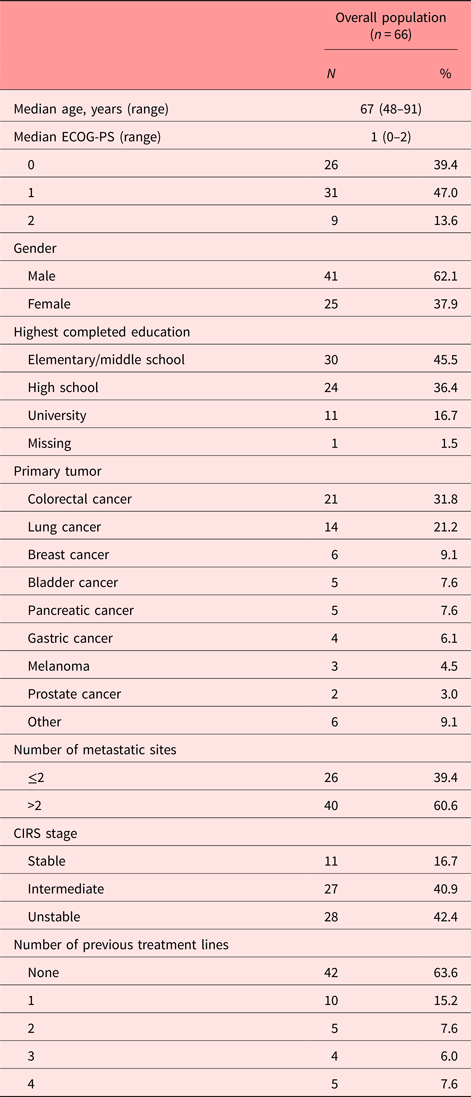
From October 2016 to March 2017, 66 patients were enrolled. Median age was 67 (range 48–91); male/female ratio was 25/66. Twenty-six patients (39.4%) had an ECOG-PS 0, 31 (47.0%) had ECOG-PS 1, and 9 (13.6%) had ECOG-PS 2. Different primary tumors were colorectal cancer, 21 patients (31.8%); lung cancer, 14 patients (21.2%); breast cancer, 6 patients (9.1%); urothelial cancer, 5 patients (7.6%); pancreatic cancer, 5 patients (7.6%); gastric cancer, 4 patients (6.1%); melanoma, 3 patients (4.5%); prostate cancer, 2 patients (3.0%); and other cancers, 6 patients (9.1%). Fifty-seven patients (86.4%) underwent chemotherapy ± targeted agents; six patients (9.1%) underwent targeted therapy alone and three patients (4.5%) an immune checkpoint inhibitor. Eleven patients (16.7%) had primary CIRS stage cancer, 27 patients (40.9%) an intermediate CIRS stage cancer, and 28 patients (42.4%) a secondary one. Twenty-six patients (39.4%) had ≤2 metastatic sites and 40 patients (60.6%) had >2 metastatic sites. Median number of previous chemotherapy treatment lines was 1 (range 1–5). Table 1 lists patient features.
Patient features

CIRS, Cumulative Index Rating Scale; ECOG-PS, Eastern Cooperative Oncology Group performance status.
PERSONS score evaluations
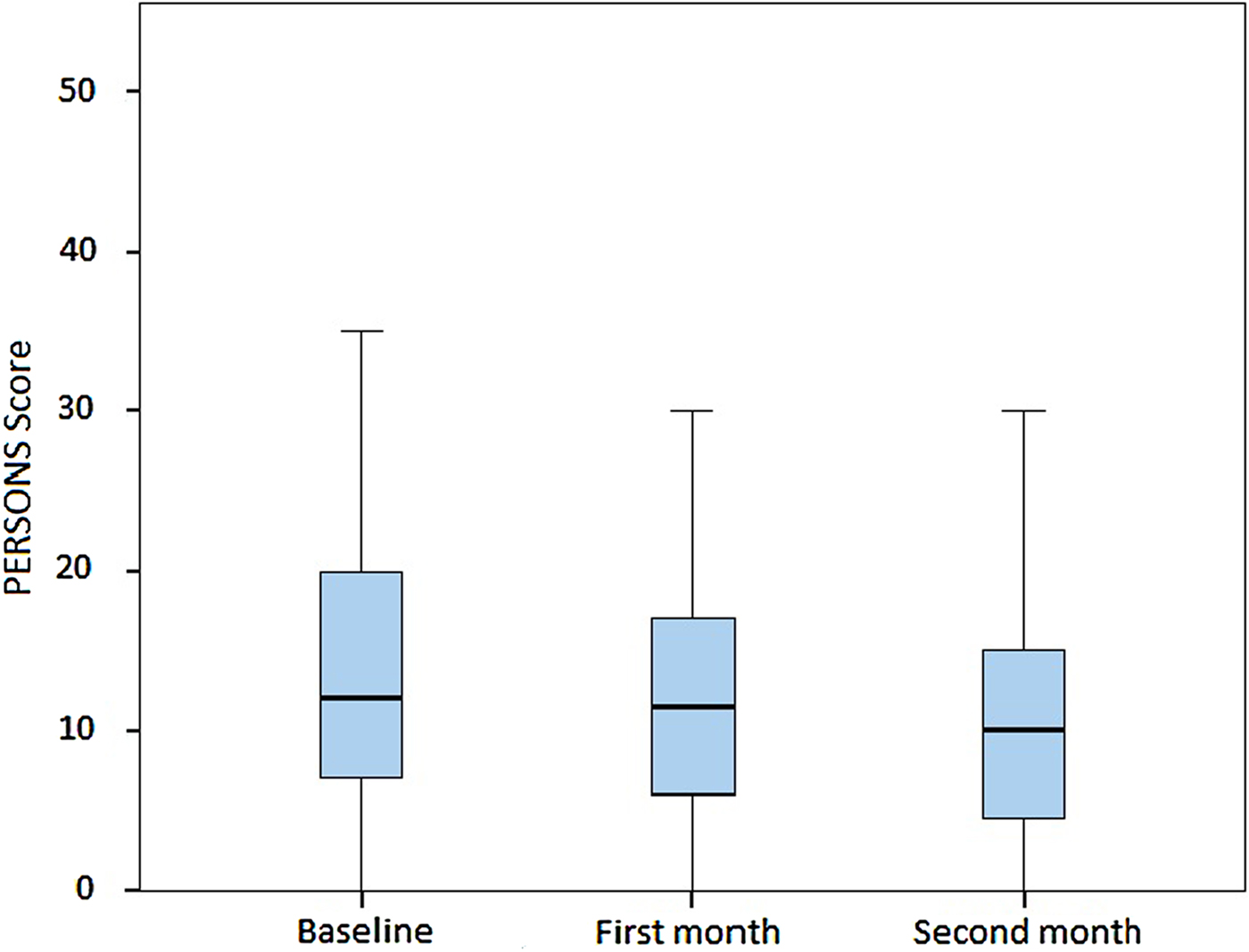
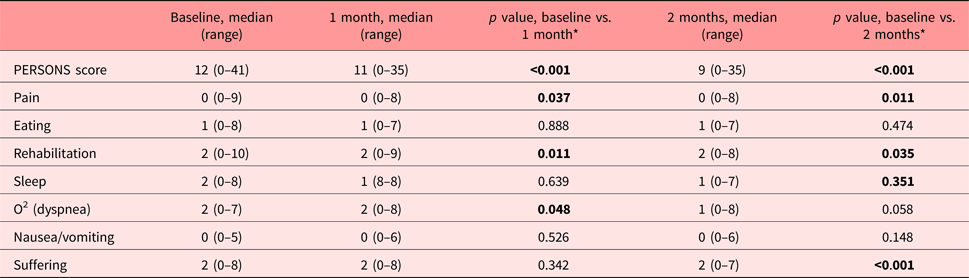
Following if the scores of each item of any reported severity (0–10). Thirty-one patients (46.9%) reported pain (median 0, range 0–9), 38 patients (57.5%) experienced problems with eating (median 1, range 0–8), 59 patients (89.3%) reported asthenia (median 2, range 0–10), 49 patients (74.2%) reported sleep disorders (median 2, range 0–8), 52 patients (78.7%) reported dyspnea/cough (median 2, range 0–7), 16 patients (24.2%) experienced nausea and/or vomiting (median 0, range 0–5), and 51 patients (77.3%) reported anxiety/depression (median 2, range 0–8). The median baseline PERSONS score was 12 (range 0–41) (Table 2; Figure 2). No correlation of baseline PERSONS score and primary tumor (p = 0.648), level of education (p = 0.298), or number of metastatic sites (p = 0.106) was found. Interestingly, a statistically significant association was observed between number of previous treatment lines and baseline PERSONS score (Spearman correlation coefficient 0.280; p = 0.023). Median PERSONS score after 1 month of treatment was 11 (0–35) and 9 (0–40) after 2 months of treatment (Figure 2). Importantly, a statically significant median reduction (p < 0.001) from baseline to 1 month and from baseline to 2 months was observed (p < 0.001). No impact of primary tumor (p = 0.437), level of education (p = 0.272), number of metastatic sites (p = 0.443), or number of previous treatment lines (Spearman correlation coefficient –0.045; p = 0.724) on median change of PERSONS score from baseline to 2 months was observed. Focusing on each item, a statistically significant median reduction of the score was observed from baseline to 1 month and to 2 months in pain (p = 0.037 and p = 0.011, respectively) and in rehabilitation (p = 0.011 and p = 0.035, respectively). A statistically significant median reduction in O2 (dyspnea) was observed at the first evaluation (p = 0.048), but not at the second one, even at the limit of significance (p = 0.058). Curiously, an impressive statistically significant median reduction in suffering was observed from baseline to 2 months, but not from baseline to 1 month (p < 0.001 and p = 0.342, respectively) (Table 2).
Graphical representation of median PERSONS score at baseline and after 1 and 2 months. PERSONS, pain, eating, rehabilitation, sleep, O(2), nausea/vomiting, and suffering.

Median PERSONS score at baseline and 1 and 2 months after initiation of treatment

*Paired t-test. Bold values indicate p ≤ 0.05.
Discussion
This study found the PERSONS score to be a feasible tool for symptom assessment and management in an oncological outpatient setting. To reach an efficient and early integration of palliative care into oncology, it is important to have a clear idea of what the main therapy goals are (Verna et al., Reference Verna2016). One is the efficient and timely treatment of symptoms, independent from the state of the disease and the cause that has triggered the symptoms (disease and/or treatment). Having appropriate tools to evaluate symptoms that are also user-friendly and fast may allow to overcome these limitations, which hinder efficient integration between palliative care and oncology practice. Median PERSONS score was rather low in each evaluation, probably because of the patient selection. The study population came from the ambulatory setting, so the cumulative incidence of symptoms was lower than what commonly found in palliative care setting. The absence of a correlation between baseline PERSONS score and primary tumors, level of education, and number of metastatic sites makes it a tool that could be used for any patient. Referring to the statically significant median reduction from the baseline score to months 1 and 2, without impact of primary tumor, level of education, and number of metastatic sites, the PERSONS score seems to be a valid tool to screen and monitor symptoms in an outpatient cancer care setting. The only statistically significant relation of median change of the score was seen in the number of previously administered chemotherapy lines, probably because it correlates to a more advanced state of disease and thus with a worse burden of symptoms. Our data suggest that the PERSONS score could address these needs and could be a valid tool to evaluate symptoms in patients receiving active antineoplastic treatment. Indeed, it was well accepted by patients and was feasible to administer before the chemotherapy session as well as in the context of routine visits. Oncologists could administer the questionnaire rather quickly, while working on other standard clinical evaluations, because thanks to its intuitive name, it was easy to remember, so much so that sometimes the scoring sheet was not required. The administration of PERSONS was done by residents at their first year of residency; they did not need any experience to undertake this task. Even if not every outpatient center has a palliative care consultant who could properly treat more severe symptoms, the PERSONS score could help oncologists focus on patient needs, devoting the best care to the worst manifestation of disease, not only to the oncological outcomes. Strengths of the study are the prospective nature, the centralized review of resulted overall scores, and standardized assessment plan of scores for mild (0–3), moderate (4–6), and serious symptoms (≥7). Limitations are the sample size, the noncomparative nature, and that, although the PERSONS score could be considered a good screening tool, not every outpatient cancer care center has a palliative care consultant to report more severe symptoms. Before the development of the questionnaire, a lower percentage of patients was sent to the PC division, and the PERSONS score became oncologists' common clinical practice in our institution. The PERSONS score seems simplistic when compared with established assessment measures such as the Edmonton Symptom Assessment Scale, probably because of the number of items (7 vs. 10). On closer perusal, these differences are smoothed. While Pain, eating, rehabilitation, sleep, O(2), and nausea/vomiting have a direct comparator, the item “suffering” is a collector for “depression,” “anxiety,” and “well being.” In our opinion, a first screening may be sufficient to identify the emotional suffering of patients, but more time is then necessary to study it and provide adequate support out of the outpatient clinical practice. To confirm that PERSONS score could be a “smarter” tool in simultaneous care setting, we recently designed a prospective comparative trial of the PERSONS score with the Edmonton Symptom Assessment Scale, which is the most commonly used questionnaire for symptoms evaluation (Chang et al., Reference Chang, Hwang and Feuerman2000); the study is currently recruiting patients both in outpatient and in home care settings.
Conclusion
Our data seem to confirm the feasibility of the PERSONS score and its efficacy in screening and monitoring symptoms. This may improve integration between oncology and palliative care, and could also be useful in centers where there is limited availability of resources and manpower. The PERSONS score was easy to remember because of its name; therefore, it could be easily used in ambulatory oncology or in a home care setting. Further studies are required to validate the PERSONS score.
Conflicts of interest
The authors declare that they have no competing interests.