

1 INTRODUCTION
La crisis actual es la misma de 1870, la de 1865, la de 1860, de la 1852, de la 1840, etc. El país ha vivido en esas crisis desde que dejó de ser colonia de España. Podría decirse que no es económica sino política y social. Reside en la falta de cohesión y de unidad orgánica del cuerpo o agregado social que se denomina Nación Argentina, y no es sino un plan, un desideratum de nación. La diversidad y lucha de sus instituciones de crédito, la anarquía de sus monedas, la emulación enfermiza que preside a sus gastos dispendiosos en obras concebidas para ganar sufragios y poder, vienen del estado de descomposición y desarreglo en que se mantienen las instituciones, los poderes, los intereses del país Footnote 1.
Juan Bautista Alberdi (1810-1884)Footnote 2
Social sciences researchers exposed to Argentinean economic history for the first time are usually surprised by the abrupt changes in its economic variablesFootnote 3. Those who delve deeper are shocked: some extreme economic events, like crises, seem to come and go over and over again, creating a sense of dejà vu. Argentina not only had a larger number of crisis years than any other country, as documented by Eichengreen and Bordo (Reference Eichengreen and Bordo2002), but also was the protagonist of some of the most resounding cases of sovereign debt default in world history such as those in 1827, 1890 and 2002.
The cost of several crises and crashes for Argentina has been huge, not only in terms of real output losses but also from a socioeconomic viewpoint. The country has suffered frequent drains on its stock of human capital, dramatic institutional changes and severe income distribution imbalance. To give some examples, the latest crash in 2001-2002, known as Tango, brought about a 15 per cent decrease in real GDP and pushed vast sectors of the population below the poverty line. Similarly, the 1989 crash, featuring hyperinflation, resulted in a 9 per cent collapse in real GDP. In the 19th century, there were also costly crises such as that of 1890-1891, which caused a fall in GDP of 13.5 per cent.
Furthermore, Argentina seems to be vulnerable to crises originated elsewhere, not only to widespread crises such as that of 1929-1930, but also to regional crises such as the Tequila, with epicentre in Mexico in 1994.
Are there, as sustained by Juan Bautista Alberdi in the introductory quote, regularities in the Argentine crises? Are these crises best explained by domestic inconsistencies or by external factors? This paper addresses these questions. To answer them, we first construct a Market Turbulence Index (henceforth MTI) to identify and classify crises in three categories: very deep or crashes, deep and mild. The index was computed from annual data from as early as 1825 to 1913 and from monthly observations from 1914 to 2002.
Second, we study the determinants of Argentina's currency crises using non-parametric techniques, graphic analysis and bivariate and multivariate logit models. These methodologies were previously adopted in the literature for a large number of economies but over shorter time spans.
Our paper contributes to the existing literature on the economic history of Argentine currency crises in two important aspects. On one hand, our study covers 177 years, most of Argentina's life as an independent nation. Notice that Argentina declared its independence in 1816 and started the so-called national organization period in 1862 under the Bartolomé Mitre administration. Unlike earlier papers that select a given crisis or a limited set of crises and analyse its causes and consequences, we examine the entire record of a country that suffered recurrent crises throughout its history, and look for regularities in its main macroeconomic variables.
On the other hand, we put together several disperse data sets to assemble the MTI from 1825, thus extending (only for Argentina) the Eichengreen and Bordo's (Reference Eichengreen and Bordo2002) study that covers the period 1885-1998 with annual data. Moreover, to the best of our knowledge this is the first paper to identify and categorize Argentine currency crises from monthly data from 1914, which allows us to identify the beginning, the peak and the end of each episode accurately.
The remainder of the paper is organized as follows. Section 2 surveys the theoretical and empirical literature on currency crises. Section 3 is dedicated to the identification and categorization of Argentine currency crises by means of an MTI for the period 1825-2002. Section 4 shows the results from non-parametric tests, graphic analysis and bivariate and multivariate logit regressions. Section 5 concludes.
2 REVIEW OF THE LITERATURE
Several theoretical models have been developed to explain currency crises. Traditional models, inspired in the influential work of Krugman (Reference Krugman1979), showed how basic inconsistencies between fiscal policy and exchange rate commitment lead to the collapse of the currency peg. In Krugman's paper, the budget deficit is fully monetized and economic agents get rid of the excess money supply by exchanging domestic money for foreign reserves of the central bank. When reserves fall to a critical threshold a speculative attack takes place, forcing authorities to abandon parity. Policy inconsistency may only be sustained while the central bank has sufficiently large amounts of reserves.
In the so-called first-generation model of currency crises, economic agents’ expectations are not assumed to affect authorities’ policy decisions on fiscal and monetary issues. Quite the opposite, second-generation models, associated with the work of Obstfeld (Reference Obstfeld1986, Reference Obstfeld1994), emphasize the role of economic agents’ expectations on government policy decisions. These models allow for self-fulfilling crises: any outcome can emerge from the interaction between agents’ expectations and government decisions, giving rise to multiple equilibriums.
In second-generation models authorities decide whether to adopt, defend or abandon an exchange rate regime depending on costs and benefits, which in turn are influenced by agents’ expectations. Hence, there are various reasons that can lead a government to devaluate its currency. For example, a government might be tempted to devaluate if facing a large debt burden denominated in local currency or to alleviate social pressures in a context of high unemployment and rigid wages. Another important difference between these two approaches is that the moment of the depletion of reserves can be anticipated in first-generation models, while in second-generation models the timing is undetermined, so it can happen unexpectedly, even if fundamentals remain unchanged.
As first- and second-generation models failed to capture important aspects of the 1997 Southeast Asian crisis, the third-generation models of currency crises arose. Financial intermediaries have a central role in these crises. They borrow short-term money, often in foreign currency, and lend that money long term in local denominated currency. The market euphoria leads to excessive lending, which in turn causes asset price inflation. When crises burst, asset prices fall and the mismatch insolvency of intermediaries becomes evident.
Recently, Calvo (Reference Calvo1998) and Calvo and Reinhart (Reference Calvo and Reinhart2000) put forward the sudden stop theory of currency crises. They argue that massive reversal in capital inflows generates currency crises in emerging economies. The reversions generally happen in countries that experienced heavy capital inflows and, consequently, considerable current account deficits. To face this sudden capital outflow, governments spend reserves — which increases financial vulnerability — and finally devalue their currency. The resulting reverse in current account deficit impacts on economic activity and employment.
The empirical literature on currency crises has followed two different paths. On one hand, a large number of studies relied on cross-country evidence to determine which theoretical model best describes a particular crisis or a given group of crises. On the other hand, several papers were dedicated to case studies, which allow for more qualitative and detailed discussion.
By definition, a currency crisis is a speculative attack against a currency whether successful (if it ends up in devaluation) or not. However, empirical studies require a testable definition of currency crises. Eichengreen et al. (Reference Eichengreen, Rose and Wyplosz1994) provide a useful MTI that serves to identify currency crises. MTI captures not only successful speculative attacks but also several turbulent situations in which authorities defend the currency against the attack by spending foreign reserves and/or increasing the rate of interest. The MTI is defined as the weighted sum of three variables: the growth rate of exchange rates, the growth rate of international reserves and the domestic interest rate. These variables result from an index of market pressure in the monetary market developed by Girton and Roper (Reference Girton and Roper1977).
Several cross-country studies find that the majority of crises in emerging countries are explained by domestic policy inconsistencies and also assign an important role to external shocks in triggering crises. For example, Eichengreen et al. (Reference Eichengreen, Rose and Wyplosz1994), studying 22 developed and emerging countries, find significant differences in the behaviour of macro variables before the speculative attack in emerging economies, but no differences in developed countries. They conclude that crises in emerging countries respond to first-generation models, while those in developed countries to second generation ones. Similarly, Kaminsky and Reinhart (Reference Kaminsky and Reinhart1999) use a sample of 20 countries (mostly emerging) from 1970 to mid-1995, covering 76 currency crises and 26 banking crises to analyse the link between banking and currency crises. They find ample evidence of weak and deteriorating fundamentals in both types of crises, which allow them to rule out the self-fulfilling explanation. Edwards (Reference Edwards1989, Reference Edwards1993) examines the behaviour of macroeconomic variables in cases where devaluation took place in comparison to a non-devaluation control group for the period 1948-1971 and 1962-1982. He concludes that before devaluation, international reserves decline, real exchange rates become overvalued and fiscal policies are excessively expansionary. Kaminsky (Reference Kaminsky2006) contributes with more evidence sustaining the importance of fundamentals in currency crises. In her investigation of the determinants of contagion and sudden stops during the 1990s in Mexico, Thailand and Russia, she presents evidence that transmission of crises across countries and capital inflow reversals tend to occur in economies with financial fragility and current account problems.
On the contrary, Sachs et al. (Reference Sachs, Tornell and Velasco1996), studying the 1994 Mexican crisis, find some elements of contagion and self-fulfilling panic. Traditional explanations relying on current account deficits, fiscal policy stances and the size of the capital inflows are not supported by their evidence.
On the other hand, most of the empirical studies exploring the nature of the 1997 Asian crisis stress the fragility of the financial sector as the key factor, supporting the emergence of another model, called third generation (see Burnside et al. Reference Burnside, Eichenbaum and Rebelo1998; Corsetti et al. Reference Corsetti, Pesenti and Roubini1998; Chang and Velasco Reference Chang and Velasco1998). In third-generation crises, we should observe important differences in variables related to the financial system (deposit, money, money multiplier) before, during and after a crisis.
The recent 2008-2009 crisis has focused attention on the relationship between credit growth and crises. Schularick and Taylor (Reference Schularick and Taylor2012) present evidence for the strong increase in financial leverage in the second half of the 20th century as shown by a decoupling of money and credit aggregates. They study the behaviour of money, credit, and macroeconomic indicators over the long run based on a historical data set for fourteen developed countries over the years 1870-2008 and find that credit growth is a great predictor of financial crises. This finding is consistent with the results obtained by Gourinchas and Obstfeld (Reference Gourinchas and Obstfeld2012) for a panel of advanced and emerging economies covering the 2007-2009 global crisis and post-1973 crises. They conclude that the two most robust and significant predictors of crises in general, for emerging and advanced economies alike, are domestic credit growth and real currency appreciation. Moreover, those emerging economies that avoided leverage booms during the 2000s were also most likely to avoid the worst effects of the 21st century's first global crisis.
2.1 Empirical research on Argentina
Case studies on Argentine crises also find evidence sustaining the role of fundamentals. Early inquiries, mainly descriptive, associated with the names of Terry (Reference Terry1893) and Wirth (Reference Wirth1893) appeared after the crisis of 1890. Some years later, Prebisch (Reference Prebisch1921) tried to find regularities in Argentine crises since 1823. Studies using modern instruments came in the 1980s. Cumby and van Wijnbergen (Reference Cumby and van Wijnbergen1989), in their investigation of the crawling peg experience during the 1980s, suggest that crises were generated by inconsistency of exchange rate policy with domestic credit policy. Likewise, Della Paolera and Taylor (Reference Della Paolera and Taylor1999, Reference Della Paolera and Taylor2000) confirm the importance of fiscal links in the 1929 crisis, although they also stress other factors, like poor banking sector design. Bordo and Vegh (Reference Bordo and Vegh2002) also point at public sector behaviour when analysing the early 19th century Argentinean experience of high inflation. They emphasize the increasing problems in accessing world capital markets because of Argentina's earlier default and its inadequate tax structure based on trade taxes, which were subject to disruption in periods of blockades and war. According to these authors, both constraints prevailed because of the unwillingness of the dominant political group, the ranchers, to allow themselves to be taxed.
Since the 2001-2002 episode, there has been a renewed interest in Argentine crises. Calvo et al. (Reference Calvo, Izquierdo and Talvi2002) identify domestic vulnerabilities as playing a crucial role in magnifying the sudden stop effect of the 1998 Russian crisis. Saxton (Reference Saxton2003) sustains that the 2001-2002 crisis was not caused by market failures, but was the result of bad economic policies.
Very few papers have pooled together Argentine crises to study their determinants. Choueiri and Kaminsky (Reference Choueiri and Kaminsky1999) examine several crises in the period 1975-1999, finding evidence of contagion in those crises, which in turn were aggravated by inconsistent monetary and exchange rate policies. Veigel (Reference Veigel2004) analyses three major episodes: the crises of 1890, 1980 and 2001, concluding that both technological and fundamental political changes influenced the nature and consequences of each crisis, despite the fact that the constraints faced by Argentina in each circumstance were essentially unchanged.
Della Paolera et al. (Reference Della Paolera, Irigoin and Bózolli2003) also investigate the macroeconomic performance of Argentina over a long period but rather than focusing on crises, they examine each of the thirty-three administrations from 1853 to 1999 by means of two indices. The first one, called the Classical Macroeconomic Pressure Index, aggregates inflation, devaluation and interest rates, together with annual estimates of changes in the level of economic activity (output growth). This is a version of the Market Pressure Index used in this paper (see Section 3) to identify crises. The other index, called the Fiscal Pressure Index, includes the ratios of public debt to GDP and to exports, the ratio of primary deficit to revenues and debt service, and the real interest rate faced by Argentina (a proxy for country risk) adjusted by the increase in the level of activity (an adjustment to control for the explosiveness of the debt to GDP ratio).
3 IDENTIFYING AND CATEGORIZING CURRENCY CRISES
We identify and categorize Argentina's currency crises using an index of speculative attacks. The procedure involves two steps. First, we compute an MTI for period t as
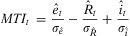 $${MTI}_t \, = \,\frac{{{\hat{e}}_t }}{{\sigma _{\hat{e}} }}\,{\rm{ - }}\,\frac{{{\hat{R}}_t }}{{\sigma _{\hat{R}} }}\, + \,\frac{{{\mathop{{{\hat{i}}_t }}\limits^{{}}} }}{{\sigma _{\hat{i}} }}$$
where the symbol ∧ represents the growth rate of the variable, e is the exchange rate, R stands for international reserves, i is the domestic interest rate denominated in local currency (pesos) and  $$$ \sigma _{\hat{e}}, \,\,\sigma _{\hat{R}}, \,\,\sigma _{\hat{i}} $$$
are the standard deviations of the growth rate of the exchange rate, international reserves and domestic interest rate, respectivelyFootnote 4. Notice that MTI is weighted by the inverse of the respective standard deviation to prevent the most volatile component dominating the movements of the indexFootnote 5. It is worth mentioning that crises determinations were quite robust to different weighting schemes.
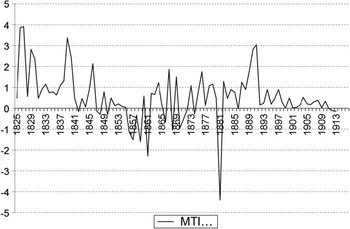
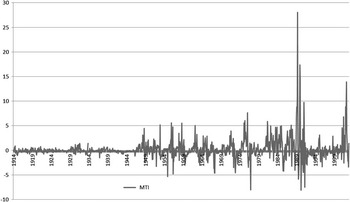
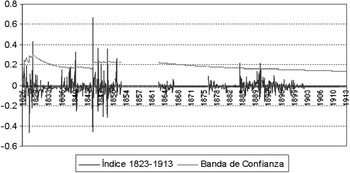
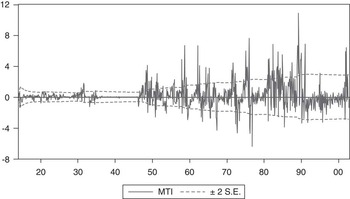
The objective of the index is to identify both successful speculative attacks (that end up in currency depreciation) and speculative attacks that are successfully warded-off by the authorities. Otherwise, the MTI would suffer from selectivity bias. How do monetary authorities defend against speculative attacks? The standard way is to increase interest rates and spend reserves. This is captured by the MTI (see Figures 1A and 1B).
MARKET TURBULENCE INDEX (MTI) (ARGENTINA 1825-1913: ANNUAL DATA)
Source: see text.

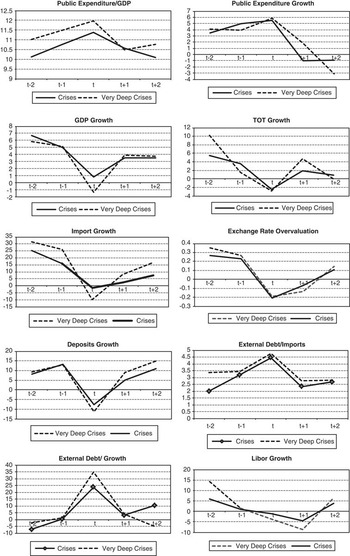
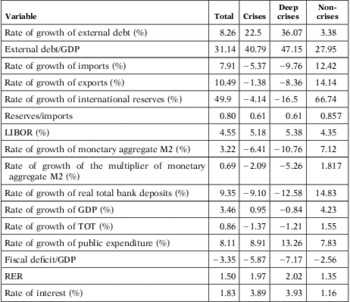
MACROECONOMIC VARIABLES BEHAVIOUR BEFORE, DURING AND AFTER CRISES (1865-2002)
Source: see text.

Our MTI specification differs slightly from previous papers. We include the rate of change of the nominal interest rate to deal with the inflationary process Argentina experienced over several decades. This long-lasting inflationary process implied a high and volatile domestic interest rate, hence other specifications such as the level of the domestic interest rate or the difference between domestic and international rate proved to be inadequate to capture turbulent periods.
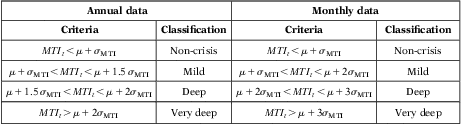
The second step for determination and classification of currency crises requires imposing a set of criteria to distinguish tranquil periods from the diverse categories of speculative attacks. Most researchers construct bands based on the moments of the MTI distribution, mainly mean (μ) and standard deviation (σ). Thus, whenever the MTI is greater than the mean plus k standard deviations, a «signal» of turbulence is identified. Depending on the number of standard deviations, a signal is categorized as mild, deep or very deep. Other authors prefer the moments of each component of the index (Moreno Reference Moreno1995). The simplest criterion is an absolute cut-off as proposed by Frankel and Rose (Reference Frankel and Rose1996).
Due to data limitations, we compute MTI from 1823 to 1913 with annual observations and from 1914 to 2002 with monthly figures. This restriction not only affects the accuracy of crisis identification in the early years but also forces us to establish different sorting criteria for annual and monthly series. With annual data, we arbitrarily classified an episode as a «deep crisis» when the MTI exceeded μ plus one and a half standard deviations in a given year. If MTI is greater than μ plus two σ, we say that the crisis is «very deep» or a crash and if MTI only exceeds its mean value in one σ, we term that episode as «mild».
3.1 Criteria to identify and categorize crises
We impose the following criteria to identify and categorize crises from monthly data. If MTI is greater than the mean value plus three σ we consider that episode as a very deep crisis, but if the MTI is greater than μ plus two σ, we call it a «deep crisis». Finally, if MTI exceeds its mean value by one and a half σ, the episode is considered «mild». We require at least two consecutive months with MTI greater than μ plus k σ to consider that episode as a signal. The remaining events are termed as «non-crisis» or tranquil times. Table 1 summarizes these criteria.
CRITERIA TO CLASSIFY CRISES
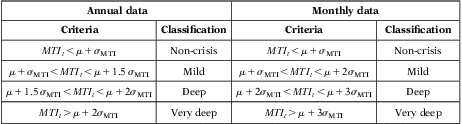
MTI = market turbulence index.
Note: μ and σ MTI stands for the average MTI and its standard deviation in each sub-period, respectively.
Source: see text.
We exclude hyperinflation episodes (1976 and 1989) from the estimation of the moments so that inflationary data do not distort the bands and to avoid the incorrect exclusion of crisis episodes that could appear as tranquil times when compared with hyperinflation periods. To determine the boundaries of a given crisis and to refrain from including the same crisis twice, we require at least 6 months with no signals.
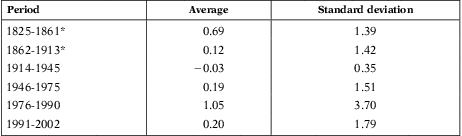
The MTI was computed for six sub-periods in order to keep its variance relatively homogeneous. Sub-periods were chosen considering structural breaks resulting from political and economic eventsFootnote 6, Footnote 7. As shown in Table 2, there are remarkable differences between sub-periods.
MTI STATISTICS
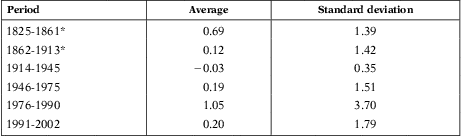
MTI = market turbulence index.
Note: *Annual data.
We reject the null hypothesis of equality of variances by means of the Levene test.
Source: see text.
It is worth remarking that the terms «very deep», «deep» and «mild» refer to the sub-period considered and are not intended as an absolute qualification for the whole period. The sub-periods were the following:
(a) 1825-1861: from President Rivadavia's Administration to National Organization (President Mitre Administration).
(b) 1862-1913: from the Mitre Administration to World War I.
(c) 1914-1945: from World War I to World War IIFootnote 8.
(d) 1946-1975: from the first to third President Perón Administration.
(e) 1976-1991: from the first to second hyperinflation.
(f) 1992-2002: Convertibility years.
The President Mitre administration, dubbed the beginning of the «national organization», marked the first structural break. From independence in 1816 to 1861 provinces led by local bosses (caudillos) were defining provinces and national boundaries as well as their economic and political organization through several internal and external wars.
Mitre was the first president to govern all provinces including the powerful Province of Buenos Aires. The sub-period that spans from the Mitre administration in 1862 to 1913 was characterized by high rates of growth (an annual average of 5.2 per cent), huge immigration waves and high capital inflows. This 52-year sub-period is considered Argentina's golden years. It was a period, however, which was struck by one of most severe episodes in the country's history: the 1890 crisis.
The two World Wars were also landmarks in the economic history of Argentina. The 32 years from 1914 to 1945 were transition years. The country passed from an open economy — the openness rates were the highest in its history — to a rather closed one, and the government changed its role from scarce regulation to high intervention, particularly after the Great Depression. The end of World War I implied the beginning of a new economic world order that confirmed the leading role of the United States substituting the United Kingdom, a major partner of Argentina. This period includes the first coup d'etat in 1930, which opened a dark period of interruptions of the constitutional order.
The fourth sub-period opens with the first administration of Juan Perón, a major protagonist in the 20th century, and ends with the military coup d’ état against María Estela Martínez, his third wife and Vice President who succeeded him after his death, in 1974. The Perón administration was characterized by high intervention in the economy, particularly in the price system. He obtained rapid industrialization by altering the relative price of agricultural vs. industrial goods and carried out expansive fiscal policies financed by international reserves, the social security system and increasingly inflationary taxes. This sub-period features the alternation between democratic governments and military coups d’ état in 1955 (which removed Perón), 1962 (which removed President Frondizi), 1966 (which removed President Illia) and 1976 (which removed Martínez). During this period, the economy remained mostly closed and its fiscal policy disordered under both democratic and military governments. After Perón's death in 1974, the fiscal situation was out of control and the first hyperinflationary process, known as «rodrigazo», started. The chaotic economic and political situation ended with the last coup d'etat against Estela Martínez.
The fifth period covers 21 years from the first to the second hyperinflation processes. It began with the last military irruption in March 1976 (Junta Militar) and finished after President Alfonsín's resignation. This particularly tumultuous period was characterized by outrageous fiscal deficits, high inflation, null economic growth and two hyperinflationary processes. The de facto government, as well as Alfonsín's democratic administration, tried unsuccessfully to make economic reforms mainly directed at stopping inflation. In 1988, inflation went completely out of control and in March 1989 the country suffered the second hyperinflation, which caused chaos and signalled the final collapse of the closed-economy approach.
The last period begins and ends with the so-called Convertibility Plan, a currency board system that tied the peso to the U.S. dollar. This period was characterized by price stabilization, economic growth, high external indebtedness and important market-oriented reforms. In December 2001, in a chaotic economic and political situation, a general strike and protest resulted in the resignation of President De la Rúa. Three presidents followed in less than two weeks. One of them, Rodriguez Saá, decided to default on the government debt. Finally, Congress chose Duhalde in 2002 to serve the rest of former president's term. His first measure was to put an end to the convertibility system.
3.2 Banks as financial agents of the government
Before the creation of the Central Bank of Argentina in 1935, we compute the depreciation of the currency issued by different banks that operated as financial agents of the governmentFootnote 9: (a) from 1823 to 1826: Banco de Descuentos; (b) from 1826 to 1836: Banco Nacional de las Provincias Unidas del Río de la Plata; (c) from 1836 to 1854: Casa de la Moneda; (d) from 1854 to 1861: Banco de la Provincia and Casa de Moneda; (e) from 1862 to 1872: Banco de la Provincia de Buenos Aires (and Exchange Office); (f) from 1873 to 1887: Banco Nacional; (g) from 1891 to 1935: Banco de la Nación Argentina and Caja de Conversión.
These banks of issue defended their peg from speculative attacks in the way anticipated by the theory. Even more, when banks could not defend parity generally due to the excess supply of bank notes to finance public expenditures, government declared inconvertibility, but always under the promise of returning to it.
Notice also that before the law of monetary unification in 1881 (Law No. 1130), there were many currencies circulating in the Argentine territory. Nonetheless, the preeminence and influence of Buenos Aires over the rest of the provinces was undisputable (see Gelman Reference Gelman2008).
3.3 The classification of crises
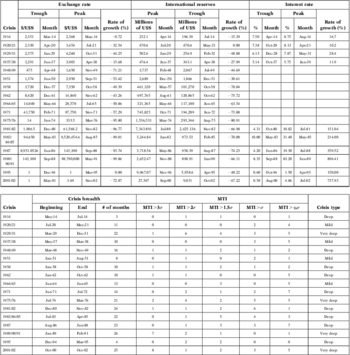
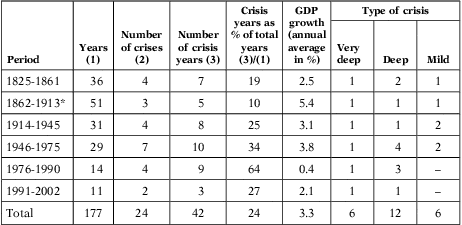
We identified twenty-four crises throughout 177 years of history. Six crises were rated as «very deep», twelve as «deep» and seven as «mild». Tables 3A and 3B shows the details. Interestingly, the number and magnitude of the crises increases over time.
CRISIS CHARACTERISTICS: 1825-1913 (ANNUAL DATA)

MTI = market turbulence index.
Source: see text.
CRISIS CHARACTERISTICS: 1914-2002 (MONTHLY DATA)

MTI = market turbulence index.
Note: The rate of growth of exchange rates and international reserves were computed from a peak to trough, considering the behaviour of these variables 6 months before and after the signal given by the MTI announces the beginning and end of the crisis.
Source: see text.
The twenty-four crises implied 42 crises years. That is, 24 per cent of the 177 years under analysis were crisis years, which meant 1 crisis year every 4 years. According to our index, the most turbulent period of Argentina's history was 1976-1990, not only because it registered four crises in 14 years, but also because nine of those years (or 64 per cent of the period) were crisis years (see Table 4).
SUMMARY OF CRISES
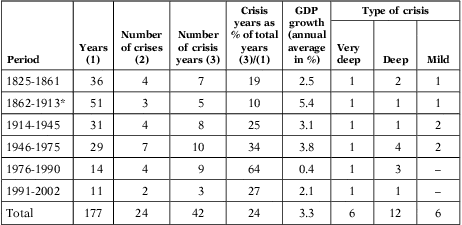
Source: see text.
Our results differ from those obtained by Eichengreen and Bordo (Reference Eichengreen and Bordo2002) for Argentina. They identified crises for twenty-one countries from 1883 to 1971 and fifty-six countries from 1972 to 1998 by computing MTI relative to a centre country. Comparing the same period (1885-1998), we identify eighteen crises, four more than Eichengreen and Bordo. They failed to recognize the deep crisis of 1914 and the following mild crises: 1920-1921, 1937-1938 and 1964-1965. On the other hand, Eichengreen and Bordo identified a currency crisis in 1908, after the 1907 U.S. banking crisis, and another in 1967 while our MTI only registers small turbulences that do not qualify as mild crises.
We conjecture that most of the difference between their dating and ours is explained by the periodicity of data: we use monthly data while they relied on annual data. Yearly observations may hide some speculative attacks, especially unsuccessful ones. Pressure against a pegged currency can escalate quickly and be repelled by increasing interest rates or foreign exchange market intervention (spending reserves) within a year or even shorter periods, therefore the average behaviour of interest rates and international reserves over a year may not reveal the intensity of speculative pressures. Our monthly observations add precision to the identification of the beginning and end of each episode and, hence, help compute the span of each crisis as shown in Table 3B. This is a substantial improvement over Eichengreen and Bordo (Reference Eichengreen and Bordo2002).
According to our criteria to categorize Argentine crises, we considered those that took place in 1826-1827, 1889-1891, 1929-1931, 1975-1976, 1989-1991, 2001-2002 as very deep. Correspondingly we classified the following episodes as deep crises: 1829-1830, 1839-1840, 1885, 1914, 1948-1949, 1958, 1962, 1971, 1981-1982, 1983-1985, 1987 and 1995. Finally, we termed the events that took place in 1846, 1876, 1920-1921, 1937-1938, 1951 and 1964-1965 as mild.
4 EMPIRICAL ANALYSIS
How did the Argentine economy perform in the neighbourhood of crises? Are there regularities in the behaviour of key macroeconomic variables, namely, public expenditures, fiscal deficits, imports, GDP, terms of trade (TOT), real exchange rates, domestic interest rates, monetary aggregate M2 and its monetary multiplier, bank deposits, external debt, international reserves and LIBOR, in the vicinity of these extreme episodes? Did the Argentine crises respond to the predictions of any particular theory?
To answer these questions we carried out the following empirical strategyFootnote 10. First, we evaluated non-parametric tests to determine whether macroeconomic variables behave significantly differently in crises and non-crisis periods. Second, we performed graphical analysis to learn how these macro variables behave before, during and after crises. Finally, we estimated logistic bivariate and multivariate regression models to assess the significance of variables representing different crisis models. Due to data limitations, empirical analysis is restricted to the period 1865-2002.
We introduce macroeconomic variables that are indicators of currency crises. Following Kaminsky (Reference Kaminsky2006), these indicators are grouped according to the symptoms which the various generation models focus on. Expansive fiscal policy or excess real M1 balances may be signalling first-generation model of crises. Exports, imports, real exchange rate, TOT may be indicators of second-generation model of crises. On the other hand, third-generation model of crises may be related to financial sector variables, such us domestic credit/GDP, M2/reserves, deposits, among others. Sudden stop models imply a capital inflow before crises followed by a considerable fall afterwards, so we should see world real interest rates and foreign exchange reserves. Lastly, sovereign debt crises are related to over-indebted countries, an excessively high debt to imports or exports ratio may be signalling these types of crises.
4.1 Non-parametric tests
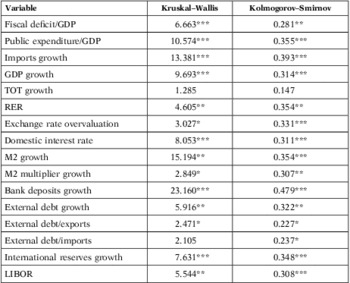
We carried out the Kruskal–Wallis test and the Kolmogorov–Smirnov test for fifteen macroeconomic variables proposed by the theories at stake. The null hypothesis is that the population (Kruskal–Wallis) or distribution (Kolmogorov–Smirnov) of each variable does not differ significantly during crisis and non-crisis periodsFootnote 11. The results are presented in Table 5. Except for the rate of growth of TOT and external debt to imports, we reject the null for all variablesFootnote 12. These results are in line with those obtained by Eichengreen et al. (Reference Eichengreen, Rose and Wyplosz1994), who found significant differences in a group of macroeconomic variables between crisis and non-crisis periods for emerging economies but not for European countries. The fact that TOT growth does not vary significantly in crisis and non-crisis periods indicates that unfavourable international trade conditions not always result in a currency crisis.
KRUSKAL–WALLIS AND KOLMOGOROV–SMIRNOV TESTS FOR CRISIS AND NON-CRISIS PERIODS (ARGENTINA 1865-2002: ANNUAL DATA)

TOT = terms of trade; RER = real exchange rate.
Notes: Values correspond to χ 2.
***Significant at 0.01; **Significant at 0.05; *Significant at 0.10.
M2 stands for monetary aggregate M2 (coins and notes in circulation plus short-term savings deposits).
4.2 Graphic analysis
Figure 2 shows movements in selected variables 2 years before and 2 years after each crisisFootnote 13. For each crisis, we denote t as the peak of the crisis and compute the average value of the variables for t − 2; t − 1; t; t + 1; t + 2. The average is reported for all crises and for the sub-group of very deep crises (dotted lines).
MARKET TURBULENCE INDEX (MTI) (ARGENTINA 1914-2002: MONTHLY DATA)
Source: see text.

We observe that all the variables behave differently before, during and after crises. For instance, Public Expenditure to GDP peaks during crises and the trough is reached at t + 2 with an average fall of 11.4 per cent. In a similar way, GDP growth reaches a peak 2 years before the beginning of the crisis (on average 6 per cent) and the trough occurs during the crises (0.8 per cent on average). The difference between peak and trough is 5.2 per cent on average. Likewise, Imports Growth peaks, on average, two periods before crises and the trough occurs during crises. Exchange rate overvaluation looks similar to imports. The maximum value is reached at t − 2 (26.3) and the minimum value during crises (−20.8).
Deposits Growth reaches a maximum at t − 1 (13.2 per cent) and a minimum during the crises, averaging −7.7 per cent. The ratio of External debt to imports peaks at t with an average value of external debt of 4.4 times Imports, while its trough occurs at t − 2 with a value of 1.98.
External conditions are also present in the explanation of crises. Changes in the International Rate of Interest (LIBOR) reach a peak at t – 2 and a trough at t + 1 (average values are 5.9 per cent and −4.5 per cent, respectively). For emerging economies, the increase in the international interest rate is important for two reasons. First, it helps to explain capital inflows and outflows in emerging countries as pointed out by Calvo et al. (Reference Calvo, Leiderman and Reinhart1996). Second, it impacts on the service of external debt. An increase in the rate of interest is associated with a worsening in fiscal accounts.
The rate of growth of TOT shows a different behaviour on average at different moments of crises, reaching a peak two periods before crises begin (5.4 per cent). The fall in TOT during crises (−2.5 per cent) provides evidence that adverse external conditions were present in most severe crises.
4.3 Regression analysis
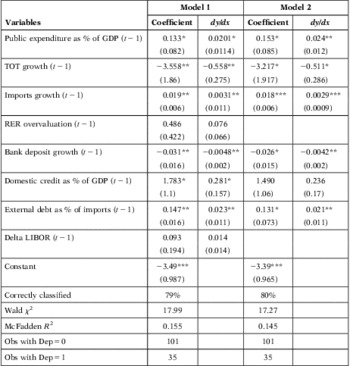
The non-parametric and graphical studies are intrinsically univariate so we enriched and complemented them by means of multivariate analysis. In the spirit of Kaminsky and Reinhart (Reference Kaminsky and Reinhart1999) and Kaminsky (Reference Kaminsky2006), we estimate early warning regression (see Table 5). We run logit models whose binary-dependent variable takes the value 0 for non-crisis years, and 1 for crisis years. The set of explanatory variables represents different models of crises. Public expenditures as percentage of GDP corresponds to first-generation models of currency crises; second-generation models are represented by the rate of growth of Imports, the overvaluation in real exchange rate and the rate of growth of TOT. The rate of growth of real Bank Deposits is included to capture the effects of third-generation models and external debt as percentage of imports represents sovereign debt models. LIBOR attempts to capture the influence of sudden stop models. All explanatory variables were lagged once to mitigate endogeneityFootnote 14. We also carried out unit root tests to check for stationarity of the variables. We found that most of them are integrated of order 1, so we worked correspondingly with their rates of growth to achieve stationarity.
Results of the logistic estimations are reported in Table 6. Columns 1 and 3 show the estimated coefficient of two alternative models, while columns 2 and 4 present the changes in variables (dy/dx). Since some of the explanatory variables showed relatively high correlation among themselves, we were unable to capture their joint effect. The second model only includes variables that were statistically significant at usual levels in the first model, so we dropped real exchange rate overvaluation (correlated with imports) and LIBOR (correlated with the ratio of public expenditure to GDP).
BIVARIATE LOGIT REGRESSION RESULTS Dependent variable: Crisis (dummy = 1 if crisis years and 0 otherwise) Observations: 136. Period: 1865-2002

TOT = terms of trade; RER = real exchange rate.
Note: Robust Standard errors below coefficient.
***Significant at 0.01; **Significant at 0.05; *Significant at 0.10.
We find that the probability of crisis rises as public expenditure (as per cent of GDP) increases, meaning that those periods of expansive public expenditure precede currency crises. Likewise, a worsening of the TOT increases the probability of crises, confirming that unfavourable external conditions can deteriorate a domestic economy via commercial channels. The coefficient of Imports is positive and very significant, indicating that periods with high levels of imports, which coincide with the intervals of overvaluation of domestic currency, increase the risk of a currency crisis.
We also find that a fall in bank deposits anticipates a currency crisis: people fearing a devaluation of domestic currency take their money out of the banking system, to avoid or mitigate the expected loss. Similarly, the positive and significant coefficient of external debt (as per cent of imports) suggests that periods of high indebtedness (measured in relation to imports, exports or its growth) increase the probability of crises. Finally, LIBOR has the expected sign but it is not significant at usual levels.
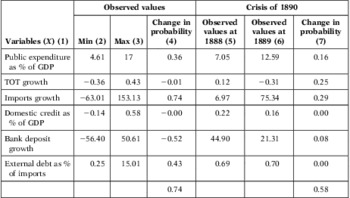
Since logit regression coefficients are not directly interpretable, we compute the estimated changes in the probability of crisis in two different situations: (a) for observed maximum and minimum values of the variables (see column 4 in Table 7) and (b) for the crisis of 1890 (see column 7 in Table 7), keeping other variables at their means. In both cases figures are obtained from the following equation:
 $${\rDelta \hat{p}}_{} \,\left( {y_i \, = \,1_{} } \right)\, = \,\frac{{e^{{{{\bar{x}}}_0}{{{\hat{\beta }}}_0}\, + \,{{{\bar{x}}}_1}{{{\hat{\beta }}}_1}\, + \, \cdots \, + \,{{{\bar{x}}}_i}^{{MAX}} {{{\hat{\beta }}}_i}\, + \, \cdots \, + \,{{x}_k}{{{\hat{\beta }}}_k}} }}{{1_{} \, + \,e^{{{{\bar{x}}}_0}{{{\hat{\beta }}}_0}\, + \,{{{\bar{x}}}_1}{{{\hat{\beta }}}_1}\, + \, \cdots \, + \,{{{\bar{x}}}^{MAX}} _{i} {{{\hat{\beta }}}_i}\, + \, \cdots \, + \,{{{\bar{x}}}_k}{{{\hat{\beta }}}_k}} }}\,{\rm{ - }}\,\frac{{e^{{{{\bar{x}}}_0}{{{\hat{\beta }}}_0}\, + \,{{{\bar{x}}}_1}{{{\hat{\beta }}}_1}\, + \, \cdots \, + \,{{{\bar{x}}}_i}^{{MIN}} {{{\hat{\beta }}}_i}\, + \,\cdots \, + \,{{{\bar{x}}}_k}{{{\hat{\beta }}}_k}} }}{{1_{} \, + \,e^{{{{\bar{x}}}_0}{{{\hat{\beta }}}_0}\, + \,{{{\bar{x}}}_1}{{{\hat{\beta }}}_1}\, + \, \cdots \, + \,{{{\bar{x}}}^{MIN}} _{i} {{{\hat{\beta }}}_i}\, + \, \cdots \, + \,{{{\bar{x}}}_k}{{{\hat{\beta }}}_k}} }}$$
CHANGES IN THE PROBABILITY OF CRISES

TOT = terms of trade.
The probability of crisis increases by 0.36 when public expenditure as per cent of GDP goes from its minimum value (4.61) to its maximum (17), keeping other explanatory variables at their means (see column 2). Similarly, for the 1890 crisis, as public expenditure as per cent of GDP goes from 7.05 in 1888 to 12.59 in 1889, the probability of crisis increases by 0.16 (see column 7). In Table 6 we also present the same exercise for all variables. It is worth noting that the probability of crisis increases by 0.58 when all variables are evaluated at their observed 1888-1889 values.
4.4 Multinomial logit regressions
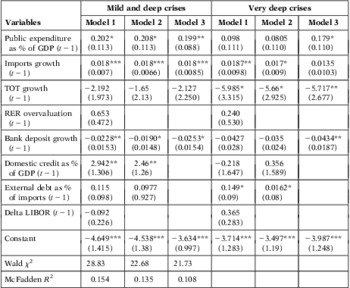
We also performed multinomial logit regressions to capture the differential behaviour of variables in very deep crises, on one hand, and deep and mild crises, on the other (see Table 7). We redefine our dependent variable, assigning the value of 0 to non-crisis periods, 1 for deep and mild crises, and 2 for very deep crisis episodes. We put forward three models. The first three columns of Table 8 show the results for mild and deep crises, while the last three those for very deep crises. The results of multivariate logistic estimations strengthen those obtained with bivariate logistic models and give new information regarding the impact of each explanatory variable in crisis episodes of different intensities. We find that domestic conditions are very important to explain mild and deep crises: public expenditure (as per cent of GDP), imports growth, domestic credit (as per cent of GDP) and bank deposits growth are very significant, while TOT are not. On the contrary, external circumstances (TOT growth and external debt) play a key role in very deep crises, jointly with domestic conditions. In other words, very deep crises are the result of a worsening of both external and domestic conditions, while mild and deep crises are mostly explained by deterioration in domestic variables.
MULTIVARIATE LOGISTIC REGRESSION RESULTS Dependent variable: Crisis (dummy = 2 if very deep crisis years; 1 if deep and mild crises and 0 otherwise) Observations: 135. Period: 1865-2002

TOT = terms of trade; RER = real exchange rate.
Note: Robust standard errors below coefficient.
***Significant at 0.01; **Significant at 0.05; *Significant at 0.10.
These results are in line with Neumeyer and Perri's (Reference Neumeyer and Perri2005) study of the Argentine business cycle. They consider two components of the domestic real interest rate: the international interest rate and the country risk and found that eliminating country risk lowers Argentine output volatility by 27 per cent while stabilizing international interest rates lowers it by less than 3 per cent.
5 CONCLUSIONS
Argentina's crises have been the subject matter of numerous research papers. Scholars have mainly focused on a particular crisis or group of crises to obtain a deeper understanding of each episode. We take a different approach, attempting to complement previous analyses. We identify and categorize crises from 1825 to 2002 using an MTI and analyse them all together by means of non-parametric and parametric techniques, looking for regularities.
We identify twenty-four currency crises in 177 years, six of them considered very deep or crashes, twelve deep crises and six mild crises. Unlike other papers that rely on annual observations to compute the MTI, we use monthly data from 1914 to 2002, which allows us to identify the beginning, the peak and the end of each episode with accuracy. The evidence from non-parametric tests, containing Kruskal–Wallis and Kolmogorov–Smirnov tests, graphic analysis and regression analysis, featuring bivariate logit and multinomial logit regressions, suggests that domestic imbalances, in particular fiscal mismanagement, played a major role in most of the crises. Huge expansions in public expenditures as well as immoderate augments in the debt to GDP ratio contribute to spur the probability of crisis. Likewise, abrupt falls in the rate of growth of bank deposits, frequently linked to domestic inconsistencies, were another key ingredient in Argentine crises. We detect the presence of external factors in crashes. That is, very deep crises are the result of unfavourable external and domestic conditions while mild and deep crises are mostly explained by deterioration in domestic variables.
This point should not be missed by policymakers since they can influence and decide on domestic policies, but not on external conditions. Our results not only reinforce recent evidence on the Argentine business cycles like the Neumeyer and Perri's (Reference Neumeyer and Perri2005) study, but also support Alberdi's old conjecture on the causes of early Argentine crises.
APPENDIX
MEAN VALUES OF KEY MACROECONOMIC VARIABLES (ARGENTINA 1865-2002)

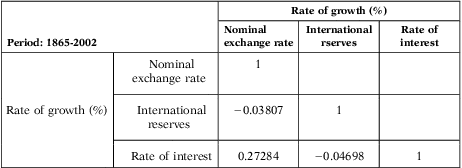
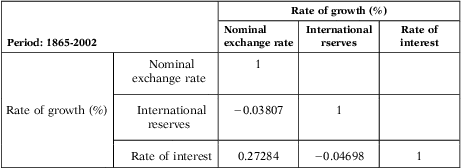
COEFFICIENT OF CORRELATION BETWEEN MTI COMPONENTS (ANNUAL DATA)
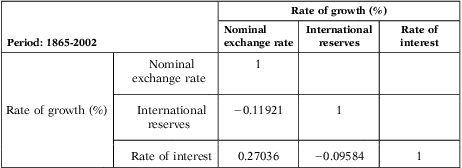
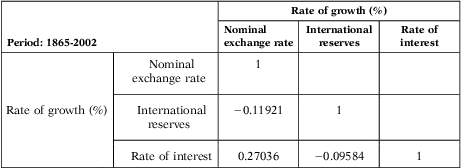
COEFFICIENT OF CORRELATION BETWEEN MTI COMPONENTS (MONTHLY DATA)
CRISIS DETERMINATION BASED ON RECURSIVE ESTIMATED BANDS (ARGENTINA 1825-1913)

CRISIS DETERMINATION BASED ON RECURSIVE ESTIMATED BANDS (ARGENTINA 1914-2002)
Source: see text

DATA SOURCES
Considerable effort has been devoted to the construction of time series for 177 years. The MTI was computed using monthly data from 1914 to the present. Exchange rates were taken from Vázquez–Presedo (Reference Vázquez-Presedo1971, Reference Vázquez-Presedo1976), Ámbito Financiero (1984), FIEL (1989) and Ferreres (Reference Ferreres2005). To construct the international reserves series we use data from Vázquez–Presedo (Reference Vázquez-Presedo1971, Reference Vázquez-Presedo1976), the International Monetary Fund and the Memoria Annual of Banco Central de la República Argentina (BCRA). Interest rates were taken from Vázquez–Presedo (Reference Vázquez-Presedo1971, Reference Vázquez-Presedo1976), Indicadores de Coyuntura of FIEL and Revista Economía of BCRA. Monetary, fiscal and international trade variables were obtained from Cortés Conde (Reference Cortés Conde1989) and also from BCRA, Ministerio de Economía de la Nación, Vázquez-Presedo, from Gerchunoff and Llach (Reference Gerchunoff and Llach2003) and from Ferreres (Reference Ferreres2005). The following tables contain a detailed description of the original series and the assembled series. Series are available upon request
DATA SOURCES AND DEFINITIONS (ANNUAL DATA)

DATA SOURCES AND DEFINITIONS (MONTHLY DATA)

VARIABLES USED IN THE REGRESSIONS (ANNUAL DATA)