1. Introduction
The relationship between legislation and economic activity has recently been the subject of extensive research in economics because of its undeniable importance. Indeed, the interdependence between the legislative framework and economic development has been a central concern of modern social theory, providing a focal point for the analyses of Marx (Reference Marx and Fowkes1867), Durkheim (Reference Durkheim1893) and Weber (Reference Weber, Shils and Rheinstein1923). Together with law enforcement and social customs, legislation plays a relevant role in defining the institutional quality of a country and in promoting its growth (North, Reference North1990, Reference North1994). Some scholars also highlight the importance of law enforcement in growth (see, among others, Acemoglu and Johnson, Reference Acemoglu and Johnson2005; North, Reference North1990). The impact of legislation and regulation has been studied more extensively from a microeconomic perspective.Footnote 1 Goff (Reference Goff1996) in his seminal paper on the economic impact of legislation, used data for the United States and found Granger-causality between legislation and GDP growth. This innovative research has been followed more recently by Alesina et al. (Reference Alesina, Ardagna, Nicoletti and Schiantarelli2003), Blanchard and Giavazzi (Reference Blanchard and Giavazzi2003), Clemenz and Gugler (Reference Clemenz and Gugler2000), Dawson and Seater (Reference Dawson and Seater2013); Djankov et al. (Reference Djankov, LaPorta, Lopez-De-Silanes and Shleifer2002); Djankov et al. (Reference Djankov, McLiesh and Ramalho2006); Ginsburg (Reference Ginsburg2000), Kaufman et al. (Reference Kaufman, Kraay and Mastruzzi2003), Loayza et al. (Reference Loayza, Oviedo and Serven2005); Nicoletti et al. (Reference Nicoletti, Bassanini, Ernst, Jean, Santiago and Swaim2001), Nicoletti and Scarpetta (Reference Nicoletti and Scarpetta2003).Footnote 2 Despite extensive research, none deals with the economic impact of legislation during the first stages of growth or after a process of political unification.
This paper studies the economic effect of the establishment of the Kingdom of Italy on economic growth in the Italian peninsula from 1861 to the beginning of World War II. The Kingdom of Italy constitutes an example of the unification of smaller states: the Kingdom of Sardinia, the Duchy of Parma, the Papal States, the Kingdom of the Two Sicilies, to name just a few. These small states had different legislations, currencies and social customs and this represented, as in Germany, an obstacle to economic development due to divergent, and sometimes conflicting, legislation. As a consequence of the unification of Italy, the Constitution of the Kingdom of Sardinia (the Albertine Statute, in force since 1848) and much of its administrative apparatus was extended to the territories of the unified kingdom. The creation of a unified kingdom, instead of numerous smaller pre-unification states, was expected to promote economic growth. In fact, the creation of a single market and the introduction of a single currency (the lira) throughout the Italian peninsula should have fostered economic activity and trade. At the same time, the establishment of uniform legislation should have had a direct positive impact on growth, thanks to less uncertainty and a straightforward identification of the applicable law, factors that are beneficial to economic activity. Legislative uniformity also reduces the costs of law enforcement.Footnote 3 Furthermore, an indirect positive effect of uniform legislation on GDP is imaged as result of less litigation. Indeed, less uncertainty enhances information and reduces asymmetries between economic agents: this smooths economic transactions (less litigation) and therefore sustains economic growth. These are not two separate channels: the latter is imagined to be embedded in the former.Footnote 4
The effect of legislative uniformity and civil litigation on GDP is discussed and empirically tested. It is expected that during the early stages of the new kingdom, the new unified legislation favoured economic growth. The data used cover 77 years, from 1861 to the beginning of World War II.
The paper is organized as follows. Section 2 contains a brief history of the legislative evolution of the Kingdom of Italy. Section 3 supplies a simple theoretical framework for the relationship between GDP per capita, legislation and civil litigation. Section 4 reports and discusses the econometric analysis. Some final remarks conclude the paper.
2. The legislative evolution and the decline of litigation in the Kingdom of Italy: a historical overview
In this section, the main steps in the evolution of legislation and litigation in the different phases of the Kingdom of Italy are discussed. To succeed in fully understanding this evolution first of all it is necessary to retrace the principal steps taken to construct the new state. The kingdom was established in 1861 as the result of a gradual process of extension of the frontiers of the Kingdom of Sardinia.Footnote 5 The hypothesis of a federal solution was excluded as well as the convocation of a constituent assembly: it was therefore decided to extend and centralize the hierarchical Piedmontese model to the territories annexed (Cassese and Melis, Reference Cassese and Melis1990). This involved the extension not only of the Statute of the Kingdom of Sardinia, but also of fundamental parts of its legislative structure (Pecorari, Reference Pecorari2003).Footnote 6 There were few new institutions, while there were many provisions applying or adjusting the Piedmont institutions to the Kingdom of Italy (Cassese, Reference Cassese2014).Footnote 7
An examination of the legislation in the first four years after unification allows us to understand the roots of the Kingdom of Italy. These are not attributable to the desire to strengthen military capacity, as elsewhere, nor are they to attributable to the aspiration to elevate a nation to the state level. It should be underlined that there were few elements able to create a national identity. This depended largely on the diversity of economic and social development across the regions of the new kingdom (Felice, Reference Felice2013).Footnote 8 The reasons for the creation of an Italian state are ascribed to the ambitions of the dawning Italian capitalism. The ruling political class wanted to emulate the rapid industrial development under way in England and France, a development that they attributed to the creation of a wide internal market able to sustain production and trade (Cassese, Reference Cassese2014). This perspective emerges from the fact that economic unification was pursued even before administrative unification was completed. The first governments of the kingdom, in other words, were less concerned with the building of a state than with the creation of a market (Cassese, Reference Cassese2014).
Indeed, at the beginning of the 19th century, the German state did not exist as a political and economic entity. Germany in 1815 consisted of 350 political entities, each with its own laws, currency, weights and measures. Moreover, additional customs and administrative divisions existed within each state.Footnote 9 Starting from the second half of the 18th century, a new awareness began to emerge that attributed underdevelopment to political and administrative fragmentation. Based on these ideas, at the beginning of the 19th century a vast reformatory campaign began: the states began to abolish their internal customs and then all the German states agreed to form a customs union (Zollverein) in 1834. Over a period of 40 years, Germany became a modern, fast-growing economy (Pflanze, Reference Pflanze1971).
A similar process of institutional and economic unification occurred in Italy. Before the creation of the Kingdom of Italy, political fragmentation led to a plurality of legislations. Nevertheless, the norms essentially maintained common characteristics (if not in the content at least in the basic principles) across the different pre-unification Kingdoms that were typical of civil law countries (La Porta et al., Reference La Porta, Lopes-de-Silanes, Shleifer A and Vishny1998). The codes of the pre-unification states, in fact, had imitated the Napoleonic model or, when they followed other canons, they had at least transposed the ‘spirit’ of that model (Ghisalberti, Reference Ghisalberti1982). This undoubtedly facilitated the legislative unification of the new Kingdom, a unification that could have been achieved through three alternative strategies. One option consisted in extending the legislation of the Kingdom of Sardinia to the entire national territory. A second alternative was to maintain the laws of the single pre-unification states, thus creating a decentralized legislative system on the basis of specific territorial needs. The third option was to predispose (ex novo) a single valid national codification for the whole territory of the new Kingdom (Ghisalberti, Reference Ghisalberti1982).
At beginning of the unification process, the first of these options was chosen and the Piedmontese legislation was extended to four regions: Lombard, Emilia, Marche and Umbria. For political reasons, however, this option was subsequently abandoned. On the other hand, the will to achieve real legislative unification was in conflict with the second option, which was the maintenance of the collection of ‘old’ laws and codes.Footnote 10 Consequently, the final solution could only be editing and publishing new legislation to be introduced and applied in the whole kingdom (Ghisalberti, Reference Ghisalberti1982). This materialized in the 1865 codes, which were founded upon the same Napoleonic model that had been applied more or less uniformly to the whole of the peninsula since 1814 (Ghisalberti, Reference Ghisalberti1982).Footnote 11 Their immediate application, observance and duration over time demonstrate the compliance of the unitary legislation to the demands of the new Italian society (Ghisalberti, Reference Ghisalberti1994). When the Sinistra storica came into power in 1876, it maintained continuity by adding the Merchant Marine Code (Codice della Marina Mercantile, 1877), the Trade Code (Codice di Commercio, 1882) and the Criminal Code (Codice Penale, 1889); this latter completed and improved the institutional model created in 1865 (Ghisalberti, Reference Ghisalberti1994).Footnote 12
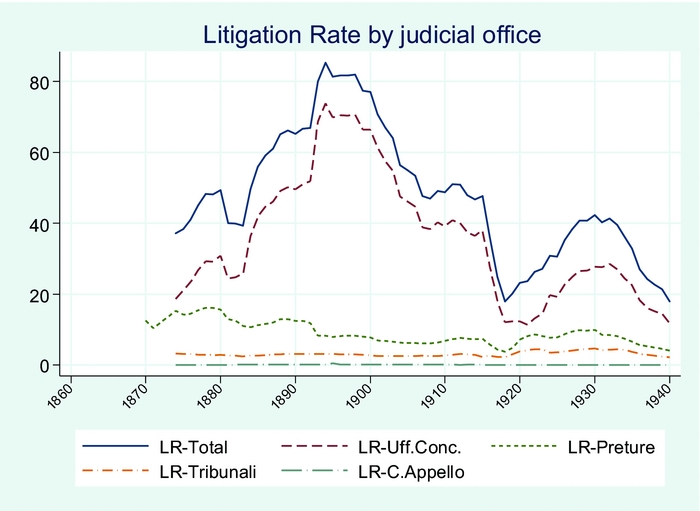
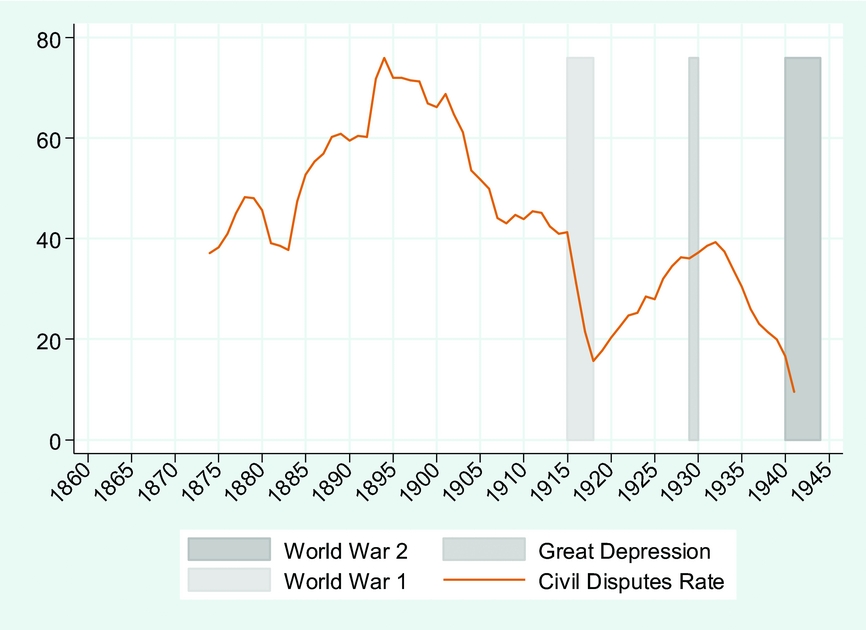
To verify the impact of the new codes of the kingdom on civil litigation one solution could be to look at the evolution of the Litigation Rate (LR), that is, the ratio between new civil disputes and population; this is shown in Figure 1 (LR-total). Up to the end of the 19th century this ratio undoubtedly shows an increasing trend with a maximum in 1894. It is possible to divide such a rate for each judicial office which is part of the judiciary. At that time, the judiciary dealing with civil disputes was made up of: (1) Uffici di Conciliazione: Conciliation Judges, which dealt with civil disputes of minor importance; (2) Preture: Limited Courts, with a competence for disputes of limited importance; (3) Tribunali: Full Courts, with jurisdiction for all the other, more important, disputes; (4) Corti d'Appello: Appeal Courts, for exceptional judgements.Footnote 13 The litigation rate divided by judicial office shows that only ‘small’ litigation grew, that is, the disputes managed by the Conciliation Judges (LR-Uff. Conc. in Figure 1). In fact, if disputes handled by the Limited Courts are looked at, the trend of litigation related to this office is seen to decrease (LR-Preture in Figure 1). Finally, the number of disputes handled by the Full Courts (LR-Tribunali in Figure 1) seems to be quite constant.
Litigation rate by judicial office

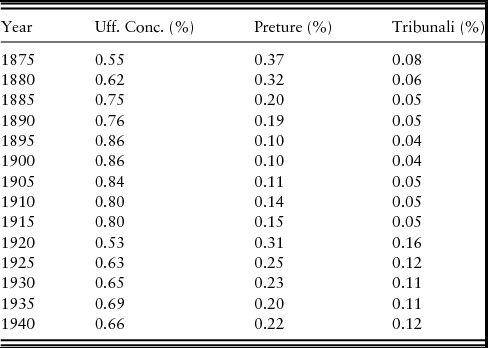
The evolution of the structural composition of litigation (share by judicial office) can be evaluated better through the values in Table 1. The Conciliation Judges’ share decreases, while the Limited and Full Courts’ share increases during the period from World War I to World War II. Such a structural variation in litigation is a trend that will emerge in the second post-war period too.Footnote 14
Litigation by judicial office

The correspondence of the laws encoded between 1865 and 1889 with the economic and social needs of the new-born kingdom resulted in the lack of substantial reforms in the 15 years that marked the apogee of the liberal state (Ghisalberti, Reference Ghisalberti1994). Nevertheless, at the beginning of the 20th century, the legislative uniformity typical of the preceding period was abandoned (Cassese, Reference Cassese2014).
A long time after formal unification, Italy was still a country characterized by deep and intense disparities, disunited on economic, cultural and even linguistic grounds, divided by strong dissimilarities of development. This contributed to producing a characteristic feature in Italian institutional history: derogatory legislation. It aimed at differentiating legislation according to the area of its application and therefore to meet the particular demands of the depressed areas, not only those in southern Italy.Footnote 15 This was a solution, albeit partial, to the disunited nature of the territory.Footnote 16 Nevertheless, the creation of local administrations and procedures that developed parallel to the national ones limited the uniformity of the laws (Cassese, Reference Cassese2014). Special laws for Naples (1885 and 1904), Calabria (1906) and Basilicata (1908) introduced the principle of legislative differentiation into the Italian legal system. Diversity was achieved in various ways: by increasing infrastructural works in less developed areas; by introducing special procedures and organs; and by providing for tax cuts, credit facilities and contributions in specific areas of the national territory (Cassese Reference Cassese2014).
In the period from 1900 to 1915, which was a period of economic and administrative growth, the quantity, but even more the quality, of the laws changed radically. From universal and abstract, the laws became specific and concrete (from leggi-monumento to leggi-provvedimento). In the meantime, the administration assumed a new role as the specific place in which the application of the law found its technical mediation, sometimes its mitigation. In short, administrative discretion emerged as a decisive element of government (Melis, Reference Melis2010).
In the period that marks the industrial take-off of the kingdom – that is, according to Mori (Reference Mori and Mori1992), the years of the ‘true’ economic miracle for Italy – the LR showed a clear fall. In fact, after a peak in 1894, litigation decreased progressively to almost half this level in 1914. The decrease, this time, concerns both the litigation managed by the Conciliation Judges (small disputes) and those that were dealt with by the other judicial offices.
The outbreak of World War I caused a real collapse in litigation, which is to be expected in a war period. Rapid growth followed in the post-war period: in 1926 the ratio of litigations doubled that in 1918. This ratio, however, did not reach the level reached before World War I.
In the Fascist period (1922–43), a large part of the legislative picture remained solidly founded upon the principles of the preceding juridical tradition. Not only were the Fascist reforms respectful of the inheritance received from the liberal state, they also maintained most of the legislation accumulated during the previous period. The legislative initiative of the Fascist regime was nevertheless conspicuous, ambitious and incisive. The Fascist regime set its hands on vast sectors of the society, often giving them a new order. It was a season of impressive legislative fertility (at least on the grounds of quantity), unprecedented in unified Italy's history (Melis, Reference Melis2014). The role of the national parliament as a place of legislative output declined in favour of the government, which was granted special power to issue laws from 1926. This task was carried out by the bureaucratic elites of each sector of the administration, which consisted of experts in specific fields (Melis, Reference Melis2014).
The codification produced in the Fascist period was almost entirely independent of the juridical ideology of fascism. This was because its formative process developed slowly and with a series of strict controls designed to prevent Fascist ideology from influencing legislation. The 1942 civil code, for example, was the most important normative text of the Fascist period, and this fit well in the tradition of Italian laws. It succeeded in innovating that tradition by adjusting it to the demands of an economy that was becoming largely, even if not yet primarily, industrial. Indeed, it outlived the regime. The 1942 code, along with the other codes compiled during the Fascist period, facilitated the changes in Italian society and helped Italy to approach the Western democracies after the war with a set of norms that, despite the dictatorial regime, the code was able to preserve and improve (Ghisalberti, Reference Ghisalberti1994).
In conclusion, legislative unification represented an essential condition for the creation of an Italian common market. The elites of the new kingdom thought that, if a uniform legislation had not been adopted, juridical particularism would have developed, with serious consequences for economic growth (Cassese, Reference Cassese2014). At first, an extension of the Piedmontese legislation answered this need, and later the 1865 code. As demonstrated, this process continued and, despite the advent of a derogatory legislation, it led to a far more uniform legal system than the ones in force in the different pre-unification states. With regard to the effect of legislative unification on total litigation, it was positive in the long term: the analysis of the LR from 1870 to World War II shows an overall decreasing trend.
3. A simple theoretical framework
As mentioned in the introduction, the positive impact of effective legislation on economic activity is an established result in development economics (Montes and Paschoal, Reference Montes and Paschoal2016). It is assumed that the unification of legislation reduces legal uncertainty, and that this directly favours economic growth. At the same time, a uniform legislation reduces litigation (Jacobi, Reference Jacobi2009), and this reinforces its positive effect. To make the analysis simple it is assumed that law enforcement is uniform among Italian regions and remains constant within the period considered.
Nonetheless, legislation may also have a negative effect: an excessive accumulation of laws may lead to an unsustainable level of legislative complexity (Bardhan, Reference Bardhan2002; Dawson and Seater Reference Dawson and Seater2013; Di Vita, Reference Di Vita2017; Friedman, Reference Friedman2004; Marcos et al., Reference Marcos, Santalò and Sanchez Graells2010). Indeed, legislative complexity is considered an obstacle to growth in many countries (OECD, 2014). Legislative complexity, due to overlapping and accumulation of laws, creates uncertainty about which norm applies. As the number of laws increases, consequential issues of interpretation and negative externalities of coordination between laws passed at different points in time grow in turn. This generates legislative complexity with social costs that may outweigh social benefits, especially in countries with a long history of liberal democracy as their form of government (Di Vita, Reference Di Vita2017; also Reference Di Vita2010; Reference Di Vita2012a; Reference Di Vita2012b; Mora-Sanguinetti and Salvador-Mora, Reference Mora-Sanguinetti and Salvador-Mora2016).
Based on the results of the empirical literature (Khan and Hudson Reference Khan and Hudson2014), which suggests a positive impact of effective rule of law, but also the adverse effect of excessive legislation on growth, the relationship between legislation and GDP is therefore unlikely to be linear. Before proceeding to the empirical analysis, theoretical assumptions are clarified about the overall effect of legislation (direct and indirect through litigation) on GDP per capita.
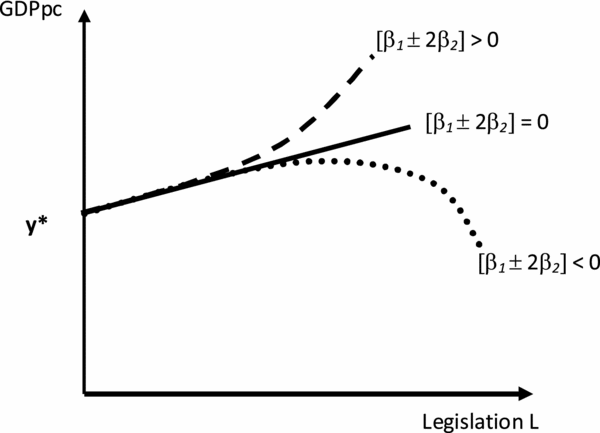
It can be assumed, as shown in Figure 2, that the relationship between legislation L and GDP per capita y could be either an increasingly convex curve (dashed line), or be linear (continuous line) or a rising concave curve (bullet line). In mathematical notation:
 $$\begin{equation}
y = f(\vec{X}),
\end{equation}$$
Relationship between GDP per capita and legislation

where y is GDP per capita and the vector  $\vec{X}$ includes all the relevant independent variables, including legislation (L) and the civil litigation rate (LR), that are assumed to be negatively correlated with the degree of legislative uniformity (LU, i.e. ∂LR/∂LU < 0).
Assuming a log-linear form, equation (1) can be expressed as follows:
 $$\begin{equation}
{y_{}} = \alpha + {\beta _1}L + {\beta _2}{L^2} + \sum\limits_{i = 3}^n {{\beta _i}{x_i}} ,
\end{equation}$$
α is the intercept and βi is the elasticity of each single variable considered. Given our focus on legislation, the emphasis is placed on β1 and β2representing, respectively, the impact of legislation and its square on GDP per capita. β1 is assumed to be positive and (by far) lower than one, while β2could be either negative or positive. The other independent variables (x 3, . . ., xn) will be included in the following econometric analysis. In equation (2) the argument L-squared addresses the problem of the shape of the relationship between legislation and per capita GDP.
Using the first partial derivative of equation (2):
 $$\begin{equation}
\frac{{\partial y}}{{\partial L}} = {\beta _1} \pm 2{\beta _2}L\left\{ {\begin{array}{@{}*{1}{l}@{}} {{\rm{ > \ 0}} \to {\rm{the\ function\ is\ increasing\ in\ {\it L}}}}\\ {{\rm{ = \ 0}} \to {\rm{the\ function\ is\ a\ horizontal\ line}}}\\ {{\rm{ < \ 0}} \to {\rm{the\ function\ is\ decreasing\ in\ {\it L}}}} \end{array}} \right.
\end{equation}$$
limiting the analysis to the hypothesis of ∂y/∂L > 0, and taking the second partial derivative the result is:
 $$\begin{equation}
\frac{{{\partial ^2}y}}{{\partial {L^2}}} = \pm 2{\beta _2}\left\{ {\begin{array}{@{}*{1}{l}@{}} {{\rm{ > \ 0}} \to {\rm{the\ function\ is\ convex}}}\\ {{\rm{ = \ 0}} \to {\rm{the\ function\ is\ a\ line}}}\\ {{\rm{ < \ 0}} \to {\rm{the\ function\ is\ concave}}} \end{array}} \right.
\end{equation}$$
as represented in Figure 1. Under the condition that the first and second derivative of y compared to L are both positive (i.e. ∂y/∂L > 0 and ∂2y/∂L 2> 0), legislation always causes a positive externality on the GDP, because its effect on the dependent variable is more than proportional. For ∂y/∂L > 0 and ∂2y/∂L 2 = 0 the economic impact of legislation on the GDP is constant. Finally, under conditions ∂y/∂L> 0 and ∂2y/∂L 2< 0 legislation generates a positive externality on the GDP until a threshold level L* is achieved, beyond that point, legislation has a negative effect on y. The term L 2 accounts for the non-linear effects of legislation on per capita GDP.
In principle, all the three alternatives are plausible. The sign and significance of βi is likely to depend upon the specific case considered (country and time), so it is matter of applied research and this will be examined in the following empirical analysis.
4. Econometric analysis and results
In this section the relationship between legislation, civil litigation rate and the GDP is studied. In fact, the analysis of Italy's GDP per capita in such a period poses many challenges. Indeed, this period goes from Italy's first main step towards unification in 1861, when the Kingdom of Italy was established, to the collapse of the monarchy and the establishment of the new republic in 1946.Footnote 17
As known, Italy's defeat in World War II caused the collapse of its previous constitutional order which had governed since 1861. Indeed, that constitutional order had remained formally the same from 1861 to 1943, although Italy turned de facto into a dictatorship from 1922 onwards after the seizure of power by the Fascist party. Nonetheless, a sufficient degree of continuity in terms of legislation (section 2) and economic development exists from 1861 to 1940. This period is therefore analysed, ruling out the years after 1940.
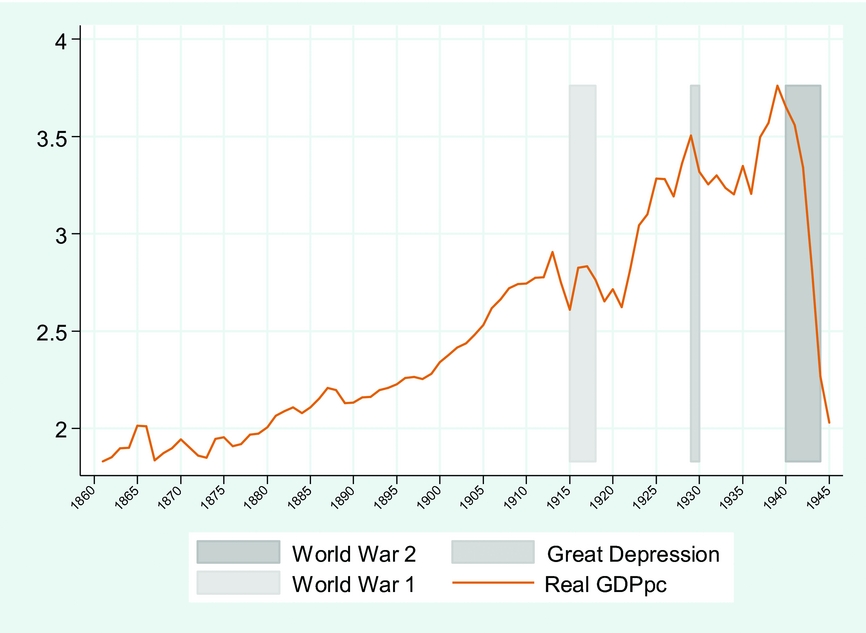
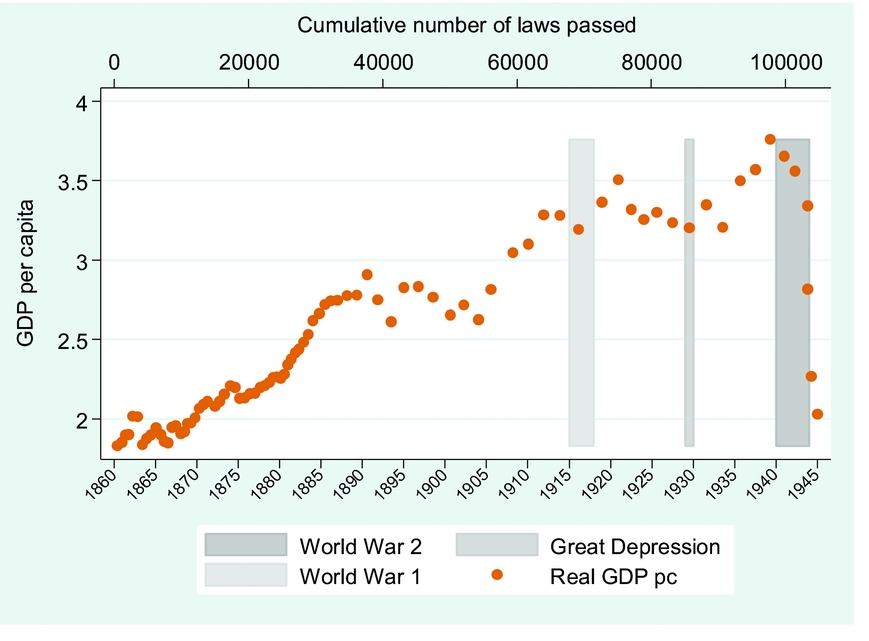
The variable of interest is the real GDP per capita; this is extracted from the database of the Bank of Italy (Baffigi, Reference Baffigi2011). The data refer to Italy's current boundaries.Footnote 18 Real GDP per capita is shown in Figure 3.
Real GDP per capita

As discussed in the first part of the paper, this analysis is focused on checking whether the legislative uniformity achieved in the Kingdom of Italy had a positive impact on the GDP per capita in the Italian Peninsula. It is assumed that the institutional development impacted, among other things, on civil litigation by causing its decrease. Consequently, decreasing litigation should have favoured economic growth. Litigation is supposed to have been particularly high in the first post-unification years due to the different legislations and habits to which pre-unification citizens were accustomed. The harmonization of norms, practices and institutions across the whole territory is supposed to have reduced litigation to the advantage of economic development, as a result of a reduction of legislative uncertainty.
The level of legislative uniformity achieved is approximated using the number of laws (Lex) passed by the Kingdom of Italy's parliament.Footnote 19 A simple way to start studying the relationship between legislation and GDP is to draw a scatter-plot. This is done in Figure 4.
Cumulative number of laws passed against real GDP per capita

The positive relationship emerging from Figure 3 is unsurprising. As known, GDP per capita has a positive upwards trend while the number of laws passed each year adds positively to the previous one. Then, both variables have a clear upwards trend. Based on this consideration, a proper econometric analysis can be used to check for a causal effect from legislation to GDP.
Litigation is quantified by the LR, which is equal to the number of new civil disputes started each year per 1,000 inhabitants. Official data on the LR are available only from 1880. Six further observations were added through a historical investigation of some sources (Annuario Statistico Italiano, 1878, 1881, 1884), and data for the period 1874–1940 are therefore available. Figure 5 shows the evolution of the LR in this period.
Litigation rate

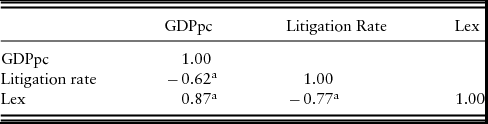
On looking at the correlation across the variables of interest their contemporaneous evolution can be understood. Correlations are reported in Table 2. Such correlations suggest that a decrease of the LR is associated with an increase of GDP per capita, improvements of legislative uniformity (Lex) are associated with positive GDP variations, and those improvements of the institutional framework correspond to a significant decrease in the civil litigation rate. Moreover, the dynamics of the civil litigation rate in Italy, over the period considered, reflect the business cycle fluctuation, as recently sustained by Palumbo et al. (Reference Palumbo, Giupponi, Nunziata and Mora-Sanguinetti2013).
Correlations between the variables of interest

a marks significance at 5%.
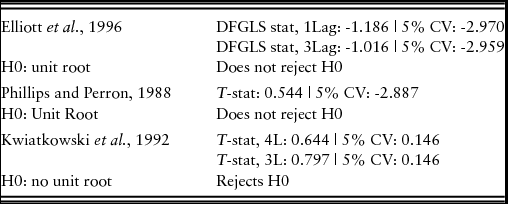
The GDP series has been the subject of econometric analysis for decades, although not particularly in the literature on determinants of economic development: Levine (Reference Levine, Aghion and Durlauf2005) and Arcand et al. (Reference Arcand, Berkes and Panizza2015) include excellent reviews of this literature. GDP series are commonly known not to be covariance-stationary processes. This is why as a first check it is verified the stationarity of the series object of this analysis through unit root tests. The hypotheses tested are: (1) ‘H0: unit root’ using the DF-GLS test (Elliott et al., Reference Elliott, Rothenberg and Stock1996) and the Perron test (Phillips and Perron, Reference Phillips and Perron1988); (2) ‘H0: no unit root’ using the KPSS test (Kwiatkowski et al., Reference Kwiatkowski, Phillips, Schmidt and Shin1992). Unit root tests notoriously depend upon the inclusion of the deterministic components and they are sensitive to the number of lags included in the regression.Footnote 20 Various alternatives were tried, and the results are reported in Table 3. On the whole, the tests suggest that the real GDP per capita series is not covariance-stationary.
Unit root tests on real GDP per capita

xL means test executed with x Lags.
As a consequence of the non-stationarity found, the first-difference of log GDP is investigated. As known, first-differencing is likely to make the GDP series stationary. The first-difference of log variables approximates the growth rate. To study the GDP evolution through its growth rate is a common practice in the current literature. The typical cross-sectional specification for the analysis of the GDP growth rate is:
 $$\begin{equation}
\Delta lGD{P_i} = {\rm{\alpha }} + {\rm{\beta }} \cdot lGD{P_{i/t - 1}} + {\rm{\vec{\Gamma }}} \cdot {{\rm{\vec{X}}}_i} + {{\rm{\varepsilon }}_i}
\end{equation}$$
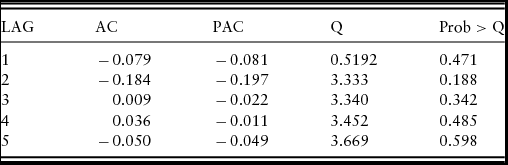
where the dependent variable is the first-difference of log GDP, α is the constant, the initial level of the GDP is included to test conditional beta-convergence (Young et al. Reference Young, Higgins and Levy2008) and  ${{\rm{\vec{X}}}_i}$ is a set of explicative variables; for applications of this specification, see Arcand et al. (Reference Arcand, Berkes and Panizza2015) or Barro (Reference Barro1996). This cross-sectional specification is adapted to the time series data. The main concern in this regard would be serial correlation, but the series of the real GDP growth rate does not exhibit serial correlation at all as the autocorrelation and partial autocorrelation functions in Table 4 shows. The following specification is therefore estimated:
Auto and partial correlations

 $$\begin{equation}
\Delta lGD{P_t} = {\rm{\alpha }} + {\rm{\beta }} \cdot lGD{P_{t - 1}} + {\rm{\vec{\Gamma }}} \cdot {{\rm{\vec{X}}}_t} + {{\rm{\varepsilon }}_t}.
\end{equation}$$
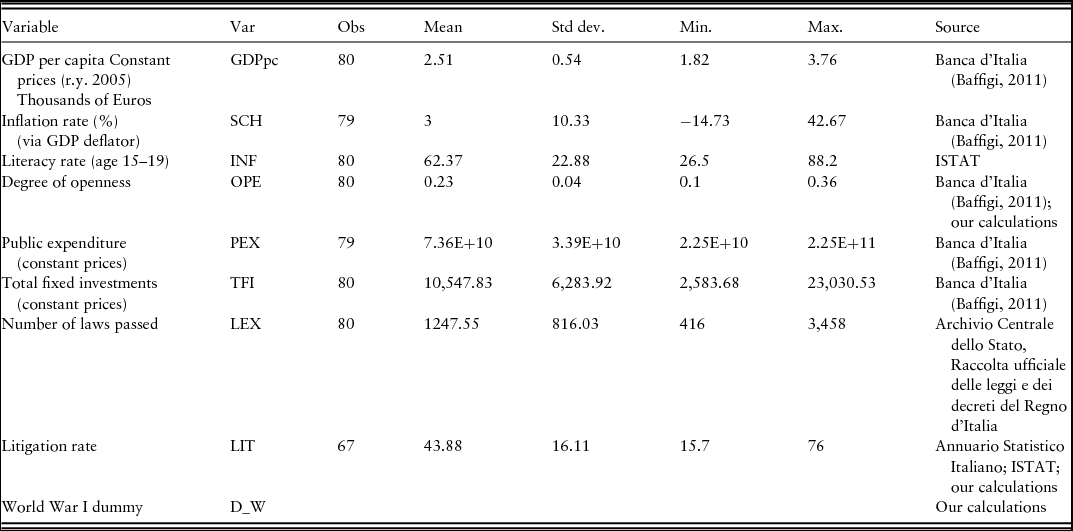
The explicative variables ( ${\rm{\vec{X}}}$) are included in Table 5 coherently with the literature on the determinants of GDP growth (Sala-i-Martin et al., Reference Sala-i-Martin, Doppelhofer and Miller2004), plus the variables of interest for the scope of our analysis. Table 5 also shows summary statistics for the variables used in the estimation.
Variables

Note: The period under analysis is 1861–1940: this counts as 80 observations.
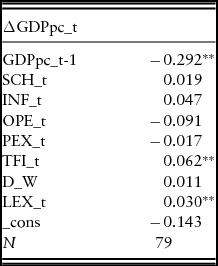
The estimation output is in Table 6; Newey–West standard errors are computed and used to check statistical significance.
The estimation output shows a negative and significant effect of the initial GDP per capita level coherently with the concept of beta-convergence. Among the covariates included, Total Investment in fixed capital turns out to be statistically significant and possess the algebraic sign expected. The other independent variables are not statistically significant. As for the contribution of a more uniform legislation, as approximated by the number of laws passed (‘LEX’ in Table 6), the estimation suggests that it is positive.
Estimation output, the effect of legislation

Notes: All variables are in log terms.
**marks significance at 5%; *marks significance at 10%.
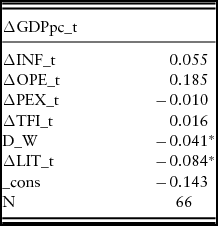
At this point the effect of litigation on GDP growth is estimated, where it is envisaged that litigation negatively affects GDP growth. The specification is slightly different with respect to the one in Table 6 because the sample is substantially smaller now: it includes just 66 observations. Indeed, as previously explained, it was not possible to reconstruct the LR series further back in the past. In contrast to the one including Lex, which totals 79 observations (Table 6), some variables (like SCH_t and GDPpc_t-1), which are irrelevant in terms of information and were non-statistically significant in such a small sample, are not included. This allows to save degrees of freedom and achieve a more reliable estimate output. The estimation output is in Table 7, which shows a negative and significant effect from litigation. This means that a decrease of litigation seems to support higher economic growth as outlined in the main argument developed in section 2.Footnote 21
Estimation output, the effect of litigation

Notes: All variables are in log terms.
**marks significance at 5%; *marks significance at 10%.
5. Final remarks
In this paper the potentially positive effect of the political unification of Italy on its economic growth is explained through the establishment of a single Italy-wide market and the enactment of uniform legislation within the borders of Italy, with respect to the pre-unification states. Such uniform legislation started to be implemented with the extension of the Albertine Statute from the Kingdom of Sardinia to the newly founded Kingdom of Italy, and further steps were achieved through the enactment of the legislative codes based on the Napoleonic tradition. The beneficial effect of uniform legislation is likely to be strengthened by lower rates of civil litigation.
On the whole, the findings of the analysis are consistent with previous historical discussion and theoretical premises. The unification process, at a low level of legislative accumulation and stratification, made the social revenue of legislation greater than its social cost (because of a negative coordination externality). This is likely to depend on the fact that the threshold level of the legislation stock, after which those externalities emerge, was not achieved in the age of the Kingdom of Italy.
Acknowledgements
We should like to thank two anonymous referees, and also Alessandro Melcarne, Giovanni Ramello, Juan Mora Sanguinetti and Massimiliano Vatiero. The participants at the seminar held at University of Montpellier (27–8 June 2016) made valuable suggestions and comments on a preliminary draft of this paper. All remaining errors are the author's responsibility.