In Australia, prostate cancer is the most commonly diagnosed cancer, and the fourth leading cause of cancer death among men.1 A proportion of patients diagnosed with prostate cancer will receive curative intent megavoltage radiotherapy to the prostate gland and seminal vesicles.Reference Hayden, Martin and Kneebone2 Throughout radiotherapy, the prostate gland is susceptible to intra- and inter-fractional motion leading to reductions in target coverage.Reference Deurloo, Steenbakkers and Zijp3 Consequently, inadequate image-guided radiotherapy (IGRT) protocols to correct for this target movement will result in reduced tumour control.Reference De Crevoisier, Tucker and Dong4
Increased application of IGRT minimises inter-fractional random set-up errors, however rigid couch translations cannot fully compensate for rotations and deformation effects of the prostate and seminal vesicles caused by intra- and inter-fractional rectal distension.Reference Yahya, Zarkar, Southgate, Nightingale and Webster5 While many variables such as bladder and bowel filling, respiration and leg rotation are implicated in causing internal prostate motion, rectal distension is cited as the most important factor influencing prostate deformation and movement in the anteroposterior and superoinferior directions.Reference Ki, Kim and Nam6–Reference McNair, Wedlake, Lips, Andreyev, Van Vulpen and Dearnaley8 Therefore, a bowel preparation resulting in stabilised rectal volume, and hence reduced prostate motion and deformation throughout radiotherapy treatment remains an area of clinical interest harbouring potential positive impacts on patient outcomes.
Clinical practices routinely utilise bowel preparations, with measures ranging from simple dietary advice, soluble and insoluble fibre supplements, microenemas and aperients, to mechanical/digital evacuation.Reference McNair, Wedlake, Lips, Andreyev, Van Vulpen and Dearnaley8 Consequently, the implementation of many of these interventions has been correlated with increased prostate stability and reduction in rectal dose.Reference Yahya, Zarkar, Southgate, Nightingale and Webster5, Reference McNair, Wedlake, Lips, Andreyev, Van Vulpen and Dearnaley8 Similarly, the observation that psyllium husk in particular does not promote gas formation by gastrointestinal microflora due to its partially fermentable nature,Reference Gonlachanvit, Coleski, Owyang and Hasler9 may account for the documentation of its use as a bowel preparatory agent in prostate radiotherapy.Reference Stillie, Kron and Fox10, Reference Oates, Schneider and Lim Joon11
Studies also suggest that the use of live microorganisms, or probiotics, to manipulate enteric microflora may have applications in reducing radiation-induced bowel toxicities,Reference Fuccio, Guido and Eusebi12 intestinal transit time and gas accumulation,Reference Ki, Kim and Nam6, Reference Magro, de Oliveira and Bernasconi13 and as a potential bowel preparation supplement for colonoscopies.Reference Lee, Kim and Kim14 However, despite this evidence, there remains a paucity of empirical data connecting the use of probiotics to reduced rectal distension during radiotherapy treatment. At the time of writing, a single study had assessed probiotics as a bowel preparatory agent for patients receiving radiotherapy.Reference Ki, Kim and Nam6
Nevertheless there is evidence to suggest that both probiotics- and psyllium-supplemented diets will result in improved bowel preparation for patients receiving radiotherapy for prostate cancer over a no preparation control.Reference Ki, Kim and Nam6, Reference Stillie, Kron and Fox10, Reference Oates, Schneider and Lim Joon11 Therefore, this retrospective pilot study aimed to analyse and compare the impact of a probiotics-based bowel preparation against a psyllium protocol in reducing rectal distension. In line with surrounding literature,Reference Ki, Kim and Nam6, Reference Fuccio, Guido and Eusebi12–Reference Lee, Kim and Kim14 we hypothesised that a probiotics-based bowel preparation would perform as well as, if not better than a psyllium supplementation protocol.
MATERIALS AND METHODS
Study design
This was a retrospective chart review with the primary endpoint of using cone beam computed tomographies (CBCTs) taken as part of routine patient care to compare the efficacy of probiotics in inducing a consistently sized rectum compared with psyllium throughout radiotherapy treatment.
Patient group and ethics
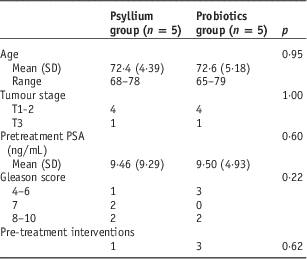
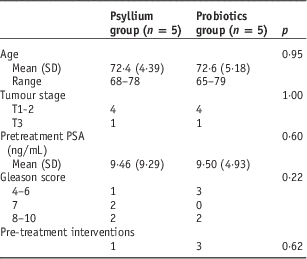
Following approval from our organisation’s Human Research Ethics Committee (LR10813), 10 patients who received radical radiotherapy for non-metastatic adenocarcinoma of the prostate were retrospectively selected. Patients were selected chronologically from March 2012, with patient characteristics listed in Table 1. Of the 10 patients, five were regularly taking one capsule of probiotics containing 1·25×1010 units of Lactobacillus acidophilus NCFM and Bifidobacterium lactis Bi-07 a day (Ethical Nutrients Inner Health Plus™, Health World Limited, Queensland, Australia), and the other five were prescribed a psyllium-based bulk-forming laxative to be taken daily (Fybogel™, Reckitt Benckiser, Slough, UK; 3·5 g/day psyllium husk).
Patient characteristics
Abbreviations: PSA, prostate-specific antigen; SD, standard deviation.
Bladder and bowel preparation
In order to ensure consistent bladder filling, both groups were instructed to empty their bladder 30 minutes prior to simulation CT/treatment sessions and drink three glasses of water (∼500 mL total). Patients assigned psyllium were instructed to commence taking one sachet of Fybogel™ nightly, 1 week prior to simulation, continuing throughout the course of treatment. During their initial consult it was documented that all patients in the probiotics group consumed one capsule of Ethical Nutrients Inner Health Plus™ daily as part of their daily dietary regimen. Adherence to the above bowel preparation was confirmed during weekly nursing toxicity reviews and documented.
Radiotherapy and delivery
All patients were inverse-planned on Varian’s Eclipse™ treatment planning system version 11·0·42 (AAA version 10·0·28; Varian Medical Systems, Palo Alto, CA, USA) on 1·25 mm resolution planning CTs and were treated on a Varian Clinac iX linear accelerator (Varian Medical Systems) up to 78 Gy at 2 Gy per fraction. All patients were planned in the supine position on a personalised vacuum cushion to immobilise the pelvis and lower extremities. All patients had daily online corrections with a zero action threshold. The imaging protocol consisted of CBCT image guidance for the first three fractions and then weekly afterwards, with kV/MV orthogonal matching on all other fractions. While the CBCT images were primarily utilised to ensure accuracy of treatment setup, they also informed on adequacy of bladder and bowel preparation. If large degrees of rectal distension, and/or insufficient bladder filling were observed, patients were removed from the treatment couch and asked to evacuate and repeat the bladder preparation prior to being rescanned (pre-treatment intervention).
Rectal distension measurement
Captured CBCTs were registered to their respective planning CT using bony anatomy. The rectum (including faeces and gas) was contoured on each planning CT and subsequent CBCT scans by a single experienced observer to minimise inter-observer variability. To ensure consistent demarcation between all scans, rectal volume was defined as the volume of the contoured rectum 1 cm above and below of the largest PTV as per EORTC guidelines.Reference Boehmer, Maingon and Poortmans15
The following surrogate measures of rectal distension were considered in this study: rectal volume (RV), difference in rectal volume from planning CT (ΔRV), rectal cross-section area (CSA) and relative cross-section area (CSArel). Rectal volume was readily obtained through the treatment planning system. Rectal CSA was calculated by dividing the rectal volume by its length, and relative CSA was determined by dividing the rectal CSA on each CBCT by the original planning CT rectal CSA.Reference De Crevoisier, Tucker and Dong4, Reference Yahya, Zarkar, Southgate, Nightingale and Webster5
Analysis and statistics
Difference in rectal volume from planning CT (ΔRV), rectal CSA and relative CSA were compared between the two groups with two-tailed independent samples t-tests, and 95% confidence intervals. The non-parametric equivalent of the t-test, the Wilcoxon–Mann–Whitney test, was subsequently employed to confirm the results of the former test. Patient characteristics were compared using independent samples t-tests and Fisher’s exact test for binary data. Statistical significance was set at a two-sided p-value of 0·05. All analyses were performed using IBM® SPSS (Version 20·0. Armonk, NY: IBM Corp 2010).
RESULTS
During the study period (May 2012 to January 2013), 56 patients received radical intent radiotherapy for prostate cancer at our department. Of these, 46 were excluded because of the use of alternative bowel preparatory agents (n=9), non-compliance with the specified preparation regime (n=7), no dietary intervention (n=20), missing data (n=8) and bilateral hip prostheses precluding CBCT assessment (n=2), leaving 10 patients for inclusion into the study. All 10 patients completed their radiotherapy without treatment suspensions, providing 90 CBCT images and 10 planning CT images for analysis. The incidence of pre-treatment interventions during patients’ course of treatments was three in the probiotics group and one in the psyllium group (p=0·62; Table 1).
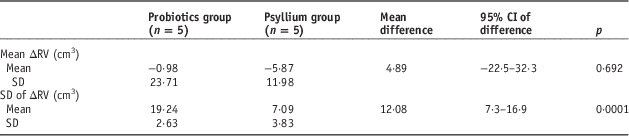
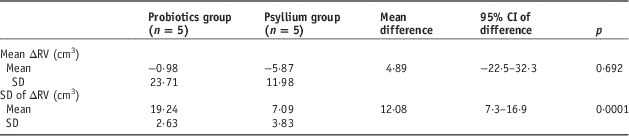
The mean and SD values of the difference in rectal volume from planning CT (ΔRV) for both groups are shown in Table 2. Between the two groups, members of the probiotics group reported increased mean ΔRV, as well as increased rectal volume variation (SD ΔRV). While the mean ΔRV between the groups did not achieve statistical significance (p=0·692), the variation in rectal volume from planning was significantly higher for the probiotics group compared with the psyllium group (p=0·0001). The study observed an almost three-fold increase in the variation of ΔRV with the administration of probiotics.
Mean of mean and SD of difference in rectal volume from planning (ΔRV; cm3)
Abbreviations: CI, confidence interval; SD, standard deviation.
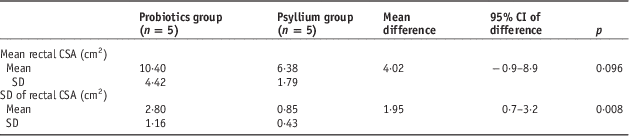
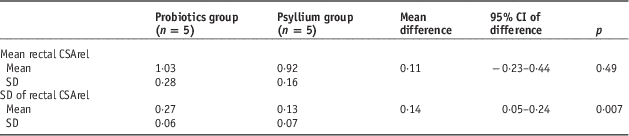
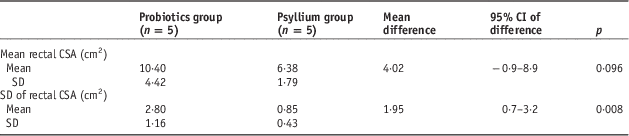
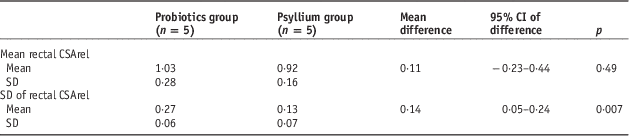
Tables 3 and 4 illustrate the mean and SD of rectal CSA and relative CSA. Increased values for the probiotics group were noted across all variables. On comparison of the mean rectal CSA between the probiotics and psyllium groups, the difference indicated a trend towards, but did not approach, statistical significance (p=0·096). Difference in mean CSArel was also shown to be non-significant (p=0·49). The variability in CSA and CSArel values, however, were shown to be significantly higher in the probiotics group than the psyllium group (SD of CSA: p=0·008, SD of CSArel: p=0·007).
Mean of mean and SD of rectal cross-section area (CSA; cm2)
Abbreviations: CI, confidence interval; SD, standard deviation.
Group mean and SD of relative rectal cross-section area (CSArel)
Abbreviations: CI, confidence interval; SD, standard deviation.
DISCUSSION
It was hypothesised in this study that a probiotics-based preparation would minimise gas production, and hence stabilise rectal distension throughout treatment as well as, if not better than a psyllium-supplemented diet. However, contrary to this hypothesis, the current study suggests that the administration of the probiotics L. acidophilus and B. lactis resulted in significantly increased variation in ΔRV (p=0·0001), rectal cross section area (CSA) (p=0·008) and relative cross section area (CSArel) (p=0·007) compared with a psyllium-supplemented preparation.
We compared these results with those of Stillie et al.,Reference Stillie, Kron and Fox10 De Crevoisier et al.Reference De Crevoisier, Tucker and Dong4 and Yahya et al.Reference Yahya, Zarkar, Southgate, Nightingale and Webster5 who employed similar methodologies to delineate the rectum, the latter two of which also used a retrospective chart review study design. In the study conducted by Stillie et al.,Reference Stillie, Kron and Fox10 in addition to dietary advice, psyllium husk (Fybogel™) was administered to patients who reported irregular bowel movements for 7 days before the planning CT, and daily throughout treatment, whereas the study by De Crevoiser et al.Reference De Crevoisier, Tucker and Dong4 issued no bowel preparation. Conversely, the pilot study conducted by Yahya et al.Reference Yahya, Zarkar, Southgate, Nightingale and Webster5 retrospectively compared three groups; a daily microenema, high fibre diet, and no preparation group.
On comparison, it was noted that the median mean CSA value of the probiotics group in this study (10·35 cmReference Hayden, Martin and Kneebone2) was shown to be increased when compared with the study by Stillie et al.Reference Stillie, Kron and Fox10 (7·3 cm2), which is consistent with our findings that a probiotics-based preparation was inferior to a psyllium-supplement diet. It was also noted that the median rectal CSA of the current study’s probiotics group approximated the no preparation group in the De Crevoisier et al. studyReference De Crevoisier, Tucker and Dong4 (11·2 cm2). Furthermore, upon comparison with the small retrospective study by Yahya et al.,Reference Yahya, Zarkar, Southgate, Nightingale and Webster5 the probiotics group displayed an almost equivalent mean SD of rectal CSA (2·8 cm2) to the control and high-fibre diet groups (2·7 and 2·6 cm2, respectively). Due to obvious differences in study materials and methodologies, drawing definitive conclusions from these comparisons is hazardous; however, these observations suggest that a probiotics-based preparation may result in greater magnitude and variation of rectal distension than a psyllium-supplemented diet. Moreover, they also infer that the current study’s probiotics preparation may perform similar to no preparation at all.
The indication that a probiotics-based preparation will perform similar to a no preparation control is inconsistent with the findings of the only other study to investigate the use of probiotics on rectal filling during prostate radiotherapy by Ki et al.Reference Ki, Kim and Nam6 Their study of 40 patients randomised half into a probiotics group and a placebo-controlled group, and ultimately reported that a probiotics-based preparation had a beneficial effect on rectal filling among prostate radiotherapy patients. Ki et al.Reference Ki, Kim and Nam6 similarly prescribed the L. acidophilus species to the intervention group, however, found a significant reduction in the median percentage volume change of the rectum compared with the control group (p<0·001).
While the results are not readily comparable between studies due to differences in methodology and the lack of a control group in the current study, one factor that may account for differing performances of the probiotics groups is the dose–response effect of the L. acidophilus species. The participants in the probiotics group in the current study were prescribed an almost hundred-fold higher dosage of L. acidophilus (1·25×1010 colony-forming units) than those in the Ki et al. study. As an excessive dose of L. acidophilus has been linked with increased gas production,Reference Ki, Kim and Nam6, Reference Ehrlich16 this may account for greater rectal distension and variation observed in the current study’s probiotics group.
Additionally, as the strain of L. acidophilus used by Ki et al. was not reported, and as purported therapeutic benefits of probiotics on certain functional bowel disorders have been indicated to be strain-dependent,Reference Miller and Ouwehand17 this may be a factor that accounts for the differing efficacies observed between studies. Though the study by Ki et al.Reference Ki, Kim and Nam6 presents a more robust level of evidence given the larger sample size, greater number of images acquired per patient and prospective randomised nature, this study’s findings suggest that the efficacy of probiotics as a bowel preparatory agent may be dependent on the dose and strain and therefore advise that the administration of probiotics should be made cautiously and with these factors in mind.
While acknowledging the apparent limitations of this study, the reported findings are of clinical importance as the magnitude and variation of rectal distension as measured by rectal volume and cross-section area, have been correlated with prostate instability, and hence negative implications on rectal toxicities and tumour control, particularly in populations managed without online image guidance during treatment.Reference De Crevoisier, Tucker and Dong4, Reference Heemsbergen, Hoogeman and Witte18
CONCLUSION
While a small sample size, low frequency of volumetric pre-imaging and the non-randomised, non-blinded, retrospective nature of the study design make it difficult to draw any strong conclusions, the findings of this study suggest that a probiotics-based bowel preparation that utilises L. acidophilus and B. lactis may result in increased rectal volume variation throughout treatment in comparison with a psyllium-supplemented diet. Consequently, these results have prompted our institution to recommend against the use of probiotics in isolation as a bowel preparation for radiotherapy until more evidence supporting its use becomes available. Given the lack of research in this area the authors encourage the conduct of further appropriately powered prospective randomised controlled studies to better determine the efficacy of probiotics as a potential bowel preparation for prostate radiotherapy.
Acknowledgements
The authors acknowledge and thank Dr Rebecca Bale, Sarah Gonzales and Jim Frantzis for their contributions to this study.
Financial support
This research received no specific grant from any funding agency, commercial or not-for-profit sectors.
Conflicts of Interest
The authors report no conflicts of interest or financial interests. The authors alone are responsible for the content and writing of the paper.