Implications
Poultry meat is a desirable component of the human diet. Because meat enrichment with fish oil can affect quality, it seems that applying a withdrawal design for 1 week before slaughter is necessary for broiler feeding. Fishy taints can be removed from n-3-enriched meat; however, by this method, the levels of deposited n-3 fatty acids (FAs) may be reused by the birds for maintenance of the immune system.
The study of blood FAs can facilitate a better understanding of the changes that occur in their tissue and blood amounts following reuse or de novo synthesis in the liver or in tissue.
Introduction
In recent decades, studies have focused on poultry diet supplementation with fats rich in n-3 polyunsaturated fatty acids (n-3 PUFAs) such as fish oil (FO; Mourot and Hermier, Reference Mourot and Hermier2001). The reason for this supplementation is the presence of these fats in the nervous system, the organ with the second largest concentration of lipids, exceeded only by adipose tissue. Approximately 35% of these lipids are long-chain (LC) n-3 PUFAs, such as arachidonic acid (AA), α-linolenic acid (ALA), eicosapentanoic acid (EPA) and docosahexanoic acid (DHA; Benatti et al., Reference Benatti, Peluso, Nicolai and Calvani2004), which are known to play an essential role in brain development and function (Alessandri et al., Reference Alessandri, Guesnet, Vancassel, Astorg, Denis and Langelier2004).
The supplementation of fish extracts (oils) in animal reproduction would provide not only the physiological needs of animals, but also adequate quantities of the diet composition of humans (Kris-Etherton et al., Reference Kris-Etherton, Hecker and Binkoski2004). Recent epidemiologic studies suggest that dietary consumption of EPA and DHA affects the relative concentrations of n-6 and n-3 PUFAs and, consequently, cardiovascular disorders, presumably because of their structural and biochemical involvement in pathophysiological processes and the associated improved performance (Kris-Etherton et al., Reference Kris-Etherton, Hecker and Binkoski2004; Alparslan and Özdogan, Reference Alparslan and Özdogan2006).
To date, the roles of the withdrawal design in the metabolic fate of these fatty acids (FAs) in meat FA depot and in blood after enrichment remain poorly studied. At present, hypotheses to prevent deterioration of the sensory quality of meat are to be considered and tested on animals (Rymer and Givens, Reference Rymer and Givens2005). One of the applicable plans is withdrawal of FO from the diet for a period of 1 week before slaughter; however, the amount of LC n-3 PUFAs in the blood is decreased, likely because of lipid oxidation of the deposited FAs and/or their use up in the body for maintenance of immune system (Benatti et al., Reference Benatti, Peluso, Nicolai and Calvani2004; Das, Reference Das2006). Hence, a source of highly rich n-3 FAs series such as FO is required for n-3 enrichment of animal diet and subsequently for adequate amount deposition of n-3 series of FA in tissues (Betti et al., Reference Betti, Schneider, Wismer, Carney, Zuidhof and Renema2009). Consequently, FO rich in EPA and DHA can adequately ensure the enrichment of broiler meat if the diet is fortified with an adequate level of an antioxidant such as vitamin E and followed by an applied withdrawal plan (Zanini et al., Reference Zanini, Torres, Braganolo, Turatti, Silvia and Zanini2004). Diet enrichment with marine sources rich in LC n-3 PUFAs if managed to withdrawal plans can be a more effective method for n-3 enrichment of broiler meat compared with other forms of removing off-flavors from n-3-enriched meat such as replacing vegetable oil sources rich in n-3 FAs after 2 weeks of continuous feeding of dietary FO (López-Ferrer et al., Reference López-Ferrer, Baucells, Barrota and Grashorn1999; Betti et al., Reference Betti, Schneider, Wismer, Carney, Zuidhof and Renema2009; Zuidhof et al., Reference Zuidhof, Betti, Korver, Hernandez, Schneider, Carney and Renema2009) or feeding graded levels of FO as can be changed in the breeding period (Farhoomand and Checaniazer, Reference Farhoomand and Checaniazer2009). Removing FO for a period of 1 week can prevent the development of undesirable odors (‘fishy taints’) from FO supplemented to the diet, provided that amounts of n-3 PUFAs deposited in tissues are not reused by the body (López-Ferrer et al., Reference López-Ferrer, Baucells, Barrota and Grashorn1999).
In the current study, FO was added to diets for 32 days, and the effect of the one-week withdrawal period was investigated on several biochemical parameters including blood lipid profiles, high-density lipoprotein (HDL) and low-density lipoprotein (LDL) levels, meat flavor and performance of male broiler chickens.
Material and methods
Diets and husbandry
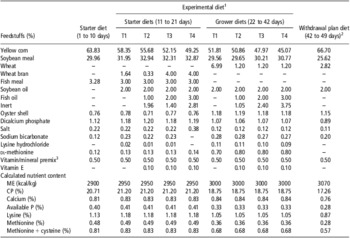
A total of 240 male Ross 308 broilers (one-day-old) were sexed and weighed before starting the trial from between 600 birds of both sexes, then were allocated to 16 pens (15 birds per pen) and fed a commercial diet for 10 days, a diet with added FO (0%, 1%, 2% and 3% FO, T1–T4, respectively) for 32 days and a withdrawal diet for 7 days. All diets were formulated using the user-friendly feed formulation (UFFDA) program (AFF16.ZIP, Stand-alone program for Windows) according to the National Research Council (NRC, 1994) guidelines. The birds had free access to water and feed. The composition and calculated nutrient contents of the experimental diets are shown in Table 1.
Composition and calculated nutrient contents of starter, growth and withdrawal diets in broilers

ME = metabolizable energy; FO = fish oil.
1T1 = 0% FO; T2 = 1% FO; T3 = 2% FO; and T4 = 3% FO.
2Remove oil for 1 week before slaughter (to decrease unacceptable odors).
3Each kg of premix contained: vitamin A, 9 000 000 IU; vitamin D3, 2 000 000 IU; vitamin B1, 1800 mg; vitamin B2, 6600 mg; vitamin B3, 10 000 mg; vitamin B6, 3000 mg; vitamin B12, 15 mg; vitamin E, 18 000 mg; vitamin K3, 2000 mg; vitamin B9, 1000 mg; vitamin B5, 30 000 mg; folic acid, 21 mg; nicotinic acid, 65 mg; biotin, 14 mg; choline chloride, 500 000 mg; Mn, 100 000 mg; Zn, 85 000 mg; Fe, 50 000 mg; Cu, 10 000 mg; I, 1000 mg; Se, 200 mg.
The mean BW, using the pen as the experimental unit at the beginning of the experiment (on day 11), was not significantly different (P > 0.05). At days 42 and 49, the birds and feed were weighed before and after withdrawal period (32 days and 1 week, respectively) and BW gain, feed intake and FCR were evaluated. FO (Clupeonella oil from fish of the Caspian Sea) was obtained from Iranian sources (Mehregan Khazer Co., Bander Abbass, Iran) and was stored at 4°C in a dry and dark place before being mixed with the other ingredients of diets.
On day 42, FO was withdrawn from the diets to avoid any organoleptic problems that might adversely affect the meat quality. All the birds were fed a commercial finisher diet beginning at this time. On days 42 and 49, two birds from each pen (8 birds per treatment) were randomly selected and weighed before being slaughtered. Blood samples were collected from the wing vein into vacuum tubes. Blood was collected into non-heparinized tubes by puncturing the brachial vein during 8 h using a standard procedure and was stored at −2°C. In a slaughterhouse, the head, neck, feet and abdominal fat were eviscerated and the carcass was air-chilled under similar conditions. Total breast and thigh tissues (excluding the skin), the spleen and the liver were stored in a freezer at −20°C until use.
Chemical analysis
Total lipids were extracted in the breast and thigh samples (1 g) using a ratio of 1 chloroform : 2 methanol (v : v) according to the method described by Folch et al. (Reference Folch, Lees and Sloane Stanley1957). The fatty acid methyl esters (FAMEs) were extracted in 0.5 ml of 3 × n-heptane, and 1 μL was injected into the gas chromatograph Dani GC 1000 DPC (Dani Instruments S.P.A., Cologno monzese, Italy) using helium as the carrier gas at a flow rate of 1.2 ml/min. Initial temperature was 75°C for 1 min, and this was followed by an increase of 30°C/min to a final temperature of 182°C, which held for 8 min at this temperature and then increased further to 200°C and held for 1 min. GC was equipped with a flame ionization detector, data processor (DS-1000, Dany), hydrogen generator (Glaind-2200, Italy) and a split–splitless injector on an Altech Econo-Cap, EC-1000 capillary column (30 m × 0.25 mm i.d., film thickness of 0.25 μm).
For the determination of blood FA, 1 ml concentrated sulfuric acid was added to 1 ml serum sample for digestion of proteins. After cooling the sample, 1 ml diethyl ether was added for extraction of fat twice. Diethyl ether phase was collected. After evaporation of the solvent, residual fat was weighed accurately for determination of total fat percentage. Then FAs were converted into FAMEs by adding 2 mL of 2 M KOH in dry methanol; FAMEs were then extracted in 1 mL of n-heptane, and 1 μL of n-heptane phase was injected into the gas chromatograph.
To measure high-density lipoprotein cholesterol (HDL-C), low- and very-low-density lipoprotein cholesterol (LDL-C and VLDL-C) levels, serum samples collected on days 42 and 49 were centrifuged at 5000 r.p.m. for 10 min and analyzed using an ALCYON-300, automated analyzer (ALCYON 300i; Abbott Laboratories, Abbott Park, IL, USA) according to fully enzymatic methods using commercial kits (Kone commercial kit, Japan).
Sensory quality evaluation of meat
Two consumer panel tests were carried out for the appropriate sensory evaluation of freshly cooked total breast and thigh tissues (42 and 49 days samples) with the skin stored at −20°C for 1 day (vacuum packed). Fifteen consumer panelists were used in both tests. They were selected from the department and all had experience in poultry meat sensory analysis. Criteria for selection were: age between 20 to 50 years, not allergic to chicken, consumption of chicken at least once per week and willingness to evaluate meat from chickens fed experimental diets. Vacuum-packed cooked chicken meat was served to the panelists by random 4-digit numbers in one session in a taste panel including flavor of the meat using a 5-point scale ranking (1 = very poor; 2 = poor; 3 = indifferent; 4 = acceptable; 5 = typical chicken flavor). The consumer panelists were also asked to rank the total acceptability of the product using a 9-point scale (1 = bad; 3 = acceptable; 6 = good; 9 = very good).
Calculation of n-3 FAs values of meat
In order to determine tissue LC n-3 PUFA contents of broilers fed enriched diets for providing daily human requirements according to the recommendations of the International Life Sciences Institute (1995), the EPA, DHA and total n-3 FAs contents of thighs, breast and liver tissues were calculated based on data presented in Figure 1 and also using recommendations of gas chromatography analyzer in the laboratory. FA values in terms of mg dry weight of sample are calculated as follows: The numbers reported for FAs in T1 to 0.38, in T2 to 0.46, in T3 to 0.51 and in T4 to 0.75 are multiplied. All calculated data are multiplied to the amount of required meat in terms of grams.
Effect of dietary FO on the amounts of EPA, DHA and total n-3 FAs in thigh (a), breast (b) and liver (c) tissues of broilers at 42 and 49 days of age. Broilers were fed identical starter (1 to 10 days) and withdrawal plan (42 to 49 days) diets without FO and experimental starter (11 to 21 days) and grower (4 to 6 weeks) diets after hatching. Each bar represents mean ± s.d. (n = 8). a–bBars with different letters are significantly different (P < 0.01). FA = fatty acid; FO = fish oil; EPA = eicosapentanoic acid, DHA = docosahexanoic acid.

Statistical analysis
All of the data (pen means) were analyzed using a completely randomized design and were subjected to ANOVA using the GLM procedures available in SAS (SAS Institute, 2001). To determine significant differences (P < 0.05), means were compared using the Least Significant Difference (LSD) method provided in the same statistical package. The sensory data (flavor and total acceptability of meat) were analyzed according to the methods described by Seemann (Reference Seemann1981). Data obtained by panelists (fifteen individuals per treatment) based on 5- and 9-point scales for flavor and total acceptability, respectively, were analyzed using a CRD design together with an LSD comparison of means. In addition, a paired Student's t-test was used to test the effect of withdrawal period via comparison of means within each dietary treatment (e.g. T1-42d v. T1-49d).
Results
Performance
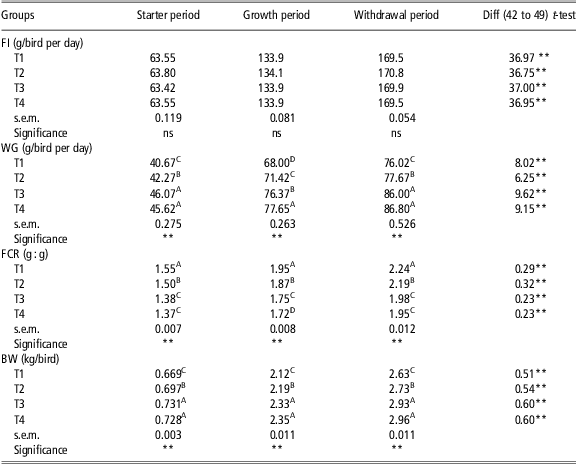
Growth performance during the 11 to 49-day period is shown in Table 2. FO supplementation of the diets significantly affected (P < 0.01) all parameters except feed intake. The T4 group demonstrated a higher BW with an optimal feed conversion on day 42 and even after 1 week withdrawal period of FO from the diet.
FI, weight gain feed conversion ratio and BW in the treatment groups and comparing results (day 42 v. day 49)Footnote 1Footnote 2
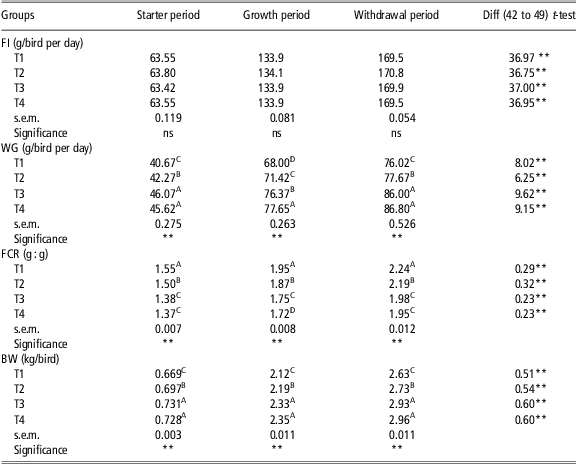
FI = feed intake; WG = weight gain; FCR = feed conversion ratio; FO = fish oil.
Values in the same row and variables with no common superscript differ significantly.
** P < 0.01.
1 Values represent the means of eight observations per treatment and their s.e.m.
2 T1 = 0% FO; T2 = 1% FO; T3 = 2% FO; and T4 = 3% FO.
Diet, serum and tissue FA compositions
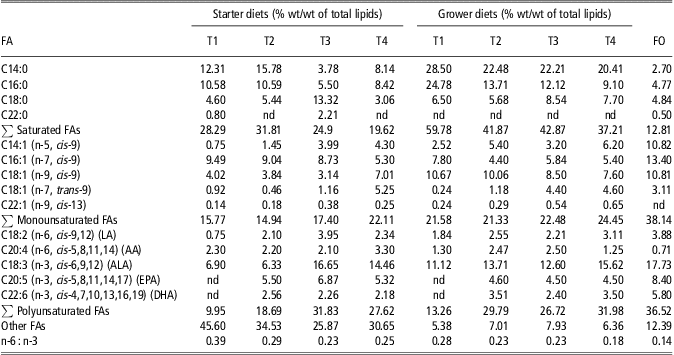
The FA profiles of the supplemental FO and experimental diets are shown in Table 3. FO contained 38.14% monounsaturated fatty acids (MUFAs), predominantly oleic acid (c9-18:1n9 = 26.84%), palmitoleic acid (c9-16:1n7 = 13.40%) and myristoleic acid (c9-14:1n5 = 10.82%), and 36.52% PUFAs, mainly linoleic acid (c9,12-18:2n-6, LA = 3.88%) and n-3 FA, predominantly linolenic acid (c6,9,12-18:3n-3, ALA = 17.73%) and LC n-3 PUFAs (c5,8,11,14,17-20:5n-3, EPA = 8.40% and c4,7,10,13,16,19-22:6n-3, DHA = 5.80%). The amount of AA (c5,8,11,14-20:4n-6, AA) was 0.71%, whereas its content was tripled in the experimental diets. The amount of total saturated fatty acids (SFA) in the FO was 12.81%, but its content in the diets was at least doubled. It is clearly shown in Table 3 that the diets supplemented with high FO did show lower n-6 : n-3 ratios.
FA composition of fish oil and experimental dietsFootnote 1
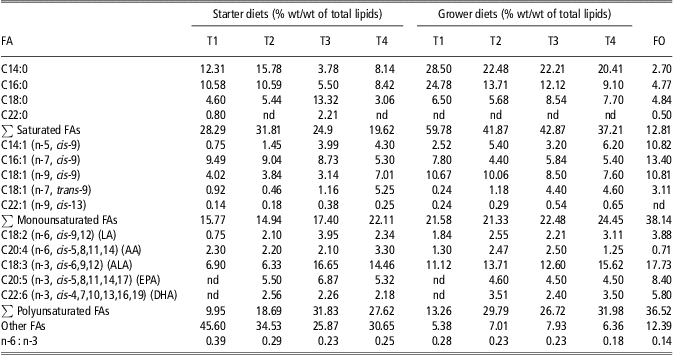
FA = fatty acids; FO = fish oil; LA = linoleic acid; AA = arachidonic acid; ALA = α-linolenic acid; EPA = eicosapentanoic acid; DHA = docosahexanoic acid.
1 Values represent the means of two determinations.
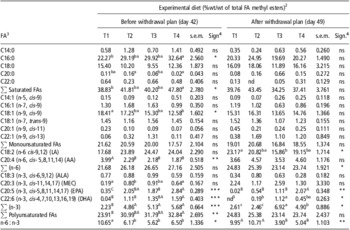
Data in Table 4 revealed that birds that received FO had higher values of total SFAs than the control group. Palmitic acid (iso-16:0, a predominant SFA) and oleic acid (c9-18:1n-9, a predominant MUFA) increased and decreased (P < 0.05), respectively, in broilers fed the FO diets (42 days) and their values did not differ significantly on day 49. The level of AA (C20:4, n-6) was decreased (P < 0.01) on day 42 and did not differ after the 1-week withdrawal period. The amount of LA, a predominant n-6 PUFA, was slightly increased on day 42, whereas it was decreased (P < 0.05) after withdrawal plan. Comparison of results before and after FO withdrawal by paired Student's t-test did reveal a significant change (P < 0.05) in the 2% FO group (T3-42d v. T3-49d, t-test = 8.611). Likewise, all LC n-3 PUFAs with high levels in the serum of day 42, were detected in blood samples of day 49 in significant amounts, especially in EPA and DHA (Table 4). However, treatments 2 and 3 showed significant differences only in the EPA content when comparing the results of days 42 and 49 (t-test = 1.506 and 0.768 for T2 and T3, respectively). Total n-3 and total PUFAs increased (P < 0.01) in day 42 samples. However, the amount of total n-3 and n-6 FAs in the blood decreased on day 49 P < 0.05, whereas the amount of total PUFA was slightly decreased. The difference observed from repeated measures was significant only in the 1% FO group (T2-42d v. T2-49d, t-test = 2.393). Meanwhile, the n-6 : n-3 ratio was decreased (P < 0.01) in birds that were fed diets supplemented with fish oil, or in those that received the withdrawal plan diets. The n-6 : n-3 ratio of T2-42d compared with T2-49d showed a significant difference (t-test = −4.541).
Serum FA composition of broilers fed dietary oils (day 42) and after the one-week withdrawal period (day 49)Footnote 1

FA = fatty acid; LA = linoleic acid; AA = arachidonic acid; ALA = α-linolenic acid; MEC = methyl eicosatrienoic; EPA = eicosapentanoic acid; DHA = docosahexanoic acid; FO = fish oil.
Values in the same row with no common superscript differ significantly.
1 Values represent the means of eight observations per treatment and their s.e.m.
2 T1 = 0% FO (control); T2 = 1% FO; T3 = 2% FO; T4 = 3% FO.
3 Other FAs that were not detected.
4 Sign. = *P < 0.05; **P < 0.001; ***P < 0.001.
It is clearly shown in Figure 1 (A = thigh, B = breast and C = liver tissues) that n-3 enrichment of diet with FO increased the amounts of total n-3 FAs, EPA and DHA. Liver had the highest values, followed by breast and thigh tissues. Although application of the withdrawal period in broilers fed FO in the last one week before slaughter – which is necessary to avoid off-flavors – significantly decreased the deposited amounts of these FAs in the tissue; however, the remaining levels of these derivatives in tissues could ensure n-3 enrichment of broiler meat. Comparison of data of days 42 and 49 from meat samples revealed that the 1-week withdrawal period significantly (P < 0.01) affected the EPA level in the liver of broilers fed the T1 diet (t-test = −6.287). Similarly, total n-3 level did show significant decreases in the breast and thigh of broilers fed the T4 diet, (t-test = −17.610 and −21.660, respectively).
Serum biochemical values and tissue sensory quality evaluation
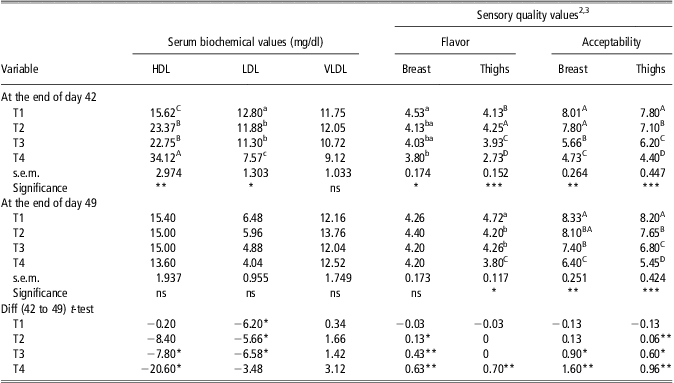
Serum biochemical and sensory quality values are shown in Table 5. Levels of HDL and LDL increased (P < 0.01) and decreased (P < 0.05), respectively, with administration of FO. However, values did not differ significantly after the 1-week withdrawal period. The t-test results revealed a significant (P < 0.05) decrease in LDL and HDL amounts of day 49 v. day 42. The VLDL concentration in both serum samples (42 and 49 days) did not differ.
Serum biochemical and sensory quality values in male broilers at days 42 and 49 and comparison of results (day 42 v. day 49)Footnote 1
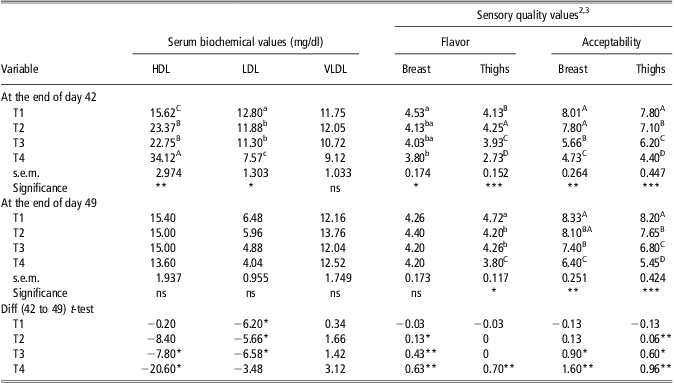
HDL = high-density lipoprotein; LDL = low-density lipoprotein; VLDL = very-low-density lipoprotein.
Values in the same row and variables with no common superscript differ significantly.
1 Values represent the means of eight and fifteen observations per treatment and their pooled s.e.m. for lipoprotein levels and the panel test, respectively.
2 Freshly cooked commercial chicken meat samples stored for 1 day at −20°C (vacuum packed) and added to the consumer test as a blinded control.
3 Consumers ranked the flavor of the meat using a 5-point scale and the acceptability of the meat using a 9-point scale (1 = bad; 3 = acceptable; 6 = good; 9 = very good).
T1 = 0% FO; T2 = 1% FO; T3 = 2% FO; and T4 = 3% FO.
ns = P > 0.05; * = P < 0.05; ** = P < 0.01; *** = P < 0.01.
Panelists presented some acceptable votes (flavor) for group 4 samples of day 42. The cooked breast meat of T4 showed optimal consumer acceptability, followed by T3 and T2 samples. Meanwhile, dissatisfaction was greater for cooked thighs with a level of significance established at P < 0.05 compared with breasts (P > 0.05); however, the unfavorable fishy smell was decreased in the cooked samples of day 49. Customer satisfaction improved (scored as good) after the 1-week withdrawal period especially in T2 samples and thigh meat. Comparison of data of days 42 and 49 revealed that the 1-week withdrawal period significantly (P < 0.01) increased the acceptability of meat. Following withdrawal planning, the average consumer acceptability ratings for treatments 3 and 4 with respect to breast meat demonstrated good scores, and for thigh meat they ranged from 5 to 7, which corresponded to a score of ‘do not like but acceptable’ to ‘good taste’.
Discussion
Growth performance
The good performance of FO-fed broilers in the current study may be related to the FA composition of the FO. Oil analyses of present study revealed that the FO-containing diets had higher levels of unsaturated FAs than control diet. It is demonstrated that the digestibility of fat increases with the degree of unsaturation (Farhoomand and Checaniazer, Reference Farhoomand and Checaniazer2009). FO has also been shown to reduce the catabolic response induced by immune stimulation and may be effective in promoting growth in broilers (Rymer and Givens, Reference Rymer and Givens2005). Furthermore, Farrell (Reference Farrell1995) stated that the removal of FO from the diets before slaughter had no effect on the performance results.
Serum and tissue FA compositions (42 v. 49 days)
In the current study, the high levels of FO and thereafter the diet's SFAs could be the main reason for the higher value of total SFAs in the blood of birds fed FO. On the other hand, the direct deposition of oleic and stearic acids from the diet to meat and their endogenous synthesis in the liver are two clear explanations for the presence of high levels of palmitic acid (iso-16:0, a predominant SFA) and low levels of oleic acid (c9-18:1n9, a predominant MUFA) in the serum of FO-fed birds. López-Ferrer et al. (Reference López-Ferrer, Baucells, Barrota and Grashorn1999) documented that the high palmitic acid (iso-16:0) content of tissues could account for the high levels of oleic acid in tissues, through elongation and desaturation. This hypothesis was confirmed in the current study by the decrease in the proportion of oleic acid in blood samples in response to diets containing higher FO levels. Cherian et al. (Reference Cherian, Wolfe and Sim1996) found similar results in broilers fed menhaden oil-enriched diets.
In the present study, the amounts of EPA, DHA and other n-3 series had the higher values in blood and tissue samples of birds fed FO (Table 4 and Figure 1). The circulating amounts of AA in serum samples in all treatment groups were lower than other predominant n-6 FAs (LA). The presented results are in agreement with results reported by Cherian et al. (Reference Cherian, Wolfe and Sim1996) and Kahraman et al. (Reference Kahraman, Özpinar, Abas, Kutay, Esenceli and Grashorn2004). López-Ferrer et al. (Reference López-Ferrer, Baucells, Barrota and Grashorn1999) reported that precursors of the n-3 and n-6 families linolenic acid (LNA and LA, respectively) were increased by diets containing FO, whereas AA decreased significantly. Bézard et al. (Reference Bézard, Blond, Bernard and Clouet1994) reported that the fundamental explanation related to the decreased level of AA in serum or tissues is the presence of EPA and DHA in the diet, which are capable of inhibiting n-3 elongation, n-6 FA desaturation and LA metabolism, which is also demonstrated in rats (Grønn et al., Reference Grønn, Christensen, Hagve and Christophersen1992). n-3 PUFAs, especially EPA and DHA, are substantial factors in this regard (James et al., Reference James, Gibson and Cleland2000; Das, Reference Das2006). EPA is the precursor for series 3 prostaglandins, many of which counteract the negative effects of AA series 2 prostaglandins. Hence, the consumption of n-3 series results in the accumulation of more n-3 and less n-6 in the body, which results in less inflammation in chicks (Korver and Klasing, Reference Korver and Klasing1997).
It is well established that FO will alter the n-6 to n-3 ratio (López-Ferrer et al., Reference López-Ferrer, Baucells, Barrota and Grashorn1999). In the present study, the n-6 : n-3 ratio of serum significantly decreased with the use of FO diets, followed by similar results on administration of the withdrawal plan diet. Diet supplementation with FO increased direct transfer of FAs by blood and the appropriate deposition in tissues. Consequently, the n-6 : n-3 ratio of both serum and meat decreased. On the basis of the results of this study, considering an applicable n-3 enrichment of meat is essential to achieve an optimally enriched meat of animal, which is one of the most important food source for humans. The current results showed that by implementation of the withdrawal plan for a period of 1 week before slaughter, fishy taints could be substantially removed from n-3-enriched meat; however, the levels of deposited n-3 FAs were reused somewhat by the birds (Figure 1).
Sensory quality evaluation of meat
In general, panelists of the current research commented that the thigh samples had more aftertaste compared with the chicken breast samples, which is likely explained by the greater occurrence of fat-associated flavor volatiles in dark meat (Betti et al., Reference Betti, Schneider, Wismer, Carney, Zuidhof and Renema2009). Therefore, the birds in group 3 presented the greatest advantages with respect to good flavor; however, thigh samples were not successful in achieving consumer satisfaction to good flavor compared with breast meat. With the increasing demands for valuable poultry products, the functional properties of meat have become a major industry concern (Barbut et al., Reference Barbut, Zhang and Marconne2005). Therefore, loss of flavor must be considered to assess the sensory quality of n-3 PUFAs-enriched products for commercialization. However, an optimization based solely on n-3 PUFA enrichment in chicken meat could lead to lower meat quality attributes.
Serum biochemical values
The presented findings showed that diets containing n-3 FAs decreased plasma LDL (bad-cholesterol) levels compared with those containing saturated FAs. Instead, the amount of HDL increased significantly. These differences could be due to alterations in the fluidity and composition of plasma cell walls (Newman et al., Reference Newman, Downing, Bryden, Fleck, Buttemer and Storlien1998). However, application of the 1-week withdrawal period in birds fed FO diets did not significantly affect lipoproteins. In recent studies, lipoproteins like LDL play a critical role in atherosclerosis and coronary heart disease have been demonstrated (Kris-Etherton et al., Reference Kris-Etherton, Hecker and Binkoski2004; López-Garcia et al., Reference López-Garcia, Schultze, Meigs, Manson, Rifai, Stampfer, Willett and Hu2005). It is documented that serum HDL level is capable of decreasing the negative effects of high blood cholesterol (Alparslan and Özdogan, Reference Alparslan and Özdogan2006). Crespo and Esteve-Garcia (Reference Crespo and Esteve-Garcia2003) reported that n-3 FAs reduce LDL and very LDL levels in the blood, the circulating free LDL concentration and the rate of triglyceride synthesis in the liver.
n-3 Enrichment of meat
For n-3 enrichment of broiler meat, adequate stability of the diet can be ensured with antioxidants and fortified vitamin E levels, for example 100 IU (relatively high levels can be used) in broiler diets (Zanini et al., Reference Zanini, Torres, Braganolo, Turatti, Silvia and Zanini2004). In the absence of such fortifications, the levels of EPA and DHA in the meat could be limited and off-flavors could occur (Wood et al., Reference Wood, Richardson, Nute, Fisher, Campo, Kasapidou, Sheard and Enser2004; Zuidhof et al., Reference Zuidhof, Betti, Korver, Hernandez, Schneider, Carney and Renema2009). Hence, FO diets of the current study were fortified by vitamin E. As mentioned previously, there are many ways of decreasing ‘fishy taints’ from n-3 enriched meats such as replacing vegetable origins rich in n-3 FA with FO in the diet, by overall planning or in combination with marine origin rich in n-3 and also by reinforcing n-3-enriched diets with antioxidants; however, it seems that the application of the 1-week withdrawal period before slaughter is one of the important factors in n-3 enrichment of meat without probable off-flavors.
Corresponding to the recommendations of the International Life Sciences Institute (1995) for daily human requirements for LC n-3 PUFAs, a serving of 200 g of meat (particularly brisket and thighs) from a broiler fed a 3% FO diet would provide ∼160 mg of EPA and 1100 mg of total n-3 FAs. In the present study, the EPA and DHA contents of 200 g of briskets and thighs of T3- and T4-fed broilers provided high-quality n-3-enriched meat. With regard to satisfaction of panelists regarding cooked samples of T3 (day 49), the breast and thigh meats of group 3 (2% FO) were selected as good sensory quality n-3-enriched meat. Serving 200 g of this meat could provide ∼286 and 100 mg of EPA, 194 and 52 mg of DHA and 1208 and 580 mg of total n-3 FAs, respectively.
Conclusion
In the current study, the transfer rate of FAs, especially LC n-3 series from the diets to the tissues, was lower in birds that received diets containing 1% FO compared with other FO groups and progressively decreased after the 1-week withdrawal period. Broilers fed on 2% FO did showed a better transfer and deposition rate of n-3 FA series in the meat via blood even when the amount of deposited n-3 FAs was reused during the 1-week oil withdrawal period. Therefore, it is concluded that the physiological mechanism of FA deposition (de novo synthesis in the liver and tissue enrichment of n-3 PUFAs) may be more efficient when FO is withdrawn from the diet to neuter sensory losses. In general, continuous improvement in the performance of male broiler chickens was obtained. Similarly, consumer satisfaction for n-3-enriched briskets and thighs was obtained. Corresponding to the sensory quality of animal products and the economic advantages of meat enrichment strategies for broiler chickens, inclusion of FO in the diet in acceptable levels (2% at the present study) and also applying a withdrawal design for 1 week before slaughter could offer healthy produce, as well as economic benefits to consumers and producers.
Acknowledgments
This study was supported in part by Bank Keshavarzi (Agricultural Bank), Tabriz Branch, Iran, and was carried out in the animal research farm of Islamic Azad University, Maragheh Branch, Maragheh, Iran. We would like to thank Prof. Dr Yunusemre Özkanlar from the Department of Internal Medicine, Faculty of Veterinary Medicine, Ataturk University, Erzurum, Turkey, for his scientific assistance; we are also grateful to Dr A.A. Matin and Dr A.M. Vatankhah for their valuable support in the experimental analyses.