Introduction
Microsporidia is a unique obligate intracellular pathogen. Microsporidia hosts are various and can infect invertebrates such as nematodes and insects, as well as vertebrates such as fish, mammals and even humans (Han and Weiss, Reference Han and Weiss2017; Pan et al., Reference Pan, Bao, Ma, Song, Han, Ran, Li and Zhou2018). Nosema bombycis, the pathogen of Bombyx mori, is the first identified microsporidia and causes pébrine disease in silkworms. However, more than 100 years after N. bombycis was identified, sericulture production has been plagued by pébrine. Currently, the prevention and control of pébrine still adopt the conventional method of strict disinfection of parasite and there is an urgent need for novel approaches (Smyk et al., Reference Smyk, Cienciala and Kosiek1952; Ishihara, Reference Ishihara1969; Wang et al., Reference Wang, Chambon, Lu, Huang, Vivares and Texier2007).
Hexokinase is an essential enzyme in the energy metabolism pathway of eukaryotes. Hexokinase of microsporidia was first reported in Nematocida parisii (Cuomo et al., Reference Cuomo, Desjardins, Bakowski, Goldberg, Ma, Becnel, Didier, Fan, Heiman, Levin, Young, Zeng and Troemel2012), and then researchers identified hexokinase in the secretory proteomics of N. Parisii, and hypothesized that it might be a secretory protein. Subsequently, it was found that the hexokinase of Paranosema locustae was secreted into the nucleus of host cells. In Trachipleistophora hominis, it was reported that hexokinase was localized on the surface of T. hominis and promoted the formation and aggregation of host ATP on its surface (Ferguson and Lucocq, Reference Ferguson and Lucocq2019). These results suggest that the glycolytic pathway may not only act as an adenosine triphosphate (ATP) production pathway in microsporidia, but also play a vital role in host modulation processes. In our previous study, it was found that N. bombycis hexokinase (NbHK) was a secretory protein located in the cytoplasm and nucleus of host cells. In the intracellular proliferation stage, the down-regulation of NbHK expression inhibited the proliferation of N. bombycis (Huang et al., Reference Huang, Zheng, Mei, Yu, Sun, Li, Wei, Chen, Li, Pan, Zhou and Li2018b), which means that NbHK participates in the energy metabolism of the host and becomes a potential target for the development of N. bombycis-resistant silkworm materials.
The single-chain antibody fragment (scFv) targeting pathogenically important proteins can inhibit pathogen infection to the host. The expression of anti-malarial parasite scFv in the salivary glands of Anopheles mosquitoes can effectively inhibit the growth of plasmodium in mosquitoes (Sumitani et al., Reference Sumitani, Kasashima, Yamamoto, Yagi, Yuda, Matsuoka and Yoshida2013), and the expression of a scFv against the plasmodium in Metarhizium anisopliae can both kill A. mosquitoes and block the transmission of malaria (Fang et al., Reference Fang, Vega-Rodriguez, Ghosh, Jacobs-Lorena, Kang and St Leger2011). In addition, studies have shown that the scFv targeting N. bombycis spore-wall protein can significantly inhibit the infection and proliferation of N. bombycis in silkworms (Huang et al., Reference Huang, Chen, Sun, Zheng, Li, Li, Tan, Wei, Pan, Li and Zhou2018a).
Ubiquitin pathway is a key component of selective protein degradation in eukaryotes and it participates in modulating the cell cycle, growth, apoptosis, metastasis, differentiation, gene expression, transcriptional modulation, signal transduction, injury repair, inflammation and immunity, and almost all life activities (Nandi et al., Reference Nandi, Tahiliani, Kumar and Chandu2006; Grumati and Dikic, Reference Grumati and Dikic2018). The result of protein ubiquitination is that the labeled protein is broken down by proteases into smaller polypeptides, amino acids, and ubiquitin that can be reused (Swatek and Komander, Reference Swatek and Komander2016). E3 ubiquitin ligase complex binds to the substrate during ubiquitination of eukaryotes, which is composed of polypeptides – Skp1, Cullin1/3, and Roc1/Rbx1 – and a fourth variable adapter, the F-box protein. The F-box protein determines the specificity of the substrate (Dui et al., Reference Dui, Lu, Ma and Jiao2012). Some research findings illustrate that, for many proteins, the first ubiquitin moiety is fused linearly to the α-NH2 group of the N-terminal residue (Ciechanover and Ben-Saadon, Reference Ciechanover and Ben-Saadon2004; Ciechanover, Reference Ciechanover2005). Slmb is an F-box protein of Drosophila, which performs various functions in development and cell physiology, and its F-box domain is located at the N-terminal of the protein. The fusion of N-terminal F-box domain of Slmb with single-chain antibody fragment can specifically degrade the target protein (Caussinus et al., Reference Caussinus, Kanca and Affolter2011).
In this study, we cloned two single-chain antibodies (scFv-7A and scFv-6H of NbHK), which were subsequently used to fuse with the N-terminal of Slmb (a Drosophila melanogaster FBP) containing an F-box domain (hereafter called NSlmb–scFv) for expression in insect cells. Further studies showed that the expression of NSlmb–scFv significantly inhibited the growth of N. bombycis in insect cells.
Materials and methods
Preparation of N. bombycis and cell cultivation
We acquired N. bombycis CQ1 mature spores (CVCC no. 102059) from the China Veterinary Culture Collection Center. The mature spores were fed on the fourth-instar silkworm for expanded culture, and the spores were separated and purified by percoll density gradient centrifugation (40 min, 21,000 g) at pupal stage for further use (He et al., Reference He, Luo, Xu, Wang, Meng, Pan, Li and Zhou2020). Sf9-III cells were cultured in Sf-900™ III SFM (Thermo Fisher Scientific, Santa Clara, CA, USA) at 28°C.
Monoclonal antibody preparation
In our previous studies, the constructed plasmid (pET-28-NbHK) expressing recombinant NbHK (rNbHK) proteins was transformed into Escherichia coli Rosetta that were then 0.5 mM isopropyl-β-d-thiogalactopyranoside in Lysogeny broth (LB) medium was employed to trigger recombinant protein expression (4 h) at 37°C. Nickel chelating affinity chromatography (Roche, Basel, Switzerland) was employed to purify the rNbHK protein. The Laboratory Animals Ethics Review Committee of Southwest University (Chongqing, China) approved the mice experiments (AERCSWU2017-7). Female BALB/c mice (6 to 8-weeks-old) were subcutaneously administered with purified rNbHK (100 μg per mouse) mixed with Freund's complete/incomplete adjuvant (1:1; Sigma, St. Louis, MO, USA) four times. The interval of injection was 7 days. The produced monoclonal antibodies (mAbs) were harvested and assessed as documented previously (Huang et al., Reference Huang, Chen, Sun, Zheng, Li, Li, Tan, Wei, Pan, Li and Zhou2018a). The mouse monoclonal antibody isotyping kit (Roche, Switzerland) was employed to assay the subtypes of mAb immunoglobulin G (IgG) as described by the manufacturer (Zheng et al., Reference Zheng, Huang, Huang, Yu, Zhou, Wei, Pan, Li and Zhou2021).
scFv sequence modifications
On the basis of the sequence assessment results, we designed primers for overlapping polymerase chain reaction (PCR). The 7A cloning of heavy-chain variable region was done with primer H7A-F: 5′-CTTCCGGAATTCSARGTNMAGCTGSAGSAGTCWGG-3′ and primer scVH7A-R: 5′-GGAAGATCTAGGGGCCAGTGGATAGACTGATGG-3′, whereas cloning of the light-chain variable region was performed with primer scVL7A-F: 5′-GAYATTGTGMTSACMCARWCTMCA-3′ and primer scVL7A-R: 5′-GGATACAGTTGGTGCAGCATC-3′. Primer H7A-F: 5′-ATGGACATTGTGCTCACCC-3′ and primer scVL7A-R1: 5′-GGAAGATCTCTTGACCAG-3′ were employed to connect the two variable regions via overlapping PCR, and with an insertion of a short polypeptide linker (G4S)3 between the two variable regions at this step. Similarly, cloning of the 6H heavy-chain variable region was done with primer H6H-F: 5-CTTCCGGAATTCSARGTNMAGCTGSAGSAGTCWGG-3 and primer scVH6H-R: 5′-GGAAGATCTCTTGACCAGGCATCCTAGAGTCA-3′, whereas cloning of the light-chain variable region was performed with primer scVL6H-F: 5′-GAYATTGTGMTSACMCARWCTMCA-3′ and primer scVL6H-R: 5′-GGATACAGTTGGTGCAGCATC-3′. Connection of these two variable regions was accomplished via overlapping PCR with primer H6H-F: 5′-ATGGACATTGTGCTCACCC-3′ and primer scVL6H-R1: 5′-GGAAGATCTAGGGGCCAG-3′. All primers in this study were synthesized by Shanghai Sangon Co, Ltd.
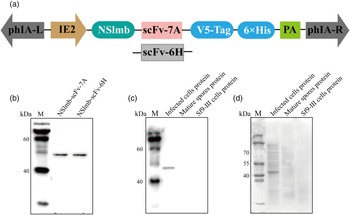
The cloned single-chain antibody sequences named scFv-7A and scFv-6H were individually inserted to the expression vector phIA-[IE2-NSlmb-V5-6 × His-PA], which was constructed in our laboratory based on pSL1180 plasmid for subsequent expression in Sf9 cells (fig. 1a).
Expression of fusion protein and analysis of NSlmb–scFv specificity. (a) Schematic diagram of the expression plasmids (NSlmb–scFv-7A or NSlmb–scFv-6H). (b) Detection of NSlmb–scFv expression in Sf9 cells. Total proteins from scFv-transfected Sf9-III cells were extracted and analyzed by western blotting with the V5 mAb being used as the primary antibody. (c) Verification of NSlmb–scFv-7A specificity. (d) Verification of NSlmb–scFv-6H specificity. Proteins extracted from the infected Sf9-III cells, mature spores, and healthy Sf9-III cells were subjected to western blot using NSlmb–scFv against NbHK. M: protein marker (Transgene, Shanghai, China).

Protein preparation
The plasmid constructs encoding NSlmb–scFv-7A and NSlmb–scFv-6H single-chain antibodies were individually transfected into Sf9 cells and at 48 h post transfection, glass-bead break methods were employed to prepare total proteins of the transfected cells as documented previously (Li et al., Reference Li, Pan, Li, Huang, Chen, Geng, Yang, Wang and Zhou2012). Briefly, RIPA lysis buffer (Beyotime, Shanghai, China) enriched with a protease inhibitor (phenylmethylsulfonyl fluoride) was employed to lyse the mixture of the harvested cells and 0.4 g glass beads (212–300 μm), and then a Bioprep-24 homogenizer (ALLSHENG, Hangzhou, China) was employed to crush the lysate for 5 min at 4°C. The treated samples were spun at 12,000 g for 5 min and the supernatant was aliquoted to a fresh tube. These samples were used to detect the expression of NSlmb–scFv.
In order to detect the specificity of NSlmb–scFv, the total protein of the Sf9 cell transfected with the recombinant plasmid was extracted using phosphate-buffered saline (PBS), so as to ensure the activity of the expressed NSlmb–scFvs.
The transfected cells were infected by N. bombycis mature spores (spore:cell = 10:1) at 48 h post transfection and cultured for additional 96 h. The total proteins from infected cells as well as untreated Sf9 control cells were prepared with the same method as descripted for the transfected cells. In order to detect the degradation of NbHK, the total protein of 96 h after mature spore infection was extracted. The transfected NSlmb–scFv-7A and NSlmb–scFv-6H recombinant plasmid Sf9 cells were used as the experimental group, and the transfected blank plasmid Sf9 cells were used as the control group.
Western blot analysis
Total proteins prepared from the Sf9 cells were fractionated on an SDS-PAGE gel. After that, the proteins were blotted onto poly(vinylidene fluoride) membranes (Roche, Switzerland). Subsequently, 5% dry milk in TBST (150 mM NaCl, 20 mM Tris-HCl, 0.05% Tween-20) was employed to block the membranes. Next, the membranes were inoculated with the anti-V5 mouse antibody (Sigma, Saint Louis, USA; 1:3000) and horseradish peroxidase (HRP)-conjugated goat anti-mouse IgG (Bio-Rad, Richmond, California, USA; 1:6000) sequentially with washing in between. Afterward, ECL Plus Western Blotting Detection Reagents (Bio-Rad, Richmond, California, USA) were employed to detect the bound antibodies. Specificity of NSlmb–scFv was assessed by the same western blot protocol except the NSlmb–scFv-7A or NSlmb–scFv-6H antibody, which was isolated from the transfected Sf9 cells, was used as the primary antibody.
To test the specificity of NSlmb–scFv, total cell proteins extracted with PBS, including the active NSlmb–scFv-7A or NSlmb–scFv-6H antibodies, were incubated with total spore proteins as primary antibodies. Then the V5 antibody and HRP-conjugated goat anti-mouse IgG were used to detect its mutual recognition with native NbHK protein.
In order to evaluate whether the expression of NSlmb–scFv antibody can effectively lead to the degradation of NbHK, we used the polyclonal antibodies against NbHK to detect its expression, and the β-tubulin of Sf9 cells as internal reference (Huang et al., Reference Huang, Zheng, Mei, Yu, Sun, Li, Wei, Chen, Li, Pan, Zhou and Li2018b).
Real-time quantitative PCR (RT-qPCR)
A DNA extraction kit (Omega, Norcross, GA, USA) was employed to isolate gDNAs of the control Sf9 cells or the cells transfected with single-chain antibodies or the cells transfected and then infected by mature spores. Nbβ-tubulin gene copy number was employed as an internal reference for the count of the N. bombycis. The gDNAs were analyzed by qPCR. The sequences of the primers were: Nbβ-tubulin-qF 5′-AGAACCAGGAACAATGGACG-3′ and Nbβ-tubulin-qR 5′-AGCCCAATTATTACCAGCACC-3′ and the real-time PCR reagent from Novoprotein Scientific Inc., Shanghai, China. The standard template was documented in previous investigation (Huang et al., Reference Huang, Chen, Sun, Zheng, Li, Li, Tan, Wei, Pan, Li and Zhou2018a). The standard curve covered six orders of magnitude (1.3 × 10²–107). The data were presented after normalization.
Results
Development of mAbs against NbHK
Purified rNbHK served as antigens to immunize BALB/c mice and screen hybridomas. We harvested splenocytes from the immunized BALB/c mice and polyethylene glycol 1500 was employed to fuse them with SP2/0 cells. The 7A subtypes were assessed using 7A hybridoma serum-free medium and the test strip confirmed that the subtype of 7A was IgG2b-κ. In the same method, 6H hybridoma serum-free medium was employed to detect the subtype of 6H and its subtype was confirmed as IgG2a-κ.
Construction of scFv and NSlmb–scFv-7A and NSlmb–scFv-6H plasmids
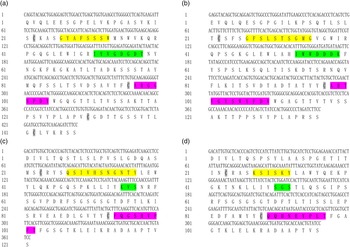
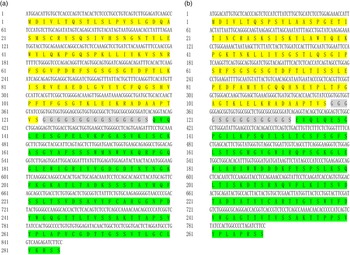
Degenerate primers selected according to 7A subtypes were employed to amplify the scFv-7A light-chain along with heavy-chain variable regions using 7A hybridoma cDNA as the template (fig. 2a, b). After that, we inserted these two amplicons into pMD19-T vector and subsequently sequenced using M13-F/R primers. The sequencing analysis confirmed that the incorporated variable region of 7A was cloned into the vector. Finally, on the basis of the sequencing data, we designed the primers of the subsequent overlap PCR, which was employed to connect the light-chain to the heavy-chain with (G4S)3 linkers (fig. 3a). The same steps were used to get scFv-6H (figs 2c, d and 3b).
Clone of scFv-7A and scFv-6H heavy-chain, light-chain variable regions. (a) scFv-7A light-chain variable region sequence. (b) scFv-7A heavy-chain variable region sequence. (c) scFv-6H light-chain variable region sequence. (d) scFv-6H heavy-chain variable region sequence. Gray, cysteine; yellow, complementarity-determining region (CDR)1; green, CDR2; pink, CDR3.

Construction of scFv-7A and scFv-6H. (a) Analysis of constructed scFv-7A sequence. (b) Analysis of constructed scFv-6H sequence. Yellow, light-chain variable region sequence; gray, (G4S)3 linker; green, heavy-chain variable region sequence.

Expression and specificity of NSlmb–scFv
The NSlmb–scFv recombinant plasmids were transfected into Sf9 cells. Western blot analysis showed that the fusion proteins NSlmb–scFv-7A and NSlmb–scFv-6H were successfully expressed based on the examination by western blot using V5 mAb as primary antibody (fig. 1b).
NbHK protein is secreted into host cells to hijack energy from host and typically cannot be detected in mature spore cell lysates (Huang et al., Reference Huang, Zheng, Mei, Yu, Sun, Li, Wei, Chen, Li, Pan, Zhou and Li2018b). In this part, western blotting data exhibited a unique positive band of NSlmb–scFv-7A and NSlmb–scFv-6H in the infected cell proteins. This band was approximately 50 kDa, which is equal to the molecular weight of the native form of NbHK (fig. 1c, d). The results indicated that the NSlmb–scFv-7A and NSlmb–scFv-6H could recognize native NbHK in infected cells protein.
Expression of NSlmb–scFv inhibited N. bombycis' proliferation
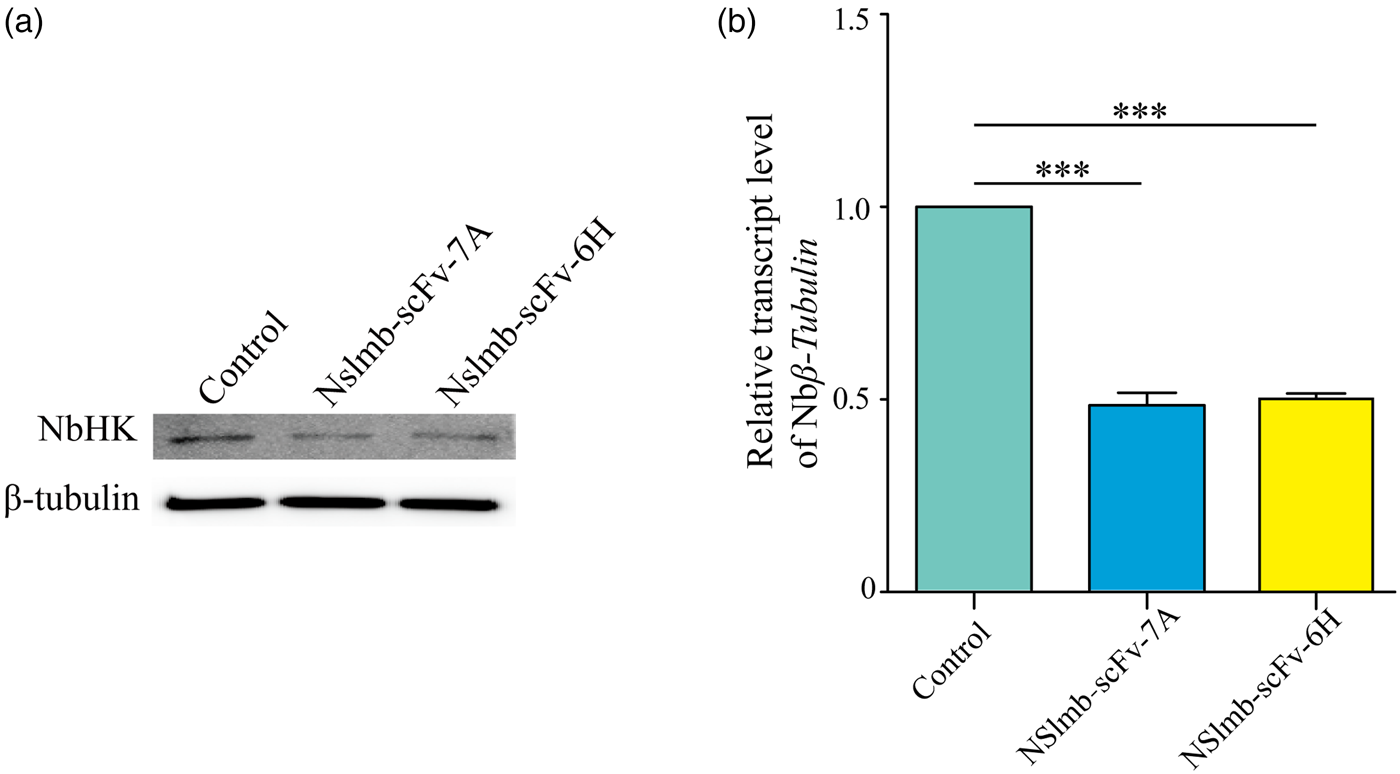
To access the functionality of expressed NSlmb–scFv proteins in Sf9 cells, the transfected cells were infected by mature spores. At 96 h post inoculation the cell lysates were prepared. First, we evaluated whether the expression of NSlmb–scFv antibodies can effectively result in NbHK degradation. For this purpose, the cell lysates prepared from the infected cells as well as the control cells were subjected to western blot using the polyclonal antibodies of NbHK as primary antibody. The result demonstrated that the protein expression level of NbHK was remarkably lowered in contrast to the control group, indicating that NbHK was partially degraded in the host (fig. 4a).
Effects of NSlmb–scFv-7A and NSlmb–scFv-6H expression on N. bombycis proliferation. (a) The detection of NbHK translation level. (b) Genomic DNAs were extracted from the Sf9 cells infected for 96 h with spores after transfection of the NSlmb–scFv-7A and NSlmb–scFv-6H recombinant plasmids. The relative transcription level of Nbβ-tubulin was quantified by real-time quantitative PCR and used as an indicator of parasite loads in Sf9 cells. Standard deviations in the bar graphs were from three independent replicates and two groups with significant differences were marked by asterisks (***P < 0.001).

To examine whether the expression of NSlmb–scFv antibodies can repress the proliferation of N. bombycis in insect cells, we quantified parasite loads based on the relative copy numbers of Nbβ-tubulin genes by real-time PCR (Huang et al., Reference Huang, Chen, Sun, Zheng, Li, Li, Tan, Wei, Pan, Li and Zhou2018a). As shown in fig. 4b, the parasite loads were significantly lowered in the cells transfected with NSlmb–scFv-7A or NSlmb–scFv-6H at 96 h post infection (fig. 4b), suggesting that NSlmb–scFvs can effectively repress the proliferation of N. bombycis in host cells.
Discussion
Energy metabolism is the most basic feature of the living body. By absorbing nutrients from the outside world, the organism carries out a series of complex decomposition and transformation in the body, releasing the energy contained in the nutrients to maintain life activities (Li et al., Reference Li, Pan, Li, Huang, Chen, Geng, Yang, Wang and Zhou2012; He et al., Reference He, Luo, Xu, Wang, Meng, Pan, Li and Zhou2020). As the eukaryotes with the smallest genome, microsporidia have lost several metabolic pathways, like tricarboxylic acid cycle, oxidative phosphorylation, and fatty acid β-oxidation, so does N. bombycis (Katinka et al., Reference Katinka, Duprat, Cornillot, Metenier, Thomarat, Prensier, Barbe, Peyretaillade, Brottier, Wincker, Delbac, El Alaoui, Peyret, Saurin, Gouy, Weissenbach and Vivares2001; Pan et al., Reference Pan, Xu, Li, Xia, Liu, Zhang, Li, Li, Liu, Yang, Liu, Zhang, Wu, Fan, Dang, Xiang, Tao, Li, Hu, Li, Lin, Luo, Geng, Wang, Long, Wan, He, Zhang, Lu, Keeling, Wang, Xiang and Zhou2013). Metabolism in the intracellular stages exhibit well adaption of microsporidia to parasitism. According to genome research, microsporidia have lost many genes compared with fungal relatives. So it has to adopt sophisticated strategies to survive in the host with the least payment. They can directly bind with host mitochondria, cluster ATP-delivering mitochondrial porin voltage-dependent anion channel (VDAC) and steal energy using plasma membrane-located nucleotide transporters (Hacker et al., Reference Hacker, Howell, Bhella and Lucocq2014; Heinz et al., Reference Heinz, Hacker, Dean, Mifsud, Goldberg, Williams, Nakjang, Gregory, Hirt, Lucocq, Kunji and Embley2014; Dean et al., Reference Dean, Hirt and Embley2016; Han et al., Reference Han, Ma, Tu, Tomita, Mayoral, Williams, Horta, Huang and Weiss2019). Molecules were secreted to regulate the host metabolism resulting in more rewards. Hexokinase of N. bombycis can be secreted to the cytoplasm and nucleus of host cell during intracellular stages (Huang et al., Reference Huang, Zheng, Mei, Yu, Sun, Li, Wei, Chen, Li, Pan, Zhou and Li2018b). Microsporidia do not have typical mitochondria, but instead only have a highly reduced mitochondrial structure, called mitosome (Shiflett and Johnson, Reference Shiflett and Johnson2010), suggesting that microsporidia may not have a complete oxidative phosphorylation pathway. The microsporidia genome is so simplified that it lacks many of the genes necessary for energy metabolism (Weidner et al., Reference Weidner, Canning, Rutledge and Meek1999; Williams et al., Reference Williams, Hirt, Lucocq and Embley2002; Embley and Martin, Reference Embley and Martin2006). However, it is interesting that hexokinase is retained in all the species of microsporidia investigated, indicating its importance in the evolutionary process (Nakjang et al., Reference Nakjang, Williams, Heinz, Watson, Foster, Sendra, Heaps, Hirt and Martin Embley2013).
Expression of single-chain antibodies is a promising approach of breeding N. bombycis-resistant silkworms, because single-chain antibodies can directly neutralize proteins of intracellular pathogens. In Anopheles, transposon-mediated transformation was employed in generating m2A10, m1C3, and m4B7 single-chain antibodies, and the transgenic mosquitoes expressing the scFv gene had remarkably lower infection levels of Plasmodium falciparum (Isaacs et al., Reference Isaacs, Li, Jasinskiene, Chen, Nirmala, Marinotti, Vinetz and James2011, Reference Isaacs, Jasinskiene, Tretiakov, Thiery, Zettor, Bourgouin and James2012). Based on successful attempts in Plasmodium, our lab also tried to use these methods to antagonize N. bombycis. We generated mAb scFv-G4 targeting SWP12, the first identified Bin/Amphiphysin/Rvs domain-containing protein which may function in membrane structure formation (Chen et al., Reference Chen, Geng, Long, Li, Li, Yang, Ma, Wu, Ma, Li, Pan and Zhou2013; Huang et al., Reference Huang, Chen, Sun, Zheng, Li, Li, Tan, Wei, Pan, Li and Zhou2018a). In vitro assay suggested that, the transgenic Sf9-III cell line expressing scFv-G4 showed better resistance relative to the controls when infected by N. bombycis (Chen et al., Reference Chen, Geng, Long, Li, Li, Yang, Ma, Wu, Ma, Li, Pan and Zhou2013). As single-chain antibodies directly affect protein function of N. bombycis, this strategy will play important role in breeding of resistant strains.
Ubiquitin degradation mechanism in eukaryotes can degrade some waste proteins and foreign proteins in vivo (Ciechanover and Ben-Saadon, Reference Ciechanover and Ben-Saadon2004; Nandi et al., Reference Nandi, Tahiliani, Kumar and Chandu2006), but this degradation mechanism does not have high specificity. Recent studies have found that the nanobody in fusion with the F-box domain of E3 ligase in the ubiquitination degradation system can lead to the degradation of the recognized target protein (Zhang et al., Reference Zhang, Zheng and Zhou2003; Wang et al., Reference Wang, Tang, Lara-Gonzalez, Zhao, Cheerambathur, Prevo, Chisholm, Desai and Oegema2017). Herein, two single-chain antibodies targeting NbHK were developed and were later used to fuse with NSlmb to direct specific degradation of NbHK proteins in insect cells. When the insect cells expressing such antibodies were infected by N. bombycis, the secreted NbHK proteins derived from the parasites were partially degraded by the expressed fusion antibody and therefore hinder parasite to hijack energy from the host cells, resulting in proliferation inhibition of N. bombycis.
Conclusions
In the present study, we constructed an NbHK single-chain antibody-guided ubiquitination system, which can specifically target NbHK protein produced by N. bombycis during infection and degrade it. It was also confirmed that this method could significantly inhibit the proliferation of N. bombycis in the host. Our research represents a novel strategy of creating N. bombycis resistant silkworm strains when combined with additional genetic manipulation techniques.
Acknowledgements
This research was funded by the National Natural Science Foundation of China (Grant number: 32072793) and the Fundamental Research Funds for the Central Universities to Southwest University (XDJK2018AA001).
Conflict of interest
The authors declare no conflict of interest.