




No CrossRef data available.
Article contents
Relationship of affect recognition with psychopathology and cognitive performance in schizophrenia
Published online by Cambridge University Press: 01 July 2004
Abstract
The purpose of the present study was to explore the relationship between emotion perception and both psychopathology and cognitive functioning in a group of Greek patients with schizophrenia. Thirty-five patients with schizophrenia were assessed with computerized tests of emotion perception, using visual faces (Kinney's Affect Matching Test, KAMT), prosody (Affective Prosody Test, APT), and visual everyday scenarios (Fantie's Cartoon Test, FCT), as well as a facial recognition test (Kinney's Identity Matching Test, KIMT). The patients were also evaluated with the symptoms dimensions derived from the PANSS (positive, negative, cognitive, depression, and excitement) and a battery of neuropsychological tests measuring executive functions, attention, working memory, verbal and visual memory, visuospatial ability, and visual scanning/psychomotor speed. The three emotion perception and face recognition tests correlated significantly with each other. The KAMT was significantly related to the cognitive symptoms dimension of the PANSS and executive functions. The FCT was significantly related to level of education and attention. Finally, the APT was significantly related to the cognitive symptoms dimension, executive functions, and attention. Our findings regarding the significant relationships of affect perception, both facial and vocal, as well as in everyday scenarios, with several cognitive abilities support the notion that deficits in decoding affective information in schizophrenia could be attributed to impairment in more basic neurocognitive domains. (JINS, 2004, 10, 549–558.)
Keywords
Information
- Type
- Research Article
- Information
- Journal of the International Neuropsychological Society , Volume 10 , Issue 4 , July 2004 , pp. 549 - 558
- Copyright
- 2004 The International Neuropsychological Society
INTRODUCTION
Affect perception refers to the ability to accurately perceive, interpret and process emotional expressions in others (Green et al., 2000). Despite some subtle cross-cultural differences, emotion perception is generally consistent throughout cultures (Green, 2001). The ability to perceive emotions in others is a component of social cognition (Penn et al., 1997), which is a construct expressing the operation of neurocognitive abilities within social and interpersonal situations (Green, 2001). Patients with schizophrenia are less accurate in the recognition of both facial and vocal expressions of emotions (Green, 2001; Green et al., 2000). In these patients, such deficits appear to contribute to impaired social relations (Hooker & Park, 2002; Mueser et al., 1996; Penn et al., 1996; Poole et al., 2000).
In a recent review of the literature addressing the ability of patients with schizophrenia to decode universally recognised facial expressions of emotions, the authors concluded that patients were impaired relative to healthy individuals, especially with respect to negative emotions (Mandal et al., 1998). Subsequent studies have found similar results (Addington & Addington, 1998; Edwards et al., 2001; Hooker & Park, 2002; Kohler et al., 2000; Kosmidis et al., 2003; Shaw et al., 1999), regardless of differences in cultural background (Habel et al., 2000). An ongoing controversy regarding deficits in facial affect perception in schizophrenia is whether this is a specific deficit restricted only to facial expressions of emotions (Borod et al., 1993; Edwards et al., 2001; Gaebel & Wolwer, 1992; Heimberg et al., 1992; Kosmidis et al., 2003; Poole et al., 2000; Shaw et al., 1999; Walker et al., 1986), or whether it arises from a generalized impairment in perceptual processing of faces (Addington & Addington, 1998; Archer et al., 1992; Baudouin et al., 2002; Feinberg et al., 1986; Hooker & Park, 2002; Kerr & Neale, 1993; Kohler et al., 2000; Salem et al., 1996; Schneider et al., 1995). Recognition of affective prosody in patients with schizophrenia is also significantly poorer than in healthy individuals (Edwards et al., 2001; Hooker & Park, 2002; Kerr & Neale, 1993; Leentjens et al., 1998; Ross et al., 2001; Shaw et al., 1999).
Many studies have investigated cerebral involvement in affect perception. In general, these studies have implicated the amygdala. Bilateral lesions of the amygdala disrupt the recognition of the emotional states of others, facial expressions of emotion and vocal affect (Johnsrude, 2002). More specifically, the attribution of negative valence to unpleasant visual stimuli in normal subjects involved increased activity in the left amygdala (Lane et al., 1997; Paradiso et al., 1999). Detection of pleasant stimuli displayed increased activity in bilateral inferior, medial, and orbital prefrontal cortices (Paradiso et al., 1999). In contrast, Lane et al. (1997) found that there was considerable overlap in the other, except left amygdala, neural correlates of both pleasant and unpleasant emotion, namely the prefrontal cortex, midbrain, thalamus, and hypothalamus. Overall, two neural systems have been suggested as the basis of normal emotion perception (Philips et al., 2003a). The ventral system, including the amygdala, insula, ventral striatum, and ventral regions of the anterior cingulate gyrus and prefrontal cortex, is important for the identification of the emotional significance of environmental stimuli and the production of affective states. It is additionally important for automatic regulation and mediation of automatic regulation of autonomic responses to emotive stimuli and contexts accompanying the production of affective states. The dorsal system, including the hippocampus and dorsal regions of the anterior cingulate gyrus and prefrontal cortex, regions where cognitive processes are integrated with, and can be biased by, emotional input, is important for the performance of executive functions, including selective attention, planning, and effortful rather than automatic regulation of affective states. Finally, a reciprocal functional relationship between these two neural systems exists. Findings regarding patients with schizophrenia have been contradictory. Patients have been reported to exhibit less (Schneider et al., 1998), right (Streit et al., 2001) or left (Gur et al., 2002), greater (Kosaka et al., 2002) or no difference (Taylor et al., 2002) in activation of the amygdala as compared with normal controls during the processing of emotional material. Less activation in distributed brain regions, including bilateral inferior prefrontal, left orbitofrontal, and left anterior cingulate cortices during facial affect recognition was reported in patients as compared with normal controls (Streit et al., 2001).
In a brief review of investigations (studies of brain damaged patients and brain functional neuroimaging of healthy individuals), Adolphs et al. (2002) explored the neural structures by which humans recognize emotion from prosody. They concluded that recognition of emotional prosody draws on distributed and bihemispheric structures with right inferior frontal regions being the most critical component of the system, working together with more posterior regions in the right hemisphere (anterior parietal cortex), the left frontal regions, and subcortical structures (i.e., basal ganglia, amygdala), all interconnected by white matter. No studies addressing the identification of brain mechanisms underlying vocal affect recognition deficits in schizophrenia were found in the literature.
There is some evidence that suggests that deficits in the perception of facial and vocal affect in schizophrenia could be attributed to impairment in more basic neurocognitive abilities (Green et al., 2000). Performance on a facial emotion discrimination test was found to be related to abstract thinking, memory (verbal and spatial), language abilities (Kohler et al., 2000; Schneider et al., 1995) and attention/vigilance (Addington & Addington, 1998; Kohler et al., 2000; Schneider et al., 1995). Facial emotion identification was related to abstract thinking as well as attention/vigilance and/or attention/rapid visual processing (Addington & Addington, 1998; Bryson et al., 1997; Kee et al., 1998a; Penn et al., 1996; Poole et al., 2000). Also, facial emotion identification has been found to exhibit a significant relationship with performance on visual immediate recall and motor speed (Silver & Shlomo, 2001). Similarly, vocal affect recognition errors were associated with deficits on attention/rapid visual processing (Kee et al., 1998a). On the other hand, there is also evidence for the relative independence of social cognition, including facial affect recognition, from other aspects of cognition (Pinkham et al., 2003). These findings suggest that impairment in specific neural modules, devoted to the processing of social information, underlie affect perception deficits in schizophrenia.
Specific positive symptoms, including persecutory delusions, and specific negative symptoms, including emotional flattening and anhedonia, evident in patients with schizophrenia, were proposed to be related to impaired recognition of emotion (Philips et al., 2003b). However, although several studies have examined the relationship between impaired affect perception and a particular subset of symptoms of schizophrenia, no conclusive patterns have emerged. The use of different symptom rating scales (i.e., BPRS, SAPS, SANS, and PANSS), as well as differences in sample recruitment (chronic inpatients, acute inpatients, and outpatients) may contribute to the inconsistencies reported in the literature. Severity of negative symptoms in schizophrenia has shown a strong relationship with performance on facial emotion discrimination tests (Baudouin et al., 2002; Schneider et al., 1995) and facial emotion identification tests (Mueser et al., 1996). Only the alogia factor of the SANS was related to impaired affect perception (Gaebel & Wolwer, 1992; Kohler et al., 2000). In one study, facial and vocal emotion identification was related only to positive symptoms (Kee et al., 1998b). In another study, performance on facial emotion discrimination was correlated with a factor consisting of the positive symptoms of attention, bizarre behavior, and thought disorder (Schneider et al., 1995), while in yet another study, facial emotion discrimination was correlated with the positive symptoms of hallucinations and thought disorder (Kohler et al., 2000). In contrast, other investigations found no association between either negative or positive symptoms and perception of facial emotion (Borod et al., 1993; Edwards et al., 2001; Lewis & Garver, 1995; Salem et al., 1996; Silver and Shlomo, 2001) and prosody (Edwards et al., 2001; Ross et al., 2001), and between facial and vocal emotion identification and negative symptoms (Shaw et al., 1999). Finally, Addington and Addington (1998) reported that facial affect identification seems to be a stable deficit that does not improve with either positive or negative symptoms.
The purpose of the present study was to explore the relationship between emotion perception and both psychopathology and cognitive functioning in a group of Greek patients with schizophrenia. We undertook this investigation since studies using an extensive neuropsychological battery, which might yield a more detailed picture of any putative relationship, are sparse in the literature. We hypothesized that problems in the perception of facial and vocal affect in schizophrenia could be attributed to impairment in more basic neurocognitive abilities, especially attention and executive functions. Secondly, we sought to investigate the potential relationship between clinical symptoms and deficits in emotion perception.
METHODS
Patients
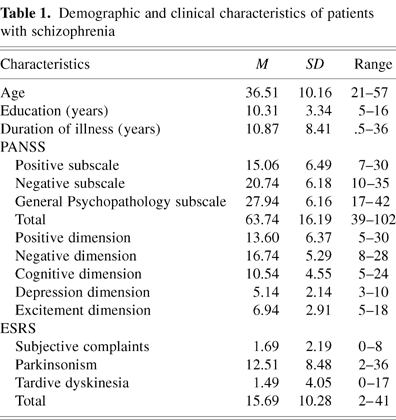
Participants were 35 patients with schizophrenia living in the community: 21 men (60%) and 14 women (40%), whose mean age was 36.51 years (SD: 10.16, range: 21–57). They had a mean of 10.31 years of education (SD: 3.34, range: 5–16). All gave their consent to participate in this study. Patients with schizophrenia were recruited from the acute ward (9 inpatients; evaluation of these patients was performed after achieving sufficient symptom remission and shortly before discharge) and the outpatient service of a university psychiatric department (26 outpatients), established in a state psychiatric hospital (Psychiatric Hospital of Thessaloniki). All patients were diagnosed according to DSM–IV criteria (American Psychiatric Association, 1994). Diagnosis was confirmed with the Greek version (translation–adaptation to the Greek language by S. Beratis) of the Mini International Neuropsychiatric Interview (4.4; MINI; Sheehan et al., 1998). Ten patients had schizophrenia of the paranoid type, 8 of the undifferentiated type, and 17 of the residual type. Their mean duration of illness was 10.87 years (SD: 8.41, range: 0.5–36). All of the patients were receiving antipsychotic medication at the time of the study: 28 of them atypical antipsychotics, 2 typical antipsychotics, 1 a combination of atypical and typical antipsychotics, and 4 a combination of two atypical antipsychotics. Anticholinergic drugs were administered to 15 patients.
Exclusion criteria were the following: non-native speakers of the Greek language, a history of neurological or developmental disorders, head injury with loss of consciousness for more than 10 min, current substance abuse (in the last 6 months), as well as a comorbid psychiatric disorder, or a medical disorder which may compromise cognitive performance.
We assessed symptom severity (positive symptoms, negative symptoms, and general psychopathology) of the patients with schizophrenia with the Greek version (Lykouras et al., 1994) of the Positive and Negative Syndrome Scale (PANSS; Kay et al., 1987). The five dimensions of schizophrenia psychopathology were also calculated (according to the five-factor model resulting from a principal components analysis of the scores of a large sample of Greek patients with schizophrenia): positive (delusions, hallucinatory behavior, grandiosity, suspiciousness, and unusual thought content), negative (blunted affect, emotional withdrawal, poor rapport, passive withdrawal, lack of spontaneity, and motor retardation), excitement (excitement, hostility, tension, uncooperativeness, and poor impulse control), depression (anxiety, guilt feelings, and depression) and cognitive impairment (difficulty in abstract thinking, stereotyped thinking, conceptual disorganization, disorientation, and poor attention) (Lykouras et al., 2000). Rating of the PANSS was based on the Greek version (Lykouras et al., 1994) of the Structured Clinical Interview for PANSS (SCI-PANSS; Opler et al., 1992) and while blind to neuropsychological performance. Extrapyramidal symptoms were assessed with the Extrapyramidal Symptom Rating Scale (ESRS; Chouinard et al., 1980), based on the clinical examination proposed by Owens (1999).
Table 1 provides means, standard deviations, and minimum and maximum scores for demographic and clinical characteristics of the patients with schizophrenia who participated in this study.
Demographic and clinical characteristics of patients with schizophrenia

Affect Tasks
Kinney's Affect Matching Test (KAMT)
In this computerized test, every stimulus consists of four photographs, one target and three others from which to choose the photograph that matches the target according to the emotional facial expression (Kinney, 1995; Kinney et al., 1995).
Fantie's Cartoon Test (FCT)
This computerized test (Fantie, 1989) comprises 57 drawings; each one depicts an everyday scenario with one or more people, and in each item the face of one person is missing. On each item, there is a series of seven photographs depicting the basic emotions (happiness, sadness, surprise, fear, anger, disgust, as well as neutral) expression. The participants were asked to indicate the photograph depicting the emotional expression which best fit the missing face.
Affective Prosody Test (APT)
In this test (Hiou et al., in press) the stimuli were 30 audio-recorded sentences of emotionally neutral content (e.g., “Today is Wednesday”), each read with intonation portraying one of the basic emotions (happiness, sadness, surprise, fear, and anger, as well as a neutral expression) expression with five items per emotion, spoken by a male actor. The participants were given a written list of the six emotions and made their choice after hearing each sentence.
Neuropsychological Tests
A battery of neuropsychological tests was administered in order to assess executive functions/abstraction, fluency, verbal and spatial working memory, verbal and visual memory, attention, visuospatial ability, and visual scanning/psychomotor speed (Table 2). Neuropsychological tests were chosen with the intention of evaluating basic cognitive abilities. Some were specifically included because they have been found to be sensitive to deficits in frontal, temporal, or parietal cortical areas. These tests were administered and scored by trained psychologists.
Neuropsychological tests

Executive functions
Assessment of executive functions included the Wisconsin Card Sorting Test (WCST; Heaton et al., 1993), the Stroop Color-Word Test (Stroop, 1935), and the Trail Making Test Part B (Reitan, 1958; for Greek norms, see Vlahou & Kosmidis, 2002). For the purposes of the present study, we investigated the number of categories achieved and the number of perseverative errors made on the WCST. The variable of interest on the Stroop Color-Word Test was the number of incongruent color words read. The Trail Making Test Part B was measured in terms of time to completion (in seconds).
Working memory
Verbal and visual working memory was assessed with the Digit Span backward, a subtest of the Wechsler Adult Intelligence Scale–III (WAIS–III, Wechsler, 1997a), and the Spatial Span backward, a subtest of the Wechsler Memory Scale–III (WMS–III, Wechsler, 1997b), respectively. Variables were the raw scores on each test.
Memory
Verbal memory was measured with a Greek Word List Learning Test (WLLT) (Folia & Kosmidis, 2003), based on the California Verbal Learning Test (Delis et al., 1987). Variables that were included were: immediate free and cued recall, delayed free and cued recall, and recognition. The Rey-Osterrieth Complex Figure Test (ROCFT; Taylor, 1959) was used to assess visual memory: immediate and delayed recall, and recognition. Drawings were scored based on the correctness and placement of each component of the figure drawn (Taylor scoring system).
Fluency
Assessment of fluency included the Design Fluency Test (Jones-Gotman & Milner, 1977) and the Greek Verbal Fluency Test (Kosmidis et al., 2004). The Design Fluency Test consisted of two parts. In the first one, examinees were asked to draw as many different abstract designs as possible in 5 min, and in the second part, to produce as many different abstract designs as possible using four lines in 4 min. The score was the total number of acceptable designs in both conditions. The Greek Verbal Fluency Test consisted of two parts: semantic and phonological. On the semantic part (categories), we asked participants to generate as many different animals, fruits, and objects as possible, each in 60 sec. On the phonological part (letters), we asked participants to generate as many words as possible beginning with the Greek letters “χ” (chi), “σ” (sigma), and “α” (alpha), each in 60 s, excluding proper nouns and variations of the same word. Variables included in the present analyses were the total numbers of words produced on the semantic test and the total number of words produced on the phonological test.
Attention
Auditory attention was assessed by the WAIS–III Digit Span forward (Wechsler, 1997a), and visual attention by the WMS–III Spatial Span forward (Wechsler, 1997b). Sustained attention was measured by a computerized task, Penn's Continuous Performance Test (PCPT) (Kurtz et al., 2001). An efficiency measure (i.e., the ratio of number of correct responses per unit time for each participant, calculated by dividing the number of true positives by the average reaction time on correct responses) was used as an index of performance.
Visuospatial skills
This was assessed with the ROCFT, copy condition (Taylor, 1959), and the Hooper Visual Organization Test (HVOT; Hooper, 1957). The latter requires mental rotation of fragmented drawings of common objects. On the ROCFT we scored the correctness and placement of each component of the figure copied, yielding an overall score; on the HVOT, we calculated the number of correct responses.
Visual scanning/psychomotor speed
Speed of performance was assessed with the Trail Making Test Part A (Reitan, 1958; Vlahou & Kosmidis, 2002), which is an index of visual scanning and psychomotor speed.
Kinney's Identity Matching Test (KIMT)
Finally, a computerized test assessing facial processing was administered. In Kinney's Identity Matching Test (KIMT) every stimulus consists of four photographs, one target and three others from which to choose the photograph that matches the target according to the identity of the pictured individual (Kinney, 1995; Kinney et al., 1995).
Statistical Analyses
We calculated z scores for each neuropsychological test for the sample as a whole, then calculated the average of all tests in each cognitive domain: executive functions, attention, fluency, verbal memory, visual memory, working memory, visuospatial skills, and psychomotor speed. We investigated correlations among affect, cognitive, demographic, and clinical/psychopathology variables with two-way Pearson coefficients. We used two-way Spearman correlation coefficients only to investigate the relationship between affect recognition and sex. Due to the large number of correlations, we used the Bonferroni correction procedure (dividing the alpha level by the number of bivariate correlations) in order to make our criterion of significance more conservative.
RESULTS
Intercorrelations among affect recognition measures are presented in Table 3. The KAMT was significantly related with the KIMT [r(34) = .59, p < .001], the FCT [r(34) = .53, p = .001], and the APT [r(34) = .52, p = .001]. The FCT was significantly correlated with the KIMT [r(34) = .51, p = .001] and the APT [r(34) = .56, p < .001]. The APT was significantly related with the KIMT [r(34) = .54, p < .001].
Correlations among measures of affect recognition

Correlations among measures of facial identity recognition, facial and vocal affect recognition and demographic characteristics are presented in Table 4. The KAMT was significantly correlated with level of education [r(34) = .46, p = .007] and duration of illness [r(34) = −.40, p = .019]. The FCT was significantly related with level of education [r(34) = .51, p = .002], whereas the APT was significantly correlated with level of education [r(35) = .34, p = .044] and sex [r(35) = .36, p = .034]. After Bonferroni correction (.05/16 = .00325), only the relationship between the FCT and level of education remained significant.
Correlations among measures of facial and vocal affect recognition and demographic characteristics

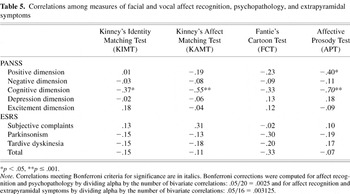
Relationships between measures of facial identity recognition, facial and vocal affect recognition, symptom dimensions and extrapyramidal symptoms are shown in Table 5. The cognitive symptom dimension was significantly related with the KIMT [r(34) = −.37, p = .032], the KAMT [r(34) = −.55, p = .001], and the APT [r(35) = −.70, p < .001]. Positive symptoms were significantly related with the APT [r(35) = −.40, p = .017]. After Bonferroni correction (.05/20 = .0025), only correlations of the cognitive symptoms dimension with the KAMT and the APT remained significant. There were not significant relationships between the KIMT, KAMT, as well as APT and measures of extrapyramidal symptoms.
Correlations among measures of facial and vocal affect recognition, psychopathology, and extrapyramidal symptoms

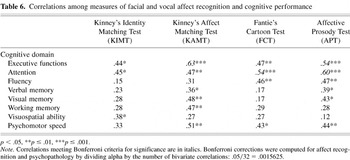
Regarding correlations among measures of facial identity recognition, facial and vocal affect recognition and cognitive domains (Table 6), the KIMT was significantly related with executive functions [r(31) = .44, p = .014], attention [r(33) = .45, p = .009], and visuospatial ability [r(34) = .38, p = .025]. The KAMT was significantly correlated with executive functions [r(31) = .63, p < .001], attention [r(33) = .47, p = .006], verbal memory [r(34) = .36, p = .037], visual memory [r(33) = .48, p = .005], working memory [r(33) = .47, p = .006], and visual scanning/psychomotor speed [r(33) = .51, p = .002]. The FCT was significantly related with executive functions [r(31) = .47, p = .007], attention [r(33) = .54, p = .001], fluency [r(31) = .46, p = .009], and visual scanning/psychomotor speed [r(33) = .43, p = .013]. Finally, the APT was significantly correlated with executive functions [r(32) = .54, p = .001], attention [r(34) = .60, p < .001], fluency [r(32) = .47, p = .007], verbal memory [r(35) = .39, p = .02], visual memory [r(34) = .43, p = .011], and visual scanning/psychomotor speed [r(34) = .44, p = .01]. After Bonferroni correction (.05/32 = .0015625), only correlations between the KAMT and executive functions, the FCT and attention, as well as the APT and executive functions and attention, remained significant.
Correlations among measures of facial and vocal affect recognition and cognitive performance

DISCUSSION
In the present study, emotion perception in patients with schizophrenia appeared to be related to more basic neurocognitive domains, especially executive functions and attention, regardless of the modality of the emotion stimuli. More specifically, facial emotion matching was related to performance on measures of executive functioning (abstract thinking and set shifting, response inhibition, and mental flexibility). Other studies have reported a significant relationship between performance on tests of facial affect identification or discrimination in patients with schizophrenia, and tests of abstract thinking, memory (verbal and spatial), language abilities, attention/vigilance and/or attention/rapid visual processing, and motor speed (Addington & Addington, 1998; Bryson et al., 1997; Kee et al., 1998a; Kohler et al., 2000; Penn et al., 1996; Poole et al., 2000; Schneider et al., 1995; Silver & Shlomo, 2001). In fact, our uncorrected results concur with the findings reported in those studies using extensive neuropsychological batteries (Kohler et al., 2000; Schneider et al., 1995). Vocal affect recognition was related to executive functions and attention. In one study, investigators calculated an “affect recognition” composite index based on measures of vocal and facial affect identification, which was found to be related to abstract reasoning, semantic memory, and executive/attentional abilities (rapid mental manipulation of sequential symbolic input) (Poole et al., 2000), while in another study, vocal and facial affect decoding were associated with deficits in attention/rapid visual processing (Kee et al., 1998a). Interestingly, we found that emotion perception in visually presented everyday scenarios was also related to attention. Finally, in our study facial identity matching was not related with other cognitive functions. These findings are partially consistent with those of previous studies, wherein face recognition was related to attention/vigilance and visual memory (Addington & Addington, 1998), while age recognition performance was unrelated to any neuropsychological domain (Kohler et al., 2000).
More importantly, our findings regarding the relationship of emotion perception with measures of executive functions and attention are in accordance with the two neural systems model of normal emotion perception proposed by Philips et al. (2003a). According to this model, the first or ventral system is important for the identification of the emotional significance of an environmental stimulus and the production of an affective state and emotional behavior, while the second or dorsal system is important for the performance not only of executive functions, including selective attention, and planning, but also of effortful regulation of affective states. In schizophrenia it was suggested that the pattern of structural and functional neural abnormalities in the two systems is associated with a restriction of the identifiable positive and negative emotions (Philips et al., 2003b).
Performance on facial identity matching was related to facial emotional matching among patients with schizophrenia. Many studies have also reported significant (Addington & Addington, 1998; Kerr & Neale, 1993; Mueser et al., 1996; Salem et al., 1996), or at trend level (Hooker & Park, 2002), associations between such tests in patients with schizophrenia. Other researchers, however, have not found a significant relationship between facial emotion decoding and facial perception (Borod et al., 1993; Poole et al., 2000). Facial emotion matching was related to vocal affect recognition in the present group of patients. Findings in the literature regarding the relationship between these functions in schizophrenia are lacking and inconsistent (Hooker & Park, 2002; Kerr & Neale, 1993; Poole et al., 2000). Edwards et al. (2001) reported small but consistent deficits in the recognition of fear and sadness in both communication channels for schizophrenia and other psychotic disorders. Unexpectedly, we also found that facial identity matching was related to affective prosody performance on the APT. Nevertheless, significant (Kerr & Neale, 1993), or at trend level (Hooker & Park, 2002), correlations between facial recognition and prosody recognition in patients with schizophrenia have been reported in the literature previously. However, the relationships that we found between the KIMT and other measures of affect processing might be related to the tasks' common demands/structure, since each of these tasks requires participants to select a target from several foils.
Only the severity of the cognitive symptom dimension was related to poor performance on facial affect matching and affective prosody. Our results are consistent with other studies, which failed to find a relationship between severity of negative and positive symptoms and facial emotion perception (Addington & Addington, 1998; Borod et al., 1993; Edwards et al., 2001; Lewis & Garver, 1995; Salem et al., 1996; Silver & Shlomo, 2001). In at least one study, prosody perception was associated with positive symptoms (Kee et al., 1998b). Poole and colleagues (2000) found an association of “affect recognition” with the positive and the cognitive symptoms dimension, but also with disorganization symptoms. Other studies, however, reported partially or totally discrepant results to ours regarding the relationship between emotion perception and psychopathology in schizophrenia (Baudouin et al., 2002; Edwards et al., 2001; Gaebel & Wolwer, 1992; Kohler et al., 2000; Mueser et al., 1996; Ross et al., 2001; Schneider et al., 1995).
Some studies have reported a strong negative relationship between recognition of facial emotions and duration of illness (Mueser et al., 1996; Silver & Shlomo, 2001), while others have not confirmed this association (Borod et al., 1993; Kerr & Neale, 1993; Kohler et al., 2000; Salem et al., 1996). We found no relationship between duration of illness in our group of patients and visual or vocal affect perception.
Of the demographic variables explored in our sample of patients, level of education was associated with perception of emotion in everyday scenarios. Silver and Shlomo (2001) reported a significant relationship between education and age on the one hand, and facial emotion identification, on the other, in a group of patients with schizophrenia. In contrast, Poole et al. (2000) did not find a relationship between demographic data and “affect recognition.” Whereas one previous study also failed to find a gender difference in schizophrenia (Schneider et al., 1995), other studies reported that women were more accurate in discriminating emotion on male rather than female faces (Erwin et al., 1992; Kohler et al., 2000). Also, healthy women have been found to perform better than healthy men in the recognition of female faces (Lewin & Herlitz, 2002).
The generalizability of findings may be limited due to several factors. First, neuropsychological tests were grouped based solely on convention and not after factor analysis. Second, we used multiple correlation analyses instead of regression methods, which are more suitable for this kind of investigation; had we done so, we would have lost 9 patients from further analysis, as they did not consent to complete a few of the tests in the battery and in such an analysis these cases would have been excluded. However, the Bonferroni correction procedure was used in order to make the criterion of significance more conservative and to reduce the risk of Type I error.
Our findings regarding the significant relationship of affect perception and everyday emotion perception with several basic cognitive abilities further supports the notion that deficits in decoding affect in schizophrenia could be attributed to impairment in more basic neurocognitive domains. Affect perception might be a possible mediator between basic neurocognition and social competence in schizophrenia (Green, 2002; Green et al., 2000).
ACKNOWLEDGMENTS
We would like to thank Dr. Bryan Fantie for providing us with several of the affect tests used in the present study.
References
REFERENCES
Addington, J. &
Addington, D.
(1998).
Facial affect recognition and information processing in
schizophrenia and bipolar disorder.
Schizophrenia Research,
32,
171–181.CrossRefGoogle Scholar
Adolphs, R.,
Damasio, H., &
Tranel, D.
(2002).
Neural systems for recognition of emotional prosody: A 3-d lesion
study.
Emotion,
2,
23–51.CrossRefGoogle Scholar
American Psychiatric Association.
(1994).
DSM–IV: Diagnostic and statistical manual of mental
disorders
(4th ed.).
Washington DC:
American Psychiatric Press.
Archer, J.,
Hay, D.C., &
Young, A.W.
(1992).
Face processing in psychiatric conditions.
British Journal of Clinical Psychology,
31,
45–61.CrossRefGoogle Scholar
Baudouin, J.-Y.,
Martin, F.,
Tiberghien, G.,
Verlut, I., &
Frank, N.
(2002).
Selective attention to facial emotion and identity in
schizophrenia.
Neuropsychologia,
40,
503–511.CrossRefGoogle Scholar
Borod, J.C.,
Martin, C.C.,
Alpert, M.,
Brozgold, A., &
Welkowitz, J.
(1993).
Perception of facial emotion in schizophrenic and right-brain damaged
patients.
Journal of Nervous and Mental Disorders,
181,
494–502.CrossRefGoogle Scholar
Bryson, G.,
Bell, M., &
Lysaker, P.
(1997).
Affect recognition in schizophrenia: A function of global
impairment or a specific cognitive deficit.
Psychiatry Research,
71,
105–113.CrossRefGoogle Scholar
Chouinard, G.,
Ross-Chouinard, A.,
Annable, L., &
Jones, B.D.
(1980).
Extrapyramidal rating scale.
Canadian Journal of Neurological Science 7,
233.Google Scholar
Delis, D.C.,
Kramer, J.H.,
Kaplan, E., &
Ober, B.A.
(1987).
California Verbal Learning Test (CVLT) manual.
New York:
Psychological Corporation.
Edwards, J.,
Pattison, P.E.,
Jackson, H.J., &
Wales, R.J.
(2001).
Facial affect and affective prosody recognition in first-episode
schizophrenia.
Schizophrenia Research,
48,
235–253.CrossRefGoogle Scholar
Erwin, R.J.,
Gur, R.C.,
Gur, R.E.,
Skolnick, B.E.,
Mawhinney-Hee, M., &
Smailis, J.
(1992).
Facial emotion discrimination: I. Task construction and behavioral
findings in normals.
Psychiatry Research,
42,
231–240.Google Scholar
Fantie, B.D.
(1989).
Fantie's Cartoon Test.
Washington, DC:
Human Neuropsychology Laboratory, American University.
Feinberg, T.E.,
Rifkin, A.,
Schaffer, C., &
Walker, E.
(1986).
Facial discrimination and emotional recognition in schizophrenia
and affective disorders.
Archives of General Psychiatry,
43,
276–279.CrossRefGoogle Scholar
Folia, V. &
Kosmidis, M.H.
(2003).
Assessment of memory skills in illiterates: Strategy differences or
test artifacts? Clinical Neuropsychologist,
17,
143–152.Google Scholar
Gaebel, W. &
Wolwer, W.
(1992).
Facial expression and emotional face recognition in schizophrenia
and depression.
European Archives of Psychiatry and Clinical Neuroscience,
242,
46–52.CrossRefGoogle Scholar
Green, M.F.
(2002).
Predicting functional outcome in schizophrenia: Lessons from
Nebuchadnezzar.
World Journal of Biological Psychiatry,
3
(Suppl. 1),
4.Google Scholar
Green, M.F.,
Kern, R.S.,
Robertson, M.J.,
Sergi, M.J., &
Kee, K.S.
(2000).
Relevance of neurocognitive deficits for functional outcome in
schizophrenia. In
T. Sharma &
P. Harvey (Eds.),
Cognition in schizophrenia: Impairments, importance and treatment
strategies (pp.
178–192).
New York:
Oxford University Press.
Green, M.F.
(2001).
Schizophrenia revealed: From neurons to social interactions.
New York:
Norton.
Gur, R.E.,
McGrath, C.,
Chan, R.M.,
Schroeder, L.,
Turner, T.,
Turetsky, B.I.,
Kohler, C.,
Alsop, D.,
Maldjian, J.,
Ragland, J.D., &
Gur, R.C.
(2002).
An fMRI study of facial emotion processing in patients with
schizophrenia.
American Journal of Psychiatry,
159,
1992–1999.CrossRefGoogle Scholar
Habel, U.,
Gur, R.C.,
Mandal, M.K.,
Salloum, J.B.,
Gur, R.E., &
Schneider, F.
(2000).
Emotional processing in schizophrenia across cultures: Standardized
measures of discrimination and experience.
Schizophrenia Research,
42,
57–66.CrossRefGoogle Scholar
Heaton, R.K.,
Chelune, G.J.,
Talley, J.L.,
Kay, G.G., &
Curtiss, G.
(1993).
Wisconsin Card Sorting Test: Revised and expanded.
Odessa, FL:
Psychological Assessment Resources.
Heimberg, C.,
Gur, R.E.,
Erwin, R.J.,
Shtasel, D.L., &
Gur, R.C.
(1992).
Facial emotion discrimination: III. Behavioral findings in
schizophrenia.
Psychiatry Research,
42,
253–265.Google Scholar
Hiou, K.,
Vagia, A.,
Haritidou, E.,
Karakostas, D., &
Kosmidis, M.H.
(in press).
Affect perception as a cognitive function: Validity and clinical
application of a neuropsychological test battery in healthy individuals
and patients with brain lesions.
Psychology: The Journal of the Hellenic Psychological Society.
Hooker, C. &
Park, S.
(2002).
Emotion processing and its relationship to social functioning in
schizophrenia patients.
Psychiatry Research,
112,
41–50.CrossRefGoogle Scholar
Hooper, H.E.
(1957).
The Hooper Visual Organization Test.
Los Angeles, CA:
Western Psychological Services.
Johnsrude, I.S.
(2002).
The neuropsychological consequences of temporal lobe lesions. In
J.E. Harrison &
A.M. Owen (Eds.),
Cognitive deficits in brain disorders (pp.
37–57).
London:
Martin Dunitz.
Jones-Gotman, M. &
Milner, B.
(1977).
Design fluency: The invention of nonsense drawings after focal
cortical lesions.
Neuropsychologia,
15,
653–674.CrossRefGoogle Scholar
Kay, S.R.,
Fiszbein, A., &
Opler, L.A.
(1987).
The Positive and Negative Syndrome Scale (PANSS) for schizophrenia.
Schizophrenia Bulletin,
13,
261–276.CrossRefGoogle Scholar
Kee, K.S.,
Kern, R.S., &
Green, M.F.
(1998a).
Perception of emotion and neurocognitive functioning in
schizophrenia: What's the link? Psychiatry Research,
81,
57–65.Google Scholar
Kee, K.S.,
Kern, R.S.,
Marshall, B.D., Jr., &
Green, M.F.
(1998b).
Risperidone versus haloperidol for perception of emotion in
treatment-resistant schizophrenia: Preliminary findings.
Schizophrenia Research,
31,
159–165.Google Scholar
Kerr, S.L. &
Neale, J.M.
(1993).
Emotion perception in schizophrenia: Specific deficit or further
evidence of generalized poor performance? Journal of Abnormal Psychology,
102,
312–318.Google Scholar
Kinney, J.M.
(1995).
Comprehension of affect in children with pervasive developmental
disorders: Specific deficits in perceptual matching tasks.
Unpublished doctoral dissertation, Washington, DC:
Human Neuropsychology Laboratory, American University.
Kinney, J.M.,
Fantie, B.D.,
Pascualvaca, D.M.,
Rodriguez, D., &
Mirsky, A.F.
(1995).
Comprehension of affect in children with pervasive developmental
disorders: Deficits in matching faces to cartoon situations.
Journal of the International Neuropsychological Society,
1,
156–157.Google Scholar
Kohler, C.G.,
Bilker, W.,
Hagendoorn, M.,
Gur, R.E., &
Gur, R.C.
(2000).
Emotion recognition deficit in schizophrenia: Association with
symptomatology and cognition.
Biological Psychiatry,
48,
127–136.CrossRefGoogle Scholar
Kosaka, H.,
Omori, M.,
Murata, T.,
Iidaka, T.,
Yamada, H.,
Okada, T.,
Takahashi, T.,
Sadato, N.,
Itoh, H.,
Yonekura, Y., &
Wada, Y.
(2002).
Differential amygdala response during facial recognition in
patients with schizophrenia: An fMRI study.
Schizophrenia Research,
57,
87–95.CrossRefGoogle Scholar
Kosmidis, M.H.,
Bozikas, V.P.,
Giannakou, M.,
Anezoulaki, D., &
Karavatos, A.
(2003).
Impaired affect recognition without visuoperceptual deficits in
schizophrenia.
Journal of the International Neuropsychological Society,
9,
512.Google Scholar
Kosmidis, M.H.,
Vlahou, C.H,
Panagiotaki, P., &
Kiosseoglou, G.
(2004).
The verbal fluency task in the Greek population: Normative data and
clustering and switching strategies.
Journal of the International Neuropsychological Society,
10,
164–172.CrossRefGoogle Scholar
Kurtz, M.M.,
Ragland, J.D.,
Bilker, W.,
Gur, R.C., &
Gur, R.E.
(2001).
Comparison of the continuous performance test with and without
working memory demands in healthy controls and patients with
schizophrenia.
Schizophrenia Research,
48,
307–316.CrossRefGoogle Scholar
Lane, R.D.,
Reiman, E.M.,
Bradley, M.M.,
Lang, P.J.,
Ahem, G.L.,
Davidson, R.J., &
Schwartz, G.E.
(1997).
Neuroanatomical correlates of pleasant and unpleasant emotions.
Neuropsychologia,
35,
1437–1444.CrossRefGoogle Scholar
Leentjens, A.F.G.,
Wielaert, S.M.,
van Harskamp, F., &
Wilmink, F.W.
(1998).
Disturbances of affective prosody in patients with schizophrenia; A
cross sectional study.
Journal of Neurology Neurosurgery and Psychiatry,
64,
375–378.CrossRefGoogle Scholar
Lewin, C. &
Herlitz, A.
(2002).
Sex differences in face recognition—Women's faces make
the difference.
Brain and Cognition,
50,
121–128.CrossRefGoogle Scholar
Lewis, S.F. &
Garver, D.L.
(1995).
Treatment and diagnostic subtype in facial affect recognition in
schizophrenia.
Journal of Psychiatric Research,
29,
5–11.CrossRefGoogle Scholar
Lykouras, E.,
Botsis, A., &
Oulis, P.
(1994).
The Positive and Negative Syndrome Scale (PANSS).
Athens:
Tsiveriotis Ed.
Lykouras, L.,
Oulis, P.,
Psarros, K.,
Daskalopoulou, E.,
Botsis, A.,
Christodoulou, G.N., &
Stefanis, C.
(2000).
Five-factor model of schizophrenic psychopathology: How valid is
it? European Archives of Psychiatry and Clinical Neuroscience,
250,
93–100.Google Scholar
Mandal, M.K.,
Pandey, R., &
Prasad, A.B.
(1998).
Facial expressions of emotions and schizophrenia: A review.
Schizophrenia Bulletin,
24,
399–412.CrossRefGoogle Scholar
Mueser, K.T.,
Doonan, R.,
Penn, D.L.,
Blanchard, J.J.,
Bellack, A.S.,
Nishith, P., &
deLeon, J.
(1996).
Emotion recognition and social competence in chronic schizophrenia.
Journal of Abnormal Psychology,
105,
271–275.CrossRefGoogle Scholar
Opler, L.A.,
Kay, S.R.,
Lindenmayer, J., &
Fiszbein, A.
(1992).
SCI-PANSS.
Toronto, Canada:
Multi-Health Systems Inc.
Owens, D.G.C.
(1999).
A guide to the extrapyramidal side-effects of antipsychotic drugs.
Cambridge, UK:
Cambridge University Press.CrossRef
Paradiso, S.,
Johnson, D.L.,
Andreasen, N.C.,
O'Leary, D.S.,
Watkins, G.L.,
Boles Ponto, L.L., &
Hichwa, R.D.
(1999).
Cerebral blood flow changes associated with attribution of
emotional valence to pleasant, unpleasant, and neutral visual stimuli
in a PET study of normal subjects.
American Journal of Psychiatry,
156,
1618–1629.CrossRefGoogle Scholar
Penn, D.L.,
Corrigan, P.W.,
Bentall, R.P.,
Racenstein, J.M., &
Newman, L.
(1997).
Social cognition in schizophrenia.
Psychological Bulletin 121,
114–132.CrossRefGoogle Scholar
Penn, D.L.,
Spaulding, W.,
Reed, D., &
Sullivan, M.
(1996).
The relationship of social cognition to ward behavior in chronic
schizophrenia.
Schizophrenia Research,
20,
327–335.CrossRefGoogle Scholar
Philips, M.L.,
Drevets, W.C.,
Rauch, S.L., &
Lane, R.
(2003a).
Neurobiology of emotion perception I: The neural basis of normal
emotion perception.
Biological Psychiatry,
54,
515–528.Google Scholar
Philips, M.L.,
Drevets, W.C.,
Rauch, S.L., &
Lane, R.
(2003b).
Neurobiology of emotion perception II: Implications for major
psychiatric disorders.
Biological Psychiatry,
54,
504–514.Google Scholar
Pinkham, A.E.,
Penn, D.L.,
Perkins, D.O., &
Lieberman, J.
(2003).
Implications for the neural basis of social cognition for the study
of schizophrenia.
American Journal of Psychiatry,
160,
815–824.CrossRefGoogle Scholar
Poole, J.H.,
Tobias, F.C., &
Vinogradov, S.
(2000).
The functional relevance of affect recognition errors in
schizophrenia.
Journal of the International Neuropsychological Society,
6,
649–658.CrossRefGoogle Scholar
Reitan, R.M.
(1958).
Validity of the Trail Making Test as an indicator of organic brain
damage.
Perceptual and Motor Skills,
8,
271–276.CrossRefGoogle Scholar
Ross, E.D.,
Orbelo, D.M.,
Cartwright, J.,
Hansel, S.,
Burgard, M.,
Testa, J.A., &
Buck, R.
(2001).
Affective-prosodic deficits in schizophrenia: Profiles of patients
with brain damage and comparison with relation to schizophrenic
symptoms.
Journal of Neurology Neurosurgery and Psychiatry,
70,
597–604.CrossRefGoogle Scholar
Salem, J.E.,
Kring, A.M., &
Kerr, S.L.
(1996).
More evidence for generalized poor performance in facial emotion
perception in schizophrenia.
Journal of Abnormal Psychology,
105,
480–483.CrossRefGoogle Scholar
Schneider, F.,
Gur, R.C.,
Gur, R.E., &
Shtasel, D.L.
(1995).
Emotional processing in schizophrenia: Neurobehavioral probes in
relation to psychopathology.
Schizophrenia Research,
17,
67–75.CrossRefGoogle Scholar
Schneider, F.,
Weiss, U.,
Kessler, C.,
Salloum, J.B.,
Posse, S.,
Grodd, W., &
Müller-Gärtner, H.W.
(1998).
Differential amygdala activation in schizophrenia during sadness.
Schizophrenia Research,
34,
133–142.CrossRefGoogle Scholar
Shaw, R.J.,
Dong, M.,
Lim, K.O.,
Faustman, W.O.,
Pouget, E.R., &
Alpert, M.
(1999).
The relationship between affect expression and affect recognition
in schizophrenia.
Schizophrenia Research,
37,
245–250.CrossRefGoogle Scholar
Sheehan, D.V.,
Lecrubier, Y.,
Sheehan, K.H.,
Amorim, P.,
Janavs, J.,
Weiller, E.,
Hergueta, T.,
Baker, R., &
Dunbar, G.C.
(1998).
The Mini-International Neuropsychiatric (M.I.N.I): The development and
validation of a structured diagnostic psychiatric interview for DSM–IV
and ICD-10.
Journal of Clinical Psychiatry,
59
(Suppl. 20),
22–33.Google Scholar
Silver, H. &
Shlomo, N.
(2001).
Perception of facial emotions in chronic schizophrenia does not
correlate with negative symptoms but correlates with cognitive and
motor dysfunction.
Schizophrenia Research,
52,
265–273.CrossRefGoogle Scholar
Streit, M.,
Ioannides, A.,
Sinnemann, T.,
Wölwer, W.,
Dammers, J.,
Zilles, K., &
Gaebel, W.
(2001).
Disturbed facial affect recognition in patients with schizophrenia
associated with hypoactivity in distributed brain regions: A
magnetoencephalographic study.
American Journal of Psychiatry,
158,
1429–1436.CrossRefGoogle Scholar
Stroop, J.R.
(1935).
Studies of interference in series verbal reactions.
Journal of Experimental Psychology,
18,
643–662.CrossRefGoogle Scholar
Taylor, E.M.
(1959).
Psychological appraisal of children with cerebelar deficits.
Cambridge, MA:
Harvard University Press.CrossRef
Taylor, S.F.,
Liberzon, I.,
Decker, L.R., &
Koeppe, R.A.
(2002).
A functional anatomic study of emotion in schizophrenia.
Schizophrenia Research,
58,
159–172.CrossRefGoogle Scholar
Vlahou, C.H. &
Kosmidis, M.H.
(2002).
The Greek Trail Making Test: Preliminary normative data for
clinical and research use.
Psychology: The Journal of the Hellenic Psychological Society,
9,
336–352.Google Scholar
Walker, E.F.,
McGuire, M., &
Bettes, B.
(1986).
Recognition and identification of facial stimuli by schizophrenics
and patients with affective disorders.
British Journal of Clinical Psychology,
23,
37–44.Google Scholar
Wechsler, D.
(1997a).
Manual for the Wechsler Adult Intelligence Scale–Third
Edition.
San Antonio, TX:
Psychological Corporation.
Wechsler, D.
(1997b).
Wechsler Memory Scale–Third Edition.
San Antonio, TX:
Psychological Corporation.
Demographic and clinical characteristics of patients with schizophrenia

Neuropsychological tests

Correlations among measures of affect recognition

Correlations among measures of facial and vocal affect recognition and demographic characteristics
Correlations among measures of facial and vocal affect recognition, psychopathology, and extrapyramidal symptoms
Correlations among measures of facial and vocal affect recognition and cognitive performance
 You have
Access
- 69
- Cited by