Introduction
Annual income twenty pounds, annual expenditure nineteen nineteen six, result happiness. Annual income twenty pounds, annual expenditure twenty pounds ought and six, result misery.
Dickens C (1850), David Copperfield, chapter 12 (Mr Micawber)Social inequalities in general health and mental health are well documented. (e.g. Marmot, Reference Marmot2001; Fryers et al. Reference Fryers, Melzer, McWilliams, Jenkins, Melzer, Fryers and Jenkins2004). The relationship between health and poverty has been of particular concern (Acheson, Reference Acheson1998) and there is a growing body of evidence linking mental health to poverty (Benzeval et al. Reference Benzeval, Judge and Whitehead1995; Patel & Kleinman, Reference Patel and Kleinman2003). Definitions of poverty have varied from ‘insufficient total earnings to obtain the minimum necessities for the maintenance of mere physical efficiency’ (Rowntree, Reference Rowntree1901) to ‘relative deprivation’ (Stouffer et al. Reference Stouffer, Suchman, Dewiney, Stor and Williams1949; Townsend, Reference Townsend1979; Wilkinson, Reference Wilkinson1997). Some studies have broadly assessed material status by education and occupation; others have looked at material assets (Lewis et al. Reference Lewis, Bebbington, Brugha, Farrell, Gill, Jenkins and Meltzer1998; Weich et al. Reference Weich and Lewis1998a). To examine links between poverty and mental health in primary care attenders in Goa, Patel et al. (Reference Lewis, Bebbington, Brugha, Farrell, Gill, Jenkins and Meltzer1998) used five proxy indicators for income (debt, ability to pay for food, ability to pay for other basic needs, crowded living circumstances and employment status). Weich et al. (Reference Weich, Lewis and Jenkins2001) were one of the few groups to use direct measures of income, but relied on the (self-report) screen General Health Questionnaire to assess psychiatric morbidity rather than standardized clinical assessments.
Among the factors associated with poverty is debt, and the consequences of debt, and there is growing awareness of the associations between debt and health. Links between debt and mental illness have been explored by social and policy studies of people in debt (Berthoud & Kempson, Reference Berthoud and Kempson1992; National Association of Citizens' Advice Bureaux, 1992, 2001), of families with young children (Reading & Reynolds, Reference Reading and Reynolds2001), and of people using mental health services (Patel et al. Reference Lewis, Bebbington, Brugha, Farrell, Gill, Jenkins and Meltzer1998; Sharpe & Bostock, Reference Sharpe and Bostock2002; Pothen et al. Reference Pothen, Kuruvilla, Philip, Joseph and Jacob2003). However, very few population-based epidemiological studies have been able to examine debt and mental disorder (Eaton et al. Reference Eaton, Muntaner, Bovasso and Smith2001; Muntaner et al. Reference Muntaner, Eaton, Miech and O'Campo2004). The present study is the first of income, debt and mental disorder using directly collected information and a standardized clinical interview in a nationally representative British sample. It tests the hypothesis that the relationship between low income and specific categories of mental disorder is mediated by debt.
Method
Study sample
The second British National Survey of Psychiatric Morbidity was carried out between March and September 2000. Adults aged 16–74 years and living in private households in England, Wales and Scotland were sampled. A total of 438 postal sectors were selected from the Small Users Postcode Address File (www.ngdf.org.uk/uksgb/CoreSpatialUnits/postcode.htm), stratified for region and social class composition to generate a nationally representative sample. Within each of these postal sectors, 36 households or postal delivery points were randomly selected from within each unit and one person aged 16–74 years was selected from each household, using the Kish grid method (Kish, Reference Kish1965). A total of 12 792 households were eligible for interview, of which 3009 (24%) refused to take part, 762 (6%) were not contactable despite repeated efforts, and 115 (1%) were incapable of being interviewed. This resulted in 8580 participants who gave interviews, 8450 (95%) of which were complete, 130 (1%) were partial and in a further 296 (3%), respondents, although willing, were unable to undertake the interview through illness or disability; instead, proxy information was gathered to allow the identification of potential bias as a result of excluding those people. Thus the overall response rate of completed questionnaires was 66%.
The first-phase interviews were carried out by Office for National Statistics interviewers, and included structured assessments of some mental conditions. They included the Clinical Interview Schedule – Revised (CIS-R) (Lewis et al. Reference Lewis, Pelosi, Araya and Dunn1992) and the Psychosis Screening Questionnaire (PSQ) (Bebbington & Nayani, Reference Bebbington and Nayani1995), and detailed questions on sociodemographic variables, income and debt. In the second phase of the survey, those who screened positive for possible psychotic disorder, half of those who screened positive for antisocial and borderline personality disorder, but showed no evidence of psychotic disorder, and one in 14 of the remainder were selected to take part in a clinical interview by Schedule for Assessment in Neuropsychiatry (SCAN) trained and supervised psychologists for the definitive identification of psychosis. A total of 1036 respondents were selected for the second phase, of whom 874 (84.4%) agreed to being approached for interview and 638 (61.7%) were interviewed successfully.
Assessment of mental disorder
All diagnostic categories of mental disorder included in the current paper were based on the International Classification of Diseases (ICD) 10 (WHO, 1992).
Alcohol misuse, alcohol dependence and drug dependence
Computer Assisted Self Interviewing was used for these sections. Alcohol misuse was assessed using the Alcohol Use Disorder Identification Test (AUDIT) (Saunders et al. Reference Saunders, Aasland, Babor, de la Fuente and Grant1993). The AUDIT consists of 10 questions, each scored 0–4, covering topics about hazardous drinking, dependence symptoms and harmful alcohol consumption. A total score of 8 indicates hazardous alcohol use. In this paper, we focus on mild, moderate and severe alcohol dependence identified though the Severity of Alcohol Dependence questionnaire (SAD-Q; Stockwell et al. Reference Stockwell, Sitharthan, McGrath and Lang1994), which was asked of all respondents with an AUDIT score of ⩾10. The SAD-Q consists of 20 questions covering a range of symptoms of dependence, and possible scores range from 0 to 3 on each question. A total SAD-Q of ⩽3 indicates no dependence, while a score of 4–19 suggests mild dependence, 20–34 moderate dependence and 35–60 severe dependence. The reference period of the questions on alcohol dependence was the 6 months prior to interview.
Information was collected on all the types of drugs that respondents had ever used, and on those used in the year before interview. Further information about drug use, in the past year and in the past month, was collected for cannabis, amphetamines, crack, ecstasy, tranquillizers, opiates and volatile substances, such as glue. These questions, originally used in the 1993 survey (Meltzer et al. Reference Meltzer, Gill, Petticrew and Hinds1995), were amended slightly to bring them in line with those used in the British Crime Survey (Ramsay & Partridge, Reference Ramsay and Partridge1999). Included in the questions about drug use in the past year and month were five questions, taken from the Epidemiologic Catchment Area study (Robins & Regier, Reference Robins and Regier1991) and used in other previous Office for National Statistics psychiatric morbidity surveys, to measure drug dependence, indicated by a positive response to any one of them.
Common mental disorders
Non-psychotic psychiatric disorder was assessed using the CIS-R (see above) administered by trained non-clinical interviewers. The CIS-R provides diagnoses of depressive episode (mild, moderate or severe), obsessive-compulsive disorder, panic disorder, phobic disorder, generalized anxiety disorder and mixed anxiety/depressive disorder. These diagnoses were the basis for an overall category of common mental disorder (otherwise non-psychotic disorder or neurosis) (Lewis et al. Reference Lewis, Pelosi, Araya and Dunn1992).
Psychosis
A two-phase approach was adopted to assess the presence of psychotic disorder. The initial lay interview criteria for possible psychotic disorder included: self-report of symptoms suggestive of psychotic disorder (e.g. hearing voices or mood swings) or of having been given a diagnosis of psychotic disorders, such as schizophrenia or manic depression by a health professional; taking anti-psychotic medication; a history of admission to a mental hospital or ward; and a positive response to a question from the PSQ that asks about auditory hallucinations. A positive response to any one of these criteria led to selection for a second-phase interview using the SCAN (WHO, 1999). A proportion of people who screened negative were also selected for the second phase. For those who had screened positive at the initial interview, a project diagnosis of functional psychosis was made using the SCAN assessment where available. However, if a second-phase interview could not be conducted, for anyone who reported two or more of the above four screening criteria, we also treated these as probable cases of psychosis, since it had been found that in a large random sample of prisoners using similar assessment instruments (Singleton et al. Reference Singleton, Meltzer, Gatward, Coid and Deasy1998), this combination of responses was most closely associated with a SCAN diagnosis of psychotic disorder.
Assessment of debt
Respondents were asked to indicate whether they had incurred different types of debt over the last year, including mail-order payments, road tax, electricity, television licence, gas, water, mortgage repayments, Department of Social Security Social Fund loan or other types of loan. The questions were originally used in a survey of Poverty and Social Exclusion, the fieldwork of which was done through the General Household Survey. More information can be found at http://www.bris.ac.uk/poverty/pse/welcome.htm
The number of debts was used as a proxy for total size of debt because, within the time constraints of the interview, it was not possible to gather detailed financial information with any accuracy. The number of debts also gives an indication of the spread and diversity of debt.
Assessment of income
To assess income, respondents were asked the following question: ‘Could you look at this card and tell me which group represents your household's gross income from all sources?’ (‘By gross income, I mean income from all sources before deductions for income tax and National Insurance’.). Income was grouped as less than £100, £100–199, £200–299, £300–399, £400–499 and £500 or more per week.
Analysis
SPSS software was used (SPSS Inc., Chicago, IL, USA). The survey data were weighted to take account of the complex survey design and non-response in order to ensure that the results were representative of the household population aged 16–74 years as a whole. Weighting occurred in three steps. First, the data were weighted to take account of different sampling rates for postal sectors in Scotland. Second, sample weights were applied to take account of the different probabilities of selecting respondents in different-sized households. Finally, weights were applied using post-stratification based on age, gender and region to weight the data to represent the structure of the national population, to take account of differential non-response among regions and age groups.
Prevalence rates of different categories of disorder were calculated for each level of income and number of debts, and two sets of logistic regressions were performed. In the first set, unadjusted odds ratios were calculated for income and mental disorders. The analysis was then adjusted for debt alone, and finally for debt and other sociodemographic variables (age, gender, ethnicity, marital status, household size, household tenure, education, social class, employment status, urban or rural, and region). In the second, unadjusted odds ratios were calculated for debt and mental disorders; the analysis was then adjusted for income alone, and subsequently for income and the other sociodemographic variables.
Results
Income and mental disorder
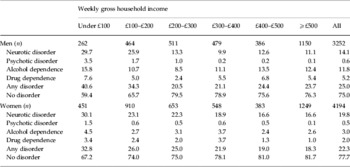
Table 1 shows the prevalence of different categories of psychiatric morbidity in relation to household gross weekly income. Low gross household weekly income was associated with increased rates of common mental disorder and psychosis. For example, men with gross household incomes below £100 per week were 2.7 times more likely to have a neurosis and 35 times more likely to have developed a psychotic disorder. In contrast, the prevalence of substance dependency was not significantly associated with low gross household income.
Mental illness and income: weighted prevalence (%) of mental disorder by household weekly gross income in men and women aged 16–74 years

Debt and mental disorder
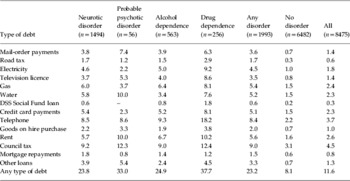
Table 2 shows that around a quarter of people with a mental disorder were in debt, compared with 8% of people with no disorder. Taking the broad categories of common mental disorder, psychosis, alcohol and drug dependency, the rates were 24, 33, 25 and 24% respectively. Thus the prevalence of debt was tripled in people with common mental disorder or substance abuse, and quadrupled in those with psychosis. Substance dependence was not associated with low income, but people with substance dependence nevertheless had twice the risk of debt of those without substance dependence.
Mental illness and debt: weighted proportion (%) of people with mental disorder who have various types of debt

DSS, Department of Social Security.
The more debts people had, the more likely they were to have mental disorder overall, neurosis, psychosis, alcohol dependency and drug dependency. These relationships still stood when the analysis was adjusted for income alone, and for income and other sociodemographic variables. The most commonly reported debts in people with mental disorder were council tax, telephone, rent, gas, water, electricity, television and mail-order payments. Certain kinds of debt were more common in people with specific disorders. For example, credit card debts were more likely to be associated with neurotic disorders, rent arrears with alcohol dependence, and Department of Social Security (DSS) Social Fund loans with drug dependence.
Debt, income and mental disorder
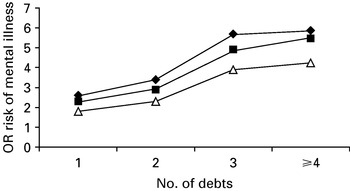
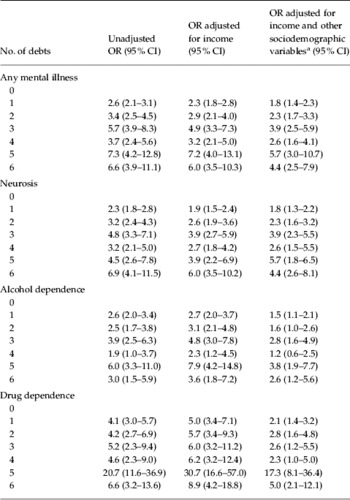
Table 3 and Fig. 1 demonstrate the relationship between number of debts and mental disorders, and shows that the relationship between number of debts and mental disorders was not reduced when income was adjusted for, and was only slightly weakened when other sociodemographic variables were introduced.
Odds ratios (OR) for risk of mental illness in people with increasing numbers of debts: unadjusted (–◆–), adjusted for income (–■–) and adjusted for income and key sociodemographic variables (age, ethnicity, marital status, household size, household tenure, education, social class, employment status, urban or rural, and region; –△–).

A comparison of strengths of association between number of debts and any mental illness, neurosis, alcohol abuse and drug abuse: unadjusted OR, OR adjusted for income and OR adjusted for income and key sociodemographic factors

OR, Odds ratio; CI, confidence interval.
a Age, ethnicity, marital status, household size, household tenure, education, social class, employment status, urban or rural, and region.
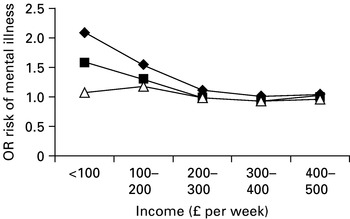
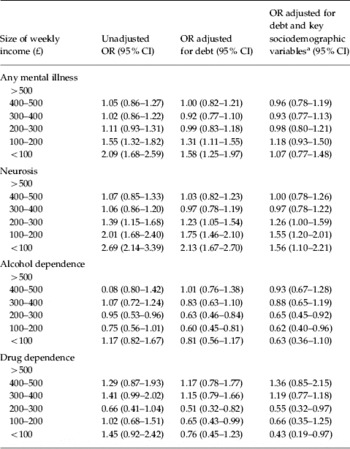
Table 4 and Fig. 2 demonstrate the smaller relationship between income and mental disorders. This was somewhat reduced when debt was adjusted for and largely vanished when other sociodemographic variables were introduced.
Odds ratios (OR) for risk of mental illness in people with increasing size of gross household income (£ per week), unadjusted (–◆–), adjusted for debt (–■–) and adjusted for debt and key sociodemographic variables (age, ethnicity, marital status, household size, household tenure, education, social class, employment status, urban or rural, and region; –△–).

A comparison of strengths of association between size of weekly income and any mental illness, neurosis, alcohol abuse and drug abuse: unadjusted OR, OR adjusted for any debt and OR adjusted for debt and key sociodemographic factors

OR, Odds ratio; CI, confidence interval.
a Age, ethnicity, marital status, household size, household tenure, education, social class, employment status, urban or rural, and region.
Discussion
Methodological issues and limitations of the study
This study was based on a large and nationally representative sample, using comprehensive standardized clinical assessments of mental disorders and substance abuse, as well as detailed information on income and debt. Such financial information is potentially sensitive, but the income bands were given numeric codes, so people did not have to say the amount they earned but just, for example, ‘Band 37’, which may have encouraged more accuracy. It was not possible to validate their responses from collateral accounts or independent information. There may be a difference in the degree to which people with disorders were prepared to reveal their income and indebtedness compared with those without disorder, as well as differences in reporting between disorders, particularly for conditions in which obtaining money is associated with the funding of alcohol and drug taking. Shame may lead to the under-reporting of debt and borrowing. In some conditions, for example psychosis, the capacity to understand financial issues may be impaired.
The assessment of debt was based strictly on answers to specific questions in relation to each of a list of common kinds of debt, and did not make any judgement about the pathway to debt, and how the individual had reached that position; whether, for example, by mismanagement of their underlying financial resources, be it from lack of motivation, insight or financial skills. The survey did not assess overall solvency, as this would have required detailed assessment of assets and liabilities. Nonetheless, the results do give some support for the financial measures used, in that the more debts people reported, the more likely they were to have a disorder.
This was a cross-sectional survey, able to indicate associations but not the temporal sequence of events. It was thus unable to establish whether low income and debt were causes or consequences of mental disorder or both. However, our analyses were designed to be capable of refuting the hypothesis that the association of low income with mental illness was mediated by debt. If such mediation did occur, then controlling for debt would substantially reduce the relationship between income and mental disorder. It would be implausible to argue for a process of mediation if controlling for debt did not substantially reduce the significant relationship between income and mental disorder. The hypothesis that debt mediates the association of low income with mental illness was therefore supported by our analyses, given that they did not in fact refute the mediation hypothesis. Moreover, the plausibility of mediation by debt is increased by the fact that the reverse strategy, of controlling for income in an analysis of the link between debt and mental disorder, had no effect on its strength. Further studies are required to explore the different potential mechanisms for the relationship between mental illness and debt.
Income, debt and mental illness
Although some large-scale surveys have examined the relationship between material hardship and mental disorder (Fryers et al. Reference Fryers, Melzer, McWilliams, Jenkins, Melzer, Fryers and Jenkins2004), there have been no previous published reports about actual debt in people with mental illness.
We found that people with mental disorder had significantly less income, and more debt and financial hardship, than those without disorder. The more debts people had, the more likely they were to have a mental disorder. Our study thus confirmed previous findings that people with low incomes were more likely than high earners to experience common mental disorder (Lewis et al. Reference Lewis, Bebbington, Brugha, Farrell, Gill, Jenkins and Meltzer1998; Weich et al. Reference Weich and Lewis1998b). People with low incomes are also more likely to be admitted to hospital with psychosis (Koppel & McGuffin, Reference Koppel and McGuffin1999). However, in the current study, the effect of low income was substantially attenuated when debt and socio-economic indicators were adjusted for. People with substance abuse did not have less income than those without substance dependence, but they had more debt.
It is possible that low income might predispose directly to mental disorder (or to increased levels of known risk factors such as life events and lack of social support), or that people with mental disorders are more likely to lose their employment or to be in low-paid employment.
In contrast to common mental disorder and psychosis, we found no association between low income and alcohol and drug dependence. The contrary findings of Dohrenwend et al. (Reference Dohrenwend, Levav, Shrout, Schwartz, Naveh, Link, Skodol and Stueve1992) may be due to reporting bias, to a selection bias towards responders, or to the fact that alcohol and drugs have to be paid for, irrespective of any underlying relationship between poverty and the propensity to become dependent on alcohol and drugs.
Social and financial exclusion
Whatever the mechanisms involved, the relationships we found have crucial practical importance. People with mental illness experience widespread social exclusion in education, employment and housing (Social Exclusion Unit, 2004). This may be compounded by financial exclusion (the inability to access recognized financial services in an appropriate way) (Kempson et al. Reference Kempson, Whiley, Caskey and Collard2000). However, there has been no epidemiological research to assess how far people with mental disorders experience financial exclusion.
Conclusions
This is one of the first studies to investigate the relationship of debt with mental disorder and substance abuse in a nationally representative household sample, and the first from the UK to investigate the relationship of income with substance abuse and psychosis. Both low income and debt were associated with mental illness. Our analysis was capable of refuting the hypothesis that debt mediates the link between poverty and mental illness contingent on debt. However, it did not do so, and the known relationship between low income and mental disorder thus seems to be largely contingent on debt.
However, in order to substantiate this finding and to identify the mechanisms for this relationship, we require prospective observational data on people with and without debt; and ultimately experimental evaluation of the impact of debt reduction intervention programmes. The causal mechanisms may vary between different mental disorders.
The fact that a quarter of people with mental disorder were in debt has direct implications for effective clinical assessments and care planning, as well as for awareness in debt counselling agencies, utility companies and financial organizations.
Acknowledgements
The study was funded by the Department of Health, the Scottish Executive Health Department and the Welsh Assembly Government. The authors’ work is independent of all funding agencies. R.J. was on secondment from the Department of Health to the Institute of Psychiatry at the time of the study.
Declaration of Interest
None.