INTRODUCTION
Endoscopic third ventriculocisternostomy (ETV), the surgical bypass of an obstruction at the sylvian aqueduct, has become an increasingly common treatment option for hydrocephalus (Burtscher et al., Reference Burtscher, Bartha, Twerdy, Eisner and Benke2003; Hellwig et al., Reference Hellwig, Grotenhuis, Tirakotai, Riegel, Schulte, Bauer and Bertalanffy2005). Standard extracranial cerebrospinal fluid (CSF) shunting procedures often result in multiple complications, including malfunction, infection, overdrainage, and poorly maintained normal CSF dynamics, including decreased CSF pulsatility (Garton & Piatt, Reference Garton and Piatt2004; Jones et al., Reference Jones, Stening and Brydon1990). After shunt placement, hydrocephalic patients often exhibit impaired intellectual, visuospatial, memory, and executive skills (Duinkerke et al., Reference Duinkerke, Williams, Rigamonti and Hillis2004; Thomas et al., Reference Thomas, McGirt, Woodworth, Heidler, Rigamonti, Hillis and Williams2005). A recent review indicated that postsurgical complications place children at a higher risk of cognitive impairment (Mataro et al., Reference Mataro, Junque, Poca and Sahuquillo2001). Despite its growing preference, few studies have examined functional outcome variables such as cognitive and emotional functioning following this procedure.
In 2001, Benabarre et al. presented the first neuropsychological outcome data on a 20-year-old man post-ETV (Benabarre et al., Reference Benabarre, Ibanez, Boget, Obiols, Martinez-Aran and Vieta2001). When tested 7 months postintervention, he displayed rapid forgetting and executive impairment, along with a significant change in personality (i.e., bulimia, impulsivity, and aggressiveness). However, this patient, who underwent his first shunt placement at 8 months of age, suffered multiple complications over the years, including 13 shunt revisions. In 2004, Bonanni et al. presented a second case study, describing a 20-year-old man who developed a dense amnesia and bulimia after stereotatic ETV (Bonanni et al., Reference Bonanni, Carlesimo and Caltagirone2004). History was complicated by presence of pineal tumor.
In 2003, Burtscher et al. conducted the only prospective study to date investigating the neuropsychological impact of ETV (Burtscher et al., Reference Burtscher, Bartha, Twerdy, Eisner and Benke2003). Prior to treatment, most of their subjects with late-onset idiopathic aqueduct stenosis (LIAS) displayed a combination of memory and frontal-executive dysfunction. Early post-ETV, two patients performed within normal limits across cognitive measures; three patients evidenced a notable recovery, with infrequent errors on testing; and one patient continued to exhibit poor verbal memory but improved executive functioning. The improved status of these patients remained constant over time, as assessed at a second follow-up evaluation (Duinkerke et al., Reference Duinkerke, Williams, Rigamonti and Hillis2004). Along with improved cognition, the authors noted a reduction in ventricular size post-ETV. In the present study, we expand this limited body of literature by presenting cognitive data on 10 patients post-ETV.
CLINICAL MATERIALS AND METHODS
Subjects were recruited through the University of Chicago Medical Center’s neurosurgery clinic. Recruitment and procedures were in compliance with the Helsinki Declaration for human research. Participants included 10 adults between the ages 18 and 58, who underwent ETV. In ETV, “a small perforation is made in the thinned floor of the third ventricle, allowing movement of cerebrospinal fluid (CSF) out of the blocked ventricular system and into the interpenducular cistern (a normal CSF space). Cerebrospinal fluid within the ventricle is thus diverted elsewhere in an attempt to bypass an obstruction in the aqueduct of Sylvius and thereby relieve pressure. The objective of this procedure, called an ‘intracranial CSF diversion,’ is to normalize pressure on the brain without using a shunt” (Kranz, Reference Kranz1997, p. 1, paragraph 1). The etiology of hydrocephalus was obstruction between the posterior third ventricle and the fourth ventricle (“aqueductal stenosis”), as demonstrated on preoperative magnetic resonance imaging (MRI). Where obstruction was questioned, it was confirmed by intraventricular computed tomography (CT) scanning, with intraventricular contrast agent. Patients demonstrated broadly normal intracranial pressure readings at their 1-year clinical follow-up, as assessed by Radionics (Randolf, MA) Telesensor telemetric ICP monitors (Frim & Goumnerova, Reference Frim and Goumnerova1997; Frim et al., Reference Frim, Lathrop and Goumnerova2000). Subjects were excluded from study participation if they had experienced increased intracranial pressure due to other causes within the year prior to enrollment.
Following informed consent, information regarding age, gender, level of education, medical history, and neuroimaging data was reviewed. Patients completed the Beck Depression Inventory (BDI) and Symptom Checklist-90–Revised (SCL-90-R; Derogatis, Reference Derogatis1994). The frequency of headaches was determined from responses to the latter questionnaire, while incidence of gait disturbance was gleaned from a review of the medical record. Available MRI and CT scans were examined to obtain a ventricle-to-cortex (V/C) ratio, calculated as the maximal frontal–ventricular width divided by the cortical width on the same slice at the same anterior–posterior level. Scans were available for all the patients.
Participants were administered a standard neuropsychological testing battery to assess intellectual functioning, visual and verbal memory, language skills, and executive functioning. Measures included the Wechsler Test of Adult Reading (WTAR; Wechsler, Reference Wechsler2001), Repeatable Battery for the Assessment of Neuropsychological Status (RBANS; Randolph, Reference Randolph1998), Brief Visual Memory Test (Benedict, Reference Benedict1997), Stroop Color Word Test (SCWT; Golden, Reference Golden1978), and Trail Making Test (TMT-A and -B; Reitan & Wolfson, Reference Reitan and Wolfson1993). As noted above, emotional functioning was assessed by the BDI-2 (Beck, Reference Beck1996) and SCL-90-R.
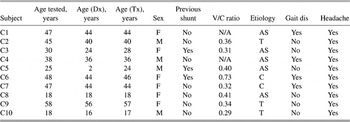
As noted in Table 1, the sample included six women and four men. Five were initially shunted and had shunts removed at the time of ETV. Two of those five had a history of two or more shunt revisions. Etiology of the aqueduct stenosis was somewhat diverse, though benign in all cases, with five (50%) presenting with a history of idiopathic aqueduct stenosis, two (20%) with cystic obstruction of the aqueduct, and three (30%) with a benign tumor (e.g., tectal glioma). In terms of presenting complaints, all subjects presented with headaches and half demonstrated gait disturbance. The average age at the ETV procedure was 35 years, with the median time to cognitive testing 2 years postoperatively (range: 1–5 years).
Descriptive data

Note
Dx, age at initial diagnosis; F, female; Gait dis, noted gait problems in medical record; headache, headache reported on the SCL-90; M, male; Tx, age at time of surgical intervention; AS, aqueduct stenosis; C, cystic obstruction; T, tumor; and N/A, not available.
RESULTS
Mean age of the sample was 37.4 years (range: 18–58 years), with an average of 13.3 ± 3.5 years of education. Intellectual functioning was in the average range: WTAR total mean = 97.0. Ventricular ratio was documented for 8 of the 10 subjects. The mean V/C ratio of the group was 0.40.
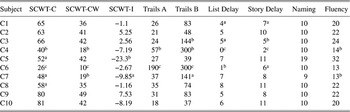
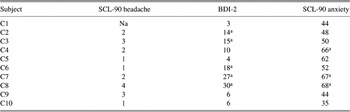
Table 2 and Table 3 present the cognitive and emotional data for this sample. This group displayed significant deficits across executive and memory tasks. Specifically, mild-to-moderate deficits were documented on tasks of processing speed and response inhibition (SCWT & Coding), cognitive flexibility (TMT-B), and memory (Story & Figure). Forty percent of our sample displayed significant deficits (>2 SDs) on two or more cognitive tasks. In terms of emotional functioning, half the sample endorsed items suggestive of depression (BDI > 11) and 30% endorsed anxiety-related symptoms (T score > 65). There was not a correlation between depression or anxiety and cognitive performance.
Cognitive data for adults treated with ETV

Note
RBANS subtests: List and Story Delays; Naming and Fluency. All scores are listed as raw scores.
a 1 SD below mean.
b 2 SD below mean.
c >2 SD below mean.
Physical and emotional status

Note
SCL-90 Anxiety T-scores. Na, not completed.
a Clinically significant scores based on normative values from manuals.
DISCUSSION
ETV has become a standard surgical procedure for hydrocephalus due to aqueductal stenosis. Indeed, shunts are often removed and ETV performed to render a patient “shunt independent.” While multiple studies have examined cognitive status following shunting, few studies have examined cognition in patients post-ETV. Two recent case reports (Benabarre et al., Reference Benabarre, Ibanez, Boget, Obiols, Martinez-Aran and Vieta2001; Bonanni et al., Reference Bonanni, Carlesimo and Caltagirone2004) documented memory and executive deficits postintervention. The prospective study by Burtscher et al. (Reference Burtscher, Bartha, Twerdy, Eisner and Benke2003) noted improvements in cognition in five of their six patients with LIAS following ETV, although practice effects could not be ruled out. They noted that three patients continued to display some errors on memory tasks, and one patient displayed significant deficits across tasks. In the present study, 40% of the patients displayed memory and/or executive dysfunction 2-years postintervention. Specifically, mild-to-moderate deficits were documented on tasks of processing speed, cognitive flexibility, and short-term memory skills. These deficits continued despite relatively normal ventricular size in the group. While case reports have suggested that injuries during surgery may have resulted in reported cognitive deficits in this population (Benabarre et al., Reference Benabarre, Ibanez, Boget, Obiols, Martinez-Aran and Vieta2001; Bonanni et al., Reference Bonanni, Carlesimo and Caltagirone2004), no new insults, such as brain contusion or stroke, were noted on postsurgical neuroimaging in our sample. While the lack of presurgical data is clearly a limitation of our current study, Burtscher et al. (Reference Burtscher, Bartha, Twerdy, Eisner and Benke2003) documented similar deficits in their sample prior to intervention. While Burtscher et al. (Reference Burtscher, Bartha, Twerdy, Eisner and Benke2003) also documented some improvement postintervention, the impact of practice effects on test data was raised by the authors as a confounding variable as patients were retested within 7 weeks. While the lack of presurgical data is problematic in the current sample, it also removes this issue of practice effects and reveals the presence of persisting postintervention cognitive inefficiencies. Thus, while ETV may prove to be a better surgical intervention, cognitive deficits may persist for a subset of these patients.
The reason for these continuing deficits is unclear but most likely multifactorial. While most of the patients, except one (C5), underwent ETV intervention within 2–4 years of diagnosis, it is impossible to determine how long their condition sat dormant or untreated. Our data are consistent with a recent study examining cognitive outcome in older normal pressure hydrocephalus patients after shunting who continue to display executive dysfunction thought to be due to longstanding disruption of frontal networks (Thomas et al., Reference Thomas, McGirt, Woodworth, Heidler, Rigamonti, Hillis and Williams2005). While ETV resolves intracranial hypertension and restores almost normal CSF pressure dynamics (Frim & Goumnerova, Reference Frim and Goumnerova1997; Frim et al., Reference Frim, Lathrop and Goumnerova2000), long-term disruption of subcortical–frontal networks due to enlarged ventricles and subsequent stretching of axons may have taken place prior to intervention and thus deficits persist despite normalization in CSF dynamics and reduced ventricular size. It is certainly noteworthy that the patient with the largest V/C ratio (C6) displayed the most cognitive impairment. Anterior arteries may also be stretched, resulting in decreased flow to frontal–subcortical regions. Animal studies have also demonstrated that hydrocephalus may compromise certain neurotransmitter systems (i.e., acetylcholine, dopamine) important for cognitive functioning (Erickson et al., Reference Erickson, Baron and Fantie2001). Finally, it should be noted that two of the patients who continued to display significant cognitive deficits had prior shunts failures and thus may have a treatment-resistant form of hydrocephalus. The longer state of hydrocephalus and repeated surgical interventions may result in some cumulative aversive impact on cognition. The impact of this latter variable should be investigated in a larger longitudinal study.
Along with the potential for persistent deficits due to neurological injury, many of the patients reported ongoing emotional problems, along with persistent headaches, which may be impacting cognitive efficiency. The high rate of depression and anxiety was surprising, yet did not correlate with RBANS total in this small sample. In fact, the most depressed patient displayed the best cognitive performance, thus suggesting that emotional dysregulation cannot solely account for these findings. Clearly, migraines and even headaches may also impact cognition (O’Bryant et al., Reference O’Bryant, Marcus, Rains and Penzien2006; Ravishankar & Demakis, Reference Ravishankar and Demakis2007). Rekate (Reference Rekate2007) also documented persistent headaches post-ETV intervention in his Long-Standing Overt Ventriculomegaly in Adults (LOVA) sample. The one patient in Burtscher’s sample who continued to display significant deficits was the only one to report continuing headaches postintervention. It is hard to statistically address the impact of headaches and emotional functioning in this small sample, but further studies should include these variables.
CONCLUSIONS
The present study documents that cognitive inefficiencies persist for some patients after obstructive hydrocephalus is treated with ETV. Specifically, as seen with other hydrocephalic conditions, memory and executive deficits are seen in adults post-ETV. Based on Butcher’s study, these deficits may be related to demyelination rather than the possible trauma caused by surgical procedure.
The preliminary findings from this study call for a more comprehensive investigation of the neurocognition status of ETV patients. Given the persistent deficits noted in this small sample, a prospective, longitudinal study that includes a control group is clearly warranted to gain a further understanding of the etiology of these deficits. Ideally, a study should use a presurgical battery comprising more comprehensive assessment tools (e.g., Behavioral Assessment of Dyexecutive Syndrome and Wechsler Memory Scale, fourth edition), although this may not be practical in preoperative cases. Practice effects should be addressed by use of parallel forms, a yearlong interval between assessments and a reliable change index methodology (Chelune et al., Reference Chelune, Naugle, Luders, Sedlak and Awad1993). The number of prior shunt revisions, presence of headaches, gait status, and current emotional functioning should also be assessed at the time of the neurocognitive testing and then considered as contributing factors to cognitive status. Further studies, especially with a larger sample and prospective design and using diffuse tensor imaging of white matter structures may elucidate these current preliminary findings. A direct comparison of the degree of cognitive impairment between aqueduct stenosis patients treated by ETV and ventricular shunting will also be of significant clinical importance. Finally, this study suggests that neurosurgeons should screen for depression and anxiety in this sample, given the high frequency seen in this small sample.
ACKNOWLEDGMENT
This study was supported in part by National Institutes of Health/National Institute of Neurological Disorders and Stroke RO1 NS041440 (to D.M.F.), the Pediatric Neurosurgery Research and Education Fund, and the Rivkin Family Fund for Hydrocephalus Research.