To echo German Chancellor Angela Merkel’s put-down of Russian President Vladimir Putin’s geopolitical mindset, power politics seems ‘so twentieth century’.Footnote 1 ‘Outdated thinking in terms of spheres of influence which tramples international law underfoot must not be allowed to prevail’, she has insisted.Footnote 2 Yet power politics, far from being passé, may be heading ‘back to the future’ in Eurasia, if indeed it was ever gone.Footnote 3 President Donald Trump’s stark departure from the liberal internationalist consensus about American foreign policy reopened the question of a more transactional relationship with Russia, reviving the relevance of debates over the feasibility and desirability of Ukraine serving as a ‘buffer zone’ between Russian and Western spheres of influence.Footnote 4
This debate raises timeless questions about rivalry in borderlands among great powers.Footnote 5 Buffer zones, as old as recorded history, lie between two more powerful rival states but are not dominated by or allied with either. Sometimes they are created and sustained by great powers seeking to regulate their rivalry. Often, however, they simply reflect a tenuous equilibrium in the ebb and flow of power and serve as arena for competition.
Buffer zones have a mixed track record as stabilisers of international rivalry. The states most likely to be gobbled up have been those sandwiched between two rival great powers.Footnote 6 Great powers that rely on buffer states as a cushion find that they are often weak or unstable and hence susceptible to manipulation, domination, and conquest by adversaries.
Still, buffers have sometimes stabilised competition among great powers. Cohesive ones, such as Switzerland, nineteenth-century Siam, Austria after the 1955 State Treaty, and Finland during the Cold War preserved their security, contributing to regional order. Even weak and vulnerable buffers have sometimes helped regulate major power rivalry. Eurasia’s ‘sick men’, the Ottoman Empire and Persia, were kept on life support for decades, insulating competitors from inadvertent clashes. Neutral states have served as canaries in the coalmine: when their status was violated, the transgression provided early warning about a looming threat. Although this information may come too late to help the buffer, as it did for Belgium in 1914 and Poland in 1939, it may be crucial in enabling a coalition against an aggressor.
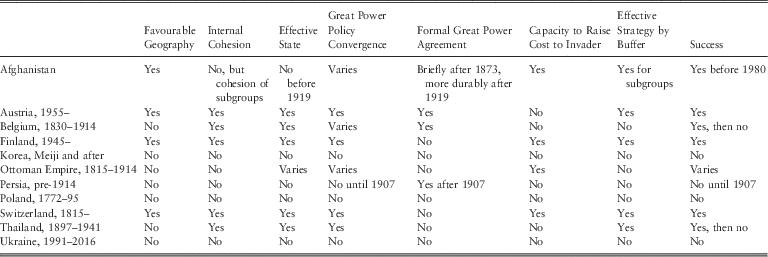
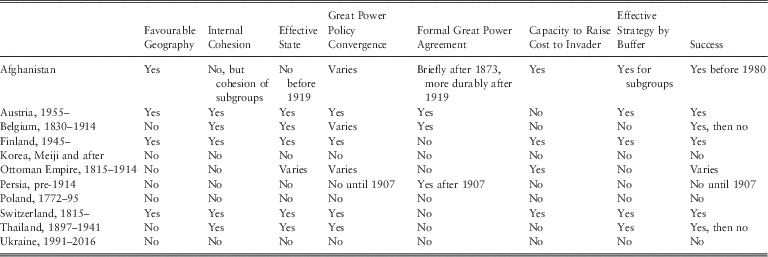
Current debates provide an opportunity to revisit the long and varied history of major powers’ efforts to manage buffer zones, and the conditions under which they succeed in shoring up peace and security. We analyse the most historically consequential cases of Eurasian buffer zones in the late eighteenth, nineteenth, and twentieth centuries: Afghanistan until 1978, Austria after 1955, Belgium from 1830 to 1914, Finland after 1945, Korea before its partition, the Ottoman Empire between 1815 and 1914, Persia before 1914, Poland from 1772 to 1795, Siam/Thailand after 1897, Switzerland since 1815, and contemporary Ukraine (see Table 1), plus other examples from Eastern Europe and the Balkans before the world wars.
Correlates of success and failure of buffers.
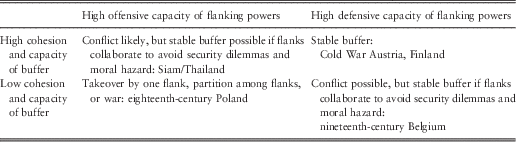
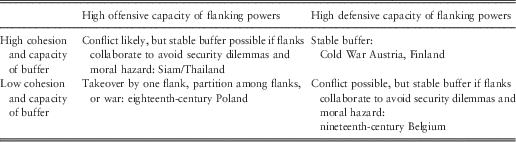
Our theory of the success and failure of buffer zones proceeds from the assumption that buffers arise where all strong flanking powers anticipate that the military and economic costs of attempting to conquer the buffer are likely to exceed the benefits. Such a buffer will be stable, and will enhance the stability of the regional system around it, when there is a durable equilibrium of military and economic power that favours the defence. This depends in part on the characteristics of the buffer itself: the extent to which there is a well-institutionalised buffer state supported by a cohesive population, animated by nationalism, benefiting from favourable geography, and endowed with resources adequate for self-defence. The stability of the buffer also depends on the characteristics of the stronger states that flank it: the extent to which they are better situated for defence than attack, and satisfied with the status quo rather than driven by revisionist ideological or material aims. These variables can combine in different ways to produce different patterns of stability or instability in the buffer zone (see Table 2 for a simplified version of the argument).
Conditions for success of buffer zones.
The stability of the buffer depends, in addition, on how the flanking powers try to manage political, security, or economic problems that arise there. Two distinctive characteristics of buffer zones often make overly zealous meddling in the buffer a greater risk than excessive diffidence. First, weak buffer zones beget power vacuums that tempt the flanking states to intervene, out of fear that the other will, triggering needless escalation between states that are mainly motivated by security. Unstable buffers are, in other words, particularly prone to the classic security dilemma.Footnote 7 Second, flanking powers may make commitments to factions within disunited buffer states in order to counter perceived or expected inroads by rivals, which the clients may then exploit in ways that the patrons do not intend, desire, or anticipate. Thus buffer zones pose the special risk of what insurance companies and social scientists call moral hazard.
When favourable conditions for a stable, defensive equilibrium are absent, flanking states sometimes succeed in collaborating to create them. This usually requires agreement on the neutrality of the buffer and pursuing a hands-off policy instead of intruding in the buffer’s domestic affairs, which heightens security dilemmas and moral hazards. Although successful arrangements for the management of buffer zones must be anchored in calculations of expediency, formal legal agreements, informal norms, and procedures encouraging diplomatic consultation can facilitate coordination of policy in the buffer zone among potential rivals that have strategic incentives to avoid unnecessary clashes and hence some convergent interests.
In advancing these arguments, we first distinguish between spheres of influence and buffer zones and identify the circumstances under which buffer zones arise. Next, we advance and assess hypotheses about the conditions under which buffer zones succeed or fail to support regional or global stability and when they are preferable to alternative arrangements. Based on this analysis of buffer zones in history, we conclude that Ukraine lacks most of the features of an effective one. In contrast to our successful cases, Ukraine lacks internal cohesion and an easily defensible territory. Moreover, Russia has a greater capacity and motivation to undermine Ukraine’s stability and neutrality than the West does to support it. Intrusive, one-sided efforts to change these conditions through dramatic reforms are more likely to generate security dilemmas and moral hazards – and perhaps even war – than stability. That said, Russia lacks the capability to incorporate all of Ukraine into its sphere of influence, let alone to annex it. If Russia decides that keeping Ukraine unstable is creating net liabilities for its overall relations with the West, a bargain to establish Ukraine as a fairly stable buffer might be feasible despite its weaknesses. This will not produce an ideal solution to the Ukraine crisis but it may prove better than the undesirable or infeasible alternatives of Russian domination of Ukraine or a Western pledge to defend Ukraine.
Buffer zones versus spheres of influence
Buffer zones lie between the spheres of influence of two or more powerful states but are not allied with or dominated by any of them.Footnote 8 Buffer states may be formally neutralised by international treaty (Austria) or self-declared to be non-aligned as a matter of the buffer state’s policy (Switzerland), but by our definition, buffers may also be non-aligned de facto without any formal status or declarations (Afghanistan in the nineteenth century).Footnote 9 By contrast, spheres of influence arise when powerful states exercise predominant sway over nearby territories, sometimes with the tacit recognition of rival powers.Footnote 10 The spheres of influence of rival great powers may be contiguous, or they may be partially or entirely separated by a buffer zone. A great power may attempt to incorporate a buffer into its sphere of influence or even to annex it outright.
Following Robert Gilpin, we assume that powerful states tend to expand their sphere of influence until the rising costs equal the marginal strategic or economic benefits. Thus, buffers between spheres of influence are most likely to arise, and mark the location, where all the rival flanking powers regard the anticipated costs of occupying an intermediate territory or achieving unrivaled influence over it as exceeding the benefits. Like Gilpin, we argue that power politics provides the most useful overall framework for understanding strategic rivalry at the frontier of empires, but also like him, we find that internal processes in buffer states and in flanking powers such as economic and institutional developments and the rise of nationalism shape the trajectory of these power trends.Footnote 11
Even formidable states’ capacity to project power declines with distance.Footnote 12 All empires struggle with the problem of the ‘turbulent frontier’, the zone at the edge of imperial control where armed opponents make endless trouble.Footnote 13 Defending the great power’s military and economic positions in far-flung places proves harder than doing so in nearby ones. This creates incentives to avoid costly struggles in low-value peripheral territories located between the spheres of rival great powers. Some imperial powers have tried to calculate the marginal costs and revenue of incremental expansion in exactly this way. For example, the British colonial office sometimes asked its administrators on the Indian frontier to justify requests for incremental troops and subsidies in terms of the marginal tax revenues to be gained or protected.Footnote 14 Seen thus, buffer zones emerge when great powers conclude that the costs of expansion exceed the benefits, and their calculations of costs versus benefits converge.
For example, in nineteenth-century Siam, Britain and France, having shorn off large parts of the kingdom populated by non-Thai groups, chose to allow it to remain an independent polity rather than be drawn into a costly contest to annex it, one that would have diverted each from pressing strategic interests and threats elsewhere, notably in Europe. Again in the nineteenth century, Russia recognised its inability to reach beyond its Central Asian imperial domains in order to conquer Afghanistan, and Britain for its part learned from bitter experience that it was more sensible to settle for more limited influence rather than wagering on an uncertain war of conquest.Footnote 15
Thus although powerful states may overreach, the limits of power and geographical obstacles eventually compel them to desist. Great powers whose economic and military capacities decline often retrench, leaving space for the emergence of buffer states.Footnote 16 Buffer zones also tend to emerge after flanking powers suffer military defeats and tend to disappear once these powers make an economic recovery. In prominent examples – after the Russo-Turkish War, the Balkan Wars, and the First World War – they arose in Eastern Europe following the defeats of the four flanking great powers, Germany, Russia, Austria-Hungary, and the Ottoman Empire. Rising nationalism in these former imperial peripheries – fuelled by imperial decline and local state-seeking efforts promoting mass literacy – strengthened their capacity as buffers. Still, rivalries among these smaller buffer states provided major flanking powers with openings to penetrate, divide, and conquer them. Ultimately, postwar economic recovery of some of these great powers led to the disappearance of some of those buffers.
As Gilpin argued, an especially dangerous moment in imperial rivalry comes when a rapidly rising power threatens to overtake a rival whose economic and military growth is slower. Examples are Germany threatening to overtake Britain at the beginning of the twentieth century and Russia in turn threatening to overtake Germany on the eve of the First World War.Footnote 17 This creates incentives for preventive war to forestall the power shift, but less dramatically it also intensifies rivalry over buffer territories whose resources might compensate for relative decline or create positions of strength for the coming showdown. Imperial and Balkan conflicts before 1914 capture that dynamic.
Explaining buffers’ success and failure
From the standpoint of major powers wedded to the status quo, buffers can help manage competition in frontier regions when their survival serves to avert unwanted conflict among rivals. From the perspective of an expansion-minded major power, however, a buffer state’s non-aligned status leaves the buffer unprotected from intimidation or invasion, enabling gains at its expense. For the buffer state, success means, at minimum, retaining its independence, remaining stable, and avoiding being dragged into great powers’ deadly disputes. Both major powers and buffer states define success relative to the outcomes that alternative strategies, whether a partition by the major powers or hegemony by one of them, might have produced. From the standpoint of the international system’s stability, buffer zones work best when they contribute to the security of the great powers, the major flanking powers, and the buffers themselves.
As we show below, buffer strategies are most likely to meet this exacting standard when three mutually reinforcing conditions are present. First, buffer states retain their independence when they have the material strength and social cohesion to resist penetration, annexation, or partition. Second, states that may contemplate using war to annex or dominate the buffer zone desist because they anticipate high risks and costs, including the diversion of resources more productively used to address more important challenges. Third, major powers avoid collisions in a buffer zone because they have reached agreement, implicitly or explicitly, on rules of the road.
Distinguishing between the effects of background conditions and diplomatic contrivances helps to illuminate the causes of success and failure. Buffers sometimes survive mainly because the overall balance of power in their region remains stable.Footnote 18 Conversely, they sometimes fail when it becomes unstable. Thailand’s durable neutrality – it was the only part of Southeast Asia to escape European colonisation – was enabled because neither Britain nor France saw an advantage in conquering it and ended abruptly when Japan needed it as a conduit for conquering the oilfields of Indonesia through British-held Malaya and Burma. In such situations, buffers are more outcomes than causes of international relations.
Sometimes, however, the creation and maintenance of a buffer needs to be contrived to stabilise what would otherwise be a dangerous situation. For example, the great powers’ creation of neutral Belgium kept French, Prussian, and Russian rivalry in the Low Countries under control amidst the revolutionary ferment there in 1831. But, as with Afghanistan after 1978, buffer arrangements, even longstanding ones, can be mismanaged, creating wider repercussions for a region and indeed the international order.
Three types of buffers
Successful buffers come in different forms, depending on the configuration of the variables that our theory expects to affect the stability of the buffer, including the cohesion of the buffer, the collective motivation and fighting capacity of its people, its terrain, the offensive and defensive capacities of the flanking states, and their strategies for managing the buffer. Among the various permutations that can lead to successful outcomes, we highlight three prominent forms: the most preferred form is the strong buffer, but ‘briar patch’ and ‘too-important-to-fail’ variants can also succeed.
The strong buffer state has adequate material capacity to resist aggression or at least to make it costly, defensible geography, internal cohesion, effective political organisation, and internal legitimacy. A geographical position off the main axes of flanking powers’ military operations or transportation routes also helps. Sweden, Switzerland, Finland, and Siam/Thailand are examples, though none enjoyed all these advantages nor in equal measure.
Buffers that are consolidated democracies have particular advantages, among them domestic legitimacy stemming from popular consent, a unifying nationalism, and self-determination sufficient to win national minorities’ loyalty.Footnote 19 Examples include Switzerland, Finland, and Austria. By contrast, ‘transitional’ or ‘democratising’ states with weak political institutions, such as post-Soviet Georgia, Moldova, and Ukraine, tend to be unstable and, in consequence, ineffective buffers.
Favourable terrain can add to a buffer’s security, but the context matters. While mountains, deserts, and seas matter, smart strategists choose defensive positions as part of a strategy that also taps other sources of security. The Swiss have used geography and a small army effectively trained for defensive warfare to their advantage. Yet they also maintained economic ties with rival states and established a canton-based decentralised system that reflects awareness, based on Switzerland’s history, of how national security can be jeopardised by religious and ethnic strife. This approach encountered its toughest test during the Second World War, when Switzerland was surrounded by the Axis powers – Germany to the north, German Austria to the east, and Italy to the south – and much of western Europe was under Nazi occupation by 1940. Hitler’s proven commitment to irredentist wars aimed at uniting Germans under one state presented a grave threat to Switzerland, three-fourths of whose population was German. Moreover, the Italians might have sheared off Switzerland’s southern (Italian majority or plurality) cantons.Footnote 20 Mountains alone would not have protected the Swiss.
A favourable international context can enable buffers to enhance their internal strength. For example, the British and French, who were encroaching on Siam from opposite directions, decided to avoid a war there through the Anglo-French Agreement on Siam of 1897 to focus on bigger prizes. Siam’s rulers capitalised on the opportunity. They surrendered extensive outlying territories containing twenty million people that they lacked the wherewithal to defend, focusing instead on consolidating control over the ethnically Thai heartland. They enacted socioeconomic reforms to modernise the economy, the civil service, and national and provincial political institutions. They fostered a unifying identity based on a ‘conception of national religion and king’, weakening localised loyalties.Footnote 21 Siam’s viability as a truncated buffer thus owed to the confluence between external circumstances (the strategic calculations of Britain and France) and internal processes (successful reforms by the Siamese state) – a pattern apparent in other successful cases but ultimately rare.
Whereas strong buffers enjoy situational advantages and then use them well, weak ones typically face more difficult international circumstances, which in turn exacerbate their internal disunity. Statesmen have been wary of relying on weak buffers, and for good reasons. Tsar Nicholas II told the British Ambassador that he ‘did not believe in buffer states, unless they were strong and independent; and Persia, with its effete and corrupt government, was too weak to play the role’.Footnote 22 Similarly, given eighteenth-century Poland’s internal disunity, the great powers on its flanks correctly concluded that it was just a matter of time before their rivals carved it up. To avoid a clash, they conspired to divide the would-be buffer.
Cohesive buffer states can hinder conquest by fortifying borders and transportation nodes or by refusing to allow outside powers to build rail lines and strategic roads and bridges on their territory. In contrast, weak buffers destabilise international relations when they fail to resist the efforts of great powers to build infrastructure that enables accelerated attacks on their adversaries. For example, diplomatic jockeying over Russian plans for railroads and pipelines in Persia and Germany’s plan for the Baghdad Railway through Turkey intensified the great powers’ security fears before 1914.Footnote 23
Whereas strong, unified buffers stabilise international politics by keeping the peace, some weaker, factionalised, briar-patch buffers may become venues for war but nonetheless manage to keep flanking powers at bay. Consider Afghanistan, which has been helped by its formidable topography, the paucity of transportation routes, and the tenacity of its tribal warriors. Despite these inhospitable features, throughout the nineteenth and early twentieth centuries Britain sought to penetrate Afghanistan in order to protect its ‘crown jewel’ colony, India, from Russian expansion. Russia in turn sought to extend its influence into the Afghan buffer. The British and the Russians agreed in 1873 that the Amu Darya River would serve as the boundary between Afghanistan and Russian-ruled Central Asia, Afghanistan serving as a buffer between the two empires, but within Britain’s sphere of influence.Footnote 24 The Russians soon welched on the deal, making overtures to a candidate for succession to the Afghan throne, leading the British to send in troops. In all, the British launched three military expeditions into Afghanistan (in 1839–40, 1878–80, and 1919) in an effort to consolidate their hegemony. But complex tribal factionalism and geographical conditions combined to stymie the projection of military power. Each time, the British learned the futility of seeking total control over Afghanistan, but the lessons faded with time and needed to be relearned through yet another round of trial and error. After 1919, Afghanistan remained a neutral, independent buffer until 1979, when it became the Soviet Union’s turn to learn the hard lesson about the difficulty of conquering Afghans. For over a century, Afghanistan, a weakly governed but defence-dominant buffer, helped keep the great powers from fighting each other, but it had to wage a series of wars in the process.
While defensibility and relative unimportance are the typical geographical characteristics of a successful buffer, sometimes the opposite characteristic – standing astride inviting transportation routes between rivals – creates a powerful incentive to sustain a neutral buffer, which becomes too important to fail. But this effort rarely succeeds fully, and strategists have been ambivalent about its feasibility. In the mid-nineteenth century, for example, two schools of thought in Britain debated whether the Ottoman Empire could be built up as a barrier to Russian expansion. Palmerston, Russell, and Disraeli argued for such a policy; Aberdeen, Peel, and Gladstone doubted that the inefficient, corrupt colossus could be reformed.Footnote 25 Notwithstanding these sceptics, Turkey survived for a century as a buffer because no great power could singly dominate the Straits and no mutually satisfactory scheme to divide control among them could work without ensuring Turkish sovereignty, which the existence of an uncolonised Anatolian Turkish ethno-religious core in the Ottoman Empire helped make feasible.
Similarly, Belgium’s geographically derived strategic centrality for Europe’s great powers gave them incentives to keep it neutral for over eight decades. But Belgium constituted a tempting land route for invading France while control of its coast would have eased a maritime invasion of Britain. In 1914, Belgium’s buffer status eventually fell victim to the combination of its strategic location and weakness, the expansion of Germany’s power, and internal political changes in Germany that laid the groundwork for a policy of expansionist war that shredded the Bismarckian prescription for prudence.
If a cohesive buffer state does not exist, neighbouring powers may find it difficult to coordinate efforts to create one. For one thing, they may have different ideas and interests about how to constitute it. In Persia, British officials, mindful of Britain’s capacity for economic investment, favoured railroad construction to jumpstart Persia’s backward economy to help it become a stable buffer.Footnote 26 But Russian Foreign Minister Nicholas de Giers knew that Russia lacked the capital to compete in such a game. By settling for economic competition alone, he noted, Russia ‘would … doom herself to certain defeat’.Footnote 27 When a reform-minded constitutional regime in Teheran hired an experienced American consultant to reform its tax system, Russia demanded that he be fired.Footnote 28 In the end, Britain and Russia, mindful of the imperative of protecting their alliance against Germany, agreed on rules that moderated their messy rivalry in the Persian buffer.
The role of flanking states
A buffer’s internal strength and cohesiveness are central to its chances of success. But no less important are the goals, strategic beliefs, and relative power of the flanking states, together with their deftness in managing the security dilemma and moral hazards. Buffers survive when flanking powers are relatively weak, satisfied with the territorial status quo, sceptical that ‘offense is the best defense’, and chary of making commitments to reckless allies and clients. Like Gilpin’s theory of imperial expansion, this may sound like common sense or even tautology, but if so, it is a useful tautology in pointing toward crucially debated causal mechanisms that determine whether buffers live or die (see Table 2).
Here we consider in turn the overall great power context, the strategies of deterrence and influence that flanking powers adopt toward the buffer, and the unintended consequences of those strategies, especially chronic problems caused by the weakness of many buffers. By ‘flanking powers’, we mean not only contiguous land neighbours but also global naval powers such as Great Britain, especially in the nineteenth century, whose capability was contiguous to buffers such as Turkey and Persia even if its homeland was not.
The strategic environment
Belgium’s fate underscores the importance of the great power context. Though the country lacked both formidable natural barriers and internal cohesion, it endured for more than eight decades, mainly as the result of great power concord. When the great-power Concert system and the Bismarckian balance of power system collapsed, so did respect for Belgian neutrality. By contrast, Austria’s post-1955 neutrality, also established through international legal guarantees, survived throughout the Cold War. That outcome owed to the generally cautious diplomacy of the nuclear-armed superpowers, Austria’s political stability, and its geographical advantage of not being situated on the main axis of any potential war between NATO and the Warsaw Pact.
Korea functioned as a successful buffer and benign cultural conduit for centuries in an era when the flanking powers, China and Japan, lacked the infrastructural capacity to sustain power projection into the buffer or to threaten each other. After the industrial revolution brought the great powers’ railways and battle fleets into play, and energised these capabilities with nationalism and other mass ideologies, the Korean buffer was conquered and then after the Second World War divided into rival spheres of influence.Footnote 29
Whereas our account points to the importance goals and beliefs as well as material power in shaping rivalries over buffer zones, the self-styled geopolitician Nicholas Spykman offered a simpler argument: the viability of a buffer arrangement depends on an equality of power between the flanking powers.Footnote 30 This claim is at best too simple and perhaps simply wrong. Current research shows that parity of power promotes mutual fears, divergent assessments of bargaining strength, a greater propensity for risk taking, and war.Footnote 31 Even if rough equality might sometimes stabilise a neutral buffer through mutual deterrence, it might also enable partition, as in century Poland. More relevant than power ratios may be the extent to which flanking powers have offensive capacities and goals, and whether they share an interest in sustaining the buffer. The interwar ‘cordon sanitaire’ in Eastern Europe was overrun by the flanking great powers not so much because Germany was stronger than the Soviet Union, but because the Nazis wanted an empire that included the buffer states and had an offensively configured military.Footnote 32 Conversely, the Austrian State Treaty produced a successful buffer despite the power advantage that proximity provided the USSR.Footnote 33
Deterrence, security dilemmas, and conflict spirals
Not only are we sceptical of the stabilising impact of equal power of the flanking states, but we are also unconvinced that military deterrence can reliably safeguard buffers. In managing buffer zones it can be risky to be too vigilant or too tolerant. Deterrence may sometimes be necessary to contain expansionists with ambitious aims, but that does not mean that it produces peaceful outcomes when buffers are weak. Indeed, strategies that rely mainly on military deterrence may fail whether expansionist goals or security fears, or both, motivate the opponent. In such a situation, regardless of the rivals’ underlying motivations, the flanking powers, fearing that their rivals will rush to fill any power vacuum in the buffer, may be tempted to seize the first mover’s advantage.Footnote 34 This could take the form of either a sudden, preemptive invasion or a steady effort to maintain nothing less than parity with the rival flanking power in establishing positions of economic, military, or political influence in the buffer zone. In the latter case, outsiders’ eager commitments to support clients in the buffer may create a moral hazard, leading the clients to believe that the powerful outsiders have written them a blank check to support the clients’ aggressive aims, further tightening the conflict spiral.Footnote 35
Whereas a clean partition into mutually exclusive spheres of influence clarifies the lines of control and the requirements for credible deterrence and enforcement, ambiguous buffer arrangements permit more leeway, creating a tactical conundrum. Moves to oppose a rival’s creeping penetration of the buffer may fail to deter if they are weak and tentative, yet more robust threats to enforce neutrality may exacerbate a security dilemma. The latter problem is prominent in the historical cases. Assertive moves by outside powers that destabilise a buffer zone are often triggered by the fear that other powers will move first in the power vacuum.
For example, the successive partitions of Poland in 1772, 1792, and 1795 were sparked by Russia’s doubts that it could maintain its position in Poland through indirect rule over that weak state.Footnote 36 This in turn created doubts in Austria and Prussia that Russia would limit itself to indirect influence.Footnote 37 Since none of the three flanking powers could annex Poland if its rivals resisted, they conspired in a series of joint partitions. The first distributed more than eighty thousand square miles, a third of Poland’s territory, among Austria, Prussia, and Russia.Footnote 38 The second was another collusive land grab, this time by Russia and Prussia. Exploiting Austria’s preoccupation with problems elsewhere and internal divisions created by the Polish nobility’s opposition to King Stanislaus’s reforms, in particular the new liberal constitution, they wrested an additional 115,000 square miles of land from Poland. The third partition was preceded by a Polish national uprising –inspired by the French Revolution and fueled by outrage over the loss of national territory – that Austria, Russia, and Prussia moved to suppress. The ensuing annexations erased Poland from the map. Poland’s fate illustrates Tanisha Fazal’s observation that ‘buffer states are pushed to weakness …, manipulated in ways that undermine their ability to balance and to govern’.Footnote 39 It also substantiates our argument that internal disunity and the connections between domestic factions and foreign powers can play a critical role in weakening, even destroying, buffers.
Instead of producing a stable partition, the prospect of armed conflict in a buffer zone can sometimes lead to spiraling great power competition. Austria and Germany vied with Russia over the Bosnia Annexation Crisis of 1908–9, the Balkan Wars of 1912–13, and the installation in 1914 of a German general to command Ottoman troops at the Turkish Straits. Unlike Afghanistan, this region did not seem like a place with forbidding terrain and warlike people best left to its own chaos. Instead, the Balkan peninsula and the Turkish Straits appeared to be a region where diplomatic intimidation and quick aggression might permit an assertive great power to gain territory, allies, and advantageous geographical positions, enabling it to change European balance of power at a time when arms races were already putting it in flux.Footnote 40 The fear of a general power shift overturning the equilibrium between Europe’s opposing alliances created incentives for opportunistic offensives aimed at rolling up the resources of the buffer zone between them. Following Austrian Archduke Ferdinand’s assassination this temptation in a Europe with offensively poised armies dragged the great powers into a calamitous war.
Buffers and moral hazard
Moral hazard can arise when buffer states conclude that an outside power will protect them from its rivals regardless of their strategic choices, leading to consequences that are unforeseen and undesired by the patron. In the run-up to the Crimean War, for example, the Ottoman Empire’s rejection of a reasonable compromise among Britain, France, and Russia, proposed in the Vienna Note, entrapped these powers in an escalatory spiral despite their desire to avoid war.Footnote 41 In 1912, Russia backed the Balkan League of small states, which it viewed as a military alliance that could help contain Austrian domination and counter the Austro-German alliance. The Balkan League, however, turned its attention first to attacking the Ottoman Empire, and the Bulgarian army came within a whisker of occupying Constantinople, which Russia sought as its own prize.Footnote 42 After the assassination of Archduke Ferdinand, Austria was emboldened by Germany’s ‘blank check’, issued an ultimatum to Serbia, and then attacked it with forces that Germany had counted on being deployed against Russia. Moral hazard can also arise when flanking states support factions within buffer states that have their own agenda and are opportunistic, as we saw in examples above in Afghanistan and Persia.
The danger of security dilemmas and moral hazards lessens when buffer states are strong, but the problem is that most buffers tend to be weak and vulnerable, not least because they tend to be located between the hinterlands of stronger states and empires. Typically, they are militarily weak, not just because they are small but also because they are less developed economically, lack unifying national identities, and are prone to clientelism and corruption. These weaknesses enable outside powers to fish in troubled waters through influence-buying, clandestine action, and pitting factions against each other. In Persia and Turkey, Britain was forever trying to reform the political and legal system (or at least the armed forces); Russia was forever trying to undermine such efforts.Footnote 43 Given the inherent difficulty of switching from a personalistic, patronage-based regime to an impersonal, rule-based social order, those seeking to destabilise a country in the midst of change often have an easier time of it.Footnote 44
In such places, uncertainty prevails about who the key actors are, how they see their interests, and how they might aggregate their power through coalitions. Because outside powers may lack good information, advocates of military intervention can sell worst-case estimates of the capabilities and intentions of rival powers. Uncertainty may hinder efficiency in bargaining among external competitors and erode deterrence as well. It may also make it devilishly difficult to agree on strategies for stabilising the buffer, deliver on commitments, muster trust, and enforce rules. Competitors seeking to use threats to enforce hands-off agreements may find it difficult to draw clear red lines, especially in unstable buffer zone. Yet they may worry that their reputations will suffer unless they demonstrate their determination to resist rivals’ attempts to encroach on the buffer and act precipitously as a result.
These difficulties create a dilemma for outside powers that seek to create stable buffer arrangements. Attempts by neighbours to fine-tune a buffer’s political and economic order, even in the name of reform and stability, will likely provoke rivals’ fears. When the British Ambassador told Tsar Nicholas that extending Russian military administration into Persia’s neutral zone could jeopardise the Anglo-Russian Entente, the Tsar said that the ‘force of circumstances’ in Persia’s chaotic state demanded intervention to establish political and economic order.Footnote 45 Like the Russians, the British, too, were ‘making an artificially created commerce serve as a screen for, and a justification of, political penetration and intervention’.Footnote 46
Moreover, a buffer zone between two great powers with divergent social and political systems will face conflicting pressures that undermine its stability. For example, the institutional weaknesses of nineteenth-century Persia and Turkey may have been exacerbated by tensions between the market-rationalising efforts of some great powers and the patrimonial or statist influences of others. Adopting a mélange of seemingly inconsistent policies may be the price such buffers pay to remain independent. While hardly ideal from the standpoint of efficiency, a mix of reformed and patronage-based economic arrangements would not distinguish these buffer states from the majority of transitional societies.Footnote 47 A continual tug of war between external proponents to impose their own economic systems may not only harm the buffer’s efficiency but also make it a flashpoint for rivalry.
Allowing a buffer state to adopt institutions of its own choosing heads off tension among flanking powers wedded to incompatible economic or political principles. Stalin believed that ‘everyone imposes his own system as far as his army can reach’.Footnote 48 But rivals seeking to avoid an armed clash in the buffer zone would be wise to exercise forbearance in their demands about the form of the buffer’s domestic institutions.
Collaborative management by international agreements and rules
Buffer zones and neutral buffer states are sometimes created or shored up through international diplomacy. Such arrangements, however, cannot substitute for power politics. Normally, buffer diplomacy reflects underlying power balances and adjusts when they change. Abstract rules of international politics disassociated from the realities of power are typically interpreted, bent, or ignored in order to accommodate pragmatic bargains.
Insightful diplomacy played a prominent role in the creation of several buffer solutions whose success was scarcely assured by facts on the ground. But even in these, pragmatic power politics was crucial. Take Belgium. It lacked defensible borders and a coherent ethnolinguistic identity. Yet it emerged as a buffer because of great power diplomacy following the revolutionary upheavals of 1830 in France and the rebellion of the Netherlands’ partly French-speaking southern region. Britain rallied support for guaranteeing Belgian neutrality, thereby averting Russian and Prussian military intervention in behalf of Netherlands and French counterintervention in support of the separatists.Footnote 49 Over the subsequent eight decades, Britain reinforced this agreed equilibrium through declarations that Belgian neutrality was vital to British security and the European balance of power.Footnote 50 The Concert of Europe also endorsed Swiss neutrality for similar reasons, though this even more clearly was a ratification of an historical fact rather than a diplomatic contrivance.
The neutralisation of Austria through the State Treaty of 1955 was a collaborative act of East-West diplomacy that extricated the post-Stalin Soviet leadership from an unnecessary occupation of a defeated former Axis power. The neutrality of Finland, however, required no explicit international collaboration, securing for Finland a great deal of domestic autonomy while providing the Soviet Union with a low-cost solution to a minor security concern. The formula for both arrangements was similar – domestic autonomy and international neutrality – and both rested on an underlying logic of domestic cohesiveness and relative strategic unimportance. The fact that the Austrian deal required an East-West treaty while the Finnish outcome did not reflected the legacy of occupation rather than the logic of commitment or enforcement.
In other cases, diplomacy clarifies a buffer zone’s status, even if only by ratifying the logic implicit in strategic facts. Siam’s status as a neutral buffer state was codified in an Anglo-French agreement of 1897, which recognised each colonial power’s respective sphere of influence in Siam’s borderlands as well as a neutral zone between them.
In many cases, buffer zones arose – by design or default – from peace settlements after wars among great powers. The accompanying agreements clarified the limits of spheres of influence, slackened security competition among powerful rivals, and turned states’ toward internal reconstruction. Normally a consortium of the strongest winning powers dictated the terms of these settlements, including those concerning buffers. The examples include the Congress of Vienna after the Napoleonic Wars, the Paris conference after the Crimean War, the Versailles, Yalta, Potsdam treaties, and agreements reached toward the end of the Cold War and in its aftermath. The terms reflected the balance of power among the major players as well as their conceptions of the postwar order.Footnote 51 Likewise, buffer arrangements following wars with second-tier powers were imposed by the strongest powers, including those that did not participate in the war. A case in point: the decision at the Congress of Berlin after the Russo-Turkish War to prune Russian military gains and establish Balkan buffer states instead.Footnote 52
Buffer arrangements may also emerge from rivals’ attempts to stabilise relations so that they can unite against a greater threat or avoid war with one another. Thus the 1907 Anglo-Russian agreement to respect a buffer zone between their respective spheres of influence in Persia arose from a mutual interest in shoring up their Entente against Germany. But such solutions do not necessarily produce buffer zones. The Nazi-Soviet Pact, which allowed Germany to attack France without opposition from Russia, divided Poland between them rather ensuring its neutrality.
Abstract rules mattered little in these arrangements, which reflected and varied with the shifting power and interests of the protagonists. For example, the bilateral treaties and multilateral conventions regulating the passage of warships through the Turkish Straits in war and peacetime have changed numerous times since 1831. The terms depended on which powers had recently helped Turkey against rebels in its empire, whether Turkey was allied to a great power or neutral, or whether Russia or Britain had won the most recent war in the region. Abstract principles of international law governing passage through straits seem irrelevant. Thus the 1936 Montreux Convention, still in force with modifications, does not conform to the straits principles of UN Convention on the Law of the Sea, which Turkey has not ratified.
Similarly, the so-called ‘right of national self-determination’ was not decisive in shaping most buffer arrangements. Wilsonian diplomacy at Versailles invoked the term as a rationale for carving up the defeated empires in eastern Europe, but the new states were not neutralised. While the de facto capacity to exercise national self-determination has played a role in decisions to recognise buffer states, the abstract principle of a ‘right’ to self-determination has not played a prominent role in the buffer cases we examined. And when the balance of power shifted in favour of revisionist powers determined to challenge the status quo, these principles did not save buffers from annexation.
The terms of four-power control of Berlin also illustrate the extent to which internationalisation arrangements can be shaped by underlying power relations, though admittedly Cold War Berlin does not count as a buffer, since it was surrounded by East Germany. Berlin’s status was negotiated and renegotiated several times during the Cold War: at Potsdam in 1945, then tacitly in the 1948 Berlin airlift crisis, in 1958 as Khrushchev used Berlin’s status as leverage to avert a nuclear-armed Bundeswehr, in 1961 as the Soviets and the East Germans manoeuvred to get Kennedy to accept the building of the Berlin Wall, under the Four-Power Agreement of 1971 on Berlin, and finally in the East-West agreements of 1990 to reunify Germany.Footnote 53
Several conclusions emerge from this overview of buffer zones’ diverse trajectories. Buffer zones are sometimes stabilising for states’ security and sometimes not. The outcome depends on a combination of social cohesion in the buffer states, geography, and shifts in the goals and relative power of flanking states. The most dangerous situations are those in which flanking powers see offense as the best form of self-defence; that augurs ill for peace and for buffers. Diplomacy can make a difference, but as numerous examples show, to be effective it must adjust adroitly to the constraints and opportunities created by the balance of power and local conditions.Footnote 54 (See Table 1, which summarises these qualitative assessments for our main case studies.)
Taking a more systemic view, the historian Paul Schroeder argues that buffer states and other ‘intermediary’ powers played a valuable stabilising role in diplomacy between the major powers during the European Concert system, particularly the small German states such as Bavaria, but also lesser great powers, especially Austria-Hungary. They were all determined to defend their independence and understood that purely military strategies would not suffice. As a result, they resisted political encroachments by the strongest powers, invoking Concert principles of sovereignty and compromise, while mobilising diplomatic support to check incipient great power moves toward hegemony – an example of our point that the agency and, in particular, the strategic acumen of the buffer state matters. Yet these conditions may not suffice. Schroeder argues that the weakening of such intermediaries destabilised the European international order, though he acknowledges that that their demise may not have been the cause but rather a symptom of disruptive forces such as great power nationalism and militarism.Footnote 55 Above all, buffers disappeared when states powerful enough to attack them could get away with it. Thus, whether buffers are stabilising depends not only on their characteristics, to say nothing of abstract principles, but also on the traits of the international system, above all the fluctuations in the balance of power.
Alternative strategies of territorial management
When the conditions that favour the creation of buffer zones are absent, rival great powers that flank the buffer might need to consider how to create those conditions. If that effort fails, they might try to develop alternatives to a buffer state solution, including ones that entail much greater intrusion. Some of these approaches may be seen as variations on the buffer solution; others encroach on the independence or neutrality of the buffer, or eliminate them entirely.
I. Neutrality in foreign relations only
One variant that limits the independence of the buffer is the decoupling of the state’s domestic system and its foreign policy. During the Cold War, for example, Austria’s domestic order was essentially the same as that of Western countries, but under the Austrian State Treaty, the country had to remain neutral in its foreign relations – a crucial provision for the Soviet Union. Finland offers another example, even though, unlike in Austria, the flanking powers did not create an architecture for ensuring Finnish neutrality. The Soviet-Finnish treaty forbade Finland from joining a hostile alliance, thereby ensuring that the USSR that Finnish independent would not threaten Soviet security. Finland provided additional reassurance by not taking sides on Cold War disputes between the Soviet Union and the West and by hosting or initiating initiatives aimed reducing East-West tensions. In a variant on this approach, under a 1907 agreement, Britain and Russia took steps to insure that Persia could not enter into transactions with other powers without their approval.Footnote 56
II. Federalism
Creating a decentralised buffer state can also address outsiders’ conflicting concerns. One expedient that falls short of full partition is the creation of federal subunits that are overseen by different outside powers or the establishment of a subunit whose political orientation differs from that of the central authority of the buffer state. An example is Kurdistan’s position as a US protectorate sharing oil revenue within an Iraqi state whose central government is more closely allied with Iran. Settlements that in colonial times could be imposed from without – for example, restrictions that Britain and France forced on Siam – may prove unacceptable in a world where the norms of sovereignty, democracy, and self-determination have gained unprecedented purchase.
III. Unbundled sovereignty
Various arrangements might constrain the buffer or transfer control over its policy in areas that are of particular concern to one or more outside powers. Great powers have received long-term military basing rights or control over land transit corridors or straits. Limitations have been imposed on arms or fortifications within the buffer state. The buffer’s army, navy, or customs have sometimes been placed in receivership to an outside power. A great power’s droit de regard over co-religionists or co-ethnic populations has been recognised. Extremist political groups objectionable to an outside power have been banned. Laws about treatment of minorities or criminal accountability for atrocities have been imposed on the buffer. Foreign powers have been granted a say in the management of sacred spaces.Footnote 57 However, many of these expedients have led to disastrous outcomes. Russia’s claim to be the protector of the Ottoman Empire’s Christians complicated diplomacy on the eve of the Crimean War. The Turkish Straits and the Danzig corridor in interwar Poland were lightning rods for crises and military struggle. The appointment of a German general to command Turkey’s Bosporus garrison steeled Russia to embark on a military buildup and a policy of unyielding deterrence that tightened Europe’s Gordian knot in 1914.Footnote 58 Ukraine’s lease of the Sevastopol naval base to Russia facilitated its takeover of Crimea.Footnote 59 While these examples do not necessarily establish that such measures should never be considered, they do suggest that remedies that unbundle sovereignty should be adopted only when the alternatives are clearly more dangerous.
IV. Internationalisation
Examples of joint administration or internationalisation include the system of Four-Power control over Berlin, international peacekeeping operations in territories disputed by major powers or their clients, and international trusteeship over territories that might spawn conflicts and draw in the major powers, such as the regimes governing Bosnia and Kosovo. This seems best suited to places where tensions are localised or that have high symbolic, rather than strategic, value.Footnote 60
V. Rule-based authority
Great powers and regional states could agree to parcel out political authority in a buffer zone based on a set of neutral rules, such as a norm of national self-determination through a plebiscite or settling sovereignty claims through court decisions based on international law. This is ideal when states agree to it, but all too often they have their own ideas about what rules should apply and who should get to vote on self-determination. One side’s demand that international law should hold sway may sound like an ultimatum to the other. For this reason, conflicting sovereignty claims in places like the South China Sea may be better handled in informal political bargaining forums such as ASEAN than in forums such as the International Court of Justice that pose the risk of winner-take-all judgments.Footnote 61
VI. Exclusive spheres of influence and alliance
One alternative involves an agreement among rivals to divide borderlands into exclusive spheres of influence. During the Cold War the United States and the USSR created their respective contiguous spheres of influence, which included the partitioning of states such as Germany and Korea. In Europe, the culminating act was the construction of the Berlin Wall in 1961. This approach can reduce uncertainty about the commitment of each rival to resist encroachment on its sphere and eliminate power vacuums that could tempt preemptive aggression. Each power has clear incentives to build institutions, including alliances, that secure its control over its domain and to deploy the military forces needed to defend it. This strategy makes the most sense when there are valuable assets worth defending and when local resources can be mobilised for the task. In peripheral areas, however, the creation of exclusive spheres, backed by military defence pacts, invites challenges to strategically marginal positions that may be costly to defend. Exclusive spheres of influence are likely to be attractive only for those frontier populations that wind up well integrated into the sphere of the more modern, economically dynamic, and more liberal alliance: better to be West Germany than East Germany, South Korea than North Korea.
VII. Conquest by a major power
One or both of the neighbouring powers might decide that its best strategy is not to share or manage the territory between them, but to try to dominate it unilaterally. Based on George Kennan’s doctrine of selective containment, a rival power might decide not to respond to the challenge because the territory is geopolitically unimportant to it or because the opponent enjoys local advantages.Footnote 62 Hence, it would be better to resist the rival’s expansion on more favourable ground elsewhere – as Secretary of State John Foster Dulles put it, ‘by means and in places of our own choosing’.Footnote 63 An example from that era was the decision not to try to roll back the Communist victory in North Vietnam.
Taking over the buffer might be accomplished through military fait accompli, intimidation, salami tactics, or fostering economic dependency. Albert Hirschman’s National Power and the Structure of International Trade showed how Nazi Germany penetrated weak East European states and shaped their international alignments using economic subsidies.Footnote 64 Investment in assets that increase dependence – whether a pipeline, a maintenance arrangement for a weapon system, or the creation of transnational patron-client relationships in a society rife with corruption – can draw buffer states into a neighbouring power’s sphere of influence. Russia has used some of these measures to maintain in its influence in the former Soviet republics; China is doing so in Central Asia.
Implications for the Ukraine crisis
Since the end of the Cold War Ukraine has been a de facto buffer by our definition: it was not allied with or controlled by Russia or the West. After the 2014 crisis, some commentators have asked whether formally a Ukrainian buffer arrangement could provide a solution to the crisis created by Russia’s annexation of Crimea and supporting for rebels in the Donbas. Our analysis suggests that it will not.
Our framework and the supporting historical examples suggest that the following conditions are strong predictors of success or failure for a buffer arrangement in Ukraine: (1) internal cohesion sufficient to prevent subversion from the outside; (2) terrain that makes conquest challenging; (3) the capacity and willingness by one or more great powers to prevent a rival from achieving conquest or establishing a sphere of influence; and (4) explicit or implicit agreement among the great powers on ground rules for determining how the intermediate territory should be organised and what they should and should not do to make the deal stick. Absent these conditions, intervention by outside powers will likely destabilise Ukraine by creating security dilemmas and crises and by empowering opportunistic internal factions that exacerbate these problems.
Perhaps the biggest challenge to organising Ukraine as a buffer is that Russia’s aim may not be ensuring Ukraine’s neutrality but rather incorporating it into the Russian sphere of influence. From Moscow’s vantage point, a neutral Ukraine would eventually be inexorably drawn toward the West by trade, investment, and educational and professional training programmes, all areas in which Europe and the United States have far more to offer than does Russia. Russia’s anxiety about the strategic consequences of Ukraine’s economic integration with the EU, which has been evident since the EU launched its Eastern Partnership in 2009 and contributed to the 2014 crisis, reflects this apprehension.
Moreover, Russia will have plenty of opportunities to meddle and prevent Ukraine from emerging as a stable buffer. Ukraine’s political and economic stability and social cohesion will be uncertain so long as domestic reform remains a work in progress – a safe bet for some years. Indeed, Russia’s wager may be that the reforms will fail and that Ukraine fatigue will set in within the West, even absent catastrophic failure. In Thailand, the key external powers, France and Britain agreed to maintain an independent, albeit truncated, state, and the Thai government implemented reforms that strengthened the state and fostered its internal cohesion. It remains an open question when and whether these enabling conditions might eventually emerge in Ukraine.
Moreover, Russia can project power into Ukraine more easily than can the West. Ukraine consists largely of plains, with mountains only in southern Crimea and Transcarpathia in the far west. It lacks natural barriers of the kind that made Switzerland and Afghanistan prohibitively hard to conquer. What Ukraine does have in its favour is size, demography, and lack of tempting economic resources. Additional Russian land grabs against a country that compares to France in size and contains forty-five million people would not be easy, even leaving aside the toll that would take on Russia’s already troubled relationship with the West. Russia’s military supply lines would be stretched as its units moved westward into Ukraine. Its forces would soon find themselves in territories that have an overwhelming ethnic Ukrainian majority and are thus hospitable to partisan warfare. Conquering large Ukrainian cities such as Dnipropetrovs’k, Kharkiv, and even Mariupol, which would have to be overrun were Russia to seek a land corridor to Crimea, would prove a daunting, bloody business. Absorbing and administering large swaths of Ukrainian territory containing people ill disposed to Russia would be a formidable task. Moreover, Russia has been unable or unwilling to bear the economic cost of administering the Donbas, let alone larger territories, ones that might be laid waste during the conquest. Still, even if Russia may therefore not be interested in conquering more of Ukraine, as recent experience has shown, it can use limited military force and support of irregular forces in order to disrupt Ukraine’s internal stability, exploiting Ukraine’s military and political weakness.
Unlike the more successful buffers in history, Ukraine lacks an external supporter firmly committed to uphold its neutral autonomy. NATO has been manifestly unwilling to defend Ukraine, and given the risks involved any discussions about moving in that direction would divide the alliance, which has been willing to sustain minor sanctions to punish Russian violations of Ukrainian sovereignty but not to guarantee it militarily. The states comprising NATO’s eastern flank – Poland and the Baltic trio – have the strongest stake in Ukraine’s independence and cohesion, but they lack the military capacity to help Ukraine maintain its buffer status, and any effort to do so would make them less secure. Politically, Poland and the Baltic states lack the clout to persuade their allies to defend Ukraine.
In addition, Ukraine matters to Russia more than it does to NATO. Oligarchical business networks connect the two countries. Ukraine has been a channel for Russia’s energy exports to Europe. It has symbolic significance for Vladimir Putin’s ‘Great Russia’ legitimation theme. Its location on Russia’s western flanks makes it critical in Russian conceptions of security.Footnote 65 Russia understands that this asymmetry of interests and capability gives it the upper hand. It has no reason to fear a war with the West over Ukraine and also lacks a compelling incentive to cooperate in setting up a buffer. Moreover, Russia can use Ukraine for nuisance value as long as the West remains rhetorically committed to Ukrainian sovereignty. During the Cold War, Khrushchev called Berlin ‘a painful corn on the toe of the United States, located in Europe, which we could step on at any time, depending on our needs, to put pressure on them’.Footnote 66 Khrushchev eventually realised that raising tension over Berlin was a game that could backfire, and so might Putin, but these situations are not entirely comparable. While the West could not extricate its vulnerable toe from Berlin, it can in Ukraine, and probably will.
Were their local clients to act recklessly, intervening in the Ukrainian buffer zone could backfire for both sides. Outside powers may not intend, or even anticipate, intemperate behaviour by the local groups they support but may nevertheless be blamed for their clients’ dangerous behaviour. Worse, their clients’ freewheeling conduct could ratchet up the conflict. For example, during the Ukraine crisis Western leaders attributed the downing of the Malaysian passenger airliner (MH 17) on 17 July 2014, to the Donbas separatists’ firing of a Russian-supplied Buk antiaircraft system. The shoot-down led the West to close ranks and to impose economic sanctions on Russia, which decision provoked an angry reaction from Moscow. In a war-torn buffer zone in which outside powers are backing rival groups, crises can easily escalate, and even careen toward conflict. Great powers may find themselves unable to rein in clients and induce them to behave prudently, even when the latter rely on their support.
If the buffer approach faces daunting challenges, what options remain? Partition along the current line of control in the Donbas is one. Prominent Western experts on Ukraine have recommended this solution, which also attracts some support in Ukraine’s centre and especially its west.Footnote 67 But Moscow may not favour it because Russia would be left with two small, impoverished rump Donbas statelets, formed from parts of Donetsk and Luhansk provinces, that together account for about 10 per cent of Ukrainian territory. Ukraine’s most strategically important parts and the overwhelming majority of its population would drift away from Russia toward the West. Russia may calculate that maintaining a fluid buffer enables it to exert leverage on all of Ukraine.
Another option involves satisfying Russia’s security concerns by according it special privileges within Ukraine. Recall that in the nineteenth-century Ottoman Empire Russia was recognised as the Orthodox Christians’ guardian. But giving Russia such rights in Ukraine would legalise and institutionalise what amounts to a Russian protectorate, the effects of which will not necessarily be confined to the Donbas. For precisely this reason the Ukrainian leadership has been leery of Russia’s call for a federal system in the Donbas, one that would provide the elected officials in Donbas influence not just over local economic and cultural policy but also a possible veto over Ukraine’s foreign and national security choices.
Ukraine has become a zone of contention between Russia and the West, but it lacks the advantages that have characterised the successful buffer zones we have discussed. Thus it seems likely to remain a place in which crises and armed conflict remain ever-present possibilities. Absent the basic conditions needed for stability, outside powers’ competitive efforts to micromanage Ukraine’s politics and to shore up their factional allies will exacerbate security dilemmas and create moral hazard.
Decentralisation combined with neutrality may be the only alternative that looks possible at the moment. Political authority in Ukraine has already been decentralised de facto, as the government has moved to devolve some powers to the regions as part of the constitutional reform process, and decentralisation makes sense in a polity as diverse as Ukraine. The question, though, is what the fine points of decentralisation would be and whether Moscow and Kyiv can agree on them.
The outlook remains dim. Moscow has called for the federalisation of Ukraine, which in its reading would also entail giving the eastern provinces of Donetsk and Luhansk substantial control over the country’s foreign policy. For the moment at least, Kyiv has rejected this approach to decentralisation. And Western leaders worry that the Russian version would give Moscow too much influence over Ukraine’s sovereign choices, especially if Russia insists that the eastern provinces must have the right to veto certain domestic and foreign policy proposals. Moreover, the competition for influence in Ukraine may persist even if Kyiv, Moscow, and the Donbas leadership reach agreement on the particularities of federalisation. Still, a scheme that combines federalism in a form acceptable to Kyiv, Moscow, and the Donbas leaders along with a provision for Ukraine’s neutrality may offer the best chance for ending the war and enabling a political settlement that makes Ukraine whole once again.
Yet a Ukraine settlement based on decentralisation and neutrality makes sense if what really worries Russia and explains its conduct in Ukraine are fears of colour revolutions and the prospect of NATO encompassing Ukraine. But if Russia’s true objective is to dominate Ukraine and to weaken the EU and NATO in the bargain, decentralisation-plus-neutrality would amount to a stopgap measure and would at the same time tarnish the credibility of the West if Russia were to use an agreement on neutrality – in effect a buffer state solution – as a way station to dominate Ukraine.
At the same time, leaving the current situation to simmer also presents risks. Confronted with a Ukraine that is weak and that faces an array of economic and political problems, Russia and the West will each continue to suspect that the other will exploit opportunities to make unilateral gains: that is a recipe for intermittent crises and the risk of escalation. As part of the competition both sides will cultivate Ukrainian clients. The clients, believing that they have their patrons’ unqualified support, might act independently to further their own particular interests, thereby aggravating external competition.
So what should the West do, given the lack of solutions that combine desirability and feasibility?Footnote 68 One approach would try to smoke out whether Putin is bluffing when he says that he wants US-Russian relations to dramatically improve. While it would be risky and inappropriate for the US or the EU to take the lead in negotiations with Russia over Ukraine’s status, the West can discuss with Ukraine its options for diplomacy with Russia. These might include a package of decentralisation, neutrality, and demilitarisation measures that would address Russian defensive concerns while at the same time stabilising the political and military situation that puts Ukrainian security at risk. Specific elements could feature enhanced autonomy for Donetsk and Luhansk, but with no veto on Ukrainian policy as a whole, strict monitoring and limitations on military forces in eastern Ukraine, Ukrainian control over its border with Russia, forswearing military alliances, and understandings that economic ties with the West would not preclude a continuation of economic relationships with Russia. The status of Crimea would have to be tabled until a later time. If Putin is defensively motivated and indeed wants to improve relations with the West, concluding and carrying out this kind of agreement with Ukraine could do it. This approach would help make Ukraine a more effective, stabilising buffer between Russia and the West.
If, however, Putin proves unwilling to move forward with this kind of agreement with Ukraine, despite the willingness of Ukraine, the US and the EU to work toward it, he would provide conclusive evidence that his true goal is the continuing destabilisation of Ukraine and of Europe for whatever objectives he may have, offensive or defensive. Even in that eventuality, the West may still decide not to formally commit itself to Ukraine’s defence, realising that the country is geographically too close to Russia to defend and that a commitment to do so, even if it does not require inducting Ukraine into NATO, would involve a commitment that the West could not honour without assuming inordinate risks. The aversion to an entangling commitment would certainly not prelude helping Ukraine economically through aid, trade, advice, and investment. But it would rule out extending to Ukraine the sort of protection pledged to formal allies. Unless Ukraine’s military, legal, and economic reforms succeed, the country will be in the unenviable position of a weak buffer. For Europe and the US, however, Putin’s rejection of a reasonable Ukrainian offer, or cheating on the resulting agreement, would clarify the nature of the problem they face and would underscore the need for collective efforts to deal with it. These will include an serious assessment of NATO’s current military capabilities to defend its eastern flank, plans to improve them, and pledges by all of the alliance’s members to do what is needed to make good on its commitments.
Conclusion
The history of buffers suggests that efforts to manage them entail considerable peril and paradox. Buffers are often designed to help the major powers avoid quagmires and conflict spirals. But the vigilant stewardship required to ensure neutrality and stability may lead to high-cost, low-value involvement. Still, the creation and management of buffer zones needs to be considered in relation to the feasible alternatives. Among these is the clean division of borderlands into exclusive spheres of influence, which in principle has the advantages of clarity of commitment and better control by principals over agents. Where eyeball-to-eyeball proximity of great power spheres seems unnecessarily risky, however, unilateral retrenchment to more easily defensible positions may be preferable.Footnote 69
This account offers a historically-based conceptual framework for understanding the challenges of governing borderlands. It underscores the continuing importance of geopolitics as well as the interaction between geopolitics and the internal processes of buffer zones. It suggests that there is no universally best choice among the options of spheres of influence, buffering, restraint, and retrenchment: the policy adopted will necessarily depend on contingent circumstances. Buffer zones work best under specific conditions that are not easily constructed, but when difficult circumstances make alternatives even more dangerous, efforts by competing powers to coordinate on buffer arrangements that relax the security dilemma and avoid commitments to reckless clients may prove to be the least bad option.
Acknowledgements
This article flows from a larger project on borderlands and buffer zones that was made possible by support from the Carnegie Corporation of New York. For valuable comments, we thank Thomas Graham, Daniel Nexon, Eric Weitz, and participants in the Carnegie project and in seminars in Bishkek, Kiev, Moscow, New York, and Washington where these ideas were presented.