Bovine glycomacropeptide (GMP) found in sweet whey (or cheese whey) is a 64 amino acid residue glycopeptide released from κ-casein by the action of chymosin during cheese making (Eigel et al. Reference Eigel, Butler, Ernstrom, Farrel, Harwalker, Jeness and Whitney1984). GMP, which is known to have various biological activities (Brody, Reference Brody2000), is thought to be a potential ingredient for functional foods. GMP, which lacks aromatic amino acids including phenylalanine, is potentially an important source of amino acids for patients suffering from phenylketonuria (Brody, Reference Brody2000), a hereditary disorder of phenylalanine metabolism. Thus, much attention has been given to the development of methods to isolate GMP with high purity. Ion exchange is a common technique used to purify GMP from sweet whey (Abd El-Salam, Reference Abd El-Salam2006). However, GMP fractions obtained by ion exchange methods contain small amounts of impurities having aromatic amino acids. For example, Nakano & Ozimek (Reference Nakano and Ozimek1999) reported that a preparation of GMP isolated from sweet whey by anion exchange chromatography contained traces (each <1 residue/peptide) of phenylalanine, tyrosine, arginine and histidine, which are amino acids not present in GMP. More recently, Nakano & Ozimek (Reference Nakano and Ozimek2015) have prepared GMP with undetectable level of phenylalanine by refining a commercially available crude GMP using anion exchange chromatography. There is, however, very limited information available concerning isolation of phenylalanine-free GMP from sweet whey. This report describes purification of GMP from bovine sweet whey products including whey protein isolate and non-dialyzable fraction of sweet whey by protein precipitation followed by anion exchange chromatography.
Materials and methods
Materials
A sample of GMP with no detectable phenylalanine was prepared by refining commercially available crude GMP (Davisco Foods International Inc., Eden Prairie, MN, USA) as described (Nakano & Ozimek, Reference Nakano and Ozimek2015), and used as a reference GMP for chemical composition analysis and size exclusion HPLC. Samples of sweet whey protein products (SWPP) used for separation of GMP were: (1) 90% whey protein isolate obtained from Vitarus Nutrition Inc., Abottsford, BC., Canada (sample no. 1); (2) 90% whey protein isolate obtained from Land O'Lakes, N, Arden Hills, MN., USA. (sample no. 2); and (3) non-dialyzable fraction of sweet whey prepared by chymosin treatment (Léonil & Mollè, Reference Léonil and Mollè1991) from fresh bovine milk obtained from the Dairy Unit at the University of Alberta Farm (sample no. 3). Diethylaminoethyl (DEAE)-Sephacel was obtained from GE Healthcare, Baie d'Urfé, PQ, Canada.
Purification of GMP
To a sample of SWPP (~1 g) weighed in a 50 ml centrifuge tube, 20 ml of water was added, and the mixture having pH 6·4–6·5 was heated in a boiling water for 10 min to coagulate protein. GMP is heat stable and does not precipitate in water. The mixture was then cooled to room temperature, and centrifuged at 27 000 × g and 20 °C for 20 min to remove protein precipitate. The supernatant obtained was subsequently adjusted to pH 4·6 (isoelectric point of casein) with 1 m HCl, and the precipitate that occurred at this pH was removed by centrifugation. These processes were important for efficient separation of GMP (see below). The supernatant obtained was then adjusted to pH 3·0 with 1 m HCl, and chromatographed on a 1·5 cm × 5·8 cm column of DEAE-Sephacel as previously described (Nakano & Ozimek, Reference Nakano and Ozimek2015). GMP adsorbed on the column was eluted using a linear gradient of 0–1 m NaCl. Chromatography for each sample was carried out in triplicate. The purification procedure is summarised in Supplementary Table S1.
Analytical methods
The content of nitrogen of SWPP sample was determined by Flash 2000 Organic Elemental (CHN-O) Analyser (Thermo Scientific, Waltham, MA, USA). The content of sialic acid was determined by the modified thiobarbituric acid reaction (Nakano et al. Reference Nakano, Ikawa and Ozimek2007), and the content of phosphorus was determined using the molybdate-vanadate reagent (AOAC, 1998). For amino acid analysis, samples (~1 mg) were hydrolysed in 1 ml of 6 m HCl in the presence of nitrogen at 110 °C for 24 h. Amino acids in hydrolysates were derivatised using the Waters AccQ-tag system (Waters Ltd., Mississauga, ON, Canada), and the derivatised amino acids were applied to a Waters AccQ-Tag column (3·9 mm × 150 mm) on an Agilent 1200 series HPLC system equipped with a G1328B multiple wavelength detector (Agilent Technologies, Santa Clara, CA, USA). The column was eluted at a flow rate of 1·0 ml/min and 37 °C using gradient formed with buffer A (10% AccQ-Tag eluent A concentrate) and buffer B (40% water/60% acetonitrile). The gradient program was as follows: 0 min (100% A), 0·5 min (2% B), 15 min (7% B), 19 min (10% B), 32 min (33% B), 33 min (33% B), 36 min (100%B), and 39 min (100% B). The derivatised amino acids were detected by setting the multiple wavelength detector at 254 nm. Methionine, cysteine and tryptophan were not determined. Size exclusion HPLC of GMP fractions was carried out as described (Nakano & Ozimek, Reference Nakano and Ozimek2015). A t-test (GraphPad QuickCalcs: t-test calculator [http://www.graphpad.com/quickcalcs/ttest1.cfm]) was used to detect significant differences (P < 0·05) between means.
Results and discussion
Protein contents in SWPP estimated from the nitrogen content (N × 6·38%) and expressed as per cent of dry weight (mean ± standard deviation, sd, n = 3) were lower (P < 0·05) in sample no. 3 (79·3 ± 3·1) than in sample no. 1 (94·6 ± 0·5) or sample no. 2 (93·8 ± 2·4) with no significant difference between sample nos. 1 and 2. Amino acid compositions were similar among SWPP samples (see Supplementary Table S2) with the exception of minor difference between sample no. 3 and sample no. 1 or sample no. 2 in the contents of asparagine/aspartic acid and serine. The content of phenylalanine, the contaminating amino acid to be removed, was found to be average 2·8 ± 0·3 moles/100 moles of total amino acids (mol%).
These samples of SWPP were then subjected to the process of protein precipitation. The amount of precipitate obtained by heat treatment (precipitate I) or precipitate obtained at pH 4·6 (precipitate II) varied (P < 0·05) among samples of SWPP from different sources. Precipitate I accounted for 63·2 ± 1·1, 53·4 ± 0·4, and 44·7 ± 1·4% of dry weight of sample nos. 1, 2 and 3, respectively, whereas the corresponding values for precipitate II were 4·7 ± 0·5, 12·6 ± 0·3, and 2·9 ± 0·4%. Thus, the total content of precipitate was calculated to be 67·9 ± 1·6, 66·0 ± 0·2, and 47·6 ± 1·8% of dry weight of sample nos. 1, 2 and 3, respectively, the percentage being similar between sample nos. 1 and 2, but lower (P < 0·05) in sample no. 3 than in sample no. 1 or 2. The removal of a large amount of protein precipitate (average 61% of dry weight of sample) helped to maintain the efficiency of chromatographic separation of GMP. Both precipitates (I and II), however, contained small amounts of sialic acid (a carbohydrate moiety of GMP) accounting for less than 4% of total sialic acid of SWPP samples (2·9 ± 0·1% in precipitate I and 0·8 ± 0·1% in precipitate II). Since in this study, neither precipitate was washed to remove the small portion of supernatant left with it, it is not surprising to see the low level of sialic acid in the collected precipitate.
Precipitate I obtained here (accounting for average 54% of dry weight of SWPP) can be regarded as ‘ricotta cheese’ or ‘whey cheese’, a product prepared by heating sweet whey. The liquid left after removal of precipitated protein during ricotta cheese making may be a valuable product rich in GMP, although not much information is available in this regard.
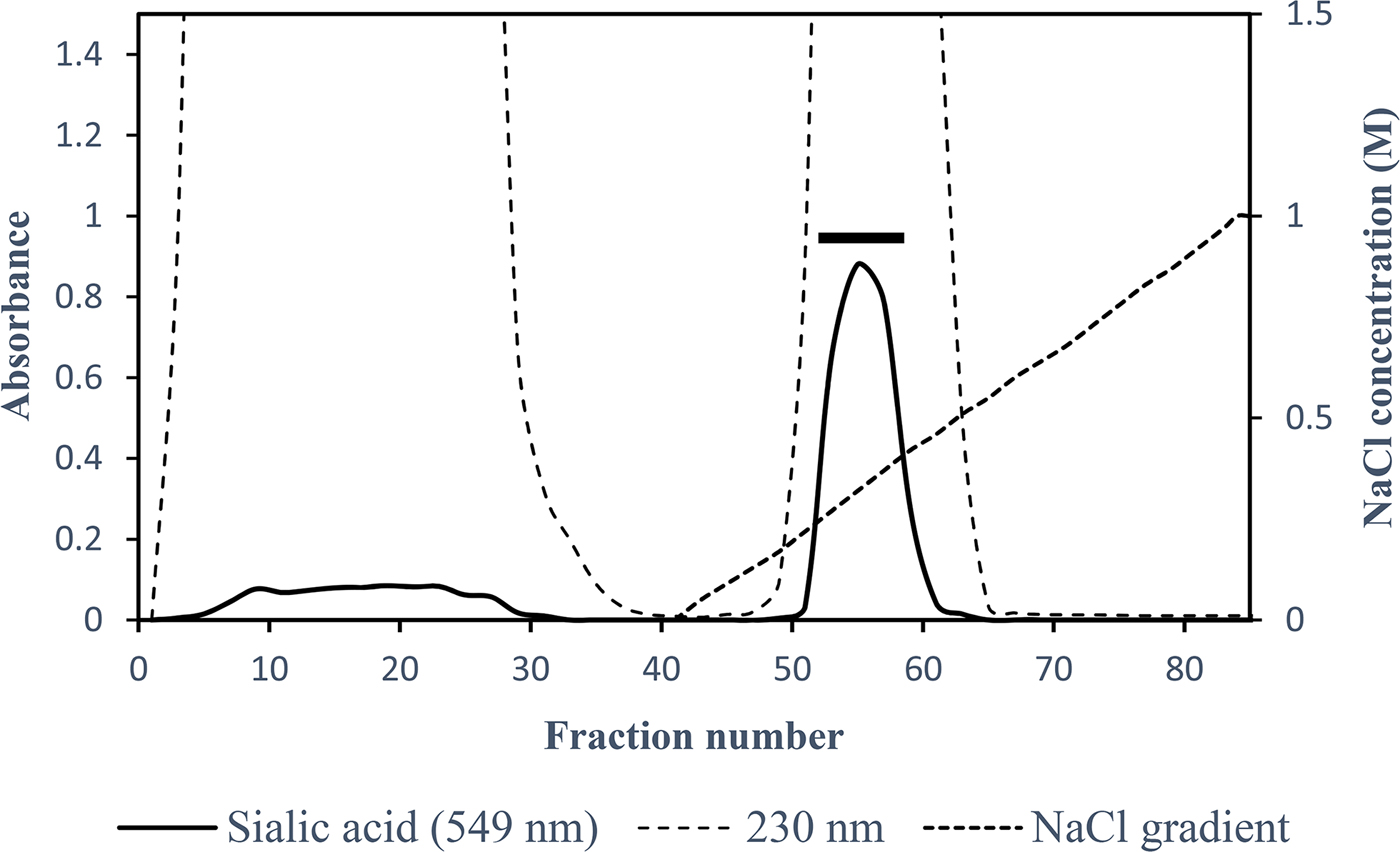
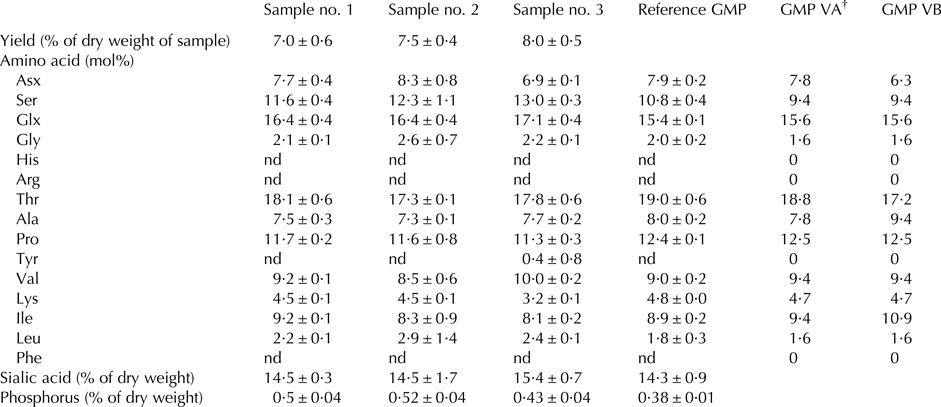
The supernatant collected after removal of precipitates I and II from each SWPP sample was then chromatographed on a column of DEAE-Sephacel (Fig. 1). The elution pattern monitored for sialic acid or peptide (absorbance at 230 nm) was similar among the samples. Most (>70%) of GMP sialic acid bound to DEAE-Sephacel and eluted in a single peak at 0·3 − 0·6 m NaCl. The yield of GMP fraction was similar (P > 0·05) among SWPP samples accounting for average 7·5 ± 0·5% of dry weight of sample (Table 1). Amino acid composition of each GMP fraction was similar to that of reference GMP, and also fairly comparable to the theoretical amino acid composition of GMP (Table 1). Thus, GMP fractions from all SWPP samples contained no detectable level of phenylalanine, arginine and histidine, which are amino acids not found in GMP. The sialic acid or phosphorus concentration in GMP fraction (Table 1) was in general similar among the SWPP samples, and also similar to that of reference GMP.
Chromatography of soluble fraction of SWPP sample no. 1 on a 1·5 cm × 5·8 cm column of DEAE-Sephacel. Fractions (~2 ml) collected were monitored for ultra violet absorbance at 230 nm and for sialic acid. The horizontal bar denotes the fractions that were pooled for further study.

Analysis of GMP fractions from SWPP samples and reference GMP prepared by refining commercial sample of crude GMP

† Amino acid composition of genetic variant A (VA) or B (VB) is based on its primary structure (Eigel et al. Reference Eigel, Butler, Ernstrom, Farrel, Harwalker, Jeness and Whitney1984)
All data are expressed as mean ± sd (n = 3)
nd: not detected
The results of size exclusion chromatography on Superdex-75 showed a single peak with retention time similar among the GMP fractions averaging 22·8 ± 0·1 min, which was similar to that (22·9 min) for reference GMP, and which was close to but less than the retention time (23·6 min) of dimeric β-lactoglobulin (36·6 kDa) (chromatogram shown in Supplementary Fig. S1). These results are consistent with those reported previously (Nakano & Ozimek, Reference Nakano and Ozimek2015).
We then tested chromatographic separation of GMP without heating SWPP sample to show the importance of clearing as much impurities as possible from sample before chromatography. Sample no. 1 was used to prepare whey protein suspension as described above. Small amounts of precipitate that occurred in the non-heated suspension and the subsequent preparation at pH 4·6 accounted for, respectively, 1·4 ± 0·03 and 0·6 ± 0·04% of dry weight of the sample. This suggested approximately 98% of the sample was soluble.
The soluble portion of the sample was then chromatographed on a column of DEAE-Sephacel. The yield of GMP adsorbed on the anion exchanger and eluted in a single peak of sialic acid averaged 4·4 ± 0·3% (n = 3) of dry weight of sample (chromatogram not shown), which was 1·7 times lower (P < 0·05) than the yield of GMP purified from sample no. 1 with heat treatment (Table 1). This was reflected by the proportion of sialic acid unadsorbed on DEAE-Sephacel (chromatogram not shown), which was higher in sample without heat treatment (54·9 ± 3·7%) compared to that with heat treatment (24·4 ± 1·0% of total recovered sialic acid, Fig. 1). It is likely that the high content of protein present in sample reduces the accessibility of sialylated phosphorylated GMP to the anion exchanger. Amino acid analysis showed presence of small amount of phenylalanine (0·3 ± 0·3 mol%, n = 3) in the GMP fraction (amino acid composition shown in Supplementary Table S3). This product could, however, be refined by re-chromatography on the same column to obtain GMP with undetectable level of phenylalanine (see amino acid composition given in Supplementary Table S3). The yield of refined GMP was high (average 98·0% of dry weight of sample applied to the column in two experiments). These results suggest that elimination of contaminants by using non-chromatographic techniques (precipitation, ultrafiltration etc.) significantly contributes to the efficiency of ion exchange chromatography with improved capacity and resolution and reduced rate of column fouling. The latter is an important factor affecting the lifetime of anion exchanger.
Finally we determined amino acids in the precipitates I and II and the product unadsorbed on DEAE-Sephacel (Supplementary Table S4). Sample no. 1 was used for this experiment. The amino acid composition was similar between precipitates I and II, but different between the unadsorbed product and precipitate I or II. For example, the content of threonine, the most abundant amino acid in GMP, was approximately twice higher in the unadsorbed product (12·4 mol%) than in precipitates I (6·4 mol%) or II (6·7 mol%). This confirms that the sample of SWPP was separated into three fractions containing: precipitated product with little GMP; GMP adsorbed on anion exchanger; and the product unadsorbed on anion exchanger. The unadsorbed product is the mixture of whey protein and GMP as shown by its amino acid composition and sialic acid peak (Fig. 1).
In conclusion, we have developed a method of purification of sialylated phosphorylated κ-casein GMP with no detectable level of phenylalanine from SWPP. The method included precipitation of a large amount of protein (accounting for average 61% of dry weight of SWPP) followed by anion exchange chromatography of soluble fraction of SWPP. The technique may be useful for the development of method of large scale production of GMP suitable as a diet for phenylketonuria patients as well as an ingredient of functional foods.
This study was supported by the grant from the Alberta Livestock and Meat Agency Ltd. We (T.N. and M.B.) are very thankful to Dr Lech Ozimek (2nd author of this manuscript) for his long time devoted contribution as a chief investigator to the κ-casein glycomacropeptide project. He passed away during preparation of this manuscript. We pray he will rest peacefully for ever.
Supplementary material
The supplementary material for this article can be found at https://doi.org/10.1017/S0022029917000838