Prior studies have established the persistent association between childhood/adolescent socioeconomic adversity and adults' health outcomes (Cohen, Janicki-Deverts, Chen, & Matthews, Reference Cohen, Janicki-Deverts, Chen and Matthews2010; Elo, Reference Elo2009, Spencer, Thanh, & Louise, Reference Spencer, Thanh and Louise2013). Particularly, research has documented that young adults who have experienced childhood/adolescent socioeconomic adversity are at higher risk for cardiometabolic (CM) disease, as indicated by elevated levels of biomarkers (Evans & Kim, Reference Evans and Kim2010; Wickrama, O'Neal, Lee, & Wickrama, Reference Wickrama, O'Neal, Lee and Wickrama2015). Furthermore, although some research has identified stressful life events (e.g., accelerated transition to adulthood) and psychosocial resources (e.g., educational attainment) as mediators of this association (Wickrama, Lee, & O'Neal, Reference Wickrama, Lee and O'Neal2015; Wickrama, O'Neal, et al., Reference Wickrama, O'Neal, Lee and Wickrama2015), these two pathways rarely have been assessed simultaneously. For instance, in a recent study using the same Add Health sample, Wickrama, Lee, O'Neal, and Kwon (Reference Wickrama, Lee, O'Neal and Kwon2015) have shown that both stress and resource trajectories of age-graded experiences link early socioeconomic adversity to CM disease risk. However, this previous study used a person-centered latent classes approach that was not compatible with a single analytical framework (thereby, indirect effects could not be tested). Furthermore, the findings were not informed by genetics as this was outside the scope of the previous work.
There is also a need for more comprehensive research incorporating potential genetic associations, particularly the serotonin transporter gene (solute carrier family C6, member 4 [SLC6A4]). Observational and experimental studies have increasingly provided evidence that polymorphisms in the promoter region of the SLC6A4 gene (i.e., serotonin transporter linked polymorphic region gene [5-HTTLPR]) are associated with developmental outcomes in both nonhumans (Lindell et al., Reference Lindell, Yuan, Zhou, Goldman, Thompson, Lopez and Barr2012) and humans (Caspi, Hariri, Holmes, Uher, & Moffitt, Reference Caspi, Hariri, Holmes, Uher and Moffitt2010; van der Doelen et al., Reference van der Doelen, Deschamps, D'Annibale, Peeters, Wevers, Zelena and Kozicz2014) by interacting with their social context (Gene × Environment [G × E] interaction effect; Risch et al., Reference Risch, Herrell, Lehner, Liang, Eaves, Hoh and Merikangas2009). The SLC6A4 gene is key for the brain's regulation of serotonin. More specifically, there are two main variants in the promoter region of this gene These variations represent a short and a long allele, and the short allele has been shown to result in lower serotonin transporter availability, which has behavioral, cognitive, and health consequences (Adkins, Daw, McClay, & Van den Oord, Reference Adkins, Daw, McClay and Van den Oord2012; Beaver, Ratchford, & Ferguson, Reference Beaver, Ratchford and Ferguson2009; Way & Taylor, Reference Way and Taylor2010). Furthermore, it has been shown to moderate the health influence of single stressors, including stressful life events (e.g., Caspi et al., Reference Caspi, Sugden, Moffitt, Taylor, Craig, Harrington and Poulton2003).
There is also reason to suspect associations between 5-HTTLPR and stressful life events and psychosocial resources, the two mediators examined in the current study, which are believed to link early adversity to subsequent physical health outcomes. More specifically, the 5-HTTLPR polymorphism has implications for emotional sensitivity and social sensitivity, as well as brain development and cognitive functioning (Battaglia et al., Reference Battaglia, Ogliari, Zanoni, Citterio, Pozzoli, Giorda and Marino2005; Borg et al., Reference Borg, Henningsson, Saijo, Inoue, Bah, Westberg and Halldin2009; Crişan et al., Reference Crişan, Pană, Vulturar, Heilman, Szekely, Drugă and Miu2009; Hariri, Drabant, & Weinberger, Reference Hariri, Drabant and Weinberger2006; Roiser et al., Reference Roiser, de Martino, Tan, Kumaran, Seymour, Wood and Dolan2009; Way & Taylor, Reference Way and Taylor2010). In addition, the 5-HTTLPR short allele is associated with negative personality traits (Anguelova, Benkelfat, & Turecki, Reference Anguelova, Benkelfat and Turecki2003). Recent research has also demonstrated that the 5-HTTLPR short allele is related to increased activity in the hypothalamus–pituitary–adrenal axis and unhealthy hormone levels, both of which may amplify the detrimental long-term physical health effects of early adversity (van der Doelen et al., Reference van der Doelen, Deschamps, D'Annibale, Peeters, Wevers, Zelena and Kozicz2014).
Taken together, this evidence suggests that youth who carry the short allele are more “sensitive” to socioeconomic adversity (i.e., “stress sensitivity”), in that they are more likely than long allele carriers to experience stress and reduced psychosocial resources in response to socioeconomic adversity (Brody et al., Reference Brody, Yu, Chen, Kogan, Evans, Beach and Philibert2013; Caspi et al., Reference Caspi, Hariri, Holmes, Uher and Moffitt2010). Thus, we expect that carriers of a 5-HTTLPR short allele have (a) enhanced stress sensitivity and increased hormonal activity, which may be associated with enhanced health effects stemming from cumulative socioeconomic adversity; (b) impaired cognitive functioning and negative personality, which together with increased stress and social reactivity may amplify stress proliferation over the early life course (e.g., cumulative socioeconomic adversity may be associated with accelerated life transitions events); and (c) at the same time, impaired cognitive functioning may also be associated with the impairment of psychosocial resource development, such as poor educational attainment (Adkins et al., Reference Adkins, Daw, McClay and Van den Oord2012; Beaver et al., Reference Beaver, Ratchford and Ferguson2009).
Thus, we expect that the 5-HTTLPR polymorphism plays a broad moderating role across multiple life domains. That is, in addition to moderating the “direct” influence of early adversity on physical health outcomes, the 5-HTTLPR polymorphism may also moderate the stress and resource pathways connecting early adversity and health. Taken together, these multiple moderating processes involving the 5-HTTLPR polymorphism could result in the amplification of direct and indirect detrimental processes beginning from cumulative socioeconomic adversity and resulting in young adults' CM disease risk. In the present study, a single analytical framework is utilized to assess indirect associations corresponding to stress and resource pathways as well as multiple genetic moderations.
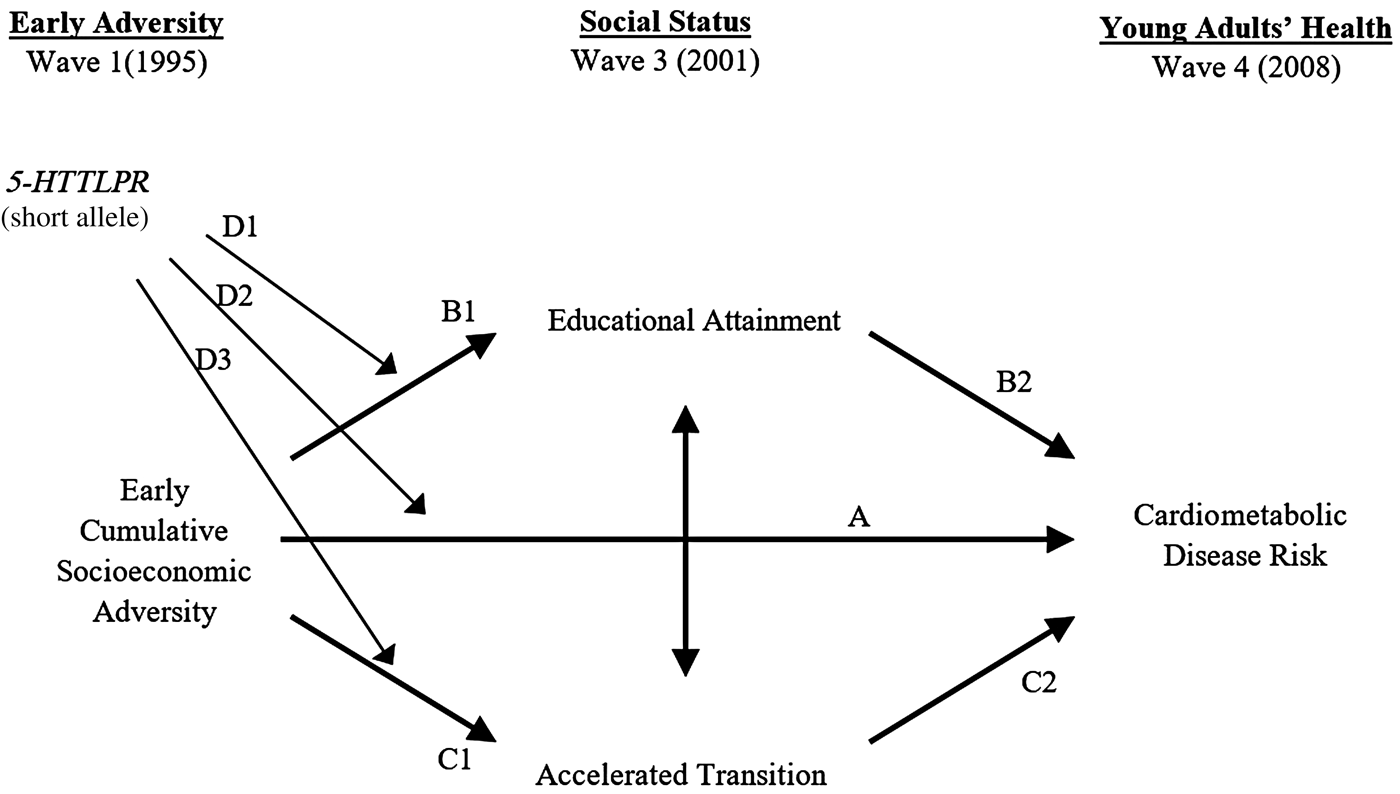
Specifically, we pursue three study objectives. As depicted by Path A in Figure 1, first, we will investigate the persistent unique associations between early cumulative socioeconomic adversity and young adults' CM disease risk, as measured by 10 biomarkers. Second, we will investigate a stress pathway (Paths B1 and B2) and a resource pathway (Paths C1 and C2) connecting early adversity to young adults' CM disease risk in the same analytical framework. In this investigation, we will focus on adolescents' educational attainment as a resource pathway and their accelerated life transitions as a potential stress pathway. Because educational attainment is related to numerous psychosocial resources, including self-esteem, self-regulation, emotion regulation, and positive components of personality (Hampson, Goldberg, Vogt, & Dubanoski, Reference Hampson, Goldberg, Vogt and Dubanoski2007; Wickrama, O'Neal, et al., Reference Wickrama, O'Neal, Lee and Wickrama2015; Zhang, Reference Zhang2003), it will be assessed as a psychosocial resource in the current study. The accelerated timing of life transition events is a central stressor during this often taxing and transitional life stage. Third, we will investigate how these pathways are modified by 5-HTTLPR genetic variations (i.e., G × E; Paths D1, D2, and D3). The study will use data from 11,030 respondents over 13 years from the nationally representative National Longitudinal Study of Adolescent to Adult Health (Add Health). We will discuss hypothesized associations in the paragraphs that follow.
Conceptual model.

Early Cumulative Socioeconomic Adversity and Stress
We expect that the accumulation of family and community socioeconomic adversities place young adults at risk for poor health outcomes. This is also consistent with the notion of “multiple risks,” which posits that when an individual is exposed to multiple adversities simultaneously, the health risk is considerably stronger than the risk of any single dimension of socioeconomic adversity (Bauman, Silver, & Stein, Reference Bauman, Silver and Stein2006; Evans & Kim, Reference Evans and Kim2010; Evans, Kim, Ting, Tesher, & Shannis, Reference Evans, Kim, Ting, Tesher and Shannis2007).
Cumulative socioeconomic adversity may increase the likelihood of youth assuming adult responsibilities prematurely (i.e., accelerated life transitions) through several mechanisms, including a lack of social support, resource limitations, a heightened stress response, increased peer and community influence, and feelings of distress (Attar, Guerra, & Tolan, Reference Attar, Guerra and Tolan1994; Sucoff & Upchurch, Reference Sucoff and Upchurch1998). We conceptualize accelerated life events as “off-time” events that deviate from the normative, anticipated timing and sequence of events (e.g., the birth of a child at an early age). Accelerated transition events are considered disruptive, which creates chronic stressful life circumstances for adolescents. Adolescents who experience such a “rush to adulthood” are often not emotionally, financially, and socially/relationally prepared to face these new life challenges and responsibilities (Foster, Hagan, & Brooks-Gunn, Reference Foster, Hagan and Brooks-Gunn2008; Wickrama, Wickrama, & Baltimore, Reference Wickrama, Wickrama and Baltimore2010).
Over time, physiological responses to chronic stressful experiences accumulate, leading to physiological dysregulation in multiple systems, or “weathering,” which places young adults at higher risk for chronic diseases (Geronimus, Hicken, Keene, & Bound, Reference Geronimus, Hicken, Keene and Bound2006) through neuroendocrine mechanisms. This includes the constant activation of the hypothalamus–pituitary–adrenal axis and the sympathetic adrenomedullary system (McEwen, Reference McEwen1998; Seeman et al., Reference Seeman, Gruenewald, Karlamangla, Sidney, Liu, McEwen and Schwartz2010).
Early Cumulative Socioeconomic Adversity and Resources
In addition to the stress pathway connecting cumulative socioeconomic adversity to CM disease risk through physiological responses to accelerated life transitions, recent studies have increasingly shown that early adversity is uniquely associated with later health outcomes through impaired development of psychosocial resources (Gallo, de los Monteros, & Shivpuri, Reference Gallo, de los Monteros and Shivpuri2009; Matthews & Gallo, Reference Matthews and Gallo2011). We focus specifically on educational attainment as the resource mediator because, as previously noted, youth educational attainment is a key psychosocial resource in this life stage.
Various dimensions of socioeconomic adversity have been shown to relate to youth educational attainment. First, highly educated and affluent parents tend to prioritize children's educational development and have access to better educational resources and support, whereas low parental education and family poverty are associated with ineffective parenting practices and less investment in children, which contributes to adolescent academic and cognitive difficulties (Conger, Ge, Elder, Lorenz, & Simons, Reference Conger, Ge, Elder, Lorenz and Simons1994; Nam & Huang, Reference Nam and Huang2009). Second, youth's educational attainment is also related to community adversity. Disadvantaged conditions are also associated with schools' lack of educational and afterschool programs and physical resources, including state-of-the-art physical spaces, equipment, and supplies (Hardy, Reference Hardy2006). Perhaps more important, early socioeconomic disadvantages, such as family and community poverty, may impair brain development, brain functioning, and cognitive capacity (Liston, McEwen, & Casey, Reference Liston, McEwen and Casey2009; McEwen & Gianaros, Reference McEwen and Gianaros2010).
Psychosocial resources, including educational attainment, also positively contribute to enhanced plasticity in limbic areas (e.g., McEwen & Gianaros, Reference McEwen and Gianaros2010), which regulate the physiological stress process. A lack of neuroplasticity can result in long-term physiological dysregulations (McEwen & Gianaros, Reference McEwen and Gianaros2010). In addition, less educated youth are more likely to engage in risky health behaviors (e.g., physical inactivity) known to increase one's health risks (McEwen & Gianaros, Reference McEwen and Gianaros2010). Thus, we expect a higher level of educational attainment will promote physiological functioning, as assessed by reduced CM disease risk.
Early Socioeconomic Adversity and Young Adults' CM Disease Risk
Although we have proposed both a resource pathway and a stress pathway linking early adversity and CM disease risk, there may be other omitted mechanisms such as early health-resource limitations that connect early adversity to later health (Ludwig et al., Reference Ludwig, Sanbonmatsu, Gennetian, Adam, Duncan, Katz and McDade2011). For example, dysregulation in physiological systems can begin early in life, as reflected by elevated levels of biomarkers, and dysregulation is linked to CM disease risk later in life (Goodman, McEwen, Huang, Dolan, & Adler, Reference Goodman, McEwen, Huang, Dolan and Adler2005). In addition, early socioeconomic disadvantage is related to defects and organ growth impairment, including detrimental changes at the molecular level and hindered brain and organ development, which drive later health outcomes (Cohen et al., Reference Cohen, Janicki-Deverts, Chen and Matthews2010; Ganzel, Morris, & Wethhington, Reference Ganzel, Morris and Wethington2010; Repetti, Robles, & Reynolds, Reference Repetti, Robles and Reynolds2011).
Interaction Between Early Cumulative Socioeconomic Adversity and 5-HTTLPR Polymorphism (G × E)
These direct and indirect effects of early adversity on CM disease risk may vary depending on an individual's genetic makeup. A handful of previous studies have examined genetic moderation of early adverse circumstances on later developmental outcomes. For example Wickrama and O'Neal (Reference Wickrama and O'Neal2013) found that the detrimental influence of mothers' marital instability on depressive symptoms and socioeconomic attainment was amplified by a cumulative genetic index (a composite measure of dopamine receptor D4 [DRD4], dopamine receptor D2 [DRD2], 5-HTTLPR, and monoamine oxidase A [MAOA] polymorphisms). The same genetic index has been shown to amplify the association between early socioeconomic adversity and young adults’ body mass index (BMI; Wickrama, O'Neal, & Oshri, Reference Wickrama, O'Neal and Oshri2014). However, to our knowledge, no study has simultaneously investigated genetic moderation of multiple pathways stemming from early cumulative socioeconomic adversity leading to CM disease. The 5-HTTLPR polymorphism is a strong candidate for this multiple moderation because, as previously discussed, its variations have implications for numerous individual tendencies including emotional, social, behavioral, and cognitive reactiveness to stressful contexts (Way & Taylor, Reference Way and Taylor2010).
Thus, in the present study, we investigate multiple genetic moderations of the 5-HTTLPR polymorphism on the direct and indirect associations between early cumulative socioeconomic adversity and CM disease risk (as measured by a composite measure of biomarkers). That is, we investigate whether adolescents’ susceptibility to an early stressful context varies depending on their 5-HTTLPR polymorphism (G × E). We expect adolescents with at least one 5-HTTLPR short allele to be more susceptible to early cumulative socioeconomic adversity by experiencing more accelerated life transitions, attaining lower levels of education, and suffering more CM disease risk than those who are not carriers of a 5-HTTLPR short allele.
Methods
Participants and procedures
Data for this study came from a nationally representative sample of adolescents participating in the National Longitudinal Study of Adolescent to Adult Health (http://www.cpc.unc.edu/projects/addhealth). In 1995, baseline (Wave 1) data were derived from a complex stratified cluster sampling of middle and high school students, yielding 20,745 respondents (mean age = 15.5 years; range 12 to 19 years at baseline) from 134 middle and high schools. The sample was stratified by school region, urbanicity, type (public/private), racial composition, and size. The second, third, and fourth waves of data were collected in 1996, 2001, and 2008, respectively (N 2 = 14,738; N 3 = 15,100; N 4 =15,701).
The present study uses data from 11,030 respondents who provided information on early adversity, life transitions, educational attainment, and biomarker data (including genetic and CM disease risk data). Attrition and missing data analysis showed that adolescents who participated in all waves were slightly younger but otherwise confirmed that there were no statistically significant differences between adolescents with missing data in our sample and those with complete data. Complete attrition analyses of the Add Health data reported only a small attrition bias from Wave 1 to Wave 4 (Brownstein et al., Reference Brownstein, Kalsbeek, Tabor, Entzel, Daza and Harris2011). The final sample consisted of approximately 53% women, and 39% of respondents reported a minority racial/ethnic status with the largest percentages reported for Blacks (16%), Hispanics (13%), and Asians (6%), respectively.
Measures
Early cumulative socioeconomic adversity
We constructed a composite measure assessing cumulative socioeconomic adversity by summing standardized continuous indicators of different adversity dimensions at Wave 1 (1995). This cumulative socioeconomic adversity index captures both material (e.g., family poverty and community poverty) and social (e.g., parents’ education) components of early socioeconomic adversity because both components have health implications for youth (e.g., Brody et al., Reference Brody, Yu, Chen, Kogan, Evans, Beach and Philibert2013). Parental education was assessed as a composite score of mothers’ and fathers’ education levels. Response options ranged from 1 = 8th-grade education or less to 10 = professional training beyond a 4-year college or university degree. The sum of five dichotomous items asking if any household member received social service benefits (1 = yes; 0 = no; e.g., social security or food stamps) captured family economic hardship. Census data from 1990 measured community adversity. Four dichotomized indicators were summed assessing high/low community proportions of families living in poverty, single-parent families, adults employed in the service industry, and unemployed men (adapted from Sucoff & Upchurch, Reference Sucoff and Upchurch1998).
Accelerated life transitions from adolescence to young adulthood
Data from Waves 3 and 4 (2001 and 2008) were used to identify respondents who experienced accelerated transitions. We operationalized most of these accelerated transitions (e.g., early sexual activities, early marriage, early cohabitation, early leaving home, and truncated education) based on US national norm ages. Events were considered precocious or accelerated if they occurred before the normative ages. A sum score was then computed indicating the total number of accelerated transitions experienced (range = 0–6).
Early sexual activity
Because the average age of first sexual intercourse is 16 years old among American males and female (Centers for Disease Control and Prevention, 2012), the onset of sex intercourse before 16 years of age was categorized as “early sex.” Respondents retrospectively reported the year that they first engaged in sexual intercourse in Wave 3 (2001).
Early marriage
Marriage before 24 years of age was categorized as “early marriage.” Utilizing Wave 3 (2001) and Wave 4 (2008) reports on marital status, duration of marriage, and the respondents’ age, we identified young adults who married before 24 years of age.
Early leaving home
Previous studies have documented that, aside from college attendance, the average age of leaving home is 21 years (Kreiter, Reference Kreiter2003). Reports (Wave 3; 2001) on the residential status (living in a separate house, apartment, trailer home, or group quarters) and year of moving were used for this classification (these reports were not available in Wave 4). Full-time college/university students were not categorized as “early leavers.” Our measure corresponds to leaving home during the adolescent years (19 years or younger) because the youngest respondents were 19 years old in 2001.
Early pregnancy
Experiencing a pregnancy (females becoming pregnant or males impregnating/fathering) before 19 years of age was classified as “early pregnancy” based on respondents’ age and their retrospective reports (Wave 3; 2001) of the year of their first pregnancy or “fathering.”
Excessive work
Youth who retrospectively reported full-time paid employment during their high school years were identified as “early workers” based on their reports at Wave 3.
Dropping out of high school
Using Wave 3 data (2003), failure to complete high school or an equivalent level of education was classified as an accelerated transition event because it generally pushes adolescents toward adult roles.
Educational attainment
Respondents’ educational attainment was assessed as a continuous variable using their highest grade, or year of schooling, completed by Wave 3 (2001). Response categories ranged from 6 = 6th grade to 22 = 5 or more years of graduate school.
Young adults’ CM disease risk
Young adults’ CM disease risk was measured by a composite index, which was computed by summing standardized, continuous scores (z scores) of 10 biomarkers of cardiovascular and metabolic systems at Wave 4 (2008; Wickrama, Lee, O'Neal, & Kwon, Reference Wickrama, Lee, O'Neal and Kwon2015). Such an aggregated biological measure captures (a) multiple system physiological dysregulation and inflammation and (b) the longitudinal context, or weathering, over the early life course (Geronimus et al., Reference Geronimus, Hicken, Keene and Bound2006). Aggregate scores of biomarkers are typically computed as the number of markers for which a participant is in the highest risk quartile. However, prior research has shown that averaging the computed z scores for each measure predicts health outcomes equally well (Seeman, Singer, Rowe, Horwitz, & McEwen, Reference Seeman, Singer, Rowe, Horwitz and McEwen1997). In addition, averaging continuous z scores more accurately reflects the continuous nature of CM disease risk. The biomarkers assessed in the current study include systolic blood pressure, diastolic blood pressure, pulse rate, glycohemoglobin, glucose, triglycerides, high-density lipoprotein, low-density lipoprotein, high sensitivity C-reactive protein level, and BMI. Systolic and diastolic blood pressure (mmHg) and pulse rate measurements were taken on the right arm, absent contraindications in a rested/seated position by trained field interviewers using oscillometric blood pressure monitors. Using standard procedures, trained and certified interviewers obtained whole blood spots for dried blood analysis. From these samples, glycohemoglobin, an integrated measure of blood glucose control over the preceding 2 to 3 months, total glucose values, triglycerides, low-density lipoprotein, high-density lipoprotein, and high sensitivity C-reactive protein level were assayed. Trained interviewers also obtained measurements of respondents’ height and weight, and this information was used to compute their BMI, the ratio of weight to height squared ([lb × 703]/in.2).
Genotype: 5-HTTLPR polymorphism
Using previously established methods, the Institute for Behavioral Genetics at the University of Colorado conducted the genotyping of Add Health DNA samples and the initial preparation of the genetic data (including analyzing the Hardy–Weinburg equilibrium of genetic sample; Harris, Halpern, Smolen, & Haberstick, Reference Harris, Halpern, Smolen and Haberstick2006). The 5-HTTLPR polymorphism was examined in the current study. Subjects were genotyped for the short 5-HTTLPR allele of SLC6A4 (12-base pair repeat), and the polymorphism was coded dichotomously such that a value of 1 indicated that the individual had at least one short allele. A value of 0 indicated that the individual did not have any copies of the short allele. For the current sample, the Hardy–Weinberg equilibrium assumption was met (v 2 = 4.20, p = .04).
Control variables
Because previous research has documented that adolescents’ developmental outcomes (e.g., accelerated life transition events and educational attainment) as well as their health risk vary depending on their gender and race/ethnicity, we controlled for these demographic characteristics in the model. At Wave 1, adolescents reported their race/ethnicity. Dichotomous variables were then created to assess Black, Hispanic, Asian, and White racial/ethnic statuses. The dichotomous variables for each of the minority statuses were included as independent variables in the regression equation resulting in regression coefficients that can be interpreted with reference to Whites. For multiracial respondents, only their first choice of race/ethnicity category was considered. Gender was coded as male (0) or female (1).
Data analysis
Mplus software (7.0; Muthén & Muthén, Los Angeles, CA) was used for all analyses. We tested the conceptual model using path analysis in a structural equation modeling framework. We computed product terms from the 5-HTTLPR polymorphism variable and the early socioeconomic adversity variable to test for G × E interaction effects. The two mediators (educational attainment and accelerated life transitions) were allowed to correlate in the model to account for their association with each other. We utilized individual sample weights from Wave 1 to account for oversampling of smaller population groups. The TYPE = COMPLEX command was used to account for potential bias in standard errors and chi-square computations due to the lack of individual independence between observations within schools in the Add Health data. Missing data were accounted for using full information maximum likelihood procedures (Enders & Bandalos, Reference Enders and Bandalos2001).
Because Kendler (Reference Kendler, Kendler, Jaffee and Romer2011) noted that gene–environment correlations may generate spurious G × E results, we utilized residual scores for the cumulative adversity variable adjusting for 5-HTTLPR to ensure that G × E findings were not confounded with gene–environment correlations, even though there was only a small correlation between the 5-HTTLPR variable and the cumulative socioeconomic adversity measure (r = .02). Similarly, we also utilized residual variables for race/ethnicity to account for associations with 5-HTTLPR and minimize the likelihood that associations between race/ethnicity and the phenotypes examined resulted from population stratification.
Results
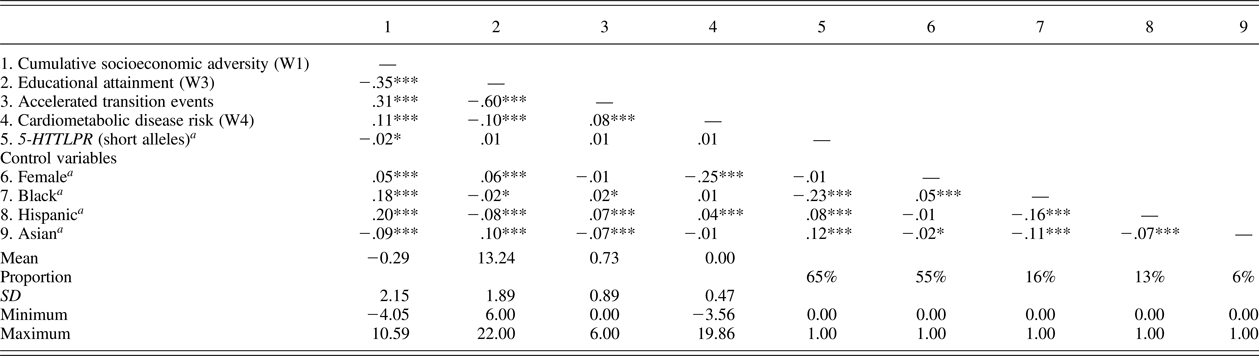
Descriptive statistics and correlations among study variables are shown in Table 1. On average, respondents experienced little cumulative socioeconomic adversity during, and leading up to, adolescence (Wave 1; 2008; M = –0.29, SD = 2.13), although there was a notable amount of variation in experiences with adversity. The computed CM disease risk index, which is the sum of standardized scores from 10 biomarkers, had a large amount of variation (–3.23 to 5.98 SD units).
Descriptive statistics and correlations among study variables

Note: W1, W3, W4, Waves 1, 3, 4; 5-HTTLPR, serotonin transporter linked polymorphic region gene.
a Point-biserial correlation coefficients.
*p < .05. ***p < .001.
Stress and resource pathways
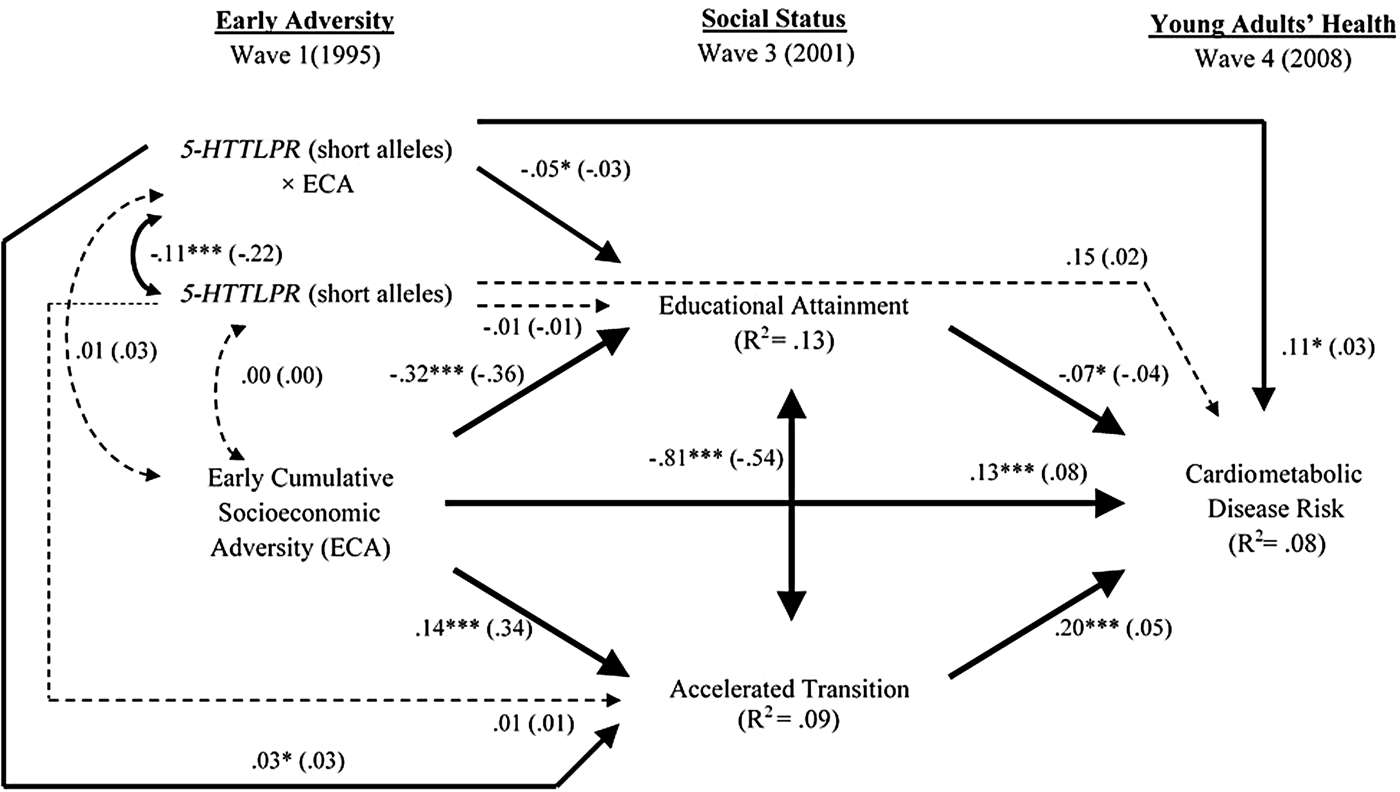
The conceptual model illustrated in Figure 1 was tested in a structural equation modeling framework in order to capture the simultaneous, yet independent, mediating stress and resource pathways (see Figure 2) as well as the presence of G × E interactions between 5-HTTLPR alleles and early cumulative socioeconomic adversity. As expected, findings supported both of the proposed mediating pathways.
Developmental processes leading to cardiobmetabolic disease risk in young adulthood and genetic amplifications. Standardized coefficients are shown in parentheses. The covariances (correlations) between races/ethnicities and cumulative adversity and serotonin transporter linked polymorphic region gene (5-HTTLPR) were zero because of our use of residualized variables. The effects of gender and race/ethnicity are provided in the text. χ2 (df) = 0.00 (0); comparative fit index/Tucker–Lewis index = 1.00/1.00, root mean square error of approximation = 0.00. *p < .05. **p < .01. ***p < .001.

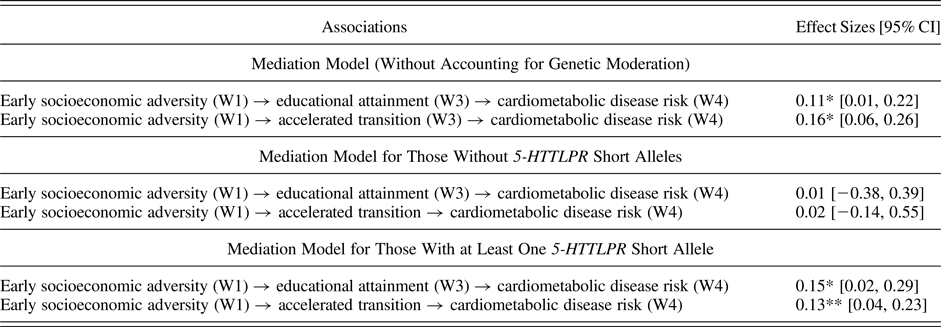
On average, early cumulative socioeconomic adversity at Wave 1 (1995) when the average age of respondents was 15.5 years was associated with experiencing more accelerated transition events and attaining less formal education compared to respondents who experienced little socioeconomic adversity (β = 0.14 and –0.32, respectively). In turn, youth with greater educational attainment, compared to those with less educational attainment, were at lower risk for CM disease (β = –0.07), whereas youth who experienced a high number of accelerated transition events, compared to those with fewer accelerated transition experiences, were at greater risk for CM disease (β = 0.14). The statistical significance of these mediating, or indirect, effects were analyzed using a bootstrapping approach with 1,000 replications (see Table 2). The results indicated that both of these mediating pathways linking early cumulative socioeconomic adversity to CM disease risk in young adulthood were statistically significant.
Indirect effect results utilizing a bootstrapping approach with 1,000 replications
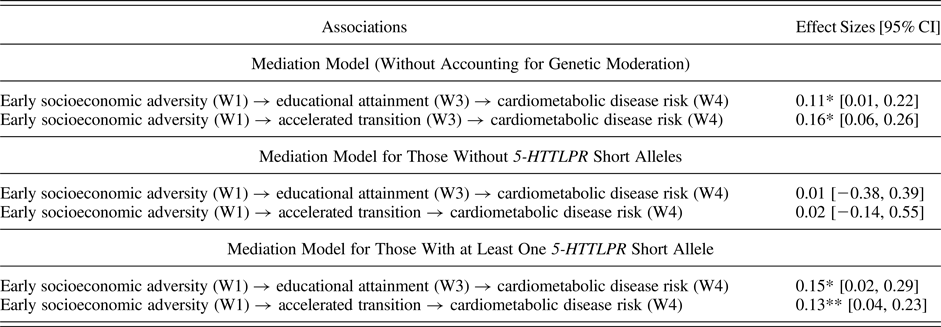
Note: Standardized coefficients are shown. W1, W3, W4, Waves 1, 3, 4; 5-HTTLPR, serotonin transporter linked polymorphic region gene.
*p < .05.
Even after accounting for these two pathways, early cumulative socioeconomic adversity remained significantly associated with young adults’ CM disease risk (β = 0.13). Educational attainment and the occurrence of accelerated transitions were also negatively associated with each other (r = –.54).
Genetic moderating effects
Our integrated conceptual framework also incorporated potential G × E effects between 5-HTTLPR alleles and early cumulative socioeconomic adversity. In particular, we assessed the presence (or absence) of one or more 5-HTTLPR short alleles. Although we assessed for the possibility of direct effects of 5-HTTLPR on educational attainment, accelerated transitions, and CM disease risk, none of these associations were statistically significant.
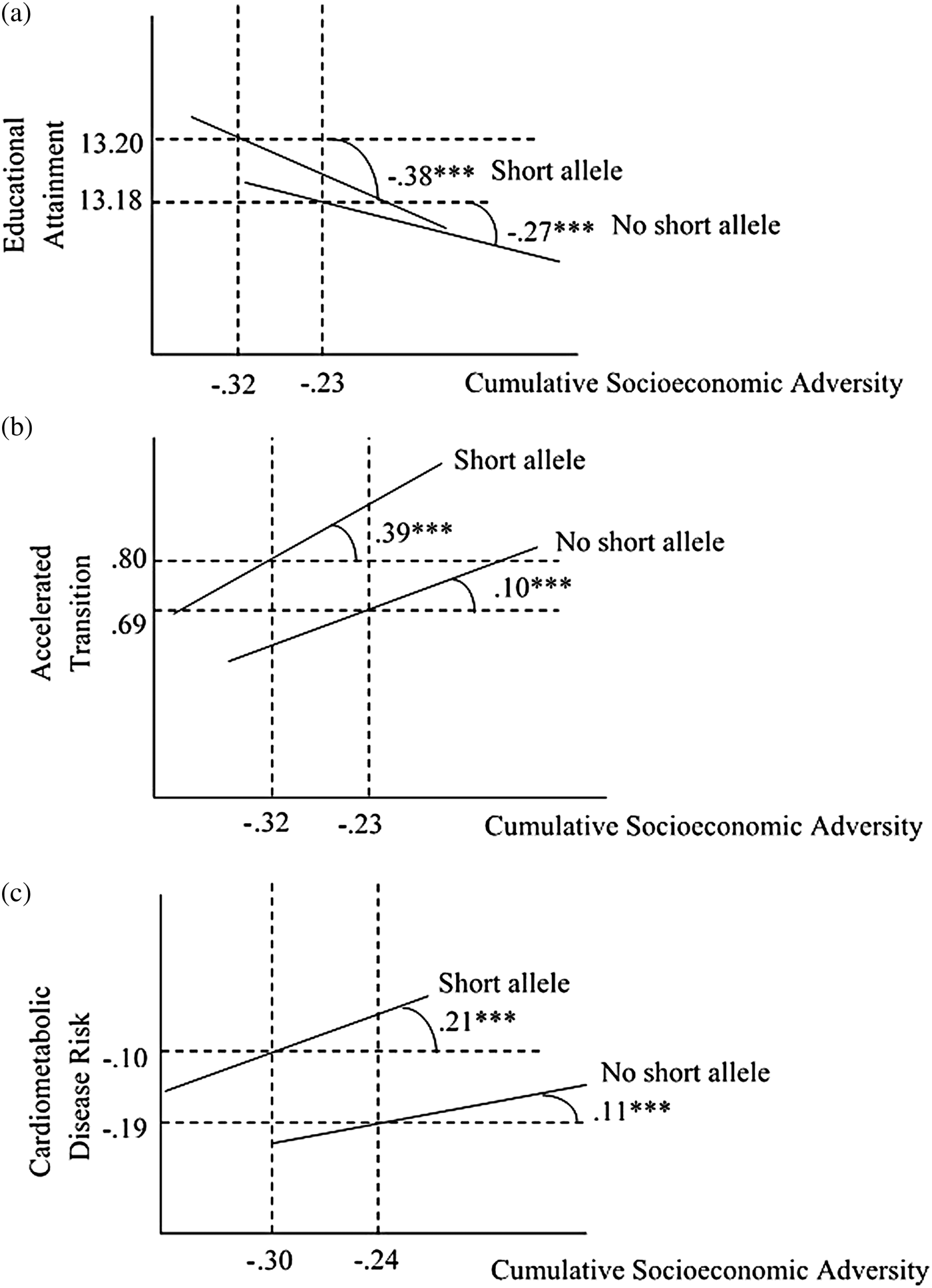
As shown in Figure 2, the product term between early socioeconomic adversity and the variable assessing the presence of one or more 5-HTTLPR short alleles explained a statistically significant amount of variation in accelerated transition events (β = 0.03), educational attainment (β = –0.05), and CM disease risk (β = 0.11). Post hoc analyses were conducted to more fully assess these statistically significant G × E effects. More specifically, mean (±1 SD) splits were utilized to divide respondents into high and low cumulative socioeconomic adversity groups, and the associations between these two adversity groups and the three developmental outcomes of interest (accelerated transitions, educational attainment, and CM disease risk) were then examined separately for “carriers” and “noncarriers” of the 5-HTTLPR short allele.
As shown in Figure 3, stronger associations were noted for carriers of a 5-HTTLPR short allele than noncarriers for each of the three developmental outcomes assessed. Thus, the 5-HTTLPR short allele appears to increase respondents’ sensitivity to the detrimental effects of early cumulative socioeconomic adversity.
Moderating effects of serotonin transporter linked polymorphic region gene (5-HTTLPR) with early cumulative socioeconomic adversity on (a) educational attainment, (b) accelerated transition events, and (c) cardiometabolic disease risk. Unstandardized coefficients are shown. **p < .01. ***p < .001.

Supplementary analyses: Assessing individual biomarkers and mental health effects
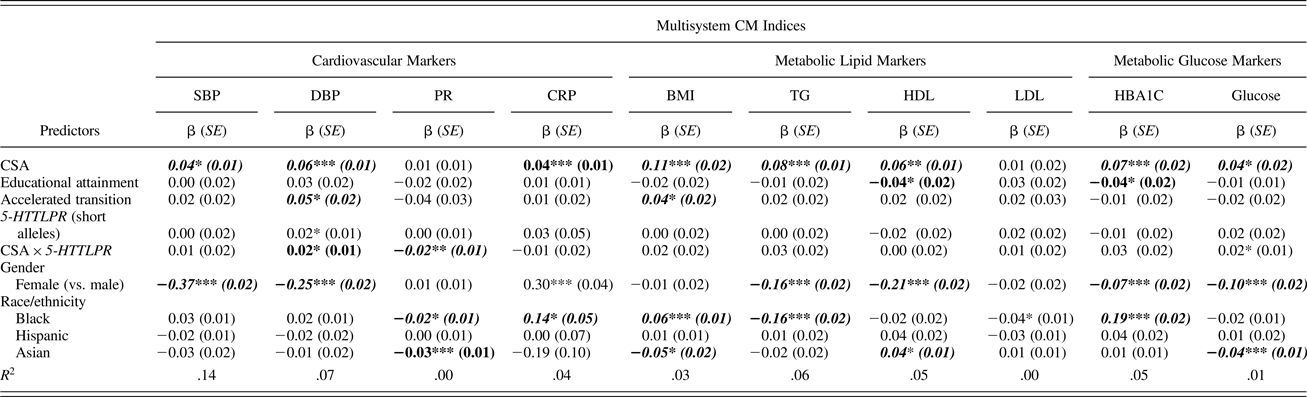
As a supplementary analysis, we tested the model in Figure 2, using each biomarker separately as the outcome variable. As presented in Table 3, the associations between biomarkers and cumulative socioeconomic adversity, educational attainment, and accelerated life transition, as well as genetic moderation, were statistically significant in some instances. Most of the associations were in the expected direction. This suggests that small effects on different biomarkers, which reflect dysregulation in various physiological systems, combine to exert a larger, cumulative effect on young adults’ CM risk (assessed by our index reflecting dysregulation in multiple systems).
Influences of early CSA and 5-HTTLPR (short alleles) on 10 biomarkers of CM disease risk (standardized coefficients)
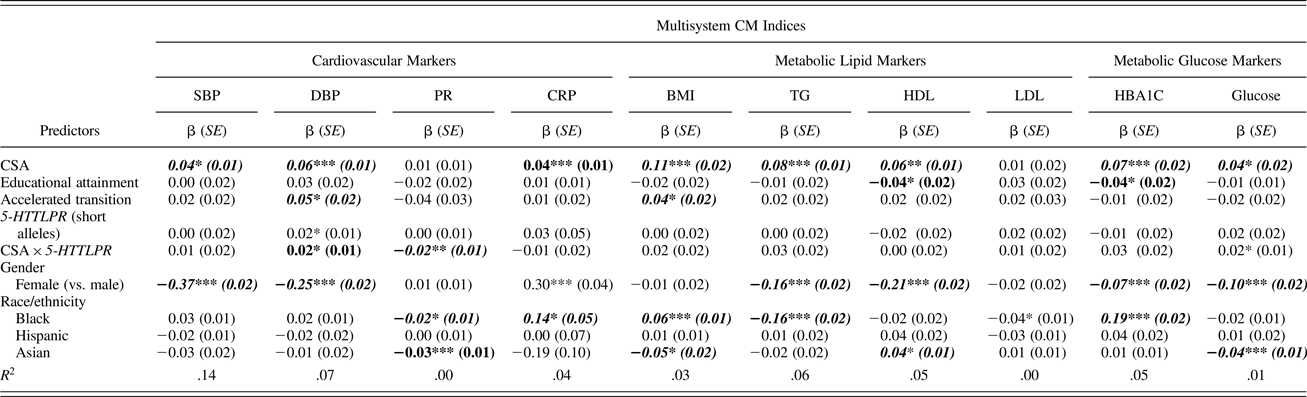
Note: All biomarkers were converted to standardized scores (z scores). Statistically significant paths are shown in bold and italic. The reference group for race/ethnicity was White. All models are fully recursive and consequently have perfect fit values. CSA, cumulative socioeconomic adversity; CM, cardiometabolic; 5-HTTLPR, serotonin transporter linked polymorphic region gene; SBP, systolic blood pressure; DBP, diastolic blood pressure; PR, pulse rate; CRP, high sensitivity C-reactive protein; BMI, body mass index; TG, triglycerides; HDL, high-density lipoprotein (reversed coded so high scores indicate unhealthy HDL); LDL, low-density lipoprotein; HBA1C, glycosylated hemoglobin.
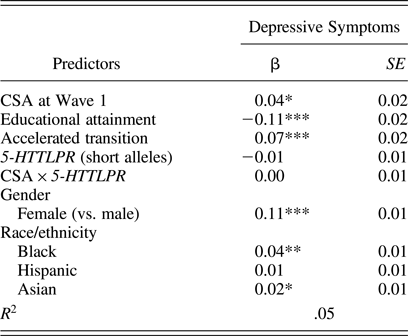
We also assessed depressive symptoms as an outcome variable, to ascertain if the proposed model predicts mental health outcomes in addition to physical health outcomes (see Table 4). Only cumulative socioeconomic adversity, educational attainment, and accelerated life transitions were related to the level of depressive symptoms at Wave 4. There were no statistically significant associations with 5-HTTLPR (direct or moderation effects). These findings indicate that the proposed model is more appropriate for explaining physical health, rather than mental health, outcomes.
Hypothesized model results explaining variation in young adults' depressive symptoms in Wave 4 in 2008
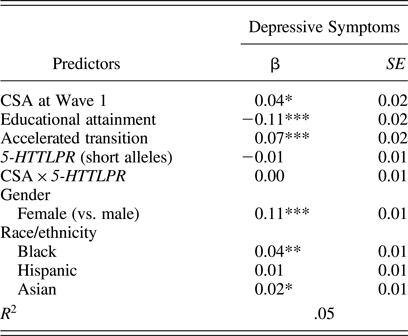
Note: CSA, cumulative socioeconomic adversity; 5-HTTLPR, serotonin transporter linked polymorphic region gene. Standardized coefficients are shown. The reference group for race/ethnicity was White. The model fits perfectly, χ2 (df) = 0.00 (0). Comparative fit index/Tucker–Lewis index = 1.00/1.00; root mean square error of approximation = 0.00.
*p < .05. **p < .01.***p < .001.
Associations with control variables
Within these analyses, we also accounted for gender and race/ethnicity as potential background characteristics that may relate to the developmental outcomes of interest. For the full model illustrated in Figure 2, compared to men, women averaged greater levels of educational attainment (β = 0.08), fewer accelerated transition events (β = –0.02), and less CM disease risk (β = –0.25). Although statistically significant racial/ethnic differences were found in the bivariate correlations (see Table 1), in this model, most racial/ethnic differences were not statistically significant with two exceptions. Asians generally reported greater educational attainment and fewer accelerated transitions compared to their White counterparts (β = 0.07 and –0.04, respectively). The lack of statistically significant racial/ethnic differences may be due to the race/ethnicity variables being confounded with the cumulative adversity measure.
Discussion
Although previous research has documented the link between early socioeconomic adversity and later physical health risk (Bauman et al., Reference Bauman, Silver and Stein2006; Evans & Kim, Reference Evans and Kim2010), less is known about how stressful experiences as a youth and available resources simultaneously mediate this association over the early life course. Thus, the present study incorporated both youth educational attainment and accelerated life transitions along with early socioeconomic adversity in an integrated theoretical model to explain variation in young adults’ CM disease risk. More important, the present study investigated the G × E interaction between 5-HTTLPR and early socioeconomic adversity on the stress and resource pathways stemming from early cumulative socioeconomic adversity and leading to health risks in young adulthood.
First, our examination of a “stress pathway” explored how adolescents’ accelerated life transitions follow from early socioeconomic adversity and lead to increased CM disease risk in young adulthood. The stress pathway is consistent with the life course notion of a “chain of risks” over the life course (O'Rand & Hamil-Luker, Reference O'Rand and Hamil-Luker2005). Second, our examination of a “resource pathway” assessed educational attainment as a mechanism linking early socioeconomic adversities to young adults’ increased CM disease risk. Thus, within an integrated model, the study provided evidence for independent stress and resource mechanisms connecting early socioeconomic adversity to CM disease risk in young adulthood.
The results also provided evidence for the unique direct relationship between early socioeconomic adversity and young adults’ CM disease risk even after accounting for youth stress and resource pathways. That is, part of the long-term association between early socioeconomic adversity and young adults’ health risk may operate through hampered brain and organ development as well as through early-developing psychological and biological response patterns to stress (Cohen et al., Reference Cohen, Janicki-Deverts, Chen and Matthews2010; Ganzel et al., Reference Ganzel, Morris and Wethington2010; Repetti et al., Reference Repetti, Robles and Reynolds2011).
In addition, the results indicated that the 5-HTTLPR polymorphism interacts with a stressful context (early socioeconomic adversity) to amplify these developmental processes. These findings are consistent with other research indicating that the impact of specific environments and context–gene interplay on an individual phenotype may not be observed until a later life stage because the strength of G × E effects likely increases from childhood to young adulthood. Thus, the present study examined these G × E associations by locating them in a comprehensive life course model, thereby allowing the environments and gene assessed to “act in concert” over the life course rather than examining gene–environment interactions in an isolated manner. The study findings show that 5-HTTLPR polymorphisms amplify multiple aspects of the life course process leading to young adults’ CM disease risk. In particular, the present findings provide evidence to suggest that genetic influences are age sensitive. The observed G × E interactions in the present study occurred during early to middle adolescence. In late adolescence/young adulthood, no genetic moderation was observed. Thus, the present findings provide important clues for future epigenetic developmental studies.
We measured CM disease risk using a cumulative index comprising 10 biomarkers. In previous studies, phenotypes have often been assessed by self-reports (e.g., depression or anxiety); the present study's use of clinical measures of disease risk as a phenotype is a strength and one of its novel contributions to existing research. This cumulative CM disease risk measure captures physiological changes over time, which frequently stem from stress exposure (Evans & Schamberg, Reference Evans and Schamberg2009). Although these physiological changes can take considerable time to manifest, and are often subtle in nature, their combination can exact a huge health toll. Similar composite measures of biomarkers (i.e., allostatic load measures) are valid predictors of subsequent morbidity and mortality (Juster, McEwen, & Lupien, Reference Juster, McEwen and Lupien2010).
While the focus of this study is on the early life span, concluding with our measurement of disease risk in young adulthood, these findings can have long-term implications at subsequent life stages. Consequently, these findings of multiple mechanisms explaining young adults’ CM disease risk (including a direct impact of socioeconomic adversity as well as resource, stress, and genetic associations) are influential for subsequent life stages as the findings point to early life contexts that potentially place individuals on an expedited path toward disease, disability, and, ultimately, premature death.
Note that other research has been critical of G × E interaction studies, particularly studies examining candidate genes, such as the 5-HTTLPR polymorphisms, as genetics research is increasingly relying on genome-wide association studies. However, there is a large volume of research on 5-HTTLPR showing the consistent association between this polymorphism and individual tendencies. More generally, a major limitation of most existing candidate gene studies is small effect sizes. Nevertheless, a study by Reitveld et al. (Reference Rietveld, Medland, Derringer, Yang, Esko, Martin and Koellinger2013), published in Science, has reported that three alleles are associated with educational attainment with small estimated effect sizes (R 2 ≈ 0.02% per allele). Yet, a linear cumulative index from all measured alleles accounted for ≈2% of the variance in both educational attainment and cognitive function. Moreover, small genetic effects on developmental processes over the early life course may culminate in sizable health effects later in life.
Furthermore, Reitveld et al. (Reference Rietveld, Medland, Derringer, Yang, Esko, Martin and Koellinger2013) argue that these findings, although small in magnitude, provide promising candidate alleles for follow-up work, and their effect size estimates can anchor power analyses for future research. In the same vein, we believe that the current study will generate evidence for potential candidate genes that may additively (G) and interactively with the environment (G × E) modify early socioeconomic life course processes leading to young adult CM disease risk for future studies.
Several factors potentially limit the scope and generalizability of the results. First, enhanced measures would increase the confidence that can be placed in these findings. Replication using more objective measures (e.g., official documents for educational attainment, birth records, and marriage licenses) is needed. In addition, our measure of accelerated transitions relied primarily on retrospective reports, which may be subject to memory errors. Second, potential confounding variables may exist that were not considered in the present study. One recent study has shown that sexual minority status (lesbian, gay, or bisexual) moderates the association between stressful life events and allostatic load. Consequently, future studies should investigate this moderating effect of sexual minority status in relation to current study findings (Hatzenbuehler, Slopen, & McLaughlin, Reference Hatzenbuehler, Slopen and McLaughlin2014). Third, other than G × E effects, we did not examine potential moderating effects, which may protect youth from the detrimental health effects of early socioeconomic adversity and stressful life transitions. In particular, because of the lack of available data, we did not examine neuroendocrine markers as a mediator of these effects. Fourth, recent studies show that the epigenetic state of genes can be modified by the environment. That is, genes can be “turned on” or “turned off,” depending on the individual's environment and experiences (Shanahan & Hofer, Reference Shanahan, Hofer, Binstock and George2011). Particularly in the early life course, environmental factors may contribute to changes in gene expression (Whitelaw & Whitelaw, Reference Whitelaw and Whitelaw2006). It is unclear how such epigenetic effects impact the current findings because very little research has assessed these effects for the 5-HTTLPR polymorphism.
The findings from the present study contribute to existing literature by demonstrating that both stress and resource pathways connect adolescents’ socioeconomic adversity with their CM disease risk as young adults. This is a compelling finding because it indicates that the impact of life stressors and resources are not the reverse of each other, and life stressors and resources have unique health associations. Consequently, the findings suggest psychosocial and health models should be broadened to incorporate both stress and resource experiences simultaneously. Further, the present study also examined genetic moderation of the influence of cumulative socioeconomic adversity on mental health risk (i.e., depressive symptoms) in addition to CM disease risk. The results show important differential genetic moderation of cumulative socioeconomic adversity influence for mental and physical health risk. To our knowledge, no study has examined life course models with G × E interactions for both a mental and physical health outcome, which allows for an examination of these differences.
Significant G × E interactions in the current findings reflect the moderating (or amplifying) role of adolescent life experiences on subsequent health outcomes for individuals with a 5-HTTLPR short allele. In sum, this specific gene variation appears to amplify early life course processes stemming from stressful contexts and leading to young adult CM disease risk. Because of the increased availability of genetic data in developmental research, life course and health researchers alike should extend this line of research to enhance our understanding of health over the life course.