1. INTRODUCTION
Creativity is defined as the ability to develop concepts or ideas, or produce works (solutions) that are both novel and valuable (useful and appropriated; Sternberg & Lubart, Reference Sternberg, Lubart and Sternberg1999; Sarkar & Chakrabarti, Reference Sarkar and Chakrabarti2007). The creative design process may be inhibited by a focus on existing, standard solutions or variants of existing solutions, that is, by becoming fixated. Fixation can be triggered by diverse causes, such as a designer's unfamiliarity with or limited knowledge of analogous fields of study, cognitive blocks, difficulty in identifying new applications and functions, and familiarity with existing, feasible, and known sets of solutions.
Fixation is a phenomenon that is perceived as unwanted due to its conceptual conflicts with creativity and design. Fixation and its effects in the design process across knowledge domains have been a subject of study from a research and practical viewpoint. Such research has attempted to understand and avoid the negative impact that design fixation may have in the early stage of ideation, for example, limiting design space exploration, and thereby narrowing the range or divergent possibilities of solutions.
A number of methods have been developed to tackle design fixation. One class of such methods is design by analogy (DbA), which has proven to be effective in generating novel and high-quality ideas, as well as in reducing design fixation (Linsey et al., Reference Linsey, Clauss, Wood, Laux and Markman2007, Reference Linsey, Markman and Wood2012; Moreno, Hernandez, et al., Reference Moreno, Hernandez, Yang, Otto, Hölttä-Otto, Linsey and Linden2014; Moreno, Yang, Blessing, et al., Reference Moreno, Yang, Blessing and Wood2014). A cognitive model for ideation considers ideas to emanate from one of three sources or processes: serendipity, discovery, and analogy (Markman & Wood, Reference Markman and Wood2009). Analogy or analogical transfer appears to support designers in identifying and reaching distant domains that enable the exploration of innovative or disruptive solutions based on experience or external sources of inspiration and knowledge.
Despite being a critical topic and investigated from diverse perspectives, design fixation remains a relatively unexplored and intriguing area of research and exploration, especially in knowledge domains such as engineering. There is still much to learn about the capabilities and success factors of de-fixation approaches, as well as, more generally, the extent to which design fixation can limit or benefit the design process.
Based on the discussion above, the present study expands previous work presented in the Design Computer and Cognition Conference (DCC'14; Moreno, Yang, Hernandez, et al., Reference Moreno, Yang, Hernandez, Linsey and Wood2014) and addresses the following research questions related to fixation in the context of ideation methods. First, what are the dimensions of de-fixation approaches and to what extent has a cumulative understanding of these approaches been developed? Second, are design fixation metrics comprehensive? Do they capture fixation's concept and extent? Third, considering analogy as a relevant source of ideas and an approach to overcome design fixation, what are the results of applying two different DbA methods (WordTree and SCAMPER) for overcoming design fixation? Are there differences in the creativity and fixation metrics after applying the methods?
2. BACKGROUND AND CONTEXT
2.1. Design fixation
Various definitions of fixation can be found in literature with different characteristics depending on its context or field of knowledge. Examples of fixation include memory fixation, problem-solving fixation (Luchins & Luchins, Reference Luchins and Luchins1959), cognitive fixation (Smith & Blankenship, Reference Smith and Blankenship1991), conceptual fixation, knowledge fixation (Youmans & Arciszewski, Reference Youmans and Arciszewski2012), operational fixation, functional fixation (Purcell & Gero, Reference Purcell and Gero1996), and design fixation (Jansson & Smith, Reference Jansson and Smith1991; German & Barrett, Reference German and Barrett2005).
Design fixation is described as the inability on the part of designers to solve design problems, or the persistent commitment to a limited exploration of alternatives by self-imposing constraints (Youmans, Reference Youmans2007), employing a familiar method ignoring diverse opportunities, or limiting the space of solutions by means of developing variants (Luchins & Luchins, Reference Luchins and Luchins1959, Reference Luchins and Luchins1970; Jansson & Smith, Reference Jansson and Smith1991). Jansson & Smith (Reference Jansson and Smith1991) provided one of the first operational definitions of design fixation as “a counterproductive effect of prior experience on the generation of creative designs aimed at solving a realistic problem.” These studies indicate that design fixation has a negative connotation, which may explain the research related to fixation and concerted efforts to avoid it when solving design problems.
A number of causes can contribute to design fixation: expertise (Linsey et al., Reference Linsey, Tseng, Fu, Cagan, Wood and Schunn2010), unfamiliarity with principles of a discipline or domain knowledge (Purcell & Gero, Reference Purcell and Gero1996; Cross, Reference Cross2004), personality types (Toh et al., Reference Toh, Miller and Kremer2012; Choo et al., Reference Choo, Lou, Camburn, Wood and Grey2014), a lack of awareness of technological advances, or conformity due to proficiency in the methods and supporting technologies of an existing solution (Luchins & Luchins, Reference Luchins and Luchins1959).
During the design process, design fixation can emerge when example solutions are presented (Christensen & Schunn, Reference Christensen and Schunn2007; Tseng et al., Reference Tseng, Moss, Cagan and Kotovsky2008; Jensen, Reference Jensen2010; Linsey et al., Reference Linsey, Tseng, Fu, Cagan, Wood and Schunn2010; Agogué et al., Reference Agogué, Kazakçi, Weil and Cassotti2011; Smith & Linsey, Reference Smith and Linsey2011), when a considerable quantity of resources are invested in a potential solution (Viswanathan & Linsey, Reference Viswanathan and Linsey2011), when there are weak or ill-defined problem connections either internally (within elements of the problem) or externally (between the problem and other problem domains; MacCrimmon & Wagner, Reference MacCrimmon and Wagner1994), and when there are more vertical (refined version of same idea) than lateral transformations (moving from one idea to another; Goel, Reference Goel1995).
Design fixation research is critical due to both its impact on design outcomes and the potential, if mitigated, to improve designers’ abilities to generate innovative solutions. Studies from diverse design disciplines, engineering, and cognitive science provide findings across a number of fields, as described below.
2.2. Ideation approaches to overcome fixation
Design process success has been linked with ideation stage results (Andersson, Reference Andersson1994; Perttula & Sipilä, Reference Perttula and Sipilä2007). Extensive studies have focused on the formulation of metrics to evaluate ideation process and their outcomes: quality, quantity (fluency), novelty (originality), workability (usefulness), relevance, thoroughness (feasibility), variety, and breadth (MacCrimmon & Wagner, Reference MacCrimmon and Wagner1994; Shah et al., Reference Shah, Kulkarni and Vargas-Hernandez2000; McAdams & Wood, Reference McAdams and Wood2002; Shah et al., Reference Shah, Smith and Vargas-Hernandez2003; Srivathsavai et al., Reference Srivathsavai, Genco, Hölttä-Otto and Seepersad2010; Girotra et al., Reference Girotra, Terwiesch and Ulrich2010; Linsey et al., Reference Linsey, Clauss, Kortoglu, Murphy, Wood and Markman2011, Reference Linsey, Markman and Wood2012; Oman et al., Reference Oman, Tumer, Wood and Seepersad2013; Moreno, Hernandez, et al., Reference Moreno, Hernandez, Yang, Otto, Hölttä-Otto, Linsey and Linden2014). Some studies have considered design fixation directly measurable in a quantitative way, and others as a qualitative finding or measured indirectly through other ideation metrics.
Based on recent ideation studies we developed the framework shown in Figure 1 to characterize the existing approaches that have shown some effectiveness in overcoming design fixation. This framework is composed of quadrants that are defined by means of two dimensions:
• trigger or source provided by a method, which is divided into intrinsic and extrinsic and
• implementation method corresponding to the number of designers involved, either individual or as a team.
Approaches to overcome fixation.

Some methods can be found at the intersection of the dimensions presented; for example, functional analysis is an extrinsic method that can be applied individually or as a team.
The next sections describe the modalities and cognitive processes behind each of the intrinsic and extrinsic approaches.
2.2.1. Intrinsic approaches
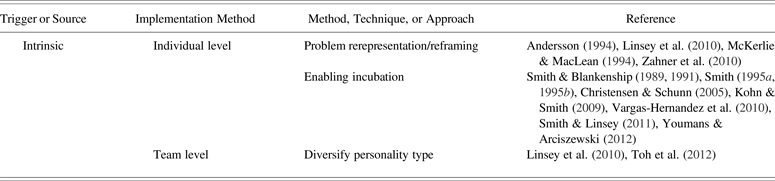
Intrinsic approaches are based on the generation of ideas from intuition or previous experience. Table 1 presents the approaches and related literature for the two quadrants of the intrinsic dimension of Figure 1.
Intrinsic approaches to overcome fixation according to Moreno et al. Reference Moreno, Yang, Blessing and Wood2014
At the individual level, problem rerepresentation or reframing increases retrieval cues for analogical inspiration or expands design space exploration (Andersson, Reference Andersson1994; McKerlie & MacLean, Reference McKerlie and MacLean1994; Linsey et al., Reference Linsey, Tseng, Fu, Cagan, Wood and Schunn2010; Zahner et al., Reference Zahner, Nickerson, Tversky, Corter and Ma2010). Incubation encourages the disconnection from a problem by taking a break or performing a nonrelated task, and by doing that, the individual may access other critical information where insightful ideas may emerge, enabling the development of novel or original solutions (Smith & Blankenship, Reference Smith and Blankenship1989, Reference Smith and Blankenship1991; Smith, Reference Smith, Sternberg and Davidson1995b; Christensen & Schunn, Reference Christensen and Schunn2005; Kohn & Smith, Reference Kohn and Smith2009; Vargas-Hernandez et al., Reference Vargas-Hernandez, Shah and Smith2010; Smith & Linsey, Reference Moreno, Yang, Hernandez, Linsey and Wood2011; Youmans & Arciszewski, Reference Youmans and Arciszewski2012).
At the team level, diversify personality type relates to the way people prefer to interact with others. This approach has been found to have a positive impact on design activities. For example, extroverted persons have a preference to participate in dissection activities that have the potential to increase creativity (Linsey et al., Reference Linsey, Tseng, Fu, Cagan, Wood and Schunn2010; Toh et al., Reference Toh, Miller and Kremer2012).
2.2.2. Extrinsic approaches
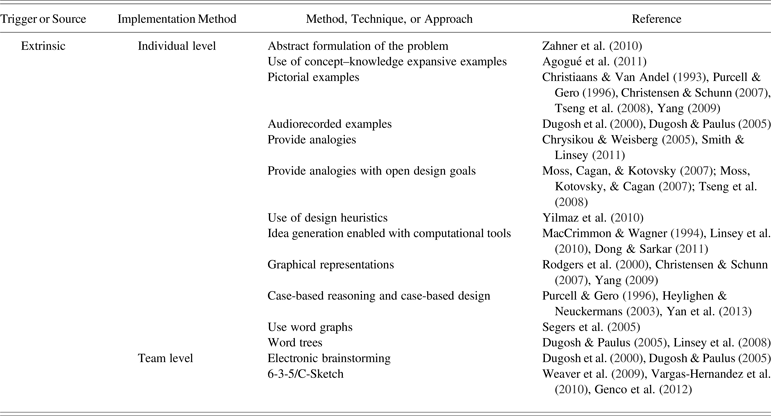
Extrinsic approaches make use of heuristics, stimuli/assistance, or prompts external to the designer to promote the development of ideas (see Table 2).
Extrinsic approaches to overcome fixation according to Moreno et al. Reference Moreno, Yang, Blessing and Wood2014
At the individual level, abstract formulation of a problem is proposed to promote divergent thinking processes and generation of original ideas (Zahner et al., Reference Zahner, Nickerson, Tversky, Corter and Ma2010).
Approaches that make use of examples to increase the number of original ideas generated are concept–knowledge expansive examples to allow interrelated exploration of the concept and knowledge spaces (Agogué et al., Reference Agogué, Kazakçi, Weil and Cassotti2011), pictorial examples to allow designers to consider additional design information without over constraining the design (Christiaans & Van Andel, Reference Christiaans and Van Andel1993; Purcell & Gero, Reference Purcell and Gero1996; Christensen & Schunn, Reference Christensen and Schunn2007; Tseng et al., Reference Tseng, Moss, Cagan and Kotovsky2008; Yang, Reference Yang2009), and audiorecorded examples to foster retrieval of long-term memory concepts and concepts distantly associated (Dugosh et al., Reference Dugosh, Paulus, Roland and Yang2000; Dugosh & Paulus, Reference Dugosh and Paulus2005).
Two approaches make use of analogies. The first provides analogies assists in restructuring a problem and triggers new clues to developed solutions (Chrysikou & Weisberg, Reference Chrysikou and Weisberg2005; Smith & Linsey, Reference Smith and Linsey2011). The second provides analogies with open design goals that may (due to the openness) influence cognitive processes in filtering information that will be then incorporated in the concept solutions, thereby increasing originality (Moss, Cagan, et al., Reference Moss, Cagan and Kotovsky2007; Moss, Kotovsky, et al., Reference Moss, Kotovsky and Cagan2007).
Design heuristics promote divergent thinking by providing multiple sequential and/or systematic ways to approach a problem and generate novel and original solutions (Yilmaz et al., Reference Yilmaz, Seifert and Gonzalez2010). Idea generation enabled by computational tools allows a designer or design team to alternate among types of problem representation and provides semantic or visual stimulus that will generate more productive ideas (MacCrimmon & Wagner, Reference MacCrimmon and Wagner1994; Linsey et al., Reference Linsey, Tseng, Fu, Cagan, Wood and Schunn2010; Dong & Sarkar, Reference Dong and Sarkar2011). Graphical representations offer a cognitive structure by means of external representation that highlights design complexity, condenses information, and enables lateral transformations (Rodgers et al., Reference Rodgers, Green and McGown2000; Christensen & Schunn, Reference Christensen and Schunn2007; Yang, Reference Yang2009).
Case-based reasoning (CBR) and case-based design, which is the application of CBR to design, have roots in analogical reasoning by learning from experience (Purcell & Gero, Reference Purcell and Gero1996; Heylighen & Neuckermans, Reference Heylighen and Neuckermans2003; Yan et al., Reference Yan, Zanni-Merk, Rousselot and Cavallucci2013). CBR is used to contrast existing experiences/solutions/cases with new unsolved problems to find similarities and extend existing solutions to those new problems. Word graphs (Segers et al., Reference Segers, De Vries and Achten2005) and Word trees (Dugosh & Paulus, Reference Dugosh and Paulus2005; Linsey, Markman, et al., Reference Linsey, Markman and Wood2008; Linsey, Wood, et al., Reference Linsey, Wood and Markman2008) provide a synergic combination of analogies, semantic and graphical information, computational tools, and graphical representations to generate ideas.
At the Team level, electronic brainstorming enables interaction between members by a computer interface that prompts sets of ideas for overcoming production blocking (Dugosh et al., Reference Dugosh, Paulus, Roland and Yang2000; Dugosh & Paulus, Reference Dugosh and Paulus2005). 6-3-5/C-Sketch combines “use of examples,” “use of design heuristics,” and “use of graphical representations” that provide a sequential structure with visual and textual information (Genco et al., Reference Genco, Hölttä-Otto and Seepersad2012; Weaver et al., Reference Weaver, Kuhr, Wang, Crawford, Wood and Jensen2009; Vargas-Hernandez et al., Reference Vargas-Hernandez, Shah and Smith2010).
2.2.3. Approaches at the dimension's intersections
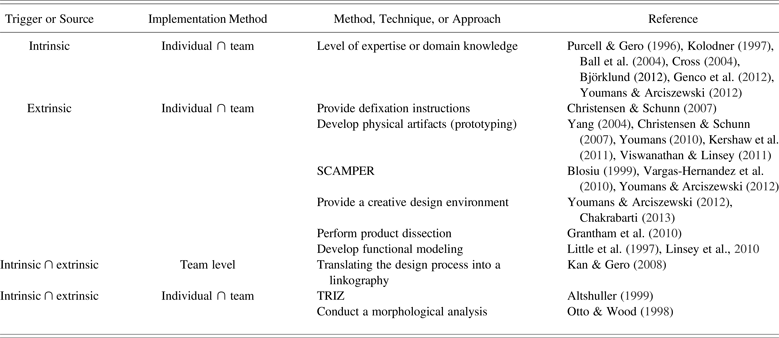
Figure 1 shows approaches that lay at the intersection of the quadrants determined by the categorization dimensions. Table 3 lists such approaches.
Approaches to overcome fixation at the intersection of categorization dimensions according to Moreno et al. Reference Moreno, Yang, Blessing and Wood2014
Level of expertise or domain knowledge can be found at the intersection of individual and team levels. Expertise emerges with a designer's immediate knowledge, and can be expanded when working in teams, by using distant and/or different domain knowledge due to interactions with others (Purcell & Gero, Reference Purcell and Gero1996; Ball et al., Reference Ball, Ormerod and Morley2004; Cross, Reference Cross2004; Youmans & Arciszewski, Reference Youmans and Arciszewski2012). However, some results indicate that novice designers generate more original concepts (Genco et al., Reference Genco, Hölttä-Otto and Seepersad2012), while others show that experts consider details in their solutions due to a more evident association between problem and previous knowledge (Björklund, Reference Björklund2013). Due to prior exposure to a wide range of problems, situations, and solutions (Purcell & Gero, Reference Purcell and Gero1996), experts have the ability to frame and break down a problem into more manageable parts (Ball et al., Reference Ball, Ormerod and Morley2004; Cross, Reference Cross2004), to work with in-complete or ill-defined problems (Kolodner, Reference Kolodner1997), and to identify relevant information, patterns, and principles in complex design problems (Cross, Reference Cross2004).
There are six approaches at the intersection of individual and team levels: providing de-fixation instructions makes designers aware of features/elements that should be avoided, overcoming repeating ideas and, instead, producing novel ideas (Christensen & Schunn, Reference Christensen and Schunn2007). Development of physical artifacts deals with design complexity (mental load). These models represent mental concepts as well as identify and manage fixation features (Yang, Reference Yang2004; Christensen & Schunn, Reference Christensen and Schunn2007; Youmans, Reference Youmans2010; Viswanathan & Linsey, Reference Viswanathan and Linsey2011). Introducing critical feedback during concept generation with prototyping may increase design fixation (Kershaw et al., Reference Kershaw, Hölttä-Otto and Lee2011). SCAMPER is a set of seven brainstorming operator categories that allow problem reframing and increase creativity through the use of analogies and metaphors that expand the design space (Blosiu, Reference Blosiu1999; Vargas-Hernandez et al., Reference Vargas-Hernandez, Shah and Smith2010; Youmans & Arciszewski, Reference Youmans and Arciszewski2012). A creative design environment is considered an approach to overcome fixation because designers may be motivated by a nurturing and encouraging environment (Youmans & Arciszewski, Reference Youmans and Arciszewski2012; Chakrabarti, Reference Chakrabarti2013). Product dissection allows “examination, study, capture, and modification of existing products.” The method improves form and function understanding to develop new and different ideas (Grantham et al., Reference Grantham, Okudan, Simpson and Ashour2010). Functional modeling enables functionality representation, to explore alternative means to link customer needs with product function, thus generating novel solution approaches (Little et al., Reference Little, Wood and McAdams1997; Linsey et al., Reference Linsey, Tseng, Fu, Cagan, Wood and Schunn2010).
Two sets of methods are at the intersection implementation. At the team level, Linkography translates a design process into graphs that represent the designers’ cognitive activities (Kan & Gero, Reference Kan and Gero2008). At the intersection of implementation, TRIZ and morphological analysis are found. TRIZ facilitates solutions by matching contradictions in design problems to generalized design parameters and design principles (meta-analogies; Altshuller, Reference Altshuller1999). A study comparing graphical representations (sketching), control, and TRIZ showed that TRIZ was best in enhancing novelty (Otto & Wood, Reference Otto and Wood1998; Keller et al., Reference Keller, Eckert and Clarkson2009). Morphological analysis enables generation of new solutions by combining different elements recorded in a matrix of functions versus solution principles per function. Concept solutions may be generated combinatorically based on the synthesis of solution principles per function (Otto & Wood, Reference Otto and Wood1998).
The cumulative information presented above provides a better understanding of current approaches as well as implicit opportunities for integration to evaluate possible applications. The presented dimensional classification implies typology of new approaches and possible benefits or outcomes of these approaches.
2.3. Existing design fixation metrics
This section investigates existing metrics that have been developed and applied to assess fixation, considering their comprehensiveness and the way they capture fixation, which covers the broad spectrum of design problems domains from service to products. From the literature reviewed, two distinctive main categories are identified: direct and indirect metrics.
2.3.1. Direct metrics
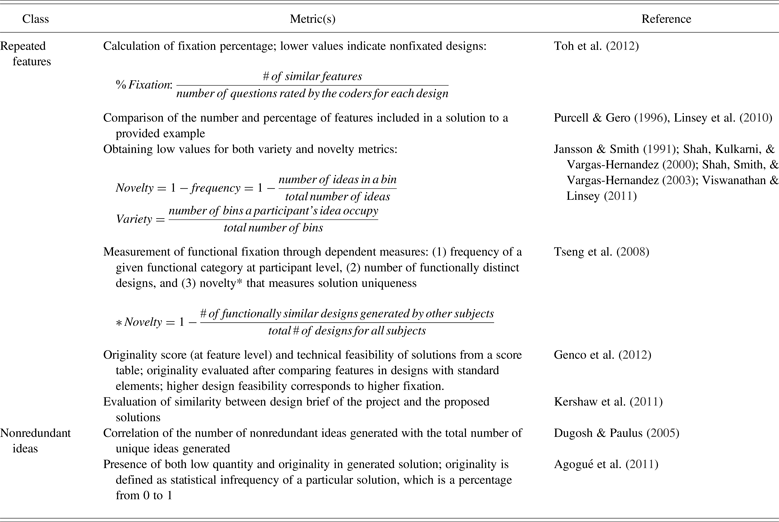
These metrics inform a designer when fixation occurs and provide a crisp range of understanding for the concept of fixation. Table 4 shows a classification for direct metrics found in the literature. The metric definitions are coincident to the fixation definition in Section 2.1 and enable fixation identification and accountability.
Direct metrics classification according to Moreno et al. Reference Moreno, Yang, Blessing and Wood2014
2.3.2. Indirect metrics
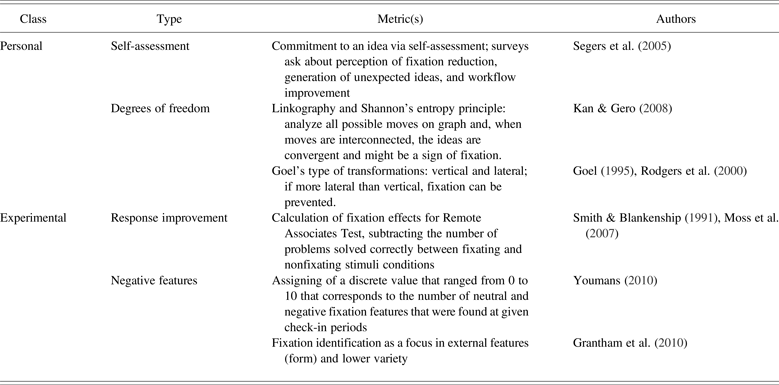
Indirect metrics estimate fixation through indicators, but are not explicitly measured (Table 5). These indicators gauge if a designer is fixated, but do not provide additional information to validate the result. Two main classes are identified: personal and experimental. The personal class of indirect metrics are extracted from the designer(s) and their design processes. The experimental class corresponds to predetermined experimental attributes or responses that are contrasted before and after an experiment.
Indirect metrics classification according to Moreno et al. Reference Moreno, Yang, Blessing and Wood2014
2.4. Service and product design problems
Design problems or opportunities can arise from a variety of situations. Some of these may have an intangible nature, such as obtaining a degree (education service), requesting credit (financial service), or sending a document or object to a recipient (transporting service). Other situations relate to a clear physical product or artifact associated with a solution like using a coffee maker to make coffee (electromechanical appliance). Product design results in tangible artifacts, while service design corresponds to virtual systems of an intangible nature. Shostack (Reference Shostack1982) defines services as acts that only exist in time. Vermeulen (Reference Vermeulen2001) notes features that differentiate services from products: intangibility, simultaneity of production and consumption, heterogeneity, and perishability.
Services and products can be found interconnected to varying degrees (e.g., logistics) and may be considered as part of a continuum. This interconnection implies the potential of tools and methods for conceptual design from engineering, architecture, and other domains to be transferred to transactional fields to assist idea generation and overcome design fixation (Moreno, Hernandez, et al., Reference Moreno, Hernandez, Yang, Otto, Hölttä-Otto, Linsey and Linden2014; Moreno, Yang, et al., Reference Moreno, Yang, Hernandez, Linsey and Wood2014). It has been opined that the early stage of development for services is no different than for physical products and that it is at the detailed design phase where the methods diverge (Cagan & Vogel, Reference Cagan and Vogel2013). This viewpoint supports the transferability of design methods between domains at least in the idea generation (ideation) stage.
2.5. DbA selected methods
We explore a DbA approach to overcome fixation due to its relevance, effectiveness, and its potential to have synergic results when integrated with other approaches. There is evidence that design solutions can be developed or adapted from preexisting systems or solutions from other domains (Otto & Wood, Reference Otto and Wood1998; Keller et al., Reference Keller, Eckert and Clarkson2009; Fu et al., Reference Fu, Moreno, Yang and Wood2014). For example, astronauts’ vortex cooling systems were later adapted as a means to mold and cool glass bottles (Hernández-Luna & Cárdenas-Franco, Reference Hernández-Luna and Cárdenas-Franco1988). Inspiration from analogous domains can be achieved by associations among shared characteristics, attributes, properties, functions, or purposes (Gentner & Markman, Reference Gentner and Markman1997; Hey et al., Reference Hey, Linsey, Agogino and Wood2007). Once an association between a design problem and a solution in another domain is established, a solution to the design problem can be developed (Bonnardel, Reference Bonnardel2000; Ball et al., Reference Ball, Ormerod and Morley2004; Linsey et al., Reference Linsey, Clauss, Wood, Laux and Markman2007; Linsey, Wood, et al., Reference Linsey, Wood and Markman2008; Markman et al., Reference Markman, Wood, Linsey, Murphy, Laux, Markman and Wood2009).
Two methods, WordTree and SCAMPER, were selected to investigate a DbA approach to overcome fixation for a service design problem. Though other DbA methods exist, many are meant to be applied to design problems in the physical domain. WordTree and SCAMPER methods were selected considering that their semantic transformations and directives do not assume a design has a physical embodiment that may be more appropriate to service design problems and solutions.
2.5.1. WordTree
WordTree (Linsey, Markman, et al., Reference Linsey, Markman and Wood2008; Linsey, Wood, et al., Reference Linsey, Wood and Markman2008) is based on semantic transformation of textual representations of design problems by means of Princeton's WordNet or VisualThesaurus, which is a visual display of the WordNet database. WordTree enables rerepresentation of the problem and expansion of solution space due to new semantic associations, finding and exploring potential analogies and analogous domains (Segers & De Vries, Reference Segers and De Vries2003; Segers et al., Reference Segers, De Vries and Achten2005; Linsey, Markman, et al., Reference Linsey, Markman and Wood2008; Linsey, Wood, et al., Reference Linsey, Wood and Markman2008; Smith & Linsey, Reference Smith and Linsey2011; Verhaegen et al., Reference Verhaegen, D'hondt, Vandevenne, Dewulf and Duflou2011). Using the WordTree method, a designer constructs a diagram of “key problem descriptors,” focusing on key functions and customer needs of the given design problem (Linsey, Markman, et al., Reference Linsey, Markman and Wood2008). Key problem descriptors are then placed in a tree diagram and semantically rerepresented by hypernyms and troponyms selected from WordNet. The WordTree Diagram facilitates associations; therefore, analogies and/or analogous domains can be identified. All analogies, analogous domains, and new problem statements can then be used to enrich group or individual idea generation.
2.5.2. SCAMPER
This method is based in directive transformations that enable a systematic search for solutions (Harris, Reference Harris1973; Yilmaz et al., Reference Yilmaz, Seifert and Gonzalez2010). Each of the seven letters from SCAMPER's name correspond to a specific operator category with a set of questions that, when attempt to be answered, redirects analogical search to solve a problem. The operator categories are as follow: substitute (S), combine (C), adapt (A), modify/magnify/minimize (M), put to other uses (P), eliminate (E), and reverse/rearrange (R; Eberle, Reference Eberle1996). When applying the method, the designer may start with any of the operator categories at random, reflecting on the design problem from the category perspective and through the posed questions, which may enable the identification of analogous solutions or domains where a solution may be extracted. The designer can then proceed with exploring more questions of the same operator or move to another operator and repeat the procedure.
3. EXPERIMENTAL METHOD
Ninety-seven transactional process experts were recruited from professional development programs in Mexico and Singapore. Participants came from a variety of disciplines and involved 25 product and 29 service companies. Domain knowledge expertise was based on professional background and work role.
A service design problem was adopted from a previous study from the banking sector (Moreno, Hernandez, et al., Reference Moreno, Hernandez, Yang, Otto, Hölttä-Otto, Linsey and Linden2014; Moreno, Yang, et al., Reference Moreno, Yang, Hernandez, Linsey and Wood2014): “Reduce overdue accounts/unpaid credits.”
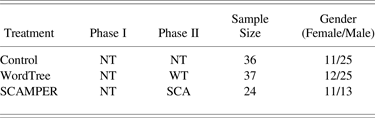
The experiment included control and experimental treatments, and it was conducted in two phases (Table 6). The control treatment did not specify a method [no technique (NT)] for either phase. Phase I of the Experimental treatments were NT, whereas phase II included two DbA methods: WordTree (WT) and SCAMPER (SCA). Phase I and phase II were held with 2 days in between, with the same design problem in both. Groups were distributed by background, gender, and other demographics.
Experiment phases and treatments
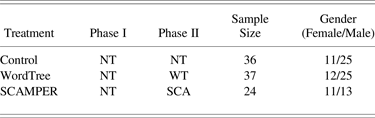
The experimental phases and treatments enabled the distinction of results. The inclusion of a 2-day separation in between the two experimental phases enables evaluation of incubation effects for the same set of participants. The purpose of having a control (NT) Phase I is to verify that there are no statistical differences between participants. This verification is critical to be able to contrast the results of a control treatment to those of the DbA treatment groups, isolating personal or other factors that may influence the outcomes, that is, comparing prolific participants who may have randomly been assigned to a control (NT) treatment against “average performer” participants assigned to WordTree or SCAMPER treatments.
In all phases, participants were asked to individually create as many solutions for the design problem as possible, recording solutions as text and/or sketches/diagrams. In phase I, all participants were given 15 min to generate solutions using intuition alone (Fig. 2).
Experimental execution diagram.
For Phase II, participants were divided into three groups, NT, WT, and SCA, and directed to separate rooms. NT participants were asked to continue generating solutions without a specific method for 15 min. WT participants were given a 15-min tutorial of the WordTree DbA method (Linsey, Markman, et al., Reference Linsey, Markman and Wood2012) and WordTree software (Thinkmap's Visualthesaurus©). Each WT participant was provided with a computer with Thinkmap's Visualthesaurus©. Relevant information and graphical associations between words were displayed by the software. SCA participants were also given a 15-min tutorial of the SCAMPER method. Each SCA participant was provided with a printed template with the operator and corresponding triggering questions. Participants from WT and SCA were then asked to generate solutions to the transactional design problem using the method and software tools for 15 min.
During Phase II, WT participants were asked to select words that rerepresented the design problem, and/or indicated particular solutions or solution domains. The goal was to understand semantic retrieval from the participants’ long-term memories that allowed them to switch domains while developing analogous problem statements. Participants were required to list all alternative solutions they developed after extracting useful information from the provided software tool. Similarly, SCA participants were asked to record ideas under the operator category that enabled its generation, to understand how the analogical search and redirection was performed.
At the end of both phases, all listed ideas were collected, coded, sorted by affinity by two domain knowledge expert raters, and analyzed. Participants were also asked to complete a questionnaire after completing each phase to collect their self-perception about the session and their individual performance. The results of these questionnaires are explained in detail in another publication (Moreno et al., Reference Moreno, Blessing, Wood, Vögele and Hernandez2015).
4. ANALYSIS
One of the research questions for this study relates to analogy as a relevant source of ideas and approach to overcome design fixation. The results of applying two different DbA methods are evaluated and compared, followed by a discussion of references and connections to the comprehensive framework of approaches to overcome fixation (Section 2.2) as well as fixation's existent metrics (Section 2.3).
The collected set of ideas was sorted into bins of similar ideas (affinity). Examples of bins are “negotiation,” “reward systems,” and “role swap.” The sorting process was performed by two independent and domain knowledge raters who separately sorted the total 1,788 ideas recorded by the participants, where a Cohen κ interrater agreement was calculated resulting in a Cohen κ (Von Eye & Mun, Reference Von Eye and Mun2005) of 0.78, which is considered an “excellent” level (Robson, Reference Robson2002). All disagreements were resolved through discussion, resulting in a final total of 134 bins.
4.1. Quantity of ideas
Three representations are defined: quantity of total ideas generated (Q Total); quantity of repeated ideas (Q R), where a repeated idea occurs when a participant develops a slight variation of a previous idea; and quantity of nonrepeated ideas (Q NR), which corresponds to the remaining number of Q Total once repeated ideas have been removed.
 $${Q_{\rm Total}} = \sum {all\,ideas\,generated} = {Q_{\rm R}} + {Q_{\rm NR}}$$
Equation 1 shows that Q Total can be expressed as the summation of all ideas generated at different levels such as by phase (I, II), experimental group (WT, NT), and participant. Alternatively, Q Total can be defined as the addition of its two subcomponents: Q NR and Q R.
Considering that the experiment was designed and executed in two phases, two sources for repeated ideas (Q R) are possible:
• Repeated ideas within a phase (R W): all repeated ideas across all participants for which frequency (F) is greater than 1 [Eq. (2)].
(2)where F ijk is the frequency of repeated ideas for the ith phase, jth bin, and kth participant, respectively; i is the phase number (1, 2); b is the number of bins (134); and n is the number of participants. A unit is subtracted from F ijk to maintain the accountability of the total ideas generated. $${R_{{{\rm W}_i}}} = {\displaystyle\sum\limits_{\,j = 1}^b {\sum\limits_{k = 1}^n} \,{{F_{ijk}}}} - 1\quad \forall {F_{ijk}} \gt 1\comma$$
• Repeated ideas between phases (R B): all ideas that were generated in Phase I that reappear in Phase II at bin and participant levels [Eq. (3)].
(3)where F ijk is the frequency of repeated ideas for the ith phase, jth bin, and kth participant, respectively; i is the phase number (1, 2); b is the number of bins (134); and n is the number of participants$${R_{\rm B}} = {\displaystyle\sum\limits_{\,j = 1}^b {\sum\limits_{k = 1}^n} \,{{F_{2jk}}}} \quad \forall {F_{1jk}} \gt 1\quad {\rm AND}\quad {F_{2jk}} \gt 0\comma$$
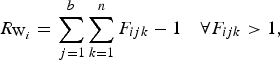

The previous definitions provide identification of the moment where the repeated ideas occur, shedding light on the critical moment where a method can be more effective to overcome the design fixation effect.
4.2. Evaluating fixation
Design fixation was assessed using the procedure outlined by Linsey et al. (Reference Linsey, Tseng, Fu, Cagan, Wood and Schunn2010) and Viswanathan and Linsey (Reference Viswanathan and Linsey2012) and follows the definitions provided in Section 4.1. The proposed metric elaborates what a repeated idea is for the study and, instead of reporting an absolute value, contrasts or normalizes this value against the total number of ideas developed. This approach provides a sense of the intensity of design fixation. A design fixation definition is implemented as shown in Eq. (4):
 $$\eqalign{Fixation = & \displaystyle{{Total\,\# \,of\,repeated\,ideas} \over {Total\,\# \,of\,generated\,ideas}} = \displaystyle{{{Q_{\rm R}}} \over {{Q_{{\rm Total}}}}} = \displaystyle{{{R_{\rm W}} + {R_{\rm B}}} \over {{Q_{{\rm Total}}}}}.}$$
4.3. Novelty
Following the definitions of Jansson and Smith (Reference Jansson and Smith1991) and Chan (Reference Chan, Fu, Schunn, Cagan, Wood and Kotovsky2011a), we define novelty as the total quantity of nonrepeated ideas (Q NR). In this experimental design, Phase I is considered the design space baseline. Novelty corresponds to the design space composed of all ideas (not bins) generated by a participant in Phase II that were not generated by any participant in Phase I, over the participant's total Phase II ideas [Eq. (5)].
 $$Novelt{y_{k{\rm\comma} l}} = \displaystyle{\displaystyle{\sum\nolimits_{\,j = 1}^b {{F_{2jkl}}} \quad \forall {F_{1jkl}} = 0\quad \hbox{AND}\quad {F_{2jkl}} \gt 0} \over {\displaystyle\sum\nolimits_{\,j = 1}^b {{F_{2jkl}}}}}\comma$$
where F ijkl is the frequency of ideas for the ith phase, jth bin, kth participant, and lth group, respectively; i is the phase number (1, 2); k is the participant number (1, … , 97); l is the group (WT, SCA, NT); and b is the number of bins (134).
5. RESULTS
5.1. Statistical data validation
A retrospective power study was performed to validate power of statistical tests and assumptions. For ANOVA and two tailed t tests, power factors were as follows: significance level α = 0.05; variability and minimum difference depending on the metric being evaluated; and actual sample sizes of the study (NT = 36, WT = 37, SCA = 24). All power values were greater than 92% for evaluated metrics, corresponding to a suitable power to perform statistical analysis. The normality of the data was tested and verified using Anderson Darling's Normality Test.
5.2. Quantity of ideation
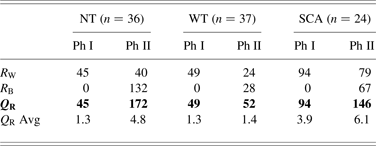
To calculate fixation (Section 4.1), we first determined Q Total, Q R and Q NR. Table 7 presents the quantity of ideas across phases and group levels. Here, Q Total corresponds to 1,788 ideas distributed as 1,230 Q NR ideas and 558 Q R ideas.
Quantity of generated ideas and nonrepeated ideas
Table 7 includes t and p values from paired t tests comparing QTotal of Phase I and II for the three experimental conditions. It was found that NT has no statistically significant difference (which is expected because Phase II is also nonassisted), which in the case of WT there is a statistically significant difference, consistent with previous cognitive studies where intervention scenarios add significant load because of the cognitive processing (Tseng, Moss, Cagan, & Kotovsky, Reference Tseng, Moss, Cagan and Kotovsky2008; Chan et al., Reference Chan, Fu, Schunn, Cagan, Wood and Kotovsky2011a, Reference Chan, Fu, Schunn, Cagan, Wood and Kotovsky2011b). In the case of SCA, there was no statistically significant difference.
For Q NR, t and p values from paired t tests compare Phase I and II for the three experimental conditions. The results show statistically significant differences in the quantity of ideas for NT and WT. There was no statistically significant difference for SCA in the quantity of nonrepeated ideas between both phases.
An ANOVA showed that the means of the three experimental conditions in both phases and all Q Total, Q R, and Q NR have statistically significant differences (Table 8). Using Tukey pairwise comparisons, we found that in Phase I for both Q Total and Q R, SCA is significantly different (greater) than the other two conditions; and for Q NR SCA is only different than WT (greater). In Phase II for Q Total the three conditions are significantly different from each other; for Q NR, WT is significantly different than the other two (smaller), and SCA is significantly different (greater) than the other two conditions.
Analysis of variance results for QTotal, QR, and QNR

Table 7 shows that only WT presents a reduction in QTotal from Phase I to Phase II. After removing repeated ideas, all three conditions resulted in a reduction in the number of ideas generated in Phase II from Phase I. SCA produced more QNR in Phase II compared to the other two conditions.
Table 9 summarizes the quantity of repeated ideas by source as defined in Section 4.2. In the case of repeated ideas between phases (R B), “Impose penalty” is an example of an idea stated in Phase I and then repeated in Phase II by the same person. Likewise, for repeated ideas within phases (R W), “Make credit performance public” was an idea stated by a participant more than once during a single phase.
Repeated ideas by group, source, and phase
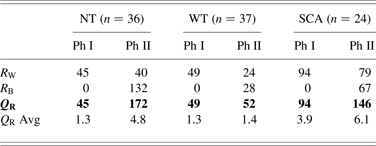
For the NT group, the quantity of R W is almost the same for both phases, and there is a large quantity of R B; that is, participants repeated ideas they created in Phase I. The WT group reduced the number of repeated ideas within Phase II. The quantity of R W and R B for WT in Phase II is almost the same. SCA had the largest amount of R W in both phases.
Paired t tests for Q R contrasting Phase I and II results in the three experimental conditions show that NT exhibits a statistically significant difference (t = 6.63, p = 0.000) in quantity of ideas of the control group (NT), which is consistent with literature showing that design fixation in the form of repeated ideas can be higher if no method is employed (Dugosh & Paulus, Reference Dugosh and Paulus2005; Toh et al., Reference Toh, Miller and Kremer2012; Viswanathan & Linsey, Reference Viswanathan and Linsey2012). There is no statistically significant difference in the case of WT (t = 0.26, p = 0.799), which appears to indicate that the use of WT did not change the quantity of repeated ideas between phases, but there likewise was no significant increase in repeated ideas that did dramatically occur for the NT and SCA conditions. Finally, there is also a statistically significant difference (t = 3.22, p = 0.004) in SCA results, which was not expected.
5.3. Fixation
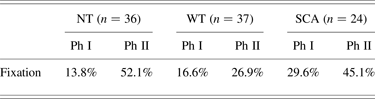
Table 10 presents the calculated fixation metric as defined in Section 4.1. ANOVA analysis for fixation results for all experimental conditions in Phase I shows a statistical significant difference (F = 5.26, p = 0.007). Tukey pairwise comparisons show that there is a statistically significant difference between the SCA condition and the other two conditions. Comparing Phase I with Phase II, statistically significant differences are shown across conditions (SCA: F = 1 3.41, p = 0.001; WT: F = 5.81, p = 0.019; NT: F = 95.34, p = 0.000). Phase II results for experimental conditions showed a statistically significant difference (F = 10.99, p = 0.000), and applying Tukey pairwise comparisons, it is found that WT is statistically significantly different than the other two conditions.
Fixation by group and phase
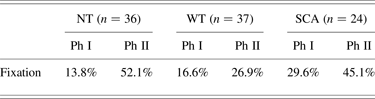
These results imply that all conditions resulted in fixation, but what is interesting is that a distinctly lower level was achieved with the WT condition. The participants who used the SCAMPER method exhibited a very similar fixation level as the control condition.
5.4. Novelty
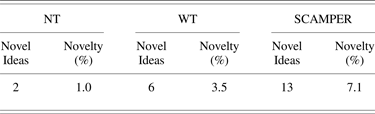
Following the definition given in Section 4.3, a total of 15 bins were uniquely generated in Phase II, with the following distribution: NT = 1, WT = 5, and SCA = 9. These 15 bins contained a total of 21 nonrepeated ideas uniquely generated in Phase II (novel ideas). Table 11 presents the distribution of novel ideas for all experimental conditions as well as their calculated novelty values as defined by Eq. (5).
Novel ideas and novelty
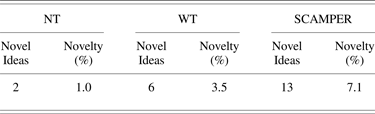
After performing an ANOVA for novel ideas, a statistically significant difference among all the experimental conditions is found (F = 8.06, p = 0.001). Tukey pairwise comparisons showed that the SCA condition is statistically different (greater) than the other two conditions.
An ANOVA analysis is calculated for novelty values across experimental conditions (F = 4.65, p = 0.012). Both DbA conditions, SCA and WT, have statistically significant higher novelty percentages when compared to NT. The SCA condition, however, appears to have the most significant contribution of total novel ideas.
6. DISCUSSION
To address the research questions related to the existing design defixation approaches, the literature review shows that a holistic and cumulative understanding of design defixation approaches has been investigated across different domains such as cognitive science, architecture, and engineering. These approaches have been developed to avoid the negative impact that design fixation may have in the design process at the idea-generation stage. In particular, much of the literature focuses on external approaches such as the use of heuristics, prompts, or external support to the designer that promote the development of ideas but may also be effective for overcoming design fixation.
Although there are few expert studies with sample sizes that can provide sufficient statistical power to support the results found for overcoming design fixation, the findings from literature review shed some light on interesting directions such as analogy-based approaches (TRIZ, SCAMPER, WordTree, Word Graph, providing analogies and in addition having open goals) and visual stimuli (providing inspirational pictures, sketching, and 6-3-5).
The literature review also led to additional questions. Should design defixation approaches be used together, integrated or synthesized? Are there dominant or more attractive approaches? Should a suite of methods be developed, tested, and implemented?
With respect to the research question related to design fixation metrics, a broad range of ways to account for design fixation was identified and classified. These results may indicate that fixation can manifest in multiple forms that range from personal perception to tangible results of the cognitive process (ideas developed). All metrics capture manifestations of design fixation at different levels. The metrics could be applied together or synthesized to provide a better understanding about the way that different factors impact design fixation.
The literature offers several overlapping metrics and indicators for fixation. Direct and indirect dimensions for the design fixation metrics were developed in an attempt to unify metric criteria. A fixation metric is proposed building on previous work to include service design problems. The proposed metric for measuring design fixation captures the intangibles of service problems, and takes into consideration the predominantly semantic nature of service design. The proposed metric can also be applied in the product domain. The results of a study for a service design problem are comparable with the ones obtained in engineering and architecture, allowing possible generalization of conclusions.
Finally, addressing the research questions related to the application of DbA methods to overcome design fixation with a service design problem, it is found that analogies enable generation of increased novel ideas and that DbA methods are transferable across design problem domains (product to service) in the idea-generation stage of the design process.
In our study, there was a reduction in the total quantity of ideas generated by the WordTree participants, which is believed to be a reflection of the cognitive load that the method adds and that is consistent with previous cognitive study findings (Tseng et al., Reference Tseng, Moss, Cagan and Kotovsky2008; Chan et al., Reference Chan, Fu, Schunn, Cagan, Wood and Kotovsky2011a, Reference Chan, Fu, Schunn, Cagan, Wood and Kotovsky2011b). The control (no technique) and SCAMPER groups had similar results for the total quantity of ideas generated, which was not expected, and nonintuitive, and may be an indicator that SCAMPER shares some similarities with nonassisted scenarios. When contrasting these findings with the fixation results, it can be seen that the levels of fixation exhibited by the two experimental groups show no statistical difference, which confirms our hypothesis. It appears, however, that the SCAMPER method also enables fixation in certain cases, which is unexpected. While the SCAMPER method led to increased novelty compared to the control group, which is an indicator of defixation, the use of the SCAMPER method also demonstrated a high number of repeated ideas between phases. It thus appears that as the SCAMPER representation questions were being implemented by designers, they would become fixated in certain regions of the design space, but then new operator questions would result in de-fixation, allowing designers to navigate to other regions of the space.
The quantity of nonrepeated ideas was reduced in Phase II for the three experimental conditions, but the reduction compared with their respective Phase I was not statistically significant for SCAMPER, which was not expected and may indicate that the method overcomes the cognitive load of learning a new method and provide means to increase the quantity of ideas generated. This result indicates that the SCAMPER method is different from nonassisted scenarios, and it can be seen that it performed better than control when comparing the average number of nonrepeated ideas for the two experimental conditions, which was greater for SCAMPER. The quantity of nonrepeated ideas in phase II shows interesting results because Wordtree had the lowest quantity and SCA the largest; however, contrasting this result to the one obtained for novelty, where both DbA methods yield more novelty than control, demonstrates the effectiveness of DbA methods to support designers during idea generation. One conjectural explanation for the different performance of WordTree compared to SCAMPER could be that WordTree requires more nonintuitive work from the users, and in contrast, the question-guided approach of SCAMPER may better reflect our natural process of semantically linking concepts in long-term memory. This, however, requires further exploration.
The quantity of repeated ideas shows that the WordTree DbA method helped overcome fixation to predeveloped solutions as compared to a control. SCAMPER and control conditions exhibited similar numbers of total repeated ideas, which was not expected, and they both increased in Phase II the baseline of repeated ideas determined in Phase I, which would be an indicator that SCAMPER is not an effective approach to overcome the presence design fixation, at least during certain times as ideas are being offered. However, considering the results obtained for novelty, where SCAMPER yielded the largest quantity of novel ideas, it appears that SCAMPER is a method that provides, unexpectantly, both fixation and defixation means during idea generation.
As stated above, fixation results indicate a similar level of fixation for control and SCAMPER treatments, at least in terms of repeated ideas, while WordTree appears to mitigate fixation much more effectively. However, novelty results show that both SCAMPER and WordTree yielded higher novelty than control, but SCAMPER had the highest number of novel ideas. Previous studies have shown that fixation will typically distract from novelty; therefore, the results presented here are not only counterintuitive but also open new questions about the benefits that fixation may offer for improvement and refinement of ideas.
One possible explanation for this counterintuitive result may be the modality of representation for the selected DbA methods of the study. SCAMPER poses active questions that guide the designer into developing a response, while WordTree is enabled by designer-driven semantic rerepresentation of key elements (customer needs, functional requirements, user activities, clarifying descriptions of the design problem, etc.) of a design problem. The results of the study show that the rerepresentation of the design problem is a shared feature for both methods and enables a divergent mindset (analogy) when developing solutions for a transactional design problem, which is shown in the improved novelty metrics for both methods when compared to a nonassisted condition. In contrast, following a list of active questions of a given SCAMPER category may trigger in the designer the need to rework or complement previously developed ideas, hence promoting fixation. SCAMPER's fixation within a given category or question may be overcome when the designer is required to switch to another category or active question from the method.
Quantity values were used to calculate fixation percentages, revealing that there is a base level of fixation for nonassisted scenarios. Contrasting Phase II with Phase I, all experimental conditions result in fixation; however, comparing the statistical results of the three experimental conditions in Phase II, it is found that the lowest level of fixation is achieved with the WordTree method. These results highlight the efficiency of the WordTree method in mitigating design fixation.
From the study, there is evidence that in a nonassisted scenario (control), a significant portion of the allotted time was devoted to the development of solutions that are not distinctive from each other (quantity of repeated idea was greater than quantity of nonrepeated ideas). It also appears, at least from the number of repeated ideas, that the analogical transfer provided by the WordTree method enables problem rerepresentation, exploration of divergent words, and effective space solution exploration to solve the problem. The fixation level exhibited by SCAMPER was in the form of idea refinement, while the WordTree and control conditions corresponded to minimal variations or rewording of ideas. This unexpected finding leaves open the question of a “desirable” fixation level that enables refinement and improvement of ideas.
The DbA methods used in this paper combine some of the previous approaches that were found and presented in the proposed framework to overcome design fixation, which may explain its performance. From Figure 1, the studied DbA methods incorporate elements from different categories. It includes reframing, by characterizing the problem and problem rerepresentation. The 2-day break between phases served as an incubation period. It considers expertise that allowed working with incomplete information, framing the problem, identifying relevant information, and developing more solutions. It provides and enables analogical exploration. It uses software tools that provide visual representation of the semantic cognitive process, allowing problem and solution representation. It makes use of heuristics or directives that guide and redirect analogical search.
The results obtained from the experiment also align with reported results in the field of psychology. Leynes et al. (Reference Leynes, Rass and Landau2008) found that fixation can be overcome in two ways: first with an incubation period of around 72 h, and second (and closely related to our approach) by presenting alternative semantic information to participants. They found that block and unblock effects occur in different parts of the brain. The results of the present study align with this result because after the semantic stimulation and analogical exploration, the participants were able to overcome design fixation.
7. CONCLUSIONS
In the quest to enhance creativity, avoid design fixation, and better support designers, different factors and methods have been developed with diverse results. The work presented here is critical because it provides for the first time a state-of-the-art review and framework for ideation approaches to overcome design fixation. It also presents the existing ways to account for fixation and proposes a fixation metric that builds on existing literature and that can be implemented across product and service design problems.
The findings from the literature review highlight a promising area to overcome design fixation in the direction of analogy-based approaches. Some DbA approaches were further explored in this article and extended to include service design problems, an area of application that has not been extensively studied. The results presented here are robust and supported in a large sample size that involves service domain experts that are not frequent in literature. The experimental results obtained are encouraging and exciting not only for innovation and idea generation but also to effectively support the spectrum from product to service design. However, there is still much to learn about analogical reasoning behind DbA approaches and the factors that may influence creative performance.
The intention of this study is to promote a critical reflection about the potential of the available suite of techniques, their modalities, and the associated cognitive processes behind them. The complexity of real-life problems requires the use of approaches with solid cognitive foundations and mechanisms that make them suitable for a broad range of design problems and opportunities.
ACKNOWLEDGMENTS
The authors acknowledge the support and sponsorship of the University of Luxembourg and Fonds National de la Recherche (National Research Fund) to conduct this work. The authors are also thankful for the support provided by the Singapore University of Technology and Design–MIT International Design Centre and the ITESM-BMGI Lean Six Sigma Program. Any opinions, findings, or recommendations are those of the authors and do not necessarily reflect the views of the sponsors.
Diana Moreno is a Postdoctoral Researcher at the University of Luxembourg. She received her BS degree in industrial engineering from Pontificia Universidad Javeriana in Colombia and two MS degrees, one in quality systems and productivity from Tecnológico de Monterrey and one in technology and management of energy companies (from a joint program between Instituto Superior de la Energía and Universidad de Navarra's Business School). Dr. Moreno completed her PhD studies in engineering sciences at Tecnológico de Monterrey, where she was coadvised with the University of Texas at Austin.
Luciënne Blessing is a Professor at the University of Luxembourg and the Director of the University of the Greater Region. She obtained her MS in industrial design engineering in Delft and her PhD at the University of Twente. She worked in the Engineering Design Centre of the University of Cambridge as a Senior Research Associate and as Assistant Director. She was appointed to Professor in 2000 at the University of Technology Berlin. Dr. Blessing became Vice-President for Research at the University of Luxembourg in 2007. She received an honorary doctorate from the Swedish Mälardalen University in 2013.
Maria C. Yang is an Associate Professor of mechanical engineering and engineering systems at MIT. She earned her SB in mechanical engineering from MIT and her MS and PhD from Stanford University's Mechanical Engineering Department, Design Division. She joined the MIT faculty in 2007. Her industrial experience includes serving as Director of Design at Reactivity, Inc. (now part of Cisco Systems). She has performed research into collaborative design tools at Apple Computer and Lockheed. In addition, Dr. Yang has explored the user interaction issues for software design, as well as ergonomics issues of force-feedback devices for Immersion Corporation.
Alberto A. Hernández is a Professor at the Instituto Tecnológico y de Estudios Superiores de Monterrey (ITESM). He received his BS in electrical engineering from ITESM, his MS in mechanical engineering from the University of Wisconsin–Madison, and his PhD in mechanical engineering from the University of Texas at Austin. Dr. Hernández was the Director of the Product Design and Innovation Center, the Quality and Manufacturing Center, and a leader for the manufacturing master program at ITESM. He holds an international certification as Lean Six Sigma Master Black Belt and is the Director of the Six Sigma program at ITESM.
Kristin L. Wood is the Head of Pillar of Engineering Product Development at Singapore University of Technology and Design and the Codirector of the International Design Center. Dr. Wood received his BS in engineering science from Colorado State University and obtained his MS and PhD in mechanical engineering (AT&T Bell Laboratories PhD Scholar) from the California Institute of Technology. He was previously a Professor of mechanical engineering in the Design & Manufacturing Division at the University of Texas at Austin.