I. INTRODUCTION
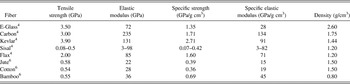
With the increasing of worldwide societal awareness about environmental impact, sustainability and renewable energy sources, the green composites recently have attracted the attention of researchers due to the fact that they are recyclable and biodegradable. Natural fibers, such as flax, jute, sisal and bamboo, have been extensively used to produce environment-friendly composites in past years.Reference Cheung, Ho, Lau, Cardona and Hui1–Reference Kinoshita, Kaizu, Fukuda, Tokunaga, Koga and Ikeda5 Natural fibers have advantages over conventional reinforcement fibers in that they are cheap ($0.5/kg) with low density (1.2g/cm3) and excellent specific mechanical properties as listed in Table I, while conventional reinforcement fibers are nonrenewable, nonbiodegradable, and high-energy consumption in manufacturing process. For example, the cost of glass fiber is $3.25/kg, while carbon fiber can be as expensive as $200/kg.Reference Bogoeva-Gaceva, Avella, Malinconico, Buzarovska, Grozdanov, Gentile and Errico4
Mechanical properties of conventional reinforcements and natural fibers.

Among these plants, bamboo is a typical natural biological composite with superior mechanical strength and toughness. As one of the fastest growing plants, bamboo can grow at about 15–18 cm/day and reach its full height in 4–6 months.Reference Albermani, Goh and Chan7 With these superior properties and other factors like low cost, rich natural resources, and environment-friendly service, bamboo stalks have been widely used in the construction of scaffolding, packing board, furniture panel, and especially for interior paneling in the automobile industry.Reference Saheb and Jog2, Reference Bogoeva-Gaceva, Avella, Malinconico, Buzarovska, Grozdanov, Gentile and Errico4, Reference Kinoshita, Kaizu, Fukuda, Tokunaga, Koga and Ikeda5, Reference Bledzki, Faruk and Sperber8, Reference Wambua, Ivens and Verpoest9
The bamboo culm, as shown in Fig. 1(a), is an approximately cylindrical shell that is divided periodically by transversal diaphragms at nodes. Through millions of years evolution, bamboo has become a smart material with an optimized distribution of longitudinal fibers (i.e., vascular bundles) and biomatrices. In the transverse cross section of a bamboo culm [see Fig. 1(b)], it can be observed that the vascular bundles are distributed nonuniformly through the wall thickness, and the concentration is most dense near the outer periphery. The vascular bundle shown in Fig. 1(c), composed of mataxylem vessels and sheaths of sclerenchyma fibers and surrounded by the parenchyma tissue, is a longitudinal fiber that plays the role as the reinforced phase in bamboo composite to supporting the bamboo. With spatially varying the vascular bundles geometrical parameters (the volume fraction, type, size, etc.) through the culm wall thickness,Reference Ray, Mondal, Das and Ramachandrarao10, Reference Liese and Weiner11 bamboo developed itself into a functionally graded material (FGM).Reference Ray, Mondal, Das and Ramachandrarao10, Reference Nogata and Takahashi12–Reference Silva, Walters and Paulino15 Owing to its excellent characters, the vascular bundle recently has been used as an effective reinforcement to produce high-performance “green FRPs.”Reference Kinoshita, Kaizu, Fukuda, Tokunaga, Koga and Ikeda5, Reference Chen, Guo and Mi16–Reference Ogawa, Hirogaki, Aoyama, Taniguchi and Ogawa19
Schematic diagram of bamboo internode: (a) L, T, R orthogonal coordinate system; (b) typical transverse cross-sectional features of Moso bamboo; (c) vascular bundle.

Many researchers try to explore the mechanical properties of bamboo by experiments on bamboo bulk and bamboo slice.Reference Nogata and Takahashi12–Reference Amada and Untao14, Reference Ahmad and Kamke20–Reference Shao, Fang, Huang and Tian23 Nogata and Takahashi found that the strength and stiffness of bamboo bulk were increased exponentially with radial distance,Reference Nogata and Takahashi12 while Amada and his cooperators found the strength and stiffness increased parabolically.Reference Amada, Ichikawa, Munekata, Nagase and Shimizu13, Reference Amada and Untao14 Shao et al. found that there exists a linear relationship between tensile properties of bamboo and volume fractions of vascular bundles.Reference Shao, Fang, Huang and Tian23 All these authors reduced the mechanical properties of vascular bundles from those of the bamboo using the rule of mixtures (ROM). Recently, the single bamboo sclerenchyma fiber has been tested too.Reference Yu, Jiang and Fei24 But for the mechanical properties of a single vascular bundle, there were a few studies presented experimentally,Reference Ray, Mondal, Das and Ramachandrarao10, Reference Shao, Fang, Huang and Tian23 and quantitative analyses of the variation in longitudinal and radial directions are still absent.
It is very difficult to separate intact vascular bundle from bamboo matrix with enough length since there is strong interfacial adhesion between these two phases. The isolation techniques such as steam explosion,Reference Okubo, Fujii and Yamamoto25 manual extraction,Reference Shao, Fang, Huang and Tian23, Reference Rao and Rao26 mechanical extraction,Reference Ogawa, Hirogaki, Aoyama, Taniguchi and Ogawa19 and chemical treatment methodReference Kinoshita, Kaizu, Fukuda, Tokunaga, Koga and Ikeda5, Reference Ray, Mondal, Das and Ramachandrarao10, Reference Rao and Rao26 have been used to extract bamboo vascular bundles. Though the chemically treated wood fibers have much lower strength and stiffness compared to the mechanically isolated fibers,Reference Rao and Rao26, Reference Burgert, Keckes, Frühmann, Fratzl and Tschegg27 experimental results show 10 wt% NaOH solution can soft bamboo matrix and with little effects on vascular bundles.Reference Ray, Mondal, Das and Ramachandrarao10, Reference Gomes, Matsuo, Goda and Ohgi28
Although there were many experimental researches on natural fiber-reinforced materials, analytical models are necessary to accomplish the experiments.Reference Gibson3 In this article, Moso bamboo vascular bundles are picked out from different zones via alkali treatment method. Then, the longitudinal mechanical properties of bamboo vascular bundles and bamboo slices are tested, and the variations along the radial direction are analyzed. With the experimental results of the components, the mechanical proprieties of bamboo culm are estimated and compared with the experimental results of bamboo slices. It is found that the results derived from the standard ROM are inappropriate for calculating the elastic modulus of bamboo composite. To develop the correct relationship between the bamboo culm and the vascular bundles, a modified ROM is used. It is shown that the results obtained from the modified ROM are consistent with the experimental results.
II. EXPERIMENT
A. Materials
The material is selected from one of the most popular bamboo species in China, known as Moso bamboo, Phyllostachys pubescen. The 4-year-old Moso bamboo is collected from Tianhuangping town, Anji county, Zhejiang province in eastern China.
Three straight internode culms are cut at heights of 2, 5, and 8 m above the bottom of a bamboo stalk and designated as the base, middle, and top parts, respectively. These culms, as shown in Fig. 1(a), were split into 7–13 strips along the longitudinal direction using a radial splitting machine and seasoned for about 6 months before test.
First, some straight strips in the culms are cut into two parts with 50 mm in length and 10 mm in width. Then, these two parts are further subdivided into five to eight slices along the radial direction. Part one is used to extract vascular bundles, and part two is used for bamboo slices testing.
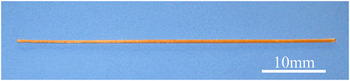
The slices cut from part one are steeped in 10 wt % NaOH solution for 24–36 h and then washed with distilled water. Single vascular bundle is carefully picked out from the soft slices under a stereo microscope. Once the surrounding matrix is totally eliminated, the vascular bundle will keep straight throughout the seasoning process (Fig. 2), otherwise it will bend due to the different shrinkage between the matrix and the vascular bundle.
The bamboo vascular bundle.

For part two, the 50-mm-long bamboo slices are shaped into the dimension: 50 mm (L) × 5 mm (T). The thickness of slice is increased gradually so as to ensure that there are enough vascular bundles in each slice. To determine its position in radial direction, the thickness of each slice is measured using a digital vernier caliper. After that, the slice is sanded smooth, and its thickness is measured again.
B. Tensile test of single vascular bundle
The longitudinal mechanical behavior of air-dry bamboo vascular bundle is investigated via the tensile test. Two pieces of hard paper with 10-mm length are glued on the ends of the specimen to fix the specimen in the tensile testing device without splitting. The gauge length of the vascular bundles (about 20 mm) is determined by the gap of the clamps. The test is conducted on the testing machine (INSTRON, 5544, Norwood, MA) with a cross-head speed of 2 mm/min. To obtain the stress–strain relationship, the cross-section area of vascular bundle [Fig. 1(c)] is measured from the image taken under an optical microscope (Leica, DM2500, Wetzler, Germany), and the strain is detected indirectly from the machine path.
C. Tensile test of bamboo slices
The tensile test of thin slices is conducted on the same testing machine. The dog-bone shape design once used in bamboo strip has been used in bamboo slice, and the test results showed that the thin slice near the epidermis often broke along the longitudinal direction at the enlarged shoulders position. To avoid this failure, the bamboo specimen is cut into rectangle, and the length of the specimen is kept at least four times of the width. The typical tensile stress–strain curves of bamboo slices are presented in Fig. 3. All the slices tests exhibit linear stress–strain behavior before failure.
The typical tensile stress–strain curves of bamboo slices (1–8: the numbers of slices cut from the outside to inner side in a bamboo culm wall along the radial direction).

D. Tensile test of bamboo matrix
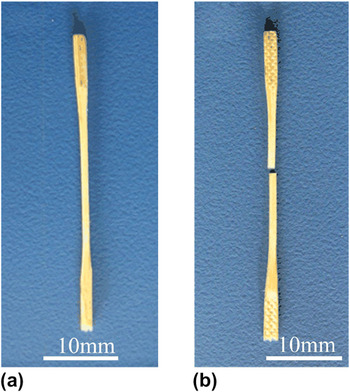
Some small bamboo strips without vascular bundles, selected from inner side of bamboo culm, are cut and smoothed into dog-bone shape as shown in Fig. 4(a), then tensile test is performed to measure the strength and the Young’s modulus of matrix. Figure 4(b) shows the tension fracture picture of bamboo matrix strip.
The small specimen of bamboo matrix used for tensile test. (a) Bamboo matrix strip and (b) the tension fracture picture of bamboo matrix strip.

E. The volume fraction of vascular bundles
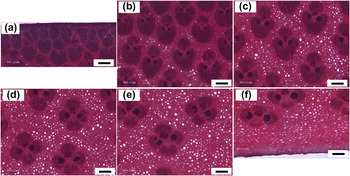
Assuming the volume fraction of vascular bundles (V f) is equal to the corresponding cross-section area fraction (A f) within one internode. Under an optical microscope equipped with a digital camera (Leica, DM2500, Wetzler, Germany), internode cross sections are observed and cross-section images normal to the radial direction are captured using the digital camera. Then, the outline of each vascular bundle is traced by hand, and the whole area of vascular bundles is measured using CAD software. Thus, the variation of V f along the radial direction is analyzed. Some cross-sectional images of vascular bundles across a culm wall in the radial direction are shown in Fig. 5.
Images used for the measurements of volume fraction of vascular bundles (V f). (a)–(f) A series of cross-sectional images of vascular bundles across a culm wall in the radial direction from the outer to the inner part of a culm wall (scale bar = 200 μm).

III. RESULTS AND DISCUSSIONS
A. The mechanical properties of bamboo vascular bundles
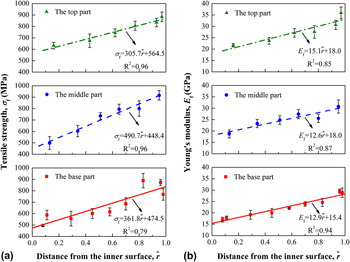
To obtain the variation of the mechanical behavior of vascular bundles along the radial direction, more than 10 vascular bundles in each slice are separated and tested. The mean strength and mean Young’s modulus of vascular bundles within each slice are measured. Through mathematical regression analysis of the obtained data, the fitting linear lines are established and shown in Fig. 6.
Variation of the mechanical behavior of vascular bundles along the radial direction. (a) Tensile strength and (b) Young’s modulus.

The vascular bundles near the outer side are stronger than those near the inner side [Fig. 6(a)], and the strength variation for all the three parts can be represented by Eq. (1).

where σ f is the tensile strength of vascular bundle;  is nondimensional radius, and r 0 is the inner radius of a bamboo culm, t is the culm thickness, thus
 corresponds to the inner surface and
 to the outer surface in the culm wall. The constants A and B depend on the height location, which are
The base part :A = 361.8,B = 474.5,
The middle part :A = 490.7,B = 448.4,
The top part :A = 305.7,B = 564.5.
The vascular bundles near the outer side are stiffer than those near the inner side [Fig. 6(b)]. Analogous to the tensile strength, the Young’s modulus is linearly increased from the inner to the outer side for all the three parts, and it can be written as

where E f is the Young’s modulus of vascular bundle, and the constants a and b are
The base part :a = 12.9,b = 15.4,
The middle part :a = 12.6,b = 18.0,
The top part :a = 15.1,b = 18.0.
For vascular bundles at different height as shown in Fig. 6, the strength and Young’s modulus of the top part are nearly equal to that of the middle part, and all these values are higher than that of the base part.
B. The variation of V f
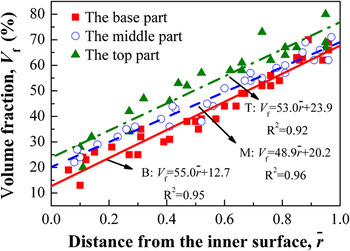
The V f in different height positions are shown in Fig. 7. Along the radial direction, the V f is increased from the inner side (15–25%) to the outer side (65–75%), and through mathematical regression analysis of the obtained data, the V f can be written as

Variation of volume fraction of vascular bundles along the radial direction (B: the base part; M: the middle part; T: the top part).

and the constants c and d are
The base part: c = 55.0, d = 12.7,
The middle part: c = 48.9, d = 20.2,
The top part: c = 53.0, d = 23.9.
From Fig. 7, it also can be found that the V f is gradually increased from the base to the top location.
C. The mechanical properties of the bamboo matrix
In the bamboo composite, the matrix is foam-like parenchyma cells, and its mechanical properties are usually supposed to be constant. Some researchers predicted the strength of bamboo matrix is about 25Reference Nogata and Takahashi12 or 50 MPa,Reference Amada, Ichikawa, Munekata, Nagase and Shimizu13 and the Young’s modulus is 2 GPa.Reference Nogata and Takahashi12, Reference Amada, Ichikawa, Munekata, Nagase and Shimizu13 It should be mentioned that all the above results are back-calculated from the experimental results of bamboo culm using ROM. From nanoindentation tests, Zou et al. measured that the Young’s modulus is about 3.4 GPa.Reference Zou, Jin, Lu and Li29
Here, we measured the mechanical properties of matrix via the tensile test. Four small specimen are tested, and the results show that the mean strength and mean Young’s modulus of matrix are about 29 MPa and 2.16 GPa, respectively. The maximum tensile strain is about 1.5%.
D. The mechanical properties of bamboo slices
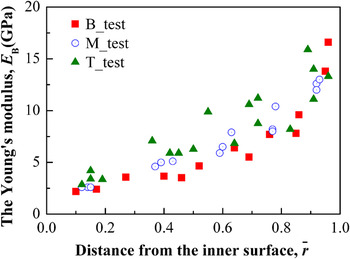
During the tensile test, the thin slices are easily broken at the clamps of the testing machine, which will influence the results of the tensile strength. In this article, only the initial Young’s moduli of bamboo slices are considered. Figure 8 shows the experimental results. It can be seen that the Young’s modulus is gradually increased from the inner side to the outer side along the radial direction.
Variation of Young’s moduli of bamboo slices along the radial direction. (B: the base part; M: the middle part; T: the top part).

E. Theoretical analysis
In conventional unidirectional and continuous composites, the composite axial stiffness is always predicted using the ROM:

where E is the Young’s modulus and the subscripts c, f, and m refer to the composite, fiber, and matrix, respectively.
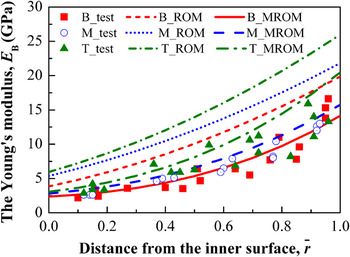
Using the ROM, the mechanical behavior of vascular bundles and matrix has been back-calculated from the experimental results of bamboo culm,Reference Nogata and Takahashi12–Reference Amada and Untao14, Reference Shao, Fang, Huang and Tian23 but a few studies have been presented experimentally and compared with the estimated results. To verify the validity of the ROM, the Young’s moduli of bamboo culms at three height locations are estimated from that of vascular bundles and matrix (E m = 2.16 GPa) via the ROM and compared with the experimental results (Fig. 9). It can be found that for all the three height parts, there is a large gap between the estimated results and the experimental results, which means that the ROM is inappropriate for estimating the elastic modulus of natural bamboo composite and its components.
The estimated results and experimental results of bamboo slices (B: the base part; M: the middle part; T: the top part; ROM: rule of mixture; MROM: modified rule of mixture).

For the fiber-reinforced composites, one assumption made in the standard ROM is that all the fibers are uniform, parallel, and continuous. While for the natural composites, the plant fibers are parallel, continuous but not uniform along the length.Reference Summerscales, Dissanayake, Virk and Hall30 This phenomenon also exists in bamboo composite: the vascular bundles distribute nonuniformly through the wall thickness.Reference Kanzawa, Aoyagi and Nakano31 Furthermore, as discussed in Section III.A, the stiffness of vascular bundles vary linearly throughout the culm wall, thus a same longitudinal load applied on different vascular bundle will induce different strain and vice versa.
During the testing procedure, with the tension load applied to bamboo slice, the slice and its components will elongate with equal strain. Since the vascular bundles are nonuniformly or nonperiodically distributed in bamboo slice, there will be the generation of a resultant force and a resultant bending moment at the end of bamboo slice. The standard ROM did not consider the effect of the appended bending moment, thus it is inappropriate for estimating the mechanical behavior of bamboo composite from its components.
Su and Zhou developed a modified ROM to calculate the longitudinal elastic modulus of unidirectional composite with a bending moment at its end.Reference Gibson32 This method is used here to calculate the longitudinal Young’s modulus of bamboo slice. In this method, the longitudinal elastic modulus of composite is obtained as

where the subscripts B, f, and m refer to the bamboo culm, vascular bundle, and matrix, respectively.
With the modified model, the E B at three height locations are calculated again and shown in Fig. 9. It can be found that for all the three parts, the estimated results from the modified ROM are closed to the experimental results, while those from the ROM are nearly two times larger than the experimental results, with which we can say that the modified ROM is more valid than the standard ROM in predicting the mechanical behavior of bamboo composite.
The mechanical properties of bamboo are determined by its components. Since the E f and V f are linearly increased from the inner to the outer side, and the E m is a constant (E m = 2.16 GPa). Substituting Eqs. (2) and (3) and E m into Eq. (5), the Young’s modulus of bamboo culm can be obtained as the following expression:

where the coefficients in the three height locations are respectively
The base part: A = 3.9, B = 5.8, C = 2.1, D = 2.4,
The middle part: A = 3.0, B = 6.3, C = 3.7, D = 2.2,
The top part: A = 4.2, B = 8.3, C = 4.9, D = 3.1.
Nogata and TakahashiReference Nogata and Takahashi12 have given the expression of E B as
The base part (height = 1 m): 
The middle part (height = 5 m):  .
Our results for the values of E B are smaller than those of Nogata and Takahashi.Reference Nogata and Takahashi12 The differences can be attributed to the sampling area, the age of bamboo, and the growing environment: the specimen in Nogata and TakahashiReference Nogata and Takahashi12 did not give the age and was selected from Japan, while the present specimen is 4 years old and selected from China.
For the strength of bamboo, it can also be estimated using the modified model, and the same conclusion may be reached.
IV. CONCLUSIONS
With a gradient structure and mechanical properties, bamboo copes with external and internal stresses efficiently. The vascular bundles from three height locations are extracted and tested. The conclusions can be summarized as follows:
(1) In the cross section, the vascular bundles near the outer side are stronger and stiffer than those near the inner side. Both the longitudinal tensile strength and Young’s modulus are linearly increased from the inner side to the outer side.
(2) For vascular bundles at different height, the strength and Young’s modulus of the top part are nearly equal to that of the middle part, and these values are higher than that of the base part.
(3) In the cross section, the volume fraction of vascular bundles is linearly increased from the inner side to the outer side. And along the longitudinal direction, the volume fraction of vascular bundles is gradually increased from the base to the top location.
(4) The longitudinal Young’s modulus of bamboo culm is cubically increased along the radial direction.
(5) The experimental results show that the standard ROM is inappropriate for calculating the mechanical behavior of the bamboo composites. The modified ROM has been verified as an appropriate analytical model in calculating the mechanical behavior of bamboo composite.
ACKNOWLEDGMENTS
The supports from National Natural Science Foundation of China (NSFC) (Grant Nos. 11025209, 10972173, 11072184, and 11021202) are appreciated.