1. INTRODUCTION
Sound art and music have generally been understood as opposing traditions in that sound art often implicated a break with the autonomous view on music. Recent research (Vandsø Reference Vandsø2015; Kotz Reference Kotz2001) points towards a new situation in which sound art, through a post-Cagean understanding, has become increasingly normalised, while music simultaneously has become increasingly spatialised. Annette Vandsø therefore suggests that the analytical perspective should seek a middle ground in which phenomenological listening should be incorporated with an intertextual and discursive framing to acknowledge the post-Cagean situation. This article endorses this new starting point, and proceeds by suggesting a break with the human-centred focus of the presented analytical perspectives by subscribing to an object-oriented ontological approach, proposing that the correlational prominence only presents us with insight into human-world relations, and not interobjective attunements. Instead, we propose a perspective in which the wavefrontFootnote 2 (Khare and Swarup Reference Khare and Swarup2009: 153–7) becomes a central term, suggesting a focus on how the materiality behaves, interacts, develops, manifests and translates through other objects (both human and non-human). Thus, using a vinyl record as an example, the specks of dust that gather on the record are as much an artist as the composer of the music that is inscribed as modulated spiral grooves in the rotating polyvinyl chloride.Footnote 3
From this perspective, the analysis of sound art and music should also be a process of tuning into the attunementFootnote 4 between the objects involved, thus the analysis of the two pieces presented in this article explore how the contact between human and non-human objects resolves the habitual distinctions between world and self. They do this not by trying to minimise signs of translation, but by taking into account and exploring the inconsistency and fragility of the objects involved, through a conceptualisation that the sounding materiality possesses thingliness and at the same time constitutes the illusion of an environment (Morton Reference Morton2007: 41).
2. OBJECT-ORIENTED ONTOLOGY
The following section briefly introduces central perspectives within object-oriented ontology (OOO), and therefore only scratches the surface of this diverse philosophical field. Although it is by no means exhaustive, pivotal terms and conceptualisations are presented in order to develop a dark ecological approach to sonic analysis.
2.1. No human superposition
The larger context of OOO originates from the speculative realism of Graham Harman, Ray Brassier, Quentin Meillassoux and Iain Hamilton Grant. A speculative realist wants to break with correlationism – a term used to describe how being exists only as a correlate between mind and world, placing humans at the centre (Harman Reference Harman2010a). As an example, Heidegger claimed that objects can exist outside human consciousness, but their being exists only through human understanding (Bogost Reference Bogost2012: 4). Therefore, based on phenomenological thinking, speculative realism breaks with its fundamental focus on human perception and suggests that ‘one must abandon the belief that human access sits at the centre of being, organising and regulating it like an ontological watchmaker’ (Bogost Reference Bogost2012: 5). In the development of a non-human phenomenology,Footnote 5 all things exist equally, which introduces notions of flat or tiny ontology, which collapses the traditional distinctions between subject and object and thus the world as our stage.Footnote 6
2.2. Objects appear and withdraw
Central to OOO thinking is that it is not only humans that objectify other objects. Non-human objects also use other objects, but never exhaust them because objects are also always withdrawn (Harman Reference Harman2002; Morton Reference Morton2013b). Withdrawal is understood as an unbreakable encryption irreducible to perception or meaning, which makes it impossible for any knowledge to replace the object in question (Morton Reference Morton2013b: 17–59). All objects are simultaneously fragile and autonomous, as they possess a potentially infinite progress in which they can be unfolded. At the same time, objects contain other objects and are contained in other objects (Morton Reference Morton2011: 150–151; Morton Reference Morton2013b: 45). Objects appear but withdraw at the same time – a double-edged quality that constitutes the objectness of what an object is; an open secret (Morton Reference Morton2013b: 202). As objects withdraw, no object or parts of an object can have direct access to any other object (Bryant Reference Bryant2011: 18, 26). This means that the object is not reducible to its parts (undermining), but also implies that an object cannot be reduced to its whole (overmining) (Harman Reference Harman2011: 7–18; Morton Reference Morton2011: 150; Morton Reference Morton2013b: 44). Following this line of thinking, the World (including other holistic concepts such as Nature and the Environment) also ceases to exist as a neutral background or stage for humans to occupy.
2.3. The Rift, causality and the aesthetic dimension
For Timothy Morton,Footnote 7 objects are ontologically riven between their withdrawn essence and their appearance for other objects (Morton Reference Morton2013b: 56). The Rift becomes central to the development of an expanded form of causality, which becomes integrated within a new view on aesthetics, claiming that causality is the aesthetic dimension produced by the interaction between objects (Morton Reference Morton2013b: 64). Within the realm of sound, the Rift can be understood as the medium or mediation between the essence of the sound and its appearance, which is meaningful in relation to how the speed of sound changes depending on what material it is mediated by. This makes it impossible to grasp the essence of a sound without its mediation, suggesting that it is impossible for the sound object to be without its mediation, as it would then be reduced to appearance only. If this mediation is happening in air, making sound acoustically audible to humans, or if movement of the pickup needle on the record player is secondary in this context, the important issue is the awareness regarding this Rift within the sound object (Morton Reference Morton2013b: 122). The aesthetic experience is then not solely something that occurs within our human mind, but is instead expanded to incorporate all causal events taking place in and between objects (Morton Reference Morton2013b: 120–1). This leads to a non-human phenomenology in which there is very little difference between how a shadow is perceived by a light sensor and by a human (Morton Reference Morton2013b: 35).
Causality and the aesthetic dimension does not take place in a space- and time-container that has already been established; instead, it pours or radiates from the tension of the Rift between essence and appearance, establishing the notion of interobjectivityFootnote 8 (Harman Reference Harman2010b: 150; Morton Reference Morton2013b: 35–66). Thus there is no environment in which objects float; instead, time and space are emergent properties of interacting objects themselves. This understanding resonates with post-Einsteinian physics, in which space-time is the product of objects (Morton Reference Morton2011: 151); therefore, objects space and time each other, not unfolding in time and residing in space.
2.4. A dark ecology of the ambient
Through an OOO line of thinking, art becomes a collaboration between humans and non-humans, and thus an important way to explore the Rift of objects through attunements between objects (Morton Reference Morton2012a: 138). From this perspective, the aesthetic is not some kind of icing on the cake, but an elementary exploration of causality as the aesthetic dimension, opposing the historical separation of rhetoric from logic and substance from accidents (Morton Reference Morton2013b: 79). This understanding of the aesthetic and causal dimension permeates traditional distinctions between background/foreground, figure/ground, inside/outside that are often taken to be key analytical concepts in approaching the artwork. Therefore, according to Morton reality is like an illusion, albeit a real illusion, as we often judge something to be an object when it is actually just its appearance, habituated to our own normalisations (Morton Reference Morton2013b: 143). Morton denotes this illusion as the Ambient, a conceptualisation of a here and now being evoked and sustained for a while, with cracks and strangeness pouring out, as inconsistent and fragile as the Rift. If art tries to hide the translations taking place in the aesthetic dimension, or claims that they do not exist (e.g. its timing and spacing qualities, but also the medial relations), it is attempting to pretend that there is no Rift. In attempting to create consistency, the in-itself ceases too become a real illusion because they fail to recognise the fragility and inconsistence of the Rift. In Morton’s notion of the Ambient, the environment comes forward from the background when art explores the fragile materiality of objects, which subverts the idea of the world as our neutral stage (Morton Reference Morton2010: 107). Through ambient effects, art makes it appear as if, for a fleeting second, there is something in between (Morton Reference Morton2007: 50), an understanding that challenges the concepts of ambient and atmosphere as something blurry in between, something that just sits there ready for humans to perceive – reducing objects to pure appearances (Morton Reference Morton2013b: 71).
The role of this ecologically aware art then becomes a way of attuning to the inconsistency of the Ambient as a dark ecology that collapses the subject–object division, giving rise to a sense of coexistence and connection to other objects. An attuning that is slightly out of phase – recognising its inconsistency and fragility and thereby also its own uncanny strangeness (Morton Reference Morton2013b: 177).
3. A MULTITUDE OF SOUNDING ONTOLOGIES
The contemporary music and sound art scene has exploded, imploded and scattered among an overwhelming number of artistic and academic traditions. It can seem like an impossible task to initiate a discussion concerning how music constitutes itself in relation to sound art, and how sound art relates to music.Footnote 9 Does the difference lie unfolded in the relationship between music’s and sound’s symbolic conceptualisation, as opposed to its physical manifestation (Wishart Reference Wishart1977; Nussbaum Reference Nussbaum2007)? Is the question of whether something belongs in a musical or sound art tradition more a question of poetics (Gonsales Reference Gonsales2011; Kane Reference Kane2013)? Trying to define both what constitutes music and sound art often takes its starting point in what it is not. This point is exemplified in the term ‘cochlear music’, coined by Seth Kim-Cohen and unfolded through a discussion of intra-musical (sounds in themselves) and extra-musical perspectives relating to the enclosing Western musical traditions (Kim-Cohen Reference Kim-Cohen2009). These traditions embrace the premise that it is possible to analyse music that is in itself independent of both ambient and temporal translations and also, for example, material manifestations of the symbolic score (e.g. the paper it is printed on). This implies that it would be ideal if we somehow could experience the piece without the instruments, room and recording technology (Morton Reference Morton2007: 30). An example is Eduard Hanslick’s autonomy of music, in which music has one type of content, which is the notes it consists of; music does not only speak through notes, but it also speaks nothing but notes (Benestad Reference Benestad1977: 299). New musicology breaks with this autonomous view of music by highlighting the discursive, social and institutional frameworks ‘around’ music, often combined with a more traditional structural analysis.
The autonomy of music has also been challenged in cognitive musicology (Zbikowski Reference Zbikowski2005; Pearce Reference Pearce2006; Dean and Bailes Reference Dean and Bailes2010), paired with studies in cognitive perception (Bailes and Dean Reference Bailes and Dean2012) and music semiotics (Tarasti Reference Tarasti1995), giving the mental representation of music a central role as ‘higher-level’ phenomena (Clarke Reference Clarke2005: 191). Although sound art and writings on sound art have led musicology to acknowledge the role of the environment, correlationism is still apparent in the perception-based (Wishart and Emmerson Reference Wishart and Emmerson1996) and spectromorphological (Smalley Reference Smalley1986; Thoresen and Hedman Reference Thoresen and Hedman2007) analysis of sonic art. More recent research has started to incorporate sound’s enclosing and encapsulating qualities, paired with broader philosophical perspectives of the sonic (Voegelin Reference Voegelin2010) and expanding sound and music palette through notions of ambience and affect (Kassabian Reference Kassabian2013; Schmidt Reference Schmidt2013). Ecological and material approaches to music and sound art break with the idea of a disembodied mental representation in perception (Cox Reference Cox2011), ordering phenomena hierarchically (Clarke Reference Clarke2005: 15) by emphasising the interrelationship between the sonorities of music and the environment.
Vandsø (Reference Vandsø2015), among others, proposes that we have moved into a post-Cagean aesthetics, where sound art no longer can be said to be primarily a negation of conventional ideas of the autonomous artwork in music, but a positive expansion into the social situation. She argues that because of the widely acknowledged conceptualisation that sound is inseparable from its context, it requires a different ontological status of the object in question. She proposes an approach that understands the act of perception as something that is always already conditioned by the discursive formations, and as such is in between the two predominant positions in the current field of sound art studies: the one that emphasises the pure phenomenological act of listening and underlines the non-discursiveness of sound as an artistic medium; the other that emphasises the linguistic, symbolic and intertextual dimension of sound art. Due to this relational condition she concludes that there is not only one new ontology of the work of art, but also a multitude of local ontologies in the field. Here she is referring to Georgina Born who calls for a relational musicology that is ‘alert to the diversities of the musical ontologies of the world’ (Born Reference Born2010: 241).
Despite its various theoretical and methodological expansions within the presented fields of analysis, the approaches described above still point towards a widespread correlationism that does not yet embrace a multitude of different ontologies. Even though ecological and material approaches wish to abandon the rigid separation between human and non-human environments (Harley Reference Harley1996), similar to OOO’s break with correlationism, it still takes the human perception as its only valid starting point (Harley Reference Harley1996: 9; Clarke Reference Clarke2005: 197), which only presents us with insight into human-world relations.
Adhering to the described post-Cagean and ecological positions the following will present the pieces Lys, Landskab og Stemmer and Opaque Sounding, in order to articulate these with a dark ecological perspective that breaks with the human-centred focus, thereby exploring what an OOO perspective has to contribute to the diversity of sounding ontologies.
4. LYS, LANDSKAB OG STEMMER [LIGHT, LANDSCAPE AND VOICES]
Lys, Landskab og Stemmer is a mixed-media piece by Elle-Mie Ejdrup Hansen and Marie Højlund from 2011.Footnote 10 Commissioned by the Cultural Circle of East Jutland, Denmark, consisting of six municipalities around Aarhus, this large-scale cultural project took place over a period of two years, with the aim of giving local citizens a possibility to experience and participate in innovative and interactive art outside Aarhus (as the largest city in the area). The project takes its starting point in explorations of relations between a multiplicity of objects in a specific location in each municipality (the six sites) and connecting them to a multiplicity of recordings of voices from the same area, reciting a poem.
To explore what a shift of perspective from the human perspective towards a dark ecological perspective has to offer, the following analysis charts Morton’s proposal for an object-oriented rhetorical theory that reverses the implicit order of Aristotle’s five parts of rhetoric: ‘The five parts are invention (or discovery); ordering (or disposition); style; memory; and delivery’ (Morton Reference Morton2013b: 84). Reversing the order by starting with delivery, or viewing them as simultaneous processes, both in the composing process and in the analysis, serves to short circuit the romantic idea of the genius composer who gets an idea, figures out how to compose it and then performs it (Morton Reference Morton2013b: 84). On this view, delivery or performance cannot be an invisible medium that delivers the message from the composer’s mind; instead, it becomes an attuning object in its own right. The causal relationships between the various objects, voices and landscapes are thus the aesthetic dimension for the artist to explore without any predetermined end point, making the composing process one of listening or tuning into the multiple objects.
4.1. Recording voices of humans and non-humans
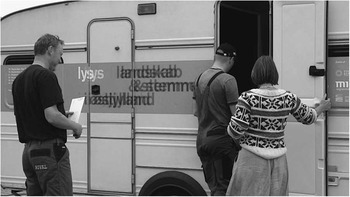
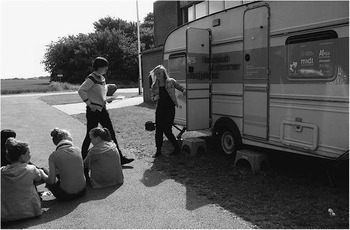
In the spring of 2011, a caravan that had been converted into a mobile recording studio (see Figures 1 and 2) travelled the six municipalities, where local people were invited inside one by one to read parts of Inger Christensen’s poem Lys [Light] (Christensen Reference Christensen1962) aloud. Participants were informed that the recordings would be transformed into an outdoor installation for them to experience some months later at a specific location in their area. In total, 758 voices were recorded.
Caravan converted into a mobile recording studio for Lys, Landskab og Stemmer.

Caravan converted into a mobile recording studio for Lys, Landskab og Stemmer.

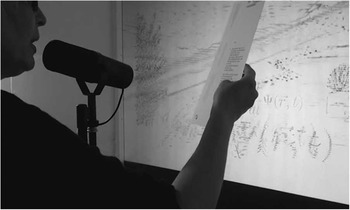
Participants entered the caravan alone; inside they could only see a microphone and a button on the ground. They were informed that the recording of their voice reciting the poem would start when they stepped on the button. During the reading, the input of the voice transformed large digitised landscape drawings (see Figure 3) of the sites in real time on a semi-transparent screen in the middle of the caravan. During the reading, the voice input made the drawings emerge from nothing, magnifying how the voice vibrates the landscape. Furthermore, a convolution reverb made at the same location was added to the voice, and played through speakers in front of the participant, mixed with a non-edited outdoor field recording also from the site of the area.Footnote 11
Voice transforming digital landscape drawings in Lys, Landskab og Stemmer.

Starting with the vocal delivery reverses the normal ways of understanding a poem through human interpretation before performing it, as there is no preparation time for the participant. The voice translates the words it speaks, as an improvised evocation of the encrypted heart of objects not via revelation but via obscurity, thus pointing towards an environmental understanding of the poem. The vibrating landscape drawings excited by the voice make the participants aware of the shape and size of the space around them; as to voice is also to room (Morton Reference Morton2007: 48). Furthermore, to voice is also to time through a rhythmic causality that emerges between voice and the algorithms of the landscape’s transformations. A sensual aesthetic appearance of an object to another object emerges, dissolving the landscape as a neutral background for humans to act upon. The interobjective causality organises space and time in a very literal and visual way in the caravan. We lose the words and hear the room, as voice and room are mutually determining; one does not precede the other.
The convolution reverb, the interactive landscape drawings and the field recording act as ambient effects that have the dual purpose of underlining the strangeness of listening and seeing your own voice interact, and also of creating the illusion of a here and now that emerges from the causal relationship between the objects involved. This ambient illusion demands engagement and, in doing so, motivates participation, as there is no background or foreground defined beforehand, only a coexistence that emerges from the interobjective translations. The choice of introducing these ambient effects as a deliberate overhear in the caravan runs counter to normal recording practices of minimising overhear from other objects as much as possible.Footnote 12 It also points to the importance of regarding the aesthetic as something emerging in the causal relationship between objects. Many people feel as though their own voice does not sound like their own. This is underlined by the fact that participants are hearing their voices through speakers, which amplifies the medial translations that wavefronts have for other objects such as skulls, ears, speakers, microphones and walls. This realisation is connected to the withdrawal of the inconsistent object, as the self is also withdrawn (Morton Reference Morton2010: 87).
4.2. Transforming voices
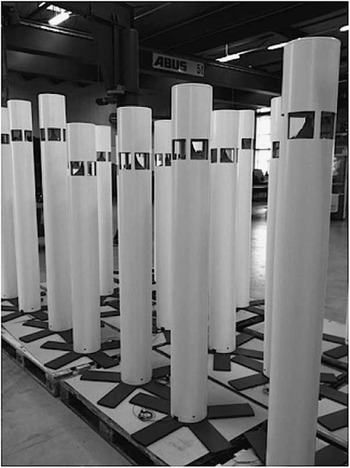
The transformation of the 758 voices into a site-specific piece for 24 outdoor speakers (see Figures 4 and 5) presents a continuation of the ambient translations in the caravan, as the delivery of the poem is not an envelope that delivers a message of the meaning of the poem in itself, rather, the multiplicity of recordings reveals itself as a new withdrawn object. It is only through this repeated delivery that the causal aesthetic of sampling is revealed, as are the similarities of inconsistency shared among strangers. The renderings of the timbral voices through the recordings have a strong ambient effect, pointing to the very medium of the voice itself and the recording as a recording. This undermines the normal distinction between the recording medium as a background and the voice medium as a material physicality in the foreground. In Danish and German, this tuning of the ambient and the voice is present in the word for voice (stemme/Stimme) and correlates to the word for the atmosphere of a room (stemning/Stimmung). Both words refer to tuning as the way objects are vibrating each other, as we are also environments for other objects. Therefore, the timbre is not changed in post-production with wet effects such as reverb. No faults are corrected or edited out, which makes the voices vibrate as inconsistent ‘noisy, messy, fuzzy, grainy, vague and slippery’ (Morton Reference Morton2010: 66) objects. The rendering effect of the anonymous voices resembles that of the disembodied acousmatic wavefronts that emanate from an unrecognised source, provoking uncertainty because of the inherent hesitation between an obscure source and no source at all.
The transformations of the recordings are created through temporal and spatial negotiations between voices and algorithms within Max/MSP. The algorithms translate the recorded files through predefined parameters set by the artist, both in the recordings and in the software, by placing up to 15 cues in all of the voice recordings, according to the same parts in the different readings of the poem, different algorithms can be executed with different patterns. The algorithms execute both spatial patterns in the 24 speakers simulated in the software and a temporal unfolding of the voices triggered by the cue numbers.Footnote 13 The algorithms build on repetitions and suspensions that play with familiarity and difference. Meeting repetition and rhythms through voices and speakers provides us with an opportunity to face our own artificiality projected onto the outside world; the voices of the anonymous speakers become stranger through repetition and layering. The changing rhythms and repetitions present a kind of moving without moving by being suspended in the framing of an illusionary here and now. These sampling translations interrupt the flow of a prototypical chronological reciting of a poem from beginning to end, making us aware of the ambience around the poem. In this inclusion of unintention, the inclusion of silences, pauses and coughing evokes the illusion that the piece is working by itself.
The voice transformation are accompanied by rhythmically organised sound samples recorded at the sites (e.g. wind in trees, birds singing, planes passing, pebble being stepped on, cars driving on pavement) as well as notes played on an old, out of tune piano prepared with multiple objects from the sites. This accompaniment can be said to express a dark ecological approach in two ways. First, the sounds are not played by traditional music instruments, but by instruments either created by sounds recorded from the sites or prepared by objects from the sites. Furthermore, the inconsistency and fragility of the piano is highlighted through its detuned notes and the awareness of the inner structures and physicality of the strings prepared with objects. Second, it is not intra-musical parameters or harmonic concerns created by the composer that structure how the sequences are developed, but the intonation and rhythms of the voice transformations. Thus, the rhythmic patterns are not set as a fixed tempo or time signature beforehand, but emerge in the interplay between the rhythms of the voices and the rhythms of the sound samples.Footnote 14 Likewise, arpeggios played on the sampled, prepared piano are structured through listening to the intonations in the cacophony of voices without a pre-prepared melodic and harmonic progression or based on a fixed key signature.
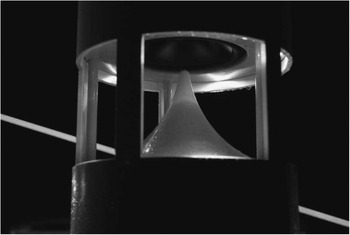
The 24 speakers were designed and built for the project in conjunction with Dynaudio.Footnote 15 When the speaker is activated, a circle of LED lights illuminates the opening from which the voices are heard. The speakers are designed in such a way that they come forward from the background as speakers – that is, objects with their own physicality and translations – and thus become sculptures that co-define the presentation sites. Therefore, the general observation that familiar objects tend to fall into the habituated background is challenged by the unfamiliar design of the speakers, provoking an awareness of the speaker as both object and environment.
Outdoor speakers designed for Lys, Landskab og Stemmer together with Dynaudio.

Outdoor speakers designed for Lys, Landskab og Stemmer together with Dynaudio.

4.3. Ambient voices
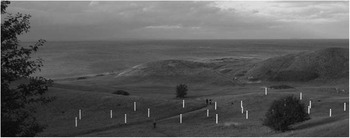
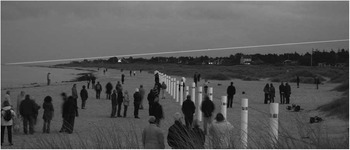
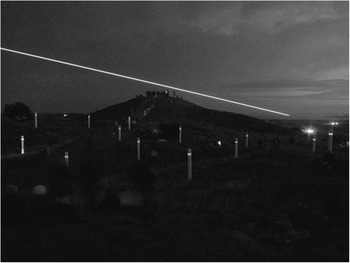
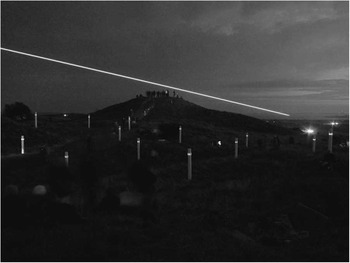
The presentation of Lys, Landskab og Stemmer consists of six different parts, each six hours long, at each of the six sites, consisting of the voices from that specific area and chorus parts with voices from all the areas. The presentations unfolded over six evenings in September 2011, starting at 6 p.m. and ending at midnight, accompanied by a green laser beam (see Figures 6–8). The length of the pieces attunes to temporalities in the landscapes, weather and circadian rhythms different from normal concert practices. During the evening, the sites transformed into an uncanny darkness, covering rather than discovering the poem and the voices. This covering was also represented in the voices changing over the evening, from high-pitched children in the beginning to grown women’s voices at dusk, to deeper male voices in the dark, pulsating the voice-activated light of the speakers. One visitor described the site as having transformed into a kind of burial mound, coming to life with the voices of the strangers. By presenting the anonymous voices that originated from and reconnected to the specific area, the local not only becomes the familiar, but also the familiar becomes strange. The voices through the translations of the recording, the algorithms, and the speakers spread out over a large area combined to make it difficult to maintain the aesthetic distance to the landscape as a background. This challenges the dividing lines that we normally draw between nature, subject and objects. Approximately 5,000–6,000 people visited the sites over the six evenings, making their own compositions while walking around, sitting or lying down, thereby defying the idea of a perfect sweet spot created for the listener. The piece is not primarily about human internal interpretation of the meaning of the poem (discovery) but about creating a ‘musical-social space for a while (hours and days) in which the project of attunement to the nonhuman is performed’ (Morton Reference Morton2013a).
Issehoved, Samsø: one of the six sites of Lys, Landskab og Stemmer.

The Beach, Grenaa: one of the six sites of the Lys, Landskab og Stemmer.

Tre Høje, Mols Bjerge: one of the six sites of Lys, Landskab og Stemmer.
5. OPAQUE SOUNDING
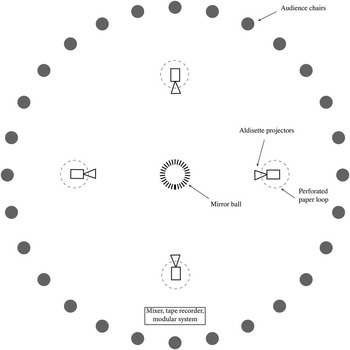
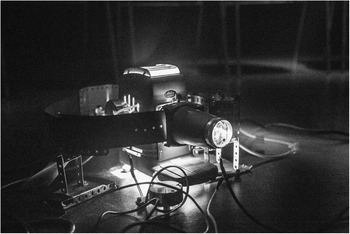
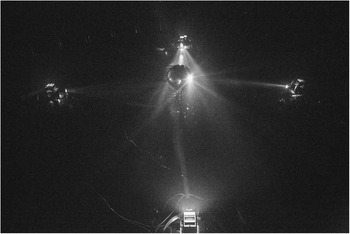
Opaque Sounding Footnote 16 is a piece written, built and attuned by Morten Riis in 2014 by commission of SPOR Festival (Spor 2014) and ACTS Festival (Acts 2014). The piece consists of four Aldisette vintage slide projectors that project light onto a mirror ball placed at the centre of a completely darkened room filled with smoke (see Figures 9 and 11). Each projector has been modified by replacing the original slide system with a perforated paper strip that runs through the projector operated by a specially designed mechanism, built in Meccano and driven by a small 12v DC engine (see Figure 10). The perforated paper strip now forms a loop around the slide projector, controlling how much light is projected onto the mirror ball.
Diagram of Opaque Sounding by Morten Riis.

An LDR (light-dependent resistor) is mounted on the lens of each of the four projectors to measure the light intensity from the apparatus. Through a specially designed circuit, the resistor values are transformed into control voltage that drives four separate voltage-controlled amplifiers. The outputs of these amplifiers are connected to a transducer mounted on the body of each of the Aldisette projectors, transforming the metal structure of the projector into a speaker. The audio that is fed to the amplifiers consists of pitched noise, sine and square waves generated from a modular synthesiser, all of which are tuned to the resonating frequencies of each projector. Additionally, a four-track cassette recorder is used to play back pre-recorded sine waves consisting of simple fifth and fourth intervals in different transpositions on each projector. The performance is structured in five sections, each of which focuses on explorations of noise, square or sine waves, or simple combinations of the mentioned sound sources.
Close-up of one of the projectors used in Opaque Sounding by Morten Riis (photo by Kasper Hemme) showing the perforated paper strip that controls the intensity of light. This figure also shows two transducers (one on the floor in front, and one on mounted on the projector) that are used to excite the metal structure and wooden floor.

Overview of Opaque Sounding by Morten Riis (photo by Kasper Hemme) showing the four Aldisette projectors projecting light onto the central mirror ball.

5.1. Alien listening
The transducer mounted on Aldisette projector number 1 begins to vibrate. This vibration excites the metal structure of the projection apparatus, which starts to propagate the floor with the vibrational energy of pitched noise that flows through the copper wires that connect the output of VCA-1 (voltage controlled amplifier) in the modular synthesiser to the input of power amp-1 that drives transducer-1. The pitched noise is generated by a white noise generator connected to a notch filter, tuned to the resonating frequency of the metal structure in the projector; this now functions as the audio input of the VCA-1. The control input of VCA-1 is derived from the LDR mounted on the projector measuring the intensity of light that is mechanically operated by the rotating perforated paper strip. The light intensity captured by the LDR is outputted as a resistor value going through a circuit designed to convert resistance to control voltage. This operates the amplitude of the VCA-1 based on the amount of light particles hitting the surface of the LDR.
In a dark ecological perspective, the described fifth and fourth intervals played back from the cassette tape recorder can be seen as raising the awareness of how humans throughout history have forced the temperament of, for example, the piano. In this light the well-tempered scale proposes a structure that seems to be consistent and solid (making it possible to play in every key for instance), but this stable structure is founded on an even distribution of errors and incompleteness that internally breaks with its own consistency. To be able to stage this inconsistency and fragility within the well-tempered scale would be to acknowledge the Rift between essence and appearance, as for example in La Monte Young’s explorations of equal temperament in his The Well-Tuned Piano (Young Reference Young1987). A piece that proposes an alternative form of tuning that stages the inconsistency of the well-tempered piano through a reflexive liberation of the piano from human slavery (Morton Reference Morton2013a: 166). By subscribing to this perspective, the reductionist understanding of intervals that reduce sonic objects and events to be describable within the proposed consistency of the well-tempered scale, dissolves itself. Instead, OOO proposes an investigation into the inconsistency within the piece from the perspective of the objects involved.
When the human audience in the concert hall hears the sound of the transducer exciting and vibrating the metal structure of the projectors and the wooden floor, what are they listening to? The sound of the floor? The sound of metal? The sound of transducers? The ears of the audience members are hearing wavefronts in the vibrating metal and wood through their human ears. The transducer hears the electrical signals flowing through the copper wires in a transducer-morphising manner, translating it into transducer-ish. Through this perspective, it becomes hearing-as and sounding to something else unfolded in a relational framing. A notion that resembles Morton’s description of how matter always is relational too: its matter-for something, not matter in itself as a closed entity (Morton Reference Morton2013b: 82).
It may seem counterintuitive to propose that non-human objects listen. However, this anthropomorphism must be contextualised through Ian Bogost’s concept of Alien Phenomenology,Footnote 17 in which he investigates the question of what it is like to be a thing, and outlines a conceptualisation in which computers ‘do entail human experience and perception’ (Bogost Reference Bogost2012: 9). This conceptualisation takes its starting point in Harman’s vicarious causation (Harman Reference Harman2012), a construct in which things never truly interact with each other, but interact through an unknown fuse not really fusing the objects in question. Thus, it becomes the philosopher’s job to write the speculative fiction of non-human objects through the practice of alien phenomenology (Bogost Reference Bogost2012: 34). Bogost’s phenomenology of things is greatly influenced by Thomas Nagel’s objective phenomenology, which aims to describe ‘the subjective character of experiences in a form comprehensible to beings incapable of having those experiences’ (Nagel Reference Nagel1974: 449). However, where Nagel calls for an ‘objective phenomenology’ that avoids the anthropomorphising and mediating tendencies of figurative language, Bogost’s alien phenomenology deliberately embraces it. ‘In a literal sense’, writes Bogost, ‘the only way to perform alien phenomenology is by analogy’ (Bogost Reference Bogost2012: 64). In this context, Jane Bennet also points out that anthropomorphism can be used to remind us that we are no longer ‘above or outside a nonhuman environment’ (Bennett Reference Bennett2010: 120). This stresses the importance of an analytic perspective that turns attention towards the ears of the objects in question, unfolding a speculative anthropomorphic listening of objects.
The transducers mounted on the metal structure of the slide projectors are of the moving-coil actuator type – a device that transforms one kind of energy (electrical current) into another (physical movement via electromagnetic induction). The coil listens to the electrical current flowing through the copper wires connecting the output of the amplifier to the transducer. It pays special attention to the way in which current flows through the coil around the iron core, creating a magnetic field that works against and with the permanent magnets (Campbell Reference Campbell1994: 180–3; Sinclair Reference Sinclair2001: 135). The moving coil itself tries to position itself according to the flowing current that enters its sensory apparatus, and tries to balance itself between the strength of the magnetic field and the torsional force in the spring that facilitate its movement. The coil’s ears are tuned to a variety of different signal types. It is trying its best to keep up with the seemingly endless stream of electrons hitting its metal and copper eardrums, as it reacts to even the tiniest almost inaudible changes of electrical current. The coil rapidly digests its auditive impressions, and begins to give voice to its own version of the current. A voice that is based on and inspired by the electrons’ movement within the copper wire, but the coil somehow makes it its own song, not like a cheap cover version, but rather a version that expresses the coil’s deepest and most grounding feelings of what it is like to be a moving coil.
The proposed alien listening perspective of the moving coil presents us with an expanded perspective of what agencies are at stake within the objects that together constitute what we normally denote as listening situations. Alien listening offers a step further into a phenomenology of objects than for instance proposed by a technical mapping, or the ontography of Bogost (Reference Bogost2012: 38) – the mapping of objects, their differences and their relations to one another. In this manner alien listening becomes a way to expose how causality can be denoted as belonging to the aesthetic dimension, a turn that emphasises that aesthetic experiences are not limited to interactions between humans or between humans and objects (Morton Reference Morton2013b: 19–20). Through the figurative and anthropomorphising language we have the possibility to unfold this new perspective on causal aesthetics and investigate how art directly works with causes and effects (Morton Reference Morton2012c: 205–6). The transducer is a good example of aesthetics as causality – what Harman calls vicarious causation – because we never hear the transducer itself – neither do the humans ears, the projector’s metal structure nor the wooden floor grasp the essence of the sounding transducer. But instead we – and the other objects involved – translate the effect of the transducer as it creates and build space, understood as interobjective timing and spacing (Morton Reference Morton2012c: 214; Harman Reference Harman2011: 99–102).
6. CONCLUDING REMARKS
Eric Clarke has observed that the relationship between analysis and a newly applied theory can imply a danger of being temporarily impressed by a substitution of terminology, or a reframing of some kind or other, only to discover that nothing has really changed. According to this view, applying a new theory to analysis has a potential circularity risk (Clarke Reference Clarke2005: 201). Therefore, Clarke argues that it is worth considering what such a reframing might be able to achieve, regarding the revealing of relationships and perspectives that were previously hidden and even unsuspected, and help to explain phenomena that remained inexplicable by presenting them within a different conceptual framework (Clarke Reference Clarke2005: 202).
As the above-mentioned critique of OOO indicates, an OOO perspective is often accused of being inhuman. However, advocates of OOO claim that it is necessary to break with the superposition of the human perceiver in order to return to the human position through a new flat and dark perspective that includes other objects and non-humans on the same level. This enables a new sort of humanism that is liberated from the correlational system (Bogost Reference Bogost2012) and can help us break from the autonomous and consistent view of music and sound art. We recognise the potential pitfalls in, for example, proposing an alien listening, even though it is described by a human, but find that a dark ecological perspective can serve an intermediate function in broadening our insight into the sounding objects that constitute our present auditory reality, by recognising that they are not consistent entities exhaustible within a single ontological conceptualisation.
We end this article by considering the key aspects of what the attempt to take a dark ecological perspective might contribute to the diversity of sounding ontologies. These are as follows:
-
∙ The focus on the voice as not just a representation of the human, but as something that emerges in interobjective translations between multitudes of different objects.
-
∙ The acknowledgement of the mediating mechanisms – such as computers, transducers, and projection devices – having a role as artists and not just as transparent, ubiquitous devices ready to serve human artistic goals.
-
∙ The break with traditional dichotomies such as human/nature and figure/ground, instead emphasising the interobjective spacing and timing between objects.
-
∙ The proposal of an alternative paradigm of listening, in which not only humans but also objects listen or attune to one another, enabling speculative and anthropomorphic modes of listening, in which the causal belongs to the aesthetic dimension.
Morton argues that in the age of the anthropocene (Morton Reference Morton2011: 154; Whitehead Reference Whitehead2014), the dark ecological perspective is not only important within analysis, but also in the creation of sounding pieces. This is because art is forced to relate to the current state of affairs concerning the human-made ecological crisis (Morton Reference Morton2013b: 20, 22). Connecting the aesthetic to the causal dimension through dark ecological art forces us to coexist with a vast plenum of non-human objects and must help us explore our own fragility and Rift within ourselves. Doing so collapses the belief that we can distance ourselves from the world; consequently, art and music cannot separate themselves from the world either.