Common ragweed is an erect summer annual broadleaf weed frequently found on roadsides, wastelands, and agronomic fields predominantly under reduced or no-till cropping systems (Bassett and Crompton Reference Bassett and Crompton1975; Jordan et al. Reference Jordan, Nice, Smeda, Sprague and Loux2007; Saint-Louis et al. Reference Saint-Louis, DiTommaso and Watson2005). Common ragweed is native to North America and has been documented as a major cause of hay fever due to its prolific production of pollen that is allergenic and easily carried by wind (Fumanal et al. Reference Fumanal, Chauvel and Bretagnolle2007; Rogers et al. Reference Rogers, Wayne, Macklin, Muilenberg, Wagner, Epstein and Bazzaz2006; Simard and Benoit Reference Simard and Benoit2011). High pollen production, wind pollination, and self-incompatibility promote outcrossing and high genetic diversity in common ragweed, and consequently increase the potential for evolution of herbicide resistance (Friedman and Barrett Reference Friedman and Barrett2008; Jordan et al. Reference Jordan, Nice, Smeda, Sprague and Loux2007). Common ragweed germinates on or near the soil surface, preferably <2.5 cm deep, and most of the emergence occurs from late April to mid-May (Bassett and Crompton Reference Bassett and Crompton1975; Gebben Reference Gebben1965). Common ragweed grows 1 to 2 m tall with distinct male and female flowers on the same plant, and produces 32,000 to 62,000 seeds per plant (Dickerson and Sweet Reference Dickerson and Sweet1971; Jordan et al. Reference Jordan, Nice, Smeda, Sprague and Loux2007). These characteristics, combined with long seed viability (approximately 39 years), enable common ragweed to easily establish and persist as a potential dominant weed in new habitats (Bassett and Crompton Reference Bassett and Crompton1975).
Common ragweed interference with crop growth results in variable yield losses depending upon the density, time of emergence relative to the crop, and the type of crop infested (Jordan et al. Reference Jordan, Nice, Smeda, Sprague and Loux2007; Weaver Reference Weaver2001). Common ragweed is a very competitive weed in several agronomic crops, including corn and soybean (Chikoye et al. Reference Chikoye, Swanton and Weise1995; Cowbrough et al. Reference Cowbrough, Brown and Tardif2003; Jordan et al. Reference Jordan, Nice, Smeda, Sprague and Loux2007). For example, Weaver (Reference Weaver2001) reported an average yield loss of 38% in corn at a common ragweed density of ≥32 plants m–2. Similarly, Coble et al. (Reference Coble, Williams and Ritter1981) and Shurtleff and Coble (Reference Shurtleff and Coble1985) reported 10% to 12% soybean yield loss with 2 to 4 common ragweed plants per ten meter row length. Weaver (Reference Weaver2001) reported that common ragweed is more competitive in soybean than it is in corn and caused yield losses of 65% to 70% at a density of ≥30 plants m–2. Season-long interference of 1 common ragweed plant per meter row of peanut (Arachis hypogaea L.) also resulted in 40% yield loss (Clewis et al. Reference Clewis, Askew and Wilcut2001). Therefore, management of common ragweed is imperative to reduce crop yield losses.
Prior to the commercialization of glyphosate-resistant (GR) soybean, acetolactate synthase (ALS) inhibitors such as chlorimuron-ethyl, cloransulam, or imazaquin; and protoporphyrinogen oxygenase (PPO) inhibitors, including fomesafen or lactofen, were primarily used for POST common ragweed control in soybean (Jordan et al. Reference Jordan, Nice, Smeda, Sprague and Loux2007; Rousonelos et al. Reference Rousonelos, Lee, Moreira, VanGessel and Tranel2012). However, the continuous use of GR corn and soybean in the Midwest resulted in an overreliance on glyphosate and the consequent evolution of GR weed species, including common ragweed. The first report of GR common ragweed was from Missouri in 2004, and subsequently it has been reported in 13 other states in the United States, including Alabama, Arkansas, Indiana, Kansas, Kentucky, Minnesota, Mississippi, New Jersey, North Carolina, North Dakota, Ohio, Pennsylvania, and South Dakota (Heap Reference Heap2016). Additionally, common ragweed biotypes resistant to ALS and 5-enolpyruvylshikimate-3-phosphate synthase (EPSPS) inhibitors have been reported from Minnesota and Ohio in the United States and from Ontario, Canada; and biotypes resistant to ALS plus PPO inhibitors have been reported from Delaware, Ohio, and Ontario (Heap Reference Heap2016; Rousonelos et al. Reference Rousonelos, Lee, Moreira, VanGessel and Tranel2012; Van Wely et al. Reference Van Wely, Soltani, Robinson, Hooker, Lawton and Sikkema2015a). In recent years, management of common ragweed has become more complicated due to its evolution of resistance to herbicides belonging to distinct sites of action.
In the summer of 2014, a soybean grower reported a failure to control common ragweed following sequential applications of glyphosate at the labeled rate in a field in Gage County, Nebraska. The field had been continuously under GR corn–soybean cropping systems, with one or two glyphosate applications in each cropping season, over the last several years. This situation necessitated the need to evaluate whether this common ragweed biotype is resistant to glyphosate and to determine the level of resistance. Further, it became imperative to evaluate the efficacy of POST corn and soybean herbicides with different sites of action to determine if putative GR common ragweed has reduced susceptibility to other herbicides. Additionally, this information can be used to develop an alternate effective common ragweed control program. The objectives of this study were to confirm and quantify the level of glyphosate resistance in the putative common ragweed biotype in Nebraska and to evaluate, under greenhouse conditions, its response to POST herbicides labeled for control of broadleaf weeds in corn and soybean.
Materials and Methods
Plant Materials
Inflorescences of putative GR common ragweed were collected in the fall of 2014 from the plants that survived sequential applications of a field rate of glyphosate (1,260 gaeha–1) in a soybean production field in Gage County, Nebraska (40.44°N, 96.62°W). Before threshing, the seed heads were dried for a week at room temperature, and after cleaning, composite seed samples from about 20 plants were prepared and stored at 4C until used in this study. Seeds from a known glyphosate-sensitive (GS) common ragweed biotype were collected from a field near Clay Center, Nebraska and used for comparison in this study.
Greenhouse Dose-Response Study
Whole-plant dose-response bioassays with putative GR and GS biotypes were conducted under greenhouse conditions at the University of Nebraska–Lincoln. During both experiments, similar growth conditions were maintained in the greenhouse with a daytime temperature of 25±2 C and a nighttime temperature of 18±3 C, and a relative humidity of 70% to 75%. Sodium halide lamps were used as a supplemental light source to ensure a 15-h photoperiod. Seeds of the putative GR and known GS common ragweed biotypes were germinated in plastic trays containing potting mix (Berger BM1 All-Purpose Mix, Berger Peat Moss Ltd., Saint-Modeste, Quebec, Canada). Uniform-size seedlings were transplanted to square plastic pots (10 by 10 by 12 cm) containing a 3:1 mixture of potting mix to soil after the appearance of the first true leaves. Plants were supplied with adequate nutrients weekly as needed and watered daily.
The experiments were conducted in a randomized complete block design with six replications and repeated in time. The treatments were arranged in a ten by two factorial with 10 glyphosate rates [0, 0.06×/0.12×, 0.25×, 0.50×, 1×, 2×, 4×, 8×, 16×, and 32×, where 1× is the labeled rate of 1,260 gha–1 (Roundup® PowerMax, Monsanto Company, 800 North Lindberg Ave., St. Louis, MO)] and two common ragweed biotypes (GR and GS). A single common ragweed plant per pot was considered an experimental unit. Glyphosate treatments were prepared in distilled water and mixed with nonionic surfactant (Induce®, Helena Chemical Co., Collierville, TN) at 0.25% (v/v) and ammonium sulfate (DSM Chemicals North America Inc., Augusta, GA) at 2.5% (wt/v). Seedlings were treated with glyphosate at the six- to eight-leaf stage (8 to 10 cm tall) using a single-tip spray chamber (DeVries Manufacturing Corp, Hollandale, MN) fitted with an 8001E nozzle (TeeJet, Spraying Systems Co., Wheaton, IL) calibrated to deliver 190 L ha–1 carrier volume at 207 kPa.
Control was visually estimated and recorded at 21 d after treatment (DAT) using a 0% to 100% scale with 0% equal to no control and 100% equal to complete control or death of the treated common ragweed plant. Percent control of treated plants was assessed based on comparison with the nontreated control plants with respect to symptoms such as chlorosis, necrosis, stand loss, and stunting. Aboveground biomass of each common ragweed plant was harvested close to the base at 21 DAT and dried in an oven at 65 C for 2 d before dry weight was recorded. Aboveground biomass data were converted into percent biomass reduction compared to the nontreated control (Ganie et al. Reference Ganie, Sandell, Mithila, Kruger, Marx and Jhala2016; Wortman Reference Wortman2014) using the following equation:
 $${\rm Percent}\,{\rm biomass}\,{\rm reduction}\,{\equals}\,\left[ {{{\left( {\,\bar{\!C}{\minus}B} \right)}\! \mathord{\left/ \!{\vphantom {{\left( {\bar{\!C}{\minus}B} \right)} {\bar{\!C}}}} \right. \kern-\nulldelimiterspace} \,{\bar{\!C}}}} \right]{\times}100,$$
where
 $\bar{\!C}$
is the biomass of the nontreated control replicate and B is the biomass of an individual treated experimental unit.
Field Dose-Response Study
A field dose-response study was conducted in the summers of 2015 and 2016 at the field in which the putative GR common ragweed had been reported, which was located in Gage County, southeast Nebraska (40.44°N, 96.62°W). The study was established under non-crop conditions in a natural stand of common ragweed containing about 40 plants m−2. The treatments were arranged in a randomized complete block design with four replications and ten glyphosate rates, similar to the greenhouse dose-response experiments. A nontreated control was included for comparison. Individual plots were 3 m wide and 9 m long. Glyphosate treatments were applied to putative GR common ragweed plants at the four- to six-leaf stage (6 to 12 cm tall) with a CO2-pressurized backpack sprayer calibrated to deliver 140 L ha–1 at 276 kPa and equipped with a four-nozzle boom fitted with AIXR 110015 flat-fan nozzles (TeeJet, Spraying Systems Co., PO Box 7900, Wheaton, IL). Control was visually estimated and recorded at 21 DAT on a 0% to 100% scale as described in the greenhouse dose-response experiment. At 21 DAT, common ragweed plants that survived glyphosate treatments were cut at the stem base, close to the soil surface, from two randomly selected 0.25-m2 quadrats per plot. The plants were then placed in paper bags and dried in an oven for 72 h at 66 C, after which aboveground biomass was recorded. The aboveground biomass was then converted into percent biomass reduction using Equation 1.
Data for control estimates and biomass reduction from greenhouse and field dose-response studies were regressed over the glyphosate rates using a four parameter log-logistic function (Knezevic et al. Reference Knezevic, Streibig and Ritz2007):
 $$Y\,{\equals}\,C{\plus}\left\{ {D\,{\minus}\,C\!/\!1{\plus}{\rm exp}\left[ {B\,\left( {\log \,X{\minus}\log \,E} \right)} \right]} \right\},$$
where Y is the response variable (percent control or percent reduction in biomass), C is the lower limit, D is the upper limit, E is the dose resulting in 50% or 90% control (known as ED50 or ED90) or growth reduction (known as GR50 or GR90), B is the slope of the curve around ED50, and X is the glyphosate dose. Analyses of dose-response data from greenhouse and field experiments were performed separately and the effective doses (ED50 or ED90 being doses that provided 50% or 90% control, and GR50 or GR90 being doses that resulted in 50% or 90% biomass reduction relative to the nontreated control) were determined using the drc package (drc 1.2, Christian Ritz and Jens Strebig, R2.5, Kurt Hornik, online) in software R (R statistical software, R Foundation for Statistical Computing, Vienna, Austria; http://www.R-project.org) (Ritz and Streibig Reference Ritz and Streibig2005). The level of resistance from the greenhouse dose-response experiment was determined using a ratio of the ED90 or GR90 values of the putative GR and known GS biotypes. Resistance levels based on the control estimates and biomass reduction were determined separately since the ED90 or GR90 values were not the same, though the resistance levels from the field dose-response study were determined compared to the field rate of glyphosate (1,260 gha–1).
Model Goodness of Fit
The indices to check model fitness, including root mean square error (RMSE) and modeling efficiency coefficients (EF), were determined using Equations 3 and 4 in the drc package of R software (Mayer and Butler Reference Mayer and Butler1993; Roman et al. Reference Roman, Murphy and Swanton2000; Sarangi et al. Reference Sarangi, Irmak, Lindquist, Knezevic and Jhala2016):
 $$\scale95%{{\rm RMSE}\,{\equals}\, \left[ {{1 \over n}\mathop{\sum}\nolimits_{i{\equals}1}^n {\left( {P_{i} \,{\minus}\,O_{i} } \right)^{2} } } \right]^{{1/2}} \;{\rm and}}$$
 $$\scale94%{{\rm EF}\,{\equals}\,1{\minus}\Big [ {{{\mathop{\sum}\nolimits_{i{\equals}1}^n {\left( {O_{i} \,{\minus}\,P_{i} } \right)^{2} } } \mathord{\Big /\left {\vphantom {{\mathop{\sum}\limits_{i{\equals}1}^n {\left( {O_{i} {\minus}P_{i} } \right)^{2} } } {\mathop{\sum}\limits_{i{\equals}1}^n {\left( {O_{i} {\minus}\bar{O}_{i} } \right)^{2} } }}} \right. \kern-\nulldelimiterspace} {\mathop{\sum}\nolimits_{i{\equals}1}^n {\left( {O_{i} \,{\minus}\,\bar{\!O}_{i} } \right)^{2} } }}} \Big],}$$
where P
i
is the predicted value, O
i
is the observed value,
 $\bar{\!O}_{i} $
is the mean observed value, and n is the total number of observations. Smaller RMSE values indicate better fit, and EF values closer to 1 indicate more accurate predictions.
Frequency of Glyphosate Resistance
Field experiments were conducted in 2015 and 2016 at the site where the putative GR common ragweed was reported (described earlier) to determine the percent survival of the natural stand of GR common ragweed biotype. Twenty-five 0.25 m2 quadrats were randomly established across the field. Common ragweed plants were counted from quadrats on June 10, 2015 and June 12, 2016, when more than 90% emergence had completed, and sprayed with 2×(1x=1,260 gha−1) rate of glyphosate when most of the plants were 8 to 12 cm tall. Four weeks after the treatment, surviving plants were counted by considering plants with ≥80% injury as dead, and plants with <80% injury as survivals. Frequency of glyphosate resistance was determined by the following equation (Walsh et al. Reference Walsh, Owen and Powles2007):
 $$\eqalign{\scale93%{{\rm Frequency}\;{\rm of}\;{\rm resistance}\,{\equals}}\cr\quad\!\scale93%{{{{\rm Number}\;{\rm of}\;{\rm common}\;{\rm ragweed}\;{\rm plants}\;{\rm surviving}} \over {{\rm Number}\;{\rm of}\;{\rm common}\;{\rm ragweed}\;{\rm plants}\;{\rm sprayed}}}{\times}100$$
Response to POST Corn and Soybean Herbicides.
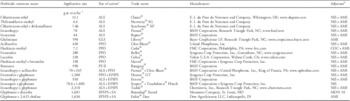
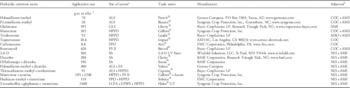
Experiments were conducted in the greenhouse at the University of Nebraska–Lincoln under the same growth conditions described in the greenhouse dose-response study. Treatments included herbicides registered for POST application in soybean (Table 1) and corn (Table 2). The goal was to determine the response of GR and GS common ragweed biotypes to herbicides with distinct sites of action. The experiments were conducted separately for corn and soybean POST herbicides in randomized complete block designs with four replications and repeated in time. Herbicide rates were selected based on the labeled rates (Tables 1 and 2) and were applied at the six- to eight-leaf stage (8 to 12 cm tall) to GR and GS common ragweed biotypes. Control was visually estimated and recorded at 21 DAT using the 0% to 100% scale described in the dose-response studies. The aboveground biomass was recorded using the same procedure explained in the greenhouse dose-response study and converted into percent biomass reduction using Equation 1.
Details of soybean POST herbicides used to evaluate response of the glyphosate-resistant and susceptible common ragweed biotypes in a greenhouse study conducted at the University of Nebraska–Lincoln

a Abbreviations: ALS, acetolactate synthase; AMS, ammonium sulfate (DSM Chemicals North America Inc., Augusta, GA); COC, crop oil concentrate (Agridex®, Helena Chemical Co., Collierville, TN); EPSPS, 5-enolpyruvylshikimate-3-phosphate synthase; GLS, glutamine synthetase; NIS, nonionic surfactant (Induce®, Helena Chemical Co., Collierville, TN); PPO, protoporphyrinogen oxidase; PS II, photosystem II; SA, synthetic auxins.
b AMS was mixed at 2.5% (wt/v); COC was mixed at 2.5% (v/v); NIS was mixed at 0.25% (v/v).
Details of POST corn herbicides used to evaluate the response of glyphosate-resistant and susceptible common ragweed biotypes in a greenhouse study conducted at the University of Nebraska–Lincoln

a Abbreviations: ALS, acetolactate synthase; AMS, ammonium sulfate (DSM Chemicals North America Inc., Augusta, GA); COC, crop oil concentrate (Agridex®, Helena Chemical Co., Collierville, TN); EPSPS, 5-enolpyruvylshikimate-3-phosphate synthase; GLS, glutamine synthetase; HPPD, 4-hydroxyphenylpyruvate dioxygenase; LCFA, long-chain fatty acid; NIS, nonionic surfactant (Induce®, Helena Chemical Co., Collierville, TN); PPO, protoporphyrinogen oxidase; PS II, photosystem II inhibitor; SA, synthetic auxins.
b AMS was mixed at 2.5% (wt/v); COC was mixed at 2.5% (v/v); NIS was mixed at 0.25% (v/v).
Data were subjected to ANOVA in SAS® version 9.4 (SAS Institute Inc, Cary, NC) using the PROC GLIMMIX procedure. Before analysis, the data were tested for the normality of residuals using the PROC UNIVARIATE procedure. Control and biomass data were arcsine square-root transformed before analysis; however, back-transformed data are presented with mean separation based on the transformed data. If the ANOVA indicated that treatment effects were significant, means were separated at P≤0.05 using Fisher’s Protected LSD test.
Results and Discussion
Dose-Response Study
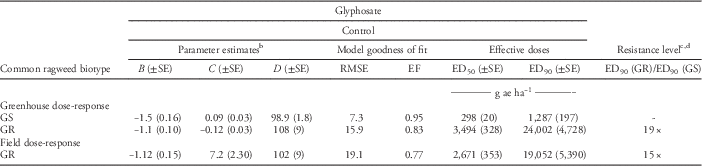
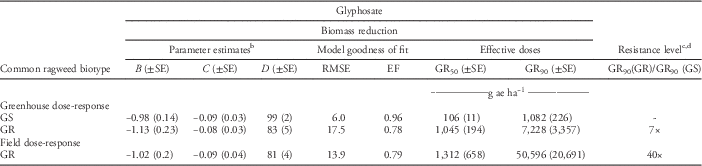
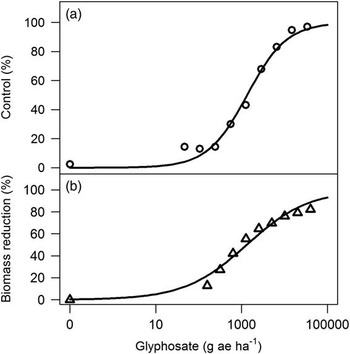
Treatment by experiment interactions in the greenhouse dose-response study were not significant for either common ragweed control (P=0.22) or biomass reduction (P=0.10); therefore, data from both experiments were combined. The labeled rate of glyphosate (1,260 gha–1) resulted in ≥90% control of the GS common ragweed biotype, compared to ≤40% control of the putative GR biotype (Figure 1), confirming resistance. Effective glyphosate rates for 50% (ED50) and 90% (ED90) control of the GS common ragweed biotype were 298 and 1,287 gha–1, compared to 3,494 and 24,002 gaeha–1 for the GR biotype, respectively, in the greenhouse dose-response study (Table 3). However, effective glyphosate rates for 50% (GR50) and 90% (GR90) biomass reduction were lower compared to ED50 and ED90, respectively for both GS and GR biotypes in the greenhouse dose-response study (Tables 3 and 4). For example, GR50 and GR90 of the GS common ragweed biotypes were 106 and 1,082 gaeha–1 compared to 1,045 and 7,228 gha–1 for the GR biotype, respectively. Thus, the putative GR biotype showed a 7- and 19-fold level of resistance to glyphosate relative to the GS biotype, respectively, based on the ratio of GR90 and ED90 values determined from biomass reduction and control estimates (Tables 3 and 4). Similarly, Brewer and Oliver (Reference Brewer and Oliver2009) reported two GR common ragweed biotypes from Arkansas with 10- and 20-fold levels of resistance relative to known GS biotypes, based on visual estimates of control. In contrast, Pollard (Reference Pollard2007) reported a 9.6-fold resistance to glyphosate in a GR common ragweed biotype from Missouri, based on biomass reduction. Parrish (Reference Parrish2015) further reported two GR common ragweed biotypes from Ohio with 4.5- and 12-fold levels of glyphosate resistance relative to known GS biotypes, based on control estimates, and 4- and 7-fold levels of resistance based on biomass reduction. The RMSE values for control estimates for the greenhouse dose-response study were 7.3 and 15.9 and the EF values were 0.95 and 0.83, respectively for the GS and GR common ragweed biotypes, indicating a good fit of the model (Table 3).
Dose-response curves of glyphosate-resistant (GR) and glyphosate-susceptible (GS) common ragweed biotypes from Nebraska. (a) Control at 21 days after treatment and (b) percent biomass reduction at 21 days after treatment, in a whole-plant glyphosate dose-response study conducted in the greenhouse at the University of Nebraska–Lincoln. Percent biomass reduction was calculated using the following equation: Biomass reduction
 $\left( \,\%\, \right)\,{\equals}\,\left[ {{{\left( {\overline{{C }} {\minus}B} \right)} \!\mathord{\left/ {\vphantom {{\left( {\overline{{C }} {\minus}B} \right)} {\bar{C}}}} \right. \kern-\nulldelimiterspace} {\bar{\!C}}}} \right]{\times}100$
, where C is the biomass of the nontreated control replicate and B is the biomass of an individual treated experimental unit.

Regression parameter estimates, model goodness of fit (RMSE and EF)Footnote a , and effective glyphosate doses resulting in 50% (ED50) and 90% (ED90) control of glyphosate-susceptible and resistant common ragweed biotypes in greenhouse and field dose-response studies

a Abbreviations: EF, modeling efficiency coefficient; GR, glyphosate-resistant common ragweed biotype collected from Gage County, Nebraska; GS, glyphosate-susceptible common ragweed biotype collected from Clay County, Nebraska; RMSE, root mean square error; SE, standard error.
b Regression parameters B, C and D represent slope, and lower and upper limits of the four-parameter log-logistic model, respectively, and were determined by using the nonlinear least-square function of the statistical software R. ED50, effective glyphosate dose required for 50% control of common ragweed at 21 days after treatment; ED90, effective glyphosate dose required for 90% control of common ragweed at 21 days after treatment.
c Resistance level in the greenhouse dose-response study was calculated by dividing the ED90 value of the GR common ragweed biotype by that of the GS biotype.
d In the field dose-response study, resistance level was determined by dividing the ED90 values of the GR common ragweed by the labeled rate of glyphosate (1,260 g ae ha–1), because the GS biotype was not available for comparison.
Regression parameter estimates, model goodness of fit (RMSE and EF)Footnote a , and effective glyphosate doses resulting in 50% (GR50) and 90% (GR90) biomass reduction of glyphosate-susceptible and resistant common ragweed biotypes in greenhouse and field dose-response studies

a Abbreviations: EF, modeling efficiency coefficient; GR, glyphosate-resistant common ragweed biotype collected from Gage County, Nebraska; GS, glyphosate-susceptible common ragweed biotype collected from Clay County, Nebraska; RMSE, root mean square error; SE, standard error.
b Regression parameters B, C, and D represent slope and lower and upper limits of the four-parameter log-logistic model, respectively, and were determined by using the nonlinear least-square function of the statistical software R. GR50, effective glyphosate dose required for 50% biomass reduction of common ragweed relative to the nontreated control at 21 days after treatment; GR90, effective glyphosate dose required for 90% biomass reduction of the common ragweed relative to the nontreated control treatments at 21 days after treatment.
c Resistance level in the greenhouse dose-response study was calculated by dividing the GR90 value of the GR common ragweed biotype by that of the GS biotype.
d In the field dose-response study, resistance level was determined by dividing the GR90 values of the GR common ragweed biotype by the labeled rate of glyphosate (1,260 g ae ha–1), because the GS biotype was not available for comparison.
Results from the field dose-response study suggested relatively higher levels of resistance in the putative GR common ragweed biotype. The effective glyphosate rates determined from the field dose-response study for 50% and 90% control were 2,671 and 19,052 gha–1 compared to 1,312 and 50,596 gha–1 required for aboveground biomass reduction, respectively (Figure 2, Tables 3 and 4). Van Wely et al. (Reference Van Wely, Soltani, Robinson, Hooker, Lawton and Sikkema2015b) reported that 1,606 and 7,675 gha–1 of glyphosate were required for 50% and 95% control of GR common ragweed at 28 DAT under field conditions in Ontario, Canada. The comparison of ED90 and GR90 values from the field dose-response study with the labeled rate of glyphosate (1,260 gha–1) revealed that the glyphosate rate required to achieve 90% control and biomass reduction was 15- and 40-times the labeled rate, respectively (Tables 3 and 4). In a field dose-response study in Ontario, Van Wely et al. (Reference Van Wely, Soltani, Robinson, Hooker, Lawton and Sikkema2015b) reported two GR common ragweed biotypes with 2- to 28-fold levels of resistance relative to a known GS biotype based on biomass reduction and control estimates. The RMSE values for control and biomass reduction for the field dose-response study were 19.1 and 13.9 and the EF values were 0.77 and 0.79, respectively, indicating a good fit of the model (Tables 3 and 4). Sarangi et al. (Reference Sarangi, Irmak, Lindquist, Knezevic and Jhala2016) also reported RMSE values ranging from 5.4 to 11.6 and EF values of 0.83 to 0.97 for validation of a four parameter log-logistic model for common waterhemp (Amaranthus rudis Sauer) plant height in response to water stress.
Dose-response curves of a glyphosate-resistant common ragweed biotype from Nebraska. (a) Control at 21 days after treatment and (b) percent biomass reduction at 21 days after treatment, in a whole-plant glyphosate dose-response study conducted at the putative glyphosate-resistant common ragweed field research site in Gage County, Nebraska. Percent biomass reduction was calculated using the following equation: Biomass reduction
 $\left( \,\%\, \right){\equals}\left[ {{{\left( {\overline{{\!C }} {\minus}B} \right)}\! \mathord{\left/ {\vphantom {{\left( {\overline{{C }} {\minus}B} \right)} {\bar{C}}}} \right. \kern-\nulldelimiterspace} {\bar{\!C}}}} \right]{\times}100$
, where C is the biomass of the nontreated control replicate and B is the biomass of an individual treated experimental unit.

Frequency of Glyphosate Resistance
The results suggested that 82% of 1,750 common ragweed plants treated in 2015 and 84% of 2,125 plants treated in 2016 survived 2×(where × is 1,260 gha−1) rate of glyphosate 4 wk after treatment. Therefore, the frequency of glyphosate resistance in common ragweed biotype ranged from 82% to 84%.
Response to POST Soybean Herbicides
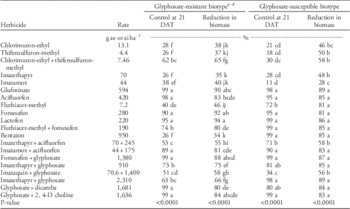
Treatment by experiment interactions for common ragweed control (P=0.09) and biomass reduction (P=0.12) were not significant; therefore, data were combined over two runs. Acifluorfen, fomesafen, fomesafen plus glyphosate, glyphosate plus dicamba or 2,4-D choline, glufosinate, imazamox plus acifluorfen, and lactofen provided 89% to 99% control of GR common ragweed at 21 DAT (Table 5). In recent years, glufosinate and PPO inhibitors have been widely used for controlling GR weeds: for instance, glufosinate provided 99% control of GR giant ragweed (Ambrosia trifida L.) (Kaur et al. Reference Kaur, Sandell, Lindquist and Jhala2014) and ≥80% control of GR common waterhemp (Sarangi et al. Reference Sarangi, Sandell, Knezevic, Aulakh, Lindquist, Irmak and Jhala2015). Previous studies have reported >90% control of common ragweed with fomesafen or lactofen (Chandi et al. Reference Chandi, Jordan, York and Lassiter2012; Taylor et al. Reference Taylor, Loux, Harrison and Regnier2002) and glyphosate plus fomesafen (Van Wely et al. Reference Van Wely, Soltani, Robinson, Hooker, Lawton and Sikkema2015b).
Response of glyphosate-resistant and susceptible common ragweed biotypes to POST soybean herbicides at 21 days after treatment in a greenhouse study conducted at the University of Nebraska–Lincoln

a Abbreviations: DAT, day after treatment.
b Data were arcsine square-root transformed before analysis; however, back-transformed actual mean values are presented based on interpretation from the transformed data.
c Means presented within each column with no common letter(s) are significantly different according to Fisher’s Protected LSD test where P≤0.05.
d Percent control data (0%) of the nontreated control were not included in the analysis. Reduction in biomass was calculated based on the average biomass of the nontreated control.
ALS inhibitors (Table 1) were not effective for control of GR or GS common ragweed biotypes and resulted in only 11% to 62% control (Table 5). Similar to the results of this study, Van Wely et al. (Reference Van Wely, Soltani, Robinson, Hooker, Lawton and Sikkema2015b) reported <61% control of common ragweed with ALS inhibitors, including chlorimuron-ethyl, cloransulam, imazethapyr, and thifensulfuron. Conversely, common ragweed biotypes showed a differential response to bentazon (PS II inhibitor) and fluthiacet-methyl (PPO inhibitor). Bentazon resulted in 26% and 99% control and fluthiacet-methyl provided 40% and 72% control of GR and GS biotypes, respectively (Table 5).
Results of the biomass reduction were mostly in consensus with the control estimates in both GR and GS biotype. Glufosinate, fomesafen, lactofen, and glyphosate plus fomesafen or 2,4-D choline resulted in a biomass reduction ranging from 80% to 94% without statistical difference among them (Table 5). Similarly, Van Wely et al. (Reference Van Wely, Soltani, Robinson, Hooker, Lawton and Sikkema2015b) reported >90% biomass reduction in common ragweed with glyphosate plus fomesafen or acifluorfen under field conditions. Additionally, most ALS inhibitors resulted in <65% biomass reduction of both GR and GS biotypes (Table 5). The reduced efficacy of ALS inhibitors for common ragweed control is not surprising since common ragweed biotypes with resistance to ALS inhibitors have been previously reported (Chandi et al. Reference Chandi, Jordan, York and Lassiter2012; Patzoldt et al. Reference Patzoldt, Tranel, Alexander and Schmitzer2001; Van Wely et al. Reference Van Wely, Soltani, Robinson, Hooker, Lawton and Sikkema2015a). In Nebraska, other weed species, including common waterhemp, kochia [Kochia scoparia (L.) Schrad.], horseweed [Conyza canadensis (L.) Cronq.], and Palmer amaranth (Amaranthus palmeri S. Wats.) have evolved resistance to ALS inhibitors due to repeated applications of these herbicides in corn–soybean cropping systems (Jhala et al. Reference Jhala, Sandell, Knezevic, Kruger and Wilson2014; Sarangi et al. Reference Sarangi, Sandell, Knezevic, Aulakh, Lindquist, Irmak and Jhala2015). More research is needed to confirm whether this GR common ragweed biotype is resistant to ALS inhibitors and to determine the mechanisms of resistance.
Response to POST Corn Herbicides
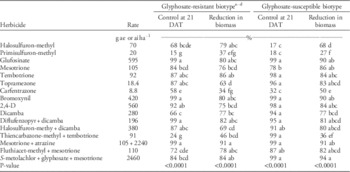
Treatment by experiment interactions for common ragweed control (P>0.10) and biomass reduction (P>0.16) were not significant; therefore, data were combined over the experimental runs. Bromoxynil, 2,4-D, diflufenzopyr plus dicamba, glufosinate, halosulfuron-methyl plus dicamba, mesotrione plus atrazine, tembotrione, and topramezone controlled GR and GS common ragweed biotypes 87% to 99% at 21 DAT (Table 6). Everman et al. (Reference Everman, Burke, Allen, Collins and Wilcut2007) also reported ≥90% control of common ragweed with glufosinate applied at 470 g ai ha–1 in cotton (Gossypium hirsutum L.). Despite having a similar site of action, 4-hydroxyphenylpyruvate dioxygenase (HPPD) inhibitors tembotrione and topramezone resulted in 98% and 96% control of GS common ragweed, respectively, in contrast to 78% control with mesotrione applied alone with no difference in response of GR biotype (84% to 87% control) (Table 6). Zollinger and Ries (Reference Zollinger and Ries2006) reported 52% control of common ragweed with mesotrione compared to 94% and 97% control with tembotrione and topramezone, respectively. Tank-mixing mesotrione with atrazine provided 99% control of the GR and GS common ragweed biotypes in this study; this is likely due to the synergistic effect of photosystem II (PS II) and HPPD inhibitors as reported in the literature (Hugie et al. Reference Hugie, Bollero, Tranel and Riechers2008; Walsh et al. Reference Walsh, Stratford, Stone and Powles2012; Woodyard et al. Reference Woodyard, Bollero and Riechers2009). For instance, Whaley et al. (Reference Whaley, Armel, Wilson and Hines2006) reported 37% to 49% control of common ragweed with mesotrione; however, control improved to >83% and 95% when tank-mixing atrazine at 280 and 560 gha–1, respectively.
Response of glyphosate-resistant and susceptible common ragweed biotypes to POST corn herbicides at 21 days after treatment in a greenhouse study conducted at the University of Nebraska–Lincoln

a Abbreviations: DAT, day after treatment.
b Data were arcsine square-root transformed before analysis; however, back-transformed actual mean values are presented based on the interpretation from the transformed data.
c Means presented within each column with no common letter(s) are significantly different according to Fisher’s Protected LSD test where P≤0.05.
d Percent control data (0%) of the nontreated control were not included in the analysis. Reduction in biomass was calculated on the basis of the average biomass of the nontreated control.
Variable control was observed with dicamba, fluthiacet-methyl plus mesotrione, and S-metolachlor plus glyphosate plus mesotrione. For example, dicamba resulted in 66% and 94% control, and fluthiacet-methyl plus mesotrione provided 72% and 87% control of GR and GS biotypes, respectively, compared to 84% and 99% control with S-metolachlor plus glyphosate plus mesotrione. However, Chandi et al. (Reference Chandi, Jordan, York and Lassiter2012) reported ≥99% control with thifensulfuron early-POST fb dicamba POST in corn. ALS-inhibiting herbicides such as halosulfuron-methyl provided 17% to 68% control compared to 15% to 18% control with primisulfuron-methyl (Table 6), whereas, Taylor et al. (Reference Taylor, Loux, Harrison and Regnier2002) reported that halosulfuron, primisulfuron, prosulfuron, or cloransulam-methyl provided ≥98% control. Surprisingly, thiencarbazone-methyl plus tembotrione provided 24% and 99% control of the GR and GS common ragweed biotype, respectively, though differences in the biomass reduction were not prominent. Most herbicide treatments that provided effective common ragweed control resulted in 63% to 94% biomass reduction of GR and GS biotypes, with few statistical differences among them (Table 6).
Phenoxy-based herbicide tank-mixtures are anticipated to be available for use in multiple-herbicide-resistant soybean in the near future (Craigmyle et al. Reference Craigmyle, Ellis and Bradley2013; Miller and Norsworthy Reference Miller and Norsworthy2016; Wright et al. Reference Wright, Shan, Walsh, Lira, Cui, Song, Zhuang, Arnold, Lin, Russell, Cicchillo, Peterson, Simpson, Zhou, Ponsamuel, Yau and Zhang2010). In this study, glyphosate plus 2,4-D choline or dicamba provided 99% control of GR common ragweed. Similarly, Chahal et al. (Reference Chahal, Aulakh, Rosenbaum and Jhala2015) reported >90% control of 10 cm tall GR common waterhemp and GR giant ragweed with 2,4-D choline plus glyphosate applied at 1,640 gha–1. Chahal and Johnson et al. (Reference Chahal and Johnson2012) further reported ≥95% control of GR horseweed with 2,4-D amine plus glyphosate, while in a recent study, Miller and Norsworthy (Reference Miller and Norsworthy2016) reported >90% control of GR Palmer amaranth with 2,4-D choline and glyphosate dimethylamine. Craigmyle et al. (Reference Craigmyle, Ellis and Bradley2013) reported improved weed control efficacy as a result of tank-mixing glufosinate with 2,4-D compared to the efficacy of either of these herbicides applied alone.
Practical Implications
This is the first report of GR common ragweed in Nebraska. Greenhouse dose-response studies confirmed a 7- to 19-fold level of resistance compared to the known GS biotype, while a field dose-response study conducted at the putative GR common ragweed research site revealed that 15- and 40-times the labeled rate of glyphosate was predicted to be required for 90% control and biomass reduction, respectively. The evolution of GR common ragweed in Nebraska will make weed control more challenging for corn and soybean growers in eastern Nebraska as GR common waterhemp, giant ragweed, horseweed, and Palmer amaranth have been confirmed and are widely distributed in the area. The response of GR common ragweed to POST corn and soybean herbicides suggested that alternate POST herbicide options are available for effective management of GR common ragweed. Since both GR and GS common ragweed biotypes exhibited reduced sensitivity to labeled rates of ALS inhibitors, dose-response studies are needed to evaluate whether GR common ragweed from Nebraska is also resistant to ALS inhibitors. Field studies are needed to evaluate common ragweed management programs based on the integration of herbicides with different sites of action applied PRE and/or POST with non-chemical options including crop rotation, minimum tillage, reduced row spacing, and the use of cover crops.
Acknowledgements
The authors wish to thank the Indian Council of Agricultural Research, New Delhi, India for partial financial support to Zahoor A. Ganie. We thank Lowell Sandell for identifying the site and providing the grower’s contact information. We also appreciate help of Ethann Barnes and Ian Rogers in this project.