Introduction
As European societies are ageing, larger numbers of older people experience functional limitations. Family members, especially partners and children, contribute strongly in caring for older dependent persons. In the light of progressing population ageing and austerity in professional care, European welfare states increasingly rely on unpaid elderly care (Broese van Groenou and De Boer, Reference Broese van Groenou and De Boer2016). At the same time, demographic shifts and societal developments – such as shrinking family sizes, increased female labour-force participation and higher retirement ages – may put pressure on the future availability of informal care (Agree and Glaser, Reference Agree, Glaser and Uhlenberg2009). Therefore, numerous papers have studied when or why relatives take up a care-giver role, with particular attention to the care provision of adult children. Although care-giving for parents essentially takes place in parent–child dyads, the amount of care children provide generally results from interdependent decisions in multiple-child families (Allan, Reference Allan1977; Finch and Mason, Reference Finch and Mason1993; Checkovich and Stern, Reference Checkovich and Stern2002). As such, parent–child care exchanges are embedded in the family and likely to be affected by siblings (Henretta et al., Reference Henretta, Soldo and Van Voorhis2011; Szinovacz and Davey, Reference Szinovacz and Davey2013; Tolkacheva et al., Reference Tolkacheva, Broese van Groenou and van Tilburg2014; Grigoryeva, Reference Grigoryeva2017).
A prominent component of the family context is gender composition. Care for parents is still regarded as daughters’ work (Matthews, Reference Matthews2002; Haberkern et al., Reference Haberkern, Schmid and Szydlik2015; Verbakel et al., Reference Verbakel, Tamlagsrønning, Winstone, Fjær and Eikemo2017). The primacy of women in elderly care is particularly reflected when care for parents is allocated within the family. Sons frequently shirk from parent care, while their present sister(s) often shoulder(s) the care burden instead (Grigoryeva, Reference Grigoryeva2017). Other individual characteristics (e.g. geographic proximity or employment), shown to be most conducive to care-giving, are hardly considered at the family level. However, not only a child's own propensity to care, but also the prospects of his or her siblings, could adjust the care an adult child provides. The present study aims to address this gap by examining how siblings affect the dyadic parent–child care exchange in Europe. As a result, we contribute to existing research investigating how care arrangements are shaped within the family context (Tolkacheva et al., Reference Tolkacheva, Broese van Groenou and van Tilburg2010; Szinovacz and Davey, Reference Szinovacz and Davey2013). We elaborate on individual predictors of care-giving by assessing their influence on a child's care provision at the sibling level. A major strength of this research paper is the use of the rich Survey of Health, Ageing and Retirement in Europe (SHARE) panel data to deal with endogeneity of the sibling predictors. Our longitudinal approach allows the impact of sibling characteristics prior to care provision to be tested, taking into account the temporal ordering of the transition to care-giving (Pillemer and Suitor, Reference Pillemer and Suitor2013; Leopold et al., Reference Leopold, Raab and Engelhardt2014). This avoids reversed causality as a child's care-giving may forge changes among his or her siblings (e.g. start to work when a brother or sister takes the care burden).
In addition, this study seeks to explore how sibling characteristics differently affect children's care for parents across Europe. As pointed out by Haberkern et al. (Reference Haberkern, Schmid and Szydlik2015), gender inequality in intergenerational care is highest in countries with a low provision of professional home care services, a traditional division of unpaid household labour and a strong emphasis on families’ care responsibilities. Furthermore, according to recent inquiry, children caring for dependent parents are particularly driven by cultural norms in countries where strong family ties prevail (Klimaviciute et al., Reference Klimaviciute, Perelman, Pestieau and Schoenmaeckers2017). This suggests that daughters may feel more obliged to look after their parents in these countries, irrespective of their siblings’ care prospects.
The empirical analysis draws on recent SHARE data from Waves 5 and 6 (2013–2015). SHARE includes rich information on both care receiving of parents and their children's characteristics. To examine the associations between sibling characteristics and a child's care-giving, 79,020 parent–child dyads are considered in a logistic regression analysis of the transition to care for a parent. The consecutive waves are used to correct for endogeneity as we relate prior sibling characteristics (Wave 5) to the start of giving care in Wave 6.
Theory
Lifecourse and family systems theory provide the guiding principles of this study, both highlighting the interdependence of family members (Bengtson and Allen, Reference Bengtson, Allen, Boss, Doherty, LaRossa, Schumm and Steinmetz1993; Cox and Paley, Reference Cox and Paley1997; Szinovacz and Davey, Reference Szinovacz and Davey2013). A priori we consider the lives of children and their parents interrelated as we examine the care children give to their parents. In addition, we expect that the care-giving of children is influenced by the availability, characteristics and care-giving of their siblings. Informal care for parents often occurs with siblings involved together (Tolkacheva et al., Reference Tolkacheva, Broese van Groenou and van Tilburg2014). Dividing care between siblings lowers the individual care-giving burden (Tolkacheva et al., Reference Tolkacheva, Broese van Groenou, De Boer and Van Tilburg2011). By a logical progression, children with more siblings are likely to give less parent care than children in smaller families (Bonsang, Reference Bonsang2007). At the same time, children may consider a trade-off between their own and their siblings’ care-giving prospects (Silverstein et al., Reference Silverstein, Conroy, Gans, Szinovacz and Davey2008). Not only does one life domain relate to another at the individual level (e.g. one's employment and care-giving), but those life domains could also be linked between different siblings (e.g. siblings’ employment and one's care-giving). A child's decision to provide care may take siblings’ care opportunities and constraints into account, as well as normative and affective commitments (Finch and Mason, Reference Finch and Mason1993). The present study therefore focuses on the role of individual care predictors aggregated to the sibling level. We distinguish between three groups of care-giving determinants: (a) gender and gender roles, (b) the costs of care-giving, and (c) parent–child commitment. Those factors will be discussed in the following paragraphs. Subsequently, we briefly address cross-country variation.
Gender and gender roles
The gender division of informal support for parents has been well documented, particularly that intensive care-giving is unfairly weighted against women in Europe (Haberkern et al., Reference Haberkern, Schmid and Szydlik2015; Verbakel et al., Reference Verbakel, Tamlagsrønning, Winstone, Fjær and Eikemo2017). In the literature, the distinctive gender roles in informal care-giving are explained from different theoretical perspectives (Finley, Reference Finley1989; Lachance-Grzela and Bouchard, Reference Lachance-Grzela and Bouchard2010). However, most studies underline the importance of normative factors concerning the primacy of daughters in care for the elderly. The daughter's role of principal care-giver cannot be traced to different resources and constraints of men and women (e.g. women perform less paid work) (Haberkern et al., Reference Haberkern, Schmid and Szydlik2015). As reported by Silverstein et al. (Reference Silverstein, Gans and Yang2006), normative beliefs are important for the care provision of daughters, which is consistent with traditional gender ideology regarding family labour (Cunningham, Reference Cunningham2001a, Reference Cunningham2001b). Gendered care attitudes prescribe that daughters are more responsive to personal care needs of family members, while sons are expected to perform practical and paid tasks (Haberkern et al., Reference Haberkern, Schmid and Szydlik2015). A variant of this perspective points at gender construction. According to this view, family care is crucial to the female role (Knudsen and Wærness, Reference Knudsen and Wærness2008). Their unpaid work is an expression of the female gender identity, whereas men resist performing more household labour to defend and reinforce the male identity (Erickson, Reference Erickson2005). Gender inequality can also be linked to the preferences of care recipients. Mothers are often closer and more intimate with their daughters than sons. Since intimacy is of particular importance for the task of care-giving, mothers generally prefer receiving care from their daughters (Pillemer and Suitor, Reference Pillemer and Suitor2006). Given that most elders in need of care are women, the mother–daughter tie contributes to the observed gender differences in intergenerational care.
As mentioned earlier, family members potentially reduce the intergenerational care burden since siblings often take up a joint care responsibility. American research, however, suggests that also a family's gender composition matters. The number of sisters available to care appears to influence children's care-giving more compared to the number of brothers (Wolf et al., Reference Wolf, Freedman and Soldo1997; Tolkacheva et al., Reference Tolkacheva, Broese van Groenou and van Tilburg2010; Szinovacz and Davey, Reference Szinovacz and Davey2013). This corresponds with gendered family care as sisters reduce the care efforts of other children, especially brothers (Grigoryeva, Reference Grigoryeva2017). Since women are generally seen as ‘natural’ care-givers, brothers may easily find justification to refrain from care tasks. Daughters providing no or only a minimum of care, however, feel more often guilty and experience difficulties in legitimising disengagement (Ingersoll-Dayton et al., Reference Ingersoll-Dayton, Neal, Ha and Hammer2003). In sum, we expect that the gender division of care-giving for parents is reflected at the family level. The first hypothesis hence reads:
• Hypothesis 1: Irrespective of both individual and siblings’ care opportunities, (a) daughters are more likely to give care to their parents than sons, (b) especially in families where sons are prevalent.
The cost of care-giving: geographic proximity, family demands and employment
Besides normative considerations of gendered care, research on filial care-giving generally relies on rational choice and exchange theory. This strand of the literature highlights the importance of the ‘price’ of informal care services, mostly translating into the opportunity costs of children's time to care (Finch and Mason, Reference Finch and Mason1993; Silverstein et al., Reference Silverstein, Conroy, Wang, Giarrusso and Bengtson2002; Bianchi et al., Reference Bianchi, Hotz, McGarry and Seltzer2006). The present study considers barriers to interacting with parents (geographic distance) and competing demands or obligations (a child's own family life and employment), both increasing the costs of care-giving. However, a child's decision to help his or her parents is not reducible to an individual cost calculation. Instead of pursuing a costly care activity, children may count on siblings as an alternative source of support (Silverstein et al., Reference Silverstein, Conroy, Gans, Szinovacz and Davey2008). Hence, individual children's care opportunities interact with those of siblings, emphasising the relativity of his or her own care-giving prospects (Tolkacheva et al., Reference Tolkacheva, Broese van Groenou and van Tilburg2010, Reference Tolkacheva, Broese van Groenou and van Tilburg2014). In accordance with rational choice theory, children are assumed to allocate care for parents so that the care burden is distributed efficiently between siblings. We expect that children encountering the lowest care costs are most likely to provide assistance to their parents.
A well-documented determinant of care for parents is geographic proximity. A closer proximity facilitates contact between family members and increases the possibility of exchanging care (Joseph and Hallman, Reference Joseph and Hallman1998; Bonsang, Reference Bonsang2007; Hank, Reference Hank2007; Pillemer and Suitor, Reference Pillemer and Suitor2013; Leopold et al., Reference Leopold, Raab and Engelhardt2014). Shorter distances between children and parents reduce travel costs and increase time-efficiency for care providers, particularly for recurrent and demanding care. A few studies have considered the distance of siblings to parents as a predictor of care-giving, with Matthews (Reference Matthews2002) and Leopold et al. (Reference Leopold, Raab and Engelhardt2014) suggesting more care-giving among children living at a closer parent–child distance compared to siblings. Tolkacheva et al. (Reference Tolkacheva, Broese van Groenou and van Tilburg2010), examining average travel time between siblings and a parent, find a limited association between siblings’ proximity and individual care intensity. However, geographic location is not necessarily exogenous to care-giving. Stern (Reference Stern1995) demonstrates that family members also move closer because of the decision to start caring, introducing a reverse relationship between care and proximity (Pettersson and Malmberg, Reference Pettersson and Malmberg2009, Smits et al., Reference Smits, Van Gaalen and Mulder2010). A longitudinal research design addressing the impact of proximity prior to the onset of care-giving allows an adequate assessment of siblings’ proximity effects.
Adult children's lives are not exclusively linked to their parents and siblings. Children also occupy other adult roles, such as being someone's partner or parent. Competing family demands are thought to limit children's availability to provide care for their parents. First, studies show that partnered children are less often care-givers (Henz, Reference Henz2006; Silverstein et al., Reference Silverstein, Conroy, Gans, Szinovacz and Davey2008; Haberkern and Szydlik, Reference Haberkern and Szydlik2010). A study relating the proportion of siblings with partners to children's individual care-giving efforts corroborates this result (Tolkacheva et al., Reference Tolkacheva, Broese van Groenou and van Tilburg2010). Second, parenting children may have less time available to provide care for a parent (Henz, Reference Henz2006; Igel et al., Reference Igel, Brandt, Haberkern and Szydlik2009). In accordance, Henretta et al. (Reference Henretta, Soldo and Van Voorhis2011) reveal that a higher share of parenting siblings increases the individual likelihood of taking up care.
A third evident cost-related predictor is employment. The connection between employment and care for parents is a complex one. The high demands of both care and employment diminish the willingness and effective hours of care-giving among workers (Bonsang, Reference Bonsang2007; Carmichael et al., Reference Carmichael, Charles and Hulme2010). Working kin have less time available to care. In addition, children with high earnings are reluctant to shoulder care tasks since it might jeopardise future employment and income prospects (Carmichael et al., Reference Carmichael, Charles and Hulme2010). Indeed, research suggests that care-givers frequently cut back in hours of paid work or leave the labour force to meet the needs of care recipients (Bolin et al., Reference Bolin, Lindgren and Lundborg2008; Van Houtven et al., Reference Van Houtven, Coe and Skira2013). This confirms a two-way causality between caring and employment status (Leopold et al., Reference Leopold, Raab and Engelhardt2014). Again, research addressing the role of siblings’ employment in children's care provision requires longitudinal analysis to avoid spurious interpretations.
Taken together, we anticipate that care for parents is frequently taken on by children having siblings with limited opportunities to care. This leads to the second hypothesis:
• Hypothesis 2: An individual child is more likely to provide care if his or her siblings encounter higher care-giving costs.
Parent–child commitment
Finally, we introduce contact frequency between parents and their children as an explanatory variable of children's care-giving. Regularity of parent–child contact is often regarded as a measure of relationship quality and emotional closeness (Leopold et al., Reference Leopold, Raab and Engelhardt2014). As pointed out by Pillemer and Suitor (Reference Pillemer and Suitor2006), parents prefer to receive care from children who are emotionally close. In this respect, previous work by Tolkacheva et al. (Reference Tolkacheva, Broese van Groenou and van Tilburg2010) also demonstrates that children take up more care when siblings have emotionally poorer relationships with their parents. Besides feelings of closeness, children having frequent contact might be more aware of parents’ care needs or preferences as well, which, in turn, makes them prone to become parents’ expected care-giver (Pillemer and Suitor, Reference Pillemer and Suitor2013; Leopold et al., Reference Leopold, Raab and Engelhardt2014). In addition, parent–child contact may also enhance or reflect care-promoting factors such as shared values and familialism (Pillemer and Suitor, Reference Pillemer and Suitor2006; Silverstein et al., Reference Silverstein, Gans and Yang2006). Most studies have considered the association between contact and care in cross-section, with the caveat that care depends on regular interpersonal contact. Therefore, it is clear that contact frequency and emotional ties are reinforced through care-giving. To control for this, research should pay attention to the temporal ordering of the contact–care nexus. All in all, the third hypothesis is as follows:
• Hypothesis 3: An individual child is more likely to provide care if his or her siblings are less in contact with their parents.
Cross-country variation
Across Europe the organisation of care for the elderly is subject to substantial heterogeneity. Comparative studies show a clear north–south gradient, with intensive informal care prevailing in southern Europe and only a limited prevalence of demanding intergenerational care in the north. Western and central European countries are in an intermediate position (Brandt et al., Reference Brandt, Haberkern and Szydlik2009; Brandt, Reference Brandt2013). These country differences are largely attributable to varying welfare state regimes and cultural contexts (Verbakel, Reference Verbakel2018). Recent studies find that elderly care in southern European countries is predominantly driven by family obligations, while countries with weaker family ties rely more on the supply of state care provisions (Viazzo, Reference Viazzo2010; Klimaviciute et al., Reference Klimaviciute, Perelman, Pestieau and Schoenmaeckers2017). Here, informal care seems voluntary and is more often perceived as a joyful task (Brandt, Reference Brandt2013), suggesting that care for parents is carried out by children with favourable care-giving opportunities and is less imposed by normative expectations. At the same time, it appears that gender differences in intergenerational care are congruent with the prevalence of intensive informal care. The design of welfare state regimes and family norms may not necessarily be gender neutral (Haberkern et al., Reference Haberkern, Schmid and Szydlik2015). Concerning the welfare state, we consider the public provision of care services and cash-for-care paid to care recipients or providers. Whereas a wide availability of professional care services relieves the care burden of daughters (e.g. Denmark), generous cash-for-care schemes tend to preserve gendered care (e.g. Italy). Cash benefits are mostly distributed to women as they earn less and norms are often strongly in favour of female elderly care (Haberkern et al., Reference Haberkern, Schmid and Szydlik2015). The latter is also reflected in the fact that unpaid family and household work is unequally divided in all European countries, although it is most gendered in eastern and southern Europe (Plantenga et al., Reference Plantenga, Remery, Figueiredo and Smith2009; World Bank, 2018). Strong family norms translate into more care obligations for daughters than sons in these countries (Haberkern et al., Reference Haberkern, Schmid and Szydlik2015). This leads us to the fourth hypothesis:
• Hypothesis 4: (a) Particularly in countries with strong gender and family norms daughters are more likely to give care to their parents than sons, (b) while siblings’ care-giving opportunities are more decisive in other countries.
Data and methods
The analysis uses data from the Survey of Health, Ageing and Retirement in Europe (SHARE) (Börsch-Supan et al., Reference Börsch-Supan, Brandt, Hunkler, Kneip, Korbmacher, Malter, Schaan, Stuck and Zuber2013). SHARE is a multi-disciplinary and cross-national panel survey covering a large number of European countries. Respondents aged 50 and older, together with their co-habiting partners, are questioned on health and wellbeing, socio-economic status, and social and family networks. To address our research questions, we selected a sample from the recent SHARE Waves 5 and 6 (conducted in 2013 and 2015) (Börsch-Supan Reference Börsch-Supan2017a, Reference Börsch-Supan2017b). SHARE includes consistent information on both care receiving of parents and their children's characteristics across panel waves, enabling us to study the antecedents of care for parents.
The present sample encompasses SHARE respondents with children in Waves 5 and 6. The information on children and intergenerational care is aggregated to the couple level in Wave 5 as the questionnaire combines care received by both the respondent and his or her partner. From the 40,262 selected households in Wave 5, 28,185 were also interviewed in Wave 6, yielding 41,264 matched Wave 6 interviews with individual respondents aged 50 or older (care receiving is measured per respondent in Wave 6).Footnote 1 To examine children's care-giving, the data-set is transposed in the next step. Child observations per respondent (i.e. parent–child dyads) are considered as the unit of analysis and children are identified by gender and birth year to match them between waves.Footnote 2 Together with background information on the parent, individual characteristics are stored for each child observation. This results, after excluding lone children (8,203 observations), in a sample of 83,090 parent–child dyads.Footnote 3
In the selected sample, 18.47 per cent of the children show at least one missing value on the variables in the analysis (both waves), resulting in 67,747 complete child observations. The largest share of missing data stems from the reported child characteristics (11,391). Many respondents fail to provide specific data on their own or their partner's descendants, constituting an important amount of item non-response. To reduce the risk of obtaining biased estimates and avoid a substantial loss of statistical power, missing data are imputed using ICE in Stata (Royston, Reference Royston2005). Ten data-sets are generated and imputations are informed by the variables in the analysis. From the imputed data-sets sibling characteristics are computed. Subsequently, we retain children of age 18 and older in Wave 6 (16 or older in Wave 5) (N = 81,927), taking out children who are generally too young to provide substantial care (1,163 children omitted). A final step is to restrict our sample to children not providing care in Wave 5. As mentioned earlier, we take heed of the potential endogenous character of time-changing care-giving predictors of siblings. Hence, these characteristics are measured among children not giving care and related to the subsequent transition to care-giving in Wave 6. This leads to a final sample comprising 79,020 dyads. Model estimates from all generated data-sets are pooled with the MI ESTIMATE prefix in Stata (Johnson and Young, Reference Johnson and Young2011).Footnote 4
Dependent variable and modelling strategy
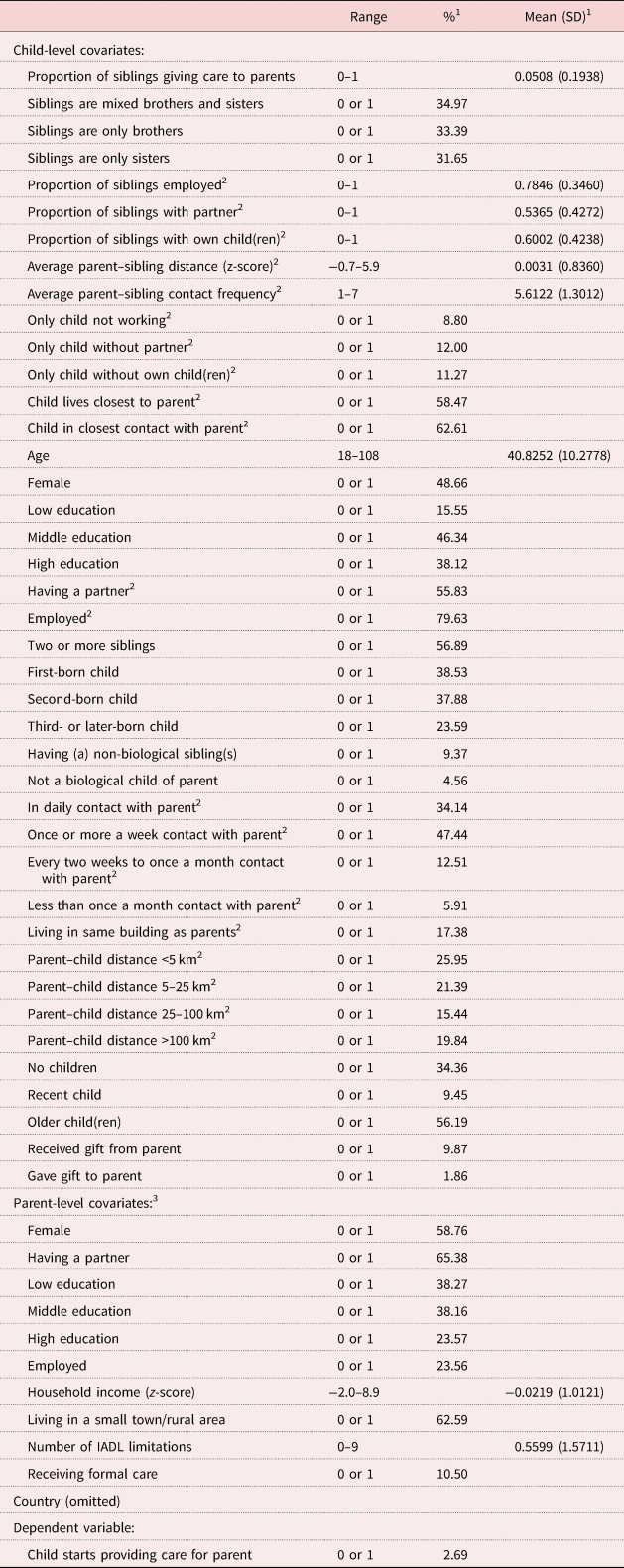
Whether a child starts taking care of his or her parent is the outcome variable of the analysis. We distinguish between two situations to regard children as care-givers in SHARE. (a) Respondents first select children who provided care during the last 12 months and live outside the household. We consider both children shouldering personal care (e.g. dressing, bathing, etc.) or helping with household chores (e.g. paperwork, home repairs, transportation, shopping, etc.) at least weekly as care-takers. (b) Respondents can also identify children living inside the household as care-givers, but only if they provided personal care (e.g. dressing, bathing, etc.) during the last 12 months. Although it is not asked how often respondents received personal care from persons living inside the household, we assume that co-residing children are frequently involved because of their day-to-day presence (Michaud et al., Reference Michaud, Heitmueller and Nazarov2010). Table 1 shows that children make the care-giver transition in 2.69 per cent of the selected parent–child dyads.
Descriptive statistics of (in)dependent variables for selected sample of parent–child dyads

Notes: The table presents variables (including missing) of the original data-set, N (total = 79,020) depends on missing values for variable of consideration. 1. The proportions are presented for categorical variables, means and standard deviations (SD) for continuous variables. 2. Measured at Wave 5 because covariates are potentially endogenous to care-giving for parents. 3. Descriptive figures are presented at the parent level (not representing parent–child dyads). km: kilometre. IADL: instrumental activity of daily living.
Source: Survey of Health, Ageing and Retirement in Europe Waves 5 and 6, calculations by authors.
Multi-level binary logistic regression is used to estimate the associations between each child's care-giving and sibling characteristics. The multi-level models nest the 79,020 child observations (level 1) in 53,240 children (level 2) since some children are observed twice (both their father and mother are interviewed), whereas children are nested in 21,311 families (level 3). Hence, we take into account the clustering of children from the same family. The level 3 random-intercept variance reflects the between-family variances not accounted for by the independent variables in the model. The regression models also adjust for the fact that the individual care-giving of a child may result from the care-giving of siblings by including the proportion of siblings providing care as an explanatory variable (cf. Table 1) (Tolkacheva et al., Reference Tolkacheva, Broese van Groenou and van Tilburg2010). As mentioned earlier, individual actors are assumed to be responsive to behaviours of significant others, i.e. siblings (Leenders, Reference Leenders1995, Reference Leenders, Doreian and Stokman1997). The unspecified mutual dependence of siblings’ care-giving may lead to biased parameters.
Independent variables
Table 1 presents descriptive information on the analysed variables. The independent variables are grouped at three levels: (a) children, (b) parents, and (c) country. At the country level, we control for the 14 countries in which parents are living (Austria, Belgium, Czech Republic, Denmark, Estonia, France, Germany, Israel, Italy, Luxembourg, Slovenia, Spain, Sweden and Switzerland).Footnote 5
Sibling characteristics are of central interest in this paper. Three groups of sibling care-giving predictors are assessed to address our hypotheses: (a) gender composition, (b) care-giving costs, and (c) parent–child commitment. The first, gender composition, distinguishes between three groups, with a child's siblings being (a) mixed brother(s) and sister(s), (b) brother(s) only, and (c) sister(s) only. The models test interaction terms between siblings’ gender composition and the individual gender of a child to investigate whether sons or daughters are more or less likely to provide care in varying gender configurations. The second group of variables, reflecting potential care-giving costs, includes indicators of siblings’ employment, partner status, parental status and parent–child distance. These are considered among children not providing care, and hence not affected by their care involvement yet, to investigate their influence on the subsequent care-giving transition. As regards the employment and family situation of a child's siblings, we examine the proportions of employed and partnered siblings of each child, together with the share of siblings with own children. Furthermore, the child's position is compared to his or her siblings. A child's relative position is captured by dummies indicating whether he or she is the only one not working, without a partner or childless in the sibling group. Also, the analysis considers the closeness to parents in terms of geographic distance. The average parent–sibling geographic distance (standardised per country) and a variable indicating whether a child resides the closest to the parent are studied. Thirdly, parent–child commitment translates into the parent–child contact among siblings. The contact of siblings is grasped by the mean of a variable reflecting the frequency of contact by each sibling with his or her parent. This is expressed by a seven-point scale representing the contact frequency between a child and parent, with 7 denoting daily contact and 1 depicting no contact. A child's relative parent contact is included as a binary variable. Other information on siblings is included as control variables. A dummy expressing whether the number of siblings is either one or two or higher controls for the connection between parent care and sibling group size. The likelihood of providing care generally decreases for individual children when more siblings are present. In larger families, the probability increases that children have both positive and negative relationships with their parents (Ward et al., Reference Ward, Spitze and Deane2009). Further, the models adjust for the fact that a child has at least one half-sibling, or step-sibling or adopted/foster sibling. Recent inquiry on SHARE data shows that non-biological children are less inclined to provide care for parents (Haberkern et al., Reference Haberkern, Schmid and Szydlik2015). Finally, we control for birth order of the child (i.e. first-, second- or higher-order birth). Konrad et al. (Reference Konrad, Künemund, Lommerud and Robledo2002) argue that first-born children tend to avoid family responsibilities via the strategic choice to live farther from their parents.
Individual child characteristics are age (centred at the mean, both a linear and quadratic term included), gender (male and female), education (low, middle and high education), partnership status (not having a partner and having a partner) and employment status ((self-)employed and not employed).Footnote 6 Further, the individual contact frequency between the child and parent controls for the dyadic parent–child tie, with the following categorisation: (a) daily, (b) once or more a week, (c) about every two weeks or once a month, and (d) less than once a month. A dummy variable indicates whether a child is a biological child or not. The geographic parent–child distance comprises five categories: (a) living in the same building, (b) living at a distance less than 5 kilometres (km), (c) living at a distance between 5 and 25 km, (d) living at a distance between 25 and 100 km, and (e) living farther away than 100 km. The presence of own children is measured in three categories: (a) no children, (b) recent birth(s) (within a period of two years prior to the interview), and (c) older children. Financial solidarity is introduced by dichotomies expressing whether children received or gave gifts from or to parents of at least €250 in the 12 months before the interview.
Several parental characteristics are selected for the current analysis. Gender, education, partnership status and employment status have a similar coding compared to the variables for children. Household income is computed as a standardised score per country, correcting for between-country differences in income levels. The analysis further incorporates information on the parental neighbourhood of living: either this is a rural area or a small town versus a large town or urban centre. The number of limitations with instrumental activities of daily living (e.g. getting out of bed, buying groceries, etc.) is used as a measure of parental health. The scale ranges from 0 (no limitations) to 9 (limited with respect to all activities). In addition, a binary variable reflects whether the parents used professional care services in the 12 months preceding the interview. Overnight stays in a nursing home, professional help with personal care and domestic tasks, and the use of meals-on-wheels are regarded as formal care receiving.
Addressing European heterogeneity
To gain knowledge on how sibling characteristics differently affect children's care-giving across Europe, the final step of the analysis is to estimate the models per European region. Countries are grouped together as the transition to care-giving is rather infrequently observed between two waves. The classification of countries takes into account (a) gender gaps in unpaid care and (b) both family care norms and the coverage of professional care services for the elderly. The first group consists of four northwestern European countries: Belgium, Denmark, France and Sweden. The countries are ranked among the most gender egalitarian in terms of time spent on unpaid family work (World Bank, 2018). In tandem with a high coverage of professional care, weaker filial care norms signal a de-familialisation of care in these countries (Haberkern and Szydlik, Reference Haberkern and Szydlik2010). The second group predominantly includes central European countries: Austria, the Czech Republic, Estonia, Germany, Israel, Luxembourg and Switzerland. According to research using SHARE, the gender gap in care-giving for parents is smaller in this group compared to southern Europe (Haberkern et al., Reference Haberkern, Schmid and Szydlik2015). This group is in an intermediate position with respect to the provision of state services for elderly care (Saraceno and Keck, Reference Saraceno and Keck2010), while a large majority holds fast to strong family obligations (Haberkern et al., Reference Haberkern, Schmid and Szydlik2015, Verbakel, Reference Verbakel2018). The third group involves three Mediterranean countries: Italy, Slovenia and Spain. These countries show the largest gender differences in time spent on unpaid domestic and care work during the last decades (Plantenga et al., Reference Plantenga, Remery, Figueiredo and Smith2009; World Bank, 2018). This does not surprise since southern European countries combine a low availability of professional elderly care with strong gender and family norms (Haberkern and Szydlik, Reference Haberkern and Szydlik2010; Saraceno and Keck, Reference Saraceno and Keck2010; Verbakel, Reference Verbakel2018).
Results
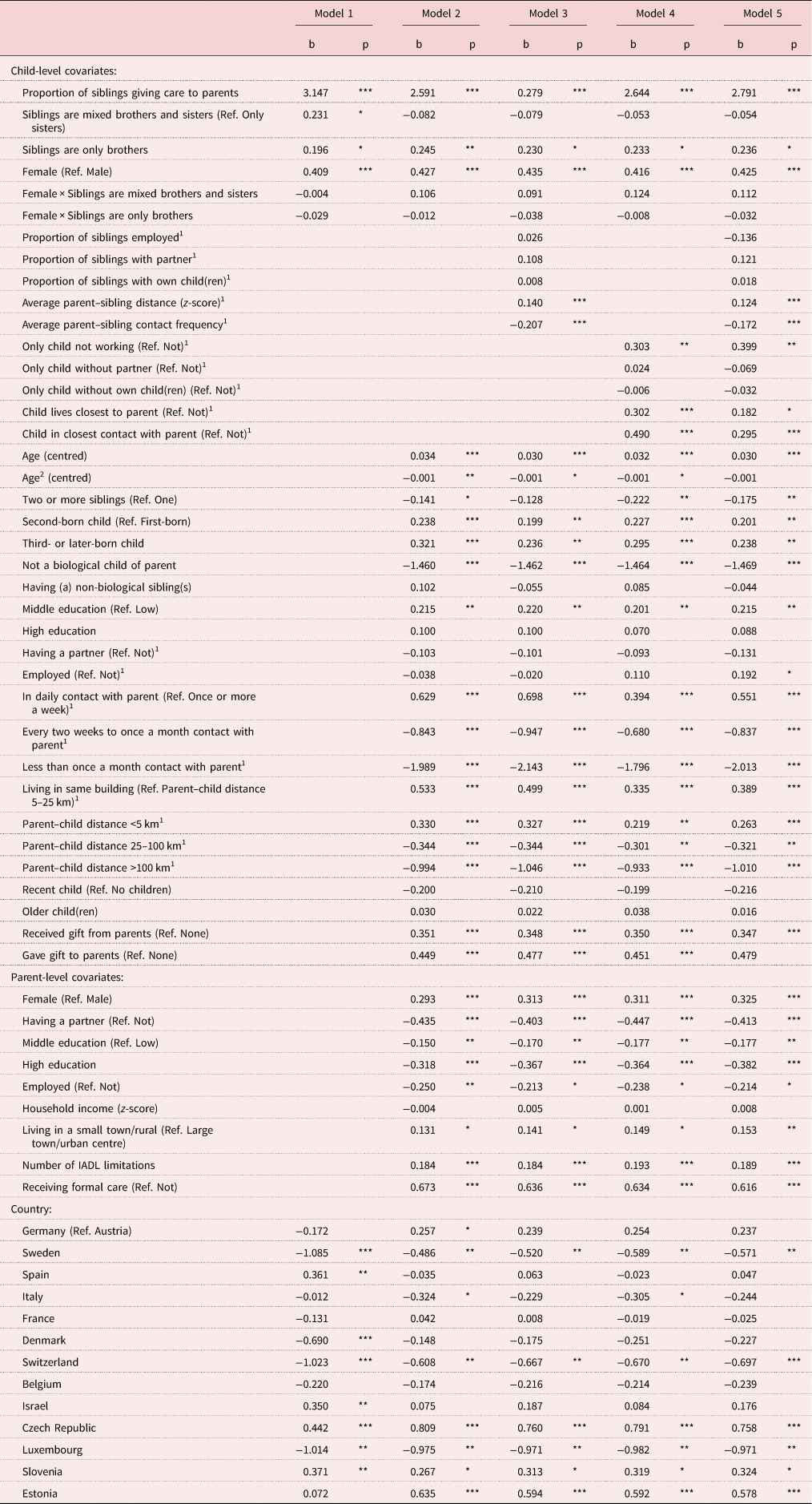
Table 2 presents the parameters and significance levels of the multi-level logistic regression models, with children's transition to care-giving as the outcome variable. An empty model (not shown) indicates substantial between-family (level 3) differences (variance is 7.94). Adding the proportion of siblings providing care (Model 1) dampens the variance almost completely (variance is 0.01Footnote 7). The positive regression coefficient expresses that siblings often provide care together (b = 3.147, p < 0.001). In tandem, this suggests that clustering of children's care-giving within families results from the fact that caring for a parent is generally a shared commitment within sibling groups.
Regression coefficients of multi-level logistic regression analysis of children's transition to care for parents (Ref. Not providing care)

Notes: N = 79,020. 1. Measured at Wave 5 because covariates are potentially endogenous to care-giving for parents. Ref.: reference category. km: kilometre. IADL: instrumental activity of daily living.
Source: Survey of Health, Ageing and Retirement in Europe Waves 5 and 6, calculations by authors.
Significance levels: * p < 0.05, ** p < 0.01, *** p < 0.001.
Model 1 (Table 2) also shows that gender plays a vital role in children's transition to care-giving. To test Hypothesis 1, interaction terms between individual gender and gender composition of siblings are estimated. The parameter estimates for sibling composition reflect the care-giving differences among sons (reference category gender). These suggest that sons with mixed brothers and sisters (b = 0.231, p < 0.050) or only brothers (b = 0.196, p < 0.050) are more likely to initiate care than sons with only sisters. In other words, sons with fewer sisters feel more compelled to shoulder care tasks. The effect of mixed brothers and sisters weakens in models adjusting for parental, individual and sibling characteristics (Models 2–5). The b-coefficient of gender tells the difference between sons’ and daughters’ transition to care-giving when a child has sisters only (reference category gender composition). In this gender configuration, we find that daughters are more frequently providing care compared to sons (b = 0.409, p < 0.001). Further, the interaction terms between individual gender and gender composition of siblings express whether daughters’ care-giving start diverges from sons according to the share of brothers. The models indicate that the impact of siblings’ gender composition does not vary greatly between sons and daughters. As a result, care for parents is allocated more often to the one daughter if she has brothers only, whereas sons divide care in brothers-only sibling groups. In sum, our results support the first hypothesis (a) since, irrespective of siblings’ gender composition, daughters start caring the most. Furthermore, sons proceed to care-giving more when daughters are not present, while a daughter has higher odds of caring in the case of having brothers only. Hence, this provides evidence for part (b) of the first hypothesis: daughters make the transition to care provision most in male-dominated sibling groups.
Models 3–5 include other sibling characteristics. This part of the analysis examines whether children are more likely to start providing care in relation to the care-giving costs and involvement of their siblings. Model 3 exhibits a significant association between a child's care transition and the average geographic parent–child distance of siblings (b = 0.140, p < 0.001). Greater geographic parent–sibling distances encourage children's care-giving. In addition, we observe that a higher contact frequency between the parent and a child's siblings reduces the odds of starting to care (b = −0.207, p < 0.001). This implies, in turn, that a child starts care-giving more often when his or her siblings have, on average, less close bonds with their parents. Model 4 introduces the relative measures of a child's care opportunities within the sibling group. The parameter estimates reveal that a child's position in terms of employment responsibilities is associated with the start of care. Being the only jobless child facilitates care (b = 0.303, p < 0.010). In a similar vein, living closest to the parent (b = 0.302, p < 0.001) and being in closest contact (b = 0.490, p < 0.001) positively affects the start of care-taking. This corresponds with the results of Model 3, underlining the important role of siblings’ geographic distances and contact frequencies. Moreover, Model 5 points out that net of being the child living closest, average sibling distances matter for care provision. In other words, larger parent–sibling distances enhance children's care-giving transition, regardless of the child being the nearest descendant or not. The same goes for parent–child contact frequency of siblings. Despite being the child in closest contact or not, the odds of starting to care are higher when the average parent–sibling contact is limited. Taken together, we find some evidence for Hypothesis 2, concluding that children more frequently make the transition to care when siblings experience higher costs in terms of travelling distance and employment responsibilities. Concerning Hypothesis 3, the analysis corroborates that children are more likely to start care-giving if their siblings have less parent–child contact.
As to the individual child characteristics, we find that children with a higher age, having only one sibling, being a second- or higher-order birth, being a biological child of the parent, holding an intermediate educational degree, keeping frequent contact with the parent, living in the proximity of the parent and exchanging financial resources with the parent are more inclined to start providing care. Employment, partnership status, childbearing and siblings’ descent are only weakly related. As regards parental characteristics, we observe more frequent care provision for mothers. Besides, positive effects are found for singlehood, low educational degrees, not having a job, living outside urban areas, higher functional limitations and receiving professional care services.
European heterogeneity in sibling influences
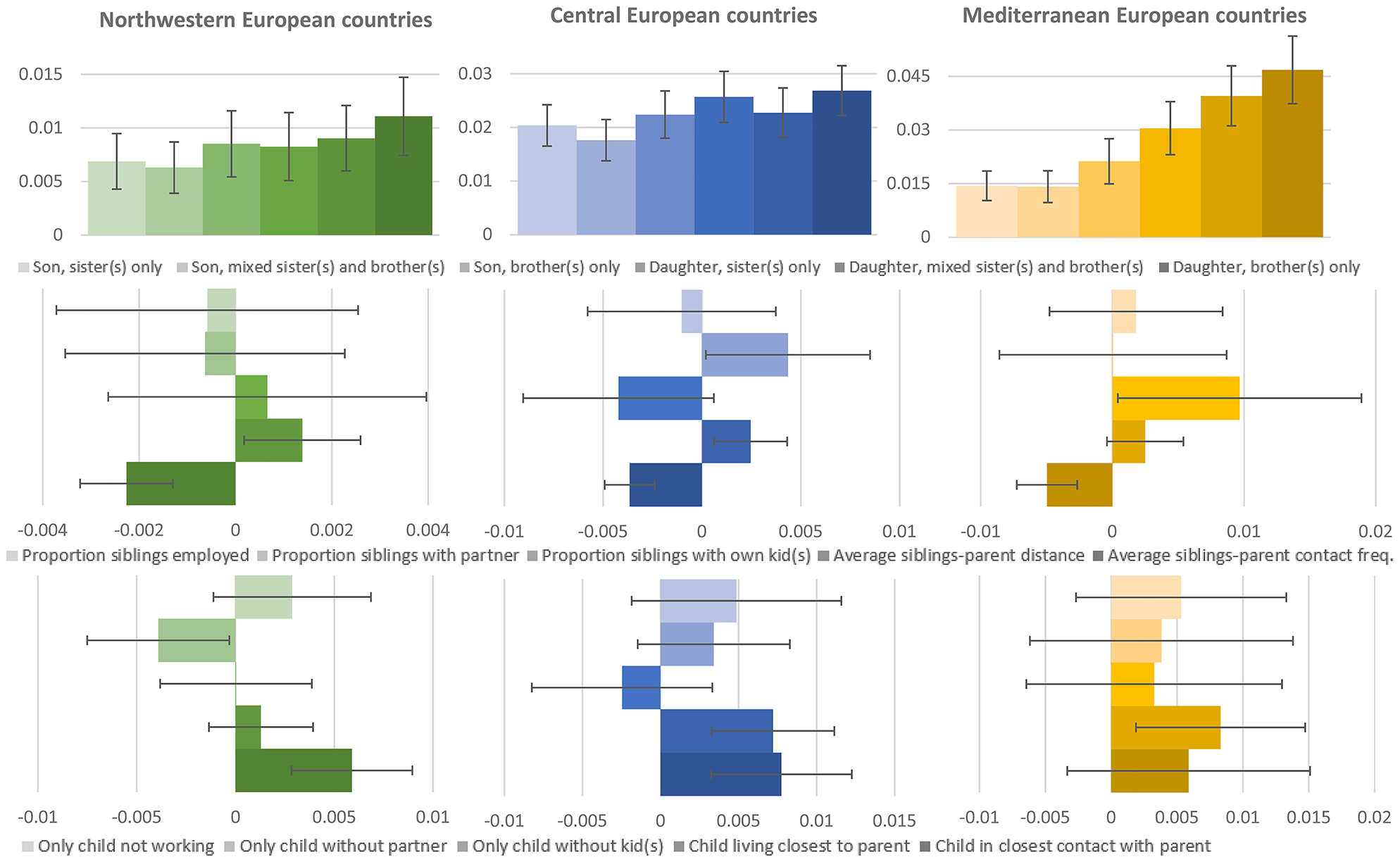
To explore whether sibling characteristics affect care-giving transitions similarly across different European regions, the last part of the analysis tests our models for three country groups separately: (a) northwestern (Belgium, Denmark, France and Sweden), (b) central (Austria, Czech Republic, Estonia, Germany, Israel, Luxembourg and Switzerland), and (c) Mediterranean Europe (Italy, Slovenia and Spain). In this order, the top row of Figure 1 presents the predicted probabilities of starting to care for different gender configurations per region (cf. Model 2). Notice that the probability scales differ between the panels. The panels for northwestern and central Europe suggest limited gender differences. In general, sons with sisters only or mixed brothers and sisters are least inclined to commence care-giving. However, except for daughters with brothers only, starting to care the most in both country groups, son–daughter differences are not statistically significant. In neither country groups do the care probabilities vary significantly between sons and daughters with brothers only. Also, gender composition of siblings impacts care-giving weakly if sons and daughters are considered separately. The third panel paints a very different picture for Mediterranean countries. The 95 per cent confidence intervals demonstrate that sons with brothers only make the transition to care-giving significantly more than sons with sisters. Moreover, daughters appear to start care-giving significantly more than sons in all gender compositions. In particular, daughters are most likely to care when having brothers. As such, our findings elucidate that gender and siblings’ gender composition influence care provision to a greater extent in countries characterised by stronger family and gender norms (cf. Hypothesis 4a).
Predicted probabilities (first row) and average marginal effects in predicted probabilities of starting to care (second and third rows) (with 95% confidence intervals).
Notes: N = 79,020. The first column of panels presents the northwestern country group (shades of green), the second the central group (shades of blue) and the third Mediterranean countries (shades of yellow); note that the probability scales differ between panels. freq.: frequency.
Source: Survey of Health, Ageing and Retirement in Europe Waves 5 and 6, calculations by authors.

The second and third rows of Figure 1 exhibit the effects of other sibling characteristics on children's transition to care per country group (cf. Models 3 and 4). The magnitude of the effects shows considerable variety as the panel scales differ. The panels of the second row reflect the expected changes in care probabilities if a proportion or average sibling characteristic increases by one unit (e.g. percentage point). As anticipated from Model 3, the average sibling–parent geographic distance and sibling–parent contact frequency are statistically significant in all country groups. Only in the Mediterranean group does a zero-effect of siblings’ distance lie within the confidence interval, implying a weak association with care. In this country group a significant positive effect of the proportion of siblings with their own children is observed, suggesting the importance of competing family demands. For central European countries, we find a positive association between starting to care and the proportion of siblings with a partner. The third row presents the changes in care probabilities in accordance with relative sibling characteristics. For all three country groups we find that the only child not working has a higher probability of embarking on care-giving, although the effects are not statistically significant. Being the only jobless child is infrequent (cf. Table 1), limiting the statistical power of the effects. The panels also reveal significantly positive effects on the probability of starting care for children living closest to the parent, except for the northwestern countries. Being the child in closest contact with a parent particularly increases care probabilities in northwestern and central Europe. Finally, the results suggest a marginally significant negative effect of being the only child without a partner for northwestern European countries. Overall, we find no evidence for Hypothesis 4b that siblings’ care-giving opportunities are stronger predictors in one or the other country groups.
Discussion
The present study illuminates the role of sibling characteristics, such as gender composition and care-giving costs, to explain differences in children's care-giving for parents. By doing so, this research is among the first in Europe to address the interrelationships between siblings in the context of intergenerational care. The longitudinal research design of the study enabled us to start disentangling the temporal ordering of the connection between sibling predictors and individual care-giving. The analysis relates sibling care-giving costs and parent–child commitment of siblings in the pre-care-giving phase to the subsequent care transition.
Previous research has provided abundant evidence for the prominent position of daughters in taking care of older parents. Our approach is novel in comparing sons and daughters between various gender compositions of the sibling group. In line with recent American inquiry (Grigoryeva, Reference Grigoryeva2017), the results confirm that daughters are most likely to enter a caring role, especially in families with brothers only (cf. Hypothesis 1). Sons, from their side, start care-giving more in the absence of sisters. Male-dominated compositions necessitate sons to divide care between brothers. These gender differences remain after accounting for individual and sibling characteristics. Hence, the primacy of daughters in caring for parents is not attributable to other factors (Haberkern et al., Reference Haberkern, Schmid and Szydlik2015), including daughters’ care opportunities from a sibling perspective (e.g. being the only sibling without work). Country comparisons reveal that gendered intergenerational care predominantly applies to southern European countries. Although a daughter with brothers only has the highest care probability in all country groups, the gender gap is most eminent in Italy, Spain and Slovenia. This enhances our knowledge of how care distributions are contingent on the family's gender configuration across Europe. In northern and central Europe intensive care tasks are frequently transferred to professional providers (Brandt, Reference Brandt2013), easing the care burden of daughters in particular (Haberkern et al., Reference Haberkern, Schmid and Szydlik2015), whereas elderly care is the responsibility of the family and most notably daughters in Mediterranean countries (Viazzo, Reference Viazzo2010; Verbakel, Reference Verbakel2018). Especially in countries with strong family norms the gendered nature of care remains a vital aspect of care-giving for parents (cf. Hypothesis 4a). We also note that a potentially important aspect of gender differentials is lacking in our analysis as we do not control for the care provision of children-in-law. Our results might reflect larger gender gaps among children in countries where daughters-in-law take the care burden instead of sons (Merrill, Reference Merrill1993).
Going beyond gender composition, the results point out that parent–sibling contact and geographic distances between siblings and their parents influence the onset of children's care. Both average scores as well as relative measures of those sibling characteristics are strong predictors. The findings are also consistent over different European regions. The overriding importance of siblings’ contact frequency and proximity does not surprise as they are crucial determinants at the individual level as well. As regards contact frequency, we observe that children with relatively more contact are also more inclined to start care-giving. The measures reflect to what extent parents and siblings are committed and maintain good connections. Children with good parent contact prior to the care-giving stage may also be well informed about the needs of parents and constitute the preferred care provider later on. As such, our findings correspond with a previous study suggesting that committed children compensate for siblings with weak parent–child ties being in an unfavourable position to provide care (Tolkacheva et al., Reference Tolkacheva, Broese van Groenou and van Tilburg2010). The outcomes concerning siblings’ geographic parent–child distances reconfirm that the family's spatial dispersion is important for informal care-giving. In accordance with research asserting that a closer geographic proximity facilitates care exchanges, we observe that the closest residing children and children with siblings living at farther distances are most likely to commence care-taking. Given that children with high-quality parent–child relationships, and thus more willingness to give care, are prone to live near their parents (Gillespie and Van der Lippe, Reference Gillespie and Van der Lippe2015; Gillespie and Treas, Reference Gillespie and Treas2017), it is meaningful that these associations hold when correcting for contact frequency of the individual child and his or her siblings.
In contrast to the considerable impact of interaction barriers (i.e. geographic distance) and parent–sibling commitment (i.e. contact frequency), the influence of siblings’ competing family demands on the care transition appears limited. Our results do not corroborate earlier research indicating that higher proportions of siblings with a partner or children increase a child's care (Tolkacheva et al., Reference Tolkacheva, Broese van Groenou and van Tilburg2010; Henretta et al., Reference Henretta, Soldo and Van Voorhis2011). Country comparisons show that we only observe some weak effects in central and southern European countries, respectively. In those regions stronger family obligations may also work in a different direction. Children's responsibility to look after their descending family may outweigh care for other relatives, inducing higher odds of elderly care among their siblings. With respect to the competing demands of employment, our study finds a salient significance of being the only child without a job. Being the sibling unconstrained by time regimes of paid work increases the likelihood of entering the care-giving role. From a sibling perspective, employment plays a steering role in distributing care for parents. The employment indicators are, however, limited since no detailed information on the flexibility of employment is available (e.g. reduced hours, flexible working schedules, etc.).
Most of the results are consistent with Finch and Mason's (Reference Finch and Mason1993) important qualitative examination of siblings negotiating responsibilities within the family. Children with ‘legitimate excuses’ or high care-giving costs are inclined to allocate care for parents to siblings (cf. Hypothesis 2), while children with less family-involved siblings are likely to provide care (cf. Hypothesis 3). Altogether, the impact of siblings’ care-giving costs and parent–child commitment does not vary substantially between European regions (cf. Hypothesis 4b).
The analysis of this paper is restricted by some noteworthy limitations that warrant future inquiry. First, in SHARE interviews parents provide the information on children. Some parents might be selective in reporting on their children. Children having a difficult relationship with their parents are likely to be shunned, introducing bias. The indirect data recording also increases non-response on certain child characteristics. In addition, this procedure hampers the longitudinal follow-up of children, excluding multiple same-sex births from the analysis. A second limitation is the crude outcome variable of the regression models. Whereas we select on frequency (at least weekly) of care, the measure is unrefined with respect to care-giving intensity. Future research should improve knowledge on more subtle contrasts regarding type and hours of provided care. Some argue that most research focuses on typical female care tasks, yielding exaggerated gender differentials in care provision. Adding or distinguishing between other types of support (e.g. gardening, home repairs, settling financial matters, etc.) might improve the relative position of sons. Another promising avenue of research is the expansion of the longitudinal observation window. Our current analysis is limited to the initial transition to care for parents, while recent investigation demonstrates the volatility of care-giver networks over time (Szinovacz and Davey, Reference Szinovacz and Davey2013). Together with capturing the dynamic nature of informal care-giving, an elaborated longitudinal approach taps changes in children's life circumstances (e.g. job changes, geographic relocations, etc.), affecting their care-giving opportunities. A final limitation is that the analysis pools countries to address the cross-national variation of the sample. Future research should explore country variation in more detail.
Despite the shortcomings of the current study, it shows that siblings can play an important role vis-à-vis individual decisions on providing care for parents. We add to family system theory that individual features are not sufficient to predict a child's care-giving. The sibling perspective is identified as a fruitful approach to explain intergenerational care differences between children in European countries. At present, older people in Europe often have a rich pool of family members upon which to call for personal assistance. However, in the context of population ageing, shrinking families and welfare systems under pressure, it is essential to understand how the intra-family organisation of intergenerational care-giving will further develop.
Acknowledgements
This research received financial support from the UA BOF-TOP grant (no. 32258) and the FWO Project grant (no. G017319N).