INTRODUCTION
Although the number of bilingual programs in New York City public schools has declined over the past 16 years, one form of bilingual education has actually expanded: dual language bilingual education (DLBE), traditionally defined as programs in which students who speak English at home and those who speak a language other than English at home learn academic content instruction through both English and the partner language. DLBE has grown in popularity, resulting in long waiting lists at many city schools offering these programs (Harris, Reference Harris2015). To accommodate the demand, the New York City Department of Education (NYCDOE) awarded incentive funding to 40 schools in 2015–2016 and to 29 city schools in 2016–2017, totaling $1 million per year to expand or create new DLBE programs (NYCDOE, 2016). The NYCDOE also announced that it will be awarding an additional $1.1 million of incentive funding to start 68 new bilingual education programs in the 2017–2018 school year, of which 39 will be DLBE programsFootnote 1 (NYCDOE, 2017).
As they increase, these programs have moved beyond Spanish and Chinese (the two most widely spoken languages in the city after EnglishFootnote 2) to include less commonly spoken languages such as Bengali, French, Haitian Creole, Arabic, Japanese, Russian, Korean, Urdu, and Hebrew (NYCDOE, 2015a). The students attending these programs have likewise diversified, and the reach into communities that traditionally have not been part of bilingual education makes this a critical new area for research. This study investigates New York City's DLBE expansion through a focus on a newly opened Hebrew DLBE program in a public middle school. It demonstrates that this program, in its inception and design, confronts traditional definitions of DLBE and offers new understandings about bilingual education for the 21st century. We argue that the policies and guidelines for the provision of DLBE and the scholarship upon which they are based are rooted in notions of linguistic purism that fail to consider or meet the needs of communities enrolling in bilingual education programs today.
LINGUISTIC PURISM IN DUAL LANGUAGE BILINGUAL EDUCATION
Students in DLBE programs are typically described as a combination of emergent bilingualsFootnote 3 and students who speak English at home, and instruction in these programs is in both English and another language with the aim of developing bilingualism and biliteracy as well as cross-cultural understanding and global awareness. Two central tenets of DLBE programs argued by researchers and policymakers are that the programs should enroll an equal balance of English monolinguals and monolinguals in the target language, and that the two languages should be strictly separated during daily instruction. The following is an example of how DLBE (also known as two-way immersion) has usually been defined in the literature:
Two-way immersion models instruct roughly equal numbers of students from two different language backgrounds. For example, a new program in Carthage, Missouri, mixes approximately 50% native English speakers and 50% native Spanish speakers. The students spend half their day studying some of their subjects in English and half of their day with another teacher, studying other subjects in Spanish. (Dorner, Reference Dorner2015, p. 2)
Lindholm-Leary and Genessee (Reference Lindholm-Leary and Genessee2010) likewise define DLBE (or two-way immersion programs) by stating: “There are usually approximately 50 percent English-only speakers and 50 percent native speakers of the other language (or no fewer than a third of either group)” (p. 333).
Students are described as on one side or another of a language dichotomy, such that they are either English language learners (ELLs) or native English speakers. This conceptualized bifurcation is widespread (see also Freeman, Freeman, and Mercuri, (Reference Freeman, Freeman and Mercuri2005, p. xviii). The need for an equal balance in the student population of a DLBE program is described in the following passage:
Like all dual language programs, teachers attempt to achieve balanced numbers of language-majority students and ELs [English learners] in the classroom so that each group can serve as a linguistic resource and peer model for the other . . . Although the most desirable student ratio in the classroom is 50% English speakers and 50% Spanish speakers, the program can operate successfully as long as neither language group falls below 30% of the classroom population. (Alanís & Rodríguez, Reference Alanís and Rodríguez2008, p. 309)
Even though Alanís and Rodríguez (Reference Alanís and Rodríguez2008) noted that the 50/50 composition is negotiable to some extent, the fundamental principle is unchanged: The ideal paradigm for DLBE remains an equal balance of students as one or the other – English monolingual or monolingual in another language. Hence, DLBE, by definition, sets itself apart from other types of language learning models by presupposing that two sets of monolingual students are needed to make the model successful.
In addition to prescribing the composition of the students in DLBE classrooms, scholars have also historically argued that the two languages in a DLBE program should be strictly separated in instruction. Language separation has been presented as a key principle of DLBE since the 1980s (Jacobsen & Faltis, Reference Jacobsen and Faltis1990), that has lasted until today. For instance, in a description of DLBE, Torres-Guzmán wrote:
The dual language program design follows consistent and clear linguistic, sociocultural, and educational policies, which includes strict language separation. (Torres-Guzmán, Reference Torres-Guzmán, García and Baker2007, p. 52)
This is reiterated by Howard, Sugarman, Christian, Lindholm-Leary, and Rogers (Reference Howard, Sugarman, Christian, Lindholm-Leary and Rogers2009) in their book of guiding principles in DLBE, when they wrote the following as a guideline:
Instruction incorporates appropriate separation of languages according to program design. (Howard et al., Reference Howard, Sugarman, Christian, Lindholm-Leary and Rogers2009, p. 69)
According to Howard et al. (Reference Howard, Sugarman, Christian, Lindholm-Leary and Rogers2009), language separation should be fully implemented in order for the programs to be successful, so they include it as a component of a rubric they put forth to evaluate DLBE program effectiveness. Scholars have argued that keeping the languages separated will help children learn, and there should be no language mixing or language translation (e.g., Lindholm-Leary, Reference Lindholm-Leary, Hamayan and Freeman2006).
However, recent research and the realities of bilingualism in the United States today have begun to challenge the assumptions outlined earlier. The problem is that the expectations of bilingualism embedded within these definitions of DLBE are based on monolingual assumptions, in that an individual's languages are seen in isolation and a speaker can only be considered a “legitimate” bilingual if they perform as two monolinguals in one (Grosjean, Reference Grosjean1989). This is explained further in the following excerpt:
Far from being monolinguals in two languages, as it were, they carve out their own space as bilinguals. . . . An increasing body of evidence shows that they do not use language the way monolinguals do. They refuse to hold their two (or more) languages as distinct, disconnected systems. (Brutt-Griffler & Varghese, Reference Brutt-Griffler and Varghese2004, p. 93)
Contesting the view of bilinguals as possessing two entirely separated language codes, Brutt-Griffler and Varghese (Reference Brutt-Griffler and Varghese2004) described the language practices of bilinguals along a continuum rather than as a binary between first and second language. Moreover, recent research in translanguaging (García, Reference García2009) highlights the complex and fluid language practices of multilingual communities and further blurs the lines between “native” and “nonnative speakers.”Footnote 4
Challenging the conceptualization of bilingualism draws into question how DLBE programs can require student compositions based on a dichotomy of ELL–English monolingual and still serve the needs of the local community in places where there are first-, second-, and third-generation students at all different points along a continuum of bilingualism. As García, Velasco, Menken, and Vogel (forthcoming) wrote:
Because the dual language “model” had been developed following a monolingual framework where students were seen as either monolingual in English or monolingual in a language other than English, . . . the dynamic features of 21st century bilingualism were ignored. (García et al., forthcoming, p. 2)
Critiques of language separation, or what Cenoz and Gorter (Reference Cenoz and Gorter2011, p. 357) referred to as “hard boundaries” between languages in schools, show how policies of strict language separation are indeed rooted in monolingual norms.
In the case of bilingual and second language immersion programs, it has become axiomatic that the two languages should be kept rigidly separate. In this paper, I discuss the research and theoretical literature relevant to this “two solitudes” assumption and argue that it has minimal research basis. When we free ourselves from exclusive reliance on monolingual instructional approaches, a wide variety of opportunities arise for teaching bilingual students by means of bilingual instructional strategies that acknowledge the reality of, and strongly promote, cross-language transfer. (Cummins, Reference Cummins, Cummins and Hornberger2008, p. 50)
In this excerpt, Cummins (Reference Cummins, Cummins and Hornberger2008) encouraged more fluid language practices in instruction in ways that are aligned to the actual translanguaging practices of emergent bilingual students (García, Reference García2009; García et al., forthcoming).
Palmer, Martínez, Mateus, and Henderson (Reference Palmer, Martínez, Mateus and Henderson2014) critiqued the policy of strict language separation within the context of DLBE programs, finding that teachers actually engage in translanguaging practices in their classrooms in spite of the policy, and argued the benefits of doing so. Likewise, Gort and Sembiante's (2015) examination of two teachers translanguaging in a DLBE classroom in a preschool with a “one teacher/one language” language separation policy concluded that the teachers’ disruption of their designated language roles turned the classroom into “a vibrant bilingual space where children and teachers displayed a dynamic bilingualism that allowed them to use their entire linguistic repertoire flexibly, meaningfully, and competently” (p. 23). Martínez, Hikida, and Durán (Reference Martínez, Hikida and Durán2015) noted that teachers do engage in translanguaging pedagogy in their DLBE classrooms, but that “their perspectives on translanguaging sometimes echoed ideologies of linguistic purism that emphasize language separation” (p. 26).
As the research cited in the preceding paragraphs shows, scholars are increasingly drawing into question notions of linguistic purism and the monolingual norms on which they are based. Moreover, new evidence from studies of bilinguals’ complex language practices suggest that conceptions of students as either first or second language speakers and of languages needing to be separated are vestiges of past beliefs about bilingualism that have become outdated (García, Reference García2009; García et al., forthcoming; Gort & Sembiante, Reference Gort and Sembiante2015; Palmer et al., Reference Palmer, Martínez, Mateus and Henderson2014; Martínez et al., Reference Martínez, Hikida and Durán2015).
BILINGUAL EDUCATION EXPANSION IN NEW YORK CITY SCHOOLS
In this section, we first overview efforts to expand bilingual education in New York City, and then in the section that follows, we turn our attention to ideologies of linguistic purism embedded within policies intended to support these efforts. Chancellor's Regulations (CR) Part 154 (New York State Education Department, 2014) mandates that city schools offer at least one of the following program models (their terms) for their emergent bilingual students: DLBE, transitional bilingual education (which offers more instruction in English than a DLBE program) and English as a new language (ENL, in which instruction is typically monolingual in English). In 2001, bilingual education in New York City was commonplace, with half of all emergent bilinguals attending bilingual education programs. However, the 2000s bore witness to a dramatic loss of bilingual education programs, particularly transitional bilingual programs, as (a) anti-bilingual education legislation passed in California, Arizona, and Massachusetts affected public sentiment in New York, and (b) federal education legislation, No Child Left Behind (2002), repealed the Bilingual Education Act (1968) and required school accountability based on high-stakes testing in English (Menken, Reference Menken2013; Menken & Solorza, Reference Menken and Solorza2014). By 2015, enrollment of New York City's emergent bilinguals in bilingual education had fallen to less than 17%, with 80% enrolled in monolingual ENL programs (NYCDOE, Division of English Language Learners and Student Support, 2016). This is in spite of a robust and growing research base showing that emergent bilinguals in bilingual education outperform their peers in English-only programs and that DLBE programs are particularly successful (Christian, Reference Christian and Hinkel2011; Rolstad, Mahoney, & Glass, Reference Rolstad, Mahoney and Glass2005; Umansky & Reardon, Reference Umansky and Reardon2014).
Responding to an investigation by the U.S. Office of Civil Rights about inadequate services for emergent bilinguals in city schools, in 2011 the NYCDOE adopted a corrective action plan requiring the expansion of bilingual education programs (New York State Education Department, 2011). This resulted in 50 new bilingual programs being opened in 2013 with financial support from the NYCDOE, the most the department had ever opened in such an isolated timespan, of which 33 were DLBE programs. These efforts have continued annually since then, and the NYCDOE has since awarded funding to 40 schools in 2015–2016, 29 schools in 2016–2017, and 39 schools for 2017–2018 to expand or create new DLBE programs.
The funding formulas for these incentive grants especially promote DLBE, as evident in the following description of available grants:
A $25,000 planning grant for implementing Dual Language programs, a $10,000 grant for implementing Transitional Bilingual Education programs, and $5,000 for each program to create classroom libraries in the target language. (NYCDOE, 2016, n.p.)
As shown, schools receive more money to start a DLBE program than they would receive to start a new transitional bilingual education program, as a way to offer further incentive to schools to provide DLBE. Thus, while clearly intended to expand bilingual education offerings, the main focus is on DLBE. The school where we conducted our research was a recipient of one such planning grant, which funded the start of their Hebrew DLBE program.
LINGUISTIC PURISM IN BILINGUAL EDUCATION POLICY IN NEW YORK CITY
The design of DLBE programs within schools is guided by state and local policy mandates, which promote strict language separation and an even balance between “native English speakers” and “ELLs” that reflect the notions of linguistic purism evident in the research described in the preceding paragraphs. The New York State Education Department's (2014) CR Part 154 defines DLBE as follows:
Dual language programs serve both ELLs in need of English language development and monolingual English-speaking students who are interested in learning a second language. . . . Both groups provide good linguistic role models for each other, and through their interactions, support language development in both languages. In dual language programs, students receive half of their instruction in English and half of their instruction in the second language. (n.p.)
This definition reinforces the idea of a dichotomy between students who are either English monolinguals or monolinguals in another language and learning English, without recognizing that some students will not fit neatly into either category. In fact, families seeking to enroll a child in a DLBE program in New York City are asked on the application form, “What is your child's home language?” They must select one of the following two response options from a drop-down menu for entrance into a Spanish/English DLBE program: “My child speaks English at home” or “My child speaks Spanish at home.” There is no option for children who are bilingual in English and Spanish. A computer algorithm ensures that family responses are used to compile a class with an equal balance of Spanish speakers and English speakers.
In 2015, the NYCDOE produced the “Model Dual Language Programs Checklist,” which included elements such as the following:
• Approximately 50% of students are ELLs and 50% of students are English proficient.
• The language allocation for content and literacy instruction in English and the target language is approximately 50/50.
• The two languages are separated by time, space, or teacher and are not used simultaneously.
• Translation by the teacher is totally prohibited. (NYCDOE, 2015b, n.p.)Footnote 5
This checklist maintains that DLBE programs can only be seen as models in city schools if students are either English monolinguals or English learners and programs evenly enroll each, and if the two languages are kept strictly separated at all times. In the same year, NYCDOE Schools Chancellor Carmen Fariña and Deputy Chancellor Milady Baez identified 15 of what they termed “model dual language programs.” These programs received $10,000 apiece and were called upon to host educators from other schools and share “best practices” (NYCDOE, 2015a). The school where we conducted our research was named a model DLBE school by the NYCDOE.
SETTING AND METHODS
The findings presented in this article are from an ongoing research project examining the expansion of Hebrew DLBE programs in New York City. Data were collected from September 2016 to March 2017 at a school we refer to here by the pseudonym Multilingual Public Middle School (MPMS). At that time, the school was in its second year of implementing a Hebrew-English DLBE program. This article is guided by the following research questions:
• How are New York's bilingual education policies implemented within this school's Hebrew DLBE program?
• To what extent does this new Hebrew DLBE program in New York City reinforce or challenge traditional DLBE models?
To answer these questions, we observed 25 classroom lessons, one all-day professional development workshop (held August 31, 2016), and three weekly teachers’ meetings. Additionally, we conducted semistructured interviews with the principal and the assistant principal of the school, the school's staff developer, the Hebrew and social studies teachers, parents, and students in the Hebrew program. Finally, we collected copies of students’ written work and other classroom pedagogical materials, including worksheets and PowerPoint presentations, by gathering hard copies or taking photos. All of the interviews were recorded by digital recorder and transcribed. Both the classroom observations and interviews were coded and analyzed to identify prevalent themes (LeCompte & Preissle, Reference LeCompte and Preissle1993; Miles, Huberman, & Saldaña, Reference Miles, Huberman and Saldaña2013). Pedagogical documents and students’ written work were also analyzed to contextualize findings from the classroom observations and interviews. The findings reported here draw from the most prevalent themes having to do with the structural makeup and student population of the Hebrew program and the reasons for its inception.
School data report that MPMS serves more than 1,280 students in Grades 6–8 and has a diverse student population composed of the following (as per NYCDOE racial/ethnic categories): White, 32%; Asian or Native Hawaiian/Pacific Islander, 31%; Hispanic or Latino, 27%; Black or African American, 9%; and other, 3%. The school predominately serves a low-income community, as the Title I population is 81%, and 71% of students receive free lunch.Footnote 6 Officially designated ELLs make up 11% of the school population.
As of 2016–2017, there were a total of 44 students in the Hebrew DLBE program in Grades 6–8. Of these students, 39 are Jewish, and five are African Americans who are not Jewish (each Hebrew DLBE class has one or two African American students). At the time of the study, only one student in the entire Hebrew DLBE program was classified as an English language learner in the school's data system; a few others were designated ELLs when they entered the school system, but exited their official ELL status in elementary school.
It is significant that the student population of the Hebrew program at MPMS differs from that of traditional DLBE programs in several ways. First, bilingual education in U.S. public schools holds close ties to the civil rights movement, and the intention since that time has been that bilingual programs serve emergent bilinguals who are learning English (Baker, Reference Baker2011); yet very few of these students are enrolled in Hebrew DLBE programs. Additionally, classrooms are primarily composed of Jewish students, and African Americans represent 11% of the student population in the Hebrew DLBE program. These demographics are significant because neither Jewish nor African American students traditionally take part in New York City's public school bilingual education programs.
ORIGINS OF THE HEBREW DLBE PROGRAM AT MPMS
Attending to the ontology of the Hebrew program at MPMS reveals how, from the onset, it was misaligned with the purist models of DLBE as put forth by New York City. Our interviews reveal that a combination of top-down NYCDOE policies, the desire of the school to grow its enrollment by recruiting new students to the school, and parental interest and priorities galvanized the start of the Hebrew DLBE program. As mentioned earlier, starting in the mid-2010s, Carmen Fariña, the newly appointed chancellor of the NYCDOE expanded DLBE in the city, offering funding to set the wheels in motion.
Around the same time, the administration at MPMS was looking to transform the image of the school by creating programs that would attract families in commuting distance to enroll their children in the school. One way in which the school identified that it could boost its reputation was by reaching out to communities that were not typically inclined to send their children to this particular middle school. For this reason, the school initially created a DLBE program in Mandarin, in order to attract Chinese families, and then expanded to Russian and Spanish programs in the following years, and finally the Hebrew program in 2015. All of these programs receive students from nearby feeder elementary schools offering DLBE in those four languages. While teaching content classes in less commonly taught languages may have been daunting to some schools, the school's charismatic principal, Mr. D, who came into the field of education and administration with an extensive background in banking and business, credited his own experience learning Italian in a language immersion high school as one of the main reasons for jumpstarting the DLBE program at MPMS when the prospect of city funding became available. As he explained:
I believe the bilingual skill and ability is tremendous—a tremendous asset as far as giving you that competitive advantage in the world, especially with the globalized economy and the diversity that we have here. . . . So, I would love to support the chancellor's vision in any which way. So, this is a personal thing for me. I'm a product of a bilingual program. (Mr. D, principal, interview transcript, September 30, 2016)
Hence, the expansion of DLBE programs at MPMS can be linked to the school administration's efforts to make the school as a whole more desirable to local families. In this way, because of the increasingly popular belief that language learning offers social, personal, economic, and cognitive benefits, MPMS was also able to attract a more diverse student population, thereby addressing the segregation that defines many New York City public schools. Mr. D tacitly drew the connection between attracting this diversity and establishing DLBE programs.
The first language we brought in as foreign language was Mandarin. We wanted to create the environment that supported the needs of our demographics and people. So, we also wanted to serve what the parents were looking for. We wanted to give the parents a choice. When I first started, we had 800 students. Nobody wanted to come. There was nothing here to attract the top students around the city to support the local community. . . . So we wanted to build enrollment. We wanted to create something different here. . . . So, we did some research on bilingual programs. And the DOE was offering grant opportunities as far as planning these types of programs. And we applied and received funding from the Department of Education, which we're very grateful for. And we did research, as far as, we identified particular schools. We learned that there was no middle school choice in [borough name]. There was nothing for Chinese Mandarin in [borough name]. And we had elementary schools that had dual language programs and parents didn't have a choice of middle schools. We saw an opportunity. (Mr. D, principal, interview transcript, September 30, 2016)
After Mr. D started the Hebrew-English DLBE program in 2015, he was able to draw in Jewish families looking to continue their children's Hebrew education without having to pay private Jewish day school tuitions. As he recounted in his interview, Orthodox Jews in the area “never saw us as a choice,” but that now “people are saying this is the place to be.” That the Hebrew program was able to attract new families to MPMS led to more recognition in the community, which in turn made it even more popular and in demand. In her interview, Ms. C, the assistant principal, recalled that when she started at MPMS 9 years ago, the school had a “pretty bad reputation,” but that they “turned the school around” by offering DLBE in Mandarin, Russian, and Spanish, and how beginning to offer Hebrew has further increased the school's popularity and reputation (Ms. C, assistant principal, interview transcript, December 2, 2016).
Finally, the third impetus for the Hebrew program at MPMS can also be attributed to the specific demands of local Jewish and non-Jewish parents. Many of the students in the Hebrew DLBE program are graduates from a nearby Hebrew language elementary school, a K–5 charter school that had opened in the area in 2009, whose mission was to teach Modern Hebrew as a means of preparing students to be productive global citizens. For the parents of the first graduating class from this Hebrew elementary school, MPMS was perceived as a viable option, which would allow their children to continue their Hebrew studies. Our interview with Ms. S, a Jewish Israeli American who is the mother of a child in the school's Hebrew DLBE program and a staunch and passionate advocate of Hebrew language education, revealed how she took it upon herself to get MPMS to open a Hebrew DLBE program after learning about the school's willingness to provide DLBE in a diverse range of languages. She recounted:
So, when I came to check out [MPMS], I saw that they had a Chinese program. There was a Spanish program and a Russian program. So, I said, if there's ever going to be a chance for my kid to learn Hebrew in a public school, it's going to be here, because they already have that dual language thing going on. So, we approached the principal of the school, a bunch of families did. . . . And the principal is such an amazing person really. And he told us, “Listen, if I have enough kids here who speak a foreign language—I'm going to accommodate them. I'm going to fight for them to have this.” I'm not going to just say, “Oh, I have 50 kids who speak this language and let them lose it.” And that's exactly what he did. Come 7th grade, he was approved for a Hebrew program. (Ms. S, parent, interview transcript, December 2, 2016)
Tapping into her social network of Jewish families whose children were attending local Jewish day schools as well as families whose children attended the Hebrew elementary charter school with her daughter, Ms. S was able to galvanize a considerable number of families to send their children to MPMS for its first year. As Mr. D saw it, “All it takes is one parent. . . . She was the spark that lit up and it caught on and it really helped us” (Mr. D, principal, interview transcript, September 30, 2016).
PURISM IN PROGRAM DESIGN: FROM DUAL LANGUAGE TO HERITAGE LANGUAGE
Local education policies for middle school content and bilingual education have driven the design of the Hebrew program at MPMS, resulting in a recent shift in the school's language education policies in ways that ultimately may constrain possibilities for Hebrew. The Hebrew DLBE program at MPMS currently offers Hebrew-medium instruction during social studies class, which follows the New York State K–8 Social Studies Framework and the New York City K–8 Social Studies Scope and Sequence for each grade. The school's assistant principal explained the rationale for the focus on social studies in their program design in the following interview excerpt:
It wasn't always social studies. We did try it with other content areas. We found that we received more parent support when it was in social studies because there's no exam for the students to take. . . . Some parents do fear that their child may, for example, if they're not at an expert level in Russian or Spanish they may have difficulty translating the operations or the numbers, the symbols and so forth. So, that's why we moved more towards social studies. (Ms. C, assistant principal, interview transcript, December 2, 2016)
As Ms. C explained, New York State eliminated testing in social studies for middle school students about 10 years ago. Given the high stakes associated with state tests under current federal and local policies, the state's elimination of testing for social studies lowered the stakes of this course, opening a space for bilingual instruction (high-stakes testing in New York—as elsewhere across the United States—results in a narrowing of course content and undermines bilingual education programming; see Menken, Reference Menken2008, Reference Menken2013). In this instance, our findings show how removing the high-stakes testing allowed social studies in this school to become a space for experimentation in bilingual education programming. MPMS also offers its dual language students an additional “Hebrew Language and Culture” class.
However, the decision to begin the Hebrew DLBE program in social studies has proven problematic in terms of the school's compliance with the city's regulations for DLBE. Though the NYCDOE recognized MPMS as a “Model Dual Language Bilingual Program” in 2015—a coveted honor the school proudly marks with a large banner that hangs in its main lobby—during the 2016–2017 school year, soon after we began data collection, the school was directed by the city to change to a heritage language program model because MPMS did not offer the instructional hours in Hebrew to meet the DLBE requirements.Footnote 7
Dr. T (staff developer): I'd say what would be the preferred practice that New York City would like, I think the 50/50 model is the preferred practice. I think the demographic of students who are speakers of the target language and nonspeakers of the target language is the preferred model. And I also think that ideally the model that they want is to have it replicated from the elementary school model, so for intermediate school and high school—that 50/50 model doesn't really work. . . . But I do think that they want that so-called 50/50 model as they have noted to us in the past.
Interviewer 1: They've talked to you about this in the past?
Dr. T: At meetings. At various observations, they were. . . . You have to have a certain percentage of exposure to the target language or the heritage language or the dual language that's in practice. And when you don't have that certain percentage, it's not considered a dual language model. So, in actuality a few months ago we found out that we don't meet that percentage. So, officially on paper and in the [NYCDOE's] database we are not considered an official dual language program. Instead, we are currently called a Heritage Language program instead. (Dr. T, staff developer, interview transcript, November 9, 2016)
In this passage, Dr. T explained how the leaders of the NYCDOE's Division of ELLs mandated the school's programs no longer be considered DLBE, due to instructional time in Hebrew and the student composition not being an even balance of “ELLs” and “native English speakers.” Dr. T also explained how the structure of traditional middle schools and the policies to which they must adhere was a significant factor in the school's program design. This is consistent with the findings of de Jong & Bearse (Reference de Jong and Bearse2012), who found that the structure of the middle school where they conducted their study was in conflict with DLBE practices.
While MPMS was hoping to expand Hebrew instruction in future years, there are concerns that the heritage language program designation will be a barrier to doing so (Dr. T, staff developer, interview transcript, November 9, 2016). Based on our initial interviews, our understanding is that with a heritage language program the school will only be required to offer one period of Hebrew per day, and because heritage language programs in New York are under the umbrella of languages other than English (rather than bilingual education), this class would be taught by a certified foreign language teacher.Footnote 8 Thus the chances of the school later being able to implement a DLBE model after a heritage language program is put in place with the appropriately certified teachers seems quite slim. Ironically, as Dr. T points out, very few DLBE programs across the country at the middle school level would actually meet what she terms the NYCDOE's “50/50 purity model” (Dr. T, staff developer, interview field notes, March 16, 2017). Moreover, our findings show how purist models of DLBE have not only proven impractical to implement but also potentially counterproductive to the broader needs of students and their communities.
STUDENT POPULATION AND LANGUAGE PRACTICES
The participating students at MPMS also do not neatly fit into the native speaker/nonnative speaker dichotomy that permeates the 50/50 purist ideology. As mentioned above, the vast majority of the students in the Hebrew program self-identified as Jewish, but this nomenclature is misleading due to the significant internal diversity of American Judaism. These students vary widely in their ethno-religious backgrounds and experiences, a condition that has direct implications regarding the types of Hebrew to which they were exposed and their daily Hebrew practices (Avni, Reference Avni2012).Footnote 9 Some students come from observantly religious homes, regularly attend synagogue, and celebrate Shabbat and other Jewish holidays. Other students are more culturally Jewish, meaning that the essence of their Jewish identity is not theological in nature or practice, but is rooted in the sense of belonging to the Jewish community across space and time. There are also ethnic differences among the Jewish students, as they represent Sephardic and Ashkenazi backgrounds. Sephardic Jews descended from Spain, Portugal, North Africa, and the Middle East, whereas Ashkenazi Jews hail from Eastern Europe. Generally speaking, Sephardic and Ashkenazi Jews differ in their liturgy, religious customs, and pronunciation of Hebrew.
Their nationalities are also varied in that some students are the children of Israelis or were born and lived for some time in Israel, while others have American-born parents and have never been to Israel. While the former group speaks varying degrees of Hebrew at home, the latter may only use Textual Hebrew in religious contexts, and have had little to no exposure to Modern Hebrew prior to enrolling in DLBE. Finally, it is important to remember that the student population of these classes also includes non-Jewish students, as well as students of different races. This category includes students whose families chose to have them attend the Hebrew charter elementary school for a range of reasons, including ones that had very little to do with the learning of Hebrew per se, and more to do with dissatisfaction with their local elementary school option and beliefs that learning any additional language has cognitive benefits (Avni, Reference Avni2015).
This tremendous variation puts the Hebrew practices that these students experience outside of school into stark relief. As noted earlier, only one student in the program is an emergent bilingual. While some students speak Hebrew on a daily basis when interacting with their families, others only speak English at home and only hear or see Hebrew at school. Some of the students came to MPMS from private Jewish day schoolsFootnote 10 and thereby have had a lot of experience reading Textual Hebrew but less exposure to using Modern Hebrew, while Jewish and non-Jewish students who came from the Hebrew public elementary (charter) school had more exposure to Modern Hebrew and Israeli culture because their classes were taught by Israeli teachers recruited to teach at the school (Avni, Reference Avni2015). Consequently, students coming from these respective institutions, as well as from diverse ethnic and religious familial backgrounds, arrive at MPMS with widely varying bases of knowledge in Modern Hebrew.
What this medley of language practices and orientations means for the Hebrew program at MPMS is that dichotomies of native and nonnative that form the premise of purist 50/50 models of DLBE are not only nihil ad rem and inapplicable, but run the risk of failing to capture the distinctly unique multilingualism of language communities that have not widely participated in traditional bilingual educational programs in public schooling. The diverse makeup of the Hebrew DLBE students at MPMS suggests that the conventional model for DLBE as codified in the city's bilingual education policies is overly restrictive and could potentially preclude programs with significant communal support from being established or sustained.
HEBREW CLASSES AT MPMS: CULTURALLY SUSTAINING AND LINGUISTICALLY FLUID
The rigidity of New York City's DLBE policies runs the risk of denying spaces in public schools for the linguistic and cultural practices of many minoritized groups, including Jews. In our observations of Hebrew instruction at MPMS, we found that classes within the Hebrew DLBE program offered spaces that are both culturally sustaining for Jewish families and that reflect the complex and fluid home language practices of the students. Paris (Reference Paris2012) proposed “culturally sustaining pedagogy” as a theoretical stance that “seeks to perpetuate and foster—to sustain—linguistic, literate, and cultural pluralism as part of the democratic project of schooling” (p. 93). Although U.S. schools maintain a separation of church and state, images and symbols that index Christianity are commonplace, such as the presence of Christmas trees in the front entranceways of city schools and images of Santa Claus in classrooms during the holidays, and the distribution of Easter baskets or Easter egg chocolates by teachers in spring. While such practices can marginalize Jewish students in U.S. public schools, the Hebrew DLBE program at the school we studied instead carved out a space within instruction that was connected to Jewish students’ cultural and religious practices.
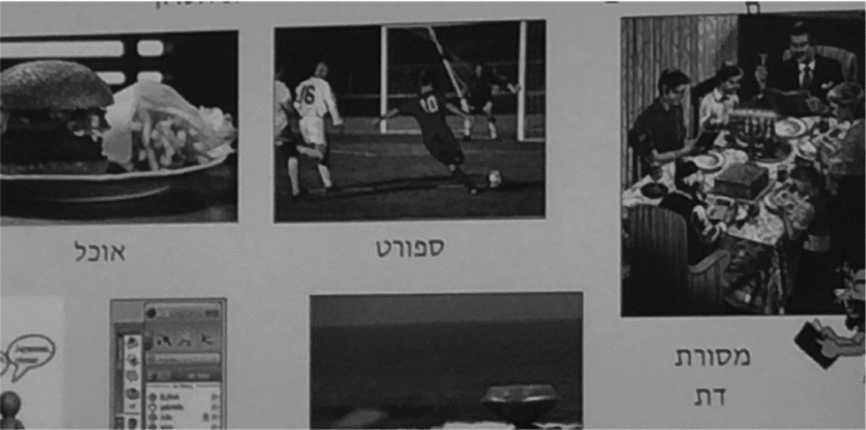
For example, during a meeting of the 6th-grade Hebrew Language and Culture class at MPMS, the teacher, Ms. R, was teaching how culture is defined, which was also the topic of discussion that week in social studies class. To define culture in Hebrew for the students, Ms. R included discussion of food, sports, and entertainment as examples. The photo in Figure 1 captures a PowerPoint slide that was presented during this class. The teacher showed an image for לכוא (dining), depicting a hamburger and French fries (common foods in the United States and many other countries), and טרופס (sports), showing a soccer match. However, for the concept of תד תרוסמ (religious tradition), what the teacher displayed is the picture of a Passover Seder table that can be seen to the right in Figure 1.
Culture in the Hebrew Classroom
(Ms. R, classroom observation PowerPoint slide, 6th-grade Hebrew Language and Culture Class, photo taken September 19, 2016)

While it is beyond the scope of this article to examine the links between Hebrew, Judaism, and Israel and how these links may or may not play out within Ms. R's classroom, our purpose here is to show how the teacher employs examples to support her teaching points that the Jewish students in her classroom will immediately recognize. In this way, her pedagogy is arguably culturally sustaining for Jewish students at MPMS. This, along with the school's provision of kosher food in the cafeteria and many other examples, shows how MPMS seeks to meet the needs of the local Jewish community through its Hebrew DLBE program in ways that simply were not seen in New York City public schools previously.
Instruction in this classroom also departs from conventional research and policies for DLBE in the ways the teacher builds on the students’ home language practices in her instruction. As noted earlier, the students’ home language practices differ widely from one another, with some needing more support than others. To support her students learning academic content through the Hebrew language, Ms. R did not teach both languages in isolation. Instead, English and Hebrew were often presented alongside one another and used together in teaching and learning within the Hebrew classroom. For example, when Ms. R taught about the Israeli kibbutz, she first showed a short video from Israel in Hebrew about the history and characteristics of these communities, and then immediately talked about the video's content with students in English. At the same time, the English discussion also accommodated Hebrew expressions, such as chadar ochel (communal dining room) and gan yeladim (children's area) that hold specific semantic meaning for the kibbutz experience (7th-grade Hebrew Language and Culture class, classroom observation field notes, October 26, 2016).
We have also observed flexible language practices in written work, such as on the teacher's PowerPoint slides or in classroom activities, usually to help students understand key vocabulary. For instance, in a recent 6th-grade social studies lesson about the five pillars of Islam, the PowerPoint defined each pillar with the words in Hebrew, English, and Arabic (6th-grade social studies class, classroom observation field notes, January 12, 2017). In a worksheet distributed during a recent 7th-grade lesson in Hebrew about U.S. court cases for students with disabilities, the teacher Ms. R included a Hebrew-English glossary. Likewise, students frequently translanguage when speaking in the classroom, and this was permitted.
Moreover, while in direct contradiction to the NYCDOE's policies promoting strict language separation in DLBE and the research on which those policies are based, we found that the fluid language practices of the classroom are necessary for this particular population, offering the students affordances they need to be able to access course content and participate in class (García, Reference García2009). The body of research in translanguaging theory shows that this is helpful not only for Hebrew-English bilinguals in DLBE programs, but also for all bilingual students in DLBE programs when done strategically and with pedagogical purpose (Cenoz & Gorter, Reference Cenoz and Gorter2011; García & Li Wei, Reference García and Wei2014; Gort & Sembiante, Reference Gort and Sembiante2015; Palmer et al., Reference Palmer, Martínez, Mateus and Henderson2014; Martínez et al., Reference Martínez, Hikida and Durán2015).
CONCLUSION
Our study illuminates how a new DLBE program challenges DLBE doctrine. In this manuscript, we highlight linguistic purism inculcated in bilingual education research, which promulgates a 50/50 balance of students and strict language separation, and show how these ideals have been codified in New York's DLBE policies. We then share research from a new Hebrew DLBE program at a public middle school, which is part of the wider expansion of bilingual education into new languages and communities in New York City schools. Our findings show how its students do not represent two distinctly different monolingual communities and how Hebrew and English are not taught in isolation. When the school's approach was found to be out of step with bilingual education policy mandates, the city imposed a heritage language model, which is not considered a form of bilingual education under local policies, rather than supporting the school to increase its Hebrew offerings.
The expansion of bilingual education in recent years and the support it has received offers exciting opportunities for minoritized communities and their languages, as well as for English monolinguals to learn new languages. Moving forward, we recommend that bilingual education policies be adopted that are based on bilingual norms rather than monolingual ones and provide space for schools to prioritize the needs of their local communities with the flexibility necessary to do so.