Writing systems such as English and French are said to be morphophonemic because they represent information at both the phonological and morphological levels of language. The alphabetic basis of French explains why the ability to apply phoneme–grapheme correspondences correctly is an important component of learning to read and to spell in French (e.g., Sprenger-Charolles, Siegel, Bechennec, & Serniclaes, Reference Sprenger-Charolles, Siegel, Béchennec and Serniclaes2003). However, this approach does not ensure the correct spelling of half of the words in French (Véronis, Reference Véronis1988; Ziegler, Jacobs, & Stone, Reference Ziegler, Jacobs and Stone1996) because many words include sounds that can be spelled in more than one way (e.g., en, an to represent /ã/) or silent letters (e.g., the final d in boulevard and bavard, talkative).
Given that morphophonemic written systems also represent the morphological structure of words, the application of information about morphemes, or the minimal units of meaning in language, often allows one to choose between several plausible spellings. Many morphological relationships are captured within the root consistency principle, which specifies that roots retain their spelling in related words (Bourassa & Treiman, Reference Bourassa and Treiman2008; Deacon & Bryant, Reference Deacon and Bryant2006; Pacton & Deacon, Reference Pacton and Deacon2008). For example, vowels can be spelled in several ways in English (/e/ as in bed, head, and said) and French (/e/ as in lait, /le/, milk, sel, /sel/, salt). Morphological information makes the choice between the different spellings straightforward; in English, health is spelled with an ea because of its root heal, and in French laitier (milkman) is spelled with an ai because of its root lait.
THE INFLUENCE OF MORPHOLOGY ON CHILDREN'S SPELLING
Prior research suggests that both English- and French-speaking children's spelling is influenced by morphological structure. In English, Carlisle (Reference Carlisle1988) found that 10- to 14-year-old writers were more likely to spell derived forms accurately if they knew how to spell their roots. In a similar vein, Deacon and Bryant (Reference Deacon and Bryant2006) showed that 7- to 9-year-old children were more likely to spell a segment correctly (e.g., turn) if it was a part of an inflected word (e.g., turning) than of a control word (e.g., turnip). Other studies have shown that children rely on morphology to spell particularly challenging sounds (Kemp, Reference Kemp2006; Rubin, Reference Rubin1988; Treiman, Cassar, & Zukowski Reference Treiman, Cassar and Zukowski1994). For instance, Treiman and Cassar (Reference Treiman and Cassar1996) showed that 5- to 9-year-old children were more likely to spell the penultimate consonant of consonant clusters correctly when that consonant was a part of the root morpheme than when it was not (e.g., /n/ in tuned vs. brand).
Sénéchal (Reference Sénéchal2000) and Sénéchal, Basque, and Leclaire (Reference Sénéchal, Basque and Leclaire2006) demonstrated that 7- and 9-year-old French-speaking children's spelling is also influenced by morphological structure. Children were more likely to spell the ends of words correctly when these had a derived form that indicated the word-final silent consonant (e.g., the derived form camper /kãpe/ suggests the use of p in camp /kã/, a camp, where it is silent) than deep words with no such related word (e.g., jument, mare). This difference suggests that children refer to related words in determining the spelling of silent endings. The use of the morphological structure to choose between several possible spellings has also been evidenced with pseudoword spelling tasks (Pacton, Fayol, & Perruchet, Reference Pacton, Fayol and Perruchet2005).
THE ROLE OF MORPHOLOGICAL AWARENESS IN SPELLING
Morphological awareness refers to children's “conscious awareness of the morphemic structure of words and their ability to reflect on and manipulate that structure” (Carlisle, Reference Carlisle and Feldman1995, p. 194). Several tasks have been developed to assess children's morphological awareness. In the completion task, children are asked to produce a related form to appropriately complete a sentence (e.g., “Four. The horse came in . . .” [correct answer: fourth]). This task is easier when the stem is pronounced similarly in the base and related form (e.g., four–fourth) than when it is pronounced differently (e.g., five–fifth; Carlisle, Reference Carlisle1988; Fowler & Liberman, Reference Fowler, Liberman and Feldman1995). In the analogy task, children are given a pair of sentences or words, such as “Tom helps Mary” and “Tom helped Mary” or “teach” and “teacher.” They are asked to carry out the same kind of transformation on another sentence (e.g., Tom sees Mary) or on word (e.g., write). As we will discuss later, the nature of the phonological relation can also be manipulated in this task. According to Bryant and collaborators (e.g., Nunes, Bryant, & Bindman, Reference Nunes, Bryant and Bindman1997a), the analogy task is particularly well suited to assessing morphological awareness because it requires explicit manipulation of the relations between morphologically related words (in contrast to, for example, the sentence completion task).
The analogy task has been used to investigate the role of morphological awareness in spelling (e.g., Bryant, Nunes, & Bindman, Reference Bryant, Nunes and Bindman2000; Deacon, Kirby, & Casselman-Bell, Reference Deacon, Kirby and Casselman-Bell2009; Kemp, Reference Kemp2006; Nunes et al., Reference Nunes, Bryant and Bindman1997a; Nunes, Bryant, & Bindman Reference Nunes, Bryant and Bindman1997b; Sénéchal, Reference Sénéchal2000; Sénéchal et al., Reference Sénéchal, Basque and Leclaire2006) and occasionally in reading (Deacon & Kirby, Reference Deacon and Kirby2004). In English, Nunes et al. (Reference Nunes, Bryant and Bindman1997a, Reference Nunes, Bryant and Bindman1997b) reported that scores on the word and sentence analogy tasks predicted 6- to 8-year-old children's subsequent successful spelling of the regular past tense verbs as -ed in both words and pseudowords. This relationship remained, even after controlling for phonological awareness (for similar evidence on spelling of the possessive, see Bryant et al., Reference Bryant, Nunes and Bindman2000). According to Nunes and colleagues, these findings suggest that the link between morphological awareness and the spelling of this morpheme is specific.
Other support for a specific relationship comes from Sénéchal's (Reference Sénéchal2000) study of French-speaking children in Grades 2 to 4. Here, morphological awareness scores contributed to children's spelling of words for which morphological information was useful, independently of multiple control measures. Children's morphological awareness scores did not contribute independently to a spelling score combined across two categories: regular words that did not include silent letters, and therefore could be spelled using phoneme to grapheme knowledge and deep words that contained a silent final consonant that could not be deduced by referring to derived forms. Sénéchal suggested that the contribution of morphological awareness was specific to words for which morphological information is useful.
This conclusion is not water tight, although, given Sénéchal et al.'s (Reference Sénéchal, Basque and Leclaire2006) findings. Sénéchal and colleagues considered the link between morphological awareness and spelling accuracy separately for different types of words. Further, they controlled for general spelling (which accounted for 30%–40% of the variance). In these analyses, there was no additional contribution of morphological awareness to spelling of regular words, a 7.2% additional contribution to the spelling of morphological words (p = .045) and a 5.0% additional contribution to the spelling of deep words (p = .079). Other evidence of a more general relationship between morphological awareness and spelling emerges in studies of English children (Deacon & Bryant, Reference Deacon and Bryant2006; Deacon et al., Reference Deacon, Kirby and Casselman-Bell2009). Thus, the specificity of the relationship between morphological awareness and spelling appears to be far less clear-cut when morphological words are contrasted specifically with deep words.
In addition to considering separately various spelling measures, it may be necessary to distinguish between measures of morphological awareness. We might need to consider whether the task can be performed by phonological analysis alone. For example, the analogical item “write:writer::work:worker” can be completed by simply adding the sound /ər/. Appreciating the similarity in meaning relationship between the two pairs is not necessary to complete the task. By contrast, sole reliance on such a phonological analogy does not achieve the correct answer for four: fourth::five:fifth. Certainly, several studies have shown that performance is generally better with items that can be processed by solely relying on phonology (e.g., Casalis, Colé, & Sopo, Reference Casalis, Colé and Sopo2004; Fowler & Liberman, Reference Fowler, Liberman and Feldman1995). However, the predictive value of each measure has not yet been assessed in correlation studies. This distinction may help in understanding the link between morphological awareness and spelling.
THE PRESENT STUDY
Our first objective was to examine whether morphological information helps French children to overcome a common source of spelling difficulty. We explored whether sounds for which there are several possible spellings are spelled more accurately in derived than in nonderived forms.
Our second objective was to examine the connection between morphological awareness and spelling of these two word types, as well as a standardized test of spelling. If morphological awareness is associated only to derived words, then we might consider relationship between these two variables to be specific. In contrast, if morphological awareness is associated to the spelling of both derived and nonderived words, the relationship might be considered to be general. Our standardized spelling measure, which provides phonetic, lexical, and syntactic scores, offers an additional test of the specificity hypothesis.
Our third aim was to examine the contribution of different morphological awareness scores in a word analogy task. Here we contrasted “stable” items, for which derivations undergo the same phonological transformation, with “shift” items, for which derived words involve different phonological shifts. Only the first kind of items can be performed by relying on phonological processing alone.
METHOD
Participants
Participants included 42 (30 females) children in Grade 3 (M age = 8 years, 4 months [8;4], SD = 5 months) and 38 (15 females) children in Grade 4 (M age = 9;3, SD = 4 months). Children were recruited from a primary school located in an area of average socioeconomic status in Dijon. The children all had parental permission, French as native language, and no language problems according to their teachers.
Materials and procedure
Phonological awareness. Phonological awareness was assessed individually with a phoneme deletion subtest from the BELEC battery (Mousty & Leybaert, Reference Mousty and Leybaert1999). Participants were asked to pronounce the part that remains after removing the first phoneme (e.g., removing /n/ of nid, answer /i:/).
Morphological awareness. Morphological awareness was assessed with a word analogy task (e.g., Nunes et al., Reference Nunes, Bryant and Bindman1997b; items listed in Appendix B). The experimenter pronounced a pair of related words (e.g., “coiffer” and “coiffeur,” to do somebody's hair, hairdresser). The experimenter then said another word and asked the child to carry out the same transformation on this word that had been made for the first pair (e.g., “chasser” [to hunt] was to be transformed to “chasseur” [hunter]). There were four training items and 14 experimental items. For this study, the alpha reliability was 0.71.
For two training items and seven experimental items, labeled stable, the analogy task could be performed on a phonological basis alone. For instance, for the analogy above children may identify the phonological transformation from “coiffer” to “coiffeur” and carry out the same transformation on “chasser” to obtain “chasseur.” They can do so correctly on the basis of sound changes alone without appreciating the similarity in meaning relationships between the two pairs (i.e., verb and agentive).
For another two training items and seven experimental items, labeled shift, children must appreciate the similarity in the meaning relationship between the two word pairs in order to answer correctly. For instance, children provided with the pair “bavarder:bavardage” (to chat:chatting), and the word “apprendre” (to learn) cannot answer “apprentissage” (learning) if they rely on the phonological dimension alone. Reliance on phonological analogy alone would likely result in an erroneous answer such as “apprendrage” or “apprendage.”
Standardized spelling test. General spelling ability was assessed with the Corbeau standardized spelling subtest (Chevrie-Muller, Simon, & Fournier, Reference Chevrie-Muller, Simon and Fournier1997) that was dictated by the experimenter. This subtest provides three scores. The three scores assess separate aspects of spelling abilities and in later cases separate parts of the word. The “phonetic score” reflects children's ability to produce spellings that are phonologically plausible, even though not necessary orthographically correct (split half reliability = 0.78). The “lexical score” reflects children's use of word specific spelling knowledge and focuses on a specific part of the word (split half reliability = 0.64). The “syntactic score” reflects the correct use of grammatical markers (split half reliability = 0.69). This scoring can be illustrated for the item “une souris blessée” (an injured mouse). For the word blessée (/blese/), 1 point is attributed to the phonetic score if the spelling is phonologically plausible, even if it is not conventional (e.g., blécé). One point is attributed to the lexical score if the sound /s/ is spelled correctly using “ss” (instead of “c,” for instance). One point is attributed to the syntactic score if the inflectional ending ée (feminine form of the adjective) is correct.
Spelling of experimental items (derived and nonderived). Children spelled 11 nonderived words and 11 derived words (listed in Appendix A). All of these contained a sound that can be spelled in several ways in French. For the derived words, knowledge of the spelling of the stem can be used to decide how to spell a sound for which there are many possible spellings. For example, knowing the spelling of “lait” (/le/, milk) can be used to choose to use “ai” (instead of “è,” “ê,” or “ei” in lait) to spell /e/ in the derived word “laitier” (milkman). By contrast, for the nonderived words, there are no morphologically related words that can be used to decide how to spell this sound (e.g., /e/ in “falaise,” cliff). Derived words and nonderived words were matched on surface frequency based on the lexical database for written materials for elementary school children MANULEX (Lété, Sprenger-Charolles, & Colé, Reference Lété, Sprenger-Charolles and Colé2004) and length (ps = .97 and .57, respectively). For this study, the alpha reliability was 0.78.
Procedure
The dictation of the nonderived and derived words and of the Corbeau (Chevrie-Muller et al., Reference Chevrie-Muller, Simon and Fournier1997) was carried out in small groups (n ~ 10) on the same day (and in this order). One or 2 days later, the morphological awareness was administered individually followed by the phonological awareness task.
RESULTS
Description of phonemic and morphological awareness and general spelling ability
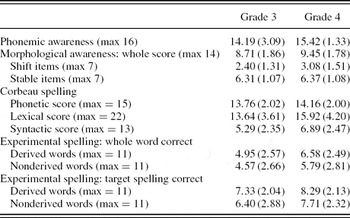
Descriptive statistics on all measures are shown in Table 1. Scores on the morphological awareness task were examined with an analysis of variance with grade (3 vs. 4) as a between-subjects factor and item type (stable vs. shift) as a within-subjects factor. Scores tended to be higher in Grade 4 than 3, although this difference did not reach significance, F (1, 78) = 3.22, p = .076. There were significantly more correct answers for stable than for shift items, F (1, 78) = 351.03, p < .001, and there was no grade by item type interaction, F (1, 78) = 2.57, p = .11.
Mean (standard deviations) scores on the various tasks

Experimental spelling task
We created two outcome measures for the experimental spelling items: whole word and target grapheme accuracy. Whole word accuracy reflected the number of words correctly spelled (e.g., falaise only spelled falaise). Target grapheme accuracy reflected the number of target graphemes (one per item) correctly spelled (e.g., ai in falaise), even if other parts of the words were spelled unconventionally (e.g., falaise spelled falaiz, fallaise . . . but not falèse or falèze).
Analyses of variance with these two outcome measures, conducted with grade as a between-subjects factor and the type of item (nonderived vs. derived) as a within-subjects factor, lead to similar results. There were better scores in Grade 4 than in Grade 3: whole word spelling, F (1, 78) = 6.84, p = .01; target grapheme, F (1, 78) = 5.47, p < .05. Scores were higher for the derived than for nonderived words: whole word spelling, F (1, 78) = 6.62, p < .05; target grapheme, F (1, 78) = 11.71, p < .001. The size of the difference between derived and nonderived words did not differ as a function of grade (Fs < 0.81).
Relationships between morphological awareness and spelling
In addition to the stable and shift scores in morphological awareness, we computed a whole score in morphological awareness that consists of the sum of the stable and shift scores. We do so following on previous studies that used such a total score.
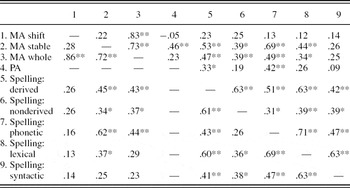
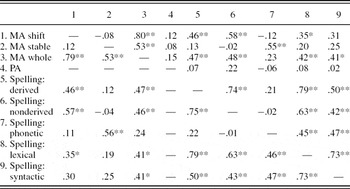
Table 2 and Table 3 (Grades 3 and 4, respectively) provide correlations between morphological and phonological awareness and several measures of spelling. There was only one significant correlation between phonological and morphological awareness: that between performance on stable items and phonological awareness in Grade 3 (r = .46, p < .01).
Correlations between morphological awareness (MA) and phonological awareness (PA) scores and spelling measures in Grade 3

Note: Bivariate correlations are above the diagonal and those after phonological awareness been partialed out are below the diagonal.
*p < .05. **p < .01.
Correlations between morphological awareness (MA) and phonological awareness (PA) scores and spelling measures in Grade 4

Note: Bivariate correlations are above the diagonal and those after partialing out phonological awareness (PA) are below the diagonal.
*p < .05. **p < .01.
In order to investigate the relationship between morphological awareness and spelling ability, we computed the correlations between the three measures of morphological awareness (whole, stable, and shift) and the different spelling scores. We also calculated correlations after controlling for phonological awareness to investigate whether the relationships remain significant after this additional control.
In Grade 3, morphological awareness whole correlated with spelling of derived and nonderived words and with the Corbeau phonetic and lexical scores. In Grade 4, morphological awareness whole correlated with the spelling of derived and nonderived words and with the Corbeau lexical and syntactic scores. These correlations generally remained significant after controlling phonological awareness, with exception of the correlation between morphological awareness whole and lexical spelling in Grade 3 that was marginally significant. Thus, in both grades, morphological awareness whole appears to be related to spelling of both derived and nonderived words as well as of several spelling subtasks.
We then considered separately the correlations between performance on stable and shift morphological awareness items and the different spelling measures. In Grade 3, the scores on shift items were not correlated with any of the spelling scores. By contrast, scores on stable items were correlated with spelling of the derived and nonderived words and with the Corbeau phonetic and lexical scores. In Grade 4, although the scores on stable items correlated only with the Corbeau phonetic score, the scores on shift items correlated with the derived and nonderived items, as well as the spelling lexical score. These significant relationships remained after controlling for phonological awareness.
DISCUSSION
The present study was designed to examine French children's use of morphology in spelling and to clarify the nature of the connection between morphological awareness and spelling. We did so by assessing morphological awareness, phonological awareness, and several dimensions of spelling in French-speaking children in Grades 3 and 4.
First, children in Grades 3 and 4 appear to benefit from the morphological structure of words in their spelling, a finding that is in line with previous studies in English (e.g., Deacon, Reference Deacon2008). The children are more accurate in spelling a sound for which there are several alternatives if the word is derived compared to when it is not. It seems that children are sensitive to spellings that can be recovered from base words, a segment that is more frequent and more likely to be known by participants than the derived form. This is consistent with previous studies that have focused on other spelling difficulties in French, such as final silent letters (Sénéchal, Reference Sénéchal2000; Sénéchal et al., Reference Sénéchal, Basque and Leclaire2006). Our data extend prior findings to a novel investigation of a widespread problem in French, that of sounds for which there are several alternative spellings (Alegria & Mousty, Reference Alegria and Mousty1996).
Second, we examined the connection between diverse spelling metrics and morphological awareness. Our results indicate that across Grades 3 and 4 morphological awareness contributed a significant and independent part of spelling accuracy, beyond phonological awareness. This was the case for both the standardized spelling subtask scores and the experimental items. For the standardized spelling task, the strongest connection was with lexical score, with the correlation with other scores depending on the grade and morphological measure. These correlations were examined in more detail to determine the specificity of the connection between morphological awareness and spelling.
If the connection between spelling and morphological awareness is specific, we would expect morphological awareness to predict spelling of derived words, and not nonderived items. Our results do not support this view. Instead, morphological awareness was consistently correlated with spelling of both categories of items. Further support for the general connection comes from the results for the standardized spelling test. Morphological awareness was strongly correlated with the lexical score, and less consistently correlated with the phonetic and syntactic scores. Notably, the lexical score involves correct spelling of words, but not of derived words in particular. Even the link with the syntactic score at Grade 4 does not necessarily reflect a specific connection, given that the morphological awareness task involves derivational and not inflectional morphology. In combination, these results suggest that morphological awareness exerts a broad influence on spelling.
Third, we examined whether the contribution of morphological awareness could be distinguished according to the phonological structure of the derived forms. Several findings converge to suggest that there is such a difference. First, performance was consistently better for stable than shift items (as in prior studies with the sentence completion task; Casalis et al., Reference Casalis, Colé and Sopo2004; Fowler & Liberman, Reference Fowler, Liberman and Feldman1995). The morphological awareness task can be solved based on phonology alone in the stable condition, and not in the shift condition. Second, performance on these two types of items had differential relationships with spelling. Performance on the stable items was significantly correlated with phonological awareness in Grade 3, but there was no such correlation between the shift items and phonological awareness in either grade. This strengthens the view that some aspects of the stable items in the morphological awareness task may be solved by phonological processing. Moreover, although performance on the morphological awareness task as a whole was correlated with some aspects of spelling performance across Grades 3 and 4, scores dissociating stable and shift items revealed a very different pattern. Spelling of both derived and nonderived word items was associated with stable items at Grade 3 and, in contrast, with shift items at Grade 4. These differences are unlikely to be explained by statistical effects because there was no evidence of floor effects; nor can they be explained by ceiling effects at Grade 4, given that scores for the stable items were similar in Grades 3 and 4 and these scores correlated consistently with the phonetic spelling score. A task involving shift items might constitute a more focused morphological awareness task, because it appears to be distinguishable from phonological awareness.
A remaining question lies in whether the shift and stable items in the morphological awareness task assess the same underlying ability. The lack of correlation between the two sets of items in both grades suggests that they tap different processes, despite the surface similarity. We think that performance on the stable items taps, at least partly, phonological processes. In contrast, we think that performance on the shift items is more likely to reflect morphological analysis. Accordingly, future studies might separate these two types of items.
If we consider that performance on shift items assesses morphological awareness more purely, then our results suggest that morphological awareness contributes to spelling performance to a greater extent at Grade 4 than at Grade 3. It then becomes possible that morphological awareness is only genuinely associated to spelling from Grade 4. In our view, this is too strict an interpretation. We cannot rule out the involvement of morphological analysis in the stable items. Further studies might tackle this question by comparing performance of stable derived items with nonderived forms (e.g., write: writer:: corn: corner). Currently, our results suggest that, when we try to remove phonological aspects of morphological awareness, there is no link between morphological awareness and spelling prior to Grade 4. Clearly, this question needs further investigation.
The present study focused on Grade 3 and 4 children. We did so because of the evidence of growth in the understanding of derivational relations in this time period (Anglin, Reference Anglin1993). Of course, measuring phonological awareness at this age is challenging, and so we focused on phonemic awareness. One of the clear limitations of this study lies in the potential ceiling effects for the measure of phonological awareness. Similarly, the inclusion of a test of vocabulary would be useful in future studies. We ensured that the words used in the present study belonged to the lexical database for children MANULEX. However, it would be informative to examine whether morphological awareness, assessed with both shift and stable items, is associated with vocabulary knowledge across grade levels, and, more, if the correlations between morphological awareness and spelling survive when vocabulary is partialed out.
Finally, it is useful to distinguish the influence of morphological structure on spelling from the involvement of morphological awareness in spelling. Our data suggest that, at least as early as Grade 3, sounds for which there are several possible spellings are spelled more accurately if they are embedded in derived words compared to nonderived words. This offers evidence that converges with prior findings of the influence of morphological structure on children's spelling (Sénéchal, Reference Sénéchal2000; Treiman & Cassar, Reference Treiman and Cassar1996).
This impact of morphological structure on spelling needs to be distinguished from the involvement of morphological awareness in spelling, particularly if tasks assess more explicit morphological processing, as analogy tasks might. Here we find that morphological awareness is associated with spelling performance regardless of whether morphological information is involved in the items to be written. This general connection suggests that the greater a child's awareness of morphology, the more accurately (and possibly fluently) he or she will spell. One possible explanation, suggested by Sénéchal and colleagues (Reference Sénéchal, Basque and Leclaire2006), is that the greater the child's ability in written language processing, the more he or she may be able to attend to specific aspects of the written language, such as graphemes that do not follow strict letter–sound correspondences. Thus, the link between morphological awareness and spelling ability is not necessarily restricted to online involvement of morphological awareness during spelling. This point of view provides an explanation for the otherwise contradictory findings that derived words are better spelled than nonderived words as soon as Grade 3 and that there is a the general connection of morphological awareness to spelling. We need to bear in mind, of course, that more pure morphological awareness tasks appear to be involved in spelling only from Grade 4. It is possible that a slightly more diverse ability, both phonological and morphological, could be linked to spelling performance at Grade 3, and perhaps earlier.
In conclusion, our study suggests that Grade 3 and 4 French-speaking children rely on morphological structure to spell sounds for which there are several alternative spellings. Further, morphological awareness appears to be generally connected to spelling outcomes. Further analyses suggest that we need to differentiate between different measures of morphological awareness and the phonological structure of the morphological awareness task. New research is needed to provide a more precise picture of the aspects of language that are progressively integrated by children in their mastery of written language.
APPENDIX A
Stimuli for experimental spelling test
Derived: baignade (bathing), blancheur whiteness), caisson (case), chaudière (boiler), chauffage (heating), défaite (failure), laideur (ugliness), lainage (woolen garment), laitage (dairy product), mangeoire (trough), mangeur (eater)
Nonderived: bedaine (paunch) cauchemar (nightmare), corsaire (pirate), falaise (cliff), guirlande (garland), langouste (crayfish), molaire (molar), naufrage (shipwreck), nuance (shade), porcelaine (porcelain), urticaire (nettle rash).
APPENDIX B
Stimuli for morphological awareness task

Note: Items are written in French, with translations provided in italics. The item to be provided by the child is in parentheses.