A recently reported outbreak of endophthalmitis occurred in a private, single-physician ophthalmology clinic that performed outpatient cataract surgery in Norway. Reference Lind, Olsen and Angelsen1 Among 290 patients who underwent outpatient phacoemulsification cataract surgery under topical anesthesia at the clinic between January 4 and January 28, 2019, 6 developed signs and symptoms of endophthalmitis between January 26 and April 30, 2019. Cultures of vitreous or anterior chamber fluid or implanted intraocular lenses and lens capsules from each patient were obtained by the Department of Ophthalmology, University Hospital of North Norway, Tromso, Norway, and were positive for Burkholderia cepacia complex based on matrix assisted laser desorption ionization time-of-flight (MALDI-TOF) mass spectrometry. Reference Lind, Olsen and Angelsen1 Subsequent recA sequence analysis showed that all patients were infected with Burkholderia contaminans, a species within the B. cepacia complex. Multilocus sequence typing (MLST), derived from draft whole-genome sequences, showed that all isolates had an identical allelic profile (sequence type [ST] 102 in the PubMLST database at pubmlst.org). As reported, Reference Lind, Olsen and Angelsen1 a systemic review of the clinic’s infection control and surgical decontamination processes, together with culture of samples from medicinals, medical devices, and environmental sites did not reveal a source of infection. We subsequently investigated the clinic’s air ventilation system.
Methods
Laboratory and epidemiologic investigation
Several dozen swabs of biofilm and samples of standing water within the clinic’s fresh air ventilation system were obtained in October 2019, and sent to the University of Michigan, Ann Arbor, Michigan, for processing. Swabs or water (100 µL) were cultured directly onto Burkholderia cepacia selective agar (BCSA) Reference Henry, Campbell, LiPuma and Speert2 and incubated at 37°C for up to 5 days. Agar plates were inspected daily for bacterial growth and colonies with distinct morphologies were identified. Individual colonies representing each morphology were subcultured onto cation-adjusted Mueller-Hinton agar and again incubated at 37°C. After overnight growth, bacterial cell lysates, made from single colonies were used as template in a Burkholderia-specific polymerase chain reaction (PCR) assay targeting the bacterial recA gene. Reference Storms, Van Den Vreken and Coenye3 The DNA sequence of amplified products was determined by Sanger dideoxy sequencing. Draft genome sequences of the isolates that were identified as Burkholderia based on recA gene sequence were generated at the University of Michigan as described previously. Reference Spilker, Darrah and LiPuma4 Burkholderia isolates recovered from 5 of the 6 infected patients were available and draft genome sequences of these were generated at Ghent University, Ghent, Belgium, as described previously. Reference Peeters, De Canck and Cnockaert5 Core genomic distances, insertions and deletions, and single-nucleotide polymorphism (SNP) visualization was performed using Harvest version 1.2 software (https://harvest.readthedocs.io/en/latest/). MLST was performed based on gene fragments obtained from draft genomes. All draft genomes generated in this study are available at project number PRJNA689475, accession numbers SAMN17208788-SAMN172087894 and SAMN18310906-SAMN18310912.
Results
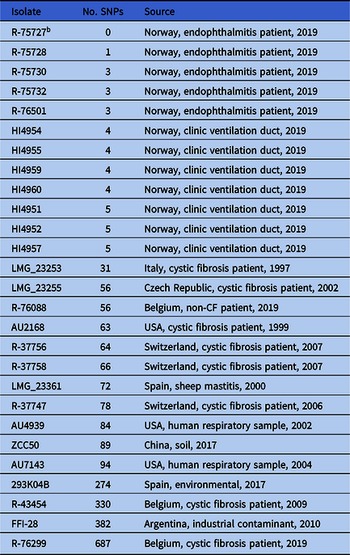
In total, 118 swab or water samples taken from the clinic ventilation system (N = 106 samples) and liquid medical products (N = 12 samples) used in the clinic were cultured on BCSA medium. Among these, 7 cultures yielded bacterial growth that tested positive by Burkholderia-specific PCR assay. One of these samples was from standing water that was pooled in an air intake duct in the ventilation system, and the other 6 were swabs of biofilm from the same duct. DNA sequence analysis of PCR-amplified recA identified each isolate as B. contaminans. MLST analysis showed that all 7 isolates had an identical allelic profile, which was identified as ST102 in the PubMLST database (pubmlst.org). Whole-genome sequencing analysis revealed 1 SNP among the core genomes of these 7 isolates, and no more than 5 SNPs differentiated these isolates from the B. contaminans recovered from the patients with endophthalmitis (Table 1). In contrast, an analysis of draft genomes of 15 other ST102 strains available at NCBI (https://www.ncbi.nlm.nih.gov/genome/browse/#!/prokaryotes/17767/) revealed between 31 and 687 SNPs relative to strain R-75727, representing the isolates recovered from infected patients.
Whole-Genome Sequence Analysis a

a The number of SNPs, relative to the reference strain, in the core genomes of B. contaminans isolates recovered in this study is provided, along with the number of SNPs found in draft genomes of B. contaminans ST102 isolates available in NCBI.
b Reference.
Discussion
Acute endophthalmitis, characterized by reduced visual acuity, eye pain, hypopyon and vitreous infiltration, is a rare complication of cataract surgery, occurring in 0.04% of >8.5 million surgeries performed in the United States between 2013 and 2017. Reference Pershing, Lum and Hsu6 The clustering of 6 cases following cataract surgery in a single clinic within 1 month suggested a common source of infection. The recovery of the same strain of B. contaminans, an unusual human pathogen, from all 6 patients provided further compelling evidence of a common source outbreak. Reference Lind, Olsen and Angelsen1 An initial investigation to identify the source of this outbreak included culture of samples from liquid drugs and products, medical devices, and ‘multiple environmental sites’ in the clinic, including sink drains. Reference Lind, Olsen and Angelsen1 No source of Burkholderia infection was identified, prompting our subsequent investigation, which focused on the clinic’s ventilation system because this was found to have pooled water and soil in air intake vents. Cultures of water and biofilm from the ventilation ductwork, performed at the University of Michigan, identified the same B. contaminans strain (ST102) as had been recovered from endophthalmitis patient cultures at the University Hospital of North Norway.
Species within the B. cepacia complex are well recognized as healthcare-associated opportunistic pathogens, most often causing infection by virtue of their capacity to contaminate aqueous pharmaceutical and personal care products and disinfectants. Reference Tavares, Kozak, Balola and Sá-Correia7 Not infrequently, however, the source of nosocomial outbreaks remains obscure, despite extensive investigation to identify a common source. Among B. cepacia complex species, B. contaminans is (as its name implies) most notorious for its proclivity to contaminate medical products and cause outbreaks. Within this species, ST102 is a strain with a global distribution that has been recovered from persons with cystic fibrosis and has been involved in outbreaks traced to a variety of contaminated products, including nasal spray Reference Dolan, Dowell, LiPuma, Valdez, Chan and James8 and liquid docusate (Table 1). Reference Glowicz, Crist and Gould9
In the outbreak described here, analyses of draft genomes showed that the B. contaminans ST102 isolates recovered from the clinic ventilation system were essentially identical (≤5 SNPs within the 5.8 Mb core genome) to those recovered from cultures of eyes from patients with endophthalmitis. Several other B. contaminans ST102 isolates, not related to this outbreak, showed greater genome sequence variation, strongly implicating the ventilation system as the source of infection.
The ventilation system, which provided 8 air exchanges per hour, received regular maintenance, and had operated without incident for 13 years. Local flooding due to an unusually early thaw resulted in pooling of water in air intake ducts. Whether contamination of the operative field and patient eyes occurred directly from airborne particles from the ventilation system or via an intermediary (eg, topical ophthalmic medication or surgical instrument contaminated with bacteria from the ventilation system) could not be ascertained with certainty. Active air sampling was not routinely utilized in this clinic, and air sampling with settle plates was not performed in our investigation. Notably, however, a vent providing fresh air to the clinic was located directly over the operating field, and multiple cultures of all liquid pharmaceuticals used during surgery did not yield Burkholderia. Furthermore, contamination of the clinic ventilation system, which provided air into the clinic, by a contaminated medical product used in the clinic or by an infected patient is highly improbable.
In summary, our study provides strong evidence that a fresh air ventilation system was the source of an outbreak of postsurgical endophthalmitis due to B. contaminans. Investigations of outbreaks of healthcare-associated infections involving B. cepacia complex species that fail to identify a contaminated healthcare product should consider examination of air handling systems. Our study also demonstrates the utility of whole-genome sequence analyses in epidemiologic investigations of outbreaks involving bacterial strains that are widely distributed in the natural environment and indistinguishable by MLST analysis alone.
Acknowledgments
This publication made use of the PubMLST website (https://pubmlst.org/) developed by Keith Jolley and sited at the University of Oxford. The development of that website was funded by the Wellcome Trust. PV and ED thank the Oxford Genomics Centre at the Wellcome Centre for Human Genetics (funded by Wellcome Trust grant reference 203141/Z/16/Z) for the generation and initial processing of the sequencing data.
Financial support
J.J.L. receives grant support from the Cystic Fibrosis Foundation. E.D. was supported by fellowships from the Fund for Scientific Research Flanders (FWO).
Conflicts of interest
All authors report no conflicts of interest relevant to this article.