Introduction
In rural China, children are typically seen as the main source of security in later life. The Confucian norm of ‘filial piety’ obliges adult children to provide their parents with financial and material support as well as physical care and assistance. The multi-generational household, in which older parents co-reside with their adult children, is often seen as the embodiment of this informal support system (Silverstein, Cong and Li Reference Silverstein, Cong and Li2006; Whyte Reference Whyte and Ikels2004). In recent decades, however, living arrangements of rural Chinese elders have become more fluid and diversified. Most notably, there has been a steep decline in co-residence rates. At the same time, a number of non-traditional living arrangements have risen into prominence, including the ‘empty nest’ (older people living alone or with a spouse only) and the ‘skipped generation household’ (older people living with grandchildren whilst the middle generation lives and works elsewhere).
The causes and consequences of changes in living arrangements are the topic of a lively debate both in the Chinese public discourse and in academic literature (see e.g. Benjamin, Brandt and Rozelle Reference Benjamin, Brandt and Rozelle2000; Biao Reference Biao2007; Giles and Mu Reference Giles and Mu2007; Giles, Wang and Zhao Reference Giles, Wang and Zhao2011; Silverstein, Cong and Li Reference Silverstein, Cong and Li2006; Zhang Reference Zhang and Ikels2004). The decline in co-residence rates is normally attributed to China's transformation from a planned economy to a market-based system. Although successful in terms of stimulating economic growth and reducing absolute poverty rates, China's economic reforms were accompanied by an increase in socio-economic inequality, particularly between urban and rural areas. This led to a massive outflow of workers from the countryside to the cities: the National Bureau of Statistics (2013) estimated the total ‘floating population’ in 2012 at 236 million.
Since most migrants belong to younger age cohorts,Footnote 1 large-scale out-migration has raised concerns about the wellbeing of older generations. They are often portrayed as victims of socio-economic modernisation and cultural change, left behind by their children who have moved to the cities in search of a better life. The decline of the multi-generational household is seen as a worrying trend that reflects a weakening of traditional norms of filial piety and inter-generational support (Croll Reference Croll2006; Zhang, Gu and Luo Reference Zhang, Gu and Luo2014).
Others have argued that changes in living arrangements do not necessarily reflect a weakening of the inter-generational support system. Both in China and other East Asian countries, it has been observed that the decline in co-residence rates has been partially offset by a corresponding increase in older people living independently in close proximity to their children (Knodel and Ofstedal Reference Knodel, Ofstedal and Hermalin2002; Lei et al. Reference Lei, Strauss, Tian and Zhao2011; Whyte Reference Whyte and Ikels2004). This arrangement has been alternatively described as a ‘networked’ family or ‘intimacy at a distance’ (Thang Reference Thang, Dannefer and Phillipson2010: 206). From this perspective, separate residences can be seen as a wealth effect reflecting both generations’ preferences for privacy and independence (Giles, Wang and Zhao Reference Giles, Wang and Zhao2011). Living apart does not preclude the maintenance of close inter-generational ties nor the receiving of intensive support from adult children (Croll Reference Croll2006).
Thus far, the academic discussion on social change and informal family support in rural China has mainly focused on the financial dimension, in particular the remittances provided by migrant children. This paper looks at another, equally important aspect of family support: the provision of care to older people with functional disabilities. Contrary to financial or even emotional support, care-giving requires frequent face-to-face contact (Silverstein and Litwak Reference Silverstein and Litwak1993), which makes it particularly vulnerable to large-scale out-migration. It is thus surprising that there is little empirical research relating family care-giving to the recent phenomena of rural-to-urban migration and decreasing co-residence rates.
This paper seeks to fill this void by providing detailed statistics on the care-giving arrangements of physically impaired older adults, in line with the overarching research question ‘How does care provision vary by living arrangement?’ In order to assess the importance of the proximity of children, it compares older parents in three different living arrangements: with any child or child-in-law (co-resident); independent with at least one child living in the same community (networked); and without any children in either the household or the community (isolated). Multivariate logistic regression models were used to assess how they differed in their respective likelihood of not having any care-giver, receiving care from a child and receiving care from a spouse. Further analyses were conducted by marital status and age cohort.
The findings contribute to related literature by (a) providing a more extensive typology of living arrangements, (b) considering various types of family care-givers in addition to adult children and (c) using a recent and nationally representative sample. Data were derived from the 2011–12 China Health and Retirement Longitudinal Study (CHARLS), which is the most comprehensive source of information on older adults in China. In line with the substantive interest of the paper, the sample was limited to individuals over 60 who lived in rural areasFootnote 2 and had an explicit need for care. The issue of informal family care is particularly crucial in rural China because of the virtual absence of formal long-term care facilities, most of which are located in urban areas (Chow Reference Chow2011; Ikels Reference Ikels, Goodman and Harper2008). At the same time, demographic trends such as reduced fertility, out-migration and increased longevity put increasing pressure on the inter-generational support system.Footnote 3 The findings of this paper provide a first indication of how family care networks are responding to these on-going challenges.
Background and hypotheses
Family care-giving in East and West
The selection of family care-givers to frail older people is a complex process in which the availability of potential care-givers, the needs of the recipient, as well as cultural norms and expectations all play an important role. Cantor's influential hierarchical-compensatory model of care-giving assumes that various categories of care-givers follow a descending order of preference. In Western societies, the primary care-giver of choice is normally the spouse, followed by children (particularly daughters) and more distant relatives (Cantor Reference Cantor1979). Formal options such as residential care facilities may be called upon when care needs exceed the capacity of the informal support network.
In rural China, on the other hand, formal long-term care facilities tend to be either absent or unaffordable. Like other Asian countries, China has a strong tradition of children caring for parents. According to Zhan and Montgomery,
Traditional patterns of parent care have been widely attributed to the deeply rooted cultural belief of xiao, or filial piety, which has been long believed to be the essential element holding together the Chinese familial system of care, determining who is likely to be a care provider, and deciding the types and amount of care that are provided. (2003: 210)
In the typical case, older Chinese would live with the family of their oldest son and receive physical care from their daughter-in-law (Cong and Silverstein Reference Cong and Silverstein2011; Holroyd and Mackenzie Reference Holroyd and Mackenzie1995; Zhan and Montgomery Reference Zhan and Montgomery2003; Zimmer and Kwong Reference Zimmer and Kwong2003). It is unclear to what extent this traditional pattern still holds following the decline of the multi-generational household. Several authors have observed that hierarchical norms of filial obligation have weakened, as children increasingly focus on their own nuclear family (Du Reference Du2013; Miller Reference Miller2007; Zhang Reference Zhang and Ikels2004). The following sections outline the most common family constellations in contemporary rural China and hypothesise about their relation to care-giving arrangements.
The decline of the multi-generational household
Living arrangements have changed particularly rapidly in rural China: the percentage of older people that live with an adult child has declined from almost 70 per cent in 1991 to just over 40 per cent in 2006 (Cai et al. Reference Cai, Giles, O'Keefe and Wang2012: 48). It is often assumed that sharing a household with children is advantageous for elders, since various types of support and transfers tend to occur naturally and unacknowledged (Arber Reference Arber, McDaniel and Zimmer2013; Thang Reference Thang, Dannefer and Phillipson2010). Indeed, various studies identified important benefits from co-residence, including better mental health (Silverstein, Cong and Li Reference Silverstein, Cong and Li2006), a lower risk of poverty (Yang Reference Yang2010) and more help from children (Song, Li and Feldman Reference Song, Li and Feldman2012). There is a widespread concern in China and other Asian countries that declining co-residence rates reflect the weakening of inter-generational ties and threaten the informal support network of older people (see e.g. Benjamin, Brandt and Rozelle Reference Benjamin, Brandt and Rozelle2000; Biddlecom, Chayovan and Ofstedal Reference Biddlecom, Chayovan, Ofstedal and Hermalin2002; Guo, Chi and Silverstein Reference Guo, Chi and Silverstein2009; Silverstein, Cong and Li Reference Silverstein, Cong and Li2006). Care-giving, in particular, requires frequent physical contact and is thus most easily provided by relatives that live with or nearby the recipient (Litwak and Kulis Reference Litwak and Kulis1987; Silverstein and Litwak Reference Silverstein and Litwak1993). For this reason, Zhang and Yeung believe that increased rural–urban migration, changing family structures and the rising number of nuclear households raise questions about ‘the sustainability of the family institution in the provision of care’ (Reference Zhang and Yeung2012: 615). Thus far, no study has compared care-giving constellations of co-resident and non-co-resident Chinese elders, although Peng, Wu and Ling (Reference Peng, Wu and Ling2014) found that living alone increased the risk of having unmet care needs. Also, a study from rural Thailand has shown that parents living independently are much less likely to receive care from a child (Knodel and Chayovan Reference Knodel and Chayovan2012). This leads to the hypothesis that older adults who do not co-reside with children are (a) less likely to receive support from children and (b) more likely not to have a care-giver (Hypothesis 1).
The networked family perspective
Not all observers see the decline of the multi-generational household in negative terms. Recent qualitative studies suggest that even though the multi-generational household is still a traditional ideal in rural China, ‘the aged do not necessarily prefer or benefit from co-residence with their children’ (Miller Reference Miller2007: 32). Stress and conflicts caused by co-residence for both older and younger generations are frequently recurring themes. Many older Chinese have adapted their preferences and ‘no longer see co-residence with a married son as the ideal manifestation of filial piety’ (Thøgersen and Anru Reference Thøgersen and Anru2008: 22) or are afraid of becoming a burden to their families. Proponents of this view, which is more dominant in recent works, have pointed out that most non-co-resident parents live close to one or more of their children (sometimes in adjacent residences) and receive extensive support from them (Hermalin Reference Hermalin2002; Lei et al. Reference Lei, Strauss, Tian and Zhao2011; Cai et al. Reference Cai, Giles, O'Keefe and Wang2012). In a meta-study of ethnological findings from across Asia, Croll concludes that ‘the resource flows hitherto associated with co-residence are not constrained by the physical boundaries of separate households and that living near, as opposed to with, children does not necessarily mean that there are fewer resource flows between the generations’ (Reference Croll2006: 485). The concept of the ‘networked family’ is often used to describe ‘the relations, exchanges and connections between separate but close-kin related nuclear households’ (Croll Reference Croll2006: 485). Networked parents enjoy the benefits of proximity whilst avoiding the downsides of co-residence, which include a lack of privacy and an increased potential for inter-generational conflict (Giles, Wang and Zhao Reference Giles, Wang and Zhao2011; Zhang Reference Zhang and Ikels2004). In China, it has been observed that frail older people increasingly value and receive assistance from non-co-resident married daughters, whose traditional role is to look after their parents-in-law (Liu Reference Liu2014; Xu Reference Xu2001; Zhan and Montgomery Reference Zhan and Montgomery2003). From this perspective, there is thus no reason to expect substantial differences in care-giving arrangements between the networked and the co-resident categories (Hypothesis 2).
Care-giving by spouses and other relatives
It appears that isolated older adults, who are neither co-resident nor have children living nearby, are worst off in terms of care-giving. Children's propensity to provide care is normally found to decline gradually with geographical distance or travel time (e.g. Litwak and Kulis Reference Litwak and Kulis1987), which suggests that the isolated category is least likely to receive support from children, and most likely to lack a care-giver (Hypothesis 3).
That being said, proximity to children is not the only factor that determines whether care needs are provided for. The presence of alternative care-givers such as a spouse or (adult) grandchildren may reduce the need to rely on children for support. The role of the spouse, in particular, has been largely neglected in studies on informal family care in China, presumably because of the perceived primacy of adult children as care-givers. It is likely, however, that the large-scale out-migration of children and corresponding decline in co-residence rates have increased the importance of spouses as care-givers, particularly for men. In the absence of empirical studies on spousal care-giving in China, it can be insightful to look at studies from neighbouring countries that share some of rural China's socio-economic characteristics. For example, in rural Thailand spouses were found to be the most common care-giver for married elders, particularly if they did not live with or close to children (Knodel and Chayovan Reference Knodel and Chayovan2012). In rural Vietnam, on the other hand, spouses were found to play a relatively marginal role, but receiving care from grandchildren was common (Hoi, Thang and Lindholm Reference Hoi, Thang and Lindholm2011). I therefore hypothesise that the presence of a spouse or a grandchild can mediate the negative impact of not living with children, particularly for isolated elders (Hypothesis 4).
Finally, it has been observed that the division of labour between family care-givers tends to shift over the lifecourse. In Western countries, married parents most often receive care from their spouse. Children and other relatives generally take over primary care-giving responsibilities after widowhood or when the spouse experiences health problems, typically at a later stage in life (Chappell Reference Chappell1991; Penning Reference Penning1990). It is uncertain whether a similar pattern holds in China, where taking care of elders is generally considered to be the responsibility of their children, and filial norms are more strongly developed than in the West (Cong and Silverstein Reference Cong and Silverstein2011; Holroyd and Mackenzie Reference Holroyd and Mackenzie1995; Whyte Reference Whyte and Whyte2003). According to Xu, however, ‘spousal support can often postpone or avoid the period of complete dependency on children’ (2001: 310), and it was observed that some parents transition into co-residence after widowhood or when their health deteriorates (Zimmer Reference Zimmer2005; Zimmer and Korinek Reference Zimmer and Korinek2010; Zimmer and Kwong Reference Zimmer and Kwong2003). We would therefore expect the role of different care-givers to vary by age, with ‘younger old’ parents more likely to receive care from a spouse and the ‘oldest old’ more likely to receive care from a child (Hypothesis 5).
Data and methodology
Sample
All analyses are based on data derived from the National Baseline of the CHARLS, which was conducted in 2011–12 (see Zhao et al. Reference Zhao, Strauss, Giles, Hu, Liu and Smith2013). CHARLS is part of a family of surveys modelled on the American Health and Retirement Survey (HRS), including amongst others the Survey of Health, Ageing and Retirement in Europe (SHARE) and the Japanese Study on Ageing and Retirement (JSTAR). The Gateway to Global Aging Data created a harmonised version of CHARLS, which is comparable to the RAND HRS and other harmonised data-sets. Wherever possible, this study used the harmonised variables.
CHARLS covers 28 out of 30 provinces in China and is nationally representative of the non-institutionalised population over the age of 45.Footnote 4 It has a total sample size of 17,708 individuals in 10,257 households (in cases where the main family respondent was married, the spouse was included in the sample as well). Each survey contains highly detailed information on topics such as demographics, family support and transfers, health status and functioning, employment, pensions, income and assets. Data quality was ensured by employing a Computer Assisted Personal Interviewing system as well as extensive quality checks and follow-ups. The rural response rate amounted to 94.15 per cent (Zhao et al. Reference Zhao, Strauss, Giles, Hu, Liu and Smith2013).
For the purposes of this paper, I only looked at respondents that lived in rural areas and had reached the age of 60, which is generally seen as the start of old age in China (being, for example, the eligible age to receive the New Rural Pension) (Lei et al. Reference Lei, Strauss, Tian and Zhao2011). Moreover, I restricted the sample to respondents with at least one living child and at least one serious functional impairment (see below). After deleting 157 cases due to missing values on some key variables, the sample was reduced to 887 parents. In 79 households both husband and wife were over 60 and had a need for care. In this case, each spouse is both a potential care recipient and a potential care-giver (standard errors are clustered by household to correct within-household correlation in these cases).
Dependent variables
I follow Uhlenberg in defining care-giving as ‘assistance provided to persons who cannot, for whatever reason, perform the basic activities or instrumental activities of daily living for themselves’ (Reference Uhlenberg1996: 762). Activities of Daily Living (ADLs) and Instrumental Activities of Daily Living (IADLs) are standard measures of functional ability that have been incorporated in most health-related household surveys (Vlachantoni et al. Reference Vlachantoni, Shaw, Evandrou and Falkingham2013; Wolff and Kasper Reference Wolff and Kasper2006). In CHARLS, difficulties with each ADL (dressing, bathing, eating, getting out of bed, using the toilet, controlling urination and defecation) and IADL (doing chores, preparing hot meals, shopping, managing money, making phone calls, taking medications) are measured on a four-point scale: 1 = I don't have any difficulty, 2 = I have difficulty but can still do it, 3 = I have difficulty and need help and 4 = I cannot do it.
Respondents are considered functionally impaired and included in the sub-sample if they responded (3) or (4) to at least one ADL or IADL, which is true for 23 per cent of the total sample of rural people above the age of 60 (note that the analytical sample thus includes only respondents who explicitly state their need for care and excludes those who merely express difficulty). These respondents were asked the follow-up question ‘Who most often helps you with [list of ADLs and IADLs]?’ Possible responses included various categories of family members, paid helpers or volunteers, as well as ‘no one helped’. Although they could theoretically indicate up to three individuals, most mentioned only one (70 per cent) or two (17 per cent) primary care-givers. For the regression analyses these answers are converted to four binary outcome variables representing (a) not having any care-giver, (b) receiving care from any child or child-in-law, (c) receiving care from a spouse and (d) receiving care from a grandchild.
Independent variables
The primary variable of interest in this study is the living arrangement of the parent in relation to his or her children. Many observers believe that close proximity to children can be a functional equivalent to co-residence, whereas others see any kind of non-co-residence as a sign of weakened inter-generational ties. In order to test these hypotheses, living arrangement is divided into three categories:
-
• Co-resident (sharing a household with any child and/or child-in-law).
-
• Networked (not co-resident, but with at least one child living in the same village).
-
• Isolated (not co-resident, all children living outside the village).
Control variables
Respondent gender
A number studies have shown than mothers are more likely to receive informal family care (e.g. Yarger and Brauner-Otto Reference Yarger and Brauner-Otto2014; Zimmer and Kwong Reference Zimmer and Kwong2003). On the other hand, age differentials in marriage and the gendered nature of care-giving suggest that men are more likely to receive care from their spouse (Haberkern, Schmid and Szydlik Reference Haberkern, Schmid and Szydlik2015; Zhan and Montgomery Reference Zhan and Montgomery2003).
Intensity of care needs
Family care-giving decisions are generally responsive to parents’ needs (e.g. Guo, Chi and Silverstein Reference Guo, Chi and Silverstein2009; Silverstein and Litwak Reference Silverstein and Litwak1993; Song, Li and Feldman Reference Song, Li and Feldman2012). Whilst all parents in the analytical sample have an identified need for support, the intensity of this need may vary. I therefore control for age and for the number of (I)ADLs that the parent is not able to perform independently.Footnote 5 Age is a particularly important control variable because it is strongly correlated with a number of other factors and lifecourse events that may affect care needs and care-giving, including health status, income-generating capacity and social status.
Potential care-givers
The probability that a parent receives care when needed is likely to increase with the number of potential care-givers. Respondents with a spouse may have a lower need to rely on children for support, but when both spouses have functional impairments this may reduce their capacity for mutual care. The marital status variable therefore has three categories: (a) married: healthy spouse, (b) married: spouse has care need and (c) single. The large majority of respondents belonging to the ‘single’ category are widowed. I also include the total number of children as well as a categorical variable indicating whether the children are all male, all female or both sexes. It is typically believed that parents who have both daughters and sons are better off in terms of care than those who have only sons or daughters (Xu Reference Xu2001).
Socio-economic status (SES)
The inter-generational reciprocity perspective assumes that parents who control assets or have an independent source of income are more likely to receive care transfers from their children, since they can reciprocate these by making financial transfers or bequests to the care-giver. On the other hand, high SES may relate to a more individualistic lifestyle, which reduces the probability of receiving family care (Yarger and Brauner-Otto Reference Yarger and Brauner-Otto2014). I include two proxies for SES to control for these competing effects: education level (in three categories) and self-reported living standard (poor, average or high).Footnote 6
Analytical strategy
In the first stage, logistic regression models were used to assess how living arrangements affect the likelihood of (a) not having any care-giver and (b) receiving care from a child or child-in-law, controlling for the variables described above. In order to assess how the presence of a spouse affects this relationship, these analyses were replicated for the married and single sub-samples. Single elders are often considered a vulnerable group (Barrientos, Gorman and Heslop Reference Barrientos, Gorman and Heslop2003), and their care-giving arrangements are thus of particular interest. Finally, I explore the role of age in more detail. Since CHARLS uses a clustered sampling design, sampling weights (which include a correction for non-response) are applied to all descriptive tables and figures. Note that the study is based on cross-sectional data and living arrangements are not exogenous to family care-giving; results should therefore not be interpreted as causal relationships.
Results
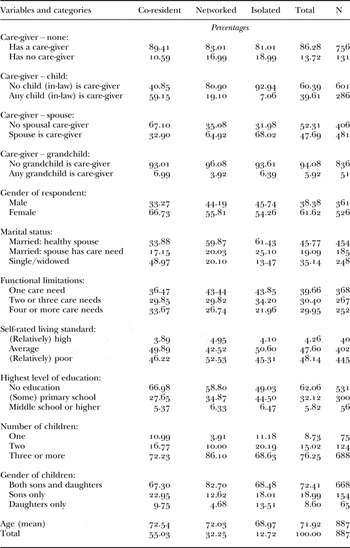
Table 1 provides descriptive statistics of all dependent and independent variables, separated by living arrangement. It shows that about 52 per cent of sampled parents were co-resident, 34 per cent were networked and 14 per cent lived isolated from their children. The corresponding figures for non-impaired parents were 45, 36 and 18 per cent, respectively, which suggests that co-residence was at least partially responsive to functional health, as Korinek, Zimmer and Gu (Reference Korinek, Zimmer and Gu2011) have shown. The prevalence of networked extended families demonstrates that out-migration of children was not the only reason for non-co-residence: many functionally impaired elders maintained independent households rather than moving in with a nearby child.
Descriptive statistics for sample, by living arrangement

Note: Values are weighted percentages and unweighted N.
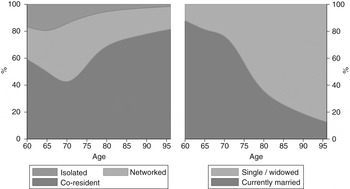
Most sampled parents had three or more children,Footnote 7 and just over a third did not have a spouse. They also tended to have little or no formal education and to rate their standard of living as (relatively) poor or average (see Table 1). Figure 1 plots living arrangement and the presence of a spouse against age. Co-residence tends to increase from around age 70, when a large number of parents have become widowed. As a result, co-resident parents are slightly older than average. Co-resident, networked and isolated parents differed in a number of other aspects as well. For example, the co-resident group had more intensive care needs and isolated respondents were more likely to be male and to be married. All these variables will be controlled for in the regression analyses.
Living arrangement (left) and presence of spouse (right), by age of respondent.

Table 1 also lists the primary care-givers of the sampled respondents. It shows that 14 per cent of the sample respondents did not have any care-giver, 40 per cent received care from a child (in-law) and 47 per cent from a spouse (note that respondents could indicate more than one primary care-giver). The high incidence of spousal care-giving, particularly for the networked and the isolated groups, highlights the need to pay more attention to this particular care arrangement. Grandchildren played a somewhat less important role: they were primary care-givers in about 6 per cent of all cases.
The determinants of receiving informal family care
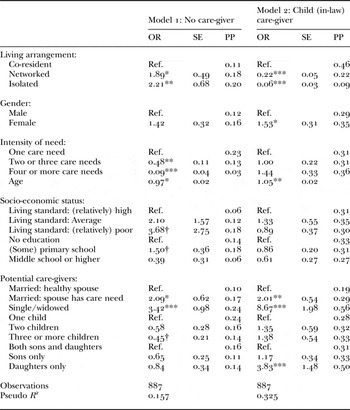
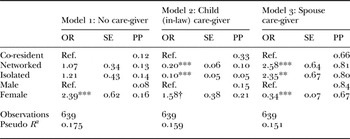
Table 2 presents the results from two logistic regression models predicting the likelihood of not having any care-giver (Model 1) and receiving care from a child or child-in-law (Model 2). To facilitate their interpretation, I present the results both as odds ratios and as average predicted probabilities (calculated using the observed values of all other covariates).
Logistic regression models, full sample

Notes: OR: odds ratio. SE: robust standard error. PP: average predicted probability. Ref.: reference category.
Significance levels: † p < 0.10, * p < 0.05, ** p < 0.01, *** p < 0.001.
Predicted probabilities show that family care-giving was strongly related to living arrangements. As expected, the isolated group had the lowest probability of receiving care from a child. Contrary to the ‘networked family’ hypothesis, networked parents were much less likely to receive care from a child than co-resident parents (46 versus 22%). Moreover, both networked and isolated parents were more likely to have unmet care needs (18 and 20%, respectively). These findings suggest that the networked family is at best an imperfect alternative to co-residence. Descriptive evidence, however, suggests that most non-co-resident respondents live with their spouse and may thus be less dependent on adult children to meet their care needs. Indeed, the odds of having a child as primary care-giver were 8.7 times higher for single respondents than for respondents with a healthy spouse. Children were also more likely to be care-givers when both spouses had a physical impairment, which suggests that they step in when their parents are no longer capable of providing mutual care. The role of marital status and spousal care-giving will be explored further in the next section.
The control variables largely have the expected direction. For example, mothers and comparatively older parents were more likely to receive care from a child. Parents’ SES appeared to be unrelated to child care-giving, although poor living standards increased the risk of not having a care-giver (p < 0.10). Perhaps surprisingly in the Chinese context, the number of children did not have a major effect on care-giving after controlling for living arrangement and other covariates. Zimmer and Kwong (Reference Zimmer and Kwong2003) and Song, Li and Feldman (Reference Song, Li and Feldman2012) came to a similar conclusion. It is thus the proximity to children that mattered for care-giving rather than the number of offspring. Child gender also played a role: parents with daughters only were more likely to receive care from children than those with only sons or children of both sexes.
The role of marital status and alternative care-givers
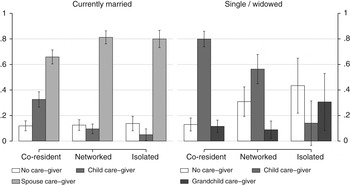
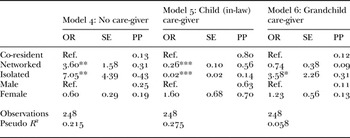
In order to understand better the role of marital status in defining care-giving arrangements, Tables 3 and 4 present analyses for parents living with and without a spouse. In line with Hypothesis 4, I also consider the importance of alternative care-givers, notably the spouse for married respondents (Model 3) and grandchildren for single respondents (Model 6). The predicted probabilities from each model are plotted in Figure 2.
Predicted probabilities, by living arrangement and presence of spouse.

Logistic regression models, currently married respondents

Notes: OR: odds ratio. SE: robust standard error. PP: average predicted probability. Ref.: reference category. Control variables (same as in Table 2) not shown: full table available upon request.
Possible significance levels: † p < 0.10, * p < 0.05, ** p < 0.01, *** p < 0.001.
Logistic regression models, single respondents

Notes: OR: odds ratio. SE: robust standard error. PP: average predicted probability. Ref.: reference category. Control variables (same as in Table 2) not shown: full table available upon request.
Possible significance levels: † p < 0.10, * p < 0.05, ** p < 0.01, *** p < 0.001.
Figure 2 shows that spousal care-giving was predominant amongst married respondents. Even for respondents that were married and living with a child, the predicted probability of the spouse being a care-giver was 66 per cent, compared to 33 per cent for any child (in-law). Moreover, respondents that lived with a spouse had a constant, low risk of unmet care needs regardless of the proximity of children. As expected, men were more likely to receive care from their spouse.
Single respondents, most of whom were widowed, relied largely on children to fulfil their care needs. As a result, proximity to children was of more importance for this population segment. In particular, both isolated and networked respondents had much higher levels of unmet care needs than their co-resident counterparts (Model 4). It is possible that some of these elders have indeed been ‘abandoned’ by their children, although they constitute a relatively small percentage of the sample. Moreover, as can be seen in Model 6, grandchildren often step in when neither a spouse nor a child is available to provide care. The role of gender also varies according to marital status. Notably, after controlling for gender differences in other covariates, married mothers have a higher risk of unmet care needs than married fathers (p < 0.001), but for single parents the effect is reversed (p > 0.10).
Family care-giving over the lifecourse
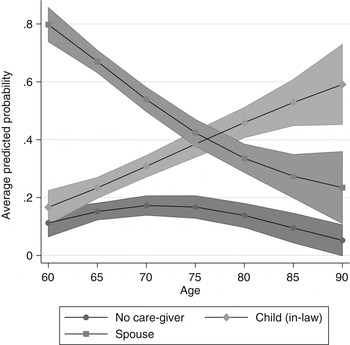
Family care-giving arrangements tend to change over time in accordance with the needs of the recipient and the availability of various types of care-givers. As a result, comparatively older parents are expected to rely more heavily on their children and other relatives rather than on a spouse. To illustrate the effect of age, we can compare the predicted probabilities of having a particular care-giver at different ages. Figure 3 shows that spousal care-giving declines sharply with age, whilst the probability of having a child care-giver increases. The probability of not having a care-giver is highest around age 70 and then declines. Further research will be necessary to determine which lifecourse events induce a change in care-givers, and to distinguish between age and cohort effects.
Main care-giver(s) of physically impaired elders, over age.

Discussion
The purpose of this paper was to identify patterns in family care provision in rural China, which recently experienced an unprecedented decline in inter-generational co-residence. In particular, it tried to assess whether living close to children can be considered a functional equivalent to co-residence and how the presence of a spouse affects family care-giving choices.
CHARLS data indicate that approximately one out of every seven older parents in rural China did not receive any help with (I)ADLs, in spite of a reported need. This is higher than what was reported by Peng, Wu and Ling (Reference Peng, Wu and Ling2014), although their sample only included respondents aged 80 and above. The findings showed that older adults with unmet care needs are predominantly non-co-resident, which is in line with Hypothesis 1. It is important to note that this effect only occurred for widowed elders: those who lived with a spouse were equally (un)likely not to have a care-giver as the co-resident group. The presence of a spouse thus mediated the negative impact of not living with children, which is in line with Hypothesis 4. The fact that widows – most of whom are female and have low living standards – are more likely to have unmet care needs is rather worrying. The Chinese government has tried to improve the position of elders by enshrining filial responsibility into law (Du Reference Du2013), but this is unlikely to resolve the complex problems that lead to deficiencies in inter-generational support.
The second hypothesis regarded parents that live close to their children rather than in the same household. The networked family arrangement is often seen as an alternative to co-residence, granting privacy and independence to both parents and children whilst maintaining the close inter-generational ties typical for the multi-generational household. The findings provided mixed evidence for this view. Married parents that lived independently were mostly cared for by their spouse, regardless of whether a child lived nearby. For single parents, however, having one or more children in the locality can provide important benefits.
The findings also showed that the spouse is the most common care-giver overall. Due to mortality and morbidity, however, comparatively older respondents are less likely to be able to rely on a spouse. Since care-giving by children increases with age (Hypothesis 5), there appears to be a hierarchy in family care-giving responsibilities, where children (or grandchildren) step in only when the spouse is no longer able to fulfil this role (see also Miller Reference Miller2007; Xu Reference Xu2001; Zimmer Reference Zimmer2005). In this sense, Chinese care-giving patterns are rather similar to those observed in the West. This is a somewhat surprising finding because the discourse on care-giving in China and other Asian countries is largely focused on adult children. The predominance of spousal care-giving in rural China is likely a result of the unprecedented decline in co-residence rates. If, and under what circumstances, the independent living arrangement reflects the preferences of frail older people is a topic that deserves more attention in the Chinese context.
The findings of this study do not suggest that children have abandoned their aged parents. First of all, it was shown that care-giving is generally responsive to need. Parents that are widowed and/or comparatively older are more likely to receive care from a child. Secondly, the decision to leave care in the hands of spouses or even grandchildren reflects a likely adaptation to the changed economic circumstances in rural China. Young adults may be more important to their families by working in urban areas and remitting part of their salary to support family members back home. Indeed, there is ample evidence that most labour migrants provide significant financial support to their parents and maintain close emotional bonds (Biao Reference Biao2007; Cai, Giles and Meng Reference Cai, Giles and Meng2006; Du, Park and Wang Reference Du, Park and Wang2005; Giles, Wang and Zhao Reference Giles, Wang and Zhao2011; Guo, Aranda and Silverstein Reference Guo, Aranda and Silverstein2009; Liu Reference Liu2014).
The above findings should be seen in the light of a number of limitations. First of all, since the paper is based on cross-sectional data, it is not able to account for lifecourse transitions in both care-giving and living arrangement. There is substantial evidence that parents move in with their children (or vice versa) in order to receive care (Korinek, Zimmer and Gu Reference Korinek, Zimmer and Gu2011; Miller Reference Miller2007; Xu Reference Xu2001; Zimmer and Korinek Reference Zimmer and Korinek2010). When further waves of CHARLS become available, it will be possible to relate changes in the location of parents and children to care-giving arrangements. For example, it might be the case that networked children are more likely than migrant children to move in with parents and become primary care-givers. Furthermore, I could not control for certain (potential) confounding variables such as emotional closeness between parents and children because they were not measured in CHARLS. Previous studies have shown that intra-family conflicts and disagreements are an important reason for disruptions in the inter-generational support system. Finally, the paper focused on primary care-givers only. Future research may want to consider secondary care-givers as well as task specificity in care-giving.
These limitations notwithstanding, the study provides a detailed account of informal family care provision in rural China, using a comprehensive and recent data-set of functionally impaired elders. It extends previous literature by comparing different types of care-givers and living arrangements, particularly the role of spouses and networked children.
The findings raise serious questions about the sustainability of the ‘traditional’ way of providing elder care in rural China, in which the family takes up the entire care-giving burden. CHARLS data show that a majority of physically impaired older adults now live independently from their children and are primarily cared for by their spouse. This development is likely to continue as increasing longevity, low birth rates and large-scale rural-to-urban migration further erode the ratio of potential child care-givers to recipients of care. It is important to note that population ageing is still at an early stage in China; the cohorts that were most affected by the fertility reduction policy are only beginning to approach later life.
Still, even today a substantial number of older adults do not receive the care that they need, and they tend to belong to the most disadvantaged segments of the older population. The plight of rural elders has received considerable attention in the Chinese public discourse, and there is a growing awareness that families cannot be expected to shoulder the entire care-giving burden alone. Through the New Cooperative Medical Insurance Scheme (established in 2008) and the New Rural Pension Programme (established in 2009), China has recently expanded basic health insurance and (minimal) pension coverage to the majority of the rural population, which is a major achievement. With respect to long-term care, however, the government's effort has been less comprehensive. Experts have argued for the establishment of a long-term care insurance scheme similar to the ones found in Japan and Korea, as well as for the expansion of (community-based) nursing homes and home care services (Du Reference Du2013; Glass, Gao and Luo Reference Glass, Gao and Luo2013; Peng, Wu and Ling Reference Peng, Wu and Ling2014). Given the persistently low income levels of rural elders, such initiatives would need significant public funding in order to reach the most vulnerable groups.
Acknowledgements
The study uses data from CHARLS Wave 1 (Baseline), updated on 13 March 2013. CHARLS has received critical support from Peking University, the National Natural Science Foundation of China, the Behavioral and Social Research Division of the National Institute on Aging and the World Bank. For more information, see http://charls.ccer.edu.cn/en. It also makes use of the harmonised CHARLS data-set and Codebook, Version B as of June 2015 developed by the Gateway to Global Aging Data. The development of the harmonised CHARLS was funded by the National Institute on Ageing (R01 AG030153, RC2 AG036619, 1R03AG043052). For more information, see www.g2aging.org.