

1 INTRODUCTION
The importance of Peru in the Spanish empire is undeniable. As a key source of silver, mercury, and indigenous labour, these lands became a pillar of Spanish colonial dominion. The exploitation of silver played a significant role in shaping the economic and social structure of this colony. In addition, Spain established a highly restricted colonial trade system and Peru had one of the few ports authorised to trade with the motherland. Given this prominent role in the empire, the conservative elites, deeply entrenched in this colonial structure, became a resilient stronghold against independence from Spain. It is not surprising then that independence was a costly and difficult enterprise in this territory as part of the elite was in line with the Crown to protect its economic interests.
Despite the severance of colonial ties in the early 19th century, silver remained Peru's economic cornerstone (after a decline during the wars of independence) following a new nationalistic turn. A couple of decades later, Peru became the main worldwide supplier of the famous bird dung fertilizer: guano. The impact of the exploitation of guano on the Peruvian economy was impressive. It became the main export commodity reaching 74 per cent of total exports in 1853, while also becoming the main source of public revenue. GDP per capita climbed from a mere $400 Geary-Khamis 1990 dollars on the eve of independence to $1,124 by 1876. This remarkable economic growth experience put Peru just 15 per cent behind Argentina's GDP per capita level during the same period. The exhaustion of the guano model and the vicissitudes of the War of the Pacific erased the growth achieved. Almost two decades after the war, the Peruvian economy regained some ground starting the new century with a GDP per capita of $674.Footnote 1
During the 19th century Peru was trapped between two different commodity-based strategies: colonial silver and postcolonial guano. While the guano boom has attracted much attention in literature, the study of the 19th century as a whole has drawn fewer contributors. Moreover, while many facets of the guano bonanza have been explored, its impacts on welfare and cost of living have received little attention. Overall, the literature agrees that the guano boom did not translate into sustainable development for the country (Hunt Reference Hunt1973; Bonilla Reference Bonilla1974; Tantaleán Arbulú Reference Tantaleán Arbulú1983; Gootenberg Reference Gootenberg1993). Instead, Peru mishandled this opportunity and boom rapidly became bust.
In this paper, I bridge the gap in the literature by looking at the evolution of cost of living and living standards during the entire 19th century.Footnote 2 By using primary sources from an array of Peruvian archives, I construct cost of living and welfare series for Lima from 1820 through 1900. To assess the evolution of the cost of living, I continue the work published by Gootenberg (Reference Gootenberg1990) for the rest of the 19th century using similar sources.Footnote 3 I estimate the cost of the subsistence (bare-bones) basket for a household using comparable methodology to the pioneer work by Allen (Reference Allen2001). In addition, I calculate a price index with the basket structure developed by Gootenberg (Reference Gootenberg1990). Using wages for unskilled labour in public records, I calculate the welfare ratio defined as the number of «bare-bones» baskets that an unskilled labourer's household could afford in a year. This indicator then enables comparison with other cities and countries for the same period.
From these new series we learn that Lima underwent a striking swing in cost of living and living standards during the 19th century. There was an initial period of deflation following the wars of independence, followed by inflation during the guano boom. Prices more than doubled between the 1840s and the early 1870s while they remained stable after the deflation experienced during the War of the Pacific. This dramatic fluctuation of prices had detrimental effects on the living standards of the popular class. Nominal wages failed to catch up with the rise in prices, resulting in an overall drop in living standards before the guano boom was over. This result suggests that the gains from this growth episode were not widespread. In fact GDP per capita peaked in 1876, two decades after the welfare ratio reached its maximum. This divergence indicates that the income from the guano boom in the later stage most likely benefitted the upper segment of the population. These results are in line with the anthropometric evidence presented by Twrdek and Manzel (Reference Twrdek and Manzel2010). In this study the authors find that from 1820 to 1880 statures of the lower class did not improve.
The study of the cost of living and living standards in this paper starts with the historical background of Peru during the 19th century followed by a discussion of the sources and methodology with the presentation of the cost of living series using the «bare-bones» basket and another series similar to that of Gootenberg (Reference Gootenberg1990). These series are compared with the index estimated by this author. Using the subsistence basket and nominal wage data, I present the series on living standards measured by the welfare ratio. The following section discusses Peru's living standards in historical and comparative perspectives and the final section offers concluding remarks.
2 PERU IN THE 19TH CENTURY: THE ECONOMIC CONTEXT
The economic history of Peru during the 19th century is marked by notable political and economic shocks. From wars to the guano boom, this country travelled a winding road after colonial rule. To facilitate discussion of the historical trends in Peru during the 19th century, a simple periodisation was chosen. The first stage, from the 1820s to the 1840s, is characterized by the wars of independence and the legacies of and changes to colonial rule. The second stage, from the 1850s to the 1870s, is a period of modernisation and commodity boom. Finally, the third stage encompasses the rest of the 19th century, a phase distinguished by the War of the Pacific, crisis, and their aftermath.Footnote 4
2.1 Stage I: Colonial Legacies, Wars and Change (1820s-1840s)
Independence from Spain arrived late in Peru when compared with the rest of South America. Peru was also different as external revolutionary forces played a major role in the process. As a result, some influential sectors remained sympathetic to the colonial power given their vested interests in the colonial productive structure (Quiroz Reference Quiroz1993). Immediately after independence, the state continued to use the colonial institutions already in place. For example, the main sources of fiscal revenue, the tribute on the indigenous population and the proceedings from silver mining, accounted for two-thirds of total revenues (Dancuart Reference Dancuart1905). Despite this inertia, the new government's needs for funds led to an increase in tariffs. This protectionist turn was mostly geared towards specific sectors such as the textile industry.Footnote 5 Despite the initial sizable protectionist move, the government decreased the rates as customs revenue was increasingly important, reaching 52 per cent of total government revenue in 1831 (Tantaleán Arbulú Reference Tantaleán Arbulú1983).
In terms of production, silver remained the main export representing over 50 per cent of total exports until it was displaced by guano.Footnote 6 Overall production plummeted in the 1820s as a result of the unstable economic and political situation but it regained dynamism a few years later. By the 1840s, production recovered to early 19th-century levels (Gootenberg Reference Gootenberg1990; Quiroz Reference Quiroz1993). The wars of independence gravely disrupted the functioning of the sugar and import sectors. Sugar production decreased substantially as slaves were first recruited for armies and the conflict made transportation difficult.
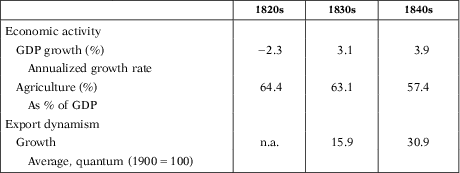
Overall, the instability of the independence times had a negative impact on GDP growth. During the first quarter of the 19th century, GDP fell by over 30 per cent. The greatest drop took place during the 1820s when the annualised growth rate was −2.3 per cent (see Table 1). It was only in 1840 that Peru reached the pre-war GDP level. This severe decline in economic activity was accompanied by a significant deflation; the price level only stabilized in the late 1840s.
GROWTH AND EXPORTS, 1820S-1840S
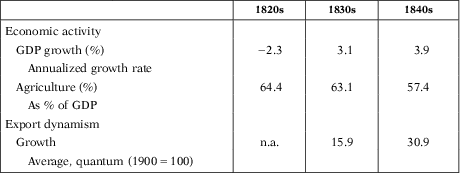
Sources: GDP and agriculture: Seminario de Marzi (Reference Seminario De Marzi2011), export growth and silver share: Hunt (Reference Hunt1973).
2.2 Stage II: Modernisation as the Result of a Boom (1850s-1870s)
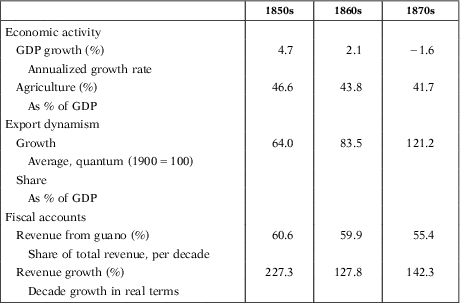
The modernisation of the Peruvian economy came along with the guano boom. Tantaleán Arbulú (Reference Tantaleán Arbulú2001, p. 405) claims that this fertilizer caused a «true revolution […] that created the objective conditions for growth and modernization». Guano export dependency reached a peak in 1853 with 74 per cent of total exports, declining to 56 per cent and 40 per cent for the following two decades (Hunt Reference Hunt2011). This boom had profound effects on the Peruvian economy ranging from a hefty increase in fiscal revenue to the expansion of the domestic market.Footnote 7 Economic activity surged during these first decades as annual GDP growth averaged 4.7 per cent in the 1850s. GDP per capita peaked in 1876 at $1,123 Geary-Khamis 1990 dollars, 90 per cent higher than in 1850. Mining, manufacturing and retail sectors increased their overall participation in GDP while agriculture was the clear loser (based on Seminario de Marzi Reference Seminario De Marzi2011).
From a fiscal perspective, guano exports boosted the public coffers, tripling the funds available in the 1850s. It also displaced other forms of taxation contributing up to 83 per cent of total revenue in 1857 and 1869 while averaging over 55 per cent during this period (see Table 2).Footnote 8 This sudden influx of resources financed the growth of the government, from 1848 to 1878 over 50 per cent of the guano proceedings paid for the expansion of the civil and military bureaucracy (Hunt Reference Hunt1984).Footnote 9
GROWTH, EXPORTS, FISCAL ACCOUNTS, 1820S-1870S
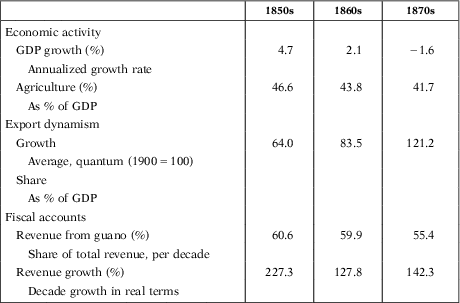
Sources: GDP and agriculture: Seminario de Marzi (Reference Seminario De Marzi2011), export growth: Hunt (Reference Hunt1973); fiscal accounts: Tantaleán Arbulú (2001).
The expansionary fiscal policy had effects on the size of the domestic market. A new cadre of public employees broadened the domestic market (Contreras Reference Contreras2004). In addition, 20 per cent of guano funds were devoted to railroad construction. This project intended to diminish transportation costs and provide the country with a transport infrastructure. Unfortunately, the project was plagued with difficulties and was not completed until after the War of the Pacific.
2.3 Stage III: Recovering from the Boom and the War (1880s-1890s)
The war with Chile, known as the War of the Pacific, and the exhaustion of the guano-led growth model marked a new stage in Peruvian history. By the early 1870s guano reserves were severely depleted. Moreover the development of an artificial fertilizer was quickly eroding the leading position guano had enjoyed in the past. Faced with dire fiscal circumstances, the government turned to the nitrates sector to solve its problems.Footnote 10 In 1873, it levied an export tax on nitrates but the largest producers failed to comply with the new requirements. The government responded by expropriating 161 nitrates companies. The armed conflict emerged when the Bolivian government increased export taxes on nitrates, a move which violated a treaty between Bolivia and Chile. Given the importance of nitrates in the Peruvian economy and the secret alliance between Peru and Bolivia, Peru was drawn to war.
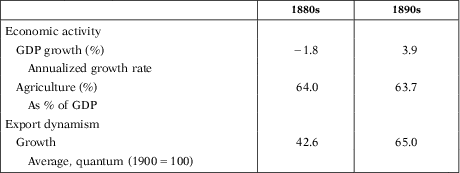
The results were devastating for the Peruvian economy. Economic activity plummeted as total GDP dropped by more than 30 per cent from 1879 to 1883 (see Table 3).Footnote 11 Peru also lost the nitrate-rich province of Tarapacá while Bolivia lost access to the Pacific Ocean. From a fiscal perspective, the state was bankrupt. Fiscal revenue nosedived from 35 million soles in 1879 to around one million in 1883 (Klarén Reference Klarén2005). The export sector ceased to be the revenue generator as exports of guano and nitrates vanished. In 1887, exports were a mere 23 per cent of the pre-war level (Yepes Reference Yepes1992).
GROWTH AND EXPORTS, 1880S-1890S
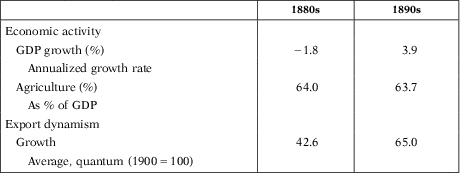
Sources: GDP and agriculture: Seminario de Marzi (Reference Seminario De Marzi2011), export growth: Hunt (Reference Hunt1973).
The recovery only got underway after the external debt problem had been solved. GDP growth reached 1.7 per cent per year during the 1890s despite the turbulence caused by the Barings crisis. By the second half of this decade, exports regained dynamism fuelled by exchange depreciation and investment (Thorp and Bertram Reference Thorp and Bertram1978). In particular, the manufacturing sector was expanding rapidly with annual growth rates reaching 18 per cent in 1896.
3 COST OF LIVING WAGES AND WELFARE IN 19TH-CENTURY PERU
Research on prices and wages in Latin America followed the footsteps of historians such as Hamilton. Romano (Reference Romano1963) and Florescano (Reference Florescano1968) produced pioneering works on Latin American prices, followed by Johnson and Tandeter (Reference Johnson and Tandeter1990); however, the scope and coverage varied substantially by country. While many of these studies correspond to colonial times, in recent decades few have emerged for the 19th century. For example, Williamson (Reference Williamson1999) computed real wages for several countries in the region with some coverage of the 19th century. On a country basis, the coverage is thin for most of the region. In the case of Mexico, Gómez-Galvarriato and Musacchio (Reference Gómez-Galvarriato and Musacchio2000) created a cost of living index for the late 19th century. For Venezuela, Arroyo Abad (Reference Arroyo Abad2013) looked at the cost of living and living standards for the 19th century. Relatively speaking, more studies are available for the southern cone. Cuesta (Reference Cuesta2007, Reference Cuesta2012) studied 18th-century prices and the evolution of real wages in Buenos Aires for the period 1850-1913. Bértola (Reference Bértola2000) and Braun et al. (Reference Braun, Braun, Briones and Diaz2000) present a cost of living index for Uruguay and Chile respectively. For Peru, Macera (Reference Macera1992) assembled the most impressive collection of retail prices for different urban and rural locales during colonial times. Gootenberg (Reference Gootenberg1990) looked at the cost of living in Lima for most of the 19th century.
To estimate cost of living and living standards it is necessary to collect retail prices and wages. Most of the studies quoted above supplied either data and/or analysis on prices and their trends. However, data on wages are scarcer in general, and even more so in the case of the 19th century. The disarticulation of the colonial system brought about tangible consequences for the political, social and economic structure of the Spanish colonial possessions, including data collection and record keeping. As a result, compilation of such data is difficult and slow, especially when compared to the research available for colonial times. Despite the challenge, we observe some progress for some countries. In the case of Peru, the pioneering study by Hunt (Reference Hunt1980) was supplemented by Zegarra (Reference Zegarra2011) on wages and poverty for the early 20th century.
The quest to discover and understand the historical evolution of cost of living and living standards around the world has been quite fruitful lately. A new wave of studies has looked at different areas in the world for long periods of time inspired by the seminal work for Europe by Allen (Reference Allen2001). As a result of this work, new studies used similar consumption baskets to compare living standards around the world. Using comparable methodologies, Özmucur and Pamuk (Reference Özmucur and Pamuk2002) worked on the Ottoman Empire. India was tackled by Allen (Reference Allen2007) followed by Allen et al. (Reference Allen, Bassino, Moll-Murata and Van Zanden2011) for selected countries in Asia. More recently, Cvrcek (Reference Cvrcek2013) looked into the Habsburg Empire during the 19th century. For Latin America, Arroyo Abad et al. (Reference Arroyo Abad, Davies and Van Zanden2012) studied the long-term trends for a sample of locations during colonial times. However, there is a gap in the literature for the 19th century with the exception of Venezuela. Arroyo Abad (Reference Arroyo Abad2013) has calculated both cost of living and living standards for the 19th century.
Exploiting the data already available for 19th-century Peru and supplementing them with my own archival work, this paper uses the methodology devised by Allen (Reference Allen2001) and expanded by Arroyo Abad et al. (Reference Arroyo Abad, Davies and Van Zanden2012). As detailed below, the methodology also includes other consumption baskets available from other sources.
3.1 Prices and Price Indices
Prices correspond to retail transactions in the city of Lima. Gootenberg (Reference Gootenberg1990) published retail prices for over twenty products from 1825 through 1873. Following his footsteps, I completed the series by collecting data for the rest of the late 19th century from similar sources.Footnote 12 The price data were taken from the Archivo del Arzobispo de Lima. The records correspond to churches and monasteries such as Trinitarias and Santa Clara.Footnote 13 Compared with modern-day price data, these sources present limitations. In the first place these ecclesiastical institutions were private and, as such, followed private accounting practices. It is often impossible to control for quality and at times the prices obtained included a discount «in the name of god».Footnote 14 Despite these limitations, the consensus is that this type of source is the best available for retail prices as they cover long periods of time and the prices are market based (Cuesta et al. Reference Cuesta, Moras and Newland2011). The frequency was mostly monthly transactions. Not all prices were available for all years. If the gap was small, the intervening observation was interpolated. Prices were quoted in soles, pesos and reales. We used the conversion of 1 sol equalled 10 reales (Gootenberg Reference Gootenberg1990) and prices were converted to the metric system. Unfortunately, no data were available for the period 1875-1880. Following Gootenberg's methodology, I estimated the price of textiles with U.S. wholesale cotton sheeting prices compiled by Hanes (Reference Hanes2006).Footnote 15
With the available prices it is possible to trace the general evolution of prices over time; however, to estimate the cost of living it is necessary to use a representative consumption basket. In this study, two types of baskets are considered: a subsistence basket and a more comprehensive basket. For both cases, I use a fixed weight index taking into consideration the consumption baskets described below. The first basket offers the bare minimum necessities for subsistence. Also known in the literature as the «bare-bones» basket, it comprises a few goods under the category «foodstuffs» and other consumption goods such as sundry items for clothing, heating and lighting. The basket presented in Table 1 is comparable with the ones conceived by Allen (Reference Allen2001) and Allen et al. (Reference Allen, Bassino, Moll-Murata and Van Zanden2011). The rationale behind the subsistence basket is to create a consumption basket that reflects the «price of subsistence» as introduced by Adam Smith in The Wealth of Nations. As cited in Allen et al. (Reference Allen, Bassino, Moll-Murata and Van Zanden2011, p. 1), Smith (Reference Smith1776) noted that the nominal wages paid in Europe were higher than in China not only as a result of differences in cost of living, in Smith's words the «price of subsistence», but also because the return on labour was higher in Europe.
To construct such a basket, I consulted an array of sources ranging from Gootenberg's (Reference Gootenberg1990) original basket to 19th-century primary sources.Footnote 16 In general, the popular class had a nutritious diet as beef and bread were plentiful. In fact, the consumption basket was not very different (in terms of the type of goods consumed) from the food consumption basket of the upper classes (Peloso Reference Peloso1985). From them, I devised a simple basket based on the consumption patterns of the popular class in the city of Lima. I followed the methodology developed by Allen et al. which considers the cost of living in different locations in the world. For England, Allen (Reference Allen2001) created a basket that was too expensive for the developing regions in the world. As a result, the basket was simplified by including only a handful of products and provides the bare minimum nutrition needs for an adult taking into account the diet preferences of the inhabitants of Lima, the limeños.
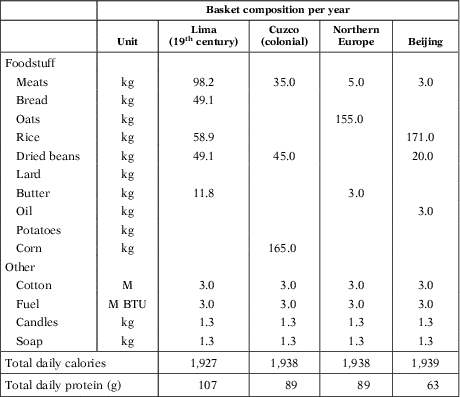
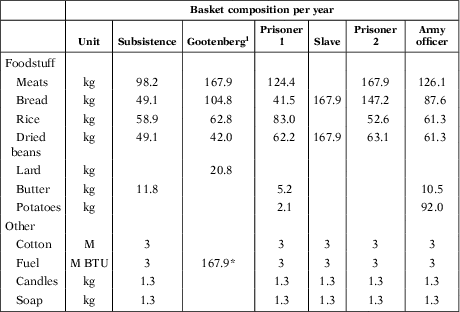
Table 4 shows the composition of this bare-bones basket in comparison with similar baskets for other locations in the world. For Lima, the basket considers a diet of 1,928 calories where beef and beans are the main protein sources. This caloric intake is similar to other subsistence baskets in other cities in history. Meats, bread, rice, beans and butter are the only food items considered.Footnote 17 From Moreno (Reference Moreno1897) it is possible to estimate the average consumption of meat based on the number of cattle slaughtered in the city of Lima: 98.2 kg of meat consumption per year.Footnote 18 The other goods included in the basket include miscellaneous items such as textiles for clothing, firewood and candles for heating/lighting, and soap. All these items constituted 95 per cent of the total budget, reserving the rest for housing costs and miscellaneous items. As the basket provides yearly quantities consumed of each product, it is possible to calculate its monetary cost in local currency. To estimate the cost of living of a family of two adults and two children, the individual «bare-bones» basket is multiplied by three.Footnote 19 The two minors are assumed to consume the equivalent of one adult's basket. This methodology allows for international welfare comparison when combined with data on wages.Footnote 20
SUBSISTENCE CONSUMPTION BASKET IN COMPARATIVE PERSPECTIVE

Notes: kg: kilogram, M: meter, M BTU: million BTU.
Sources: Lima (19th century): for food quantities, the estimations are based on Datos e Informes (1870), pp. 111-119, Moreno (Reference Moreno1897), pp. 171-174, Peloso (Reference Peloso1985), pp. 52-58 and Ruiz Zevallos (Reference Ruiz Zevallos2001), p. 41, the rest of goods are from Allen (Reference Allen2001) and Arroyo Abad et al. (Reference Arroyo Abad, Davies and Van Zanden2012); Cuzco (colonial): Arroyo Abad et al. (Reference Arroyo Abad, Davies and Van Zanden2012), Northern Europe and Beijing: Allen (Reference Allen2001) and Allen et al. (2011).
From all the sources it is clear that the limeños had a strong preference for meat. This is particularly striking when compared with the baskets for Beijing and Northern Europe. Except for slave diets until the 1850s, all the baskets cited in Datos e informes (1870) contain meat, in particular beef, as a sizable component of the everyday popular diet. Moreover, Lima had higher per-capita beef consumption than London (Datos e informes 1870, pp. 130-131, Peloso Reference Peloso1985, p. 50). According to Macera (Reference Macera1974), Lima overtook London in terms of beef consumption by the mid 19th century. In a periodical publication by the Lima Geographical Society, beef consumption figures prominently in a comparison with other major cities in 1897. According to this source, Lima's beef consumption per capita was 98.2 kg, followed by the United States and the United Kingdom with 54.5 and 47.7 kg, respectively (Sociedad Geográfica De Lima, 1897). It appears that 19th-century observers, to some extent, criticised the limeño taste for beef.
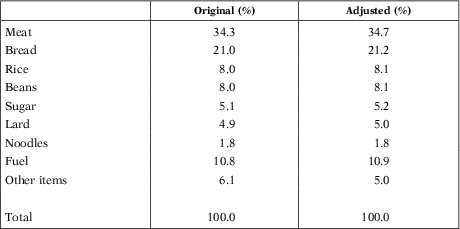
In addition to this «bare-bones» basket, I computed a «traditional» basket following Gootenberg's (Reference Gootenberg1990) estimations (see Table 5). Unlike the previous basket, this one states a relative share of consumption components. This basket includes a larger set of consumption items, in particular in terms of foodstuffs. The author used the artisan diet to build this basket and amended it based on the food budget of the Santa Ana hospital. Both sources are for the 19th century, the Santa Ana records correspond to 1837 while the artisan diet is for the year 1869. Given that the exact composition of the «Others» category is not explicit, I have recalculated the weights by reducing it to 5 per cent for miscellaneous items and housing. As a result the different components increase their share relative to the original budget as shown in the «Adjusted» column in Table 2. By looking at the weights, it is clear that the bulk of the budget was devoted to meat and bread, which accounted for almost 60 per cent of the total budget. Other foods such as rice, beans, sugar, lard and noodles represented <30 per cent of the consumption basket.
TRADITIONAL CONSUMPTION BASKET
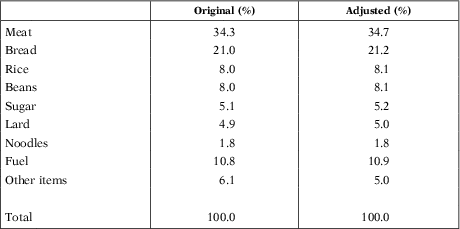
Source: Based on Gootenberg (Reference Gootenberg1990), p. 14.
In Figure 1, I present the three indices for easy comparison: Gootenberg's original index, the subsistence consumer index, and the recalculated original index (the traditional index). The three indices follow similar trends, not surprisingly the correlation coefficients between the two estimated series and Gootenberg's original index are high, 0.9 and 0.94, respectively. From these series, it is clear that the overall cost of living decreased in the mid 19th century to rise considerably until the 1880s. From the mid 1870s onwards, the data now available correspond to the series estimated in this paper. For the rest of the century, the cost of living in Lima fell slightly, remaining at significantly higher levels with respect to the mid-century values. In sum, deflation was prevalent after the wars of independence followed by a sharp generalised increase in prices from the 1850s and the century ended with moderate deflation. Overall, the price level more than doubled in this century. These results are robust to different 19th-century consumption baskets; the overall cyclical trend is reproduced when varying the sources of protein and carbohydrates.Footnote 21
COST OF LIVING, CONSUMER PRICE INDICES
Sources: For the subsistence and traditional indices, see text; Gootenberg's index: Gootenberg (Reference Gootenberg1990).
The downward trend until mid-century is driven mostly by the evolution of the prices of bread and butter. From this point onwards, inflation accelerated, especially in the 1855-1870 period. The increase in prices was such that the government appointed a commission to analyse the evolution of prices during this period (see Datos e informes 1870). This committee commented on the disparity between the actual consumption pattern observed and the potential nutritional substitutions available to the general public. The reality, according to this report, was that the popular class was making careless consumption decisions. Given the rise in the price of beef relative to the price of fish, consumption should have shifted towards the latter, especially taking nutritional content into account (Datos e informes 1870, pp. 100-105).Footnote 22 According to the medical knowledge of the time, the commission claimed that through cheaper choices, a «man could make a pound of beef with his own body» (Datos e informes 1870, p. 82). While no estimates are available for the War of the Pacific period, different sources indicate a dramatic increase in prices and generalised food scarcity (see, e.g. Peloso Reference Peloso1985). Towards the end of the century, prices stabilized albeit at a higher level relative to the preceding decades.
3.2 Wages
To evaluate living standards, it is necessary to look at the evolution of nominal wages in Lima during this period. The existing literature is scarce in this area, as different sources provide patchy data on wage levels. Following the existing literature on living standards by Allen et al., I use wage data for unskilled occupations. To be precise, these data are for occupations that require little to no skills such as watchmen, guards, doormen and servants. The sources of these data are similar to those used for prices. In particular, I have collected data from governmental branches such as the Department of Treasury, lower courts, the Department of State, and the Military Hospital.Footnote 23 In addition, I also consulted records of religious private institutions such as Santa Clara and Trinitarias. The data are from accounting records that list the occupations and the respective salaries. In many cases, these salaries are monthly. In the ecclesiastical records, a few of the records listed daily labourers.Footnote 24 To convert the series into annual earnings, I multiplied the monthly payment by a factor of 12 and in the case of a daily wage, the assumption was 250-280 days per year (Brown Reference Brown1990, Johnson 1990).Footnote 25 The series are, unfortunately, not continuous. I was only able to obtain data every five years with an important gap during the War of the Pacific.Footnote 26
Given the data limitations, it is key to confirm their validity.Footnote 27 Based on the labour force composition offered by Hunt (Reference Hunt1980), the data sources are representative of the Lima labour market: the government and the service sector employed almost 40 per cent of the labour force in 1876.Footnote 28 Unfortunately, data on wages for the 19th century are scarce; however, comparing with other available sources shows similar prevailing wage rates.Footnote 29 Ruiz Zevallos (Reference Ruiz Zevallos2001) reports an average salary of 1.5 soles per day for a peon at a manufacturing firm for 1900. Contreras (Reference Contreras2004) and Giesecke (Reference Giesecke1978) find that the unskilled wage rate was slightly less than one sol per day in 1866. In annual terms, the average of these data points is within a 10 per cent range in line with the nominal series presented here.
3.3 Welfare Ratio
With the nominal wages and the «bare-bones» basket for a family of four, it is feasible to estimate living standards by dividing the wage by the basket. This ratio is known in the literature as the «welfare ratio». A ratio of one implies that the income is just enough for a family to subsist. Consequently, an index higher than one suggests that the family could afford other goods beyond the subsistence basket.
Figure 2 shows the evolution of this ratio from 1820. The data exhibit an inverted-U pattern: there is an increase in welfare from 1820 until mid-century and a decline thereafter. The ratio increases from <1.5 in 1820 to reach a maximum of almost 2.5 ca. 1850. Towards the end of the century, the ratio stabilizes around 10 per cent above subsistence level. The lower welfare ratio from mid-century onwards is the compounded result of ever-increasing prices with a nominal salary that failed to catch up with the cost of living. In the 1860s, the dissatisfaction was palpable in the city where the workers often complained about constant price increases affecting staples in their diets (Datos e informes 1870; Peloso Reference Peloso1985).
WELFARE RATIO, 1820S-1900S
Source: see text.
4 COST OF LIVING AND LIVING STANDARDS IN HISTORICAL AND INTERNATIONAL PERSPECTIVES
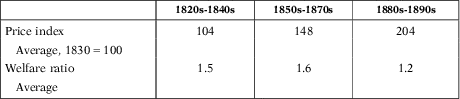
During the 19th century, the Peruvian economy, after the instability during the wars of independence, experienced a sustained growth spur thanks to the guano boom. In terms of living standards, the early years of independence saw an erosion of welfare as the welfare ratio was only 25 per cent higher than the subsistence level. Living standards improved in the following decades, driven largely by the continuous deflation experienced in this period.Footnote 30 The exploitation of guano had a profound impact on the economy, contributing to a sizable increase in Lima's cost of living (Giesecke Reference Giesecke1978; Gootenberg Reference Gootenberg1990, Reference Gootenberg1993; Ponce Vega Reference Ponce Vega1993). The city also acted as a magnet to people from other locales prompting migration and further fuelling demand (Klarén Reference Klarén2005). The city's population grew by almost 70 per cent between 1836 and 1857, slowing down during the rest of the century and reaching over 100,000 in 1876 (Fuentes Reference Fuentes1858; Dirección de Estadística 1878). Prices increased by more than 50 per cent in the 1850s and continued to rise in the following decade. The relentless rise of prices was a source of such concern that in 1870 a committee was appointed to investigate the causes of inflation. In this report, the committee concluded that prosperity was one of the main causes behind this phenomenon as manifested in population growth and the increase in the return to labour and land (Datos e informes 1870). Living standards improved significantly during the 1850s as the welfare ratio rose to 2.4 and then steadily declined in the following decades due to the rapid rise in prices (see Table 6).
PRICE INDEX AND WELFARE RATIO
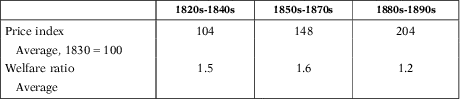
Source: see text. The price index corresponds to the subsistence basket.
The deterioration of living standards induced social discontent culminating in riots and uprisings in the city in 1858 and 1872. In the case of the latter episode, the roots of the popular discontent can be traced to expansionary monetary and fiscal policies together with a surge in imports, which translated into a rise in the cost of living. The prices of the main products in the popular consumption basket more than doubled in many cases (Giesecke Reference Giesecke1978; Gootenberg Reference Gootenberg1990; Klarén Reference Klarén2005). According to Giesecke (Reference Giesecke1978, p. 114), «the socio-economic situation of the poorest was very hard and generated a high degree of discontent […]. The social situation was, as a result, explosive».
The aftermath of the economic crisis and the war prompted a long period of deflation in the Peruvian economy. The cost of living fell substantially but remained higher than during the pre-guano era. This was good news in terms of living standards which gained (a little) ground compared with 1875. By the turn of the 20th-century Peru had survived a sizable commodity boom and a war. In GDP per capita terms, the average inhabitant was 70 per cent richer than in early independent times but from a living standard perspective, the unskilled labourer was worse off. Using the welfare ratio, the loss was around 10 per cent compared with 1825.
The rise and fall of living standards in 19th-century Peru show the disconnection between economic growth and living standards, especially during the guano boom. So far the literature shows an inverted U-shaped pattern for Peru during the 19th century: there was little growth in the two decades after independence, followed by rapid growth during the guano era.Footnote 31 The performance during the rest of the 19th century was marked by a sizable drop in economic growth before and after the War of the Pacific and a vigorous recovery in the 1890s. GDP per capita peaked in 1876 at $1,123 and 7 years later it was only $477 (Geary-Khamis dollars). Many authors have noticed this rollercoaster experience in Peruvian history, indicating the country's failure to launch into sustainable economic development and growth. While the GDP per capita trajectory is informative, GDP per capita per se is an imperfect indicator of economic welfare for many reasons; for example it only takes into account market activity and it is invariant with respect to quality of goods and services transacted. Most importantly for this discussion, GDP per capita provides no information about income distribution.Footnote 32
The rags-to-riches story had a different trajectory when looking at the welfare of the popular class with a maximum of 2.4 bare-bones baskets being reached in the mid 19th century followed by a decrease for the rest of the century. The difference between the evolution of living standards and economic growth suggests that the benefits of the guano boom were even more short-lived for the popular class. Contemporaries and scholars noted the unprecedented economic polarisation during the height of the guano boom, for example Wiener (Reference Wiener1880, p. 41) claimed that the Peruvian society was divided in two groups: «money and knowledge» at one end and «poverty and ignorance» at the other. The inflow of guano income widened the gap between rich and poor as inflation eroded real wages (Gootenberg Reference Gootenberg1989, Reference Gootenberg1993; Klarén Reference Klarén2005). Anthropometric evidence is consistent with these results. Twrdek and Manzel (Reference Twrdek and Manzel2010) found that the positive effects of the guano boom did not trickle down to the popular class.
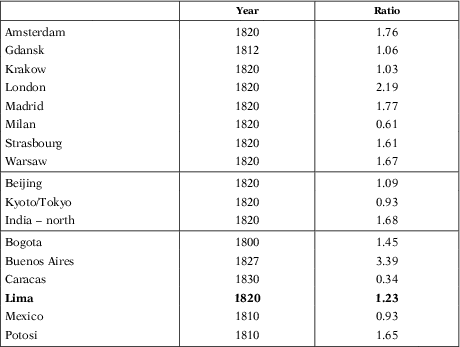
The use of Allen's (Reference Allen2001) methodology allows for international comparison. Thanks to the diligent work of many economic historians, it is possible to study comparable data for an array of cities during the 19th century.Footnote 33Table 7 offers living standard estimations ca. 1820s for seventeen cities, five of them in Latin America. Lima's welfare ratio is average for the region but lower than the European figures.
LIVING STANDARDS AROUND THE WORLD, CA. 1820S
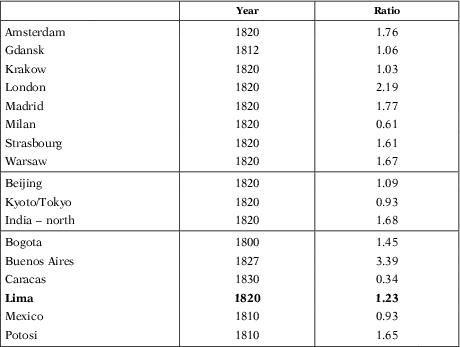
Sources: Buenos Aires, Bogota, and Mexico: Arroyo Abad et al. (Reference Arroyo Abad, Davies and Van Zanden2012); Caracas: Arroyo Abad (Reference Arroyo Abad2013), Europe: Allen (Reference Allen2001); India: Allen (2011); Beijing and Tokyo: Allen (2011).
Looking at living standards from a more dynamic perspective, it is clear that the guano boom put Lima on a higher level for a decade (see Figure 3). This impressive climb brought Lima's living standards up to levels similar to those enjoyed in London. Yet, a steep fall followed as the welfare ratio plummeted to almost subsistence level, ending the century with lower living standards than Caracas.
LIVING STANDARDS IN LIMA, CARACAS, BEIJING, LONDON, AND MADRID, 19TH CENTURY
Sources: Lima: see text; Caracas: Arroyo Abad (Reference Arroyo Abad2013), Beijing: Allen et al. (Reference Allen, Bassino, Moll-Murata and Van Zanden2011), Madrid and London: Allen (2001)
5 CONCLUDING REMARKS
Throughout the 19th century Peru faced the challenges associated with the transition from a colonial system. After the struggle of the first independent decades, a new prosperous era followed where a single export commodity, the powerful fertilizer guano, fuelled the economy and flooded the public coffers. In the early 1870s the conjunction of dwindling reserves, new artificial fertilizers, and a war with a neighbouring nation brought an end to this era of affluence. Overall, this century was an economic growth rollercoaster in which, as many scholars have pointed out, the opportunity for sustainable growth was squandered.
This paper has looked into how the cost of living and the living standards of Lima, Peru mapped to the overall economic swings experienced during the 19th century. Using an array of archival sources, I estimate two price indices, a «bare-bones» basket following Allen's (Reference Allen2001) methodology and a more comprehensive one comparable to Gootenberg's (Reference Gootenberg1990) budget. These new data series show a deflationary period following the wars of independence, followed by a sharp increase in prices during the guano boom. After a drop following the War of the Pacific, Peru's price level stabilized towards the end of the century. Living standards improved around mid-century; however, the inflationary process eroded these gains by the 1870s.
As GDP per capita continued climbing until the early 1870s, these results suggest that the gains from the guano boom were skewed towards the elite, especially after the 1850s. The popular classes did not fully benefit from the economic growth spurt. As scholars indicate the exhaustion of the guano model by the early 1870s, this new research shows that the most profitable enterprise in Peru failed to lift the popular class from subsistence consumption level for long, even with an earlier inflection point. These findings are in line with the studies which highlight the weaker institutional base in this country. The advent of the guano bonanza as the main source of revenue and income for Peru at such an early stage of its nationhood buried the need to build a more diversified economic structure and search for different sources of government revenue.
APPENDIX A: CONVERSIONS TO THE METRIC SYSTEM
Most of the prices were quoted in non-metric units. Following Descola (Reference Descola1962), Gootenberg (Reference Gootenberg1990) and Langer and Hames (Reference Langer and Hames1994), the conversions used are as follows:
1 arroba = 25 lbs = 11.36 kg
1 quintal = 4 arrobas = 45.44 kg
1 fanega of maize or wheat = 61.36 kg
1 fanega of beans = 70.90 kg
1 saco of flour or chickpeas = 90.90 kg
1 saco of maize = 70 kg
1 carga = 45.44 kg
1 lb = 0.45 kg
1 cántara = 8 azumbres = 2.5 gallons
1 vara = 3 feet = 0.91 m
APPENDIX B: ROBUSTNESS CHECKS
The construction of historical cost of living indices is challenging as it requires reliable knowledge of the typical consumer basket for a given city for a given period of time. Fortunately, for 19th-century Peru there are many sources that document the consumption patterns, in particular for Lima. Even though the cost of living in this article is based on a specific basket by Peloso (Reference Peloso1985), I believe it is important to run robustness checks in the form of alternative baskets. This exercise will allow us to ascertain the reliability of the basket chosen in terms of general patterns of cost of living. Note that the consumption baskets used are, mostly, representative of the consumption patterns of the popular class.
To be specific, the baskets chosen correspond to a low-income individual as presented by Gootenberg (Reference Gootenberg1990), a prisoner as reported by Lima City Hall (Consejo Provincial de Lima 1889), and three consumption baskets from the report on inflation in Lima in 1870 corresponding to a prisoner, a slave, and an army officer (Datos e informes 1870). These estimates are compared with the indices estimated in this article, that is the subsistence and the traditional indices. Table B1 shows the composition of each basket starting with the subsistence basket introduced in this article. With the exception of the slave basket, all the other baskets have a much higher consumption of meat, up to 167.9 kg per year. This figure appears to be too high as the per capita consumption of meat was around 98 kg, which coincides with the figure used in the subsistence basket based on Peloso (Reference Peloso1985). Looking at the total calories per basket, it is clear that all these baskets are well above the subsistence threshold. For example, Gootenberg's (Reference Gootenberg1990) basket adds at least 3,000 calories, well above the «respectable» basket devised by Allen (Reference Allen2001).
SELECTED CONSUMPTION BASKETS
The differences between these baskets provide the opportunity to evaluate the overall price level trends. Figure B1 displays the evolution of these cost of living indices over time with base 1830 = 100.Footnote 34 At first glance the trends are similar with a deflationary phase until the 1850s and an inflationary period until the 1870s. This fact is corroborated with the corresponding correlation coefficients, ranging from 0.74 to 0.99. The cost of living of army officers appears as the most dissimilar of the sample as the series overshoots before the War of the Pacific. This movement is fully explained by the sharp increase in the price of potatoes due to a widespread disease affecting this crop during the late 1860s and early 1870s.
COST OF LIVING INDICES, 1830 = 100
Sources: see Table B1.
APPENDIX C: DATA SERIES