INTRODUCTION
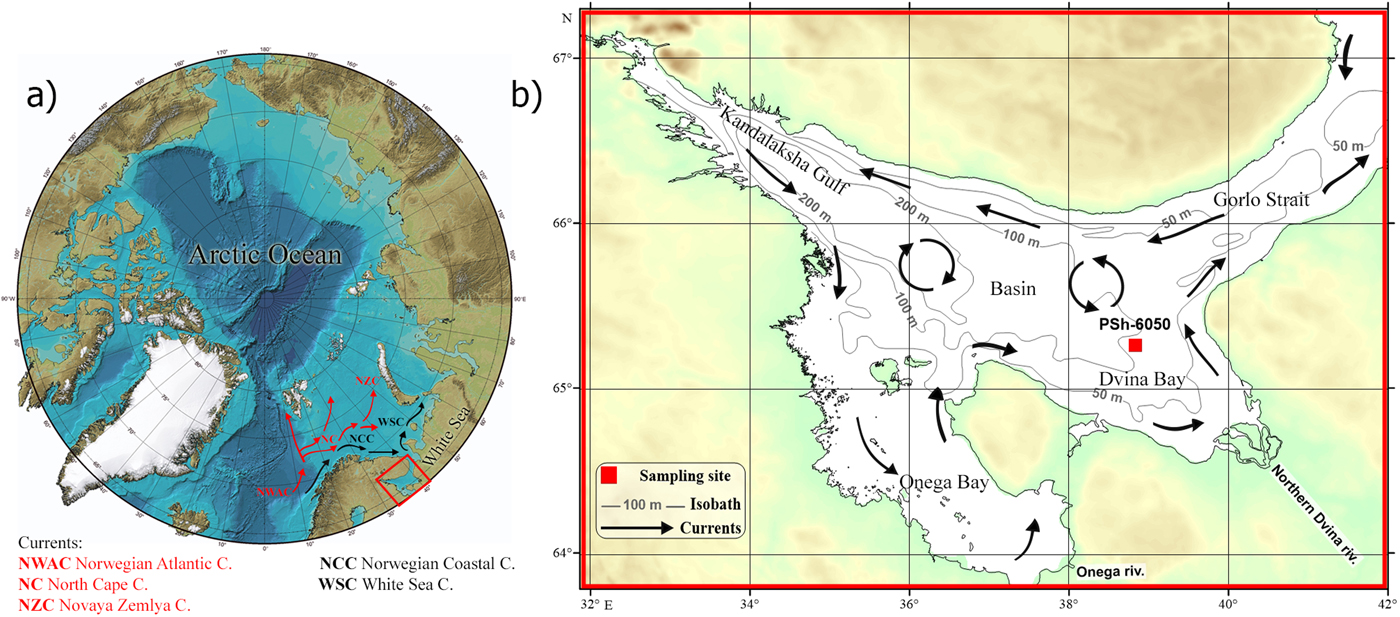
The White Sea (northwestern Russia) is a marginal sea on the edge of the Arctic Ocean. Being covered with ice more than 6 months per year, it is one of the sources of cold water and sea ice to the Barents Sea through the Gorlo Strait, while the warm Atlantic waters through the Barents Sea enter the Arctic Ocean (Fig. 1). The White Sea, connected with the Barents Sea, has an influence on its water temperature-salinity structures and biological processes and thus has an indirect impact on the Eurasian climate system. The freshwater balance of the Arctic Ocean is an important factor controlling sea-ice extent and intermediate/bottom water formation in the Northern Hemisphere, as well as Arctic Ocean surface water conditions (Stein et al., Reference Stein, Boucsein, Fahl, Garcia de Oteyza, Knies and Niessen2001). The Eurasian arctic seas’ contribution in the salinity stratification is crucial to the vertical circulation of the high-latitude ocean. Among these rivers, the Severnaya Dvina River runoff provides a relatively big contribution (110 km3/yr), the fifth place after the Yenisey River (630 km3/yr) of freshwater supply to the Arctic Ocean (Aagaard and Carmack, Reference Aagard and Carmack1989; Gordeev et al, Reference Gordeev, Martin, Sidorov and Sidorova1996). Even a small variation in the fresh water supplied to the convective gyres from the Arctic Ocean via the East Greenland Current can alter or stop the convection in what may be a modern analog to the halocline catastrophes proposed for the distant past (Aagaard and Carmack, Reference Aagard and Carmack1989). That is why it is important to investigate such a small Arctic basin like the White Sea.
(color online) (a) Location of the White Sea in the Arctic Ocean (bathymetric map of IBCAO [International Bathymetric Chart of the Arctic Ocean]; Jakobsson et al., Reference Jakobsson, Mayer, Coakley, Dowdeswell, Forbes, Fridman and Hodnesdal2012) with the circulation scheme of Atlantic water masses inflowing to the Barents Sea region (after Laukert et al., Reference Laukert, Makhotin, Petrova, Frank, Hathorne, Bauch, Boning and Kassens2019). (b) The White Sea region with location of the sampling site and the circulation scheme of the upper layers (after Main Service of Geodesy and Cartography at the Council of Ministers of the USSR, 1971).

The White Sea basin history began about 14,000 cal yr BP after the onset of the terrain deglaciation. The change of the sedimentation regime occurred at about 11,000 cal yr BP. As a result of the penetration of seawater through the Gorlo Strait, glacial-marine basins appeared in the White Sea basin. In the boreal time of the Holocene (about 9000 cal yr BP), the marine regime was finally established entirely in the White Sea.
To extract paleoceanographic information, such natural archives as sediment cores are commonly used where parameters of paleoenvironment (proxies) are recorded. Among them there are the physical (e.g., mostly grain size), biological (e.g., microfossils speciation and abundance), various organic, and inorganic geochemical proxies (Chase et al., Reference Chase, Ellword and Van de Flierdt2018).
Over the past decade, new data on the modern sedimentation processes and the geologic history of the White Sea have been obtained in the framework of the long-term multidisciplinary project “The White Sea System” (Lisitsyn and Demina, Reference Lisitsyn and Demina2018). The new study of the White Sea paleoenvironment by biogeochemical methods was based on the accelerator mass-spectrometry (AMS) 14C dating and complex microfossil analysis of diatoms and aquatic palynomorphs (Polyakova et al., Reference Polyakova, Dzhinoridze, Novichkova and Golovnina2003, Reference Polyakova, Novichkova, Lisitzin, Bauch and Rybalko2014; Novichkova and Polyakova, Reference Novichkova and Polyakova2007, Reference Novichkova and Polyakova2013; Novichkova et al., Reference Novichkova, Reikhard, Lisitzin, Rybalko and Vernal2017). Various biogeochemical processes that took place at the initial stage of sedimentation of the White Sea, including mobilizing of the trace elements in the water column and the processes of early diagenesis, have been also considered (Budko et al., Reference Budko, Demina, Lisitzin, Kravchishina and Politova2017; Demina et al., Reference Demina, Budko, Alekseeva, Novigatsky, Filippov and Kochenkova2017, Reference Demina, Bud'ko, Alekseeva, Novigatsky, Filippov, Kochenkova, Lisitsyn and Demina2018a, Reference Demina, Budko, Lisitzin and Novigatskyb). The data on organic carbon (Corg) and biogenic silica (BSi) are widely used as geochemical indicators of paleoproductivity when studying the oceanic paleoenvironment of a low-carbonate marine basin (Regueneau et al., Reference Regueneau, Leynaert, Treguer, DeMaster and Anderson1996, Reference Regueneau, Gallinari, Corrin, Grandel, Hall, Hauvespre and Lampitt2001; Kim et al., Reference Kim, Takashashi, Khim, Kanematsu, Asahi and Ravelo2014). Therefore, future researches of the sedimentation dynamics in the White Sea over the last 10,000 cal yr BP need to be supplemented with new geochemical data, which will make it possible to clarify the parameters of the paleoenvironment in the White Sea during the Holocene.
The chemical speciation of elements reflects the quantitative impact of various biogeochemical processes on the accumulation and transformation of the particular element in bottom sediments; this contributes to a deeper understanding of the peculiarities of sedimentation in marine environment. When studying the migration of chemical elements, it is important to distinguish two basically different forms of their occurrence: (1) the geochemically mobile forms that provide the processes of exchange and mobilization and (2) the geochemically inert (lithogenic) forms that carry the metals within the crystal lattices of clastic and clay minerals. The proportion of chemical elements’ speciation is controlled by such environmental parameters as organic carbon content, redox potential, grain-size and mineral composition, and sediment moisture. Over the past 20 yr, an interest in studying chemical element speciation in marine ecosystems has arisen because of the ecotoxicological effects of heavy metals and their bioavailability for living organisms (Kot and Namiesnik, Reference Kot and Namiesnik2000; Nemati et al., Reference Nemati, Abu Bakar, Abas and Sobhanzadeh2011; Grotti et al., Reference Grotti, Soggia, Ianni, Magi and Udisti2013; Fernandes and Nayak, Reference Fernandes and Nayak2015). On the other hand, the geochemical cycles of heavy metals in the modern sedimentary processes are of importance in regard to chemical element speciation (Poulton and Raiswell, Reference Poulton and Raiswell2002; Demina et al., Reference Demina, Levitan and Politova2006, Reference Demina, Budko, Alekseeva, Novigatsky, Filippov and Kochenkova2017, Reference Demina, Bud'ko, Alekseeva, Novigatsky, Filippov, Kochenkova, Lisitsyn and Demina2018a; Raiswell and Сanfield, Reference Raiswell and Canfield2012; Koukina and Vetrov, Reference Koukina and Vetrov2013; Mamindy-Pajany et al., Reference Mamindy-Pajany, Hurel, Geret, Galgani, Bataglia-Brunet, Marmier and Romeo2013), while the data on sediment cores are severely limited.
A novelty of our approach lies in combination of well-known biological (microfossil abundance and species identification: dinocysts, diatoms, and green algae) proxies with the biogeochemical parameters of the sediment core such as content of biogenic SiO2, chlorin, organic matter transformation (pyrolytic data), and major and trace elements, including their ratios and speciation. We aim to test the application of such a combination to determine the peculiarities of sedimentation in the White Sea during the Holocene.
MATERIALS AND METHODS
Study area and fieldwork approach
The eastern flank of the Late Weichselian Scandinavian Ice Sheet (SIS) reached its maximal position in northwest Russia sometime between 20,000 and 15,000 cal yr BP; in the Arkhangelsk region, this probably occurred around 18,000–16,000 cal yr BP. This position was reached up to 10,000 cal yr BP after the maximum extent in the southwestern part of the SIS (Demidov et al., Reference Demidov, Houmark-Nielsen, Kjaer and Larsen2006). During the period of 13,000–11,500 cal yr BP (Allerød–Younger Dryas), a brackish cold-water marine basin existed in the area of Anzer reach of the Onega Bay. Sedimentation in this basin took place in the immediate vicinity of the ice sheet margin, as was evidenced by the paleoreconstructions made in 1960s–1970s (Govberg, Reference Govberg1970; Dzhinoridze, Reference Dzhinoridze1971; Malyasova, Reference Malyasova1976; Nevessky et al., Reference Nevessky, Medvedev and Kalinenko1977; Dzhinoridze et al., Reference Dzhinoridze, Kirienko, Kalugin, Rybalko, Spiridonov, Spiridonova and Gershanovich1979) and according to the data on the Kola Peninsula (Kolka et al., Reference Kolka, Korsakova, Shelekhova, Lavrova and Arslanov2013). At that time, the transformed waters from the Barents Sea were already supplied to outer Onega Bay. The Preboreal period (11,500–10,000 cal yr BP) was characterized by a rapid change in hydrologic conditions and sedimentation settings in the White Sea. The cardinal transformation when water salinity and productivity increased happened at about 10,500 cal yr BP, as was evidenced by the malacofaunal data (Govberg, Reference Govberg1970). In the Boreal period (9000–10,000 cal yr BP), the supply of waters from the Barents Sea into the White Sea abruptly increased, probably causing intensification of hydrodynamics in the waters. In both Onega and Dvina bays, the concentrations of marine microalgae at that time reached the peak values, and multiple various indicating species of Atlantic waters appeared in the associations of the Arctic seas (Dzhinoridze, Reference Dzhinoridze1971; Polyakova et al., Reference Polyakova, Novichkova, Lisitzin, Bauch and Rybalko2014).
The sediment core PSh-6050 (335 cm length) was taken with a large-diameter gravity corer during cruise 80 of R/V Professor Shtockman in August 2006, in the deep-sea part of the Dvina Bay of the White Sea (65°15.44′N, 38°49.17′E; 101 m depth) (Fig. 1). The lithologic description and primary processing of the bottom sediment core were carried out onboard the ship. The bottom sediments were collected at intervals of 1 cm and packed in precleaned sealed plastic containers for further laboratory analysis.
Analytical methods
Three radiocarbon dates were obtained on bivalves and brachiopods using AMS 14C (Polyakova et al., Reference Polyakova, Novichkova, Lisitzin, Bauch and Rybalko2014) in the Leibniz Laboratory for Radiometric Dating and Stable Isotope Research (Kiel University, Germany). The radiocarbon age was transformed into the calendar age by CALIB 7.0.0 software (Stuiver and Reimer, Reference Stuiver and Reimer1993).
Analytical treatment of the sedimentary core has been determined by various methods in the Shirshov Institute of Oceanology, Russian Academy of Sciences. The core was studied with the resolution of 10 cm depending on the lithologic and stratigraphic description. The grain-size composition was analyzed for the wet sampling by the method of water-mechanical analysis (Petelin, Reference Petelin1967). The coulometric method was applied to determine the organic carbon content (Сorg) and carbonate C in the dried samples by use of Express Analyzer AN-7529M (OAO GZIP, Gomel, Belarus) with the accuracy of ± 0.1%. Biogenic silica content (BSi) was determined by a wet alkaline extraction method (5% Na2CO3 solution) with colorimetric measurement (Gorbarenko et al., Reference Gorbarenko, Derkachev and Astakhov2000). The quantitative analysis of major elements, Stot and Ba, was performed by X-ray fluorescence (XRF) spectrometry on a Spectroscan MAKS-GVM (NPO Spectron, St. Petersburg, Russia). The relative accuracy of XRF measurements was controlled by the certified reference material SDO-1 (terrigenous oceanic clay). The difference between the certificated and measured values ranged from 0% to 8%.
Sequential extraction procedure
The analysis of physico-chemical speciations of Al, Fe, Mn, Cu, Cr, Co, Ni, Cd, and As was performed from dry samples (500 mg each). Sequential extraction procedure was applied to separate elements having a different geochemical lability (Ure et al., Reference Ure, Quevauviller, Muntau and Griepink1993). The following forms were leached from the bottom sediment samples: form 1, an exchangeable complex that consists of elements adsorbed mainly onto clays and associated with carbonates (the desorbing solution was acetate buffer [25% CН3COOH + 1М CН3COONa]; Luoma and Bryan, Reference Luoma and Bryan1981); form 2, authigenic Fe-Mn oxyhydroxides and related trace elements (the reduction reagent was 2М NH2OH·HCl + 25% CН3COOH; Chester and Hughes, Reference Сhester and Hughes1967); form 3, metals bound with organic matter and sulfides (the oxidation reagent was 30% H2O2 + 0.1M HNO3; Kitano and Fujiyoshi, Reference Kitano and Fujiyoshi1980); and form 4, residual or lithogenic (complete acid decomposition with the mixture of concentrated HCl + HNO3 + HF). The first three forms allow estimating the contribution of geochemically labile metals, whereas the fourth one is a geochemically inert lithogenic form containing metals in crystal lattices of clastic and clay minerals. The effectiveness of the applied sequential extraction procedure was repeatedly tested by the European Community Bureau of Reference (Quevauviller et al., Reference Quevauviller, Ure, Muntau and Griepink1993; Pueyo et al., Reference Pueyo, Rauret and Luck2001; Sutherland and Tack, Reference Sutherland and Tack2003).
Determination of the concentration of chemical elements in the leaching solutions was carried out using an Agilent 7500a ICP-MS (Inductively Coupled Plasma-Mass Spectrometer; Agilent Technologies Inc., California, USA). The relative accuracy of trace element measurements was controlled by the certified reference materials GSD-2 and GSD-6 (estuarian bottom sediments). The difference between the certificated and measured values ranged from 1% to 20%.
Analysis of organic components
Sediment samples for the purposes of diatom and aquatic palynomorph analysis were initially freeze-dried. For the diatom analysis, approximately 2–3 g of each dried samples was treated with H2O2 (30%) and HCl (10%). Diatom valves were then concentrated by decantation using distilled water. Slide preparation was carried out following Battarbee (Reference Battarbee1973). The residues were mounted on glass slides with the medium Naphrax, which has a refraction index of 1.68. The diatom valves were examined under light microscope (Axioscope 40) at 1000× magnification. Generally, about 300–400 specimens of valves were counted in each sample. The results were then calculated to census data and number of valves per gram of dry sediment (concentration).
Sediment samples for aquatic palynomorph (dinoflagellate cysts and freshwater green algae) analysis were prepared using standard palynological preparation methods. This method includes the use of cold hydrochloric (HCl) and hydrofluoric (HF) acids to dissolve carbonates and silicates. The wet sediment was sieved after each chemical treatment through a 6 µm sieve to eliminate fine silt and clay particles. A minimum of 100 dinoflagellate cysts was identified and counted under a Zeiss light microscope at a magnification of 400× and 1000×. Concentrations of palynomorphs (individuals per gram) were calculated according to the marker grain method of Stockmarr (Reference Stockmarr1971). For each sample, one or two tablets with 12,542 ± 2081 Lycopodium spores were added. The relative abundance of dinoflagellate cysts was calculated based on the sum of all cysts counted.
For the paleoenvironmental reconstructions, we used established regularity of diatom and aquatic palynomorph assemblages formation in the surface sediments of the White Sea (Polyakova et al., Reference Polyakova, Dzhinoridze, Novichkova and Golovnina2003, Reference Polyakova, Novichkova, Lisitzin, Bauch and Rybalko2014; Novichkova and Polyakova, Reference Novichkova and Polyakova2007, Reference Novichkova and Polyakova2013; Polyakova and Novichkova, Reference Polyakova, Novichkova, Barcelo and Kostianoy2018). Diatom species were grouped into two main ecological groups according to their ecological preferences: marine and brackish-water marine diatoms and freshwater diatoms. The latter enter the shelves with riverine outflow, and the bulk of them are deposited within the coagulation-sorption stage of the marginal filter of rivers (Lisitzin, Reference Lisitsyn1994; Polyakova et al., Reference Polyakova, Dzhinoridze, Novichkova and Golovnina2003). Freshwater diatoms, which dominate the river plankton (Aulacoseira, Asterionella, Cyclotella genera, etc.) along with freshwater green algae, are reliable indicators of distribution on the shelves of river waters. The group of marine diatoms is dominated by planktonic and meroplanktonic species (Thalassiosira, Coscinodiscus genera, Paralia sulcata, etc.), taxonomically diverse benthic species. To characterize the seasonal sea-ice cover, we marked out a specific group of sea-ice diatoms (Fossula arctica, Nitzschia frigida, Fragilariopsis oceanica, F. cylindrus, Navicula vanhoeffenii, Melosira arctica, Pseudogomorphonema arcticum, P. groenlandicum, Attheya septentrionalis, and Pauliella taeniata), part of the life cycle of which is associated with sea ice.
Chlorophyll degradation product (chlorin), widely represented in Quaternary bottom sediments, can be used as paleoproductivity indicator (Harris et al., Reference Harris, Zhao, Rosell-Melé, Tiedemann, Sarnthein and Maxwell1996). To reconstruct the productivity of the Dvina Bay, subsamples (about 0.5–1 g) of homogeneous sediment were selected for chlorin content tests. Chlorin concentration was determined by the fluorometric method (extraction in 90% acetone at T = 2°C) with a preconfigured Trilogy laboratory fluorometer version 1.1 (Turner Designs, USA) using the method (Arar and Collins, Reference Arar and Collins1997) adapted for bottom sediments. The accuracy of the determination was ± 0.02 mg/m3.
The transformation of organic matter (OM) in the core PSh-6050 was studied by the pyrolysis in the ‘Rock Eval (RE)’ variant (Melenevskii et al., Reference Melenevskii, Leonova and Konyshev2011). Data on the pyrolytic analysis provide information on the OM composition during diagenesis. Such data on the organic-rich lake sediment cores from western Siberia showed an increase in the thermal stability of particular organic matter components in the series: lipids → proteins → carbohydrates → lignin (or kerogen) (Melenevskii et al., Reference Melenevskii, Leonova and Konyshev2011). Thus, the final stage of diagenesis is characterized by the absolute predominance of kerogen in the OM composition. The data on organic carbon isotope composition (δ13С-Сorg) were taken from (Lein et al., Reference Lein, Novichkova, Rybalko and Ivanov2013).
RESULTS
Sediment stratigraphy and lithologic composition
The general structure of the sedimentary cover within the Dvina Bay is identified on the basis of seismoacoustic profiling. Geophysical data made it possible to characterize its three-member structure: glacial, glacial-marine, and marine facies. The late Holocene marine sediments are underlain by early Holocene (Preboreal) and late Pleistocene fine-grained sediments (Rybalko et al., Reference Rybalko, Zhuravlyov, Semyonova, Tokarev, Lisitsyn and Demina2018).
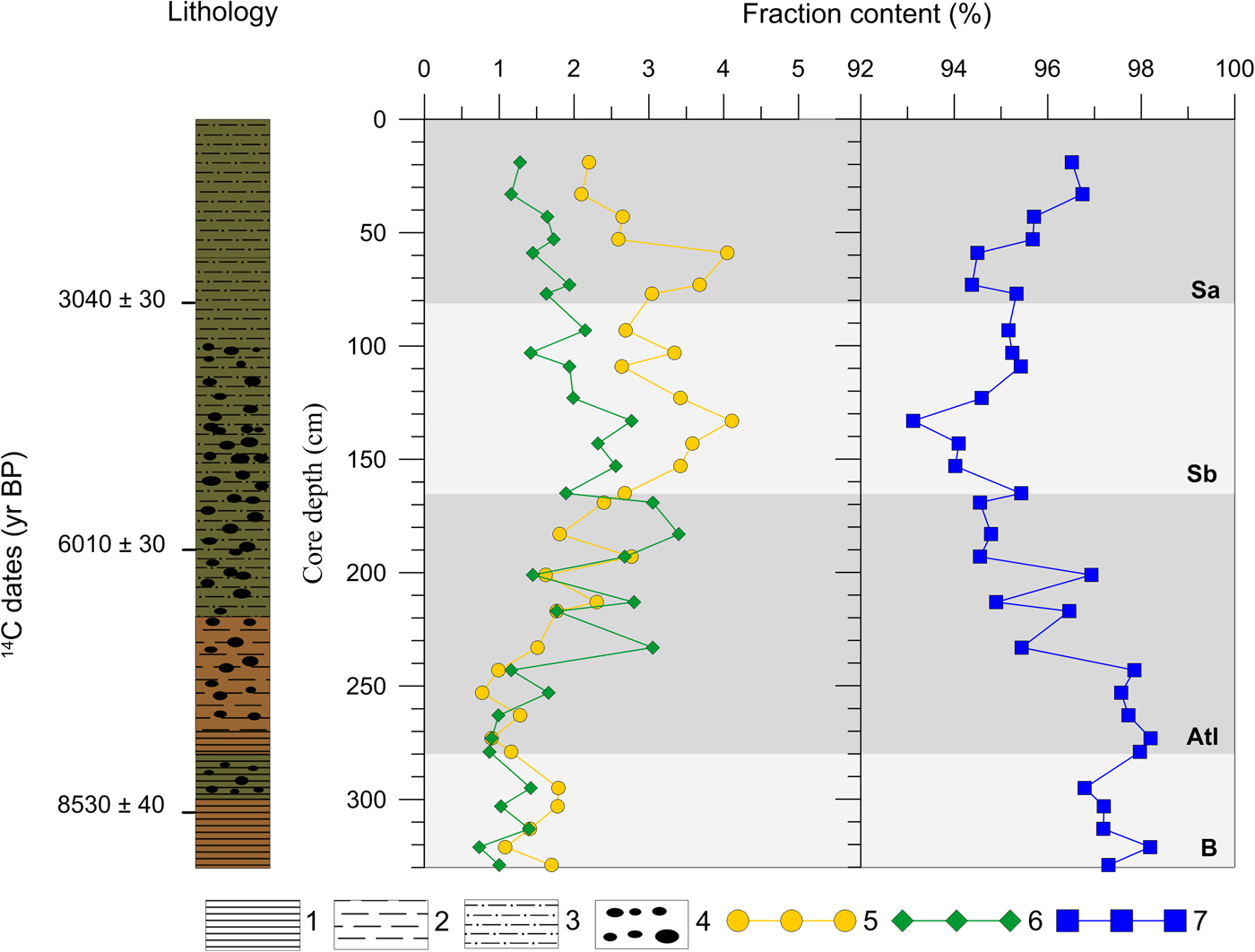
The grain-size composition of the core PSh-6050 is sufficiently homogeneous. The pelite fraction (0.001–0.01 mm) amounts more than 93% throughout the core (Fig. 2). A complex of litho- and biofacial features and AMS 14C dating indicates one major layer at core PSh-6050 that was formed under marine paleogeographic conditions. The lowest part of the core (280–330 cm) is represented by the brown-gray pelite of 9100–10,000 cal yr BP which corresponds to the end of the Preboreal-Boreal periods of the Holocene. The share of the pelite fraction (0.001–0.01 mm) reaches the maximum (98%) here for the whole core, and the sandy fraction (0.1–1.0 mm) content varies within 1–2%. The sediment texture is thin layered. Within the interval of 280–300 cm, rare patches of hydrotroilite are noted, and the color of the sediment changes to olive-gray tones.
(color online) Lithology, grain-size composition, and 14C dates (Polyakova et al., Reference Polyakova, Novichkova, Lisitzin, Bauch and Rybalko2014) of the White Sea's sediment core PSh-6050. (1) Pelite; (2) aleuropelite; (3) clayey aleurite; (4) hydrotroillite; (5) sand (%); (6) silt (%); and (7) clay (%). Colored fill indicates the stage of Holocene: Atl, Atlantic period; B, Boreal period; Pb, Preboreal period; Sa, Subatlantic period; Sb, Subboreal period.

The layer above the pelite (165–280 cm) is represented by mostly aleuropelites and clayey aleurites and associated with the Atlantic period (5800–9000 cal yr BP). These marine sediments are represented mostly by the pelite fraction (94–98%). The silty fraction (0.01–0.1 mm) is up to 2.5–3.0%, and the color of the sediment becomes variegated (olive gray with brown tints) because of hydrotroilite represented as lens-shaped inclusions up to 1.5 mm in diameter. The upper layer of sediments (0–165 cm) was also formed under the fully marine conditions and can be subdivided to the Subboreal (5800–2600 cal yr BP) and Subatlantic (0–2600 cal yr BP) periods of Holocene. An increased content of the sandy fraction (up to 4.0%) is a distinctive feature of the sediments of the Subboreal period. The upper 80 cm layer of the core related to the warm Subatlantic period is presented by clayey aleurites with finely dispersed organic matter particles.
Microfossil data and biogenic components
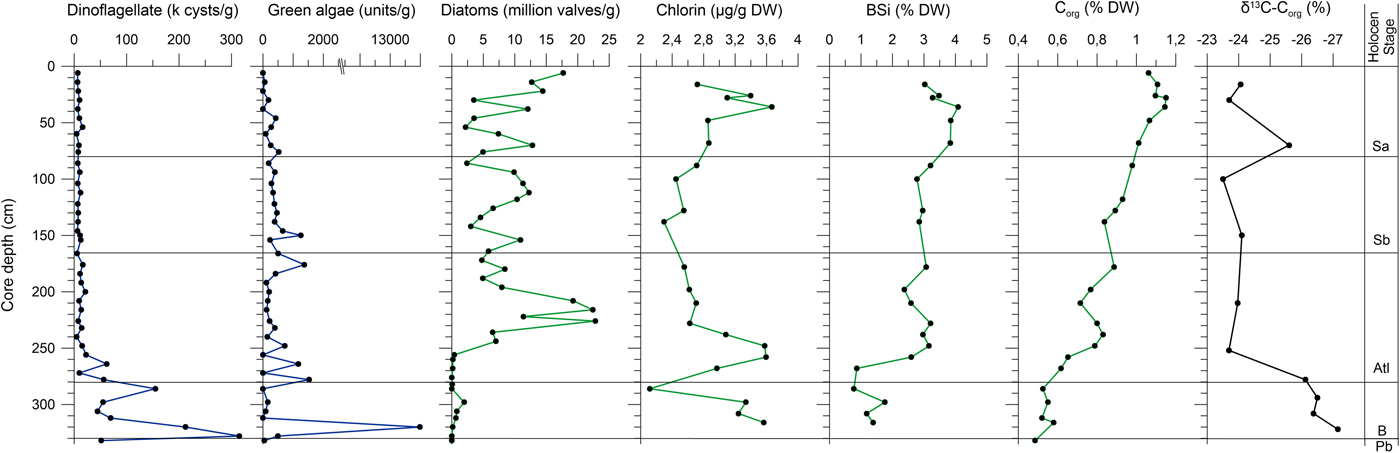
According to Figure 3, the lowest Corg (0.6%) and BSi (1.2–1.4%) content is observed at the lower part of the core (280–325 cm). Diatoms are represented here mostly by the cold-water marine planktonic arctic-boreal and bipolar species (genera Chaetoceros, Thalassiosira, and Coscinodiscus), and the sea-ice diatoms with minor total abundance ranged from 0.07 to 1.95 million valves/g of dry sediment. At the same time, this section of the core is characterized by the maximal concentrations of dinocysts (up to 212,000 cysts/g). The autotrophic cosmopolitan dynocyst Operculodinium centrocarpum (particularly, its Arctic subspecies) dominates. Although relatively “warm-water” species of dinocysts (Pentapharsodinium dalei and Spiniferites ramosus) and diatoms (Coscinodiscus radiatus, Тhalassiosira oestrupii, and some others) are numerous, indicating the inflow of transformed Atlantic waters into the White Sea during the Boreal period of about 9000–10,000 cal yr BP (Polyakova et al., Reference Polyakova, Novichkova, Lisitzin, Bauch and Rybalko2014). These sediments are also characterized by the highest concentrations of freshwater green algae (up to 14,000 units/g) and freshwater diatoms, the latter being dominated by the typical riverine planktonic species (Aulacoseira italica, A. subarctica, and A. granulata), which is reflected in the high content of chlorin (3.6 µg/g), an indicator of the total marine paleoproductivity. The relative abundance of freshwater diatoms in diatom associations reaches 12%, which, according to our data, is currently characteristic for assemblages from surface sediments of the middle part of the Dvina Bay (Novichkova and Polyakova, Reference Novichkova and Polyakova2013; Polyakova and Novichkova, Reference Polyakova, Novichkova, Barcelo and Kostianoy2018). Upward of the core section, freshwater diatoms in sediments are sharply reduced and do not exceed 1–2% in sediment assemblages referred to the Atlantic and Subboreal periods.
(color online) Distribution of microfossils (dinoflagellate, k cysts/g; freshwater green algae, units/g; and diatom algae, million valves/g), biogenic components (BSi, % dry weight [DW]; total Corg, % DW; δ13С-Соrg, % DW), and chlorin, μg/g DW in sediment core PSh-6050. Atl, Atlantic period; B, Boreal period; Pb, Preboreal period; Sa, Subatlantic period; Sb, Subboreal period.

The sediments of the 165–280 cm layer are characterized by increased content of Corg (from 0.4% to 0.9%) and BSi (up to 3.5%). This is clearly because of the highest diatom concentrations (up to 22.4 million valves/g), mainly of marine planktonic species (Thalassionema nitzschioides, and species of the Chaetoceros and Thalassiosira genera). The total relative abundances of diatom species of the Atlantic origin in diatom assemblages increase here up to 20%, and dinocysts in assemblages increase up to 70%. High content of chlorin (up to 3.6 µg/g) also corresponds to increased content of biogenic components in these sediments referring to the period of about 6000–7500 cal yr BP (mid-Holocene climatic optimum).
The sediments of the 80–165 cm layer correspond to a low content of Corg, which slightly varies from 0.8% to 1.0%, whereas the BSi content decreases to 2.5% as compared with the value of the mid-Holocene climatic optimum. Diatom concentrations, varying almost synchronously with the BSi content in the core, do not exceed 12.8 million valves/g, and the sublittoral meroplankton species (Paralia sulcata and Тhalassiosira hyperborea) dominate (up to 85.8%). Despite the fact that proportion of “warm-water” species of diatoms and dinocysts in the microalgae associations remains relatively high (10–20%), the abundance of sea-ice diatoms (up to 10.2%) and cold-water heterotrophic species of dinocysts (Selenopemphis quanta and Brigantedinium spp.) increases, which indicates a decrease in the surface water temperature. The relatively low chlorin content in the sediments of the Subboreal period (about 2.5 µg/g) also evidences a decrease in the total primary production.
In the upper 80 cm layer of the core, the elevation of biogenic components is observed. The maximum content of Corg (1.15%), BSi (4.09%), and chlorin (3.7 µg/g dry weight) in the PSh-6050 core is observed at the 36 cm layer, which refers to the Medieval Climatic Optimum of the Holocene (650–1050 cal yr BP) (Novichkova and Polyakova, Reference Novichkova and Polyakova2007). The increase in diatom concentrations up to 17.7 million valves/g was likely because of marine planktonic species belonging to the Chaetoceros, Coscinodiscus, and Thalassiosira genera; the numbers of the “warm-water” species of cysts of marine dinoflagellates, further on, dinocysts, in the same layer are consistent with this pattern. Total relative abundances of freshwater diatoms in assemblages from this core interval increased up to 4–6%.
The temperature curves (pyrograms) of hydrocarbon (HC) release from the marine sediments of the PSh-6050 core in the White Sea are presented as a single unstructured peak with a temperature of the maximum HC release rate in the range of 400–450°C (Fig. 4). These data indicate an absence (or at least insignificant content) of the lipid component in our samples. The high proportion of HCs released at temperatures above 400°C is probably because of the presence of the high molecular structure of fossilized organic matter (kerogen). However, to confirm this assumption, additional studies are necessary, including the pyrolysis of the organic matter's producers. The hydrogen index (the sum of HCs normalized to Corg) shows that its low values (100–250 mg HCs/g Corg) correspond to terrigenous OM. This confirms data on the predominantly terrigenous nature of OM in the White Sea sediments presented earlier and based on the distribution of molecular markers (n-alkanes) and isotopic composition of the Corg (Belyaev, Reference Belyaev2015).
Pyrograms of sediments core PSh-6050 (“i” indicates initial isotherm at 160°C).

The isotope composition of Corg (δ13С-Corg) in the PSh-6050 core varies from −27.2‰ to −23.5‰, generally showing the presence of organic matter of both terrigenous and marine origin (Fig. 3). In the lower part of the core (sediments of the boreal period), the isotopic composition of Corg ranges from −27‰ to −26‰, which indicates the prevalence of terrigenous OM with a small portion of marine OM. According to the quantitative calculation of terrigenous Corg using the δ13С-Corg value via the material-isotope balance equation (Lein et al., Reference Lein, Novichkova, Rybalko and Ivanov2013), Corg is represented by 80–90% by the remains of terrestrial vegetation in the sediments referring to the Boreal period (280–325 cm). In the layer of 270–280 cm, δ13С-Corg values change sharply to those typical for modern sediments of the White Sea (Lein et al., Reference Lein, Novichkova, Rybalko and Ivanov2013). In the sediments of the Atlantic period (165–280 cm) and the second half of the Subatlantic period (16–30 cm), the isotopic composition of Corg varies in a small range from –24.0‰ to –23.5‰. In this part of the core, OM is represented much the same by terrigenous and planktonic matter. The increase in percentage of terrigenous Corg (up to 70%) was recorded only at the beginning of the Subatlantic period.
Distribution of major elements
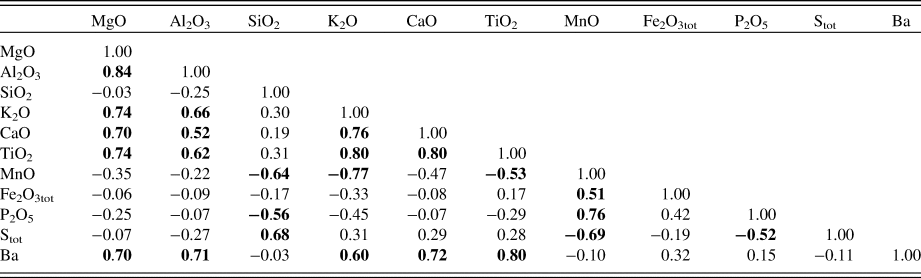
The total content of major elements expressed as oxides is 85–90% of the chemical composition of the PSh-6050 core (without Na2O). The SiO2 total content amounts to about a half (50–54%), whereas BSi averages 2.5% only. This corresponds to predominance of quartz (56–64%) in the sum of the light mineral fraction, which, in turn, prevails in the sediments of the White Sea (60–90%) (Gusakova, Reference Gusakova2013). The SiO2 total does not correlate with other major elements except Stotal (Table 1). Al2O3, the content of which varies between 14% and 16%, demonstrates a significant positive correlation with Mg, Ba, K, Ti, and Ca (R > 0.5), which indicates their occurrence in clay minerals and other aluminosilicates. The MgO and K2O constitute 3–4% each, on average. The average content of Fe2O3 is 8% in the PSh-6050 core. Among the major elements, only Fe exhibits a weak correlation with MnO (Table 1), which evidences their common geochemical feature to form the authigenic oxyhydroxides. The MnO exhibits a natural negative correlation with Stotal. The CaO content does not exceed 2%, which corresponds to the low carbonate content in the White Sea sediments. The content of the other major elements in the core does not exceed 1%.
The correlation matrix (P < 0.95) for the major elements (expressed as oxides) and Ba in the core PSh-6050. Bolded numbers indicate that the correlation is significant.

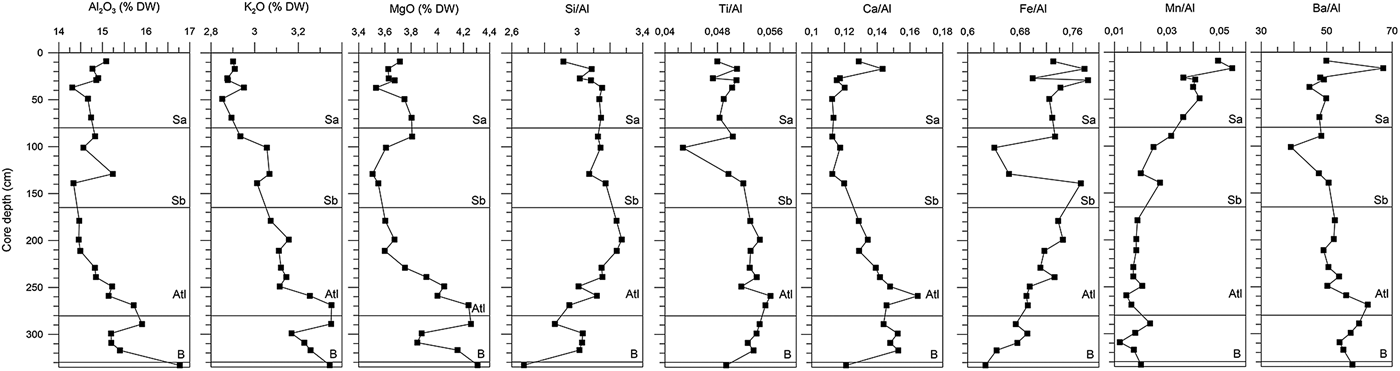
The variability of the major element content throughout the core becomes clear when using the coefficient of variation CV, calculated by the formula CV = σ / x̅ × 100%, where σ is the standard deviation and x̅ is the mean value. The rock-forming elements (Si, Al, Fe, K, Mg, and Ti) have an insignificant degree of variability in the core (CV < 10%), whereas P, Mn, Stotal, Ba, and Ca are characterized by medium and significant variability in the core (CV = 13–67%) because of their participation in different biogeochemical diagenetic processes. The maximum content of Al, Mg, and K, which are mainly associated with clay minerals (illite, montmorillonite, hydromica), was registered in the most ancient sediments (320–335 cm) penetrated from the bottom of the core (Fig. 5). An increasing in the content of these components is also observed at the core depth of 270–290 cm and ~130 cm. On the contrary, the Si-rich sediments lie in the part between 170 and 240 cm. The minimum Stot content is registered in the subsurface sediments, where sulfur can mostly have the form of sulfates. Down the core, especially below 100–120 cm, Stot content sharply increases particularly in sediments with the hydrotroilite patches (130–260 cm) and the layer of olive-gray clays (280–300 cm). The P content sharply decreases from 0.65% down to 0.15% in the layers of 9–27 cm as phosphates decompose during the destruction of organic material, and then the content of P does not change down the core.
Distribution of major elements (Al2O3, K2O, and MgO) and geochemical ratios (Si/Al, Ti/Al, Ca/Al, Fe/Al, Mn/Al, and Ba/Al) in the sediment core PSh-6050. Atl, Atlantic period; B, Boreal period; DW, dry weight; Pb, Preboreal period; Sa, Subatlantic period; Sb, Subboreal period.

Chemical element speciation
A predominance of residual (lithogenic) form is characteristic for Al, Fe, and Cr (Fig. 6). The percentage of this fraction for the Al and Cr exhibits a rather constant distribution pattern: from 91–96% in subsurface sediments to 96–99% in the lower part of the core. In subsurface layers, about 15% of Fe total content occurs in form of oxyhydroxides, and up to 10% is bound to organic matter. Down the core, the proportion of these labile forms drops sharply to 3–4% of the total Fe content, and in the lower part of the core, the percentage of the lithogenic form of Fe reaches up to 93% (Fig. 6).
(color online) Speciation of Al, Fe (% DW), Cr, Mn, As, Ni, Cu, Co and Cd (mg/kg DW) in sediment core Psh-6050. Colored fill indicates the stage of Holocene: Atl, Atlantic period; B, Boreal period; Pb, Preboreal period; Sa, Subatlantic period; Sb, Subboreal period. DW, dry weight.

The lithogenic form of Ni and As predominates (60–80%) in the core (Fig. 6), although the proportion of geochemically mobile forms of these elements is higher than that of Al, Cr, and Fe: from 10% to 20% of each of Ni and As total content is associated with OM and adsorbed on Fe-Mn oxyhydroxides. In the upper part of the core (16–50 cm), about 70% of Mn is presented as authigenic oxyhydroxides; below the layer of 150 cm, the proportion of this Mn form decreases sharply up to 10–15% of the Mn content. The main Mn form in the lower part of the core is the lithogenic one (45–70% of total content) with a subordinate proportion of forms adsorbed on clays/associated with carbonates (15–25% of total content). On average, up to 65% of each of Cu and Co is accumulated with lithogenic material (i.e., is found in the clay and clastic minerals), and only 15–20% is associated with organic matter and sulfides (Fig. 6). However, compared with the surface layers of sediments, the contribution of this form to the early Holocene sediments is significantly lower. The main portion of Cd occurs in an exchangeable complex (adsorbed on clays/associated with carbonates), which is the most mobile one. In the upper part of the core (up to 150 cm), this form amounts to almost 50% of Cd total content, whereas to 20% of Cd is associated with Mn-Fe oxyhydroxides, and up to 30%, with the residual form. In the lower part of the core, the portion of exchangeable Cd increases, reaching almost 90% of its total content. A similar distribution of the exchangeable form is characteristic of the other elements studied, although the average content of this geochemical fraction is rather less, ranging from less than 1% (Al, Fe, and Cr) up to 10–15% (Mn) of the total content of each element.
DISCUSSION
The sediment core PSh-6050 has a typical chemical composition for the White Sea deep-sea sediments in accordance with Kuz'mina et al. (Reference Kuz'mina, Lein, Luchsheva, Murdmaa, Novigatskii and Shevchenko2009). They are characterized by the rather low SiO2 content (52% on average) and high content of Al2O3 (15%), Fe2O3 (8%), K2O (3.1%), MgO (3.8%), and TiO2 (0.7%) associated with clay minerals. The Si/Al ratio varies from 2.7 to 3.3 (3.0 on average), which confirms approximately equal amounts of clay and clastic (quartz and feldspar) minerals.
Some features that have been revealed in the chemical elements’ behavior in the surface (0–50 cm) sediments of the White Sea (Demina et al., Reference Demina, Budko, Alekseeva, Novigatsky, Filippov and Kochenkova2017) are also characteristic for the deeper sediment layers formed during the Holocene. Such metals as Cd and Mn continue their active geochemical migration even in the ancient sediments, although the geochemical activity of Mn decreases and portion of the Mn lithogenic form progressively increases. For Al, Cr, Ni, Fe, As, Co, and Cu, the lithogenic form prevails (from 50% to 96% of the bulk), reflecting the important contribution of terrigenous processes to these elements’ accumulation. This corresponds to a significant decrease in their geochemical mobility at a later stage of the White Sea sedimentation.
In the Holocene sediments, Cu and Co moved to the group of the geochemically inert (lithogenic) form, unlike the surface bottom sediments (0–5 cm) where they were characterized as geochemically mobile metals (Demina et al., Reference Demina, Budko, Alekseeva, Novigatsky, Filippov and Kochenkova2017). Apparently, this resulted from decomposition of organic matter, which is accompanied by the Mn(IV) reduction with simultaneous desorption of trace elements from the Mn oxyhydroxides into the pore water. The exchangeable forms (adsorbed on clays/associated with carbonate) are important only for Cd, whose distribution pattern throughout the core slightly resembles the distribution of the pelitic fraction in sediments (R = 0.5). This fraction includes clay minerals (in particular, illite, montmorillonite, and chlorite), which are known to be an effective sorbents for different pollutants. Therefore, it is quite natural that the proportion of the exchangeable forms of Cd and the other chemical elements studied increase in the lower part of the core, where a pelitic fraction increases up to the maximum.
When combining data on the chemical element speciation with microfossil data, it becomes clear how the sedimentation environment has affected the behavior of chemical elements over the last 10,000 cal yr. In the Preboreal and Boreal periods of the Holocene, advection of the Barents Sea waters into the Dvina Bay of the White Sea increased, and relatively warm-water planktonic species, indicating intrusion of the Atlantic waters, appeared in plankton communities. As a result, the environmental conditions became more favorable for the bioproduction processes in the surface White Sea waters (Polyakova et al., Reference Polyakova, Novichkova, Lisitzin, Bauch and Rybalko2014). However, in the first half of the Boreal period, both the microfossil and lithologic-biogeochemical data allowed to reconstruct the sea-ice conditions (up to 10 months in the year by data of; Novichkova et al., Reference Novichkova, Reikhard, Lisitzin, Rybalko and Vernal2017). Thus, an input of terrigenous matter was the main factor of sedimentation in the early Holocene, which was confirmed by a highest content of such lithophile elements as Al, Mg, and K, as well as the heavy metal Cr, in this part of the core (300–335 cm), whereas the percentage of the trace metals’ mobile forms was low. A high content of freshwater microalgae in the sediments of the early Holocene in accordance with high portion of terrigenous organic matter (up to 80–90% of the OM bulk by data of δ13С-Corg) can be explained by a migration of the Northern Dvina mouth during the marine regression. According to the global sea level curve (Fairbanks, Reference Fairbanks1989) and the Laptev sea level curve (Bauch et al., Reference Bauch, Mueller-Lupp, Taldenkova, Spielhagen, Kassens, Thiede, Grootes, Heinemeier and Petryashov2001), the level of the Arctic Seas is about 10,000 cal yr BP was about 40 meters lower than the modern one. Thus, the mouth of the Northern Dvina during this period was much closer to the location of the investigated sediment core than at present.
The layer of olive-gray pelite (280–300 cm) related to the end of the Boreal period is characterized by an increase in biogenic components (diatoms, Corg, BSi), which, in turn, indicates a growth of biological productivity of the seawater (Fig. 3). A short-term cooling during the cold Bond event 5 (8200 cal yr BP; Bond, Reference Bond1997) has led to the biogenic components’ decrease in sediments to values recorded at the end of the Preboreal, the beginning of the Boreal period, as well as to the local increase of Al, Mg, and K.
According to microfossil data, during the mid-Holocene climatic optimum (6000–7500 cal yr BP), there was an increase in duration of the vegetation period and the surface water temperature in the White Sea to higher values than that observed nowadays (up to 12–14°C; Novichkova et al., Reference Novichkova, Reikhard, Lisitzin, Rybalko and Vernal2017). This is also reflected in the distribution of the Corg and BSi in the studied core. The growth of the total trace element content (particularly, their lithogenic form and sum of the labile forms) over the Atlantic period indicates, in turn, a gradual warming of the climate in that time. Unlike the data on distribution of biogenic components, a significant increase in the organically bound metals in the sediments has been recorded at a depth of 178 cm, which is associated with the most favorable climatic conditions for bioproductivity at about 5500 cal yr BP. This geochemical fraction, along with metals bound to organic matter, also includes authigenic sulfides. Therefore, because the sulfate-reduction bacteria function more vigorously in sediments enriched in bioavailable organic matter, the activity of these microorganisms (biogenic factor) has been enhanced in this period, which has led to an increase in mobile forms of Cu, Ni, As, and Co (Fig. 6).
Thus, warming of the mid-Holocene climate, accompanied by a decrease in the ice cover, has led to an increase of sedimentation rates and, consequently, to enrichment of sediments predominantly by the labile forms of trace elements. The content of biogenic components (BSi and Corg) over this period of the Holocene corresponds to values observed in the surface sediments (Budko, Reference Budko and Lisitzin2017). Despite the fact that a portion of the organic matter was decomposed at the water-bottom boundary and in the surface layer of bottom sediments, it can be assumed that the primary production during the mid-Holocene climatic optimum in the White Sea was higher than the modern one. The sediments of the Atlantic period (the 165–280 cm depth) are relatively enriched in total SiO2 (Si/Al ratio in Fig. 5). Clearly, this is linked with the additional accumulation of biogenic silica under climatic optimum conditions.
Normalization of element concentration to Al provides information on variation in lithogenous material in the sedimentary core. Contents of Si, Al, and Ti vary with the terrigenous fraction because they are related to the coarse-grained siliciclastic components of sediments, while contents of Ca, Mn, Fe, and Ba reflect the role of biologically mediated processes. The most commonly used proxies for paleoclimate reconstruction in the Arctic region are Si/Al and Ti/Al (Calvert and Pedersen, Reference Calvert and Pedersen2007). We have revealed coherent down-core variations of Si/Al and Ti/Al, which are opposite that of Fe/Al, Ca/Al, Mn/Al, and Ba/Al (Fig. 5). One can see a trend toward the growth of Fe/Al, Ca/Al, Mn/Al, and, to a less degree, Ba/Al, from the bottom (Boreal) to top part of the core. The high values of Fe/Al, Ca/Al, Mn/Al, and Ba/Al are recorded in the Medieval Climatic Optimum of the Holocene, where the high contents of biogenic components (Corg, BSi, chlorin, and diatom) were recorded. On the contrary, the Boreal period (280-–325 cm) is characterized by minimal and reduced values of Ca/Al, Fe/Al, Mn/Al, Corg, BSi, and diatom with predominance of their cold-water species.
In sediments of the Subboreal period of the Holocene (2600–5800 cal yr BP), the sum of forms of Fe, Cr, As, Ni, and Cu decreases (Fig. 6). On the contrary, the Al, Mg, and K contents slightly increase, which generally corresponds to the cooling of the climate during this period in the White Sea basin (Polyakova et al., Reference Polyakova, Novichkova, Lisitzin, Bauch and Rybalko2014). A decrease in bioproductivity in the middle of the Subboreal period is reflected in the chlorin's distribution pattern: the low chlorin content is comparable to the low values of this parameter during the cooling event of the Early Atlantic period (8200 cal yr BP) (Fig. 3). The regular decrease in content of the geochemically mobile forms, which depends on intensity of the OM production in the sea, is also accompanied by a decrease in their lithogenic forms in sediments of the middle of the Subboreal period. An increase in annual duration of the ice cover led to a slowdown of the hydrologic activity in the sea, which limits the supply of lithogenic matter from the land. As a result, cooling of the climate led to a decrease in almost all the geochemical forms of the chemical elements.
The upper part of the PSh-6050 core (0–80 cm) is comprised of by the sediments of the Subatlantic period (0–2600 cal yr BP). The Medieval Climatic Optimum of the Holocene (650–1050 cal yr BP) is marked by the maximum content of chlorin (3.67 µg/g dry weight), as well as of biogenic components (Corg up to 1.5% and BSi up to 4.1%), and of some mobile trace elements (Co, Cd, and Ni) at a depth of 36 cm.
Meanwhile, the comparison of redox-sensitive elements with the known paleoevents of this time interval is complicated. For example, the percentage of the Mn oxyhydroxides reaches about 70% from the total content in the subsurface layers 16–17 cm with further decreasing down the core because of reduction of this oxidized form of Mn. However, at the layer 140 cm, approximately 30% Mn is still found in the form of oxyhydroxides, which indicates the oxidized conditions still remain. This behavior of the oxidized form of Mn corresponds to the distribution of the redox potential (Eh) in the White Sea sediment cores reported by Gurskii (Reference Gurskii2005). He reported that good aeration of the bottom waters of the White Sea, along with a relatively low content of organic matter, led to the widespread formation of the oxidized surface layers in the bottom sediments. As a result, in the sediment cores sampled from a shallow sea areas (depth < 100 m), the boundary of transition to a reducing environment (Eh < 0 mV) can be reached at the sediment core depth of about 100 cm, while at a deep-sea areas (depth > 150 m), development of reduction conditions happens already in the sediment layer of 10–20 cm (Gurskii, Reference Gurskii2005). A similar trend is observed for the distribution of the chemical species bound to organic matter; their decrease corresponds to the decline of Corg and BSi content down the core.
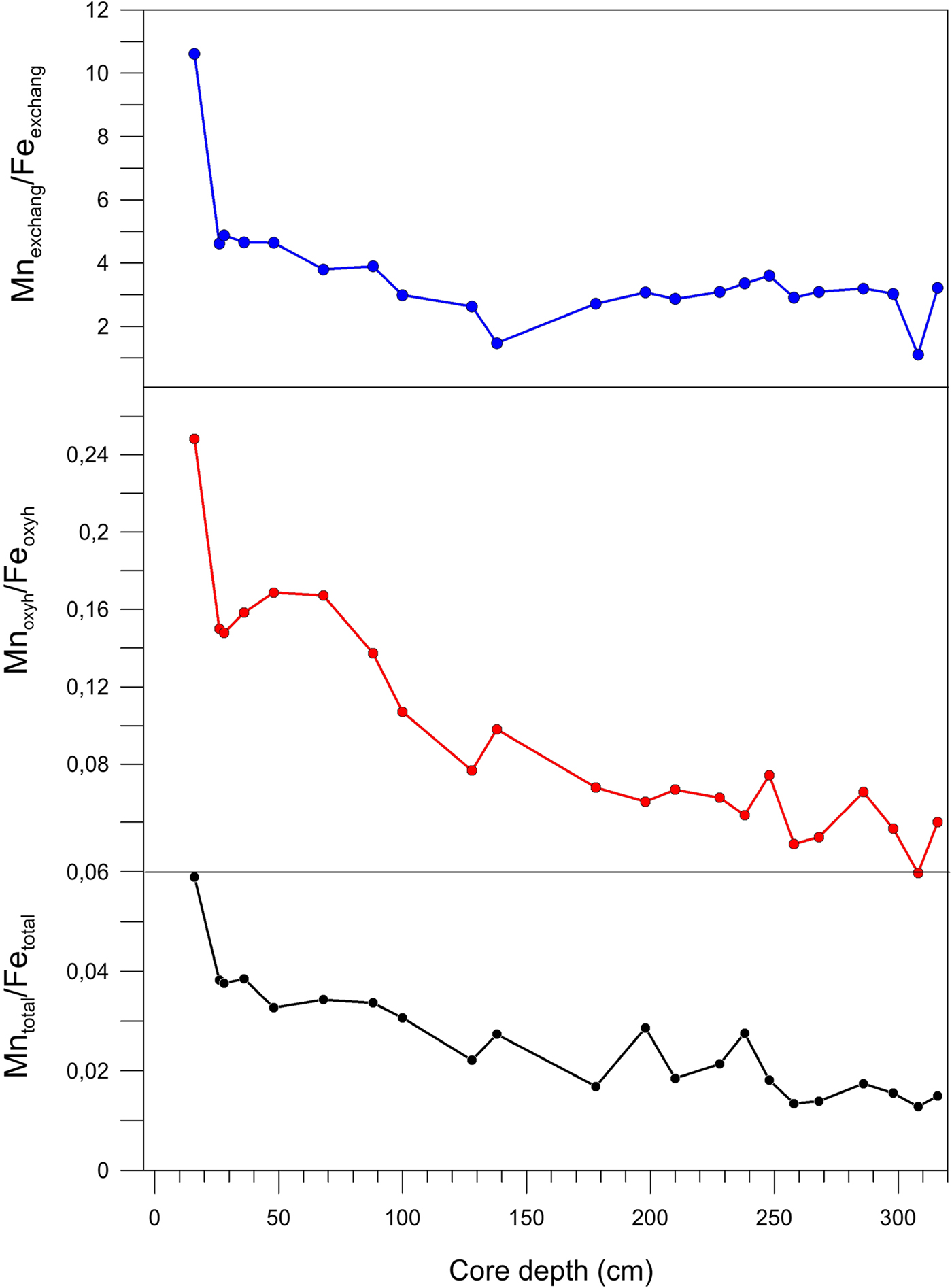
The Mn/Fe ratio is usually applied for the paleoreconstruction of oxygen dynamics in the bottom waters (Naeher et al., Reference Naeher, Gilli, North, Hamann and Schubert2013). This is caused by the different redox kinetics of Mn and Fe under anoxic conditions; Mn is reduced faster than Fe. Therefore, if Fe is oxidized faster than Mn, a higher Mn/Fe ratio is possible only under aerobic conditions. At the same time, change in the Mn/Fe ratio in mobile forms (exchangeable and oxyhydroxides) in the PSh-6050 core indicates a diagenetic reduction of the oxidized forms of Fe and Mn. Trend toward a decrease in the Mn/Fe ratio from surface layers to the depth of ~130–150 cm is clearly observed (Fig. 7). Down the core, a distribution pattern of the Mn/Fe ratio in the geochemically mobile forms is changed, apparently reflecting the redox conditions of the paleoenvironment. Predominance of terrigenous unavailable OM in sediments of the White Sea, according to δ13С-Corg data, weakens the activity of microorganisms and the rate of diagenetic processes (Lein et al., Reference Lein, Novichkova, Rybalko and Ivanov2013). The presence of terrigenous humified OM is one of the reasons for the high-temperature peak (400–450°C) registered during the pyrolysis at all depths of the PSh-6050 sediment core. Accordingly, a low reduction rate of the Mn and Fe oxyhydroxides in the core PSh-6050 also suggests a reasonably slow diagenesis.
(color online) The Mn/Fe ratio for the geochemical mobile forms (exchangeable and oxyhydroxides) and total content in the sediment core PSh-6050.

CONCLUSIONS
The marine sedimentation in the White Sea over the Holocene was complicated by a change in warming and cooling events, which are reflected in the distribution pattern down the PSh-6050 core both of microfossil and lithologic-geochemical data, including biogenic components, elemental ratios, and geochemical fractions of Al, Fe, and Mn and trace elements. From our work, we conclude the following: The early stage of Holocene sedimentation in the Dvina Bay of the White Sea was mainly controlled by the terrigenous matter input with river runoff, which was reflected in the low content of biogenic components (Corg, BSi, chlorin, and diatoms) and geochemically mobile forms of trace elements (As, Ni, Cu, and Co). The microalgae association pattern in sediments of this period, characterized by enrichment with green algae and freshwater diatoms, may be the cause of migration of the Northern Dvina mouth due to the fall sea level about 10,000 cal yr BP. The Holocene cooling events (the 8200 cal yr BP event [the Early Atlantic period] and the Subboreal period) are also indicated by the increase in the Al, Ti, Mg, and K content, and depletion of δ13С-Corg suggests the predominance of terrigenous material as a main source for sedimentation at that time. We have revealed a common trend in down-core variation in biological components (Corg, BSi, chlorin, and diatom concentration) and Fe/Al, Ca/Al, Mn/Al, and Ba/Al ratios—namely, higher values in the Medieval Climate Optimum of the Holocene. The Si/Al, Ti/Al, ratios used as geochemical proxies of coarse-grained fractions exhibit a coherent down-core variation, which as a whole is opposite to that of Fe/Al, Ca/Al, and Mn/Al.
The increase in Corg, BSi, chlorin, and the labile forms of metals, as well as the enriched signature of δ13С-Corg recorded in the core, were caused by increasing average summer temperatures of the surface waters and reduction of the ice-cover period reconstructed by microfossil data. According to the biogenic components (Corg, BSi, and chlorin), the most favorable conditions for biological production in the open part of the Dvina Bay are identified in the period of about 7000 cal yr BP. The distribution of the organically bounded fraction of trace elements reflects a sharp improvement of climatic conditions for bioproductivity at about 5500 cal yr BP. Thus, the obtained data demonstrate the warming stages relating to the middle and the end of the Atlantic period (mid-Holocene climatic optimum). The maximum Corg, BSi, and chlorin content, as well as the sum of forms of Co, Cd, and Ni, is discovered at a depth of 36 cm, which conforms to the Medieval climatic optimum of the Holocene (650–1050 cal yr BP). In this regard, the distribution of biogenic components (Corg and BSi) and chlorin in combination with the form of trace metals bound to organic matter and sulfides may serve as the indicators of the paleoproductivity of this area.
It is rather difficult to reconstruct paleoevents using data on the speciation of redox-sensitive elements in the upper part of the core (the Subatlantic period), because the processes of early diagenesis become the main factor determining their behavior. It is known that content of the Fe and Mn oxyhydroxides and associated trace elements rapidly increases in the uppermost part of the core because of oxidation of reducing compounds of Fe and Mn. We have registered similar trends for the metals bound to OM, especially at a sediment depth of 30 cm, where increase in their content corresponds to an increase in the Corg and BSi content. Distribution of the Mn oxyhydroxides and the Mn/Fe ratio in geochemically mobile forms (exchangeable and oxyhydroxides) is also very indicative: It reflects the ongoing consistent reduction of the oxidized form of Mn to the depth of ~130–150 cm, demonstrating a low rate of diagenesis in the White Sea sediments.
Thus, a comprehensive study of the White Sea sediments has shown a stable relationship of geochemical and biological proxies, complementary information about sedimentation features in postglacial time.
ACKNOWLEDGMENTS
This work was performed in the framework of the state assignment of FASO Russian (theme No 0149-2019-0007), supported in part by RSF (project No 14-27-00114-P). The authors greatly appreciate academician A.P. Lisitsyn for initiation of this research and kind advice. We are grateful to Prof. A.E. Rybalko for the lithologic description of the core PSh-6050 and Dr. T.N. Alekseeva for the grain-size distribution data. The authors greatly appreciate the editors and anonymous reviewers for their strong efforts to improve this paper.