Transmission of Mycobacterium tuberculosis in acute care facilities has been well documented.Reference Cookson and Jarvis 1 To prevent transmission of tuberculosis (TB) in acute care facilities, the Centers for Disease Control and Prevention (CDC) has recommended early identification and isolation of patients with presumptive pulmonary TB in single-bed airborne infection isolation rooms (AIIRs) and rapid diagnosis and treatment of these patients.Reference Jensen, Lambert, Iademarco and Ridzon 2 Although implementation of these CDC guidelinesReference Jensen, Lambert, Iademarco and Ridzon 2 has decreased rates of TB transmission,Reference Blumberg, Watkins and Berschling 3 , Reference LoBue and Catanzaro 4 applying these guidelines in areas with low TB burden may result in inefficient utilization of AIIRs. In one study, 92 patients required admission to an AIIR for every TB patient detected.Reference Scott, Schmid and Nettleman 5 Utilization of AIIRs in acute care facilities may also be inefficient because classifying patients as having presumptive infectious TB (ie, acid-fast bacilli smear-positive or smear-negative, culture-positive TB), having noninfectious TB (ie, culture-negative TB disease), or having no evidence of TB disease often relies on the use of smear microscopy, which has some important limitations. Smear microscopy has a relatively poor sensitivity for predicting culture-positive pulmonary TB;Reference Steingart, Henry and Ng 6 it is also labor intensive and requires experienced personnel.Reference Steingart, Ramsay and Pai 7 In addition, smear microscopy may have a low specificity for predicting culture-positive TB in geographic areas where Mycobacterium avium complex and rapidly growing mycobacteria are prevalent.
Use of clinical prediction rules (CPRs)Reference Wisnivesky, Serebrisky, Moore, Sacks, Iannuzzi and McGinn 8 combined with use of nucleic acid amplification tests (NAATs)Reference Campos, Quartin and Mendes 9 , Reference Millman, Dowdy and Miller 10 to identify patients with culture-positive pulmonary TB may allow for decreased utilization of AIIRs, and may promote rapid detection and empiric treatment of patients with infectious pulmonary TB. Increasing interest in a combined strategy for using CPRs and NAATs has been highlighted in a recently published meta-analysis of studiesReference Goncalves, Lambert Passos, Borges Dos Santos, de Andrade, Moreira Martins and de Queiroz Mello 11 evaluating CPRs for adult inpatients with suspected pulmonary tuberculosis. In addition, the US Food and Drug Administration (FDA) has approved the use of the Xpert MTB/RIF assay, a specific type of NAAT 12 which detects Mycobacterium tuberculosis complex DNA and rifampin resistance associated mutations, on 1–2 sputum specimens to guide decisions regarding release of patients from AIIRs. 13 However, to our knowledge, no studies have reviewed CPRs in the context of the current epidemiology of TB nor have any strategies been proposed for implementing a CPR along with use of NAATs. In this article, we review the epidemiology of TB in the United States, CPRs for identifying high-risk patients with culture-positive pulmonary TB in acute care facilities, and the use of NAATs for the diagnosis of pulmonary TB. Using this information, we have identified an infection prevention strategy that can be used to increase detection and empiric treatment of infectious pulmonary TB patients and optimize utilization of AIIRs.
EPIDEMIOLOGY
Disease Burden
From 1993 to 2012, US TB incidence rates decreased from 9.7 TB cases per 100,000 population to 3.2 TB cases per 100,000 population. 14 During 2012, nearly 50% of TB cases were reported in California, Florida, New York, and Texas; however, these states accounted for less than 33% of the US population. 14 The distribution of TB within states is also heterogeneous. For instance, in California, TB cases were reported in 48 of 61 local health jurisdictions during 2012; however, 6 jurisdictions accounted for 68% of reported TB cases. 15
In the United States, TB persists in specific populations. Foreign-born persons are disproportionately affected by TB and accounted for 63% of TB cases during 2012. 14 Important differences in demographic and clinical characteristics have been reported between foreign-born and US-born TB patients,Reference Demlow, Oh and Barry 16 – Reference Manangan, Elmore and Lewis 20 and these differences need to be considered to rapidly diagnose TB and to reduce TB transmission. First, a higher proportion of foreign-born TB patients have immunosuppressing conditions such as diabetesReference Demlow, Oh and Barry 16 and end-stage renal diseaseReference Chitnis, Schecter, Cilnis, Robsky, Flood and Barry 18 at the time of TB diagnosis. Second, foreign-born TB patients may be less likely to have traditional TB risk factors such as human immunodeficiency virus (HIV) infection, homelessness, or substance abuse.Reference El Sahly, Adams, Soini, Teeter, Musser and Graviss 19 , Reference Manangan, Elmore and Lewis 20 Third, among culture-positive pulmonary TB patients, foreign-born persons were more likely to have negative acid-fast bacilli (AFB) sputum smears.Reference Shah, Cavanaugh and Pratt 17 Although no difference in mortality was noted according to sputum smear status,Reference Shah, Cavanaugh and Pratt 17 previous studies have reported that a negative AFB sputum smear result is associated with delays in initiation of TB treatmentReference Pascopella, Kellam and Ridderhof 21 and is responsible for up to 17% of TB transmission.Reference Behr, Warren and Salamon 22 These characteristics of current TB epidemiology in the United States can inform approaches to diagnosis.
Hospitalizations
Cohort studies have estimated that 50%–75% of TB patients are hospitalized for TB,Reference Taylor, Marks, Rios Burrows, Weis, Stricof and Miller 23 , Reference Thomas, Laraque, Munsiff, Piatek and Harris 24 and 83% of these hospitalizations occur at the time of TB diagnosis.Reference Thomas, Laraque, Munsiff, Piatek and Harris 24 From 1995 to 2006, the number of hospitalizations with a principal diagnosis of TB decreased 41% from 15,000 to 8,800; the number of hospitalizations with a secondary diagnosis of TB decreased 10% from 55,000 to 49,700. 25 The average length of stay for a TB hospitalization is between 9 to 17 days,Reference Taylor, Marks, Rios Burrows, Weis, Stricof and Miller 23 , 25 and the estimated cost per hospitalization is $6,000 to $27,000.Reference Taylor, Marks, Rios Burrows, Weis, Stricof and Miller 23 , 25 , Reference Marks, Flood and Seaworth 26 An estimated 65%–80% of the total cost associated with TB hospitalization is borne by the public sector, which includes local, state, and federal governments as well as public hospitals. 25 , Reference Hansel, Merriman, Haponik and Diette 27 Patients hospitalized for TB are more likely to be homeless, to use alcohol or other drugs, and to have HIV infection compared with TB patients who were not hospitalized.Reference Taylor, Marks, Rios Burrows, Weis, Stricof and Miller 23 Considerable geographic variation in hospitalization among TB patients has been reported,Reference Taylor, Marks, Rios Burrows, Weis, Stricof and Miller 23 which may be attributed to local hospitalization practices or to coexisting medical conditions and severity of TB disease among patients. Despite the implementation of health department guidelines for hospitalization of patients with suspected or confirmed TB that incorporate medical and social factors, almost 40% of hospitalizations for TB patients in New York City could have been avoided.Reference Thomas, Laraque, Munsiff, Piatek and Harris 24 These findings suggest that partnerships between health departments and hospitals may be needed to ensure appropriate utilization of inpatient care for TB patients.
Mortality
From 1993 to 2010, TB mortality rates decreased from 0.6 TB deaths per 100,000 population to 0.2 TB deaths per 100,000 population. 14 During 2010, 893 deaths were reported among patients with TB; 28% of these deaths occurred before initiation of TB treatment and 72% occurred during TB therapy. 14 The substantial proportion of deaths that occur prior to treatment highlights the importance of timely diagnosis. Analyses of county and statewide TB surveillance data have identified several risk factors associated with death among TB patientsReference van der Heijden, Maruri and Blackman 28 – Reference Pascopella, Barry, Flood and DeRiemer 34 that may be important to consider among hospitalized patients. Receipt of fluoroquinolones in the 6 months prior to TB diagnosis,Reference van der Heijden, Maruri and Blackman 28 HIV infection,Reference van der Heijden, Maruri and Blackman 28 – Reference Nahid, Jarlsberg and Rudoy 32 , Reference Pascopella, Barry, Flood and DeRiemer 34 excessive alcohol use,Reference Nguyen, Hamilton, Xia and Stout 30 , Reference Kattan, Sosa and Lobato 33 and age 65 years and olderReference Kattan, Sosa and Lobato 33 , Reference Pascopella, Barry, Flood and DeRiemer 34 have all been identified as risk factors associated with death among patients with TB. Although the proportion of TB deaths that are preventable is unknown, interventions that could result in earlier TB diagnosis among patients hospitalized with risk factors and symptoms consistent with TB or death with TB may decrease the proportion of patients who die. These characteristics and outcomes of tuberculosis patients across the United States are important to consider in formulating a TB diagnostic and infection prevention strategy in diverse settings.
CLINICAL PREDICTION RULES TO IDENTIFY CULTURE-POSITIVE TB PATIENTS
Numerous CPRs for predicting patients who have culture-positive pulmonary TB in acute care facilities have been published.Reference Bock, McGowan, Ahn, Tapia and Blumberg 35 – Reference Mylotte, Rodgers, Fassl, Seibel and Vacanti 44 Although most published CPRs include clinical data routinely available at the time of admission to an acute care hospital,Reference Bock, McGowan, Ahn, Tapia and Blumberg 35 – Reference Aguilar, Yang, Brar and Markowitz 42 some CPRs include results for laboratory tests, such as the AFB sputum smear,Reference Pegues, Johnson, Pegues, Spencer and Hopkins 43 , Reference Mylotte, Rodgers, Fassl, Seibel and Vacanti 44 which are often not available when a healthcare provider must make a decision to admit a patient to an AIIR.
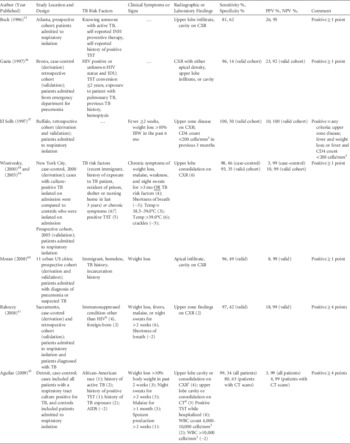
Studies evaluating CPRs that identify patients with culture-positive pulmonary TB are summarized in Table 1.Reference Bock, McGowan, Ahn, Tapia and Blumberg 35 – Reference Aguilar, Yang, Brar and Markowitz 42 All studies were conducted in an academic or academically affiliated healthcare facility in an urban area in the United States during the mid-1990s to the mid-2000s.Reference Bock, McGowan, Ahn, Tapia and Blumberg 35 – Reference Aguilar, Yang, Brar and Markowitz 42 One study was conducted in a network of facilities across the United States.Reference Moran, Barrett and Mower 40 Almost all studies included a CPR by initially conducting a derivation cohortReference El-Solh, Mylotte, Sherif, Serghani and Grant 37 , Reference Moran, Barrett and Mower 40 , Reference Rakoczy, Cohen and Nguyen 41 or case-control studyReference Gaeta, Webheh, Yazji, Ahmed and Yap 36 , Reference Wisnivesky, Kaplan, Henschke, McGinn and Crystal 38 and selecting a threshold value for the CPR that prioritized sensitivity over specificity for detection of patients without pulmonary TB.Reference Gaeta, Webheh, Yazji, Ahmed and Yap 36 – Reference Aguilar, Yang, Brar and Markowitz 42 In 2 studies, criteria were identified only through a cohortReference Bock, McGowan, Ahn, Tapia and Blumberg 35 or case-controlReference Aguilar, Yang, Brar and Markowitz 42 study. Nearly all studies subsequently used either a prospectiveReference Wisnivesky, Henschke, Balentine, Willner, Deloire and McGinn 39 , Reference Moran, Barrett and Mower 40 or retrospectiveReference El-Solh, Mylotte, Sherif, Serghani and Grant 37 , Reference Rakoczy, Cohen and Nguyen 41 study design to validate the CPRs. None of the studies validated the CPRs in independent populations or settings.Reference Bock, McGowan, Ahn, Tapia and Blumberg 35 – Reference Aguilar, Yang, Brar and Markowitz 42
Clinical Prediction Rules for Detection of Pulmonary Tuberculosis among Patients Admitted to Acute Care Hospitalsa

NOTE. All clinical prediction rules identify patients at high and low risk for pulmonary TB.
AIDS, acquired immunodeficiency syndrome; CT, computed tomography; CXR, chest radiograph; °C, degrees in Celsius; HIV, human immunodeficiency virus; IBW, ideal body weight; IDU, injection drug user; INH, isoniazid; NPV, negative predictive value; PPV, positive predictive value; Sens, sensitivity; Spec: specificity; Temp, temperature; TST, tuberculin skin test; TB, tuberculosis; US, United States; Valid, validation; WBC, white blood cell count.
a Clinical prediction rules assign 1 point to each criterion; for prediction rules that assign different points to criteria, the point value is noted in parentheses.
b Immunosuppressed conditions other than HIV infection were defined as chronic liver disease, chronic kidney disease, diabetes mellitus, active cancer of any type, receipt of any steroid or other immunosuppressive drug in the past 3 months, and alcoholism.
c All case and control patients had a CXR.
d Only 55% of case patients and 49% of control patients had a CT scan.
CPRs consisted of 4–13 criteria and included TB risk factors, clinical symptoms or signs, or laboratory and radiographic findings.Reference Bock, McGowan, Ahn, Tapia and Blumberg 35 – Reference Aguilar, Yang, Brar and Markowitz 42 The sensitivity of the CPRs for detection of patients with culture-positive pulmonary TB was 81%–100%,Reference Bock, McGowan, Ahn, Tapia and Blumberg 35 – Reference Aguilar, Yang, Brar and Markowitz 42 and only 1 CPR had a sensitivity less than 90%.Reference Aguilar, Yang, Brar and Markowitz 42 Specificity of the CPRs for identification of patients without TB was 14%–63%,Reference Bock, McGowan, Ahn, Tapia and Blumberg 35 – Reference Aguilar, Yang, Brar and Markowitz 42 and the CPR with the lowest specificityReference Gaeta, Webheh, Yazji, Ahmed and Yap 36 was evaluated in a cohort of patients admitted to an acute care facility with a diagnosis of pneumonia. All CPRs had a negative predictive value of at least 92% for ruling out pulmonary TB, while the positive predictive value for detection of pulmonary TB was 3%–26%.Reference Bock, McGowan, Ahn, Tapia and Blumberg 35 – Reference Aguilar, Yang, Brar and Markowitz 42 Differences in the patient populations included in the studies as well as the criteria included in CPRs may, in part, explain the varying estimates of diagnostic performance.
Limitations of Clinical Prediction Rules
Several factors may limit the generalizability of published CPRs. Because most studies were conducted during the 1990sReference Bock, McGowan, Ahn, Tapia and Blumberg 35 – Reference Moran, Barrett and Mower 40 when TB was more common among US-born than foreign-born persons, the risk factors used to identify patients with pulmonary TB may not be applicable to the majority of current TB patient populations. Also, because most studies were conducted in academic healthcare facilities in urban areas with high TB burden, it is unclear how these CPRs would perform in areas with low TB burden and in nonacademic facilities. Finally, to our knowledge, no studies have documented the cost-effectiveness of implementing these CPRs.
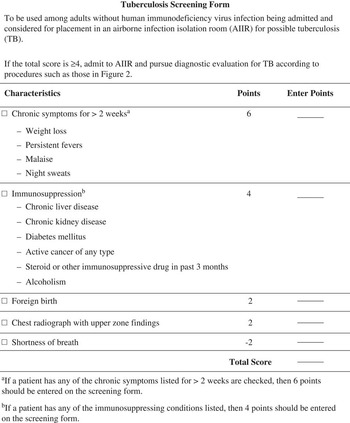
Nevertheless, a recently published CPRReference Rakoczy, Cohen and Nguyen 41 incorporates risk factors that reflect the current epidemiology of TB patients, such as foreign birth and immunosuppressing conditions such as diabetes and end-stage renal disease (Figure 1). This CPR could be part of an infection prevention strategy that also employs an NAAT.
Example clinical prediction rule based on Rakoczy et al.Reference Rakoczy, Cohen and Nguyen 41

NAATS FOR DIAGNOSIS OF PULMONARY TB
NAATs use deoxyribonucleic acid amplification–based methods to amplify target nucleic acid regions that are unique to M. tuberculosis complex bacteria, and they can be used directly on clinical specimens such as sputum samples. There are 2 types of NAATs: laboratory-developed tests, which vary widely in their design and methods, and standardized commercial kits.Reference Nahid, Pai and Hopewell 45 At present, 2 commercial NAATs have received market authorization from the FDA. Both commercial tests are authorized for use on AFB smear-positive and smear-negative respiratory specimens from patients with suspected pulmonary TB. The enhanced Amplified Mycobacterium Tuberculosis Direct Test (E-MTD, Hologic Gen-Probe, San Diego, CA) combines isothermal transcription-mediated amplification of a portion of the 16S rRNA for M. tuberculosis complex with a hybridization probe specific to the bacteria. 46 The Xpert MTB/RIF assay (Cepheid, Sunnyvale, CA) is an automated cartridge-based test that uses a hemi-nested real-time polymerase chain reaction assay to amplify an 81-base-pair core region of the rpoB gene for M. tuberculosis complex. 12 The Xpert assay also utilizes 5 molecular beacon probes to detect mutations in the core region of the rpoB gene that are associated with rifampin resistance. 12 Because the Xpert assay detects silent and missense mutations in the rpoB gene, 12 results from an additional NAAT test, such as a pyrosequencing assay,Reference Lin, Rodwell and Victor 47 that determines the DNA sequence of the rpoB gene are needed to confirm the presence of mutations associated with rifampin resistance. 48 In addition, phenotypic drug susceptibility testing of cultured isolates is required to confirm rifampin resistance.
Despite the fact that NAATs have been available in clinical practice for almost 2 decades, several factors have limited use of these tests in the United States: (1) cost and availability of the tests; (2) delayed time interval between specimen collection and communication of the laboratory report to the treating healthcare provider; and (3) laboratory policies that restrict these tests for the use on AFB smear-positive respiratory specimens. 49 The most recent CDC guidelines regarding use of NAATs for diagnosis of TB recommend that testing become a standard practice in the United States to aid in the initial evaluation of patients with suspected pulmonary TB. 49 To maximize the benefits of NAATs, these tests should be interpreted in conjunction with AFB smear results for respiratory specimens and should be performed in all patients in whom a diagnosis of pulmonary TB is being considered and in whom the results would influence clinical and public health decision making. 49
Diagnostic Accuracy of NAATs for Pulmonary TB
Several meta-analyses have been published on the performance of laboratory-developed testsReference Sarmiento, Weigle, Alexander, Weber and Miller 50 , Reference Greco, Rulli, Girardi, Piersimoni and Saltini 51 and commercial kitsReference Greco, Girardi, Navarra and Saltini 52 compared to cultures for diagnosis of pulmonary TB. For both laboratory-developed and commercial NAATs, pooled sensitivity and specificity estimates varied by AFB sputum smear status.Reference Sarmiento, Weigle, Alexander, Weber and Miller 50 – Reference Greco, Girardi, Navarra and Saltini 52 Compared to patients with negative AFB sputum smears, patients with positive smears had higher pooled sensitivity estimates (laboratory-developed NAAT: 96% vs 72%; commercial NAAT: 96% vs 66%) and lower pooled specificity estimates (laboratory-developed NAAT: 81% vs 91%; commercial NAAT: 85% vs 98%).Reference Sarmiento, Weigle, Alexander, Weber and Miller 50 – Reference Greco, Girardi, Navarra and Saltini 52 These studies did not include data on the Xpert assay because this assay was only recently developed and authorized for use in the United States. To date, few meta-analyses on the diagnostic accuracy of the Xpert assay for detection of pulmonary TB and rifampin resistance have been published.Reference Chang, Lu and Wang 53 , Reference Steingart, Schiller, Horne, Pai, Boehme and Dendukuri 54 Compared with patients with negative AFB sputum smears, patients with positive smears had higher pooled sensitivity estimates (98% vs 68%); pooled specificity estimates were 99% for patients with both positive and negative AFB sputum smears.Reference Chang, Lu and Wang 53 , Reference Steingart, Schiller, Horne, Pai, Boehme and Dendukuri 54 Using cultures and drug susceptibility tests as a gold standard, the Xpert assay had a pooled sensitivity of 95% and specificity of 98% for detecting rifampin resistance.Reference Chang, Lu and Wang 53 , Reference Steingart, Schiller, Horne, Pai, Boehme and Dendukuri 54 Because most studies included in the meta-analyses of the Xpert assay were conducted in countries with a high TB burden,Reference Chang, Lu and Wang 53 , Reference Steingart, Schiller, Horne, Pai, Boehme and Dendukuri 54 the positive predictive value of this assay may be lower in the United States. However, because the sensitivity of the Xpert assay is higher than the AFB smear, the negative predictive value of the Xpert assay is >99% in settings of both low and high TB burden. 55 Therefore, a negative result on an Xpert assay provides high accuracy in excluding TB.
The diagnostic performance of NAATs is influenced by the clinical suspicion of the healthcare provider regarding TB. Many studies conducted in lowReference Catanzaro, Perry and Clarridge 56 , Reference Piersimoni, Nista, Zallocco, Galassi, Cimarelli and Tubaldi 57 and high TB burdenReference Lim, Mukhopadhyay and Gough 58 , Reference Lim, Gough, Chin and Kumarasinghe 59 countries have demonstrated that sensitivity and specificity of NAATs is significantly lower among patients whose healthcare providers had a low clinical suspicion for TB compared with those patients with a high or moderate suspicion for TB. These differences in performance of NAATs by level of clinical suspicion have also been noted for patients with AFB smear-negative pulmonary TB.Reference Lim, Gough, Chin and Kumarasinghe 59 NAATs should not be used for patients who are being treated for TB and should be used with caution among patients previously treated for TB because NAATs can remain persistently positive following curative treatment.Reference Friedrich, Rachow and Saathoff 60 , Reference Boyles, Hughes, Cox, Burton, Meintjes and Mendelson 61
Impact of NAATs on Reducing Utilization of AIIRs and Improving Clinical Care
Cohort studies conducted in US acute care facilities have provided evidence to support the use of NAATs to reduce the use of AIIRs.Reference Campos, Quartin and Mendes 9 , Reference Millman, Dowdy and Miller 10 , Reference Lippincott, Miller, Popowitch, Hanrahan and Van 62 -- Reference Chaisson, Roemer and Cantu 64 In our review, 3 studies used a hypothetical cohort study design to assess the potential impact of the results of a single NAAT compared to the routine infection control policy for submitting AFB sputum smears of patients admitted to an AIIR for suspected pulmonary TB at county hospitals in MiamiReference Campos, Quartin and Mendes 9 and San Francisco.Reference Millman, Dowdy and Miller 10 , Reference Chaisson, Roemer and Cantu 64 In 2 studies, a single NAAT, either a laboratory-developed test or E-MTD Test,Reference Campos, Quartin and Mendes 9 and an Xpert assay,Reference Millman, Dowdy and Miller 10 detected all culture-positive TB patients admitted to an AIIR. However, in 1 study the Xpert assay was negative for an AFB smear-negative, culture-positive TB patient.Reference Chaisson, Roemer and Cantu 64 The use of a single NAAT, compared with AFB sputum smear results, had a higher sensitivity (87% vs 76%) and specificity (100% vs 96%) in the study that used the E-MTD test;Reference Campos, Quartin and Mendes 9 the studies that used the Xpert assay detected identical sensitivity (89% vs 89%Reference Millman, Dowdy and Miller 10 ) and similar specificity (100% vs 99%Reference Chaisson, Roemer and Cantu 64 ). In addition, compared to AFB sputum smears, use of a single NAAT was cost-effective and would have decreased utilization of AIIRs from an average of 2.7–1.4 days per patient and would have saved $2,278 per patient or $533,000 annually.Reference Millman, Dowdy and Miller 10 The use of the Xpert assay on a single concentrated sputum specimen was estimated to have reduced unnecessary respiratory isolation by a median of 35 h (interquartile range, 24–36 h);Reference Chaisson, Roemer and Cantu 64 whereas the use of the Xpert assay performed directly on a single unconcentrated sputum specimen reduced unnecessary respiratory isolation by a median of 45 h (interquartile range, 35–46 h).Reference Chaisson, Roemer and Cantu 64
A prospective cohort study conducted in a tertiary hospital in North Carolina compared utilization of AIIRs using the Xpert assay on 1, 2, or 3 respiratory specimens to a strategy using 3 AFB sputum smears.Reference Lippincott, Miller, Popowitch, Hanrahan and Van 62 Compared with AIIR use under the 3-AFB sputum smear strategy, the median duration of AIIR use was significantly lower with the strategies using the Xpert assay for the 1, 2, and 3 respiratory specimens, respectively (20.8 h, 41.2 h, 54.0 h, vs 68.0 h).Reference Lippincott, Miller, Popowitch, Hanrahan and Van 62 However, the 3-AFB sputum smear strategy and the 2- and 3-specimen Xpert strategies detected all 6 TB cases during the study period, whereas the 1-specimen Xpert strategy missed 1 culture-positive TB case in which the first AFB sputum smear was negative.Reference Lippincott, Miller, Popowitch, Hanrahan and Van 62 The Xpert assay demonstrated sensitivity and specificity similar to those of AFB sputum smears (93% vs 93% and 99% vs 99%, respectively).Reference Lippincott, Miller, Popowitch, Hanrahan and Van 62
In a retrospective multisite cohort study conducted in inpatient and outpatient facilities, using NAATs compared to not using NAATs was associated with significant reductions in use of AIIRs as well as reductions in the use of diagnostic procedures such as bronchoscopies and computed tomography scans and in the initiation of contact investigations for smear-positive, culture-negative suspects.Reference Marks, Cronin and Venkatappa 63 Among patients with AFB smear-positive, culture-positive TB, NAATs reduced time to diagnosis of TB.Reference Marks, Cronin and Venkatappa 63 In addition, NAATs were noted to significantly reduce duration of TB treatment for both AFB smear-positive and smear-negative patients who did not have TB.Reference Marks, Cronin and Venkatappa 63 In other studies, the use of NAATs significantly reduced time to diagnosis and initiation of a treatment regimen for multidrug-resistant TB.Reference Taegtmeyer, Beeching and Scott 65 , Reference Banerjee, Allen and Lin 66 In addition, overtreatment of patients with suspected pulmonary TBReference Davis, Kawamura and Chaisson 67 and exposure time of healthcare workers to patients with culture-positive pulmonary TB were also significantly reduced.Reference Cordeiro-Santos, Trajman and Cobelens 68
Infection Prevention Strategy to Efficiently Isolate and Treat High-Risk Pulmonary TB Patients
The CDC guidelines on prevention of TB transmission in healthcare facilities recommend that airborne infection isolation precautions for suspected pulmonary TB be discontinued when contagious TB disease is considered unlikely and either (1) an alternate diagnosis is confirmed that explains the symptoms or (2) the patient has 3 consecutive negative AFB sputum smears.Reference Jensen, Lambert, Iademarco and Ridzon 2 The CDC has previously released guidelines for the use of NAATs to diagnose pulmonary TB 49 as well as guidelines for use of the Xpert assay. 48 Both sets of CDC guidelines 48 , 49 recommend that results for NAATs should be interpreted in the context of AFB sputum smear results and clinical suspicion, and that infectious pulmonary TB disease can be excluded on the basis of microscopy, NAATs, or a combination of these tests, provided that 3 sputum specimens are examined. Also, the collection of at least 3 sputum specimens for culture is recommended to complete the microbiologic evaluation for TB disease.Reference Jensen, Lambert, Iademarco and Ridzon 2 , 48 , 49
Recently, the FDA extended the indication for use of the Xpert assay to include testing 1 or 2 sputum specimens as an alternative to the examination of serial AFB smears to aid in the decision to release a patient with presumptive pulmonary TB from an AIIR. 13 The expansion of the indication of the Xpert assay was supported by the findings of a multicenter international study that compared a strategy of 1 or 2 Xpert assays to serial AFB sputum smears for initial evaluation of patients with presumptive pulmonary TB.Reference Luetkemeyer, Firnhaber and Kendall 69 Xpert assays using 1 and 2 respiratory specimens detected 97% and 100%, respectively, of AFB smear-positive, culture-positive TB patients.Reference Luetkemeyer, Firnhaber and Kendall 69 Specificities for the 1- and 2-specimen Xpert assay strategy were 99% and 98%, respectively; these specificities were higher than the specificity of 95% for the strategy using 3 AFB smears.Reference Luetkemeyer, Firnhaber and Kendall 69 In addition, the negative predictive value of 1- and 2-specimen Xpert assays was 98% and 99%, respectively, which was higher than a negative predictive value of 93% for the 3-AFB smear strategy.Reference Luetkemeyer, Firnhaber and Kendall 69
PROPOSED COMBINED STRATEGY
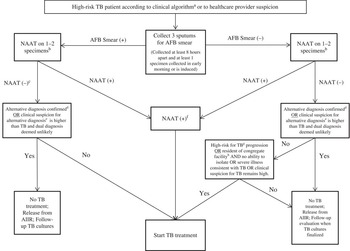
We propose an infection prevention strategy (Figures 1 and 2) based on our review of the current epidemiology of TB in the United States, CPRs to detect patients at high risk for culture-positive pulmonary TB, and NAATs for TB detection. This combined strategy aims to identify patients at high risk for pulmonary TB who warrant diagnostic evaluation with an NAAT in an AIIR. The CPR could be used or modified based on local epidemiology to detect patients at high risk for pulmonary TB. In the example CPRs, patients with scores of 4 or greater would be admitted to an AIIR for evaluation for TB and in accordance with the steps in Figure 2, would include 3 sputum specimens and at least 1 NAAT. The decision to test more than 1 sputum specimen with an NAAT will depend not only on the type of NAAT used (eg, Xpert assay or laboratory-developed test) but also on clinical factors such as suspicion for TB and confirmation of an alternative diagnosis, laboratory findings (including AFB sputum smear results and the quality of the sputum specimen), and radiographic findings. The proposed combined strategy may optimize utilization of AIIRs and increase rapid detection and empiric treatment of infectious pulmonary TB patients.
Diagnostic evaluation of patients at high-risk for pulmonary tuberculosis in acute care facilities. NOTE. AIIR: airborne infection isolation room; AFB: acid-fast bacilli; NAAT: nucleic acid amplification test; TB: tuberculosis. aEither a clinical prediction rule that is published or based on local epidemiology of pulmonary TB. See Figure 1 for an example. bThe decision to test 1 or 2 sputum specimens with an NAAT will depend on the type of NAAT used (eg, Xpert® assay or laboratory-developed test) and on clinical factors such as suspicion for TB and confirmation of an alternative diagnosis, laboratory findings including AFB sputum smear results and the quality of the sputum specimen, and radiographic findings. cDetermine the type of NAAT used by the laboratory, and the occurrence of false-negative results for this type of NAAT due to presence of inhibitors. If inhibitors are detected, then an additional sputum specimen will need to be sent for an NAAT. dLaboratory confirmation of an alternative diagnosis (eg, nontuberculous mycobacteria detected from a respiratory specimen, or non-small cell lung cancer confirmed based on pathology specimen from a lung biopsy). eAn example of an alternative diagnosis for which there may be higher suspicion than that for TB may be in a patient with post-obstructive pneumonia with a right upper lobe infiltrate that radiographically appears to be due to lung cancer. fFor high-risk TB patients who have a sputum specimen that is AFB sputum smear-negative but NAAT positive, additional diagnostic specimens (eg, sputum specimens) may be needed in order to obtain an isolate of Mycobacterium tuberculosis complex. gExamples of coexisting medical conditions and demographic factors that increase patient risk for progression to active TB disease include: human immunodeficiency virus infection; use of TNF-α antagonist; or conversion of a tuberculin skin test or interferon-γ release assay. hResidents of congregate facilities include persons in homeless shelters, prisons, jails, drug rehabilitation or mental health facilities, and end-stage renal disease patients undergoing dialysis at a dialysis facility.

CONCLUSION
Although incidence rates of TB are declining in the United States, TB disproportionately affects specific populations and geographic areas and remains an important cause of morbidity and mortality. 14 Published CPRs have a high sensitivity for identifying patients admitted to acute care facilities with culture-positive pulmonary TB.Reference Bock, McGowan, Ahn, Tapia and Blumberg 35 – Reference Aguilar, Yang, Brar and Markowitz 42 These CPRs may be used in conjunction with NAATs to efficiently identify and treat patients with pulmonary TB. Future studies evaluating the effect that implementing CPRs and NAATs have on utilization of AIIRs and on increasing detection and empiric treatment of infectious pulmonary TB patients in acute care facilities are needed.
ACKNOWLEDGMENTS
Financial support: No financial support was provided relevant to this article.
Potential conflicts of interest: All authors report no conflicts of interest relevant to this article.