Introduction
Imagine a world where oil pipelines detect and seal cracks before leaking into the environment, potholes refill themselves, and bridges signal their fatigue and avoid collapsing. We envision these solutions to be made from materials—not robots—that can sense structural, mechanical, or chemical problems, and ultimately, report and repair infrastructure. These futuristic ideas all rely on materials that are in some way “autonomous.” Autonomous materials will need to sense their surroundings, couple energy-driven elements to respond by creating force and performing work, and then halt these changes when sensing that the job is done.
Where can we start to learn the fundamental governing principles behind such autonomous materials of the future? Luckily, biology has already engineered autonomous systems that can sense, compute, and react to stimuli. Biological systems and materials perform these functions through cascading chemical reactions linking energy-utilizing components. The current designs that can be learned from a myriad of biological systems around us have developed from countless trial-and-error attempts as the organisms themselves have evolved.
While future technological demands will require such autonomous, active materials, humans currently have no capability to design, engineer, or build similar nonequilibrium, multicomponent systems. We will forever be at an impasse in materials engineering and technology until we determine the fundamental scientific principles underlying how biological systems bridge molecular and macroscopic length scales and use random molecular components and processes to create coherent material motion and work.
Machines made from machines
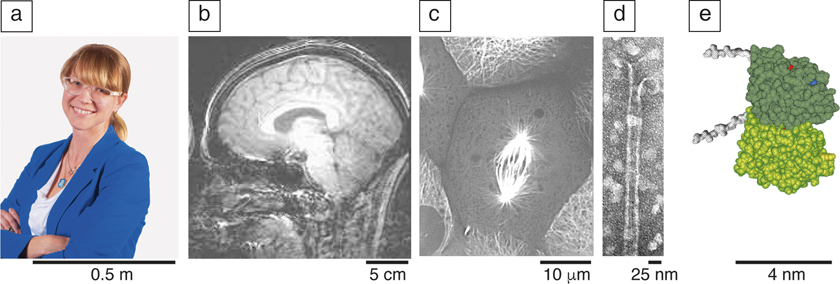
One fundamental principle that we can already glean from our current understanding of biological systems is that biological entities are machines composed of other machines. This concept was first proposed by Leibniz in the 18th centuryReference Riskin1 and revived in a recent review from Needleman and Dogic.Reference Needleman and Dogic2 Think of the human body (Figure 1). It is a machine that is capable of producing large-scale work, such as lifting a heavy load. Inside of the body are smaller machines called organs and muscles. Each of these machines performs a function that helps the larger organism/machine to function. These organs are made from smaller machines called cells that come together to make the tissues and structures of the organs. These individual cells are each self-replicating machines that produce work to keep the tissue together, and can heal and repair tissues through cell motility or cell division to create more tissue. Within cells, the smaller machines that help the cell perform its functions are called organelles and macromolecular complexes. These intracellular machines are composed of enzymes, which are nanoscale machines that can perform work by creating forces from nanometer to micrometer scales. These enzymes are themselves soft materials, a topic which is discussed in the article by ZocchiReference Zocchi3 in this issue of MRS Bulletin.
Biological systems are machines made of other machines at each scale. (a) The human body is a machine composed of other machines, such as organs. (b) Organs, such as the brain, are constructed from tissues of cells, which are also machines. (c) Within the cell are complexes, such as the mitotic spindle, which are machines made from macromolecular complexes, such as the cytoskeletal filaments. Courtesy of P. Wadsworth, Department of Biology, University of Massachusetts Amherst. (d) Microtubules are a type of cytoskeletal filaments that can perform work by growing and shrinking. (e) Microtubules are composed of tubulin dimers, which are GTP-using enzymes, or nanoscale machines. Note: GTP, guanosine triphosphate.

At each level described, the machine uses chemical and mechanical energy to perform a function that occurs without the larger-scale machine’s direct knowledge. For instance, inside cells, filamentous cytoskeletal structures are constantly forming, dissolving, and reforming from a pool of monomeric elements. These cytoskeletal filaments act as malleable bones within the cell, controlling the shape, organization, and mechanical integrity of each cell. The cytoskeletal filaments are composed from enzymes. The tubulin dimer that composes the microtubule and the monomeric globular actin that constitutes filamentous actin are both enzymes—nanoscale machines. The cytoskeletal filaments are microscale structures that polymerize from these enzymatic subunits through entropically driven, equilibrium self-assembly. The enzyme activity is used to destroy the filaments to cause dynamic instability of microtubules (where they grow and shrink from each end, switching stochastically) or the treadmilling of filamentous actin (where it grows at one end and shrinks at the other causing the center of mass to move). We will discuss the cytoskeleton as a biological example that demonstrates many of the activities we would like to mimic in abiological autonomous materials throughout this article.
Abundance
Unlike human-made systems, biological systems can achieve exciting phenomena such as self-repair. Wounds in the skin are healed when the remaining skin cells move into the wounded area through cell motility and cell division to replace the lost material.Reference Gurtner, Werner, Barrandon and Longaker4 Microtubules can also heal through the addition of tubulin dimers to the walls of microtubules.Reference Aumeier, Schaedel, Gaillard, John, Blanchoin and Théry5,Reference Schaedel, John, Gaillard, Nachury, Blanchoin and Théry6 The facilitating factor enabling self-healing is the presence of an abundant supply of the elements that make up the material. In the case of microtubules, they can easily self-repair because the background concentration of the tubulin dimers is on the order of 2 µM.Reference Itzhak, Tyanova, Cox and Borner7 Wounded tissues are even more advanced—replacing the lost tissue through moving in cells from the edges and creating new mass through cell division. The existence of a background pool of subunits is an essential requirement for repair, but it is not a typical ability of most human-created materials.
Currently, most self-healing materials in the literature are created from polymers. There are two strategies that are based on the idea of abundance, or needing to replenish material subunits to the system—capsules and vasculature.Reference Blaiszik, Kramer, Olugebefola, Moore, Sottos and White8 Materials can be made with capsules filled with precursor subunits embedded within the material matrix. When exposed to stress, water, air, light, or other triggers that signal a rupture in the material, the capsules release the subunits to heal the material. The strategy of building vasculature into materials also serves to enable the introduction of new material into the broken system to allow repair. One drawback of these strategies is that they are often one-time uses. Once the capsules are ruptured, the contents are used, and vasculature can become clogged with the new material as it polymerizes.
A different strategy is to develop polymeric materials called “vitrimers” that can reform covalent bonds after the bonds are ruptured. Such vitrimeric materials are constantly remodeling their bonds and the materials structure is glassy.Reference Mihashi and Nishiwaki9 These vitrimers can exchange bonds driven by thermal, chemical, or other triggers. A number of promising avenues are being explored to control the rigidity and plasticity of the materials made from these polymeric systems, including using composite networks or direct manipulation of the relevant glass-transition and freezing transition temperatures of vitrimeric materials.Reference Denissen, Winne and Du Prez10
Other self-healing materials use a method that is similar to wound healing. Self-healing concretes actually embed bacteria within the concrete that can self-replicate and create new material to fill in cracks and gaps as they form.Reference Mihashi and Nishiwaki9 One drawback of using a biological entity as the machine behind your technology is control. Biological organisms will mutate and evolve, which can change the material properties of the system over time or stop doing the job required.
Designer chemistry
Another lesson learned from biological matter is that the interactions between elements need to be controlled. For some biological systems, the biological machines interact through fluid flow and adhesion. The interactions between elements are basic electrostatic, hydrophobic, steric, and van der Waals interactions. These interactions are programmed into the materials through the patterning of density and location of various chemistries, such as adhesive elements that use hydrophobic or charged attraction, repulsion using like-charge, or even the stiffness of the material by locally changing the density of different polymer species. For instance, white blood cells will adhere to the surface of a blood vessel through programmed antibody interactions to facilitate initial identification, binding, rolling, and eventual adhesion to the tissue surface.Reference Chaplin11,Reference Muller12
Another element of biological interactions is that they are often weak, multivalent, and transient. An advantage of having weakly interacting elements is that you can tune their interaction through small alterations of the number of interacting partners. Thus, binding can change from weak to strong simply by increasing the number of molecules with a moderate to low affinity. We have observed that weakly interacting microtubule cross-linking proteins can overpower the strongly binding, force-generating kinesin motor protein.Reference Pringle, Muthukumar, Tan, Crankshaw, Conway and Ross13,Reference Stanhope, Yadav, Santangelo and Ross14 Yet, small numbers of these weak cross-linkers can allow microtubules to bundle to act as an entropic spring that has a restoring force caused by increasing the entropy of the system.Reference Lansky, Braun, Lüdecke, Schlierf, ten Wolde, Janson and Diez15
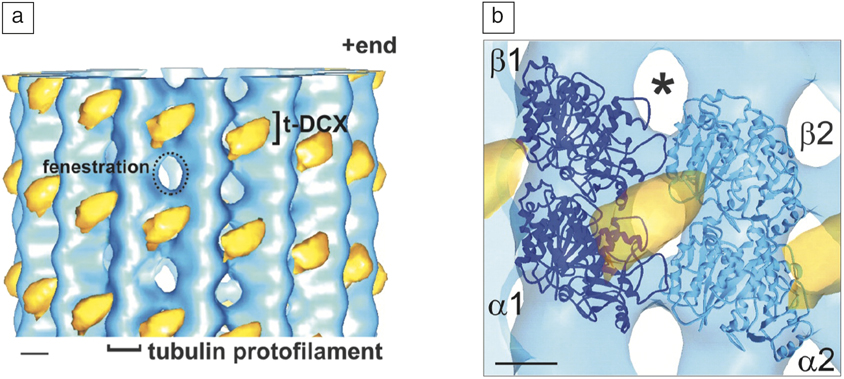
For nonbiological materials, we will need to rely on designer chemistries to create molecules and materials with binding sites at optimal affinity, density, and location to enable programmed binding and unbinding. This process will need to be multiscale—occurring at the molecular level to design polymers that will self-associate into larger assemblies, but can be disassembled by some external trigger. The larger assemblies will also need to be patterned to tune their interaction with each other to form even larger, macroscopic materials. The patterning of the molecules or elements of the smaller scale can create patterns on the surface of the larger-scale elements. As an example, the microtubule filament made of tubulin dimers displays a surface of binding sites for associated proteins, but these binding sites do not exist on the individual dimers. It is only in the assembly of the larger structure that the correct chemistry and steric interactions are created (Figure 2).Reference Moores, Pereriset, Francis, Chelly, Houdusse and Milligan16
Example of designer chemistry of biological machines. (a) Microtubule structure with the microtubule-associated protein, doublecortin (t-DCX, yellow) bound to the surface. The doublecortin can only bind to the polymerized microtubule, and not to the individual alpha–beta tubulin dimers (α1–β1 and α2–β2), since the binding site shape and interactions only exist after the filament is formed. (b) Higher-resolution structural focus on the interaction between the dimers of the microtubule lattice and the doublecortin. The asterisk denotes a hole in the microtubule wall. Reprinted with permission from Reference Reference Moores, Pereriset, Francis, Chelly, Houdusse and Milligan16. © 2004 Elsevier.

Active matter
We described the elements that make up biological matter at each scale as machines. The word “machine” implies not only the ability to perform work or a function, but also the need for an energy or fuel source. Biological systems at each level require energy to perform the work and to create the next level of complexity. The physics behind such many-body systems of machines is at the heart of many active-matter investigations.
We are just beginning to understand how adding energy to a system to create propulsion, assembly, and disassembly, or other processes can alter the steady state from the equilibrium state. The emergent properties of higher-order alignment, assembly, and large-scale motion with activity can enhance the equilibrium processes to occur faster, or might cause an entirely different state to occur. We will need to understand the fundamental principles behind active-matter systems to design the active, autonomous materials of the future.
Several areas of active matter are being explored that are likely to have significant and fruitful impact on autonomous material design. One system being studied is self-propelled colloid particles. One type of active colloid, the Janus particle, named for its “two-faced” design named after the Roman god, requires designer chemistry to alter the surface chemistry of one face of the particle so that it can perform a chemical reaction to propel the particle.Reference Zhang, Grzybowski and Granick17,Reference Walther and Müller18 For instance, a platinum coating will react with hydrogen peroxide to release gas.Reference Brown and Poon19 Such active colloids can self-propel, collectively interact to “flock,” and run parallel to the edge of a confined space.Reference Das, Garg, Campbell, Howse, Sen, Velegol, Golestanian and Ebbens20,Reference Theurkauff, Cottin-Bizonne, Palacci, Ybert and Bocquet21 The chemistry on the surface does not need to be perfectly hemispherical, but it does require an asymmetry to select a directionality preference. If colloids are randomly decorated with protein enzymes, there will be a direction that will have more enzymes.Reference Ma, Hortelão, Patiño and Sánchez22,Reference Patiño, Feiner-Gracia, Arqué, Miguel-López, Jannasch, Stumpp, Schäffer, Albertazzi and Sánchez23 These colloids can be propelled by the enzyme activity through the binding and release of product.
Another active-matter system is the so-called Quincke rollers, named in tribute to G.H. Quincke who first documented the spontaneous rotation of small spherical particles immersed in liquid dielectrics and subjected to strong electrostatic fields in 1896.Reference Quincke24 This system of colloidal particles is made from an insulating material, such as a polymeric bead, in a conducting fluid.Reference Bricard, Caussin, Desreumaux, Dauchot and Bartolo25 When an electric field is applied to the system, the colloids can roll due to spontaneous symmetry breaking of the charge gathered on the surface. Such colloids have been used to demonstrate flocking and collective motion in confined spaces. These active-matter systems could be useful in the future for autonomous materials since they are electric-field-activated and do not rely on chemical fuels that would need to be replenished.
Another interesting self-propelled active-matter system is volatile emulsion droplets, typically oil in water, that have an excess of surfactant on the surface.Reference Ban, Kobayashi, Suzuki and Nagatsu26,Reference Thutupalli, Seemann and Herminghaus27 Due to the high surfactant concentration, higher than the critical micellar concentration, the surfactant would prefer to form micelles. In the process of pinching off micelles from the larger oil droplet, there is a symmetry breaking, and the droplets propel themselves, irreversibly shrinking as they move. Another interesting phenomenon is that, since the droplets prefer to move to regions of lower micelle concentration, they avoid their own previous locations—making a trail that acts as a memory for the droplets.Reference Krüger, Klös, Bahr and Maass28
Biological active-matter self-propelled particles are often asymmetric. For instance, bacteria have been a long-used system of self-propelled rods.Reference Lushi, Wioland and Goldstein29,Reference Wu, Jiang, Kaiser and Alber30 Similarly, cytoskeletal filaments (microtubules and actin filaments) have incredibly high aspect ratios, since they are on the order of 5–25 nm in diameter and 2–30 µm long. Further, microtubules are very stiff with a high persistence length (Lp ∼ 1 mm). The persistence length is the length scale over which thermal fluctuations in the bending of a beam become uncorrelated. Actin filaments are far floppier (Lp ∼ 15 µm). The contour length (the literal end-to-end length along the filament) of actin can easily reach the persistence length, giving various regimes for self-propelled active matter made from actin filaments. Objects with high aspect ratios are useful because they should form bundles or nematic ordering at high concentration.Reference Onsager31 Self-propulsion due to the associated motors appears to enhance the effect—enabling these particles to form nematic order at lower concentrations than in the absence of motility.Reference Baskaran and Marchetti32,Reference Farhadi, Fermino Do Rosario, Debold, Baskaran and Ross33 Interestingly, both actin and microtubules have been demonstrated to form polar order when propelled by motors along a surface. Actin filaments show polar alignment in the absence of a crowding agent, which is disrupted to nematic order when crowding agents are present.Reference Huber, Suzuki, Krüger, Frey and Bausch34,Reference Schaller, Weber, Semmrich, Frey and Bausch35 Microtubules show polar alignment in the presence of a crowding agent, such as methylcellulose or poly(ethylene glycol),Reference Baskaran and Marchetti32 but not as well in the absence of crowders.Reference Liu, Tüzel and Ross36
Work from noise
Self-propulsive colloids, Quincke rollers, cytoskeletal filaments, and bacteria are only ballistic over short length- and time scales. On longer time scales, they have a rotational diffusion that causes them to reorient and ultimately randomize. Thus, these active, energy-using systems are inevitably explained by equilibrium thermodynamics. Although this makes us feel nice and safe because we understand thermodynamics and statistical mechanics of equilibrium systems, it is not exactly what we desire for learning new physics or creating autonomous materials from these subunits. Indeed, we are looking for new, emergent phenomena from these systems; specifically, we want to create large-scale work and triggered responses.
We can again learn from biological systems about how to direct random, active systems to glean productive work from noise. For instance, it is not enough to grow microtubule or actin filaments in the cell at random locations in time and space. That would not allow for the mobility of cells or the splitting of chromosomal DNA. The active processes must be organized to achieve productive, directional results. The cell combines the designer chemistry of interacting species to direct and rectify the work of the active elements. For the cytoskeleton, the act of binding filaments together creates bundles that are all pointed in the same direction to increase their force production. We can observe these self-organized structures that perform work in biological systems, but we do not yet know how to design systems that can replicate the self-organization on many levels.
Unlike biological systems that self-organize to rectify their motion at all levels, human-constructed active-matter systems have been coupled through confinement into tracks or using physical barriers.Reference Bricard, Caussin, Desreumaux, Dauchot and Bartolo25,Reference Angelani, Di Leonardo and Ruocco37–Reference Galajda, Keymer, Chaikin and Austin39 These human-constructed systems can make many active particles move together, harnessing their activity to get productive work from the noisy system. Yet, these constructed systems are still contrived and not emergent, like biological systems. Future work on the self-organization of the rectifiers that can further guide active-matter systems is needed to create autonomous materials.
Work and information
For the processes previously described, to gain active work from the system, we need to lower its entropy. In thermodynamics, we do work to put particles in a small box that can be expanded by the gas to get work. For active-matter systems, we could use designer chemistry to decorate reactive chemistries that propel larger particles using the turnover of chemical reactions. This all makes sense, but if a material system is really going to sense its environment and decide on a response, the system might also need to store information.
This article focused on the concept of work as the effect of machines. Human machines and other machines we build are actually useful for storing and generating information. Biological systems can store, review, evaluate, and use information from their environment to perform their autonomous sensing and response functions. We are just beginning to understand how molecular-, cellular-, and tissue-level biological systems can store information and use it later. Even a microtubule filament appears to be able to store stress information when undergoing dynamic instability.Reference Coombes, Yamamoto, Kenzie, Odde and Gardner40,Reference Gardner, Zanic and Howard41 Proteins can encode this information through post-translational modifications, which are chemical changes that affect the size and charge of the protein. Biological systems can also create a mechanomemory, a mechanical analog of storing information about past mechanical stress on a system.Reference Schmoller, Fernández, Arevalo, Blair and Bausch42,Reference Li, Ha and Chemla43 Further research on mechanical memory or computing will be essential to understanding, designing, and utilizing materials for sensing and response in the future.
Summary
The materials of the future will be autonomously capable of sensing their environment and responding to solve problems of fatigue and erosion. These exciting materials will lead to self-healing and adaptive materials for infrastructure technologies. We are still a long way away from understanding the principles by which such autonomous materials will work, but we can learn about them by studying active, biological materials. In biological systems, there are no leaders, governances, or project managers directing traffic or telling the individual machine elements what to do. At each scale, the activities of the machines performing the work are performed autonomously and actively. In this perspective, the concepts of active-matter, designer chemistries coupling active systems that produce work and store memories were discussed, but there is still much to learn. It is an exciting time to be in science because we are just beginning to understand the fundamental principles of such energy-using, nonequilibrium, active-matter systems.
Acknowledgments
J.L.R. has been supported to work on active matter and biomaterials by the following grants: NSF MRSEC DMR-1420382 to S. Fraden, ARO MURI Award 67455-CH-MUR to S. Thayumanavan, Moore Foundation and Research Corp. Scialog Award 4308.1, NSF INSPIRE Award 1344203, and Mathers Foundation Award. Thanks to Z. Dogic for the citation from Liebniz about machines made from other machines. Thank you to the numerous scientists who have interacted with me over the past two years on the topic of active matter, especially those who attended the Work from Noise Workshop in October 2017 at the University of Massachusetts Amherst and the 2018 MRS Spring Meeting in Phoenix, Ariz.

Jennifer L. Ross is a professor of physics at the University of Massachusetts Amherst, where she co-directs the Massachusetts Center for Autonomous Materials. She earned her PhD degree in physics from the University of California, Santa Barbara, and completed postdoctoral research at the University of Pennsylvania in the School of Medicine. Her research focuses on the organization of the microtubule cytoskeleton and microtubule-based enzymes using high-resolution and single-molecule imaging techniques. Ross can be reached by email at rossj@physics.umass.edu.