1. Introduction
Recent catastrophic events, such as the 2010 Haiti earthquake and the 2011 earthquake and tsunami in Japan, have brought the human and the material costs of natural disasters to public attention worldwide. Although the immediate impacts of large disaster events are often well documented, little is known about their long-term economic effects. Almost all of the research on the economic and human toll of disasters focuses on the short term – i.e., the impact of the disaster in the first couple of years. The difficulty, of course, is to identify any long-term impacts and distinguish them from other post-disaster occurrences. A decade after an event, how many of the observed changes in an economy can confidently be attributed to the event itself?
Hurricane Iniki hit the Hawaiian island of Kauai on 11 September 1992, and was the strongest hurricane to hit Hawaii in recorded history. It wrought an estimated US$ 7.4 billion (2008) of direct damage. Iniki is worth investigating for several reasons: (1) there are now 17 years of detailed post-disaster economic data as well as a similar amount of pre-disaster data; (2) the hurricane was both unexpected and unusual and thus clearly an exogenous event; (3) the other Hawaiian Islands, which were not hit by the hurricane, provide an ideal control group; and (4), as we document below, Hawaii's experience with disasters is not unique, as the economy of Kauai is similar in important respects to other small islands.
We use a methodological innovation recently formalized in Abadie et al. (Reference Abadie, Diamond and Hainmueller2010) and previously employed in Abadie and Gardeazabal (Reference Abadie and Gardeazabal2003) to estimate the impact of ETA terrorism in Spain on the Basque economy. The methodology is based on simulating conditions after an exogenous event based on the relationship to a control group. Kauai's similarity to the other Hawaiian Islands, which are subject to almost identical initial conditions and subsequent shocks with the exception of Iniki, enables us to implement this methodology and obtain a more precise estimation of the long-term impact of a natural disaster. We suspect that the reason no similar study of the long-term impacts of a natural disaster exists is due both to limitations in data as well as methodology. The model presented by Abadie et al. (Reference Abadie, Diamond and Hainmueller2010) presents an estimation technique for this conundrum, however, as weighted projections from the control group can be made with a relatively small sample.
Any investigation into the long-term effects of natural disasters is non-trivial since both growth theories and current attempts to empirically examine them obtain contradicting results. Growth theories, for example, can suggest either a growth spurt after a massive destruction of capital, a permanent or temporary growth slowdown, or no observable effect beyond the very short term. We thus start our investigation of Iniki's impact without strong priors.
In the next section, we discuss relevant empirical work regarding the ex-post impacts of large disaster events. The interested reader can also consult a more comprehensive recent survey (Cavallo and Noy, Reference Cavallo and Noy2011). In sections 3 and 4, we describe the economy of Kauai as well as Iniki's initial impact on the island. Section 5 details the Abadie et al. (Reference Abadie, Diamond and Hainmueller2010) synthetic control methodology in the context of Iniki, and section 6 describes our results regarding the long-term impact of Iniki on Kauai's economy and population. Section 7 concludes with a discussion of these results and implications for other islands, particularly in the context of predicted climate change.
2. The economics of natural disasters
Research on disasters' impact on the economy is arguably still in its infancy, with few papers systematically examining the dynamics of the economy following disaster events. Several research projects examine the economics of specific natural disaster events – such as the 1995 Kobe earthquake in Japan (Horwich, Reference Horwich2000), the 2001 earthquake in El Salvador (Halliday, Reference Halliday2006), the 1999 earthquake in Turkey (Selcuk and Yeldan, Reference Selcuk and Yeldan2001) and the 2005 Hurricane Katrina (Vigdor, Reference Vigdor2008).
Although this body of research is certainly relevant to this work, these analyses were written shortly after the events and thus report solely on their short-term impacts. If they do project or estimate longer term impacts, they are often unable to separate this effect from other trends and shocks that would have occurred regardless of the disaster. For example, Vigdor (Reference Vigdor2008) documents significant population declines in a carefully constructed investigation of Katrina's impact on New Orleans. However, as Vigdor readily acknowledges, it is impossible to separate these declines from a general declining trend in the area's population that long predates Katrina (and which Katrina clearly accelerated).Footnote 1
The first attempt to empirically generalize the macro-aspects of natural disasters is by Albala-Bertrand (Reference Albala-Bertrand1993), in a book which develops an analytical model of disaster occurrence and reaction based on a set of 28 disaster events (1960–1979). Surprisingly, Albala-Bertrand finds that after these large natural disasters GDP increases, capital formation speeds up, agricultural and construction output increase, the fiscal and trade deficits increase (the trade deficit sharply) and international reserves increase.
Tol and Leek (Reference Tol, Leek, Downing, Olsthoorn and Tol1999) and Skidmore and Toya (Reference Skidmore and Toya2002) argue that the positive effect on GDP can be readily explained since disasters destroy the capital stock, while the GDP measure focuses on the flow of new production generated by this destruction. Leiter et al. (Reference Leiter, Oberhofer and Raschky2009), in a firm-level study, similarly find that sudden flooding events lead to higher short-run growth rates and employment for affected firms. On the other hand, Noy (Reference Noy2009) and Noy and Nualsri (Reference Noy and Nualsri2007) use panel data techniques with cross-country macroeconomic data sets and find adverse short- and long-run effects on GDP growth, respectively. Yet, using similar techniques and data sets, Strobl (Reference Strobl2008), Noy and Vu (Reference Noy and Vu2010), and Loayza et al. (Reference Loayza, Olaberría, Rigolini and Christiaensen2009) either identify only relatively small negative impact, or distinguish between impacts on different geographical regions or sectors by differing types of disasters.Footnote 2
Two research projects have investigated the impact of hurricanes on economies in the Caribbean. These studies are likely to provide more insight into the case of Kauai's Iniki because of the similarities between island economies. Rasmussen (Reference Rasmussen, Sahay, Robinson and Cashin2006) conducts a tabulation of the data for the island members of the Eastern Caribbean Currency Union (ECCU). He finds that: ‘Among these … the median number of affected persons amounted to 9 per cent of the country's population and the median value of damage was equivalent to 14 per cent of the country's annual GDP’ (Rasmussen, Reference Rasmussen, Sahay, Robinson and Cashin2006: 7).Footnote 3 This analysis, however, is restricted in its methodology to solely identifying average short-term effects.
Similarly, Heger et al. (Reference Heger, Julca and Paddison2008) focus on Caribbean islands (not limiting themselves to ECCU countries). Their results do not agree with the earlier (largely optimistic) research concluding that disasters are typically followed by a period of higher growth. They find that, as growth collapses, the fiscal and trade deficits both deteriorate and the island economies of the region find it difficult to rebound from the short-term impact of the disaster. They relate this deepening recession to the reliance of island economies in the region on very few sectors – typically, and like Kauai, primarily tourism.
Other impacts of disasters have been investigated somewhat infrequently. Most importantly, little is known regarding the fiscal impact of large disaster events. On the expenditure side, the reconstruction costs to the public may be very different from the original magnitude of destruction of capital that occurred (see Fengler et al., Reference Fengler, Ihsan and Kaiser2008). On the other side of the fiscal ledger, the impact of disasters on tax and other revenue sources has also seldom been quantitatively examined (for recent comparative research, see Borensztein et al., Reference Borensztein, Cavallo and Valenzuela2009; Noy and Nualsri, Reference Noy and Nualsri2011).
3. Kauai and Hawaii's economy
The Hawaiian Islands are home to nearly 1.3 million people and tourism is the largest private sector industry. The state is comprised of four counties: the City and County of Honolulu, Hawaii County, Maui County and Kauai County.Footnote 4 Although the counties differ in terms of population and aggregate economic activity, they are nonetheless quite similar in terms of their sector composition.
Similarly to many other islands, Hawaii's economy is largely characterized by tourism. In 2005, over 7 million visitors arrived in Hawaii and spent US$ 16.3 billion. This accounted for 22 per cent of Hawaii's gross state product (State of Hawaii, 2008a). The island of Oahu is by far the most populated. In 1991, the year before Iniki hit Kauai, the resident population of the City and County of Honolulu (Oahu) was 850,500. Hawaii County's population was 127,300, Maui County's was 105,600, and Kauai County's was 53,400. In the same year, real per capita income (US$ 1982–1984) was US$ 16,500 for the City and County of Honolulu, US$ 11,500 for Hawaii County, US$ 13,400 for Maui County and US$ 13,100 for Kauai County. As for visitor arrivals, there were 4.8 million visitors to the City and County of Honolulu, 1.1 million to Hawaii County, 2.2 million to Maui County and 1.2 million to Kauai County (UHERO, 2010).
Tourism is clearly the largest economic driver of Kauai's economy, where direct tourism expenditures account for 28 per cent of economic activity (State of Hawaii, 2008b). In terms of intermediate industries, notable sectors include real estate transactions (comprising 6 per cent of total economic activity) and hotels (3 per cent). Although Kauai (and Hawaii) has a rich agricultural history, plantations throughout the islands have been in rapid decline since the 1970s. Agricultural activities account for only 0.1 per cent of Kauai's economy (State of Hawaii, 2008b). The federal government, through military-related activities, demands US$ 39 million in Kauai goods and services, or about 1 per cent of total economic activity. Most of the federal government's military presence is on the island of Oahu (at 11 per cent of Oahu's total economic activity) (State of Hawaii, 2008b). Although these indicators reflect Kauai's post-Iniki economy (in 2005, as the latest available figures), their relative composition was similar pre-Iniki.
As the most populated island and the home of state government, Oahu serves in many ways as the ‘hub’ of economic activity in the state. For example, in 2005, of the US$ 406 million in exports from Kauai, 60 per cent were directed to Oahu. Only 8 per cent were directed to Hawaii County and 9 per cent to Maui County. Twenty-two per cent were exported out of the state (State of Hawaii, 2008b). This trend is similar for the other neighbor islands – where Oahu is by far the largest consumer of goods from the other counties.
While no county is identical to Kauai, the other counties nonetheless provide a suitable ‘control group’ for Kauai. In particular, Maui County and Hawaii County are the most similar to Kauai due to their relative size and similar relationship to Oahu. All counties (including Oahu) nonetheless share a reliance on tourism and non-traded services as the main engines of economic activity, with a limited amount of agricultural export products. There are no other significant export sectors or domestic manufacturing. Since the counties (islands) are largely exporting comparable products and services (mostly tourism) they are likely to be subject to similar external political and economic shocks. Around the time of Iniki (11 September 1992), the islands were affected by deep recessions in both California and Japan; the vast majority of tourists to Hawaii come from these two places.
Not only do the counties share similar economic structures (albeit different in size) but, since they belong to the same state, they are subject to the same institutional and legal frameworks. Most taxes are handled at the state level and therefore most expenditures are also decided at the state level; for example, the public education system includes a single state-wide school district.
The differences between islands, particularly in the relative size of their economies, are accounted for in our estimations by the relative weights used to construct the ‘synthetic counterfactual’ for Kauai, i.e., what Kauai's economy would have been without Iniki.
4. Hurricane Iniki
Hurricane Iniki was the third hurricane to hit Kauai in the past 50 years (after Dot in 1959 and Iwa in 1982), but the direct destruction wrought by Iniki was unprecedented. The category 4 hurricane (Saffir-Simpson Hurricane Scale) landed on the south shore of Kauai in the afternoon hours of 11 September 1992. The Centre for Research on the Epidemiology of Disasters' (CRED's) Emergency Events Database (EMDAT), the most comprehensive and credible international data source on natural disasters, estimates that four people were killed, 25,000 were affected and there was US$ 7.4 billion (2008) in destruction of infrastructure and property.Footnote 5 According to the National Oceanic and Atmospheric Administration (NOAA) (1993), 14,350 homes were damaged or destroyed on Kauai, electric power and telephone service were lost throughout the island and only 20 per cent of power had been restored four weeks later. Likewise, crop damage was extensive. Sugarcane was stripped or severely set back, tropical plants such as banana and papaya were destroyed, and fruit and nut trees were broken and uprooted.
While this well describes the initial impacts to Kauai from Iniki, the indirect impacts have gone undocumented until now. This analysis focuses on the long-run indirect economic impacts to Kauai from Iniki. The challenge, however, is to isolate the outcomes of the disaster event.
5. Methodology – synthetic control for comparative case studies
As discussed previously, Kauai was experiencing the effects of a prolonged and painful recession in Japan and, to a lesser extent, in the continental USA at the time of the Iniki event. The other Hawaiian Islands were also experiencing the impacts of the recessions. At the time, Japan was important for Hawaii's economy both because of the dominance of Japanese tourism in international arrivals, and the very large inflows of Japanese foreign investment, especially in real estate. To separate the effect of the hurricane from the effect of the Japanese recession and the aftermath of the Gulf War and the US recession, a counterfactual scenario for Kauai without the hurricane is established. We employ a methodology originally introduced by Abadie and Gardeazabal (Reference Abadie and Gardeazabal2003) to develop a ‘synthetic’ Kauai. Their synthetic control methodology, used to evaluate the impact of terrorism in Spain, is further formalized and discussed in Abadie et al. (Reference Abadie, Diamond and Hainmueller2010), where it is illustrated in an assessment of the impact of Proposition 99 in California on tobacco use.
What is immediately striking about the methodology put forward by Abadie and Gardeazabal (Reference Abadie and Gardeazabal2003) and Abadie et al. (Reference Abadie, Diamond and Hainmueller2010) is the ability to use the synthetic control methodology to estimate unbiased coefficients with relatively few pre-event observations. In Abadie and Gardeazabal (Reference Abadie and Gardeazabal2003), although data availability varies by indicator, the ‘synthetic Basque country’ is estimated with as few as 13 years of pre-event data. For example, their annual GDP data start in 1955 and the first terrorist event is in 1968. The study in Abadie et al. (Reference Abadie, Diamond and Hainmueller2010), which formalized the validity of the synthetic control methodology with an application to California's tobacco control legislation, is conducted with annual data from 1970 to 2000. The event of interest, Proposition 99, passed in 1988. Thus the data available for this study of Iniki are very similar to that of Abadie et al. (Reference Abadie, Diamond and Hainmueller2010), with 17 years of pre-disaster data.
Another key element of the synthetic control methodology is the presence of an appropriate control group. In comparative case studies which aim to identify the impact of a specific event, the research necessarily relies on an event of a relatively large magnitude and the presence of comparative units of observations that do not experience the event. Kauai's Iniki is clearly a relatively large event and, as previously discussed, Kauai has natural comparative units of observation (the other Hawaiian Islands) that are both very similar and have not directly experienced the event.
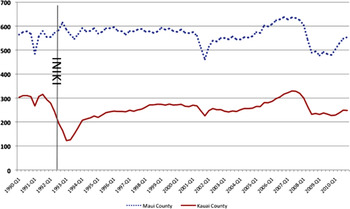
Although the other Hawaiian Islands were not directly affected by Iniki, this does not mean there were no indirect effects. The most notable is that in the days and weeks that followed Iniki, visitors to Kauai were rerouted to Maui. This, however, was a temporary effect, as can be seen in figure 1.
Total visitor arrivals to Kauai and Maui (seasonally adjusted, in thousands)

The aggregate data show that, directly following Iniki, while there is a continued downturn of visitors to Kauai, there is a coinciding increase in visitors to Maui. To verify that our results are not tainted by this temporary re-routing, we develop estimates for ‘synthetic Kauai’ based on: (1) all other counties, and (2) only Hawaii County and the City and County of Honolulu (i.e., excluding Maui County). The second set of estimates is not presented because they are qualitatively and quantitatively very similar and available upon request. This shows that the effect of re-routing visitors was thus quite insignificant, largely because of its temporary nature.
The second way in which the other Hawaiian Islands may possibly have experienced an indirect impact of Iniki is through the migration of Kauai residents. Given the ‘hub and spokes’ nature of the economy of Hawaii, however, it is unlikely that much immigration occurred from Kauai to Maui or Hawaii County and, moreover, none is observed in the aggregate data. In addition, any migration to Oahu would be difficult to observe since the population of Oahu is almost 15 times that of Kauai. Because this effect is not observed in the aggregate data (and our findings, discussed below, suggest that the relationship is not spurious), we proceed under the assumption that the other counties indeed provide a suitable control group.
5.1. Model
Let Y it be the outcome variable that shall be evaluated based on the hurricane's impact (e.g., income per capita) for county i, (with i = 1 for Kauai and i > 1 for the other Hawaii counties) and time t (for time periods t = 1, … T 0, … T; where T 0 is the time of the event); while Y itI is the outcome variable in the presence of the hurricane and Y itN is the outcome variable had the hurricane not occurred.Footnote 6 The model requires the assumption that the event has no effect on the outcome variable before the date of impact T 0(Y itI = Y itN ∀t < T 0). Although this last assumption is unjustified in cases where disaster impact is frequent and therefore expected, Hawaii had not experienced a hurricane since 1982 and never at this magnitude in recorded history.
The observed outcome is defined by Y it = Y itN + αitD it where αit is the effect of the hurricane on the variable of interest (Y itI − Y itN) and D it is the binary indicator denoting the event occurrence (D it = 1 for t ≥ T 0 and i = 1; and D it = 0 otherwise). The aim is to estimate αit for all t ≥ T 0 for the county of Kauai (i = 1). The problem is that for all t ≥ T 0 it is not possible to observe Y 1tN but only Y 1tI.Footnote 7
Although there is no way of accurately predicting the county-specific determinants of Y it entirely, the structure of the economies in all the counties is similar and the external shocks affecting them (except for the hurricane) are identical (except for mean zero iid shocks εit). In this case, Y 1t can be calculated as the weighted average of the Y it (for i = 2, …, J) observations from the other counties; i.e., Y 1tN = δ+ ∑j=2J ωjY jtN + α1tD 1t + ε1t. For pre-impact observations (t < T 0) this equation can be estimated to obtain the weights allocated to the different county observations, ωj.Footnote 8
The following estimation equation is used for each variable of interest, based only on the pre-impact observations, to obtain estimates for δ and ωj:
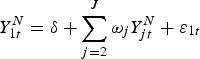
Abadie et al. (Reference Abadie, Diamond and Hainmueller2010) show that, under acceptable assumptions, one can estimate αit for t ≥ T 0 by calculating:

where the second term on the right-hand side of the equation is calculated using the weights ( ) estimated in equation (1) and the post-impact observations for the different counties.
The estimates of equation (1), reported in the appendix, are only used for constructing the counterfactual as accurately as possible. Thus we are not interested in the actual coefficient estimates of these regressions since they have no economic significance or otherwise interpretable meaning.
The usual statistical significance of our reported results, based on regression-based standard errors, is not relevant in this case since the uncertainty regarding the estimate of  does not come from uncertainty about the aggregate data. Uncertainty in comparative case studies with synthetic control is derived from uncertainty regarding the ability of the post-treatment synthetic control to replicate the counterfactual post-treatment in the treated observations. Following Abadie et al. (Reference Abadie, Diamond and Hainmueller2010), we use permutation tests to examine the statistical significance of our results. We separately assume that every other county in Hawaii is hit by a similar event in the same year. These ‘placebo disasters’ are used to produce the counterfactual synthetic control and then to examine the distribution of predictions in cases in which the treatment (the disaster) did not occur. Essentially, we apply the synthetic control comparison method to all of the potential control observations, and from these calculate averages and standard errors, and test whether our predictions for
 are statistically different. This placebo-effects methodology is described in more detail and also extended to multiple treated cases in Cavallo et al. (Reference Cavallo, Galiani, Noy and Pantano2010a).
6. Kauai after Iniki and the counterfactual synthetic control
The choice of variables we observe and analyze is purely based on data availability in terms of both pre- and post-Iniki trends. We are not testing a specific theory of post-disaster developments, largely because no such comprehensive theory exists and speculations regarding usual post-disaster developments are varied and numerous. The indicators available for this analysis are employment, resident population, personal income, per capita income, and transfer payments.
The massive destruction of property and infrastructure resulted in a dramatic rise in unemployment. Unemployment was already inching up from a low of around 3 per cent in 1990 to 6.8 per cent just before the hurricane, as the Japanese economy was suffering from the aftermath of its real estate and stock market bubbles. However, immediately after the hurricane, unemployment on Kauai shot up to 19.1 per cent. It took Kauai's labor market 7 years (until 1999 Q2) to recover to its previous pre-Iniki unemployment rate of 7 per cent.
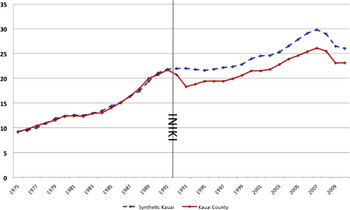
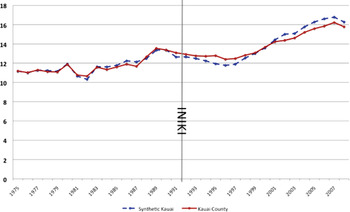
Figure 2 presents private sector employment for both Kauai and its synthetic counterfactual (the no-hurricane synthetic Kauai). This and subsequent figures compare the post-disaster observed outcomes for the island of Kauai (Y 1tI) with the counterfactual constructed by calculating the synthetic no-disaster Kauai as 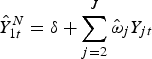 .Footnote 9
Total private sector employment in Kauai and synthetic comparison (in thousands)

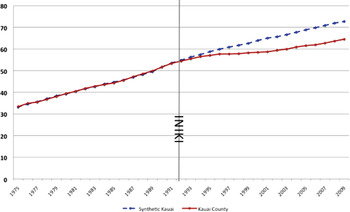
Figure 2 suggests that the recovery from the disaster impact was indeed long in coming. The number of private jobs available did not return to pre-Iniki levels until 2002, but even then, the recovery never brought Kauai back to its pre-Iniki trend. A simple calculation suggests that Kauai experienced a permanent loss of about 3,400 private sector jobs (almost 15 per cent of employment on the island). A similar picture can be observed when the populations of both scenarios (counterfactual and observed) are examined in figure 3.
Resident population of Kauai and synthetic comparison (in thousands)

Both Kauai and its synthetic comparison seem to follow a similar population trajectory, with both experiencing a fairly constant increase in population in the period 1970–1992. However, Kauai's population trajectory shifts in 1992. For several years following Iniki, Kauai's population grew much more slowly. Although it began to grow more rapidly again around 1999, population growth rate remained fairly modest even during the 2000s. As such, Kauai never regained the population that left after the hurricane. It is evident that Kauai's population would have been about 12 per cent higher had Iniki never happened. In that sense, Kauai seems to have permanently ‘lost’ about 12 per cent of its population. Using the synthetic Kauai data, we calculate that Kauai's resident population would have been around 72,700 instead of the 64,500 who lived there in 2009.Footnote 10
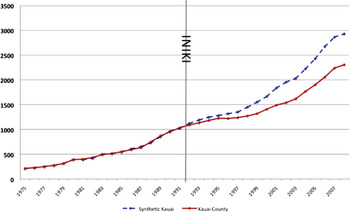
A similar picture is evident when examining the personal income of both Kauai and its synthetic comparison (see figure 4). This amounts to about US$ 650 million (2007) which has disappeared from Kauai's economy every year. It is observed, however, that the loss in personal income on the island was more gradual; probably since the adjustment of the local economy to lower labor and population numbers was gradual. The information about per capita income presented in figure 5 suggests that the main long-term impact of the hurricane was in reducing population rather than altering per capita variables.
Personal income on Kauai and synthetic comparison (in millions of current US$)

Real per capita income on Kauai and synthetic comparison (in thousands of 1982–1984 US$)

The trend lines between the actual and synthetic Kauai are quite similar. In fact, the actual per capita income of Kauai is slightly higher than its synthetic estimate for several years following Iniki.Footnote 11 This suggests that those who ‘weathered the storm’ were not necessarily left worse off.
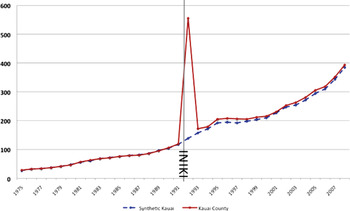
A reason why Kauai's experience with Iniki could have been much worse becomes evident through an examination of the amount of funds Kauai received from state and federal sources (figure 6). The spike in funds associated with Iniki likely enabled a quicker recovery than otherwise would have been the case. However, even with this massive increase in transfers to the state government (about US$ 450 million – almost a five-fold increase), by most measures the economy of Kauai only recovered after nearly a decade, and by some measures it has never fully recovered.
Transfer payments for Kauai and synthetic comparison (in millions of current US$)

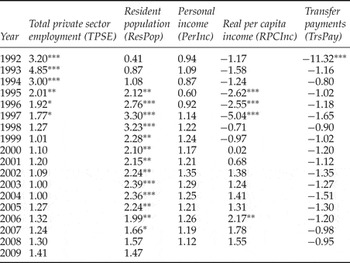
As we described in the previous section, calculating the statistical significance of our results involves constructing ‘placebo’ disasters and calculating their effects. Table 1 presents the results of these placebo-permutation tests for figures 2–6.
Confidence intervals for impact results

Table 1 presents t-statistics for the difference between the actual and synthetic observations for each dependent variable (column) and post-Iniki Year (row).”
***, **, *Significant at the 99%, 95% and 90% confidence levels, respectively.
Our central result, that population and employment took years to recover, is indeed highly statistically significant (for six years and 13 years following the hurricane, respectively). The difference in aggregate personal income, on the other hand, is not statistically significant, while the difference in real per capita income is statistically significant for only a few years after the hurricane.
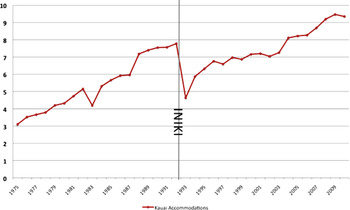
Pre-hurricane data in the tourism sector, the largest sector in both employment and income, are unfortunately not available, so any claims about the importance of the tourism sector in the long-term post-hurricane dynamics cannot be substantiated. Figure 7, however, provides insight into the number of hotel rooms available on Kauai before and after Iniki.
Hotel accommodations for Kauai (in thousands of rooms)

This shows that the number of accomodations did not return to pre-Iniki levels until a decade after the disaster event (2003). Thus the reason for the relative decline in visitor arrivals (as shown in figure 1) is more likely explained by a supply constraint than a change in demand.
While the synthetic control methodology we use does not allow us to identify the actual mechanisms that determined this prolonged path to recovery of visitor arrivals, the story of the Coco-Palms Hotel is quite illustrative. Coco Palms, founded in 1953, was the most luxurious resort on Kauai. It was internationally famous and featured in a number of movies including Elvis Presley's Blue Hawaii. The property was heavily damaged by the hurricane and still lies abandoned in disrepair. A stated combination of the weakened housing market and failure to obtain relevant permits has led the current owner to abandon a recent rebuilding project. The property is still undeveloped and its future unclear (Heckathorn, Reference Heckathorn2010). The case of Coco Palms suggests that the prolonged effect of Iniki is exacerbated by both coordination failure and regulatory delays.
As such, the major finding of this analysis is that Kauai experienced a permanent contraction of its population as a result of Iniki, with similar implications for employment. The large employment sector, hotels, was obviously dramatically struck by Iniki and there was little substitution to other industries. The agricultural sector of Kauai had already started its decline several decades earlier (with the rapid closure of sugar and pineapple plantations across the state), and other major employers similarly did not necessarily expand operations. For example, the primary military activity on Kauai was and still is the Pacific Missile Range Facility. It has been in operation since 1958 and there is no evidence that it adjusted its activities as a result of Iniki. Without additional employment opportunities beyond reconstruction, there was an outmigration of Kauai residents.
7. Conclusion
Seventeen years of hindsight and a comparison methodology with an appropriate control group makes it possible to assess the long-term economic damages of Hurricane Iniki to the island of Kauai. In spite of massive US federal and Hawaii state transfers to the county (transfers that were nearly five times larger in magnitude than the island's previous receipts), it still took seven years for Kauai to return to its pre-Iniki unemployment rate.
The presence of a large fiscal stimulus is important, given much recent work that predicts that disasters are more likely to hit poorer countries in the future (van Aalst, Reference van Aalst2006). Poor developing countries are less likely to be able to adopt counter-cyclical fiscal policies (Ilzetzki and Végh, Reference Ilzetzki and Végh2008); this will make the disaster's adverse consequences more severe. Haiti, following the January 2010 earthquake, is unlikely to receive its reconstruction needs, in spite of a massive international mobilization and a well-publicized donor conference held a couple of months after the disaster (see Cavallo et al., Reference Cavallo, Powell and Becerra2010b). In addition, sectoral dislocations that are triggered by the disaster can result in permanent inefficiencies that are probably connected to various governance failures, in particular a ‘resource curse’ and inflexible labor markets (McMillan and Rodrik, Reference McMillan and Rodrik2011).
Yet, even in a fairly developed region and with the backing of a deep-pocket fiscal authority, the disaster we examined still resulted in an out-migration of residents from which the county's population has never fully recovered. Kauai ‘permanently’ lost about 12 per cent of its population and a similar share of its income. So while, seven years after the hurricane, income per capita returned to its pre-hurricane level, the overall economy has never fully recovered.Footnote 12
These issues, of course, are not unique to Kauai, and we suspect that massive destruction in other tourism-dependent areas will likely face similar reconstruction difficulties. Kauai, however, is part of a larger political entity and thus is characterized by comparatively easy out-migration. Island nations, on the other hand, would likely experience substantially worse long-term impacts of a large disaster event because there is less ease in out-migration at the national level.
In addition, islands are considered especially vulnerable to the effects of climate change and increased frequency or intensity of ‘extreme events’ (Mimura et al., Reference Mimura, Nurse, McLean, Agard, Briguglio, Lefale, Payet, Sem, Parry, Canziani, Palutikof, van der Linden and Hanson2007). This assessment is based on the physical implications of climate change on island ecosystems and subsequent social implications for island economies. Islands have proportionately larger coastal areas, are dependent on ocean ecosystems, and often have limited fresh water availability. In addition, they are often tourism dependent, have narrow export markets and a large import base, as well as limited agricultural production. This research suggests that there are potentially prolonged impacts from disaster events, considerably worse on a per capita basis in the case of limited out-migration or lack of disaster relief funds, and thus there is a great need for planning to reduce the economic vulnerability to disasters in island economies.
While this analysis provides no specific recommendations on disaster mitigation strategies, it sheds light on the ‘true’ costs of a disaster event. The long-term impacts of disaster events are, in a sense, ‘hidden’ due to the difficulty in attributing them to an event with the passage of time. As this study documents, the long-term costs of disasters can be substantial and thus should not be ignored when cost-benefit analyses of disaster mitigation and resiliency programs are used to determine policy choices.
Appendix

***, **, *Significant at the 99%, 95% and 90% confidence levels, respectively. Regression results describe the a priori relationship between Kauai and the other counties of Hawaii constructed using data from 1975 to 1991. The data were obtained from a database maintained by the University of Hawaii Economic Research Organization (UHERO), publicly available at http://uhero-kauai.prognoz.com/.