Traditionally, Intermittent Explosive Disorder (IED) was interpreted as an impulse-control disorder, sharing some characteristics with other described disorders, such as Obsessive-Compulsive Disorder (OCD) (Potenza, Koran, & Pallanti, Reference Potenza, Koran and Pallanti2009) or Bipolar Disorder (McElroy, Reference McElroy1999) and subsequently, was considered as part of the same continuum, not a disorder itself. Nevertheless, the study of IED has largely advanced during the last years; it was observed that the disorder is more common than previously thought, and although comorbidity with other mood anxiety, or substance consumption disorders is frequent, and can lead to confusion, there are certain evidences that justify considering it as a delimited disorder itself (Kessler et al., Reference Kessler, Coccaro, Fava, Jaeger, Jin and Walters2006). Some defining criteria are the elevated levels of aggression, impulsivity, familiar risk of aggression and some abnormalities in the neurobiological markers of aggression, suggesting the inclusion of IED as a single disorder in the DSM-V (Coccaro, Reference Coccaro2012).
IED, according to the DSM-IV (APA, 2000), is characterized by a difficulty to resist the urge to carry out a recognized harmful behavior, and is more frequently found in males, arising usually in the late adolescence. IED is identified by the presence of isolated episodes in which the person is unable to control aggressive impulses, generating violence against others, propriety destruction, or violent and antisocial behaviors. Even during stability interludes, general impulsive and aggressive traits are detected in these patients. Some signs of abnormal brain structures were identified and could explain the emergence of violent behaviors: hypofunction of the prefrontal cortex or hyperactivity of subcortical structures, which are responsible for emotional modulation and linked to the impulsive form of aggression (Alcazar-Corcoles, Verdejo-Garcia, Bouso-Saiz, & Bezos-Saldana, Reference Alcazar-Corcoles, Verdejo-Garcia, Bouso-Saiz and Bezos-Saldana2010).
A central symptom of IED is aggressiveness; both physical and verbal aggressiveness are commonly found (McCloskey, Lee, Berman, Noblett, & Coccaro, Reference McCloskey, Lee, Berman, Noblett and Coccaro2008). This recurrent problem is associated with impulsive-aggressive behaviors (Coccaro, Reference Coccaro2000), and also linked to some abnormalities, usually found in the cortico-limbic circuits, that are known to modulate aggressive behaviors and to the central serotonergic activity, associated with the regulation of this kind of behaviors. There are three neural systems implicated in the aggressive behavior: 1) subcortical systems that support the production of aggressive urges, 2) circuits responsible for decision making and socio-emotional information processing that evaluate the consequences of resolving or refusing to attack and 3) fronto-parietal regions implicated in emotion-regulation and the necessity to conduct motivational impulses (Coccaro, Reference Coccaro2011). Furthermore, neuropsychology of impulsivity is related to dysfunctions in the orbito-frontal cortex, dorsolateral cortex and anterior cingulated regions, being consequently involved in cognitive mechanisms of inhibition: prepotent inhibition, interruptive inhibition and interference control (Kertzman, Grinspan, Birger, & Kotler, Reference Kertzman, Grinspan, Birger and Kotler2006). Functionally, we can observe impairments in reinforcement processing, a tendency toward risk-taking and pleasure- and sensation-seeking (Wright, Rickards, & Cavanna, Reference Wright, Rickards and Cavanna2012). Executive function impairments are predominantly found among impulse-control disorders, showing difficulties in organizing stimuli and using cognitive resources.
Pharmacological interventions are the most common ways to manage IED symptoms (Amara, Richa, & Bayle, Reference Amara, Richa and Bayle2007), and cognitive-behavioral therapy (CBT) is also recommended, but in the most severe cases, in which aggressive outbursts are uncontrollable, surgical procedures (Patel, Aronson, Sheth, & Eskandar, Reference Patel, Aronson, Sheth and Eskandar2013) as stereotactic amygdalotomy (Mpakopoulou, Gatos, Brotis, Paterakis, & Fountas, Reference Mpakopoulou, Gatos, Brotis, Paterakis and Fountas2008) or even deep brain stimulation of the orbitofrontal projections (Maley, Alvernia, Valle, & Richardson, Reference Maley, Alvernia, Valle and Richardson2010) are suggested in order to control those sudden aggressive behaviors (Faria, Reference Faria2013; Nuttin, Gabriels, Cosyns, & Gybels, Reference Nuttin, Gabriels, Cosyns and Gybels2000). Regulation of emotions is mediated by a complex circuit that involves the orbitofrontal and cingulated cortex and the amygdala, as well as interconnected regions (New et al., Reference New, Hazlett, Newmark, Zhang, Triebwasser, Meyerson and Buchsbaum2009; Rosell & Siever, Reference Rosell and Siever2015) Dysfunctions in serotonergic projections to the frontal cortex are involved in impulsive violence (van de Giessen et al., Reference van de Giessen, Rosell, Thompson, Xu, Girgis, Ehrlich and Siever2014), with dysfunctions in the limbic system eliciting experiences of abrupt aggressive behaviors without requiring environmental triggers. Therefore, controlling those pathways surgically would help to manage the symptoms or to improve their intensity, stabilizing the safety of the patient and others (Coccaro, McCloskey, Fitzgerald, & Phan, Reference Coccaro, McCloskey, Fitzgerald and Phan2007; Kim & Lee, Reference Kim and Lee2008). Different neurosurgical treatments have been employed as treatment for some therapeutically intractable mental illnesses; for instance, diverse procedures have been employed in Tourette Syndrome (TS) with different results (Porta, Cavanna, Zekaj, D’Adda, & Servello, Reference Porta, Cavanna, Zekaj, D’Adda and Servello2013).
Something that we did not find among the literature regarding the disorder is the association between symptomatology and neuropsychological factors that are identifiable within the patients. By neuropsychologically assessing an unusual case of IED patient at two different moments of his treatment, we intended to amplify the knowledge of the cognitive factors involved in control-impulse disorders.
Case Report
JML is a 43 year-old single male, diagnosed with IED according to DSM-IV-TR criteria (2000). He lives with his father and does not work or study at the moment of the study. As personal antecedents, we highlight fetal suffering after a twin pregnancy, slow childhood motor function development, but good school performance. When he was 13 years-old, he was diagnosed with Tourette Syndrome, with complete remission at the beginning of adulthood. At 15 years of age, he was diagnosed with OCD (APA, 1980). Subsequently, on the same year, IED was finally identified due to continuous familiar aggressive episodes. Impulse-control disorders were thus classified along his lifespan, and were maybe identified as different disorders depending on the principal symptom at the moment of the diagnosis. There is a great body of literature that associates neurodevelopmental factors with the concurrence of different impulse-control disorders (Eddy, Rizzo & Cavanna, 2007), as was the case of JML.
He had two episodes of meningitis at the ages of 16 and 23, followed by greater social isolation. At the age of 29 and after the decease of his mother, he suffered from aggressive periods and finally he went to prison. One year later, he was incapacitated due to recurrent behavioral incidents. After 5 years without remission of symptoms along with antidepressant (SSRI: fluvoxamine/ venlafaxine) and anticonvulsant (clonazepam and topiramate) pharmacological treatment, psychosurgical treatment was proposed.
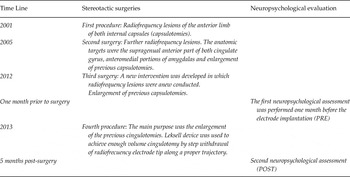
The patient underwent stereotactic surgery four times. Procedures are summarized in Table 1. In 2001, the first procedure consisted in radiofrequency lesions of the anterior limb of both internal capsules (capsulotomies). Four years later, due to the failed response to the previous treatment, new radiofrequency lesions were performed in a second surgery. In this occasion, the anatomic targets were the supragenual anterior part of both cingulate gyrus, anteromedial portions of amygdalas and enlargement of previous capsulotomies. In 2012, the patient remained unresponsive to treatment; aggressive-impulsive episodes continued and were hardly controlled, in which he was involved repeatedly into street fighting and continuously threatened family and neighbors, eliciting legal problems, thus a new intervention was developed. A fourth procedure was then conducted. The main purpose of this last procedure was the enlargement of the previous cingulotomies. Leksell device was used to achieve enough volume cingulotomy by step withdrawal of radiofrecuency electrode tip along a proper trajectory. There were no post-operative complications.
Surgeries and Assessments to JML

Informed consent was every time obtained from JML and all procedures were fully explained to him and his family. The study was accepted by the ethics commission of the “Hospital 12 de Octubre”. JML gave his approval to the publication of this article.
Neuropsychological Evaluation
The first neuropsychological assessment was performed in the fourth session of the surgical procedure, one month before the electrode implantation. Pharmacological treatment in this first assessment was venlataxine 300mg per day and topiramate 200mg/day. Neuropsychological assessments were divided into three sessions, and were always performed at the same time, on the first period of the morning, in order to control the effects of fatigue. The second evaluation was performed six months after the first assessment, and thus, five months after surgery. No pharmacological treatment at the second assessment was prescribed, and it was also performed in three sessions.
The neuropsychological tests chosen to examine the cognitive functioning before and after the electrode implantation were:
Wisconsin card sorting test (WCST). (Heaton, Chelune, Talley, Kay, & Curtiss, Reference Heaton, Chelune, Talley, Kay and Curtiss2009)
This test provides a measure of cognitive flexibility and strategy maintenance, and it is one of the classical tasks to examine executive functions.
Trail Making Test (TMT)
Part A: it measures processing speed.
Part B: this test provides an estimation of shifting attention, and thus it assesses both alternate attention and attentional control.
Verbal Fluency Test-FAS (Spreen & Strauss, Reference Spreen and Strauss1998)
This test assesses phonological and semantic fluency and capacity to access to lexical storage.
Rey-Osterrieth Complex figure-copy (ROCF; Rey, Reference Rey1994)
This is a neuropsychological assessment that examines visual-perceptual capacities, praxia, planning and both short-term and long-term memory.
Stroop test (Golden, Reference Golden2010)
The test examines processing speed, selective attention and provides information about the cognitive inhibition capacity of the subject, that is, interference control. The Stroop version that we used for the neuropsychological assessment required temporal limit to perform the task.
Conner’s Continuous Performance Task (CPT; Conners, Reference Conners2004)
The CPT is a task-oriented computerized assessment of attention disorders. This test examines specifically selective and sustained attention capacity, vigilance and the capacity to accurately manage attentional resources. In this specific task, subjects are told to press a button only when they perceive letter “X”, and to avoid pressing the button when other letters appear. Therefore, a measure of inattention is obtained when participants do not response to “X” stimuli, and as well a measure of impulsivity is provided when they response to any letter but letter “X”.
Wechsler Adult Intelligence Scale-IV (WAIS-IV; Wechsler, Reference Wechsler2012)
Matrix reasoning: for the evaluation of abstract non-verbal reasoning ability.
Digits Span: this test is a measurement of attention and short memory span.
Block design: for the examination of non-verbal intelligence and reasoning.
Digit symbol coding test: it measures visual-motor speed.
Picture arrangement: this test measures visual perception, and the ability to differentiate essential from inessential details.
Behavioral Assessment of the Dysexecutive Syndrome (BADS; Wilson, Alderman, Burgess, Emslie, & Evans, Reference Wilson, Alderman, Burgess, Emslie and Evans1996)
The battery of tests was designed to assess the effects of dysexecutive syndrome; a cluster of impairments generally associated with damage in the frontal lobes of the brain. These impairments include difficulties with high-level tasks such as planning, organizing, initiating, monitoring and adapting behaviors. More specifically, the tests we selected were: Rule shift cards task, Key search task, Action Program Test, Zoo map, Temporal Judgment and Six Components task. This set of tests was developed to examine executive functioning performance in real-world tasks.
Neuropsychological results before and after electrode implantation
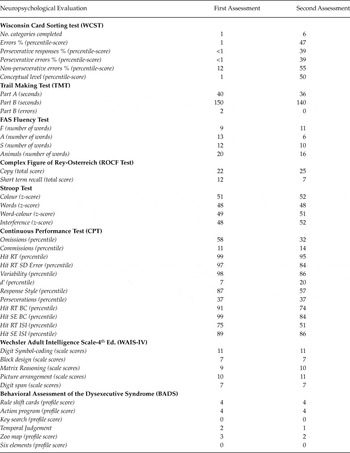
Differences between the two assessments - before and after electrode implantation- in neuropsychological performance can be found in Table 2. Tests were grouped according to the general abilities they measure, in order to have a better understanding of JML performance.
Neuropsychological performance before and after electrode implantation

Visual-perceptual capacity
The tests used to study visual-perceptual capacity were: Matrix Reasoning, Block Design, and ROCF. Regarding the first test, the patient showed a slight improvement after electrode implantation. In Block design, the subject showed the same low performance for the two moments. The score for ROCF was low in the two assessments, although the patient showed a small improvement after surgery. In both evaluations, the copy of the figure was unstructured, without a planning for sequence, and with a disrupted perceptual organization. Therefore, results suggest that, although there was some improvement in visual-spatial skills after surgery, the impairments still persisted when praxis was required, which is commonly related to OCD.
Processing speed
Digit Symbol Coding Test and TMT-part A were used. Regarding the Digit Symbol Coding Test, JML obtained the same performance before and after surgery, which indicated that his performance in processing speed was within the normal range. In pre-surgery TMT-A, he showed a normal processing speed to complete the task, and after surgery the performance was even better. Therefore, IED did not impair the processing speed functioning in this patient.
Attention
In CPT, the patient showed a 66% profile of clinical symptoms before surgery, whereas after surgery, the clinical profile decreased to 50% of clinical symptoms. These results indicated an improvement in his attentional functioning. In accordance with these outcomes, in pre-surgery assessment, omissions and commissions committed throughout the task denoted a low performance level, whereas post-surgery omissions and commissions were within normal range. Pre-surgery reaction time was atypically slow during the test performance, and the variability and the reaction time errors were mildly atypical, with inattention scores. In post-surgery assessment, even though the omissions’ percentage was within the normal range, the rest of the measures were still below the normal range. Therefore, few commissions were still shown, with a slow processing speed in the successes, and little consistency within the task. In both assessments, this fact could be explained by the existence of fatigue during the task, it could be explained as JML was decreasing his response-capacity and needed to change his reaction time to perform the task. The detectability was also good, before and after surgery. Consequently, good results in selective attention were found, and thus, the capacity to select relevant stimuli was preserved.
Impulsivity problems did not appear in JML performance, whereas low vigilance level was observed. The response style indicator was markedly different, and showed that JML was more conservative on the responses he displayed. He only replied when he was sure about the response, and thus, this response style was the origin of the low percentage in both commissions and omissions scores. However, in the post-surgery assessment, his response-style was normalized into the normal range, showing that the effort to control the response ‘per se’ decreased, being an indicator that there was a decrease in the cognitive rigidity he showed before surgery (i.e., JML showed an improvement in cognitive flexibility). Levels of behavioral impulsivity were normal, with an inferior number of commissions, as result of his response style. Post-surgery, the patient showed an increase of his reaction time, with changes in response consistency as the test progressed, which suggests inattention and high variability. Although some general improvement among sustained and selective attention were found after surgery, there were some deficits at this level that still persisted.
Concerning TMT-B, JML committed two errors before electrode implantation, whereas after surgery good performance was observed. This indicates the existence of alternate attention deficits before surgery and the appearance of reduction of those impairments after the electrode implantation. In relation to attentional span, measured by means of Digits, the level of the patient was low for the two assessments. These results suggest the improvement of attentional functioning at higher levels, whereas these effects were not obtained for simpler attention tasks.
In the Stroop Test, all the scores were within the normal range before and after surgery. This indicated that selective attention capacity of the patient was normal, as well as his attentional control capacity. The aptitude of interference-control was preserved in this patient, and this may suggest that he was able to perform correctly in a cognitive-inhibition task.
Executive functions
FAS, WCST and subtests from the BADS were used to examine executive functions. Regarding fluency capacity (FAS), the functioning of the patient was similar before and after surgery, showing a performance within the normal range. A good performance in this task involves an appropriate strategy of searching among the semantic or phonetic storage, as well as the activation and inhibition of the information networks related to the cue given to get access into the memory. About WCST performance, there was a significant improvement after surgery; pre-surgery, the patient showed a higher number of perseverative responses, perseverative and non-perseverative errors, and a lower conceptual level than post-surgery, which indicated that pre-surgery, JML showed a lack of cognitive flexibility, thus he did not benefit from the feedback given by the evaluator in order to change his classification criteria, and had a high level of perseverative responses. These results indicated subsequently better cognitive flexibility in the patient after electrode implementation, with similar results to his normative group. After the intervention, JML was able to use the external information in order to change his classification criteria and he showed adaptive behavior to the requirements of the task (i.e., he was cognitively flexible).
The BADS battery was used to obtain a global performance of the patient on his executive functioning. On the whole, the performance before and after surgery did not show any change. In relation to Rule Shift Cards, the performance was good pre and post-surgery, which showed an appropriate capacity in flexibility when the rule-conditions were simple. JML showed a correct performance to develop a plan of action when resolving a problem by manipulating materials (Action Program Test) in both assessments. However, on the Key Search Task his performance was very low, with an inefficient planning, regardless of achieving the required task, the resources used were excessive observing an obsessive search along the two assessments. The Temporal Judgement Test showed that his temporal estimation was inappropriate in both moments: pre and post-surgery.
In the Zoo Map tasks results, the performance was within normal range before surgery and slightly worse post-surgery. There was a change among the execution time, whereas in the first assessment, JML required an excessive time to plan the task, and committed some errors, possibly due to failures in his working memory. However, among the second assessment, the time to plan was scarce and there was a lack of adherence in following the rules. In both assessments, the subject failed to successfully complete the Six Components Task. This task involves two of the abilities that were impaired in JML; the capacity to follow a sequencing rule and allocating time to each task. JML was unable to plan the task when time limits were required, as well as when some rules were needed to be followed in order to perform the task.
Reasoning / comprehension
Regarding Picture Arrangement, there was a slight improvement after surgery. However, both scores indicated a performance within the normal range at this level. This indicates that performance was preserved, and any effect was produced after surgery.
Discussion
Before surgery, JML showed neuropsychological impairments when task-demand increased. Therefore, his performance was low and unattended through the examination and showed poor efficacy among behavioral and cognitive control when the fatigue increased. His behavior was not always impulsive, but the loss of inhibitory capacity seemed to be notorious when the task was more demanding or was longer. After surgery, there was a significant change in the management of attentional resources and thus the performance in attention tasks that required less effort to control his behavior improved. Another significant change was the increase in his cognitive flexibility, which allowed him to use external information to modify his behavior.
However, deficits after electrode implantation still persisted on planning, visual-perceptual capacities and attentional span. Regarding planning, low performance was related to high-demanding situations, in which there were no clues from the evaluator and also involved the adjustment within a temporal limit. Planning is a cognitive capacity that is highly necessary in order to achieve a successful functioning in daily life. Impairment on this ability will imply deficits on the management of common situations.
Neuropsychological deficits in IED are mainly characterized by executive functioning impairments. Electrode implantation surgery as possible treatment may improve cognitive performance at this level. The results obtained in JML assessments partially support this idea, although improvement in executive functions did not appear in all areas, and planning deficits were observed after surgery. The patient also showed important deficits in visual-perceptual organization and ability, and a low attentional span, before and after surgery. These impairments are commonly found in OCD, and JML was also diagnosed with this disorder. Deficits at these levels may be more related to OCD diagnosis, than to IED diagnosis. But it is hard to delimit deficits that have many features in common. Hollander and Rosen (Hollander & Rosen, Reference Hollander and Rosen2000) suggested that impulse control disorders may be conceived as part of the OCD spectrum (Hassan & Cavanna, Reference Hassan and Cavanna2012). It is difficult to find neuropsychological descriptions of patients diagnosed with IED; although the disorder is more frequent than previously thought, it presents a high comorbidity with other psychiatric disorders, so it is not easy to make an exact description of functional characteristics of these patients.
Combined pharmacologic and psychotherapy treatments are the most commonly used in IED (Siever, Reference Siever2008), but in some cases in which aggressive behaviors are unsustainable, surgical procedures searching to modify neuroanatomical elements that are known to produce disruptive and aggressive behaviors are used.
The most notorious finding of this case report was the improvement of cognitive flexibility and alternate attention after electrode implantation. Before surgery, the patient showed rigid behavior, did not use external feedback to improve his performance, and presented deficits in alternate attention, whereas after the electrode implantation, JML showed an appropriate cognitive flexibility and no dysfunction at alternate attention. Cognitive flexibility deficits may also be related to increased aggressiveness, thus improvements at this level may involve a reduction of the impulsivity and aggressive behavior that characterize IED. This case report highlights the importance of considering neuropsychological functioning for the diagnosis of IED, as well as the cognitive improvement that electrode implantation produces in some executive functioning, in a severe case of IED. Finally, and regarding the aggressiveness behavior, their family and clinicians reported some improvement in his self-control after electrode implantation, and this was also reported by himself probably because the improvement in some cognitive functions may have involved a better self-control of his aggressiveness. It is noteworthy to mention that this was a severe case of IED, with long-term evolution of the disease, as well as co-morbidity with other psychiatric pathology.
There is still scarce research on cognitive functioning in IED, thus further investigation should be carried out to obtain a better understanding of this disorder. Neuropsychological aspects of patients with IED need to be further studied in order to construct rehabilitation and psychotherapy treatments, in reducing symptoms and adverse behavioral outcomes of impulsive aggressive outburst.
For preventing executive function impairments and helping the patients to control their behavior, it would be desirable to have a complete assessment of every neuropsychological function in order to properly prepare an individual rehabilitation program that may help the patient to better manage in daily life and to be able to better take advantage of behavioral treatments and better control aggressiveness, impulsivity and general behavior. Simple pharmacological surgical treatments seem to be not enough (by themselves) for a decrease of symptoms and for obtaining successful copying abilities that will permit the patient a correct reintegration into family, society and work. For reorganizing these aspects of life, we should remember that the improvement of cognitive competences is needed in their inhibition, attention and executive functions in particular. Neuropsychological assessment of those aspects is then essential for constructing plausible rehabilitation programs. Further studies are needed, although we believe this is a commencement.