INTRODUCTION
A limited number of taxonomic investigations on brachyuran crabs, including Portunidae, along the Iranian coasts of the Persian Gulf and the Gulf of Oman have been conducted (Stephensen, Reference Stephensen, Jessen and Sparck1945; Bahmani, Reference Bahmani1997; Apel & Spirdinov, Reference Apel and Spiridonov1998).
The most comprehensive taxonomic work on the brachyuran crabs from the Iranian coasts of the Persian Gulf and the Gulf of Oman was carried out by the Danish Scientific Investigations for the Iranian government in 1937 and 1938 (Stephensen, Reference Stephensen, Jessen and Sparck1945). Apel & Spirdinov (1998) re-examined the portunid crabs collected by the Danish in Iran. However, large gaps still exist regarding our knowledge of the taxonomy and biodiversity of brachyuran crabs in the Iranian waters. For the very same reason this work has been focused on the intertidal portunid crabs of Chabahar Bay (north-east of the Gulf of Oman). The present study aims at taxonomic status of two species, Thalamita admete and T. prymna (Decapoda: Portunidae) as the first report for these two species from the Iranian coasts of the Gulf of Oman.
MATERIALS AND METHODS
For species identification of the intertidal portunids (swimming crabs), the samplings were carried out monthly at four stations (Figure 1) in soft bottom and rocky substrates in intertidal zones of Chabahar Bay (north-east of the Gulf of Oman) in 2007. Both Thalamita admete and T. prymna were only observed at Stations 2 and 3.
Map of the sampling area.

The specimens were collected by hand and dip-net at lower low tide. The specimens were fixed in 10% formalin–seawater buffered with borax. The specimens are deposited in the collection of the Iranian National Center for Oceanography and Chabahar Oceanographic Research Station (CORS).
SYSTEMATICS
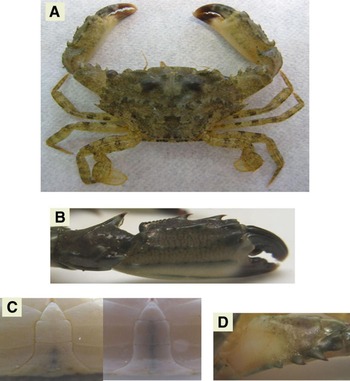
Thalamita admete. (A) Carapace dorsal surface; (B) propodus and carpus of the right cheliped; (C) male abdomen in two specimens; (D) basal antennal segment; (E) spines on anterior border of merus of the cheliped.

MATERIAL EXAMINED
Carapace measurements are carapace length × maximum breadth respectively.
Berried females (21 × 27 mm), (11 × 17 mm); male (15.5 × 26 mm), (12 × 20 mm), (14 × 23 mm), (13 × 22 mm), (12.5 × 20 mm), (10 × 12.4 mm), collected at Chabahar Bay (25°21′N 60°36′E–25°17′N 60°36′E): 21 & 24 April 2007. Male (19.5 × 24 mm), collected at Chabahar Bay (25°17′N 60°36′E): 19 May 2007.
DESCRIPTION
Characteristic features of this species have already been presented by Wee & Ng (Reference Wee and Ng1995) and Apel & Spirdinov (1998). We emphasize some features. Frontal lobes separated by a distinct notch and form an almost straight line. Inner supraorbital lobes are almost as broad as frontal lobes and orbit. Mesobranchial and cardiac ridges (especially cardiac ridge) in all specimens are weakly clear, except for one specimen (a male). There is a cardiac groove in all specimens. Pubescence restricted to the bases of anterolateral spines and the front of carapace. Fingers are short (in some specimens longer) and stumpy and have grooves. Propodus of cheliped bears six spines on the upper surface, in some specimens, two of the spines near to claw are reduced to tubercles and the upper costa on the outer surface of propodus is less prominent than two lower ones. Inner and lower surfaces of propodus are smooth. Carpus of cheliped has four spines, which in some specimens one or two spines are reduced to tubercles. Merus of cheliped has three to four spines on anterior border. Propodus of natatory leg has five to nine spines on posterior border. Merus of natatory leg has usual spine at posterior border, a spinule at the distal end and also some tubercles on posterior lower border. Carpus of natatory leg has no spines at the posterior border and is serrated on articulated part with propodus. Basal antennal segment has a granular ridge and is longer than orbit. Penultimate segment of male abdomen has nearly parallel lateral borders (in one of the specimens is completely parallel).
COLOUR
Carapace is yellowish green, yellowish or cream-brown and has reddish brown or darkish red patches that yield a dark appearance or a hue as the other parts of carapace. It also bears many small dark or bright blots. One of the specimens (male) obviously had dark bands on walking and natatory legs. Tips of pincers are fair.
HABITAT
We found this species within intertidal zones at places with sandy cobble beds. It can hide under the sand and cobble.
REMARKS
The records of Thalamita admete from different localities in the Persian Gulf have been proved to be wrong or are at least very doubtful, since this species has been confused with Thalamita savignyi (Apel & Spirdinov, 1998) that should be regarded as a distinct species (Wee & Ng, Reference Wee and Ng1995). All the specimens examined in the present collection are similar to T. admete described by Wee & Ng (Reference Wee and Ng1995) and Apel & Spirdinov (1998). This species differs from T. savignyi in the following characteristics: (1) fourth anterolateral tooth is usually markedly smaller than others; (2) frontal border form an almost straight line; (3) inner surface of the propodus of the cheliped is smooth without any granulations; and (4) T. admete is much smaller (the smallest ovigerous female of T. savignyi from the Persian Gulf measured 17.5 × 11.2 mm).
DISTRIBUTION
A widespread Indo-Pacific species, from the Red Sea, southern Oman, Madagascar and East African coast up to Pakistan, Malaysia, Japan, Australia, French Polynesia and Hawaii (Wee & Ng, Reference Wee and Ng1995; Apel & Spirdinov, 1998; Vannini & Innocenti, Reference Vannini and Innocenti2000). There are, however, no reliable records from the Persian Gulf and Gulf of Aden, where T. admete is apparently replaced by T. savignyi (Apel & Spirdinov, 1998). Also no records of T. admete from the Gulf of Oman have been published so far. In this study it was collected for the first time on the north-east coast of the Gulf of Oman (Chabahar Bay).
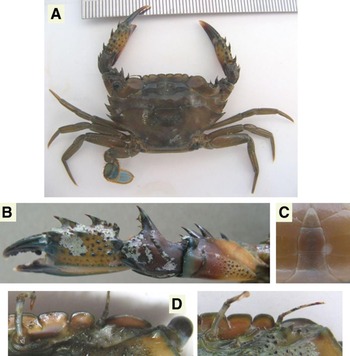
Thalamita prymna. (A) Carapace dorsal surface; (B) left cheliped; (C) male abdomen; (D) basal antennal segment in two specimens.

MATERIAL EXAMINED
Berried females (39 × 61 mm), (27 × 43 mm); female (28 × 44 mm); male (20.6 × 32.5 mm), collected at Chabahar Bay (25°21′N 60°36′E–25°17′N 60°36′E): 21 and 24 April 2007.
DESCRIPTION
The complete characteristic features of this species have already been presented by Wee & Ng (Reference Wee and Ng1995) and Apel & Spirdinov (1998). We emphasize some features. Carapace has five teeth on anterolateral border with the fourth one being rudimentary. Mesogastric ridge is continued laterally to the notch between the first and second anterolateral teeth. Fingers are somewhat elongated and have grooves. Propodus of cheliped bears two distinct costae at the lower half, of which the uppermost in longer specimens is represented by a row of rounded granules on outer surface and a more or less prominent costa on inner surface. Pubescence restricted only to bases of anterolateral spines and in front of lateral parts of the carapace ridges. Merus of cheliped bears three sharp spines on anterior border and a spinule on the distal corner of anterior border. Propodus of natatory leg has a row of tubercles and spinules along posterior border. Merus of natatory leg has usual spine at posterior border and a spinule at the distal end. Basal antennal segment is longer than orbit, bears two or more fused spines at base of antennal insertion and is granular on each side of the ridge.
COLOUR
Dorsal surface of carapace is shiny yellowish-green in some parts and orange-brown in other parts. Ventral surface is orange. Spines (in some parts), pincers, costa on propodus and some segments of walking and natatory legs are green. Tips of pincers are fair.
HABITAT
We found this species within intertidal zones at places with the cobble beds. It can hide under the cobbles. Being larger in size than T. admete, T. prymna does not seem to be able to hide inside the sandy bed.
REMARKS
The record of Thalamita prymna var. picta in the Iranian waters of the Gulf of Oman (Jask) by Stephensen (Reference Stephensen, Jessen and Sparck1945) has been proved to be wrong, since this species has been confused with Thalamita indistincta (Apel & Spirdinov, 1998), which is characterized by the presence of a supplementary tooth at the base of the first anterolateral tooth as was also stated by Stephensen (Reference Stephensen, Jessen and Sparck1945). Apel & Spirdinov (1998) have recognized four specimens clearly as T. prymna from the Tunb Islands near the Strait of Hormuz (Persian Gulf) and the United Arab Emirates (south-west of the Gulf of Oman). However, there was no record from the Iranian coast of the Gulf of Oman.
DISTRIBUTION
A widespread Indo-Pacific species from South Africa, Madagascar, the Red Sea, Gulf of Aden, the south-west of the Gulf of Oman, the south-east of the Persian Gulf, Pakistan, India, Malaysia, Indonesia and Singapore to Australia (Lovett, Reference Lovett1981; Wee & Ng, Reference Wee and Ng1995; Apel & Spirdinov, 1998; Vannini & Innocenti, Reference Vannini and Innocenti2000). In this study, this species was collected for the first time on the north-east coast of the Gulf of Oman (Chabahar Bay).
ACKNOWLEDGEMENTS
This work was funded by the Iranian National Center for Oceanography (INCO). The authors are thankful to Dr S.T. Ahyong for kind help in species identification and Dr M. Apel for kind help in species identification and for providing us with his paper. The authors would like to thank the staff of the INCO, Chabahar Research Station for their assistance.