





1. Introduction: ruins of bells
1.1. Melted bells, muted bells
In both Eastern and Western cultures, the sound of a bell serves not merely as a time-keeping tool but as a vessel for delineating spatiotemporal boundaries and establishing sacred order. However, in Japan, this order faced a devastating physical disruption in the mid-twentieth century. Following the promulgation of the National Mobilisation Law (Kokka Sōdōin Hō) in 1938 and the subsequent Metal Collection Order (Kinzoku-rui Kaishū-rei) in 1941, over 90 per cent of the bonshō in Japanese temples were forcibly requisitioned and melted down to manufacture weaponry (Figure 1). The bonshō is a type of tsurigane (hanging bell) in East Asian Buddhism; the term ‘bon’ derives from the Sanskrit ‘Brahma’, signifying divinity and silence. At the time, newspapers such as the Asahi Shimbun anthropomorphised this process, officially terming it ‘shussei’ (going out to battle), as if these bells were soldiers departing for the front lines (Tanaka Reference Tanaka2015: 15).
The requisition of bonshō during World War II.

Figure 1. Long description
A black and white photo of a person interacting with large bells in a temple setting. The individual, wearing a hat and traditional clothing, is seen using a stick to strike one of the large, ornate bells. The bells are arranged in a row, each with intricate designs and inscriptions. The background shows more bells and various decorative elements typical of a temple environment. The person appears to be engaged in a ritual or ceremonial activity.
Amidst this sonic catastrophe, a highly symbolic phenomenon emerged: after the bonshō were removed from the bell towers, many temples suspended ‘substitute bells’ made of concrete or stone to fill the visual void. These ‘mute bells’ retained the visual form of the bell but lost the capacity for phonation (Ukai Reference Ukai2022a: 182). Consequently, the damaged sites became spaces of ‘tangible silence’, while the subject of the ‘bell sound’ transformed into ‘sonic ruins’. This ‘auditory silence’ manufactured by war poses a core proposition for contemporary art: when the primordial sounds of history are physically erased, how can art narrate this ‘absence’ through the reconstruction of media?
1.2. Art from the sonic ruins
The end of the Second World War did not restore the sounds of the melted bonshō. Yet, the later development of electroacoustic music, sound art and media art provided new ways of approaching this historical silence. Fink argues that by the 1990s, sound art had become established as a practice concerned with spatialised time, interaction and heightened listening, while occupying an unstable position between art forms, media, sound and vision (Fink Reference Fink2019: 249–50). This historical instability is important for the present article. It suggests that sound art is not simply a genre category but a field in which sound, space, image, object and technology may be brought into changing relations. A mixed audiovisual work incorporating electroacoustic composition can therefore be understood within this broader intermedial development.
When sound art is situated within a history of wartime loss, however, it ceases to be merely an aesthetic experiment. It becomes a means of historical cognition. Attali famously argues that the world is not only to be seen but also to be heard (Attali Reference Attali2009: 3). In the context of the melted bonshō, this claim acquires a specific political force: the silence left by substitute bells is not an empty absence but a historical condition produced by war. To address this silence, a single auditory medium is insufficient. What is required is a method capable of connecting material ruin, auditory memory, spatial experience and visual transformation.
In a broad sense, intermediality may serve as a generic term for phenomena that, as Rajewsky puts it, ‘in some way take place between media’ (Rajewsky Reference Rajewsky2005: 46). Yet, Rajewsky also stresses that such a broad concept is insufficient for describing specific intermedial manifestations on their own formal terms. This distinction is important for the present study, since the problem at stake is not simply the addition of visual material to sound but the transformation of absence across different media. Chiaramonte situates intermedial audiovisual composition within the broader practice of intermedial composition, in which creativity may involve interaction, combination, mutual influence and interconnection among media in both time-based and non-time-based forms (Chiaramonte Reference Chiaramonte2024: 15). This provides the basis for asking how a lost sound body may be reconfigured not through restoration, but through intermedial relations.
1.3. Intermedial ruins: interference and narrativity in audiovisual practice
In this article, intermediality does not simply refer to the juxtaposition of different media but to what Antonino Chiaramonte defines as ‘intermedial interference’: a perceptual phenomenon generated by the interaction of media features in the intermedial space (Chiaramonte Reference Chiaramonte2024: 19). This definition deliberately includes both the constructive dimension of interference and its potentially disruptive dimension. To experience intermedial interference is to process a perceptual phenomenon conceptually and to unfold symbolic and metaphorical interpretations, thereby entering a potentially meaningful encounter with a media artwork.
Chiaramonte’s concept of media features is especially useful here. He defines them as expressive traits related to both form and content, including structures, rhythms, contrasts, themes, ideas, events and moods (Chiaramonte Reference Chiaramonte2024: 21). In this sense, intermedial interference does not arise simply from the physical coexistence of media but from the interaction of their specific expressive features. This provides a useful framework for the present work: the melted bell is not treated as a single object to be represented but as a cluster of sonic, visual, spatial and symbolic features redistributed across sound, image, spatialisation and historical context.
In this case, the concept of intermediality can also be understood from both the technical and aesthetic dimensions of contemporary audiovisual practice. Since the 1990s, with the development of personal computers and interactive programming environments, the synchronous generation, control and processing of sound and image in live performance and installation have become common creative strategies. Ikeshiro Ryo describes such a practice as audiovisualisation, in which the same data source is simultaneously sonified and visualised (Ikeshiro 2012, Reference Ikeshiro, Estibeiro, Payling and Cotter2025). In his work Construction in Zhuangzi, for example, the mathematical structure of the Lorenz field simultaneously generates sound and visual forms while also being associated with the Taoist metaphor of ‘Zhuangzi’s butterfly dream’. Ikeshiro’s theory emphasises that sound and image do not stand in a hierarchical relation but emerge as equal media outcomes derived from the same generative process.
A related point of reference is Nakamura Shigenobu’s notion of the ‘Eizo Onkyo Shi’, or an audiovisual poem. In comparison with Ikeshiro, Nakamura’s emphasis is not on the technical co-generation of sound and image from a single data source but on how sound and image can jointly constitute a nonverbal structural expression. He defines the audiovisual poem as ‘electronic music accompanied by visual imagery’ or as a form of computer music with images (Nakamura Reference Nakamura2008: 131–4). For Nakamura, the visual element is not an external supplement to music but a constitutive element that can change the meaning and image of sound and add new meanings to it (Nakamura Reference Nakamura2015: 24). In the creative note on his work Reassembly, he further argues that an audiovisual poem can function as a form of ‘critique’: rather than copying the original materials, it reassembles the structural relations of an existing work through sound and image (Nakamura Reference Nakamura2015: 23–6). This point is particularly important for the present article, because it shows that audiovisual work does not have to aim at representation or restoration but can instead develop a critical interpretation through medial transformation and structural reassembly.
Building on Ikeshiro and Nakamura, this article further develops their shared concern with the relation between sound and image. Ikeshiro’s audiovisualisation emphasises the synchronous transformation of a single data source into sound and image, while Nakamura’s audiovisual poem emphasises the capacity of sound and image to form a non-linguistic structural expression and even a critical form of commentary. This article shifts these two approaches to the level of a ‘conceptual source’. In the work discussed here, sound and image are not directly generated from the same mathematical data or algorithm. Instead, they are organised around the same historical and symbolic object. This object does not appear as original material to be restored but as a conceptual core that is continually decomposed, transformed and reassembled across multiple media.
This approach is closer to Chiaramonte’s notion of associative mapping than to strict parametric mapping. In associative mapping, media are linked not through direct numerical data transfer, but through shared phenomenological, perceptual or gestural attributes established as a compositional strategy (Chiaramonte Reference Chiaramonte2024: 52). This provides a useful way to understand how a conceptual source, rather than a single data source, may organise relations among different media.
Within this framework, the ‘melted bell’ can be understood as a special conceptual source: it is a sounding body that has lost its capacity to sound and a visual remnant deprived of its sonic medium. This article therefore understands it as an ‘intermedial ruin’: it is both a material ruin and a trace of sonic absence. The function of intermedial interference in this audiovisual context is not to fill this absence or to restore the bell’s original sound but to make this absence continuously appear between sound, image and space so that it becomes a condition for the ongoing production of meaning. In other words, the work constructs not a complete digital restoration but a dynamic ruin.
As the author has discussed in previous research, ruins should not be regarded as dead objects but as active ‘narrative agents’. Borrowing Christopher Woodward’s view, the ruin is a symbol that dissolves itself within the flow of time. When sound is understood as ruin, composition does not merely simulate a physical phenomenon but activates a nonlinear narrative potential, guiding the audience to reassemble memory from fragments (Liu Reference Liu2025). This narrativity does not depend on plot, character or linear development in the conventional sense. Rather, it is closer to Ryan’s scalar understanding of narrativity as a ‘fuzzy set’, in which narrative can be approached through the cognitive construct evoked by a work and through the relations it establishes among world, transformation and meaning (Ryan Reference Ryan and Herman2007: 27–30). Herman’s emphasis on ‘human experientiality’ further suggests that narrative cannot be reduced to temporal sequence alone but also concerns how events are registered as lived or felt experience (Herman Reference Herman and Herman2007: 11–12). The ‘intermedial ruin of time’ proposed in this article is therefore not a story being told but a narrative experience perceptually reassembled by the audience through sound, image, space and historical residue. The next section turns to the cosmology of bells and the compositional logic of tintinnabuli before explaining how Are You Still Melting constructs this intermedial ruin of time through algorithm, spatialisation and visual refraction.
2. The politics of bells: cosmology and algorithms
The tuning of sound, acting as a ‘signal’, plays a crucial directive and inductive role in human society. For instance, when we hear the siren of an ambulance or a police car, we instantly associate it with emergencies and danger. This ‘signalling nature’ of sound constructs the foundational order of human society.
In the Chinese context, Chenzhong Mugu (morning bell, evening drum) vividly depicts the time-keeping function of bells in ancient cities and temples, used to demarcate time and establish daily routines. Moreover, this cyclical sonic ritual symbolises a concept of existence that is both ‘regularity’ and ‘stoic’ – by strictly obeying the sound signal, people internalise the external temporal order into a self-restraining spiritual cultivation.
For the ancients, the bell was a crucial ‘communication tool’ (Kuno Reference Kuno1996: 181). Whether in gatherings, rituals or responding to emergencies, the sound of the bell was a medium capable of penetrating space and unifying crowds. Consequently, the bell constituted not only the ‘soundscape’ of daily life but also the auditory symbol of secular power and sacred order. The ‘tuning’ that determines the specific pitch and frequency relationships of the bell became the most hidden yet core link in this process of constructing order – while nominally mathematical algorithms, they are, in reality, the externalisation of concepts.
This section will introduce two distinct tuning methods centring on the theme of the ‘bell’.
2.1. Bells in ancient Kyoto: a tuning cosmology
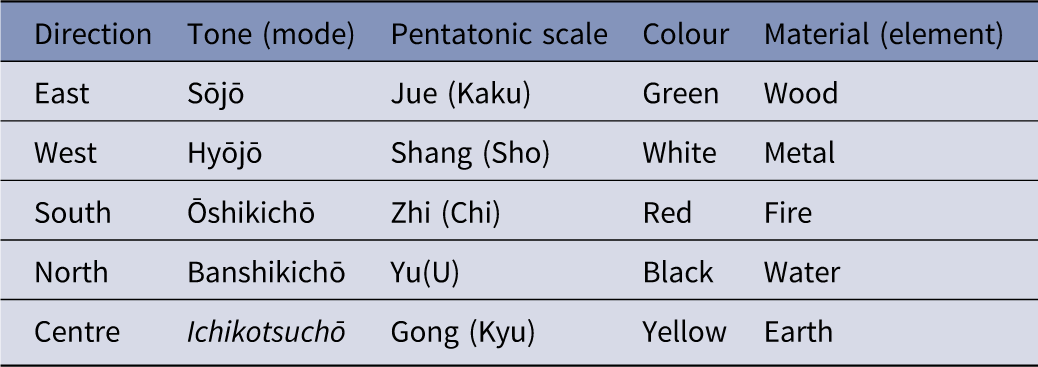
To understand the auditory order of ancient East Asia, Heian-kyō (ancient Kyoto) offers an ideal example. The city’s design blueprint was directly rooted in the traditional Chinese philosophy of the ‘Five Elements’ (Wuxing) and the idea of directional correspondence (Figure 2). This constituted a comprehensive cosmology in which the five directions – east, west, south, north and centre – corresponded, through a precise symbolic logic, to specific colours, elements, seasons, mythical beasts and sounds (Table 1).
The five elements philosophy with an ancient tuning method in Kangen Ongi.

Wuxing (Five Elements) philosophy and the relationship with direction, tones of Japanese Gagaku, pentatonic scales, colour and materials (substances)

Table 1. Long description
The table presents the relationship between the Five Elements philosophy and various attributes. It includes five main directions: East, West, South, North, and Centre. Each direction is associated with a specific tone, pentatonic scale, color, and material. For East, the tone is Sojo, the pentatonic scale is Jue (Kaku), the color is green, and the material is wood. For West, the tone is Hyojo, the pentatonic scale is Shang (Sho), the color is white, and the material is metal. For South, the tone is Oshikichio, the pentatonic scale is Zhi (Chi), the color is red, and the material is fire. For North, the tone is Banshikichio, the pentatonic scale is Yu(U), the color is black, and the material is water. For Centre, the tone is Ichikotsuchio, the pentatonic scale is Gong (Kyu), the color is yellow, and the material is earth.
Nakagawa, citing the Japanese classical music scholar Kido Toshirō, argues that Japanese sound should be understood within a worldview and cosmology based on the interrelation of material substances, directions, seasons and colours. A Buddhist temple bell, for example, should not be regarded merely as an isolated acoustic object, nor as a purely conceptual metaphysical symbol. In the mountains of Ōhara, in the north-eastern part of Kyoto, the sound of the tuned temple bell is transmitted through the temple space and becomes a medium connecting human beings with the universe (Nakagawa Reference Nakagawa1992: 28).
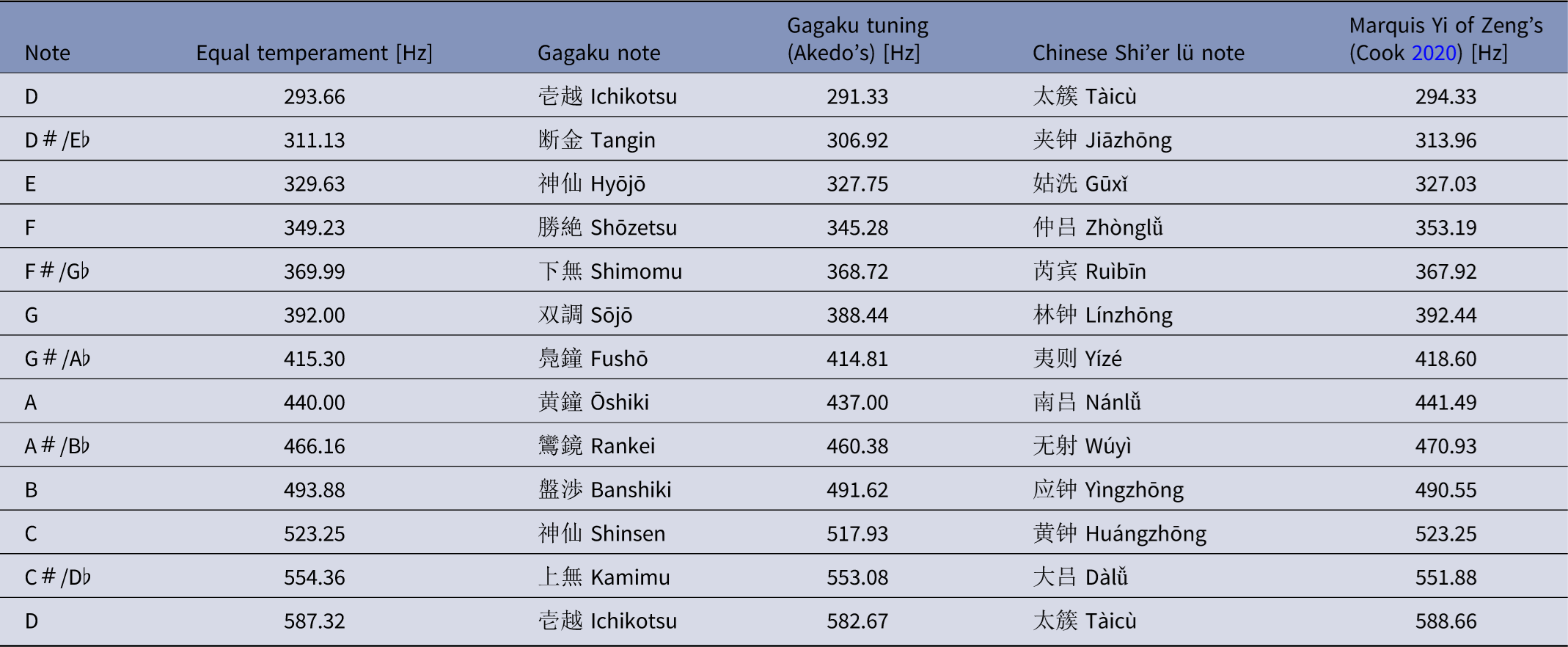
The tuning of a bonshō is based on the Sanfen Sunyi method (Three-Part Addition-Subtraction Method), a tuning algorithm originating from China that is similar to Pythagorean tuning but differs slightly in calculation details. Gagaku, the traditional Japanese court music that developed from continental musical systems, also shares this tuning background. Yet, gagaku was not only a musical system. It also functioned historically as ritual music within a broader religious sound order. The tuning data cited in this paper is based on calculations derived from extensive mathematical statistics. However, Nakagawa’s field research suggests that the actual sound of Bonshō, based on recordings and frequency analysis, is close to the traditional calculation method. In practice, slight discrepancies exist due to differences in modal calculation baselines between ancient and contemporary Gagaku, distinctions from traditional Chinese tuning and pitch deviations caused by the natural degradation of historical artefacts. The statistically estimated frequencies adopted in this article are presented in Table 2 (Akedo Reference Akedo2011).
The frequency of different tuning methods between 12-tone equal temperament, Gagaku’s 12 tones calculated by Akedo (Akedo Reference Akedo2011), and the frequency of the Marquis Yi of Zeng’s tuning (Cook Reference Cook2020)

Table 2. Long description
A table comparing the frequency of different tuning methods across 12-tone equal temperament, Gagaku’s 12 tones calculated by Akedo, and the frequency of the Marquis Yi of Zeng’s tuning. The table has 13 rows and 5 columns. The columns are labeled as Note, Equal temperament [Hz], Gagaku note, Gagaku tuning (Akedos) [Hz], Chinese Shier l note, and Marquis Yi of Zengs (Cook 2020) [Hz]. Row 1: Note, D, 293.66, Ichikotsu, 291.33, Tic, 294.33. Row 2: Note, D/E, 311.13, Tangin, 306.92, Jizhng, 313.96. Row 3: Note, E, 329.63, Hyj, 327.75, Gx, 327.03. Row 4: Note, F, 349.23, Shzetsu, 345.28, Zhngl, 353.19. Row 5: Note, F/G, 369.99, Shimomu, 368.72, Rubn, 367.92. Row 6: Note, G, 392.00, Sj, 388.44, Lnzhng, 392.44. Row 7: Note, G/A, 415.30, Fush, 414.81, Yz, 418.60. Row 8: Note, A, 440.00, shiki, 437.00, Nnl, 441.49. Row 9: Note, A/B, 466.16, Rankei, 460.38, Wy, 470.93. Row 10: Note, B, 493.88, Banshiki, 491.62, Yngzhng, 490.55. Row 11: Note, C, 523.25, Shinsen, 517.93, Hungzhng, 523.25. Row 12: Note, C/D, 554.36, Kamimu, 553.08, Dl, 551.88. Row 13: Note, D, 587.32, Ichikotsu, 582.67, Tic, 588.66.
Kōkunshō, one of the most famous historical gagaku textbooks, written in the thirteenth century, states that ‘spring is associated with Sōjō, the east, wood and green; summer with Ōshiki, the south, fire and red; autumn with Hyōjō, the west, metal and white; and winter with Banshiki, the north, and water’ (Nakagawa Reference Nakagawa1992: 37). This should not be treated as a merely static symbolic table. Tashiro’s study of Kangen Ongi shows that medieval Japanese music theory could use diagrams, pitch relations and rotational logic to present sound as an ordered field shaped by musical theory, Buddhist terminology and Five-Element thought (Tashiro Reference Tashiro2006: 25–34). The Five-Element framework should, therefore, be understood as one layer of a larger ritual sound order, rather than as a complete explanation of gagaku cosmology. Focusing exclusively on yin-yang and Five-Element thought would risk overlooking the broader religious dynamism through which gagaku was formed (Ono Reference Ono2019: 13–14).
Therefore, the ‘bells’ standing in temples across different directions in Kyoto possess significance far transcending time-keeping or religious ritual itself. They represent the embodiment of the Five Elements philosophy in the auditory dimension, functioning to guard the cardinal directions and harmonise cosmic energy. The famous opening lines of The Tale of the Heike serve as the ultimate literary resonance of this sonic cosmology: ‘The sound of the Gion Shoja bells echoes the impermanence of all things; the colour of the sala flowers reveals the truth that the prosperous must decline. The pride does not endure, they are like a dream on a spring night; the mighty fall at last, they are as dust before the wind’ (McCullough Reference McCullough2005: 23).
2.2. Bells in tintinnabuli: a spiritual duality
The construction of order through bell sound is not limited to ancient East Asia. In medieval Europe, the sounds of bells, horns and trumpets embodied power relations between lords, peasants and city governance while also mediating between religious and secular domains (Ikegami Reference Ikegami1998). In this context, Arvo Pärt’s tintinnabuli method is important because it transforms the bell from a sounding object into a compositional principle.
Born in 1935, Pärt entered the Tallinn Conservatory in the late 1950s to begin systematic musical training. His compositions emerged publicly beginning in the late 1950s and included various musical styles and techniques, such as tonal, ‘Socialist Realism’ and serialism. Most of the works at the beginning of his career as a composer were for piano in a neoclassical style. After a period of ‘self-imposed silence’ (1968–1976), Pärt emerged with a new musical style, which he termed tintinnabuli. Although this technique was influenced by medieval music such as Gregorian Chant (Cantus Gregorianus), the texture and function of its musical style cannot be described easily in terms of any single musical technique of the past.
The term tintinnabuli – coined by Pärt himself – derives from the Latin word tintinnabulum, meaning ‘small tinkling bell’. This compositional method first appeared in his piano piece Für Alina (1976). Pärt describes the philosophy behind it as follows: ‘I have discovered that it is enough when a single note is beautifully played. This one note, or a silent beat, or a moment of silence comforts me. I build with the most primitive materials – with the triad, with one specific tonality. The three notes of the triad are like bells. And that is why I called my style tintinnabulation’ (Wong Reference Wong2001: 2).
The core concept of this technique involves a combination of a two-voice texture: the melodic voice (M-voice) and the tintinnabuli voice (T-voice). This structure relates to the concept of ‘eternal dualism’, such as ‘the body and spirit’ or ‘earth and heaven’ (Kongwattananon Reference Kongwattananon2013: 8). Compositionally, these voices strictly adhere to predetermined mathematical logic rather than functional harmonic progressions. In the simplest example, the M-voice typically moves stepwise, avoiding intervals larger than a fifth or octave, while the T-voice acts as a supporting pillar, sounding the pitch of a pre-set triad nearest to the M-voice (Figure 3). The T-voice can remain above (superior) or below (inferior) or alternate between positions relative to the M-voice.
The composition method of Tintinnabuli.

Hillier reports that, in one of his discussions with Pärt, the composer described the M-voice as signifying the subjective world, the daily egoistic life of sin and suffering, while the T-voice represents the objective realm of forgiveness. The M-voice may appear to wander but is always held firmly by the T-voice. This relationship can be likened to the eternal dualism of body and spirit or earth and heaven; yet the two voices are in reality one voice, a twofold single entity (Hillier Reference Hillier1997: 96).
This relation should not be reduced to a technical rule. Hillier associates Pärt’s tintinnabuli with a mode of spiritual intensity and ‘holy poverty’ while also warning against falsely confusing the man with the music (Hillier Reference Hillier1997: 178–9). The point of the present article is therefore not to translate Pärt’s religious context directly into another cultural setting but to understand tintinnabuli as a musical model of constraint, consolation and sacred sonic order.
2.3. The order of bells: spatial cosmology and sacred constraint
The preceding two sections suggest that, in both the East Asian cosmological system and Pärt’s tintinnabuli technique, the bell functions as a mediator between the material and the sacred. In the case of ancient Kyoto, the bell participates in a spatial cosmology: pitch, direction, season, colour and elemental correspondence together form an ordered auditory world. This spatial ordering also resonates with the broader religious status of gagaku in Japan. Ono Shinryū argues that gagaku occupies an exceptional position in Japanese religious history because it was formed within the dynamics of shinbutsu shūgō, the syncretic relation between kami and buddhas. Even after the Meiji policy of shinbutsu bunri formally separated Buddhist and Shinto institutions, gagaku continued to function as ritual music across both contexts (Ono Reference Ono2019: 11).
Pärt’s tintinnabuli method transforms this bell-like symbolism into a compositional principle. Here, the bell is no longer necessarily a physical object but becomes a model of sacred constraint. The T-voice, bound to the notes of a triad, provides a stable and seemingly transcendent field within which the M-voice moves. This relationship can be heard as a musical metaphor for the tension between human wandering and sacred order or between temporal motion and spiritual stillness. In this sense, tintinnabuli does not simply imitate the sound of bells; it translates the ethical and metaphysical image of the bell into a musical structure.
This comparison is important for the following discussion of Are You Still Melting. On the one hand, the work draws on the East Asian cosmological order of bells, in which pitch and direction are connected through the logic of spatial correspondence. On the other hand, it also draws on the tintinnabuli principle, in which bell-like triadic tones suggest stability, purity and sacred restraint. The work does not reproduce either system in a historically faithful way. Rather, it treats them as conceptual and structural materials that can be gradually destabilised.
3. Intermedial interference in audiovisual practice: are you still melting
Are You Still Melting is a four-channel audiovisual live-electronics work for shō, bianzhong, electronics and visuals (Liu Reference Liu2026a). It was premiered and archived on 22 February 2025 at Kunitachi College of Music, Tokyo (Figure 4), as part of the Inter-College Sonic Art Festival 2025 (Liu Reference Liu2026b), with the shō performed by Ayako ‘Kanisasare’ Kawakami. As the second work in the Are You Still… series, it extends the author’s previous concern with ruins from architectural remains to the interrupted sound body of the melted bell. This section examines how the work constructs intermedial interference within audiovisual practice through sonic materials, visual and optical materials and their organisation around the melted bell as a conceptual source.
Are you still melting premiere at Kunitachi College of Music in ICSAF2025.

3.1. Sonic materials: gagaku, tintinnabuli and spatial deformation
Are You Still Melting is orchestrated around two historically distinct but conceptually related sound systems: the Chinese Zeng Hou Yi Bianzhong (Bells of Marquis Yi of Zeng) and the Japanese shō within gagaku practice (Figure 5). The Zeng Hou Yi Bianzhong is distinguished by its two-tone design, in which a single bell produces different pitches when struck at its central and lateral sounding areas. Measurements of a reproduced set indicate that these face-tone and side-tone pitches commonly form major- or minor-third relationships (Wang et al. Reference Wang, Li, Huang, Chiu and Lin2022: 41). In this piece, the Bianzhong represents ‘excavated time’, engaging in a dialogue with the Shō – a core instrument of Japanese Gagaku – which symbolises a ‘living tradition’.
Zeng Hou Yi Bianzhong (Bells of Marquis Yi of Zeng).

Typically, a Gagaku ensemble consists of a melodic section (Shō, Ryuteki flute and Hichiriki oboe) and a rhythmic section of percussion instruments. This work simulates and deconstructs this classic formation through the use of extended techniques on the piano and cello:
Rhythmic Deconstruction: The Shaku-Byoshi (traditional wooden clappers) of Gagaku is simulated by the percussive sound of a cello bow striking the strings (col legno battuto), combined with the heavy, percussive timbre of a prepared piano.
String Simulation: The Kakite (arpeggiated plectrum stroke) of the Gaku-biwa is simulated using samples of cello ricochet techniques, which undergo pitch shifting and spectral processing to recreate the instrument’s characteristic tension and texture.
Atmospheric Drone: The sacred, static atmosphere typical of a Gagaku ensemble is replaced by electronic synthesis. Samples of a Bonshō (Japanese temple bell) are modulated via granular synthesis to create a continuous electronic drone rich in overtones, serving as the sonic foundation of the piece.
The audio elements – Bianzhong samples, prepared piano and electronic textures – are routed to a quadraphonic speaker system positioned in the four corners of the concert hall, symbolising the four cardinal directions (north, south, east and west) of ancient city planning. This spatial arrangement mirrors traditional considerations in Gagaku staging. A notable contemporary precedent is found in the Gagaku Ensemble of Manabe Naoyuki, where musicians are evenly distributed across the four corners of the hall with percussion in the centre – a design effectively functioning as a ‘human multi-channel’ system. This work electronically reimagines that immersive ritualistic space.
The sonic design, therefore, does not reconstruct gagaku or tintinnabuli as historical styles. Rather, it treats them as systems of order that can be gradually deformed through algorithmic and spatial processes.
The micro-structure of the music is based on the tintinnabuli technique developed by Estonian composer Arvo Pärt, but here it is subjected to algorithmic variation and expansion:
M-voice (Melodic Voice): The melody begins in A major, adhering to Japanese Gagaku modal conventions, specifically starting on the note B, which signifies the North in the Banshiki-Cho mode. The pitch content centres around an F# minor pentatonic scale (F#, A, B, C#, E). As the piece progresses, the initial tonal stability is gradually eroded by chromatic progressions. This dissonance visually and aurally expresses the process of ‘melting’, eventually dissolving into a final A# sonority whose stability remains ambiguous. Stylistically, the melody breaks Pärt’s convention of stepwise motion (seconds and thirds). Instead, it constructs a vertical auditory space through wide intervals – octaves, ninths and tenths – allowing the overtone series to unfold.
T-voice (First-order Tintinnabuli): This voice establishes a cross-cultural algorithmic mapping. The sampled melody of the Chinese Zeng Hou Yi Bianzhong serves as the cantus firmus. The algorithm calculates its pitch delta (rate of pitch change) and maps this data to the root changes of the Shō’s traditional chords (Aitake). Thus, the ancient melody of the bells directly drives the harmonic motion of the Shō (Figure 6).
The Aitake (Traditional Chord) of Shō and the music score example of Are You Still Melting.

T-voice (Second-order Tintinnabuli): Functioning as the ‘T-voice of the T-voice’, this layer generates the fractured texture of the prepared piano. It takes the top-note melody of the Shō (the first-order T-voice) as its reference and strictly follows Pärt’s counterpoint rules regarding superior and inferior voices. In this way, the prepared piano acts as a sonic shadow of the Shō, completing a trans-media signal chain from the ancient Bianzhong, through the Shō, to the avant-garde piano.
This second-order treatment of tintinnabuli is also where the ethical and aesthetic stakes of the compositional method become most explicit. The work does not parody Pärt’s method or simply modernise it through algorithmic technique. Rather, it places the tintinnabuli relation under historical pressure. Hillier notes that Pärt’s music is not purely Edenic: it recognises human failure, anxiety and loneliness, while seeking the possibility of healing and transformation (Hillier Reference Hillier1997: 179). In the context of the melted bonshō, this tension becomes more radical. If tintinnabuli holds wandering subjectivity within a structure of forgiveness, the wartime melting of bells asks what remains of such consolation when the sounding body itself has been destroyed. This question also marks a limit of tintinnabuli as a model of spiritual resolution: in the context of wartime destruction, the structure of forgiveness cannot simply absorb historical violence into harmonic order. The second-order T-voice therefore makes the stability of the tintinnabuli relation perceptibly unstable, transforming a model of spiritual order into an audible process of displacement, erosion and ruin.
3.2. Visual and optical materials: model, particle and refraction
The visual layer of Are You Still Melting begins with photographs and three-dimensional models of bonshō. These materials are not used to reconstruct the bell as a stable object. Rather, the model is gradually decomposed into particles and lines so that the bell appears as a visual residue rather than a restored body.
This process is extended through the optical design of the performance. The projected image is not presented as a frontal screen image but is scattered through a spinning crystal prism sphere (Figure 7). As a result, the digital image of the bell is refracted into a fading spectrum and dispersed into the performance space. This strategy resonates with Markus Heckmann’s discussion of live visuals as ‘dissolving the screen’ and ‘moving into space’ with imagery while treating projected light as a sculptural medium (Gibson et al. Reference Gibson, Arisona, Leishman and Tanaka2023: 435).
The visual material and the reflection effect in space.

In this work, the prism and crystal sphere (Figure 8) do not simply display the image of the bell; they scatter and deform it as light. The bell therefore loses its stable visual body for a second time: first as a three-dimensional model decomposed into particles and lines and then as projected light dispersed into the room. The resulting spectrum creates an unstable optical field: the bell is no longer encountered as an object but as a dispersed trace of light.
A projection reflection test with a prism and mirror.

3.3. Intermedial interference in audiovisual composition: from data source to conceptual source
The relationship between sound and image in Are You Still Melting should not be understood as audiovisualisation in Ikeshiro’s strict sense, in which the same numerical data source is simultaneously sonified and visualised. In this work, the sonic and visual materials are not generated from identical data but are connected through shared conceptual, perceptual and symbolic features associated with the melted bell. This approach is closer to Chiaramonte’s notion of associative mapping than to strict parametric mapping, since the media are linked through shared phenomenological, perceptual or gestural attributes established as a compositional strategy (Chiaramonte Reference Chiaramonte2024: 52–53).
This intermedial strategy also distinguishes the work from a simple audio-reactive visual system. Live audiovisual performance can move beyond direct audio-input-to-visual-output relations toward more structural and multimodal mappings (Gibson et al. Reference Gibson, Arisona, Leishman and Tanaka2023: 297–298). In Are You Still Melting, the visual decomposition of the bell, the granular transformation of bell resonance, the displacement of pitch through four-channel space and the refraction of projected light do not illustrate a pre-existing story. Rather, they distribute the same conceptual source across different media. The melting of the bell is therefore not represented by one medium alone but dispersed across sound, image, space and optical distortion. On this basis, the following section turns from the work’s intermedial compositional mechanism to the question of how such distributed media processes generate narrativity.
4. Discussion: ruins of time, intermediality and narrativity
This section turns from compositional mechanism to interpretation, asking how these distributed media processes generate narrativity without relying on a conventional plot. In this sense, the work can be understood through the broader notion of audiovisual performance as a construction of experienced time (Gibson et al. Reference Gibson, Arisona, Leishman and Tanaka2023: 240–241). The ‘ruins of time’ discussed here, therefore, do not refer to a fixed historical object but to a temporal and perceptual process through which the audience encounters the bell as absence, trace and transformation.
4.1. Narrativity from concept
As discussed in Section 1.3, narrativity here refers not to plot, character or linear sequence, but to the audience’s construction of relations among audiovisual fragments, spatial experience and historical reference. This understanding of narrativity is supported by Ryan’s distinction between ‘being a narrative’ and ‘possessing narrativity’. For Ryan, narrative meaning is not simply a formal property of verbal discourse, but ‘a cognitive construct, or mental image, built by the interpreter in response to the text’ (Ryan Reference Ryan2004: 8). A work may therefore possess narrativity when it is able to evoke a narrative script, even if it is not a narrative in the literal sense. This is particularly important for nonverbal media, since Ryan notes that pictures, music or dance can have narrativity without being narratives as such (Ryan Reference Ryan2004: 9–10).
This theoretical distinction can be connected to two precedents already introduced above. Ikeshiro’s audiovisualisation demonstrates how abstract sound and image can be organised by a shared generative source, while Nakamura’s Reassembly shows how an audiovisual poem can produce meaning by reassembling the structural relations of an existing work rather than by retelling its plot. In Reassembly, Nakamura condenses Ozu Yasujirō’s Tokyo Monogatari (Tokyo Story) into six minutes, retaining its basic structure of ‘coming and going’ and its contrasts between before/after and here/there (Nakamura Reference Nakamura2015: 23–26). The narrative effect is therefore produced not through complete representation, but through structural compression, fragmentation and reassembly.
A related issue appears in Carvalho and Vieira’s discussion of Boris Chimp 504 by Rodrigo Carvalho and Miguel Neto. The work establishes a fictional premise about a chimpanzee lost in space, but its audiovisual materials remain largely abstract. Carvalho notes that if sound and image were too figurative, they would weaken the audience’s imaginative participation; instead, the base story allows the audience’s imagination to travel through abstract audiovisual forms (Carvalho and Vieira Reference Carvalho and Vieira2019: 37). This example is useful because it shows that narrativity in audiovisual performance can arise from a conceptual premise rather than from figurative storytelling.
Are You Still Melting follows this logic, but its conceptual premise is not fictional. It is the melted bonshō, a sound-producing body whose historical voice has been interrupted. The work does not narrate the history of the bell in a linear form. Instead, it distributes the bell’s absence across granular resonance, four-channel spatial displacement, particle-based visual decomposition and optical refraction. Narrativity therefore emerges as a process of conceptual and structural reassembly: the audience is invited to connect fragmented sonic, visual and spatial traces into an experience of melting, historical loss and ruined time.
4.2. Historical trauma, interruption and continuity
The Shitennoji bonshō in Osaka belonged to a temple traditionally regarded as Japan’s first official Buddhist temple, established by Prince Shōtoku in 593 AD. Ukai Hidenori, a Japanese journalist and Chief Priest of Shōkakuji Temple in Kyoto, notes that in order to counter the anti-Buddhist movement of the Meiji Period, this ‘Shōtoku Bell’ was cast to be double the size of the Great Bell at Hōkō-ji, which was the largest in Japan at the time. The monk who supervised the casting, Yoshida Genon, described the motivation behind its creation:
At the zenith of the scientific age, people have inclined toward materialism and drifted into hedonism. Spiritual religion—the very lifeblood of the Nation—has been swept from the earth and is on the verge of extinction. We aim to redeem the present age by ensuring that religion accompanies scientific progress, functioning in unison like the two wheels of a cart or the two wings of a bird. (Ukai Reference Ukai2022a: 176)
The Shitennoji bell was therefore not merely a ritual instrument but a modern Buddhist monument intended to reconnect religion, science, technology and national commemoration after the rupture of the Meiji anti-Buddhist movement. Its later destruction is consequently more than an episode of material loss. A bell created to repair a damaged religious order was itself reclassified by the wartime state as recoverable metal. The transformation from sacred sound monument to fragmented war material stages the historical rupture addressed in this article: a religious sonic order was not simply silenced but materially decomposed.
This interruption also produced a form of absence. Ukai describes concrete ‘non-sounding bells’ that remained after metal bonshō had been sent away (Ukai Reference Ukai2022b). Such objects preserve the outline and place of a bell while failing to recover its resonance. They are not restorations of sound, but material signs of a broken acoustic order. In this sense, the ruin of the bonshō is both visual and sonic: the form may remain, but the sounding body has disappeared.
Against this interrupted bell history, Omizutori, or Shuni-e, provides a contrasting model of ritual continuity (Figure 9). Held annually at Nigatsudō Hall of Tōdai-ji Temple from 1 to 14 March, with final rites continuing into the early morning of 15 March, Shuni-e is a Buddhist repentance ritual that has continued for more than 1250 years. It should not be understood merely through the public image of water-drawing or torch-bearing. Instead, it is an ‘unfaltering ritual practice’ (futai no gyōhō) that has persisted through periods of conflict and social disruption (Hashimoto et al. Reference Hashimoto, Sato and Takakuwa2012: 94–95). Its continuity is maintained not by a single object, but by a complex ritual ecology of voice, darkness, fire, water, bodily action and spatial movement.
The Omizutori (Shuni-e).

The role of the Rengyōshū, the ascetic monks who perform the rite, is crucial here. Shuni-e is not simply observed as a visual spectacle; it is enacted through repeated bodily procedures, shōmyō (Japanese Buddhist chant), footsteps, bells, handbells and ritual movements within the architectural space of Nigatsudō. Hashimoto recalls the atmosphere of the dark hall, where only the voices of shōmyō and the sound of sashikake (ritual wooden clogs) resonated (Hashimoto et al. Reference Hashimoto, Sato and Takakuwa2012: 95). Although Hashimoto does not describe this experience in terms of intermediality, his account is useful here because it shows that Shuni-e is not perceived as a visual spectacle alone. In the terms of this article, Shuni-e may therefore be understood as a ritual media field: sound, body, object and space do not simply accompany one another but jointly sustain ritual time.
This continuity is also audible in the unstable transmission of ritual sound. Makino notes that the shōmyō of Shuni-e has been transmitted orally and that notation cannot provide absolute objectivity in pitch or duration. He further observes that no instrument in the ritual functions as a reliable pitch reference; even the bell and handbell are unsuitable for determining pitch because of their timbre and ritual timing (Makino Reference Makino1965: 43, 56). Ritual sound order is therefore not a fixed acoustic grid but a process maintained, shifted and renewed through repetition, body and time.
The juxtaposition between the melted bonshō and Shuni-e is therefore not a loose cultural association. It is a structural mirror between two different fates of sacred sound. The Shitennoji bell marks a historical moment in which a religious sound body was interrupted, melted and transformed into war material. Shuni-e, by contrast, demonstrates how ritual time can persist without depending on a single stable sonic object: voice, movement, darkness, bells, handbells and the bodies of the Rengyōshū continually reassemble the ritual field. This contrast clarifies the question posed by Are You Still Melting: the work does not attempt to restore the lost bell sound but asks how the absence of that sound can be made perceptible across sound, image, space and optical refraction. The intermedial ruin constructed by the work is therefore not only a representation of destruction but also a meditation on the tension between historical interruption and ritual continuity.
4.3. Ruins of time: a dynamic narrativity
In the author’s previous study of Are You Still Moving Forward, ruin imagery was discussed as a mechanism for generating narrativity in a non-traditional audiovisual work (Liu Reference Liu2025). That study did not treat narrativity as a fixed plot structure but as an interpretive process activated by fragmented spatial remains, ideological traces and the viewer’s personal and cultural memory. The ruined school functioned as a concrete site where visual fragments, slogans, sonic distortion and spatial memory invited the viewer to reconstruct meaning from absence and incompletion.
The melted bonshō, however, presents a more radical challenge. Compared with the image of the ruined school in Are You Still Moving Forward (Liu Reference Liu2024), the bell no longer remains as an accessible architectural site or stable spatial container. Its historical sound has been interrupted, and in many cases its material body has been cut apart, removed or melted down. The problem is therefore not only how a visible ruin activates memory but also how an absent sound-producing body can be made perceptible again through intermedial transformation.
In Are You Still Melting, this absence is addressed through a tension between objecthood and fieldness: the bell is first retained as a structured digital object, but is then dissolved into particles, lines, spatialised sound and refracted light. The work therefore shifts ruin-based narrativity from the reconstruction of a fragmented site to the experience of a dispersed intermedial process.
This shift recalls Hetzler’s distinction between ruin and ruined ruin. For Hetzler, ruin is not simply a damaged object but a temporal formation: ‘Ruin time is immanent in a ruin’ (Hetzler Reference Hetzler1988: 51). This time brings together the human-made, the natural and the perceiving subject. Conversely, a ruin loses this condition when it is separated from its own ‘ruin time, space and place’ (Hetzler Reference Hetzler1988: 53). The melted bonshō extends this problem into the sonic domain. It is not merely a displaced object but a sound-producing body whose material, acoustic and ritual continuity has been broken.
In this sense, the work does not attempt to restore the bell to its former state. Rather, it constructs a new perceptual condition in which the absence of the bell can be experienced as a temporal process. Bell resonance is granulated; the gagaku-derived pitch order is displaced through four-channel space; the visual model is decomposed into particles and lines, and projected light is refracted into the performance space. Ruin time is therefore not recovered as an original historical condition but reconfigured as an audiovisual and intermedial event.
This process also clarifies the role of Shuni-e in the article. Shuni-e is not invoked as an iconographic reference to water, fire or Buddhist spectacle. Rather, it provides a contrasting model of ritual continuity. Against the wartime interruption of the bonshō, Shuni-e demonstrates how ritual time can be sustained through repeated bodily action, shōmyō, darkness, architectural space and collective memory. The relation between the melted bell and Shuni-e is therefore structural: one marks the violent interruption of sacred sound, while the other offers a model of temporal persistence.
The ‘ruins of time’ in Are You Still Melting should therefore be understood as a processual narrative condition. The work does not tell a linear story about war, religion or memory. Instead, it creates a situation in which the audience is invited to connect dispersed traces: the absent bell, the disturbed cosmological order, the deformation of tintinnabuli, the disintegration of visual form and the persistence of ritual time. Narrativity emerges from this act of perceptual and conceptual reconstruction. It is not located in plot, character or verbal explanation but in the intermedial experience of historical interruption and temporal reassembly.
5. Conclusion
This research began with a simple question: how can art speak for silenced bells? The wartime melting of bonshō was not only a material loss but also the interruption of a sound-producing body through which religious practice, spatial order and cosmological imagination had once been articulated. It was, in this sense, the silencing of a particular way of understanding the universe.
Through the case of Are You Still Melting, this article has proposed the melted bell as a conceptual source for audiovisual live electronics. Such a loss cannot be adequately addressed through sonic reconstruction alone. Rather than treating the absent bell sound as an original object to be recovered, the work reconfigures it as a historical and perceptual absence distributed across sound, image, space and light. In doing so, it transforms ruin from a static remnant into a processual condition: something encountered through change, displacement and perceptual reassembly.
The narrativity of these ‘ruins of time’ therefore does not refer to a linear story, a restored historical sound or a stable memorial image. It names an intermedial experience in which historical interruption, ritual continuity and sonic absence are held together without being resolved. Are You Still Melting suggests that audiovisual composition can make historical loss audible and visible not by repairing it, but by allowing its broken continuities to remain perceptible. In this unresolved perception, the silenced bell does not return to its original voice; it remains audible as a ruin of time.
Supplementary material
The supplementary material for this article can be found https://doi.org/10.1017/S1355771826101526.
Acknowledgements
The author is grateful to Professor Yota Morimoto for his guidance and advice during the revision of this manuscript. The author also thanks Professor Tatsuhiko Nishioka of Tokyo University of the Arts for providing the initial reference materials and inspiration for the creation of Are You Still Melting and Lecturer Qiaojun Zhang of the Central Academy of Drama, China, for her support regarding the bianzhong samples used in the work.
The author acknowledges the use of artificial intelligence tools in accordance with the journal’s publishing ethics. ChatGPT and Google Gemini were employed strictly for linguistic polishing, editing and summarising reference materials, as English is not the author’s native language. These tools were accessed between December 2025 and June 2026. The author has reviewed and verified the final content and assumes full responsibility for the manuscript.




 Open access

